#567) Morocco (1930)

#567) Morocco (1930)

OR “Chasing Amy”

Directed by Josef von Sternberg

Written by Jules Furthman. Based on the novel “Amy Jolly, die Frau aus Marrakesch” by Benno Vigny.

Class of 1992

The Plot: In the midst of the Rif War of the late 1920s, a unit of the French Foreign Legion returns to their base in Morocco. While at a local nightclub, legionnaire Tom Brown (Gary Cooper) falls for new cabaret singer Amy Jolly (Marlene Dietrich). The two meet backstage, and while there is some chemistry, Amy has become jaded from previous bad relationships, and does not want to get involved with a chronic womanizer like Tom. At the same time, Amy is being wooed by Monsieur La Bessiere (Adolphe Menjou), a wealthy man who proposes marriage. And from this love triangle came two of Hollywood’s biggest movie stars.

Why It Matters: The NFR calls the film von Sternberg’s best, praising its “exotic atmosphere” and a “sultry” Dietrich. There’s also an essay by Donna Ross, the NFR’s website guru.

But Does It Really?: I mean, I get it: “Morocco” is one of the more daring pre-Code movies, and it made a star out of Dietrich in her first American film. The film is also another von Sternberg movie that critics fawn over for its artistry. Am I missing something with this guy? Ultimately, “Morocco” is a movie I appreciated more than I enjoyed, but its place in Hollywood history is strong enough for me to label its NFR standing as “historical significance”.

Wow, That’s Dated: As always with these studio films, my sincere apologies to the people of Morocco for how they are depicted here. But hey, at least you also get “Casablanca“.

Seriously, Oscars?: “Morocco” was a hit with audiences, and the film garnered four Oscar nominations: Director, Actress, Art Direction and Cinematography. Unfortunately, the film went 0 for 4, losing to, respectively, “Skippy”, “Min and Bill”, “Cimarron”, and “Tabu“. This would be the only nomination of Marlene Dietrich’s career, and one of only two for von Sternberg (nominated later for “Shanghai Express”).

Other notes 

  • When we last covered Josef von Sternberg, he had finished “The Last Command” and headed off to Germany to film “The Blue Angel”. Film and stage actor Marlene Dietrich became the breakout star of the movie, and von Sternberg returned to America with his new discovery in tow. Paramount went all-in on turning Dietrich into the next Garbo, and “Morocco” was designed as her star vehicle (“The Blue Angel” would not see its American release until two months after “Morocco” premiered).
  • It’s important to note that while the film’s “exotic” Moroccan setting seems tame now, back then it worked as pure escapism. “Morocco” came out in November 1930, a full year after the Stock Market Crash and the beginning of the Great Depression. Audiences wanted to forget about their troubles at the movies, and “Morocco” kicked off a decade-long trend of Hollywood films with big stars in far-away places.
  • “Morocco” was made before the Hays Code went into effect, hence why its take on extra-marital affairs is more lenient. Plus, keep an eye out for some brief pre-Code nudity!
  • As with a lot of movies on this list, it’s a treat to watch a movie star in the making. Dietrich already knows how to be seductive for the camera, but it feels fresher here than in her later movies. Dietrich would later say that “Morocco” is where she and von Sternberg learned how to properly light her for maximum allure, a lesson she would take with her for the rest of her career.
  • Also playing against future-typecasting: Gary Cooper. His Tom is a character devoid of the well-meaning naïveté of a Longfellow Deeds or Alvin York. And he gets a lot more screentime here than he did in “Wings“, that’s for sure. Both Cooper and Dietrich benefit from the film’s lack of dialogue, letting the silence aid in their characters’ mystique.
  • The film’s claim to fame is in an early scene, when Amy performs her first number dressed in a tux, stopping to kiss a woman in the audience. It’s the kind of overt lesbianism we wouldn’t see in the movies for another 40 years.
  • My other takeaway from Marlene Dietrich’s performance: Madelene Kahn did her homework.
  • My only knowledge of the French Foreign Legion comes from old movies, so I had to look up if they still exist. They sure do, with almost 9,000 members from 140 countries. And as far as I can tell, they no longer wear those hats with the neck drape (which I learned is called a kepi).
  • I also learned that the official languages of Morocco are Arabic and Berber. I do not speak either, so I don’t know if what the actors playing the Moroccans are speaking is authentic or gibberish. I know the French everyone speaks in this movie is accurate, so that gives me hope.
  • Poor Adolphe Menjou, playing the third wheel to Dietrich and Cooper’s rising stars. Of all the great Menjou performances on this list, “Morocco” gives him his least impressive one.
  • One of the things preventing me from fully enjoying this movie is its lack of a score. As with most movies of the era, the only non-diegetic music in “Morocco” is played during the opening credits, which makes the other 90 minutes of near silence seem to drag on longer. I know this isn’t necessarily the movie’s fault, but come on and give me something!
  • La Bessiere to Amy: “You seem gay tonight.” Brother, you have no idea. Well, the tux was your first clue.
  • While von Sternberg’s visual storytelling and lack of dialogue is commendable, it does leave everyone giving cold, almost distant performances. I know that none of these characters want to show their true feelings to anyone, but it makes for a tougher watch, at least for me. That being said, I feel like any other set of actors would have played this as a syrupy romance/melodrama.
  • [Spoilers] I will say the ending took me by surprise. Realizing that she loves Tom, Amy leaves La Bessiere and follows Tom on foot through the desert as his unit marches out of town. It’s an ending whose power lies in its restraint: no flowery dialogue, no tearful reunion, just Marlene trudging through the desert as the film fades to black and the Paramount logo plays over the sound of the desert winds.

Legacy 

  • “Morocco” was a success, and launched the careers of both Marlene Dietrich and Gary Cooper. “Morocco” was so big, Sid Grauman lifted his ban on showing any Paramount movies at the Chinese Theater so that he could show “Morocco”.
  • Dietrich and von Sternberg would make five more movies together, including “Shanghai Express”, “Blonde Venus” and “The Scarlet Empress”. After the lackluster success of 1935’s “The Devil Is a Woman”, von Sternberg and Dietrich amicably agreed to part ways, for fear of their collaborations becoming stale and repetitive.
  • Although he continued directing for another 20 years, Josef von Sternberg’s career never reached the same heights as his years with Dietrich. In the late ’50s/early ’60s, von Sternberg taught a film course at UCLA. Among his students were Jim Morrison and Ray Manzarek, both of whom would cite von Sternberg as a major influence on the aesthetic of The Doors. Who knew?
  • Marlene Dietrich continued to be a movie star for the rest of her career, with such films as later NFR entries “Destry Rides Again“, “Touch of Evil“, and “Judgment at Nuremberg“. Now what’s it gonna take to get her best performance – “Witness for the Prosecution” – on the list?
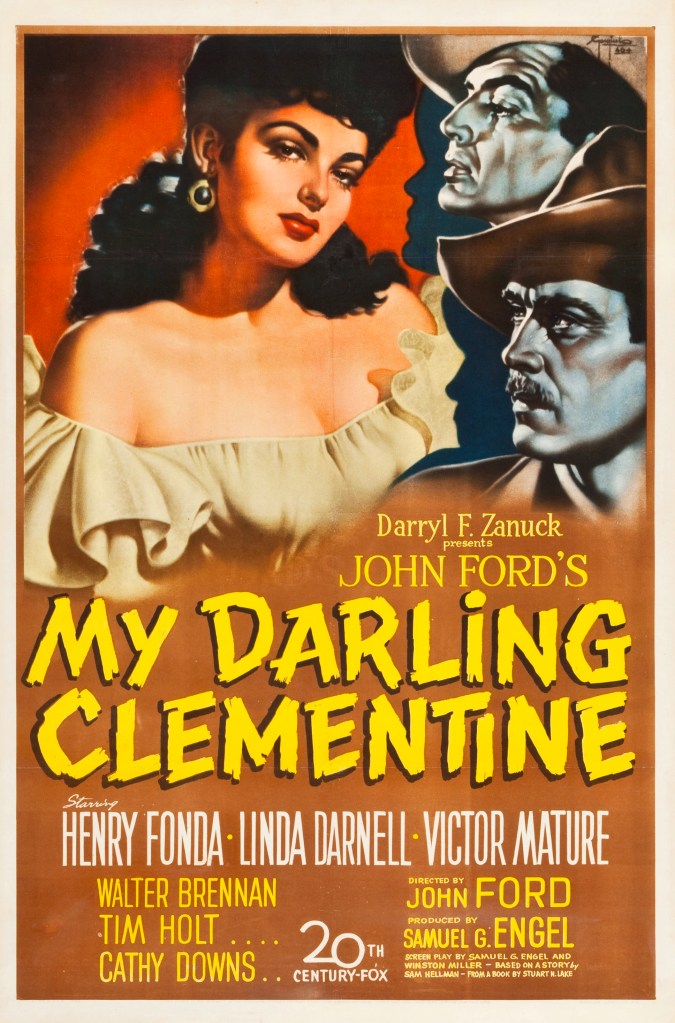
#566) My Darling Clementine (1946)

#566) My Darling Clementine (1946)

OR “What’s Up, Doc?”

Directed by John Ford

Written by Samuel G. Engel and Winston Miller. Based on the book “Wyatt Earp: Frontier Marshal” by Stuart N. Lake.

Class of 1991 

The Plot: Cattleman and former marshal Wyatt Earp (Henry Fonda) arrives in Tombstone, Arizona Territory with his brothers (Ward Bond, Don Garner, Tim Holt!) for a quick rest, unaware of the town’s lawless reputation. Following the murder of brother James, Wyatt reluctantly agrees to become the town’s new marshal. During his tenure, Wyatt befriends gambler Doc Holliday (Victor Mature), gets in a feud with local cattleman Old Man Clanton (Walter Brennan), and starts to develop feelings for Doc’s ex-lover Clementine Carter (Cathy Downs). As things with the Clanton family escalate, Wyatt Earp and Doc Holliday find themselves in a gunfight at the O.K. Corral.

Why It Matters: The NFR praises the film’s “traditional Western action” and Ford’s skill with character development, though they admit the film is “lacking in historical accuracy”.

But Does It Really?: Sorry everyone, I just couldn’t get into this movie. I tried twice to watch “My Darling Clementine”, hoping that I missed something the first time, but ultimately I just didn’t care for this movie. It’s not a bad movie by any stretch, but it helps to have a love for the genre, as well as some prior knowledge of Wyatt Earp and the O.K. Corral. I’m willing to give “My Darling Clementine” a minor classic designation: not the quintessential John Ford western, but serviceable and mentioned enough times with other Ford movies to warrant NFR inclusion.

Everybody Gets One: Cathy Downs was a model and contract player with Fox when she got the title role of Clementine. Shortly after this film’s release, Fox dropped Downs from the studio, and the rest of her career was spent solely in television and B-movies (including “The Amazing Colossal Man“). Leading man Victor Mature had a string of successful roles at Fox and RKO in the ’40s, but is perhaps best remembered for the “swords and sandals” epics he appeared in throughout the ’50s, most notably as Samson in Cecil B. DeMille’s “Samson and Delilah“.

Wow, That’s Dated: White actor Linda Darnell plays Mexican saloon girl Chihuahua. She doesn’t attempt an accent, and I can’t decide if that’s more offensive than if she had.

Title Track: Like many a classic folk song, no one knows for sure the origin of “Oh My Darling, Clementine“, though we know the melody comes from an earlier song called “Down by the River Liv’d a Maiden”, which has the same chorus. Unsurprisingly, the song appears several times throughout the film’s underscore.

Seriously, Oscars?: No Oscar love for “My Darling Clementine”, though the National Board of Review did name it one of the top 10 films of 1946.

Other notes 

  • While the real Wyatt Earp was a revered law enforcement officer in his time, his reputation as one of the Wild West’s most notorious gunfighters is a bit of an exaggeration. After Earp’s death in 1929, writer Stuart N. Lake wrote the biography “Wyatt Earp: Frontier Marshal”, a flattering, if highly embellished, retelling of Earp’s life. The book was a hit, and spawned several movies, including 1939’s “Frontier Marshal” with Randolph Scott. “My Darling Clementine” was also based on the book, as well as John Ford’s own recollections of meeting Wyatt Earp in the 1920s when Ford was a prop boy and Earp was retired in Los Angeles.
  • It’s not a John Ford movie until there’s an unnecessary slam on Native Americans. In this case, the first person Wyatt Earp fights with in Tombstone is “Indian Charlie”. Please, it’s “Indigenous Charles”.
  • John Ford staple Monument Valley appears prominently in this film, even though Monument Valley is about 500 miles north of Tombstone, Arizona. Ford had a replica of Tombstone built near Monument Valley at a price tag of $250,000.
  • Most of the beginning of this film is the revelation of the big names in this story: Wyatt Earp, Doc Holliday, Tombstone. None of these reveals packed the intended punch for me. Up until watching this movie these people and places were all just pieces of the vague tapestry that is Wild West culture. I couldn’t even have told you they were connected. Is that just me? Or does anyone remember the O.K. Corral?
  • “My Darling Clementine” is notable for being the first movie for both John Ford and Henry Fonda following their return from service in WWII. With “Clementine”, Fonda begins his transition from optimistic leading man to morally just elder statesman. Meanwhile, Ford’s post-war westerns became more meditative, their rugged backdrop serving to comment on larger ethical issues.
  • You would think that after winning an Oscar for “Grapes of Wrath“, Jane Darwell would have gotten better roles, but her time at Fox saw her getting more bit parts like here and in “The Ox-Bow Incident“. You wouldn’t see that happening to Youn Yuh-jung nowadays, that’s for sure.
  • The distance between 1946 and 1882 is the same as 2021 and 1957. We think of the Western as a genre based in mythos, but for so many early filmmakers, it was steeped in nostalgia.
  • I’m just not getting into this movie and I don’t know why. Is it the lack of a soundtrack? Is it how leisurely paced everything is? This is certainly one of the quieter westerns on this list. Even the silent ones made more noise.
  • It’s always a delight watching Henry Fonda play someone timidly trying to woo a lady. Even his dancing is wonderfully awkward.
  • Shoutout to J. Farrell MacDonald as Mac the bartender, who gets the best line in the movie (Wyatt: “Have you ever been in love?” Mac: “No, I’ve been a bartender all me life.”) Side note: MacDonald bears a strong resemblance to Walter, Jeff Dunham’s old man puppet.
  • As with many of the events in this movie, the gunfight at the O.K. Corral is accurate in the sense that it happened, and the people in the movie are based on the real people in the gunfight. I’m not going to nitpick every inaccuracy here, but the main one is that the gunfight itself didn’t actually take place at the O.K. Corral. It actually occurred in an empty lot six doors down from the O.K. Corral. But “Gunfight in a Lot on Fremont Street” doesn’t have the same ring to it.

Legacy 

  • The mythology of Wyatt Earp’s gunfight was started by this movie, and solidified with 1957’s “Gunfight at the O.K. Corral”, as well as the “Wyatt Earp” TV series from the ’50s.
  • Oh, and “Tombstone”, don’t forget “Tombstone”.
  • Among those filmmakers inspired by “Clementine” was Sam Peckinpah, who cited this film as an influence on his “The Wild Bunch“.
  • “My Darling Clementine” gets referenced a lot in conjunction with its appearance on episode of “MASH”. In 1977’s “Movie Night”, it’s revealed that “Clementine” is Col. Potter’s favorite movie, and he arranges a screening to boost morale among the 4077.
  • This is one of the rare studio era films where an alternate cut exists. A print of “My Darling Clementine” in UCLA’s archives turned out to be a preview cut of the film, with several additional scenes and alternate takes. Both versions are available on various video releases. #ReleaseTheFordCut

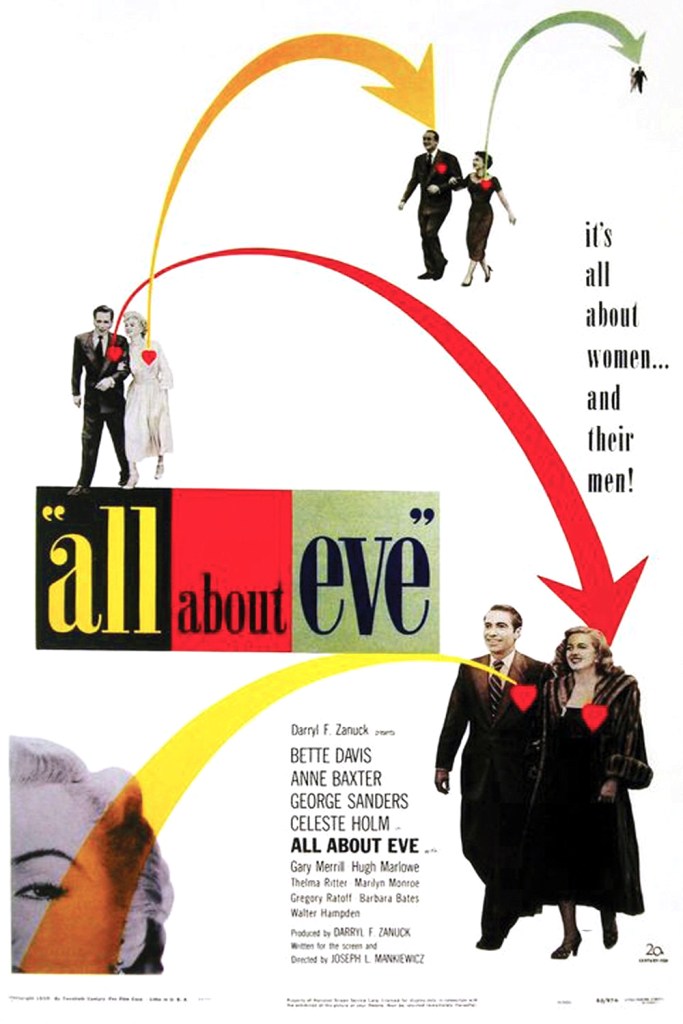
#565) All About Eve (1950)

#565) All About Eve (1950)

OR “Rat Baxter”

Directed & Written by Joseph L. Mankiewicz. Based on the short story “The Wisdom of Eve” by Mary Orr.

Class of 1990

The Plot: In the New York theater scene of the early ’50s, Margo Channing (Bette Davis) is the premier actor of her generation, each season bringing a new vehicle for her written by friend Lloyd Richards (Hugh Marlowe) and directed by her boyfriend Bill Sampson (Gary Merrill). One night, Lloyd’s wife Karen (Celeste Holm) introduces Margo to Eve Harrington (Anne Baxter), a younger woman who idolizes Margo and longs for a life in the theater. Margo hires Eve as her personal assistant, and all seems well, until Eve starts muscling in on more aspects of Margo’s life. She becomes Margo’s understudy without her knowledge, makes a pass at Bill, and tries to convince Lloyd to start writing plays for her instead of Margo. Eve is clawing her way to the top, but theater critic Addison DeWitt (George Sanders) seems to know more about Eve than anyone else.

Why It Matters: The NFR calls the film “entertaining and quote-worthy”, despite the dialogue being “often too bitingly perfect with its sarcastic barbs and clever comebacks”. Wow, you don’t see a lot of passive-agressive digs on the early entries.

But Does It Really?: “All About Eve” started its life as a classic, and I’m happy to say has remained so 70 years later. This film earns its reputation as a great movie, possibly the greatest movie ever made about the theater (though I’ll make an argument for “Birdman“). The script succeeds not only in its memorable one-liners, but in being a fascinating character study of artists devoid of stereotypes. While the film is mainly remembered in conjunction with Bette Davis’ later-in-life camp persona, anyone willing to watch “All About Eve” on its own merits won’t be disappointed. With a top-notch script and an all-star roster of talent, “All About Eve” is a no-brainer for NFR inclusion.

Wow, That’s Dated: You may need a theater degree to fully comprehend the Broadway scene of “All About Eve”. Among the more obscure references: actors Paula Wessely and Minnie Fiske, writer Clyde Fitch, the play “Our American Cousin“, and theater critic George Jean Nathan (whom Addison is based off of). Plus, a bonus meta-reference to film producer Darryl F. Zanuck.

Title Track: Joseph Mankiewicz originally titled his screenplay “Best Performance”. After some major re-writing, he took the new title from one of Addison’s early lines: “But more of Eve later. All about Eve, in fact.”

Seriously, Oscars?: A hit right out of the gate, “All About Eve” received 14 Oscar nominations, a record that has been matched, but never surpassed. “Eve” won big with six Oscars, including Best Picture, Director, Screenplay, and Supporting Actor for George Sanders. Despite receiving four nominations for its female performers (still a record), Celeste Holm and Thelma Ritter lost Best Supporting Actress to Josephine Hull in “Harvey”, while Anne Baxter and Bette Davis lost Best Actress to Judy Holliday in “Born Yesterday“. And while I do not contest any of this film’s wins, the “All About Eve” juggernaut left little room for the film’s main Oscar rival and fellow contemplation of middle-aged actresses: “Sunset Boulevard“.

Other notes 

  • Writer/actor Mary Orr based “The Wisdom of Eve” on an experience actress Elisabeth Bergner had with a young actress she befriended. Orr based the character of Eve on “many young actresses I had met, including a great deal of myself.” “The Wisdom of Eve” was originally published in Cosmopolitan in 1946, and caught the eye of Joseph L. Mankiewicz, who thought the story would be a great addition to a screenplay he was working on about an aging actress. Although Ms. Orr receives no on-screen credit for her source material, she received $5,000 for selling the film rights to Fox, and got a portion of Mankiewicz’s share of the film’s profits.
  • Bette Davis was fresh out of Warner Bros. when Margo Channing came into her life, and with this performance we see the beginning of Davis’ camp years. Her Margo is theatrical rather than over-the-top (yes, there’s a difference), and is the first of Davis’ many latter-career jaded actors.
  • Tallulah Bankhead was convinced she was the inspiration for Margo Channing, even stating that Bette Davis was emulating her trademark husky voice. The real reason behind Davis’ raspy delivery was stress caused by her divorce from husband #3 (More about husband #4 later). Even Mary Orr denied the connection when Bankhead asked about it.
  • Every movie is better with Thelma Ritter in it. As Margo’s dresser Birdie, Ritter provides the film’s non-quippy comic relief. The only downside to her performance is that she disappears halfway through the movie.
  • Anne Baxter finds the right balance of sincerity and intensity with Eve. Her opening monologue is heartbreaking, but you get a sense that something is off about her.
  • Before this movie I could not have told you the difference between Gary Merrill and Hugh Marlowe. Now…I still can’t. Adding insult to injury, I’ve also forgotten that I’ve already watched their other NFR entries.
  • I can’t get over how lax airport security was back in the day. Margo sees Bill off at the gate; she can practically touch the wing of the plane!
  • I strongly disagree with the NFR’s stance on the film’s dialogue. The characters are well defined enough (and the acting solid enough) that you believe everyone would come up with naturally clever repartee.
  • It wasn’t until doing research for this post that I realized the famous line “Fasten your seatbelts. It’s going to be a bumpy night” is a reference to airplanes. Seatbelts did not start being offered in cars until the mid-50s.
  • Ah yes, that’s an on-the-verge-of-fame Marilyn Monroe as Addison’s arm candy Miss Casswell. Her natural allure and comic timing lend themselves well to the part.
  • Quick question about Eve being Margo’s understudy: is she Equity? She doesn’t mention any previous stage experience. And while we’re on the subject, I just realized that we never see either Eve or Margo perform at any point in this movie. The closest we get is Margo’s curtain call. Interesting choice.
  • I like the rapport between Margo and Bill. Theirs is the rare film relationship that is undone not by some misunderstanding, but rather because they know each other too well. It helps that Bette Davis and Gary Merrill were starting to get romantically involved during filming, and married shortly after production wrapped.
  • Oh, that heel turn by Eve in the ladies bathroom. You know it’s coming, but man is it a sight to behold. Anne Baxter and Celeste Holm both play their sides of the scene perfectly. This scene is also further proof that the ladies’ room is always nicer than the men’s.
  • George Sanders always excelled as the sardonic intellectual, and Addison is his finest film performance. He handles the one-liners expertly, and is equally good once the character becomes more menacing. Plus, I could listen to that voice all day.
  • How old is Eve supposed to be? In real life, Anne Baxter was 27, 15 years Bette Davis’ junior, and only two years older than Barbara Bates, who plays Eve’s devoted fan Phoebe, a high school senior. Everyone in old movies look like they’re the same age. All those pre-WWII generations were built Ford tough.

Legacy 

  • As previously mentioned, Bette Davis and Gary Merrill married shortly after filming “Eve”, and adopted a baby girl whom they named Margot. Davis suggested that Mankiewicz write a sequel showing Margo and Bill’s marriage, but years later, the now-divorced Davis told Mankiewicz, “I’ve played it and it doesn’t work.”
  • Under the right circumstances, a musical version of “All About Eve” could work. “Applause” is not that musical. Charles Strouse and Lee Adams’ updating of “All About Eve” transplants the story to the Broadway musical scene of the early ’70s, with Margo Channing now played by (and tailored to) Lauren Bacall. When Bacall left the show she was replaced by – who else? – Anne Baxter.
  • A more faithful (and non-musical) stage adaptation played the West End in 2019, with Gillian Anderson and Lily James as Margo and Eve, respectively.
  • Many movies and TV shows have referenced “All About Eve” over the years, mainly evoking the title, the general plot, and/or some variation of “Fasten your seatbelts.” One of the more sincere allusions comes from Pedro Almodóvar’s “Todo sobre mi madre”, which translates to “All About My Mother”.
  • And finally, life imitated art one more time in the early ’80s when Bette Davis left the television show “Hotel” due to ill health. Her replacement: who else? Anne Baxter.

#564) The Crowd (1928)

#564) The Crowd (1928)

OR “The Wages of Sims”

Directed by King Vidor

Written by Vidor & John V.A. Weaver. Titles by Joe Farnham.

Class of 1989 

The Plot: John Sims (James Murray) arrives in New York with the dream of becoming someone important. While working a desk job for an insurance company, John meets Mary (Eleanor Boardman) on a double date. The two immediately fall for each other and are soon married. Like any marriage, theirs has ups and downs, along with the arrival of two children (Freddie Burke Frederick and Alice Mildred Puter). When tragedy strikes the Sims family, John realizes that his dream won’t make itself happen, and that in order to truly be important he has to stand out from the rest of…the population.

Why It Matters: The NFR praises the “inventive and visceral” cinematography of Henry Sharp, the “highly emotional” screenplay, and the “naturalistic performances” of the leads.

But Does It Really?: Of the first 25 films to make the National Film Registry, I would probably rank this at number 25. “The Crowd” is a well-made piece of melodrama with good cinematography, but it doesn’t deliver on the same level as the other 24 films on the original list. By itself, “The Crowd” is worth a watch and deserving of its NFR standing (somewhere between “historical” and “aesthetic” significance), but it’s a B+ effort lost on the initial list of A+ movies.

Everybody Gets One: To help with the film’s everyman aesthetic, King Vidor insisted on casting unknowns for the leads. Although he had a few speaking roles to his credit, James Murray was working as an extra when Vidor saw him on the MGM lot and thought he looked right for the part of John. Eleanor Boardman’s casting journey as Mary was a little simpler: she was married to King Vidor at the time.

Wow, That’s Dated: This movie has many of the dated elements we associate with ’20s-’30s big city living, such as having a Murphy bed, going to Niagara Falls on your honeymoon, and expectant fathers waiting outside the delivery room.

Title Track: As one character relates to John when he arrives in New York, “You gotta be good in that town if you want to beat the crowd.”

Seriously, Oscars?: “The Crowd” opened in the spring of 1928, making it eligible for the 1st annual Academy Awards in 1929. The film received two nominations: Best Director for King Vidor (losing to Frank Borzage for “7th Heaven“) and Best Unique and Artistic Picture (losing to “Sunrise“). King Vidor would have to wait another 50 years before receiving an Oscar; a lifetime achievement award in 1979.

Other notes 

  • Following a run of successful pictures for MGM in the ’20s (including “The Big Parade“), King Vidor wanted his next film to be less commercial and more experimental. While Louis B. Mayer was against the idea, Irving Thalberg understood Vidor’s vision and gave the film the go ahead.
  • Vidor was inspired by the expressionism of F.W. Murnau to attempt more artsy cinematography. This is more than evident in one of the film’s opening shots. The camera glides into the office building, over endless rows of pencil pushers, and arrives at John’s desk for a closeup. No doubt a revelation in its day, and the shot that shows up in plenty of your Chuck Workman clip packages.
  • To achieve a realistic depiction of New York City, King Vidor and Henry Sharp filmed the real streets with hidden cameras. In one shot of a traffic cop telling cars to move along, that’s an actual cop speaking directly to Vidor behind the camera.
  • John, Mary, Bert, Jane: Everyone in this movie has the blandest names. Where’s Spike Lee?
  • This movie gives us the hot take that clowns are neither amusing nor scary, they’re just doing a job.
  • This is the fourth movie I’ve covered from circa 1928 where the main characters go to Coney Island/a Coney Island type beachside amusement park. Was that all there was to do in the ’20s? Doesn’t anyone go to the movies?
  • Wow, a pre-Code movie with implications of sex. Quelle scandale.
  • And another movie for my “Die Hard” Not Christmas list. I’ve really got to get around to covering “Die Hard“.
  • Mary’s brothers Jim & Dick are the Patty & Selma of this movie: the older siblings who consistently disapprove of their sister’s husband. In one of the brother’s case, Dick is aptly named.
  • In addition to the film’s visual storytelling, there is also significantly less intertitles than the usual silent movie. When Mary tells John she is pregnant, the entire scene is done without intertitles, but you always know what’s happening.
  • Mary, to John shortly after giving birth: “I’m sorry you suffered so.” HE suffered? Who wrote this?
  • Today’s movie inflation: the $8 raise John gets is about $122 today, and his $500 bonus is about $7600.
  • This movie uses such obscure phraseology as “crab” (an informal verb, meaning “to grumble”) and “darn” (as in to mend an article of clothing).
  • Well, things got super depressing real fast. I’m getting very tired of the 1920s’ fondness for tragic melodrama.
  • “The crowd laughs with you always, but it will cry with you for only a day.” Ain’t that the truth.
  • More Murnau influence as we get images superimposed over John’s head as he struggles to work: his daughter, the cars, spinning numbers. It all works.
  • Also dated: the profession of door-to-door vacuum salesman. At least he doesn’t have to hawk bibles.
  • It just occurred to me that neither of John and Mary’s kids have names. Their son is credited only as “Junior” (presumably John Jr.) while the daughter is credited as “Daughter”. Did they run out of generic names?
  • The film’s final shot is a reverse of the office shot, as the camera pans out from John and Mary enjoying the show to the entire theater packed with audience members. Once again, John and Mary becomes anonymous figures in…this group of people.

Legacy 

  • “The Crowd” was completed in 1927, but Louis B. Mayer hated the film and held its release for almost a year. New, more upbeat endings were filmed and tested, but everyone kept coming back to Vidor’s original ending.
  • “The Crowd” was a modest success with audiences, some of whom were turned away by the film’s stark realism and opted for more escapist fantasy. The film would not get a more positive reappraisal until after WWII.
  • Neither of the film’s leads made the leap to superstardom. Eleanor Boardman divorced King Vidor and left Hollywood in the early ’30s. James Murray’s bout with alcoholism cost him his acting career, and King Vidor found him panhandling on the streets. Murray drowned in the Hudson River in 1936 at age 35. King Vidor wrote a screenplay based on Murray’s life called “The Actor”, but the film was never made.
  • The characters of John and Mary Sims would return in 1934’s “Our Daily Bread“, easily the most obscure sequel to make it onto the NFR.
  • Many filmmakers have cited “The Crowd” as an influence, from Jean-Luc Goddard to Billy Wilder, the latter whom copied the office shots for “The Apartment“.

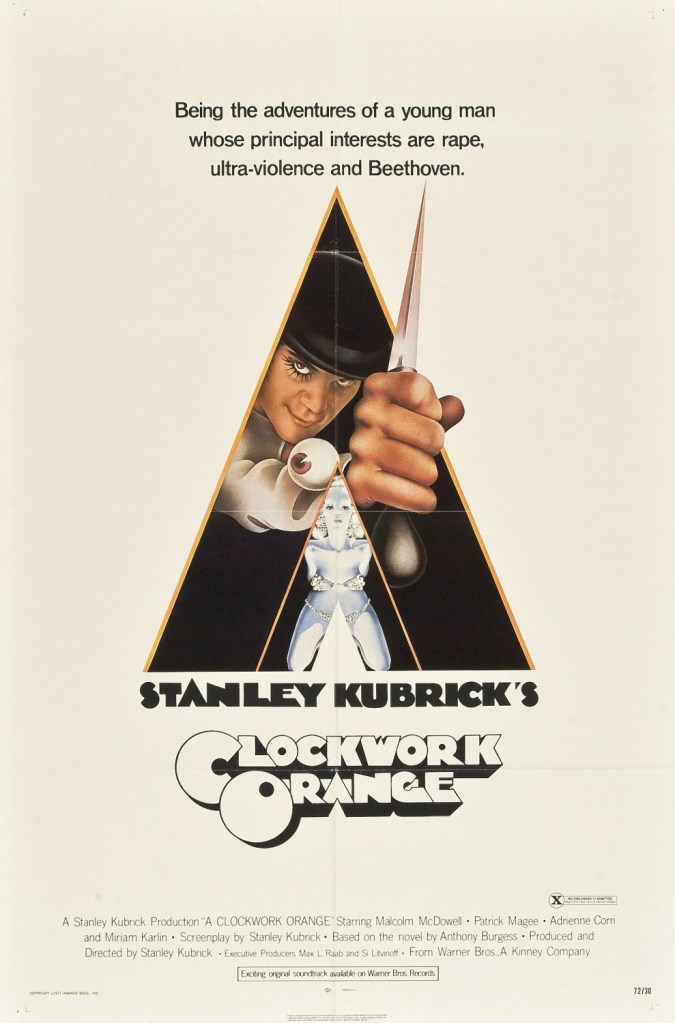
#563) A Clockwork Orange (1971)

#563) A Clockwork Orange (1971)

OR “Say No to Droogs”

Directed & Written by Stanley Kubrick. Based on the novel by Anthony Burgess.

Class of 2020

The Plot: In a dystopian future where England is overrun with teenage crime, Alex DeLarge (Malcolm McDowell) and his gang (Warren Clarke, James Marcus, Michael Tarn) spend their nights engaging in “ultra-violence”. After a botched attempt to assault an older woman (Miriam Karlin), Alex is arrested and sentenced to prison. Two years into his sentence, Alex gets an opportunity to participate in an experimental aversion therapy that will completely cure him of his criminal behavior in two weeks. The treatment goes well, except that in addition to crime and violence, Alex now has an aversion to his favorite piece of music; Beethoven’s Ninth Symphony. Will Alex become a respectable member of society? Or will his past misdeeds come back to haunt him? Burgess’ mediation on human behavior meets its match with the dark, twisted imagination of Stanley Kubrick.

Why It Matters: The NFR praises the work of Kubrick and McDowell (misspelled as “MacDowell”), and states that the film “remains as it always was: disturbing, controversial and startling unsettling.”

But Does It Really?: I’m putting “Clockwork Orange” on the “Taxi Driver” list of great movies: Riveting, iconic, but whose problematic subject matter may jeopardize its future as a classic. “Clockwork” is a visceral experience, with the kind of fantastic visuals and engaging moments you expect from Stanley Kubrick. The question is: how much longer will we revere a movie with such intense scenes of violence and assault? Ultimately, the film doesn’t condone this behavior, but it still makes me watch it. “A Clockwork Orange” deserves to be on the NFR, but I’m curious to what degree future film fans will hold it in esteem.

Shout Outs: Alex sings “Singin’ in the Rain” during the infamous rape sequence, and the Gene Kelly version plays over the end credits (Side Note: Kelly was not a fan of this). Kubrick also references his previous films: “2001” and “Dr. Strangelove“.

Everybody Gets One: Malcolm McDowell began his acting career as an extra in the Royal Shakespeare Company. His performance in the 1969 film “If…” caught the eye of Stanley Kubrick, who cast him as Alex. Although Kubrick praised his performance (even stating publicly that he wouldn’t have made the movie if McDowell had been unavailable), Kubrick never spoke to Malcolm after the film was released, which surprised and saddened the actor.

Title Track: Anthony Burgess claimed he heard the phrase “as queer as a clockwork orange” in a London pub in 1945, and it stuck with him. Further research shows no evidence of the phrase’s existence prior to the publication of Burgess’ novel. Regardless, a “clockwork orange” is used in the novel to describe Alex after he is “cured”: natural on the outside, mechanical on the inside.

Seriously, Oscars?: Despite mixed critical reception and an X rating (which Kubrick successfully bumped down to an R for the film’s re-release), “A Clockwork Orange” was a box office smash. At the 1972 Oscars, “Clockwork” received four big Oscar nominations: Picture, Director, Adapted Screenplay and Editing, losing all of them to “The French Connection“. Rumor has it that many Hollywood stars turned down the opportunity to present Best Picture for fear of this film pulling off a win. Two-time nominee Jack Nicholson ultimately did the honors.

Other notes 

  • Upon the release of the novel in 1962, the film rights for “A Clockwork Orange” were bought by Mick Jagger, who intended to star in an adaptation with his Rolling Stones bandmates. A few years later, “Strangelove” screenwriter Terry Southern recommended the novel to Kubrick. In the early ’70s, Kubrick’s long-gestating Napoleon film lost its backers, and his wife Christiane suggested he finally get around to reading “Clockwork”. Kubrick loved the novel, snatched up the film rights (which had exchanged hands a few times at this point), and wrote a surprisingly faithful adaptation.
  • This is your reminder that “A Clockwork Orange”, frequently listed among the greatest films ever made and a cultural touchstone for 50 years, was added to the National Film Registry in 2020, despite being eligible since the Registry’s inception in 1989.
  • This movie grabs you from the start. The titles are on a bright red screen, there are no opening credits (unheard of in 1971), and the first shot lingers on Alex staring down the camera while creepy synthesizer music plays. It’s unsettling, and also great.
  • While the rape scene is still difficult to watch, it stands out as the first real gut-punch of Hollywood’s post-Code era. During filming, Kubrick felt that the scene was too conventional, and asked Malcolm McDowell if he knew any songs. McDowell improvised “Singin’ in the Rain” on the next take, and Kubrick loved the choice so much he immediately sought the rights to use the song. I guess MGM really needed the money.
  • So in the future, cassettes make a comeback? At least they correctly predicted the return of vinyl.
  • Kubrick loves messing with the speed of this movie. A fast-paced sex scene is immediately followed by a slow-motion fight between Alex and his gang. I’m sure there’s some symbolism to this that I’m not getting, but it looks great.
  • Despite the dark subject matter, this movie is surprisingly funny. Michael Bates is perfectly over-the-top as Chief Guard Barnes, who apparently can only yell all his dialogue. It’s hilarious, and supports the claim that this was intended to be a dark comedy all along.
  • The violence and raping make me squirm, but the toughest scene for me to watch is always the therapy scene in the screening room where Alex’s eyes are forced to stay open. As someone who used to put contacts on every morning, this scene is beyond disturbing.
  • For those of you wondering what Darth Vader looks like without his helmet: Frank Alexander’s assistant Julian is played by bodybuilder David Prowse, just a few years away from being permanently dubbed by James Earl Jones.
  • Gotta love those Kubrick steadicam shots. It’s like the crew is on roller skates.
  • Part of Alex’s rehabilitation in the hospital is the thematic apperception test, or as it’s known today, The New Yorker caption contest. “Christ, what an asshole.
  • The final chapter of the novel involved Alex, now a bit older, finally maturing and giving up his criminal past. This chapter was omitted from the novel’s American release because the American editor felt it didn’t mesh with the rest of the book. Kubrick’s screenplay was based on the American edition, and he was only made aware of the final chapter after he had finished writing. In Kubrick’s defense, “I was cured alright” is a great curtain line.

Legacy 

  • “A Clockwork Orange” was one of the biggest hits of 1971, but unfortunately its controversy expanded beyond a few damning reviews. Shortly after the film’s release in England, “Clockwork” was connected to several copycat crimes involving teens, including a rape in which the assailants sang “Singin’ in the Rain”. At Kubrick’s request, “A Clockwork Orange” was removed from British cinemas, and the film would not be seen again in England until after Kubrick’s death in 1999.
  • Stanley Kubrick’s next film was the far more conventional (and far less controversial) “Barry Lyndon”.
  • Anthony Burgess had mixed feelings about the movie. He enjoyed Malcolm McDowell’s performance and the “brilliant” music selection, but was equally disappointed that the film overshadowed the book, as well as the rest of his bibliography.
  • Although Malcolm McDowell would never have another film role that could match Alex DeLarge, he has been working steadily for the last 50 years, usually as the bad guy in every sci-fi franchise and lackluster comedy.
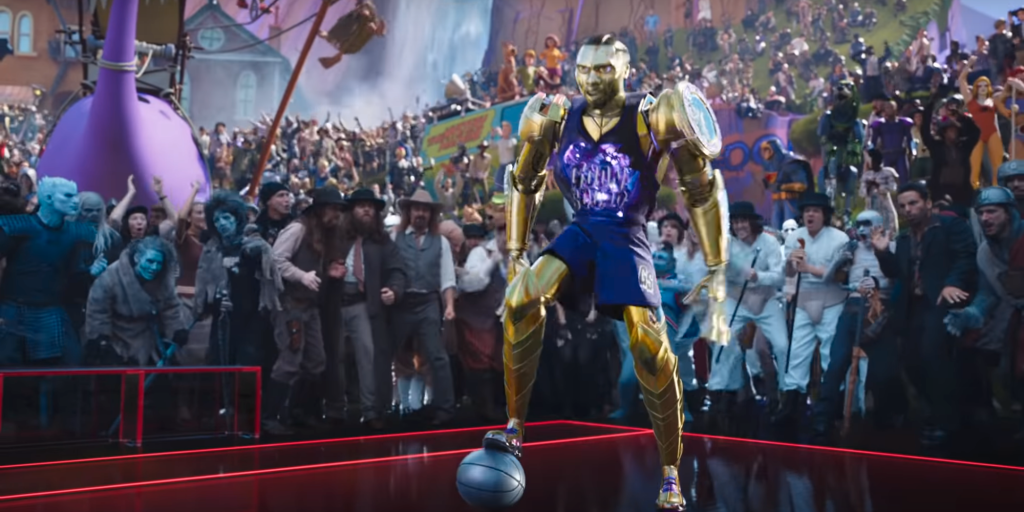
  • The aesthetic and dialogue of “A Clockwork Orange” appear in pop culture so often, the references have their own Wikipedia page. For god’s sake, Alex and his gang are in the new “Space Jam” movie!
I’m not kidding, see for yourself.

Further Viewing: “Vinyl”, Andy Warhol’s loose adaptation of “A Clockwork Orange”. Hopefully this Warhol movie is the real one, and not a fan remake that I don’t recognize until after I’ve posted an entire write-up about it.

Listen to This: “Lovely Ludwig Van” Beethoven gets represented a couple of times in the National Recording Registry. Among his selections: all 32 of his piano sonatas as performed by Arthur Schnabel, the first such recording in history.