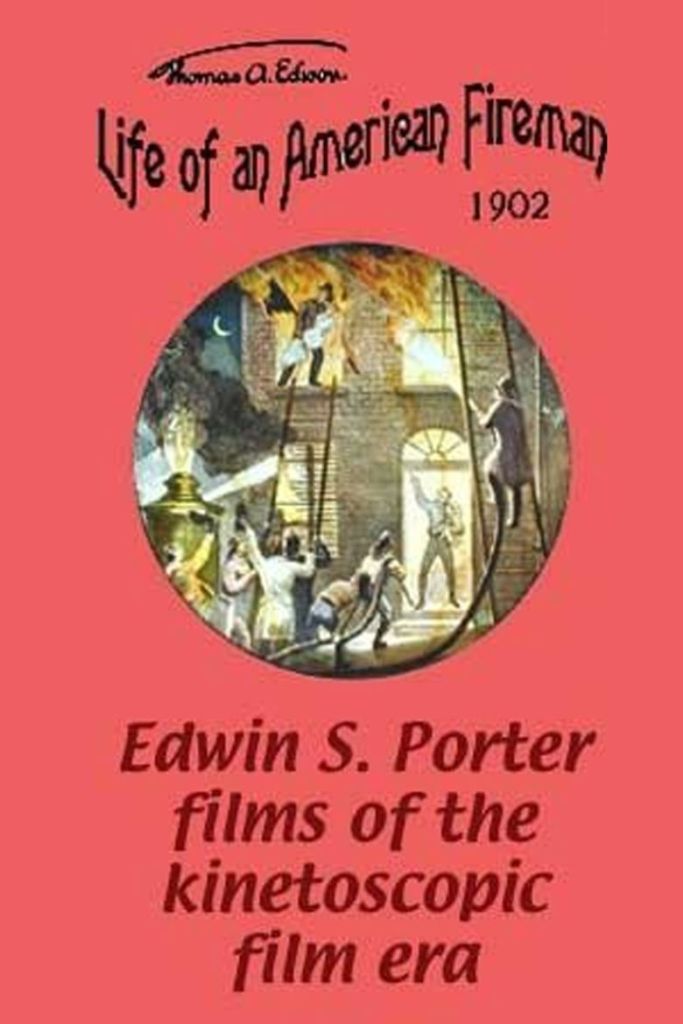
#648) Life of an American Fireman (1903)
OR “The Editing Inferno”
Directed by Edwin S. Porter
Class of 2016
The Plot: A fire chief (James H. White) has a vision of a woman and her child (Unknown Actor and Vivian Vaughan) in danger when their house catches on fire. Almost immediately afterwards, that vision becomes a reality, and we follow the firefighters as they hurry to the house. A fireman (Arthur White) rescues the two in one of the first American films to feature intercutting as a form of storytelling. Or…maybe not.
Why It Matters: The NFR calls it “among the most innovative in terms of editing, storytelling and the relationship between shots.” The film’s status as a “controversial topic in American film historiography” is also highlighted.
But Does It Really?: This one is tricky. On the one hand, the NFR is understandably quick to induct and preserve these early attempts at narrative film, especially with heavy-hitters like Thomas Edison and Edwin Porter attached to it. On the other hand, it seems like this film’s historical significance comes from a later cut of the film with more advanced cross-cutting that was erroneously accepted as the original. This feels like if 100 years from now the NFR inducted “The Phantom Menace” only to realize the film they really wanted was “The Phantom Edit”. I can give “Life of an American Firefighter” a pass as a “stepping stone” movie: the missing link between the actuality films of early cinema and the first narrative stories like “The Great Train Robbery“. Plus its “controversy” among film historians puts it in the rare “Manhattan” category of NFR films in which their controversy is also their legacy.
Before we go any further, you may be wondering what exactly is this editing controversy I keep referencing. I’m glad you asked: it’s time to break down this film’s editing history, aka Life of “Life of an American Fireman”.
As presented in 1903 the final two shots of “American Fireman” were presented as seen in the video embedded above: The first of the two is an 81 second shot inside the woman’s bedroom in which she wakes up, discovers the fire, and is rescued along with her daughter by a fireman via a ladder outside her window. This is followed by an 85 second shot of these events from outside the house in which we see the firefighters prop the ladder under the woman’s bedroom window and rescue her and her daughter.
At some point, an unknown editor (potentially history’s first fan editor) recut these two shots so that the action intercut between inside and outside the house. In 1944, this recut version ended up at the Museum of Modern Art who, naturally, assumed it was the original, leading to a decades-long evaluation of Edwin Porter as an innovative editor. Around the 1960s, the original paper print (the film’s positive print submitted on paper for copyright purposes) was rediscovered within the Library of Congress with the original uncut takes, and a debate began among film historians about the validity of both versions. An original 1903 print of “American Fireman” was discovered by the American Film Institute in the late 1970s, proving that the MoMA print was a re-edit. And so from all of this we get an NFR film whose historical significance is one big misunderstanding. It’s the “Three’s Company” of NFR movies!
Wow, That’s Dated: Primarily the technology being used by the firefighters. The one that was the most intriguing to watch in action were the horse-drawn fire engines. Steam-pumped engines had been around for a while but hadn’t caught on, and the first motorized fire engine was invented in 1897 (six years before “American Fireman”), only becoming a serious contender to replace horses around 1905.
Other notes
- So the fire chief has a vision of the fire and then it happens? When did firefighters stop being Precogs?
- Total tangent, but worth mentioning: For years my closest polling place was a fire station, and every time I voted I would ask if I could slide down the pole and the answer was always no. Understandable, but I bet voter turnout would be a lot better if you let people slide down the pole.
- All this talk about firefighters got me thinking about the future of the profession; specifically if AI could ever replace human firefighters. The answer, for the time being, is a surprising no. My research shows that while AI is currently being used to help firefighters respond faster to fires and save more lives, they are only being used to aid humans rather than replace them. Which makes sense: I imagine an AI firefighter calendar wouldn’t sell as well.
- The version I watched of “American Fireman” was from a 2004 DVD release that includes a piano score and a song! Definitely wasn’t expecting to hear an actual voice during my viewing. I cannot for the life of me find out the name of the song, but I suspect it is of the era (it has a Gilbert-and-Sullivan vibe to it). I typed in practically every intelligible lyric of this song into my search engine and couldn’t get a single lead on a name or a composer. WHO ARE YOU!?
Legacy
- Sure, Edwin Porter can’t put “Revolutionary Film Editor” on his resume, but he still made “The Great Train Robbery”, so there.
- Firefighters have continued to be a source of dramatic storytelling in the last century-plus of filmmaking. I’ve never seen “Backdraft”, but I did see the special effects show at Universal Studios. That counts, right?
Further Viewing: “Fire!” the 1901 British film by James Williamson that many film historians cite as an influence on “Life of an American Fireman”. I assume being a British firefighter is a lot like being an American one, except they spell it with an extra “u” for some reason.
 The Horse's Head
Love your detailed info about the editing and the question of what is “original.” In my research on Valentino I have been finding inaccuracies which have become ingrained in “the lore.”
LikeLiked by 1 person