#650) Red River (1948)
OR “Where’s The Beef?”
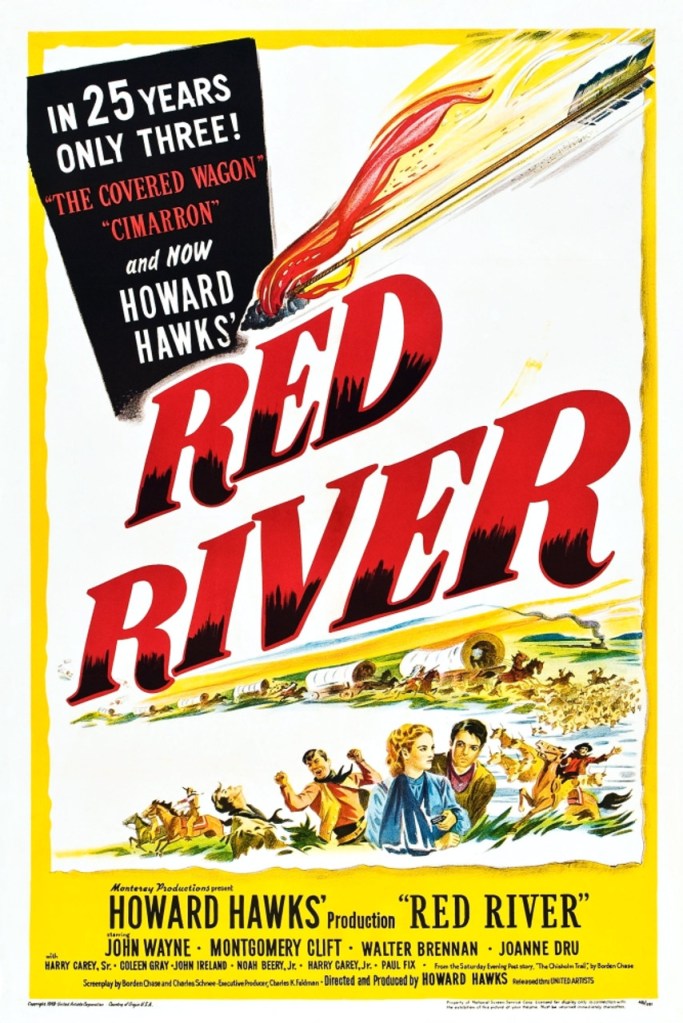
Directed by Howard Hawks
Written by Borden Chase and Charles Schnee. Based on the Saturday Evening Post story by Chase.
Class of 1990
The Plot: In a semi-fictional take on the first cattle drive along the Chisholm Trail from Texas to Kansas, “Red River” focuses on Thomas Dunson (John Wayne), a cattle rancher who becomes broke after the Civil War. With no other choice, Dunson leads his herd and a band of volunteers hundreds of miles to Missouri to sell his cattle for the best price. As the conditions worsen on the journey, Dunson becomes more tyrannical and cruel to his men. This causes a major discord between Dunson and his adopted son Matthew Garth (Montgomery Clift), who believes they will have better luck if they reroute to Kansas. And behind the camera, Howard Hawks takes his first stab at the Western genre.
Why It Matters: The NFR writeup is mostly a rundown of the film’s talent, as well as a surprising amount of space devoted to the plot details from the film’s opening 10 minutes. A more appreciative essay by filmmaker and distributor Michael Schlesinger gives “Red River” its due.
But Does It Really?: I liked “Red River” better than other Westerns on this list, but that’s not saying much. As a film experience, it’s entertaining and holds your interest thanks to the A+ talent involved behind the scenes. As a significant American film, however, it never gets brought up as often as you’d think it would within the canon of Hawks’ filmography and/or classic Westerns. There’s a generation of film historians (Your Peter Bogdanovich-es, for example) who love “Red River”, but as the years go on that admiration hasn’t really been passed down. I’m gonna put “Red River” in the “minor classic” category: a memorable movie that has started to get lost in the shuffle of classic films.
Wow, That’s Dated: Yes, there are instances of the kind of misogyny towards women and racism towards Indigenous people you should expect from Westerns, especially those of this era, but…um…yeah I got nothing.
Title Track: [In Comic Book Guy voice] Technically they do not cross Red River in this movie, but rather the Prairie Dog fork, in which the Red River merges with both the Palo Duro Creek and Tierra Blanca Creek. Worst. Title. Ever.
Seriously, Oscars?: One of the highest grossing films of 1948, “Red River” received two Oscar nominations. The film’s nods for Story and Editing lost to, respectively, “The Search” and “The Naked City“.
Other notes
- Right off the bat, there’s a credit that intrigues me: Co-Director Arthur Rosson. I can’t imagine a titan like Howard Hawks sharing his title with anyone, but Rosson (the film’s second unit director) impressed Hawks with his shooting of the cattle drive sequences and this was Hawks’ way of thanking him.
- “Red River” was Howard Hawks’ first western, but he injects a bit of his screwball comedy instincts into the movie’s DNA, with its comic relief supporting characters and overlapping dialogue. Speaking of comic relief: A reminder that Walter Brennan’s character is named Nadine Groot. Does this make “Red River” part of the MCU?
- The film’s cinematography by Russell Harlan is the kind of impressive, expansive vistas associated with the genre, though it makes the handful of rear projection shots stick out like a sore thumb.
- Wow, John Wayne actually did walk like that?
- We meet Matt as a young boy played by Mickey Kuhn, who is so miscast as young Monty Clift I didn’t realize they were supposed to be the same person until it was mentioned by the other characters later on.
- Of course Montgomery Clift is good in this, but even more impressive is the fact that “Red River” was his first movie! (though “The Search” was released first) It’s pretty impressive watching a 25 year old stage actor give John Wayne a run for his money. In fact, having an actor as skilled as Clift kinda highlights how little John Wayne is doing in this film (though I’m in the minority in this opinion). In an unintentional battle between Wayne’s untrained naturalism and Clift’s Method approach, Clift easily outacts the Duke. Side note: Monty kinda looks like a young Tom Cruise, doesn’t he? With a bit of Peter Gallagher thrown in?
- John Ireland is quite good as Matt’s rival Cherry Valance (better utilized here than in “All the King’s Men“). In his first scene Cherry and Matt handle and admire each other’s guns at length, which begs the question: What in the name of “Brokeback Mountain” is going on here? There’s enough gay subtext in the scene to make Gore Vidal blush. Hawks denied anything intentional, but come on. “Can I see it? Maybe you’d like to see mine. Nice, awful nice.” Come on!
- There’s a very impressive 360 degree shot of Dunson, his men, and the herd as they prepare to embark on their trek. I assume getting all those steer was quite the cattle call. Thank you!
- Oh good, the one Indigenous character is a full-on stereotype. Shoutout to Chief Yowlachie, a member of the Yakama tribe of Washington State, forced to play the stoic, Tarzan-level broken English speaking straight man to Walter Brennan’s antics.
- Wow, this is the most effective stampede scene this side of “The Lion King“. You definitely feel the danger these men are in both by the potential loss of and death by the cattle. Easily the highlight of the movie for me.
- There’s definitely a “Mutiny on the Bounty” vibe going on with Wayne and Clift’s characters. Even Borden Chase admitted that his original story was just “‘Mutiny’ with saddles and stirrups.”
- The wrangler Sims Reeves, about Dunson reading from the Bible after killing one of his men: “Why try to bring the Lord in as a partner on the job?” Sims gets it.
- Joanne Dru fills the Hawksian Woman trope neatly as Tess, the outspoken woman who comes between Dunson and Matt. Funnily enough, it was John Ireland who caught Dru’s attention in real life, and the two married shortly after production wrapped. Fun Fact: Joanne Dru is the older sister of original “Hollywood Squares” host Peter Marshall!
- Blink and you’ll miss Shelley Winters as a background performer in the wagon train. She was a bit player when “Red River” was filmed, but by the time it was released her star had risen with her breakout performance in “A Double Life”. Technically this is Winters’ NFR debut, but thankfully “A Place in the Sun” would be inducted the next year.
- It’s always nice to see silent screen star Harry Carey in a movie; he has an appealing soft-spokeness to him, plus he automatically makes me think of Harry Caray. “Red River” is the only time Harry Carey Sr. and Jr. would be in a film together (Jr. is one of the wranglers), and sadly would be Carey Sr.’s final movie, released almost a full year after his passing.
- [Spoilers] Well that was definitely an ending. The original story ended with Dunson getting shot, and Matt taking his body back to Texas to be buried on his property. Hawks didn’t like the idea of the main character learning a lesson and then immediately dying, so he opted for a happier ending. Neither Borden Chase nor Montgomery Clift liked this new ending (Clift called it a “farce”), and they are right to feel that way. It definitely sticks out from the rest of the movie, wrapping things up too neatly with a broadly comic bow. You expect this kind of ending from “I Love Lucy”, but not from a John Wayne western.
Legacy
- “Red River” was filmed in 1946, but its release was delayed for almost two years due to extensive re-editing when Hawks was dissatisfied with the original cut. The film’s release was delayed again thanks to this blog’s recurring heel Howard Hughes. Turns out Hughes was still bitter about Hawks quitting on Hughes’ “The Outlaw” six years earlier, and sued Hawks for similarities between the climactic shootouts of “Red River” and “Outlaw”. “Red River” was cut down by six minutes (with new footage and alternate narration) before hitting theaters in August 1948. At some point the theatrical print was lost, and the original “Directors Cut” started appearing on television and home video. Side note: Peter Bogdanovich claimed that Hawks preferred the theatrical cut, but this has been debated.
- Allegedly Hawks was so grateful of Christian Nyby’s Hail Mary editing pass that he gave Nyby the chance to direct his first movie, 1951’s “The Thing From Another World” which, depending on which film historian you believe, may or may not have actually been directed by Nyby.
- Howard Hawks gave key members of the “Red River” team commemorative belt buckles with the Red River D brand, which John Wayne wore in subsequent films (including Hawks’ “Rio Bravo”). These buckles have become collector’s items over the years, with Clift’s buckle selling for almost $14,000 at a 2014 auction.
- Wayne pays tribute to the late Harry Carey in the iconic final moment of “The Searchers“. As Wayne stands in the doorway, he holds his right elbow with his left hand, a stance Carey took in many of his movies. Carey’s widow Olive appears in this scene and was moved by the homage.
- “Red River” quickly became part of the John Wayne mythos, and was one of many clips utilized in the opening montage of Wayne’s character in his final film, 1976’s “The Shootist”.
- And of course, “Red River” was the last picture show of “The Last Picture Show“.
Wow, Movie #650, the last major checkpoint before I reach 700 movies, a personal goalpost I always wanted for the blog. Onward!
 The Horse's Head
3 thoughts on “#650) Red River (1948)”