
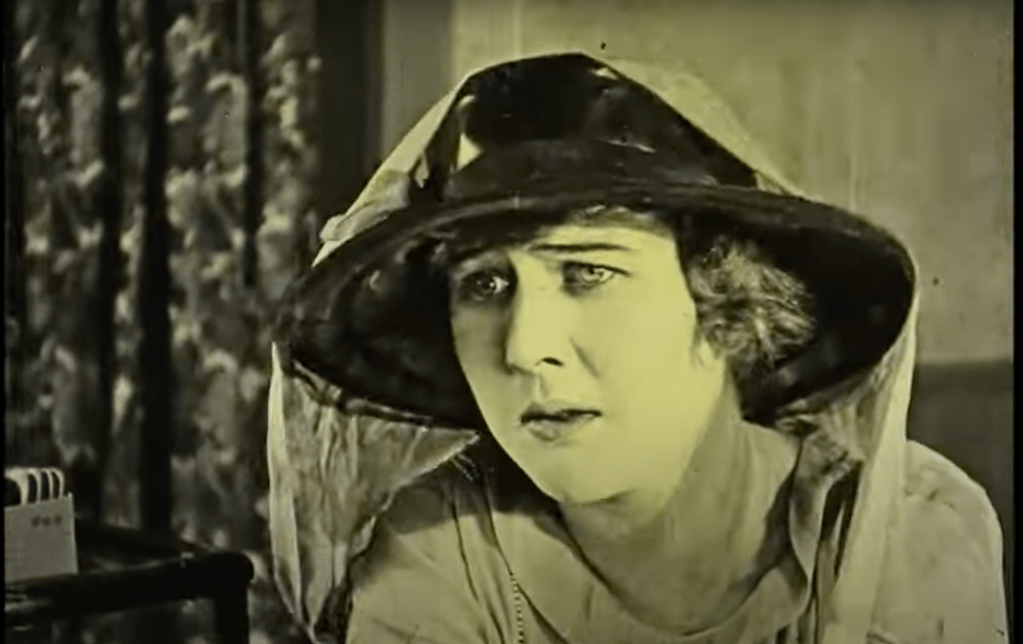
#651) Bread (1918)
OR “A Slice of Life”
Directed by Ida May Park
Written by Park and Evelyn Camp
Class of 2020
The Plot: “Bread” is a unique NFR entry, in that we only have Reels 3 & 4 of a six reel film, so a full plot synopsis involves some guesswork. Based on what we know about the first two reels of “Bread”, the film is about Candace Newby (Mary MacLaren), a young woman who leaves her small town and moves to New York to become a stage actor. She meets theater producer Emil Krause (Louis Morrison), who puts her on his payroll, and playwright Arnold Train (Edward Cecil), who falls in love with her. Reel 3 begins with Krause bringing Candace into his office, locking the door, and making advances. Candace rejects Krause and runs away. Krause retaliates by cutting off her finances, and soon Candace only has enough money for a single loaf of bread. On her way home she loses the bread and…well that’s where Reel 4 ends things. What a cliff hanger!
Why It Matters: The NFR write-up is primarily a shoutout to Ida May Park, whose “accomplished ability” as a director and scenario writer are praised. The survival status of “Bread” is also mentioned.
But Does It Really?: This is the most NFR film the NFR has ever inducted. It’s a silent melodrama directed by a woman that deals with social issues and only survives in part: That’s an NFR bingo! Obviously it’s impossible to judge this film solely on its own merits, but even as an 18 1/2 minute excerpt, “Bread” clearly has the hallmarks of a solid melodrama, and is representative of an era of female filmmaking that soon disappeared. “Bread” is definitely on the “historical significance” side of things, but I have no objection to its NFR induction. Now let’s go find those missing reels!
Everybody Gets One: We don’t know a lot about Ida May Park, other than she was a native Angeleno who started her showbiz career as a stage actor, meeting her husband Joseph de Grasse in the process. The couple were hired by Universal in 1914, with Park writing scenarios for films directed by de Grasse. Park’s first directing job was for 1917’s “The Flashlight”. Park’s pivot to directing was in part based on her successful collaborations with her husband, and in part because of Universal’s then-practice of hiring more women directors (they were the ones that gave Lois Weber her start). In 1920, Park wrote this essay about film directing, in which she refers to filmmaking as “the great cinema octopus”, which is my new favorite description of anything film-related.
Other notes
- There is no weirder feeling than coming into the middle of a movie with no frame of reference, especially when your first scene is an attempted rape. I feel like Donny in “Big Lebowski“.
- A bit of discrepancy: According to the AFI Film Catalog, the lead character is named Candace, but the intertitles call her Helen. What’s going on? I’m going with Candace until I hear otherwise. Also, her last name is Newby? A bit on the nose, eh?
- We get a scene where another woman (presumably the character of Estelle played by Gladys Fox) berates Candace for rejecting Krause after he supported her financially. First of all, yikes. Second of all, YIKES. This is more psychological manipulation than “Rebecca” and “Gaslight” combined!
- Estelle, admonishing Candace: “I’m the goat – my chance of being SOMEBODY is smashed-” I assume she means “goat” like a fool and not as the Greatest Of All Time.
- I am once again reminded that Mary MacLaren kinda looks like Amy Schumer. Last time I mentioned that I wondered what Schumer was up to. Turns out the answer was doing a forgettable job co-hosting the Oscars where Chris Rock got slapped.
- Thank god we still have the part of the film where the title is explained. Otherwise I would have assumed they meant bread as in money.
- Candace loses the bread when she bumps into a passerby on the street and drops the bread on the running board of a passing car. And that’s why cars don’t have running boards anymore! I assume that car will be hunted down by Javert for the next three hours.
- “[The bread] symbolized all the good things in life.” Thank you, movie, we get the symbolism.
- As far as I can tell, the ending of “Bread” involves Candace being reunited with her bread and accepting Arnold’s marriage proposal. Maybe I saw the most interesting third of this movie after all.
Legacy
- Like many of her contemporaries, Ida May Park’s directing days ended in the 1920s; her last two films as director were 1920’s “Bonnie May” and “The Midlanders”. Park continued to write scenarios, and her final writing credit was for 1931’s provocatively titled “Playthings of Hollywood”. Ida May Park died in 1954 at age 74.
- Of Ida May Park’s 14 films as director, only three are known to survive, all from 1918: “Bread”, “Broadway Love”, and “The Risky Road”. Of the three, “Broadway Love” is the only film that survives in its entirety.
- I assume “Bread” is Oprah’s favorite movie.
 The Horse's Head
Hi. I’m very interested in reading the essay you mentioned in this post, but the link leads to a description on Google Books. How could I access that material? Thanks
LikeLike
Thanks for your question. Try this link to the book on Internet Archive. The book is “Careers for Women” by Catherine Filene https://archive.org/details/careersforwomen00file_0/page/106/mode/2up
LikeLike
Thanks!
LikeLike