
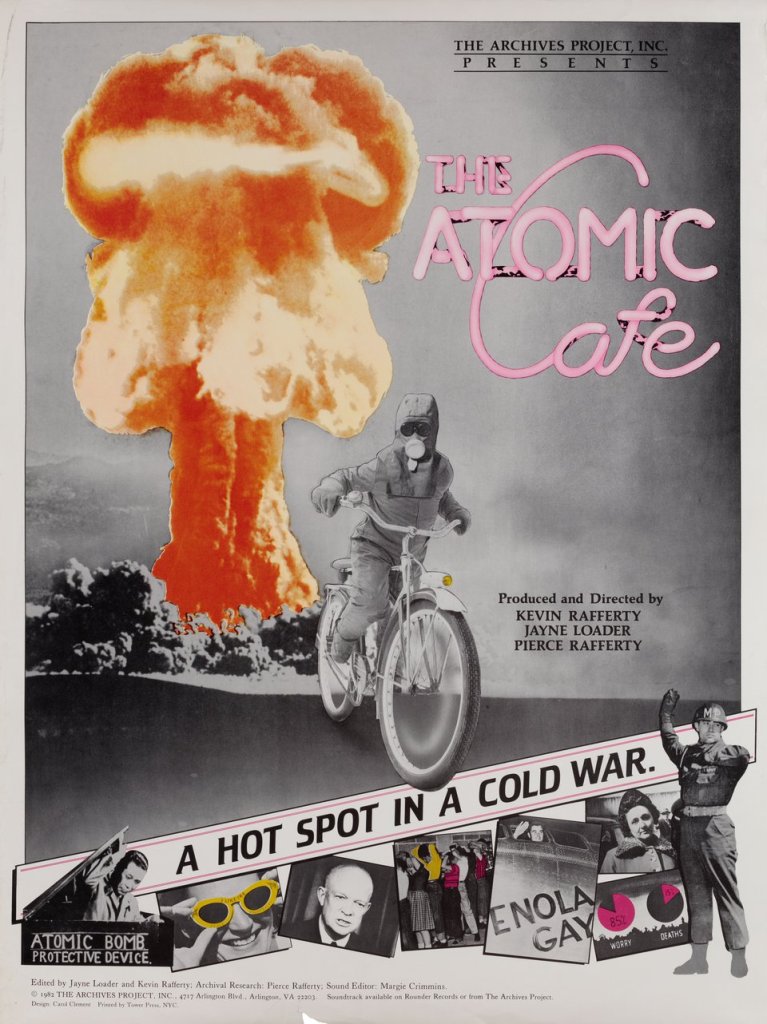
#665) The Atomic Cafe (1982)
OR “Apocalypse Then”
Directed by Jayne Loader, Kevin Rafferty, & Pierce Rafferty
Class of 2016
You can watch the entire film for free on Kino Lorber’s YouTube channel.
The Plot: In the early 1980s, when Reagan-era politics reignited the nuclear arms race, we revisited the first era of Cold War paranoia with “The Atomic Cafe”. Clips from dozens of government propaganda films, newsreels, and TV interviews are spliced together in a “compilation vérité”: no narrator, no modern-day interviews for context, just archival footage illustrating how the invention of the nuclear bomb in 1945 quickly escalated into a full-on arms race, and how the US government used the surrounding fear to keep its citizens in line. The footage is edited to highlight the absurdities of the era, as well as the darkness of a government trying to normalize this new weapon of mass destruction.
Why It Matters: The NFR calls the film “a unique document of the 1940s-1960s era” and praises the “vast, yet entertaining, collage of clips”. An essay by the University of Kent’s John Wills contextualizes the film’s production.
But Does It Really?: Oh sure. I enjoyed this movie a lot, or at least as much as I can enjoy a movie about such a dark subject matter. “The Atomic Cafe” is on the list for its succinct representation of Cold War politics, and its unique presentation makes it more accessible than a lot of its contemporaries. Part documentary, part collage, part cautionary tale, “The Atomic Cafe” isn’t an essential American film, but is an alternatingly humorous and terrifying account of essential American history. On a list with its share of government propaganda, I’m glad the Registry found room for a post-modernist takedown like “The Atomic Cafe”.
Shout Outs: It wouldn’t be a film about atomic age propaganda without an appearance from our friend Burt the Turtle in “Duck and Cover“. The NFR write-up also mentions the use of “The House in the Middle“, though I wasn’t able to confirm its appearance here. And among the needle drops from old film scores is the theme from “The Killers” by Miklós Rózsa.
Everybody Gets One: While in San Francisco, Pierce Rafferty found a catalog of US Government films and was intrigued by their unique titles such as “You Can’t Get Away With It“. He convinced his brother Kevin – then a CalArts film student – to work on a film highlighting their fascination with government propaganda. Journalist Jayne Loader was brought on board, and helped narrow the focus of the movie on government films pertaining to the Cold War and atomic bomb. The trio sifted through an estimated 10,000 hours of footage and outtakes for their 86 minute movie. While most of these films were in the public domain, a majority of the movie’s $300,000 budget went to acquiring the rights to the remaining footage, as well as the soundtrack.
Title Track: The Atomic Cafe is the name of an actual cafe seen about 72 minutes into the movie, in the midst of a montage of all the random things that got nuclear names at the time.
Seriously, Oscars?: No Oscar nomination for “The Atomic Cafe”, though it was nominated at the BAFTA’s, and the Boston Society of Film Critics gave it their Best Documentary prize. The Oscar’s Best Documentary winner that year was “Just Another Missing Kid”, John Zaritsky’s film about the disappearance of a Canadian teenager in Nebraska in 1978.
Other notes
- The print of “Atomic Cafe” I watched was the 2018 restoration by the good people at Kino Lorber, supervised by the original filmmakers. The film’s NFR designation is mentioned upfront, and the NFR logo appears during the restoration credits at the very end.
- There is something to be said about only using archival footage for this film. Obviously, even without a narrator, the clips are being edited to manipulate a narrative, but so much of that narrative is already baked into the footage: the awkward speeches, the fear mongering, the deliberate lies. Everything that needs to be said can be found within the subtext of the original footage.
- The filmmakers do an excellent job of showing the ripple effect of how the first atomic bomb led to the end of one war and beginning of another. And it all escalates so quickly, much like how I imagine it must have felt in real life. It’s saying something when your movie can only touch on the McCarthy hearings and the Rosenberg executions for only a few brief moments. But then again, if you’re looking for a streamlined documentary about the McCarthy hearings, the NFR has got you covered.
- It was very interesting watching this film so shortly after seeing “Oppenheimer” (a movie that I owe a second viewing that isn’t immediately followed by “Barbie”). In fact, “Oppenheimer” serves as an excellent primer to “Atomic Cafe”, which picks up more or less where the Nolan film left off. If nothing else, it made me appreciate the appearance in this film of Lewis Strauss, the Chair of the U.S. Atomic Energy Commission and future Robert Downey Jr. awards-bait. Strauss is on hand to downplay the nuclear fallout at Rongerik and Utirik, two islands downwind of the nuclear testing on Bikini Atoll in 1954. Strauss speech is intercut with footage of the Marshallese and their obvious signs of acute radiation syndrome.
- In addition to Strauss, this movie has a lot of notable politicians sprinkled throughout, including future presidents Lyndon Johnson, Richard Nixon, and Ronald Reagan (’80s filmmakers loved their ironic Reagan footage). Also on hand is Senator Owen Brewster, remembered today as Alan Alda’s character in “The Aviator”, and Representative Lloyd Bentsen, who would go on to famously tell Dan Quayle “Senator, you’re no Jack Kennedy.”
- For a movie hailed as being so funny, I actually found this an unsettling watch. Perhaps it’s because I don’t have the nostalgic lens of Boomers who grew up with this atomic culture, who can afford to look back on their childhoods as adults and laugh. Sure I learned about the Cold War in high school (kinda), but seeing actual footage of the frenzy that Americans whipped themselves up into is a distressing viewing experience. In some ways the film is even more relevant now than in 1982. I recognize so many of the same scare tactics in today’s cable news and clickbait headlines, applicable to any hot button issue a politician wants to scare their followers with. To paraphrase from this movie, it can happen here today, and it can be a lot worse.
- Wow, I did not realize how many songs there were about nuclear bombs. This movie’s soundtrack has such ’50s classics as “Atom Bomb Baby”, “Atomic Love”, and “Jesus Hits Like an Atom Bomb”. There’s so many of these that the movie had a soundtrack album! One song that has actually come up on this blog before is Bill Haley And His Comets’ “Thirteen Women (And Only One Man In Town)”, sung from the perspective of the lone male survivor of an atomic bomb. Unfortunate subject matter aside, you’re probably more familiar with that record’s B-side: “(We’re Gonna) Rock Around The Clock”.
- The final sequence in the film is an approximation of what a nuclear attack would have been like in the ’50s, with the nuclear family (another atomic namesake) heading into their fallout shelters and waiting out the bombing. The film ends with Father telling his kids to sweep up the glass and debris while they just relax and wait for the authorities to tell them what to do. I know it’s supposed to be funny, but I just found it all disturbing.
- The end credits play over more nuclear fallout footage with Floyd Tillman’s “This Cold War With You” on the soundtrack. Very much a lighter riff on the “Dr. Strangelove” ending (incidentally, “Atomic Cafe” was compared favorably to “Strangelove” in reviews). Check out the “Thanks” section of the credits for such varied names as Barbara Kopple, John Avildsen, E. L. Doctorow, and Abbie Hoffman.
Legacy
- “The Atomic Cafe” marks the only directing credit for either Jayne Loader and Pierce Rafferty, though Loader continues to write, and Pierce would go on to found the stock footage library Petrified Films. Kevin Rafftery’s next film was 1991’s “Blood in the Face”, which uses this movie’s archival footage approach to discuss American Neo-Nazism.
- “Atomic Cafe” was one of several films released in the late ’70s/early ’80s about the fears of nuclear power, including “The China Syndrome”, “Silkwood”, and the TV movie “The Day After” to name a few.
- Interestingly enough, it is speculated that “Duck and Cover” got a resurge in popularity thanks to its appearance in this film.
- Perhaps this film’s biggest influence: among its devotees was a young journalist named Michael Moore, who reached out to Kevin Rafferty and asked how exactly the film was made. Rafftery passed on his knowledge, and even assisted Moore as a cinematographer on his first film: “Roger & Me“. And now you know the rest of the story!
 The Horse's Head
2 thoughts on “#665) The Atomic Cafe (1982)”