#703) Shadows (1959)

#703) Shadows (1959)

OR “Whose Race Is It Anyway?”

Directed by John Cassavetes

Written by Cassavetes, Robert Alan Aurthur, and the cast.

Class of 1993

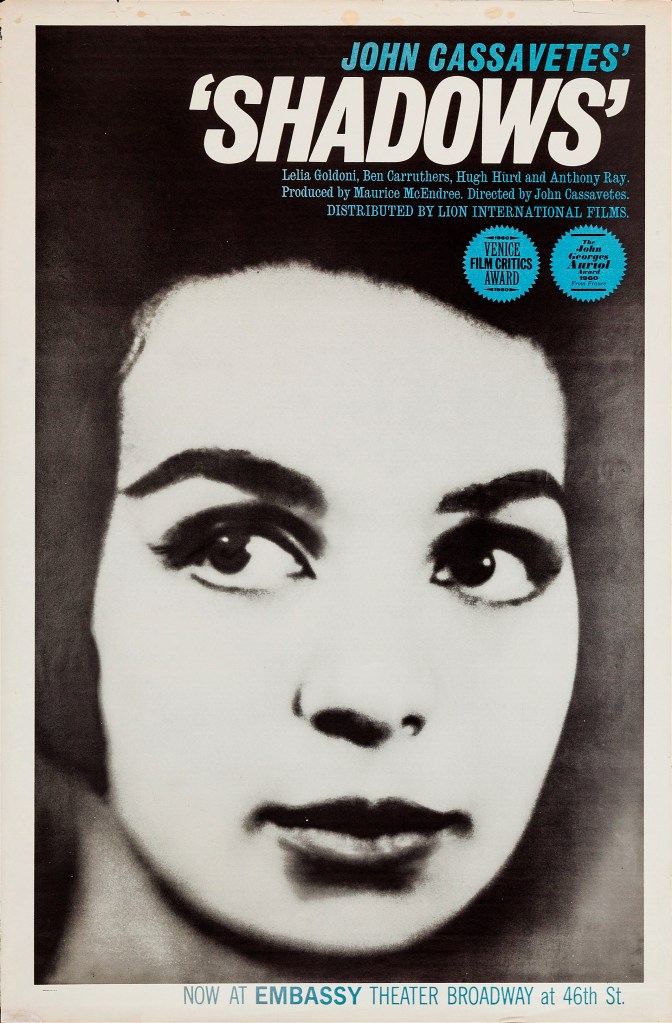
The Plot: Ben, Hugh, and Lelia (Ben Carruthers, Hugh Hurd, Lelia Goldoni) are three siblings living in New York at the height of the Beat Generation. The siblings are all African American, though Lelia is light skinned and often passes for White. Both Ben and Hugh have musical aspirations, but Ben wastes his days loafing about with friends at the local bars, while Hugh’s act can’t catch a break, despite the efforts of his agent Rupert (Rupert Crosse). Lelia’s love life takes a turn when she starts seeing Tony (Anthony Ray), a White man who doesn’t realize she’s Black. But all of this is place-setting for a freeform character study completely improvised by the actors.

Why It Matters: The NFR gives a rundown of the film’s production, and praises Cassavetes’ choice to make a film that “treats race and identity not as sociological discourse but as a sort of free jazz.” An essay by Cassavetes expert Ray Carney delves into the film’s theme of identity.

But Does It Really?: “Shadows” is one of those movies that needs a little explanation to fully appreciate. Unlike most movies, “Shadows” isn’t so much a piece of entertainment as it is the results of an experimental exercise, a filmed acting workshop. The results are far from the high production quality of many an NFR entry, but even with the film’s rough presentation, you can see Cassavetes’ love of the game: an artist determined to tell this story, whatever it ends up being. While I found the film a bit stagnant and unfocused, I get that without the film’s production context I wasn’t approaching it from the right angle. Still, I’m willing to justify “Shadows” on the NFR as an important “stepping-stone movie”: Cassavetes’ best work was still ahead of him, but none of those exist without “Shadows”.

Shout Outs: Look closely for a movie theater marquee advertising “The Ten Commandments“. Speaking of…

Wow, That’s Dated: Lots of marquee advertisements throughout for such ’50s films as “The Night Heaven Fell” and “Naked Paradise”, as well as the Broadway musical “The Most Happy Fella”. Also, we get not one but two shoutouts to Steve Allen, who at this point in his career had left “The Tonight Show” and was hosting his primetime variety series “The Steve Allen Show”. Hi-ho, Steverino!

Seriously, Oscars?: In a year dominated by “Ben-Hur” there was no way a little movie like “Shadows” was going to squeak into the Oscar conversation. The film did, however, fare better in Europe, winning the Critics Award at the 1960 Venice Film Festival and receiving four BAFTA nominations.

Other notes

  • At this point in his career, John Cassavetes was starting to make a name for himself not only as an actor, but as an acting teacher, co-founding “The Cassavetes-Lane Drama Workshop” in New York with Burt (future father of Diane) Lane. An alternative to the Actors Studio and “the method”, Cassavetes’ workshop emphasized performances stemming from character rather than psychology or emotions. One day his class performed an improvised scene about a light-skinned Black woman dating a racist White man. Cassavetes was so inspired by this scene that while he was on Jean Shepherd’s local radio program to promote “Edge of the City”, he pitched a movie based on this concept to the listening audience, who sent in money to help finance the film (hence this film’s credit “Presented by Jean Shepherd’s Night People”, a nickname for Shepherd’s listeners). “Shadows” was filmed throughout 1957 with actors from Cassavetes’ acting workshops and a script with a detailed plot description but no dialogue, which was improvised by the actors during rehearsals.
  • After the completion of “Shadows”, Cassavetes screened the film in 1958, and reception was mixed to negative. Knowing he could salvage the film, Cassavetes wrote a revised screenplay with writer and friend Robert Alan Aurthur, and reunited the cast to reshoot several new scenes that emphasized the sibling relationship over the original themes of racism and prejudice. It is this reworked version that is widely available today, with an estimated 60% of the final film being comprised of these reshoots. We’ll come back to the original cut in the “Legacy” section.
  • I must acknowledge the elephant in the room: despite her casting as one of the Black characters, Lelia Goldoni was of Sicilian descent. Ben Carruthers was 1/16th Black and used a sunlamp to make his skin appear darker, though he only did this for the original shoot, resulting in a handful of cringy shots in the final film. While this casting is obviously problematic and wouldn’t fly today, I will admit it didn’t bother me as much as I thought it would (Except for those sunlamp shots. What were you thinking, Ben?)
  • The print I watched was the UCLA restoration, which received a grant from (among others) the Hollywood Foreign Press Association, aka the organization behind the Golden Globes. I didn’t realize they did things other than hobnob with A-listers and give out awards to said A-listers.
  • “Shadows” is filmmaking at its most raw: Full-on guerrilla filming (multiple passersby look at the camera), disjointed continuity from the improvisations, and lots and lots of dubbed dialogue. It makes Cassavetes’ later films seem very polished by comparison. Given this film’s rough aesthetic, late ’50s setting, and fondness for jazz music, I was expecting it to turn into “The Cry of Jazz” at any moment.
  • I was captivated by Lelia Goldoni’s performance. The character of Lelia is flighty and indecisive, but always compelling. Goldoni really is the breakout star of this movie, and it’s a shame her film career never really took off.
  • Side note: Lelia Goldoni and Ben Carruthers, who play siblings in this movie, were briefly married shortly after this film was made. So that’s how it is in their family…
  • Both Cassavetes and his wife Gena Rowlands make cameos in this movie: Cassavetes as the man helping Lelia outside the movie theater, and Rowlands as a nightclub patron. I must have blinked during that nightclub scene because I definitely missed Rowlands.
  • This movie takes its time getting started, but when it does…it still takes its time.
  • Things escalate quickly between Lelia and Tony, with Lelia losing her virginity to Tony just a few quick scenes after their first meeting. I’m sure 1959 audiences were scandalized by the film’s depiction of pre-marital sex (although we only see them post-coital with zero nudity), to say nothing of Lelia’s line “I didn’t know it could be so awful”. I don’t know if I can endorse a movie where a guy named Tony is secretly racist and bad in bed.
  • Shout out to Rupert Crosse as Hugh’s agent Rupert Crosse. The character is nothing to write home about, but it’s worth noting that Crosse’s acting career would eventually lead to his work in the 1969 Steve McQueen film “The Reivers”, for which he became the first African American to receive an Oscar nomination for Best Supporting Actor. That’s a milestone that gets ignored way too often. Get it, Rupert!
  • The final credit reads “The film you have just seen was an improvisation.” Interesting choice, though I wonder if having this disclaimer at the beginning of the movie would have helped audiences understand/appreciate it more. It definitely would have helped me.

Legacy

  • Although “Shadows” wasn’t well received upon its initial release, the film found success in Europe and was part of an ever-growing new wave of independent American filmmakers who were able to create and successfully distribute their movies outside of the Hollywood system. The reputation of “Shadows” grew as Cassavetes’ future filmography developed a following.
  • John Cassavetes was able to parlay his direction of “Shadows” into bigger directing gigs, helming two films for Hollywood: 1961’s “Too Late Blues” and 1963’s “A Child Is Waiting”. Neither experience was particularly great for Cassavetes, who shifted back to acting on film and TV, saving up enough money to fund his next indie feature: 1968’s “Faces“.
  • As for the first cut of “Shadows”, the aforementioned Ray Carney spent over 20 years trying to track down the original 1958 version, a journey that eventually led him to an attic in Florida and the daughter of the second-hand shop owner who had inadvertently bought the missing film years earlier. The original “Shadows” was restored in 2004, though screenings of this version are scarce as the Cassavetes estate has questioned its legitimacy and have pursued legal action to prevent its release.
  • With its structured improvisational format, can we claim “Shadows” as an influence on “Curb Your Enthusiasm”? I mean, there were a few episodes where Larry dated Vivica A. Fox’s character with disastrous results; the parallels are right there.
#702) Mighty Like a Moose (1926)

#702) Mighty Like a Moose (1926)

OR “Cut to the Chase”

Directed by Leo McCarey

Written by Charley Chase and H.M. Walker

Class of 2007

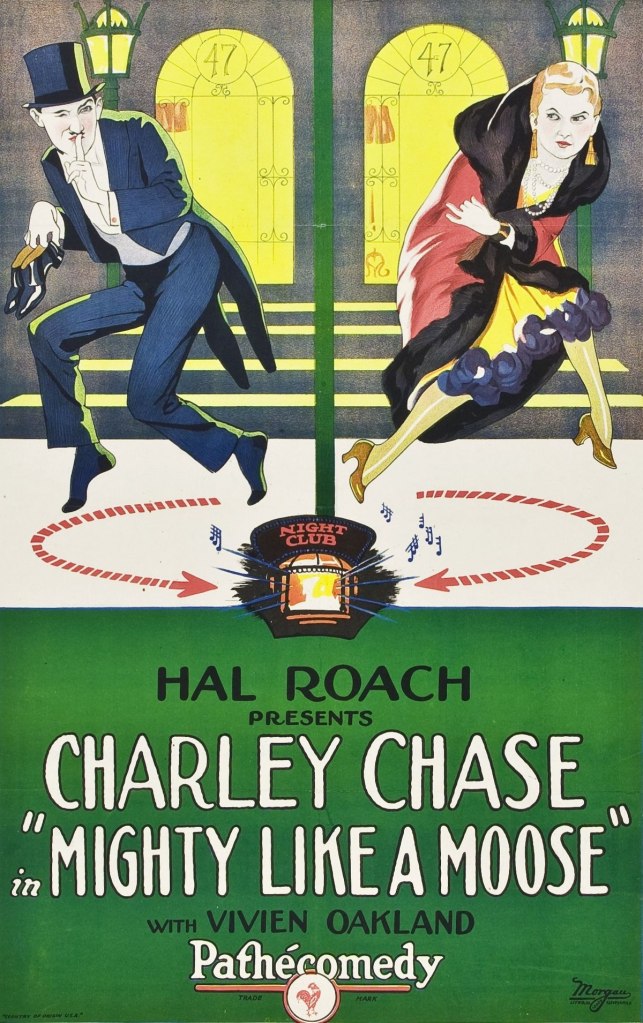
The Plot: Mr. and Mrs. Moose (Charley Chase and Vivien Oakland) each have a problem: Mr. has unsightly buck teeth, while Mrs. has a nose so large it makes kissing her husband nearly impossible. Without telling the other one, each quietly saves up money to have a secret operation. When they run into each other post-op, neither recognizes the other and they begin to flirt, eventually ending up at a wild party hosted by Mr. Moose’s dentist (Charles Clary). As you might expect, this leads to a lot of mistaken identity and shenanigans courtesy of one of the silent era’s most popular, albeit overlooked, comedians.

Why It Matters: The NFR write-up is a salute to Charley Chase, whom they call “underappreciated in the arena of early comedy shorts”. The short proper is praised for its “side-splitting series of sight gags”.

But Does It Really?: If there’s one thing the NFR loves, it’s obscure silent comedians who were famous in their day and all-but-forgotten now. “Mighty Like a Moose” is on this list to represent Charley Chase, whose filmography was finding a new wave of appreciation around the time he joined the NFR’s ranks. On its own, “Mighty Like a Moose” holds up well in the laughs department, if not so much for its overall subject matter. Ultimately, I found myself laughing quite a bit, a testament to Chase’s comic talents as both actor and writer. A pass for “Mighty” on this list; if nothing else its induction means that every so often someone attempting this NFR gauntlet will stumble upon the works of another underrated pioneer of film comedy.

Everybody Gets One: Born Charles Parrott, Charley Chase began his showbiz career when he was 19 playing bit parts in Keystone comedies. By the time he started working for Hal Roach, Chase was primarily a director, though he did star in his own series of comedy shorts, where he adopted the stage name Charley Chase. Although shorts like “Mighty Like a Moose” were directed by other people (in this case a 28-year-old gagman named Leo McCarey), Chase was always the muscle behind the scenes, contributing to his shorts’ writing, directing, and editing. 

Wow, That’s Dated: Turns out the practice of surgery has existed for centuries, though modern plastic surgery didn’t come to be until a few technological breakthroughs during World War I. Cosmetic surgery as seen in this film would have been relatively new in 1926, though nowhere near as commonplace as it is today. And that’s as much research on plastic surgery I’m willing to stomach at this time.

Other notes

  • My main beef with this short is its overall comic premise: How in the hell do these two not recognize their own spouses after their operation? They don’t look that different. Even with Mrs.’ hair dye and new wardrobe her husband should still be able to figure out who she is. But as always, I am overanalyzing something that wasn’t meant to be analyzed in the first place, so I’ll suspend my disbelief as high as I can and just go along with it.
  • Chase and Walker are clearly having fun with the intertitles, especially the ones poking fun at the couple’s abnormalities. For example: When Mrs. Moose gets her nose job, the intertitles describe her as “winning by a nose”. There’s also a joking reference to Mussolini, which seems a bit extreme. What did Mussolini ever do to yo—oh right, never mind.
  • After Mr. Moose’s surgery, the dentist gives him a false set of buck teeth for identification. Really? Are you sure this isn’t just for comic mishaps? Sorry, I will stop analyzing, starting…now.
  • I enjoyed the sequence where Mr. and Mrs. Moose are both sneaking around their house trying to get ready for their “affair” without being seen by the other one. The near misses are clever and fun to watch. The wide shots of Mr. on the second floor overlooking Mrs. on the first are staged in a way that reminded me of the quote from Chase’s former colleague Charlie Chaplin: “Life is a tragedy when seen in close-up, but a comedy in long-shot.”
  • At the party, Mr. Moose gets stuck dancing with Floradora, a homely woman who hasn’t danced “since 1888”. So according to this movie, people who don’t conform to societal norms serve no purpose whatsoever? Okay, that was my last analysis. Back to the funnies.
  • The Moose’s maid is played by Ann Howe, who gets the intriguing credit in the cast list as “Ann Howe (The Radio Girl)”. My research hasn’t pulled up anything substantial, but who is Ann Howe and what did she do that made her so synonymous with radio? Even if she was big in the ’20s but obscure now, anyone dubbed “The Radio Girl” should have left some kind of cultural footprint. And of course, the irony of a radio star being promoted as such in a silent movie is not lost on me.
  • Like every comedy, everyone must find out about the huge misunderstanding eventually, and the final sequence of Mr. Moose messing with Mrs. Moose and staging a fight with himself is a very funny farcical conclusion.
  • I was not expecting the comedy short from the ’20s to have one of the most terrifying final shots in any movie I’ve ever seen: The Moose’s dog Buddy wearing Mr. Moose’s false buck teeth! Have fun trying to sleep tonight.

Legacy

  • Unlike most of his contemporaries, Charley Chase successfully transitioned into the sound era. While his shorts were still successful, Chase found it hard to crack into features (though he does appear in a supporting role in fellow NFR film “Sons of the Desert” with his friends Laurel & Hardy). In fact, Chase’s only big attempt at a feature film, 1936’s “Neighborhood House”, had so many production woes Hal Roach Studios fired Chase, drastically cut the film down and released it as a short. Chase spent the last few years of his life directing shorts at Columbia (including a few with the Three Stooges), before his death in 1940 from a heart attack exacerbated by his heavy drinking.
  • Although Charley Chase lingered in the shadows of his more famous contemporaries for many decades, the last 20 years have seen a renewal of interest in Chase’s career. His shorts started to get released on DVD and aired on TCM, leading to new generations discovering his work. Chase’s legacy was further solidified by the induction of “Mighty Like a Moose” into the NFR in 2007.

#701) The Beau Brummels (1928)

#701) The Beau Brummels (1928)

OR “Two for the Show”

Written by Al Shaw & Sam Lee

Class of 2016

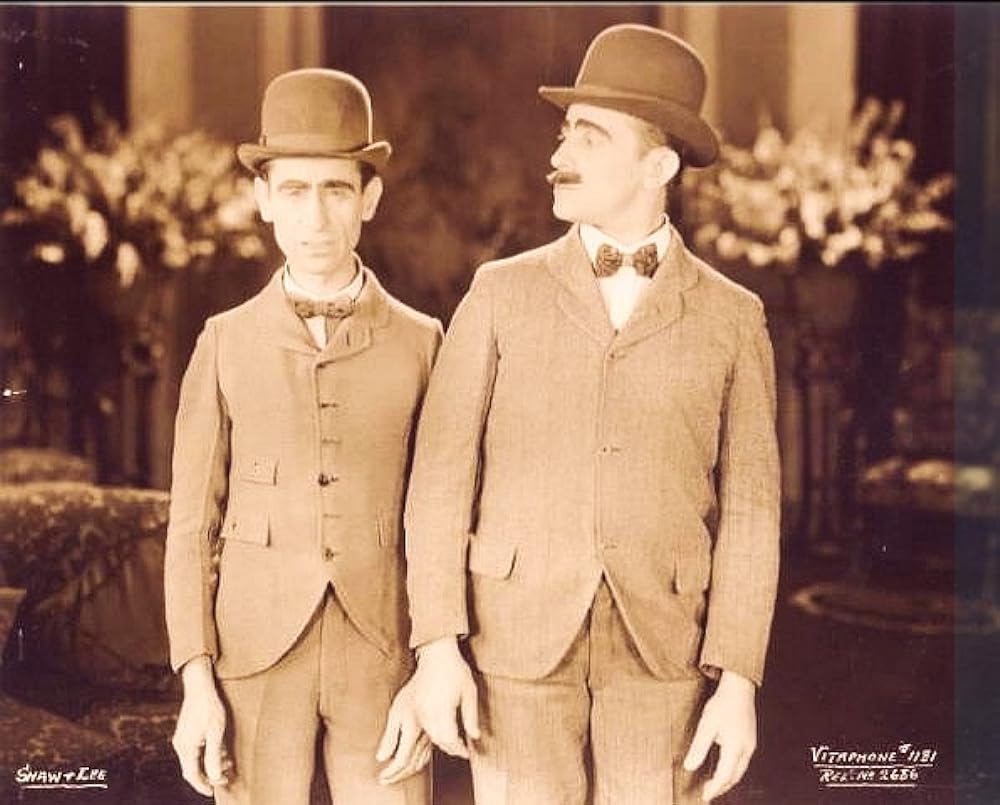
The Plot: The technological miracle of Vitaphone synchronized sound brings you the comedy stylings of Al Shaw & Sam Lee, aka Shaw & Lee! Straight from vaudeville, this comic duo performs a seemingly endless exchange of jokes and one-liners, as well as songs like “Don’t Forget to Breathe or You’ll Die”. Stick around at the end for a little soft-shoe, plus their famous hat swapping routine!

Why It Matters: The NFR gives a brief history of Shaw & Lee, stating “their brand of dry, offbeat humor is seen by some as well ahead of its time.” The write-up also includes a quote from critic Jim Knipfel: “If Samuel Beckett had written a vaudeville routine, he would have created Shaw and Lee.”

But Does It Really?: As much I enjoyed these two, I’m on the fence about this film’s historical significance. Don’t get me wrong, I laughed a lot at the unexpected absurdism of “The Beau Brummels”, but the NFR already has a Vitaphone short with a comedy team doing their vaudeville act: 1929’s “Lambchops” with the significantly more famous Burns & Allen (in fact, I’m convinced both movies use the same set). But if I’m going to nitpick, it stands to reason that if the NFR has enough room for more than one Marx Brothers comedy or Astaire/Rogers musical, then I guess there’s enough room for a second Vitaphone short. A pass for “Beau Brummels”: It’s not the most important film on the list, but it’s funny (and short) enough to warrant a viewing for the curious.

Everybody Gets One: Most of my information on Shaw & Lee comes from this very insightful article by historian Mary Mallory. Both Al Shaw & Sam Lee started in show business at a young age; Shaw in the music halls of his native England, Lee on the streets of his native New Jersey. Although stories differ on how Shaw & Lee met, we know that Shaw emigrated to America in 1907, and by 1911 the two were performing as a duo in vaudeville and burlesque. Originally, Shaw & Lee were a dance team, but over time they started adding their off-beat jokes into the act. By the early 1920s, Shaw & Lee were promoted to headliners, starring in several revues, including a few big ones on Broadway. When Warner Bros. started making sound shorts out of their recently purchased Vitagraph studio in Brooklyn, any famous stage performers with a ready-to-go act were brought in to film their routines, and Shaw & Lee got the call in early 1928. And for any future historians confused by which is which: Shaw is the shorter, clean-shaven one on the left side of the screen, Lee is the taller one on the right with the mustache.

Title Track: Much like the unrelated ’60s rock group of the same name, this film got its title from George Bryan “Beau” Brummel, a Regency-era Englishman who has become the cultural shorthand for high fashion. Shaw & Lee were known for performing on stage in nice suits, and advertisements for the two started referring to them as “The Beau Brummels” (although that was never officially the name of their act).

Seriously, Oscars?: No nominations from the newly formed Academy for “The Beau Brummels”. Create a shorts category, you cowards!

Other notes

  • Aside from Shaw & Lee themselves, there is no credit for any of the creative team on this film. I gave Shaw & Lee a writing credit at the top of this post based on my own assumption, but as is often the case with vaudeville, some of these jokes are older than the hills.
  • Right off the bat, you know these two aren’t your typical “take my wife, please” comedians. We begin with their rendition of “The Fountain in the Park” that rhymes “strolling through the park one day” with “the merry merry month of June”. The song then segues into a semi-stream of consciousness, including a verse in Yiddish!
  • I love that this is clearly just a filmed version of their vaudeville routine with no attempt to adapt it for this new medium. For example: Shaw & Lee always pause for laughs, which if you’re watching this in a movie theater with a big audience makes sense, and if you’re watching it by yourself on a TV or computer just adds to the overall absurdity.
  • Wow, these two were doing risqué updates on the “Jack and Jill” nursery rhyme long before Andrew “Dice” Clay.
  • Shaw & Lee’s presentation of their routine is fascinating. Except for their dance at the end, the two stand perfectly still, facing the camera/audience, delivering their jokes in a dry, wooden tone. It starts to feel like the kind of anti-comedy routine Andy Kaufman would perfect 50 years later: It’s so stilted it must deliberate.
  • The first true groaner of the jokes was the one about the 30,000 geese Lee has on his porch. Shaw: “Must be Portuguese.” 
  • My favorite exchange is Lee saying he works for his father. What does his father do? “He’s laid off.”
  • In a short that has already challenged my preconceptions of vaudeville-era humor, things get meta at the end with the song “This is the Chorus”, with lyrics that state which part of the song they are singing. It reminded me a lot of the theme song from “It’s Garry Shandling’s Show”. Finally, an excuse to mention Garry Shandling on this blog, because “What Planet are You From?” sure ain’t making the list anytime soon.
  • Another sign of a cut-and-pasted vaudeville routine: Shaw & Lee bow to house right and house left at the end of the act.

Legacy

  • “The Beau Brummels” was released in January 1928, playing in Los Angeles before screenings of the crime drama “Lights of New York”, Warner Bros.’ first “all-talking” picture. Funnily enough, “Beau” seems to have gotten the better reviews of the two. The short was successful enough that in 1930 the two filmed another Vitaphone short based on their routine: “Going Places”.
  • As the 20th century went on and vaudeville continued to go the way of…well, vaudeville, work for Shaw & Lee started to wane (though allegedly Burns & Allen assisted in getting them gigs in the later years). The duo continued to make appearances in film, on stage, and eventually on television, making their final appearance together playing two repairmen in the 1958 George Gobel comedy “I Married a Woman”. Sadly, this appearance would be a posthumous one for Al Shaw, who died in 1957 at age 66; Sam Lee followed in 1980 at age 88.
  • “The Beau Brummels” got a restoration in the early 2000s from the UCLA Film and Television Archive, with funding from the Vitaphone Project. While Shaw & Lee didn’t leave behind much of a legacy, “Beau Brummels” – along with “Going Places” – continues to be seen online and shared by new generations caught completely off-guard by their avant-garde style of humor.