
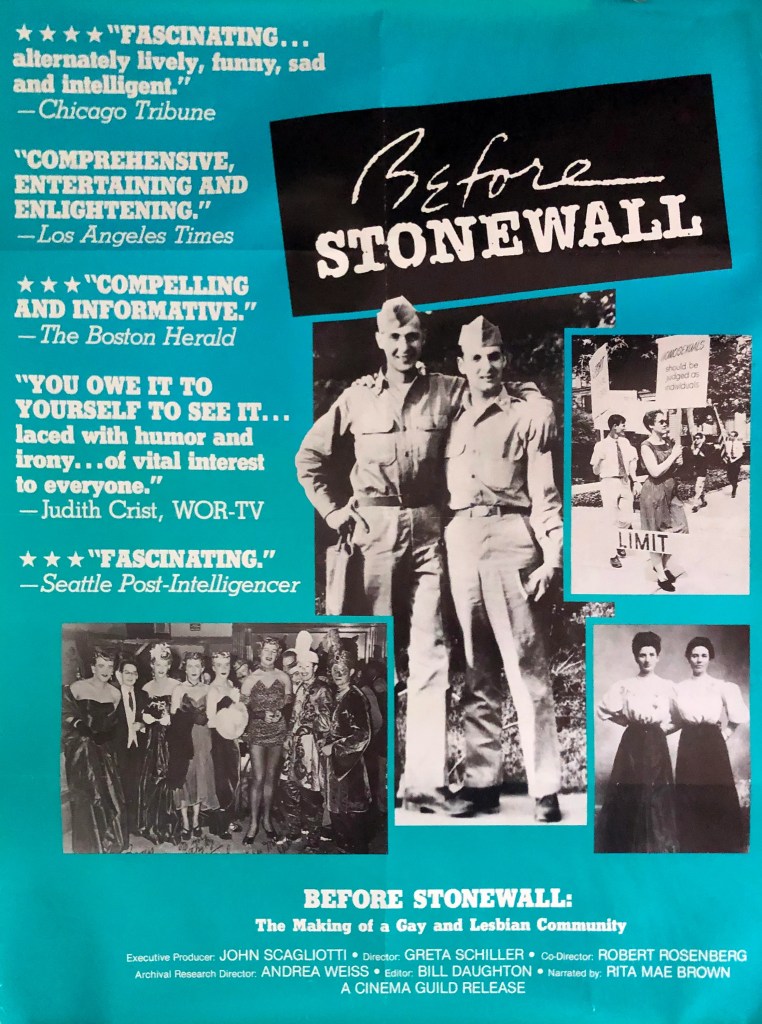
#708) Before Stonewall: The Making of a Gay and Lesbian Community (1984)
OR “Gay Old Times”
Directed by Greta Schiller. Co-directed by Robert Rosenberg.
Class of 2019
The Plot: On June 28th, 1969, a police raid of the Stonewall Inn, a gay bar in New York’s Greenwich Village, escalated when the bar’s gay clientele fought back, leading to violence and rioting over the next five days. While the Stonewall Riots have been designated the starting point of the modern gay rights movement, Greta Schiller’s documentary focuses on American gay culture within the generations leading up to that historic night. Through archival footage and first-hand accounts, “Before Stonewall” chronicles gay (or what we now call queer) life in America between 1900 and 1969; a history of repression, marginalization, burgeoning communities, and the very beginnings of liberation.
Why It Matters: The NFR write-up isn’t very helpful, describing the documentary’s overall themes without offering any superlatives for the film or its creators. It always surprises me when the NFR doesn’t specify what makes their selections important or unique.
But Does It Really?: “Before Stonewall” is the right movie at the right time. Of course this film’s subject matter is significant, but beyond that, the film is a documentation of the first “out” generations openly discussing their lives and struggles for posterity. “Before Stonewall” is a movie about beginnings: the beginning of gay rights, but more importantly the beginning of the queer activism that continues to this day. Schiller’s oral history approach, candid interview subjects, and overall optimism towards this material make “Before Stonewall” a landmark film in queer history and a compelling watch.
Shout Outs: Brief clips from “Salome” (and its allegedly all-gay cast), plus a snippet of Judy Garland singing “Over the Rainbow“.
Everybody Gets One: A 1977 graduate of The City College of New York with a BA in Film/Video Production, Greta Schiller’s first films were the shorts “Greta’s Girls”, and “Greetings from Washington D.C.”, the latter being about the first National March on Washington for Lesbian and Gay Rights in October 1979. In the early 1980s, Schiller was approached by producer Robert Rosenberg about making a documentary based on the then-unpublished book “Sexual Politics, Sexual Communities: The Making of a Homosexual Minority in the United States” by John D’Emilio. “Before Stonewall” was Greta Schiller’s first feature-length film, and quickly evolved beyond the scope of the gay communities in the book to become, as Schiller later put it, “Gay History 101”.
Seriously, Oscars?: No Oscar love for “Before Stonewall”, though it did win a handful of film festival awards and was a Sundance Grand Jury Prize nominee. Following the film’s PBS airing in 1986, it won two News & Documentary Emmys: Outstanding Information, Cultural or Historical Program and Outstanding Individual Achievement in a Craft: Researchers. You gotta love an award given out for research.
Other notes
- The film opens with an interesting disclaimer: “Unless otherwise stated, the people who appear in this film should not be presumed to be homosexual…or heterosexual.” This film knows its audience and knows it well.
- “Before Stonewall” makes heavy usage of archival footage, photos, and audio throughout. Most libraries Schiller contacted for the film claimed not to have any footage of homosexuals, but the film’s archival resource director (and future Emmy winner) Andrea Weiss had success at the Library of Congress by searching under more general terms like “cross-dressing” and “Greenwich Village street life”. Most of the film’s archival materials come from the personal photos and home movies of the film’s interviewees, as well as material sent to Greta Schiller after she printed an ad in Village Voice.
- We begin as all ’80s documentaries were required to: with an ironic in hindsight Ronald Reagan movie clip. In this case, a scene from 1943’s “This Is the Army” where, as a Corporal in charge of an Army revue show, he assigns Alan Hale to dress in drag for the “Ladies of the Chorus” number. Reagan will show up later during the ’60s segment when he’s Governor of California, calling homosexuality “a tragic illness”. No, you’re thinking of the actual tragic illness you ignored for most of your presidency.
- “Before Stonewall” is narrated by Rita Mae Brown, author, feminist, and gay activist. She’s okay, but as far as gay NFR documentaries go she’s no Harvey Fierstein.
- The film’s early segments chronicling the 1900s through 1920s lay an excellent foundation of what’s to come, mostly how repressed homosexuality was, and the extreme subtlety involved if you dared to connect with any other gay person. There’s also a brief mention of cowboys hooking up with each other out on the lone prairie. Somewhere Annie Proulx is taking notes.
- Among the film clips is a scene from the 1932 Clara Bow vehicle “Call Her Savage”, featuring one of the first (if not the first) depictions of openly gay characters, as well as a scene set in a gay cabaret. Ah, the pre-code days, we will miss you when you’re gone.
- I didn’t realize how pivotal the rise of Nazism and WWII were for gay rights. Obviously, the persecution of homosexuals by the Nazis gets a mention, but America entering the war led to (closeted) gay men and women serving in the military and discovering people just like them from across the country and around the world. This moment of discovery and a possible community was a huge eye-opener for me.
- I love when NFR documentaries overlap with each other, and “Before Stonewall” may brush up against more NFR docs than any other, a testament to how long our gay community had to stay hidden in the background of society. A segment dedicated to lesbians in the workforce during WWII feels like a lost scene from “The Life and Times of Rosie the Riveter“. This section has one of the film’s most memorable moments: former WAC member Nell “Johnnie” Phelps telling her story of standing up to General Dwight Eisenhower when he requested an investigation into lesbian infiltration within WAC. It’s an exciting tale, until you learn that based on Phelps’ military record it most likely never occurred. Whatever, it makes for good copy, and she tells it very well.
- Another NFR doc that resurfaces here: “Point of Order” and the McCarthy hearings, specifically the debate between Senator McCarthy and Chief Counsel Welch over the definition of the word “pixie”. It is one of the hearing’s rare lighthearted moments. Also, blink and you’ll miss Roy Cohn in the background of that clip. So…go ahead and blink I say.
- I was relieved that there are no homophobic slurs thrown about during this film, other than the newspaper headlines referring to outed gay men as “perverts”. We know things were bad for our gay citizens (and still are), we don’t need the slurs to go with it.
- The film’s late ’50s trip to suburbia is accompanied by “Little Boxes”, the 1962 Malvina Reynolds song that reached a new audience when it became the theme song to the TV show “Weeds”. Its inclusion here made for a fun sing-along during my viewing. Fun Fact: Reynolds wrote “Little Boxes” about the tract housing development in Daly City, California, most of which is still there.
- Speaking of the Bay Area, I was fascinated by the segment about Black Cat Café, a North Beach bar that served as a meeting spot for San Francisco’s beat and gay communities. Black Cat Café closed in 1964 after losing its liquor license, and is now the restaurant Nico’s, though there is a plaque acknowledging the building’s history. “Before Stonewall” hosts a very touching reunion between the bar’s regulars 20 years later.
- My main takeaway from this movie is “a rising tide lifts all boats”. Much like WWII, the Civil Rights and Women’s movements of the 1960s helped fan the flame of the gay rights movements. The gay community, as depicted here, were the marginalized group within these bigger marginalized group, with gay women and gay people of color becoming invigorated by these movements to stand up for their own rights. Side note: We briefly see clips from the 1963 March on Washington and, unlike another NFR documentary, “Before Stonewall” ponies up and plays a snippet of Dr. King’s “I Have a Dream” speech.
- It must be the late 1960s because I hear Jefferson Airplane’s “Somebody to Love”.
- The film, of course, concludes with the Stonewall Riots, which are surprisingly glossed over. Heck, my description in “The Plot” is more detailed than this movie’s account. Keep in mind the riots occurred only 15 years before this film was released, so the assumption is if you’re watching this documentary in 1984 the riots are recent history that don’t need any set-up. It’s like if a modern documentary said, “You remember the housing crisis, we don’t need to get into all of that.”
Legacy
- “Before Stonewall” premiered at the Toronto International Film Festival in 1984 and received a limited theatrical release in June 1985. As part of their funding agreement with the Corporation for Public Broadcasting, “Before Stonewall” aired on PBS in 1986, the first film specifically about lesbianism to be funded and broadcast by the network. When certain PBS affiliates refused to air the documentary, Greta Schiller and Andrea Weiss traveled to those regions and held special screenings for local gay and/or arts organizations.
- Based on their successful collaboration during “Before Stonewell”, Greta Schiller and Andrea Weiss founded Jezebel Productions, and continue to direct and produce documentaries to this day. Their most well-known collaboration is 1995’s “Paris Was a Woman”, their passion project about lesbians in 1920s Paris. Schiller and Weiss have also been in a personal relationship since shortly after making “Before Stonewall” and have been legally married since 2018.
- “Before Stonewall” received a restoration and re-release in 2019, commemorating the 50th anniversary of the Stonewall riots as well as the film’s 35th anniversary. The film would be inducted into the NFR later that same year.
- I was not expecting “Before Stonewall” to have both a sequel and a prequel. “Before Stonewall” co-producer John Scagliotti directed both films: 1999’s “After Stonewall” about the 30 years of gay history following the Stonewall Riots, and 2017’s “Before Homosexuals”, exploring the history of homosexuality preceding the 20th century.
- Greta Schiller’s most recent film is 2024’s “Love Letters”, a documentary about Catherine Stimpson and Elizabeth Wood, a lesbian couple whose custody battle in the ’70s broke down an important gay rights barrier. You can learn more about Schiller’s filmography on the Jezebel Productions website.
 The Horse's Head