
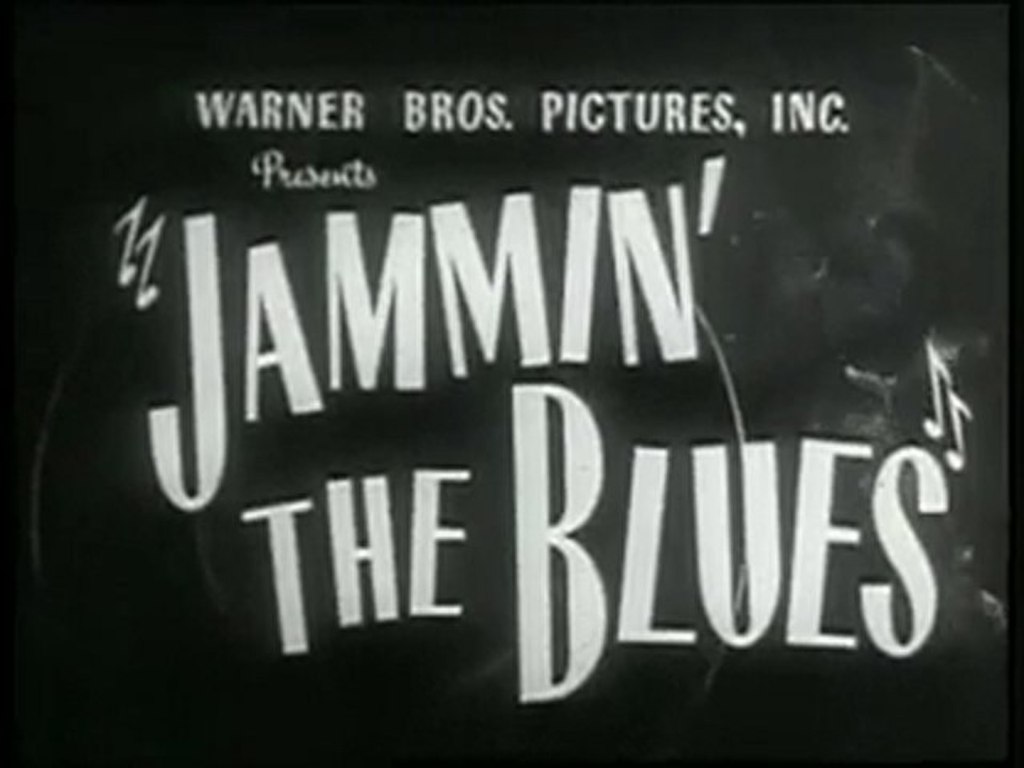
#713) Jammin’ the Blues (1944)
OR “Thoroughly Modern Mili”
Directed by Gjon Mili
Class of 1995
The Plot: Directed by Life magazine photographer and first-time filmmaker Gjon Mili, “Jammin’ the Blues” is a jam session between some of the jazz scene’s brightest talents (Lester Young and Illinois Jacquet – tenor sax, Red Callender – bass, Harry “Sweets” Edison – trumpet, Marlowe Morris – piano, “Big” Sid Catlett and Jo Jones – drums, Barney Kessel – guitar, John Simmons – double bass). After opening with the instrumental “Midnight Symphony” (written by Lester Young), the group is joined by Marie Bryant singing “On the Sunny Side of the Street”. Bryant then teams up with dancer Archie Savage to show off their genuinely impressive swing dancing skills during the titular “Jammin’ the Blues” (also written by Lester Young).
Why It Matters: The NFR write-up is mostly a rundown of the short, though they highlight the “evocative background” the lighting and sets give the piece. The write-up also erroneously states the movie is 20 minutes long (It’s 10, maybe they watched it twice?)
But Does It Really?: “Jammin’ the Blues” is a fun, quick entry in the NFR, but I kept asking myself, “Why this short? And why so early in the NFR run?” None of my research could help clarify why this film is so significant, other than its unique aesthetic and the creatives involved with it. I am willing to give “Jammin’ the Blues” a pass for NFR inclusion thanks to its depiction of a more raw form of jazz that the average moviegoer had never heard before, as well as representation of talent both in front of and behind the camera making one of their rare (and in some cases only) contribution to film.
Everybody Gets One: Gjon Mili emigrated to America from his native Albania in 1923, studying electrical engineering at MIT. At a time when photography was becoming an artform rather than just reportage, Mili experimented with various photography techniques, and in collaboration with Professor Harold Edgerton created his best-known work: photos taken with stroboscopic light, capturing several milliseconds in one photo (you’ve probably seen Mili’s shot of Picasso making a drawing with a flashlight). I’m not sure how Gjon Mili went from avant-garde photography to directing a short film for Warner Bros., but he certainly wasn’t the first or last photographer to make the pivot to film (see Gordon Parks), and he had taken enough photos of celebrities for Life by 1944 that I’m sure many an industry connection was made.
Seriously, Oscars?: “Jammin’ the Blues” was nominated in the category of Best Short Subject (One-Reel) but lost to the Paramount comedy short “Who’s Who in Animal Land”. You shouldn’t feel too bad for producer Gordon Hollingshead, though; he won later that night for the two-reel short “I Won’t Play”, his second of an eventual six Oscars!
Other notes
- Shoutout to the film’s technical director Norman Granz, a legendary record producer who, among his many accomplishments, produced some of the first “jam session” albums to receive a wide release. I presume Granz was the liaison between the film’s musicians and Warner Bros.
- My first thought before watching “Jammin’ the Blues” was, “Haven’t I watched this one for the blog already?”. Then I realized I was thinking of “Jam Session” with Duke Ellington: two very similar films from within two years of each other. When you’ve watched as many NFR films as I have, you’re going to experience the occasional case of déjà vu.
- “Jammin’ the Blues” is one of the rare live-action shorts on the Registry produced by a major movie studio, and the even rarer one-off studio short on the list. I can only imagine what it would have been like seeing this before watching “Arsenic and Old Lace” or “To Have and Have Not”.
- With one exception, all the extraordinary talent you see in the film is African American. The exception is Barney Kessel, who was filmed mostly in the shadows and had his hands dyed with berry juice for a few close-up shots of his guitar. I can’t give this film a full-on Blackface Warning, but I will give it a minor Black Hands Warning.
- I do wonder how much of this film’s music was truly improvised. I imagine the solos shot in close-up could be riffed on the spot, but the film’s four day shoot surely led to some repetition for the performers.
- The cinematography gets very artsy as we go along, with stylish compositions of the dancers, and the doubling/tripling/quadrupling of certain band members. While I’m sure Mili had a say in these artier shots, attention must be paid to this film’s cinematographer Robert Burks. A longtime member of the Warner Bros. special effects department, Burks got his first cinematographer credit with “Jammin’ the Blues”. Burks would go on to be Alfred Hitchcock’s longtime cinematographer, collaborating on some of his best films (“Rear Window“, “Vertigo“, “North by Northwest“) and winning an Oscar for his work on “To Catch a Thief”.
- Of course the music is great, but I was bowled over by the dancing. Both Marie Bryant and Archie Savage had worked closely with legendary dancer and teacher Katherine Dunham (Savage was one of Dunham’s favorite dance partners), and it’s fun watching these two cut loose and swing!
Legacy
- Gjon Mili made two more short films after “Jammin’ the Blues”: 1950’s “Improvisation” and 1954’s “Stompin’ for Mili”. Mili would continue with photography for the rest of his career, including as still photographer for a handful of Otto Preminger’s movies (including “Porgy and Bess” and “Anatomy of a Murder”). Gjon Mili died in 1984 at age 79, and his brief foray into film goes unmentioned in his New York Times obituary.
Listen to This: Of the film’s on-screen talent, the only ones I can confirm pop up in the National Recording Registry are Barney Kessel (Julie London’s “Cry Me a River”), Illinois Jacquet (“Jazz at the Philharmonic”), and Lester Young and Jo Jones (Count Basie’s “One O’Clock Jump”). Given how many of these musicians performed with some of the greats (Dizzy Gillespie, Duke Ellington, Frank Sinatra), I wouldn’t be surprised if more of them are playing in the background of other NRR entries.
 The Horse's Head
One thought on “#713) Jammin’ the Blues (1944)”