
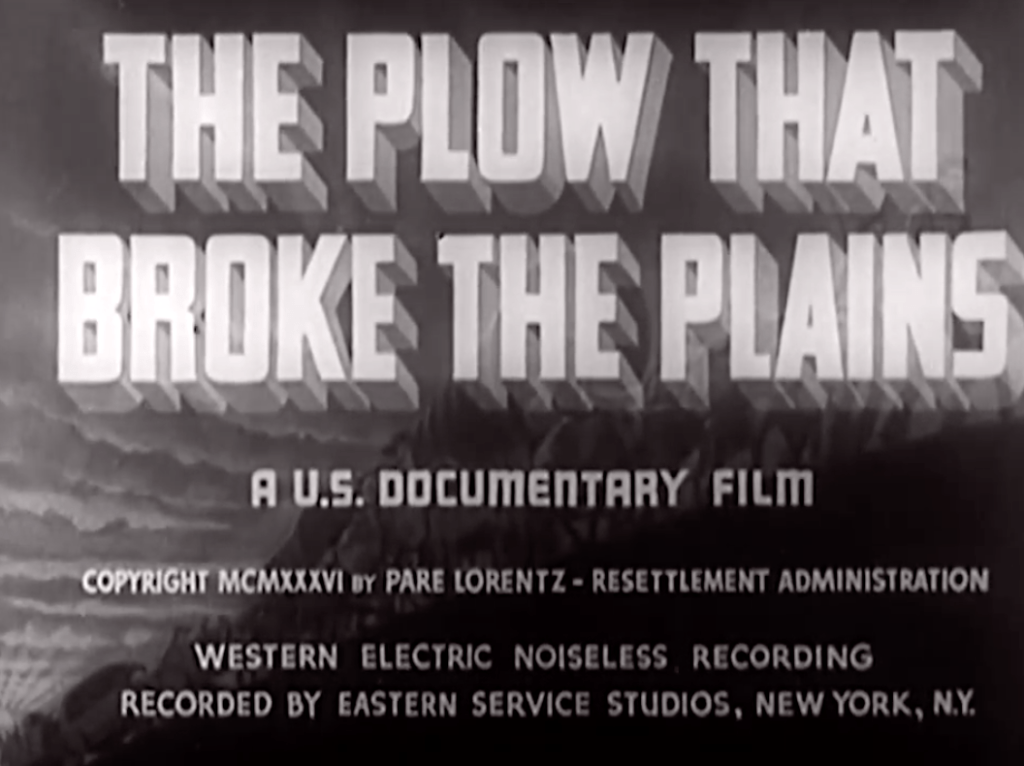
#718) The Plow That Broke the Plains (1936)
OR “Agents of Field”
Directed & Written by Pare Lorentz
Class of 1999
Today’s oversimplified history lesson: the Great Plains and the Oklahoma Dust Bowl. As always, I’m just here to talk about the movie, but I encourage further research into these expansive topics.
The Plot: “The Plow That Broke the Plains” is the story of the Great Plains; the 1.1 million square miles of flatland that stretches across 12 states in the Midwest, and how it was nearly destroyed in just a half-century. We begin in the late 1800s as settlers arrive and start developing the grassland. As those settlers continue westward, the remaining farmers start plowing the fields, despite the area’s lack of rivers and rain. The land gets a boost when World War I breaks out and there is a demand for wheat. This excessive growth continues through the 1920s but hits a breaking point with stock market crash of 1929 and the Dust Bowl and ongoing droughts of the 1930s, making the land virtually unfarmable. If only there was an off shoot of the US government that could help rehabilitate this bounteous land. Brought to you by your friends at the U.S. Resettlement Administration.
Why It Matters: Both the NFR write-up and the accompanying essay by Lorentz expert Dr. Robert J. Snyder rehash Pare Lorentz and the film’s production.
But Does It Really?: This is a situation we come across every so often on this blog: two films that cover the same ground (so to speak). Like Lorentz’s other NFR film “The River“, “Plow” is a government funded documentary short about a piece of endangered American land, narrated by Thomas Chalmers, and scored by Virgil Thompson. While they’re both equally compelling, neither is more famous or impactful than the other, which makes both being on the NFR a bit of a headscratcher. Although “The River” was made two years after “Plow”, it was added to the Registry first, and I suspect “Plow” was inducted nine years later as Lorentz’s stepping stone movie. On its own, “Plow” is an effective, dramatic look at nature’s destruction by humankind, but as an NFR entry it seems redundant. However, Lorentz is far from the only obscure filmmaker with multiple entries on the Registry, so I’ll shrug my shoulders and give “Plow” the same pass I gave its cinematic younger sibling. But if I see one more Pare Lorentz movie on this list, NFR, you and I are going to have a talk.
Everybody Gets One: Pare Lorentz started his career as a freelance writer in the 1920s, eventually being assigned as a film critic for Judge magazine even though he had no interest in films. By the 1930s, Lorentz had relocated from New York to Washington DC, and became fascinated with Franklin Roosevelt’s New Deal campaign, writing about it at length during Roosevelt’s first term as president. These writings caught the eye of Secretary of Agriculture Henry Wallace, who arranged for Lorentz to meet with Rexford Tugwell (great name) of the newly formed Resettlement Administration. Originally hired as a film consultant, Lorentz agreed to direct a short about the Dust Bowl, a topic that interested him greatly. Unfortunately, his lack of filmmaking experience caused him to lowball his budget, requesting and receiving only $6,000 (about $135,000 today) from the government, and paying with his own money for the extra costs – another $14,000 ($316,000 today).
Wow, That’s Dated: As I said in my “River” post, “this whole thing is pure New Deal propaganda”.
Other notes
- From the opening prologue: “By 1880 we had cleared the Indian, and with him, the buffalo, from the Great Plains” Yikes. You know it’s government propaganda when they gloss over Indigenous genocide and the near extinction of the buffalo in favor of their patriotic narrative.
- In the five years since covering “The River”, I forgot how much I enjoy hearing the rich, excitable tones of narrator Thomas Chalmers. Side note: In my previous research on Chalmers, I somehow missed his directing career, which includes fellow NFR short “The Sex Life of the Polyp“.
- Shoutout to this film’s cinematographers: Leo Hurwitz, Ralph Steiner, Paul Strand, and Paul Ivano. Unlike their director, each of them had previous experience in filmmaking. In fact, both Steiner and Strand have their own films on the Registry! The Great Plains are shot very stylistically throughout, with plenty of low and high horizons in the frame. Someone was listening to David Lynch as John Ford.
- Classical composer Virgil Thompson was hired to score “Plow” in part because he also had no film experience. Thompson’s score has that vibrant American sound that was coming into classical music at the time, which explains why it reminded me of something Aaron Copland would compose (Copland was a contemporary – and possibly rival – of Thompson).
- I didn’t realize World War I was such a major factor in the decline of the Great Plains. Lorentz and his team have fun showing us tractors plowing the field while Great War-era marching songs play. And then they start crosscutting with stock footage of tanks in battle just in case you couldn’t figure it out.
- The breaking point of the land development climaxes with footage of a stock ticker crashing to the ground. Get it? GET IT? Side note: Apparently none of the major Hollywood studios were willing to supply stock footage to Lorentz, so he had to use his friendships with industry insiders to get the footage he needed.
- This film would play very well before a screening of “The Grapes of Wrath“, helping give that film a proper historical context for a modern audience. According to one John Steinbeck biographer, “Plow” might have been an influence on the author while he was writing “Grapes of Wrath”. I’m a little skeptical on this one, so no “Legacy” section for you!
- Unlike other propaganda films, “Plow” isn’t so much about what you the viewer can do to help or could have done to prevent this, but more of a “isn’t your government great?” kind of film. That being said, the film does condemn those who plowed the land to begin with. Allegedly at one screening, Pare Lorentz overheard an audience member say, “They never should have plowed them plains.” Sounds like this film reached at least one person.
Legacy
- After a successful screening at the White House for President Roosevelt, “The Plow That Broke the Plains” premiered at DC’s Mayflower Hotel. Wider distribution, however, was harder to come by, as the major theater chains refused to carry the film due to its government affiliation. Pare Lorentz travelled with the film across the country, getting independent theaters to screen it and local critics to review it. This strategy created strong word of mouth and helped “Plow” get screened in over 3,000 theaters across America in 1937. The film received positive reviews from critics, and less-than-positive reviews from actual farmers and citizens of the Great Plains.
- Although Pare Lorentz had resigned from his film consultant position with the US government shortly after completing “The Plow That Broke the Plains”, Franklin Roosevelt convinced him to return and make another film, this time about the Mississippi River.
- Like many a New Deal program, the Resettlement Administration was dissolved in 1937, becoming the Farm Security Administration, which begat the Farmers Home Administration, which begat the USDA Rural Development.
- As for the Plains themselves, things finally started picking up in the 1950s thanks to concentrated efforts to better irrigate the land. While the Great Plains are nowhere near as populous as they were before the Dust Bowl, they contain plenty of usable farmland, and in more recent years have shifted their focus to wind power.
 The Horse's Head
6 thoughts on “#718) The Plow That Broke the Plains (1936)”