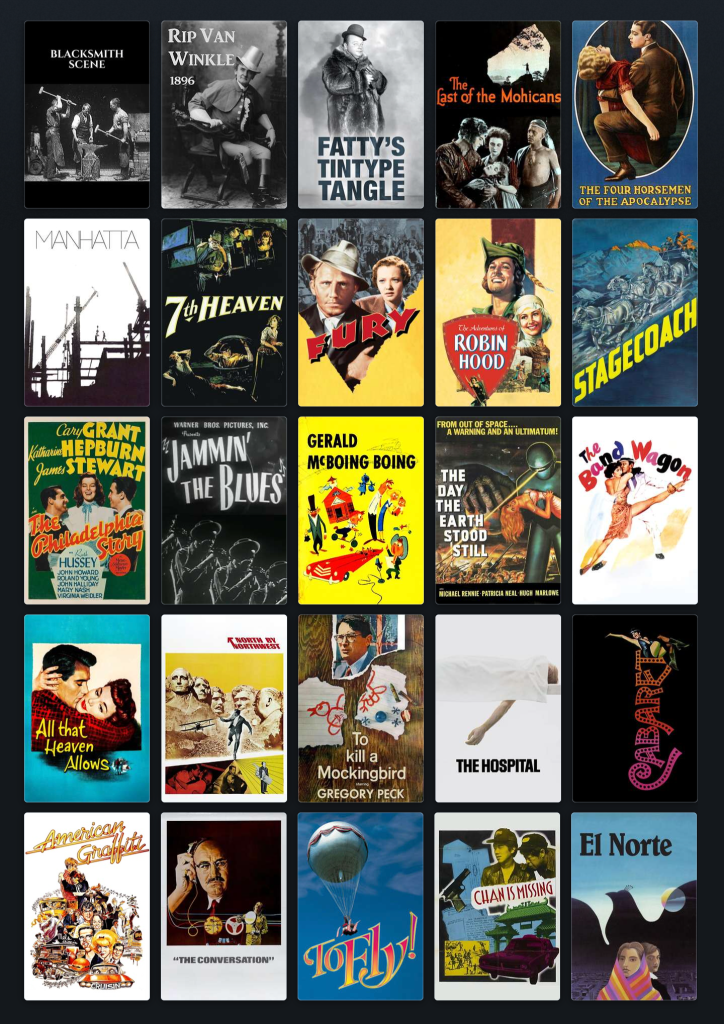
December 27th, 1995: The NFR is in 7th Heaven in their seventh year of film inductions, adding another 25 films for a new total of 175. Having finally watched all 25 films, here is my recap for the class of ’95:
- Blacksmith Scene (1893): “We can go ahead and give ‘Blacksmith Scene’ credit for motion pictures as we know them today, because why the hell not?”
- Rip Van Winkle (1896/1903): “the film that put Biograph Studios on the map”, “an entertaining (albeit not intentionally so) viewing experience.”
- Fatty’s Tintype Tangle (1915): “represents the talent of a man whose work has sadly been sidelined”
- The Last of the Mohicans (1920): “I really can’t find a compelling argument to preserve this film.”
- The Four Horsemen of the Apocalypse (1921): “a bit of drag.”
- Manhatta (1921): “encapsulates a specific time in American history”
- 7th Heaven (1927): “another ‘minor classic'”, “holds up well…but I’m not singing its praises either.”
- Fury (1936): “Not [Fritz Lang’s] best work, but…keeps getting better as it goes along.”
- The Adventures of Robin Hood (1938): “checks off all the boxes you want from a Robin Hood movie”
- Stagecoach (1939): “a quintessential western…lives up to the hype.”
- The Philadelphia Story (1940): “a must-watch for classic movie lovers”
- Jammin’ the Blues (1944): “a fun, quick entry…a more raw form of jazz”
- Gerald McBoing-Boing (1950): “a good story with inventive animation, which is really all you can ask for.”
- The Day the Earth Stood Still (1951): “the best kind of science fiction”, “a call for peace”.
- The Band Wagon (1953): “not the best Fred Astaire movie…but it is still very entertaining.”
- All That Heaven Allows (1955): “Yes, it’s a highly-stylized melodrama, but it has that Douglas Sirk touch to it that keeps it watchable.”
- North by Northwest (1959): “The movies don’t get much better than this.”
- To Kill a Mockingbird (1962): “a beautifully told, wonderfully filmed story about perspective and tolerance.”
- The Hospital (1971): “I don’t understand this movie or why it’s on the NFR.”
- Cabaret (1972): “a notch above your average movie musical, if not one of the untouchables of filmdom.”
- American Graffiti (1973): “an enjoyable coming-of-age tale that comes straight from the heart.”
- The Conversation (1974): “an exhilarating movie experience”, “those willing to seek it out will not be disappointed.”
- To Fly! (1976): “a fun, visually engaging movie, and a natural choice to represent IMAX on the NFR.”
- Chan Is Missing (1982): “continues to inspire more varied depictions of Asians throughout our popular culture.”
- El Norte (1983): “one of those movies the NFR is all about.”
Other notes
- The evolution of the National Film Registry continues as the lesser-known titles on the list start to outnumber the pre-ordained classics. Yes, there’s “North by Northwest” and “Stagecoach”, but more of these movies are either “minor classics” or films with more historical significance. This roster also contains several NFR firsts: an IMAX movie, films from the 19th century, and films by Asian American and Mexican American directors.
- Looking back on my original 25 write-ups, I have one question: What do I have against the class of 1995? I must have been in a perpetually bad mood because I don’t have a lot of positive things to say about this group; my opinion ranging from “it’s fine” to “this shouldn’t be on the list.” Perhaps when I finally complete this list, I’ll be in a better headspace to give some of these movies a second chance.
- Actual articles from 1995 about this induction are hard to come by (especially since a movie from 1995 was recently added to the NFR, complicating my search phrases). One big piece of NFR related news from around this time is that the National Film Preservation Act got reauthorized in May 1996, though only for 7 years instead of the proposed 10 years, and with a reduced budget. I assume these compromises were somehow Newt Gingrich’s fault.
- When the class of 1995 was announced, future NFR entry “Toy Story” was #1 at the US box office. Also playing in theaters at the time was “Sabrina” (the remake of another future NFR movie), and two movies that will probably make the NFR at some point: “Braveheart” and “Heat”.
- A healthy number of double-dippers this year: Actors Wallace Beery, Robert Duvall, Harrison Ford, Cary Grant, Alan Hale, and Cindy Williams; producer Joseph L. Mankiewicz, director William K. L. Dickson, and producer/director Francis Ford Coppola; cinematographers Robert Burks and Joseph Ruttenberg, composers Bernard Herrmann and Franz Waxman, art director Cedric Gibbons, and editor Frank Sullivan.
- Thematic double-dippers: Unconventional romances, third act courtroom dramas, overhead shots of New York City, biplanes/crop dusters, war as a historical backdrop, “Rock Around the Clock” during the opening scenes, mysteries set in San Francisco, and pre-fame Harrison Ford.
- Favorites of my own subtitles: Seven Years’ Bore, Carriage Story, Save the Kate, Cyd and Fancy, Did Somebody Say MacGuffin?, I’m Mad at Health and I’m Not Going to Take It Anymore!, Boomers in Cars Getting Comfy, and Forget It Wayne, It’s Chinatown.
- And finally, shoutout to the Walt Whitman photo that debuted in my “Manhatta” post and became a brief runner on the blog. What can I say, I love that photo of him. Look at that rustic Dumbledore with the come-hither stare…

Up next: The NFR class of 1996 and movie #200!
Happy Viewing,
Tony
 The Horse's Head