

#766) Koyaanisqatsi (1982)
OR
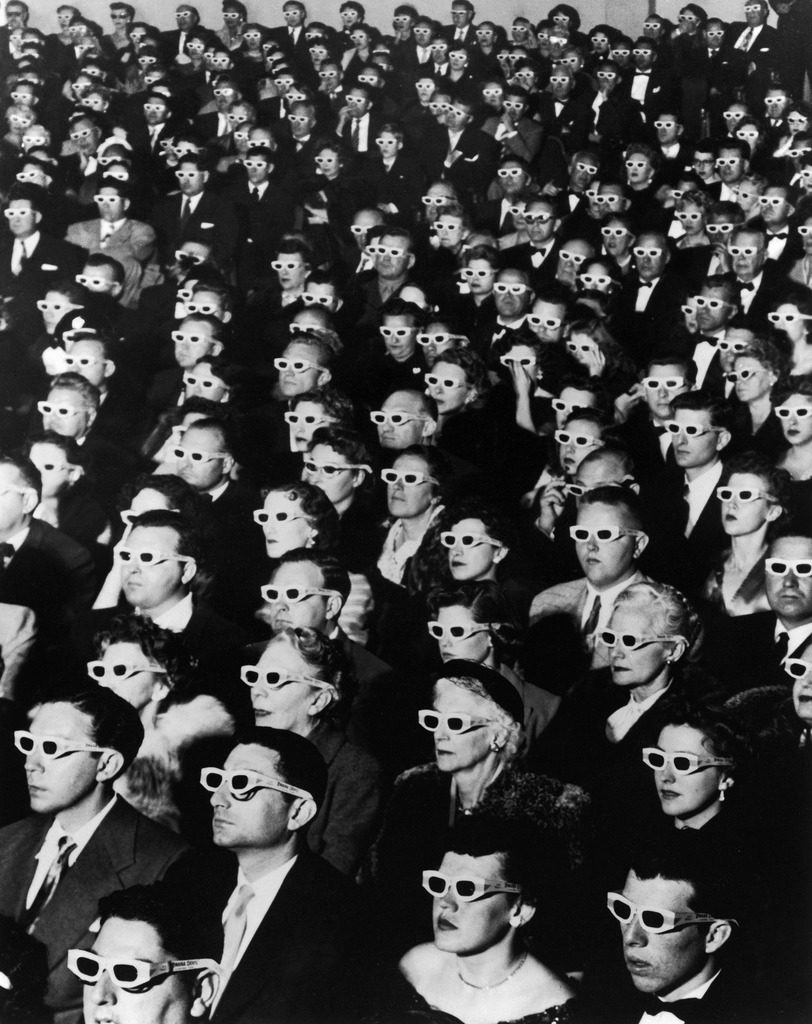
Seriously, this is the photo the director wanted to name this film instead of a word. More on this later.
Directed by Godfrey Reggio
Written by Reggio, Ron Fricke, Michael Hoenig, and Alton Walpole
Class of 2000
The Plot: The hardest thing I’ll ever have to write for this blog is a description of “Koyaanisqatsi”. The film is 86 minutes of wordless footage presented without context or narration, set to an invigorating Philip Glass score. The film begins with footage of the natural world, but quickly pivots to mankind destroying nature to create cities and skyscrapers. Through time-lapse, slow-motion, and any other camera trick you can think of, we witness humans in big American cities…existing: driving on the freeway, walking down a busy street, eating lunch, or simply looking into the camera. Director Godfrey Reggio purposefully avoids telling you what to take away from this movie, other than the translation of this film’s title: a Hopi word meaning “a crazy life”, “life in turmoil”, “life out of balance”, “life disintegrating”, and “a state of life that calls for another way of living”.
Why It Matters: The NFR calls the film “so lyrically unusual that it nearly defies description.” The write-up salutes director Reggio and composer Glass, and makes comparisons to fellow NFR entries “Manhatta” and “A Bronx Morning”.
But Does It Really?: While it took me a minute to get into “Koyaanisqatsi”, ultimately I dug it. We as humans are designed to search for patterns, and this is the ultimate pattern-finding movie. Each shot is so well composed and each visual so striking that it must mean something. My personal take was that this is a film about human destruction, of land and of ourselves. We are the life out of balance, and the film’s suggestion of our unsustainable world has only been proven more and more prescient in the last 40 years. “Koyaanisqatsi” may hit the “aesthetic significance” part of the NFR requisite harder than any other movie on the list, leaving an indelible influence on American filmmaking.
Everybody Gets One: Godfrey Reggio’s filmmaking style makes a lot more sense once you learn that he spent 14 years taking a vow of silence training with the Catholic Christian Brotherhood. After becoming disillusioned with the monks, he focused on social activism, and was inspired to try filmmaking after seeing Luis Buñuel’s “Los Olvidados” (another “yeah, that scans” moment in my research). In the ‘70s he founded the Institute for Regional Education and collaborated with the ACLU on a public interest campaign about the invasion of privacy. During this production, Reggio met with cinematographer Ron Fricke, and the two started collaborating on a film after the campaign ended. Over the course of four years (with a few stops and starts when money ran out), Reggio and Fricke filmed anything and everything across 14 different states “without regard for message or political content.”
Wow, That’s Dated: The modern city footage is a lovely slice of ‘80s corporate America, right before digital technology and home computers changed everything. And like the rest of America in the early ‘80s, “Koyaanisqatsi” has Pac-Man Fever! (Ms. Pac-Man to be specific).
Title Track: Godfrey Reggio didn’t want to give the film a title to avoid influencing anyone’s viewing experience, proposing the title be an image, specifically the J. R. Eyerman photo from Life magazine posted above. Once Reggio was told the title needed to be a word, he chose koyaanisqatsi because it “had no baggage culturally”. In perhaps the oddest title song we’ll ever get on this blog, the word koyaanisqatsi is sung throughout the movie by the Philip Glass Ensemble, with soloist Albert de Ruiter hitting those low, guttural notes. Side note: Although the Eyerman photo wasn’t used, there is a shot in the final film of an audience in a movie theater that is set up almost identically to that photo.
Seriously, Oscars?: There were a few critics organizations that gave “Koyaanisqatsi” prizes for Best Documentary or Best Score, but the film received zero recognition from the Academy. As of this writing, Philip Glass has gone 0 for 3 with his subsequent score nominations, and Godfrey Reggio has never been nominated. For the record: the 1983 Oscars gave Best Documentary Feature to Emile Ardolino’s “He Makes Me Feel Like Dancin’”.
Other notes
- The film opens with the text “Francis Ford Coppola presents”. Coppola saw an early cut of the film and offered to put his name on it as a presenter to help sell the film to distributors. I’m not quite sure the extent of Coppola’s other contributions, but apparently the cave painting bookends were his idea. The cave paintings are from Horseshoe Canyon in Utah, and I will argue they set up the destruction theme from the start (they may be beautiful, but it’s still a debasement of nature). This is followed by slow-motion footage of a rocket launch; at least I hope that’s slow-motion, otherwise that rocket is never getting off the ground.
- Philip Glass had already been composing for orchestras, operas, theater, and even a few episodes of “Sesame Street” when he composed the score for “Koyaanisqatsi”. Glass is one of those composers whose style is so distinct and original that I can only describe this score as very…Philip Glass. Serving as the film’s only soundtrack, Glass’ score threads the needle of creating an emotional impact without dictating how the audience should feel. No easy task, and the result turns an already memorable film into an unforgettable one.
- Admittedly it took me a bit to get into this film. As I watched shot after shot of canyons, dunes, bat caves, and countless other representation of the four elements, I started to wonder if I was missing something. Was I supposed to get high before watching this? Once I stopped overthinking things and met the film where it was, things started to click. I particularly enjoyed the time lapse of clouds mixed with slow motion ocean waves. I see the correlation.
- After the film’s first movement, we proceed to my destruction thesis with nature being destroyed to make way for power plants, electrical infrastructure, and other manmade ways to harness our natural resources for our own use. We also get our first sightings of people, seen here relaxing on a beach located right next to a power plant.
- Guests of “Koyaanisqatsi” fly United Airlines! You’re flying the Friendly Skies! It’s very telling when all I see is a plane on a runway near a congested freeway and I immediately think “That must be LAX”. And I was right!
- As we move into the big cities I can see the “Manhatta” comparisons with the overhead shots of New York City skyscrapers. Shout out to Hillary Harris, whose 1975 film “Organism” similarly chronicled human behavior within the confines of Lower Manhattan, and got her hired as an additional cinematographer for this film’s New York sequences.
- What is it about human nature that we enjoy watching stuff blow up? I’m trying to focus on this movie’s themes and find myself distracted by its “When Buildings Collapse” segment. There is something oddly profound about watching something get destroyed.
- Tonight on “What’s Playing on Broadway Back Now”: Christopher Reeve in the Lanford Wilson play “Fifth of July”, which puts that shot’s production somewhere in fall 1980/winter 1981.
- In a weird way, I found a lot of the big city footage as beautiful as anything from the nature opening. Part of that is the shot compositions and film processing, which gives everything this attractive green glow, but part of that is also just watching things be. Those time-lapse shots of the freeway are gorgeous to watch, with the quick stop and start of blurry headlights evocative of fireflies. It’s like a dance.
- Speaking of compositions: This is the only movie I can think of where every shot could double as the movie’s DVD main menu loop.
- I like when this movie becomes an (un)intentional social experiment. It’s fascinating how many people will opt for the revolving doors when there is a perfectly functional manual door right next to them.
- Having recently moved out of the Bay Area, I was delighted to see footage of downtown San Francisco. There’s a couple shots of people entering a BART station (side note: those automatic turnstiles were only recently updated before I left) and we even get a time lapse ride along the Embarcadero Freeway, which was damaged in the 1989 earthquake and subsequently demolished. Ah, San Francisco, you were so beautiful before the techies moved in.
- My destruction thesis continues to be supported through the end of the movie, with EMTs and firefighters navigating busy city streets, and an extended shot of a rocket launching and exploding, perhaps the “container of ashes” that will fall from the sky according to the Hopi prophecy in the end credits.
- There’s a cacophony of TV soundbites during the end credits, and while hard to decipher, I definitely heard the “Price is Right” ding-ding-ding sound effect when you correctly guess a product’s retail value. If they had thrown in the “losing horn” music cue this movie would have been flawless.
Legacy
- Following a nearly three year-long post-production, “Koyaanisqatsi” played at the Telluride and New York film festivals in late 1982. Despite several distribution offers from larger studios, Godfrey Reggio opted to work with newer company Island Alive so that he could maintain artistic input in the film’s distribution. “Koyaanisqatsi” began its theatrical run in San Francisco in April 1983, and routinely broke box office records wherever it played. The film was well received by critics, and was the highest grossing documentary of the 1980s until being surpassed at the last minute by Michael Moore’s “Roger & Me”.
- This film has two sequels! The “Qatsi” trilogy continued in 1988 with “Powaqqatsi” (roughly translated to “life in transition”) which focused on third world countries, and in 2002 with “Naqoyqatsi” (“life of war”) about the ways technology corrupts community.
- Outside of the Qatsi trilogy, Godfrey Reggio manages about one new film a decade. His most recent is 2023’s “Once Within a Time”, applying his experimental lens and global cautionary tales to the fantasy genre (though I get the feeling even that description is too limiting to the film).
- Though not his first film score, Philip Glass started to gain more recognition as a film composer thanks to “Koyaanisqatsi”. Glass would go on to score Godfrey Reggio’s subsequent films, as well as the films of Errol Morris and my personal favorite of his scores, Peter Weir’s “The Truman Show” (co-created with Burkhard Dallwitz and Wojciech Kilar).
- “Koyaanisqatsi” is one of those movies that people emulate without knowing it. Whenever you see artfully staged time-lapse footage with a minimalist yet sweeping score, odds are it can be traced back to “Koyaanisqatsi”. Perhaps the last bit of media I expected to include a “Koyaanisqatsi” reference is the trailer for “Grand Theft Auto IV”!
 The Horse's Head
4 thoughts on “#766) Koyaanisqatsi (1982)”