
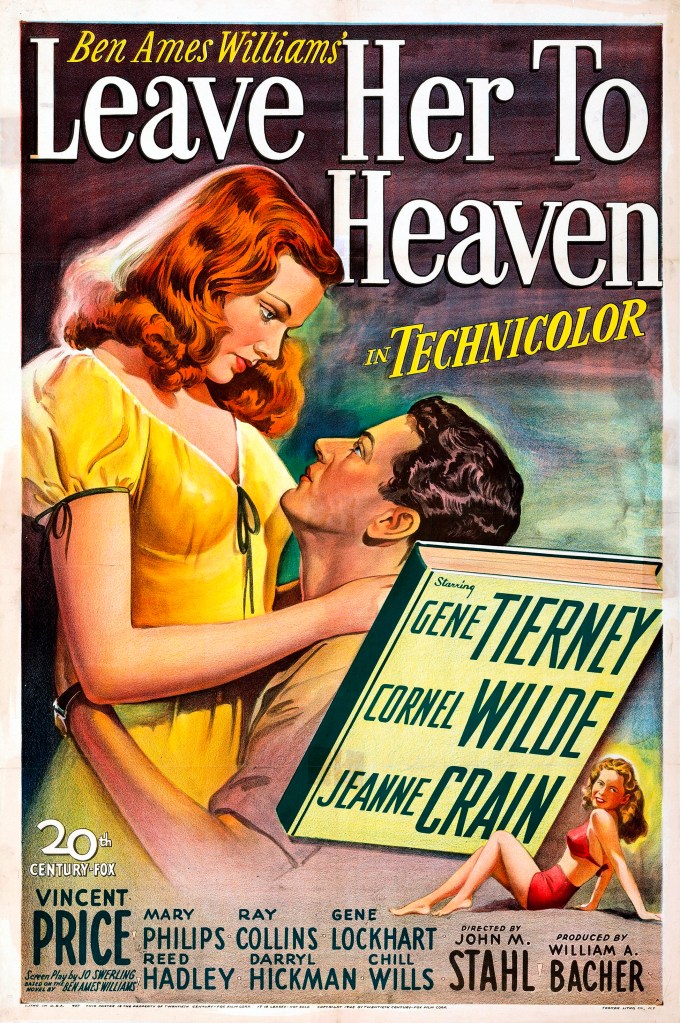
#787) Leave Her to Heaven (1945)
OR “Ellen Degenerate”
Directed by John M. Stahl
Written by Jo Swerling. Based on the novel by Ben Ames Williams.
Class of 2018
There’s not much I can say about “Leave Her to Heaven” without spoiling some of the film’s key moments. Consider yourself warned.
The Plot: Novelist Richard Harland (Cornel Wilde) meets socialite Ellen Berent (Gene Tierney) on a train in New Mexico, and a brief flirtation begins. It turns out they are both staying with the same mutual friend, attorney Glen Robie (Ray Collins), which gives Richard a chance to meet Ellen’s family, including her adopted sister Ruth (Jeanne Crain). After a few days together, Ellen announces that she is marrying Richard, a surprise to everyone, including Richard, but especially to Ellen’s now ex-fiancé Russell Quinton (Vincent Price). Ellen and Richard’s marriage quickly takes a turn for the worse, with Ellen becoming increasingly possessive of Richard, and jealous of the time he spends with his kid brother Danny (Darryl Hickman) and her sister. And if you think you know where this dark psychological drama is going, no you don’t.
Why It Matters: The NFR praises the film for being “the magnificent exception” to the rules of film noir. The work of Tierney and cinematographer Leon Shamroy is celebrated as well.
But Does It Really?: I saw “Leave Her to Heaven” for the first time about 15 years ago, and it has stayed with me as one of the great underrated Classic Hollywood movies of the ‘40s. “Leave Her to Heaven” stands out because it seems to break all the rules of classic filmmaking. It has all the hallmarks of film noir, but it’s in color and in broad daylight. It stars one of the most glamorous movie stars of the era, yet her character is unredeemable with complex, unspoken motivations. “Leave Her to Heaven” continues to shock and surprise 80 years later, and is definitely worth a watch, to say nothing of its deserving spot on the Registry.
Everybody Gets One: Cornel Wilde started his career as a professional fencer, but when Laurence Olivier hired him as a fencing instructor for his Broadway production of “Romeo and Juliet”, Olivier cast Wilde as Tybalt, and the performance got him film offers in Hollywood. The same year Wilde starred in “Heaven”, he was loaned out to Columbia to play Frédéric Chopin in “A Song to Remember”, which earned him an Oscar nomination. “Heaven” is also the sole credited NFR appearance for fellow Fox contract player Jeannie Crain (she appears in the chorus of “The Gang’s All Here”). After “Heaven”, Crain received an Oscar nomination for Elia Kazan’s “Pinky” for playing…a light-skinned Black woman!? Oh no…
Title Track: Ooh! Ooh! I know this one! It’s from “Hamlet”. Act I, Scene V, the Ghost of Hamlet’s father telling Hamlet not to blame his mother for his murder. “Leave her to heaven, and to those thorns that in her bosom lodge to prick and sting her.” Finally, my theater degree’s paying off!
Seriously, Oscars?: One of the biggest hits of 1945, “Leave Her to Heaven” received four Oscar nominations, winning one for Leon Shamroy’s cinematography. Gene Tierney received the only Oscar nomination of her career, losing Best Actress to Joan Crawford for “Mildred Pierce”.
Other notes
- We need to talk about this film’s Technicolor. Film was still primarily a black-and-white medium in the 1940s, and expensive color film stock was reserved for big budget genres like musicals and epics. While I don’t know the budget for “Leave Her to Heaven”, Fox purchased the film rights to the novel for $100,000 (about 2 million dollars today) before it was even published. This is a huge vote of confidence in the material, so it wouldn’t surprise me if that extended into the film’s budget, and therefore Technicolor. I’ve spent a good deal of this blog talking about how many black-and-white NFR films would have been ruined if they were filmed in color, but “Leave Her to Heaven” is an exception. The color makes the drama even more disturbing: psychologically complex characters don’t just exist in the dark shadows of film noir, they can live in a world that looks just like ours.
- As far as I can tell, the movie is pretty faithful to the book. Weirdly enough, despite the fame and availability of the movie, the novel “Leave Her to Heaven” has been out of print for years.
- California’s Bass Lake near Yosemite doubles for this movie’s Deer Lake, Maine. Here, Glen Robie recounts the events of the film via flashback, making Deer Lake one of filmdom’s most scenic framing devices.
- Cornel Wilde and Gene Tierney have some wonderful chemistry together, especially in their first scene on the train. Tierney in particular threads her character’s needle very well. You know something is different with Ellen, but it’s intriguing, mysterious; it makes you want to learn more about her. You can’t fault Richard at this point for wanting to spend more time with her.
- My only other experience with Gene Tierney is in her fellow NFR film “Laura”. Both play to her strengths as enigmatic objects of desire, but Ellen is hands down the more interesting character, and Tierney is clearly relishing the role of a lifetime. Prior to my post-viewing research, I assumed Tierney’s career after the 1940s declined as a result of retirement or being overlooked in favor of younger starlets. Turns out neither is true; sadly Tierney’s career started to wane in the 1950s due to a number of personal issues we won’t get into here. Although she stayed out of the limelight during these rough patches, Tierney still got plenty of film and TV offers, and would occasionally return to the screen when she was in better health.
- Boy this movie sure takes its time getting started. You can tell it’s based on a book; a lot of character development and little episodes before we finally get to the meat of things.
- I’m still not used to seeing young Vincent Price in movies. Price was 34 when making “Heaven”, and is not sporting his trademark mustache, which makes him look even younger. As much as his later work in horror movies seeps into his film persona, given how intense Ellen has been acting I’m actually scared for Vincent.
- Danny is getting his polio treatment in Warm Springs, Georgia. Say hi to FDR while you’re there!
- Despite being a full-fledged adult, I regress into my 12-year-old self anytime a character in a movie is named Dick, especially when other characters say things like “Has Dick been busy lately?” and “Can we show Dick tomorrow?” Stop that, you’re making me giggle!
- It always amuses me in classic movies when the leading lady goes to bed in full hair and makeup while wearing a skintight nightgown. Also, watching Richard and Ellen sleep in separate beds in this movie made me realize that sales for nightstands must have doubled once married couples started sharing beds.
- My god Ellen’s psychotic. And she’s not being shy about it, I feel like she’s throwing plenty of red flags for everyone to notice. It’s like a gender-swapped “Gaslight”.
- I knew the scene where Ellen takes Danny out swimming in the lake was coming, but damn if it didn’t take my breath away again this time. Ellen is so cold the whole time, patiently waiting for Danny to stop fighting the water and drown. It’s chilling. Also I appreciate the sequence’s lack of a score, it really ramps up the suspense. Take a breather, Alfred Newman. You’ve earned it.
- As I said before, you can’t fault Richard for being drawn to Ellen in the first place, or even for being in denial when her psychosis becomes more obvious. What I can fault Richard for is not dedicating his book to his wife. Rookie mistake, man.
- I really don’t want to spoil the next big evil turn Ellen takes, so I’m just going to say the word “stairs” and if you know you know. I just kept saying “oh my god” over and over again while watching that scene.
- My main question for this movie is “How did the Hays Code permit any of this?” The Code had its qualms with the story, with major notes given to the aforementioned stair scene. Their other major request was to downplay the affair between Richard and Ruth, which actually improves the movie; we never know for sure if there was an affair or if it’s just Ellen’s paranoia. But what I really want to know is how did the Code approve of Ellen committing suicide? We know from “Double Indemnity” that the Hays Code didn’t consider suicide a justifiable form of punishment for the bad guy, so how did they get away with it here? Is it because Ellen confessed to the murders beforehand? I can definitely see “Leave Her to Heaven” being an early crack in the Production Code armor.
- Before she succumbs to her own poison, Ellen has one hell of a deathbed scene. Tierney plays it a little too over the top; maybe the melodrama of it played okay in 1945, but I imagine this scene gets a few unintentional chuckles at modern screenings.
- Ellen’s final act of evil is framing Ruth for her suicide, turning the film’s last half hour into a courtroom drama with Vincent Price’ Quinton – now the county district attorney – grandstanding at the chance to grill his ex-girlfriend’s sister and husband. Price is clearly having a ball, but can Quinton serve as D.A. in a case pertaining to his ex-girlfriend’s death? Isn’t that a huge conflict of interest? Speaking of attorneys, Glen Robie sucks. Now I’m not one of your fancy city lawyers, but shouldn’t he be shouting “Objection” any time Quinton starts asking leading or prejudicial questions to Ruth and Richard? Shouldn’t he call a doctor to the stand to question Ellen’s mental state? And remember, Robie’s narrating the movie, so this is all his version of the story. “Yes, Quinton kept hounding my clients with question after question. And what did I do, you ask? Jack squat.”
- What a weird ending. Everything gets summed up very quickly by Robie, and we get one final shot of Richard and Ruth at the lake house. I’m not sure how much of this ending is true to the book, but after everything I’ve been through in the last two hours I was left thinking “Wait, that’s it?”
Legacy
- Released on Christmas Day 1945, “Leave Her to Heaven” went on to be one of the biggest box office hits of the year (second only to “The Bells of St. Mary’s”), and 20th Century Fox’s biggest hit of the decade.
- “Leave Her to Heaven” got the TV remake treatment with 1988’s “Too Good to Be True”, starring Loni Anderson, Patrick Duffy, and the Harrises: Julie and Neil Patrick. “Too Good” was directed by Christian Nyby II, whose father may or may not have directed “The Thing From Another World”.
- While “Leave Her to Heaven” isn’t as well remembered as other noir thrillers of the era, it is not without its devoted fans. Among them, Martin Scorsese, which is all the reasoning I need to explain how this movie got on the NFR.
 The Horse's Head
3 thoughts on “#787) Leave Her to Heaven (1945)”