#788) Common Threads: Stories from the Quilt (1989)
Directed by Rob Epstein & Jeffrey Friedman
Written by Epstein, Friedman, & Cindy Ruskin
Class of 2024
Another topic I am woefully unqualified to discuss at length: the American AIDS epidemic of the 1980s. While “Common Threads” provides an excellent overview, this post can only cover so much of it, and I encourage you to do further research.
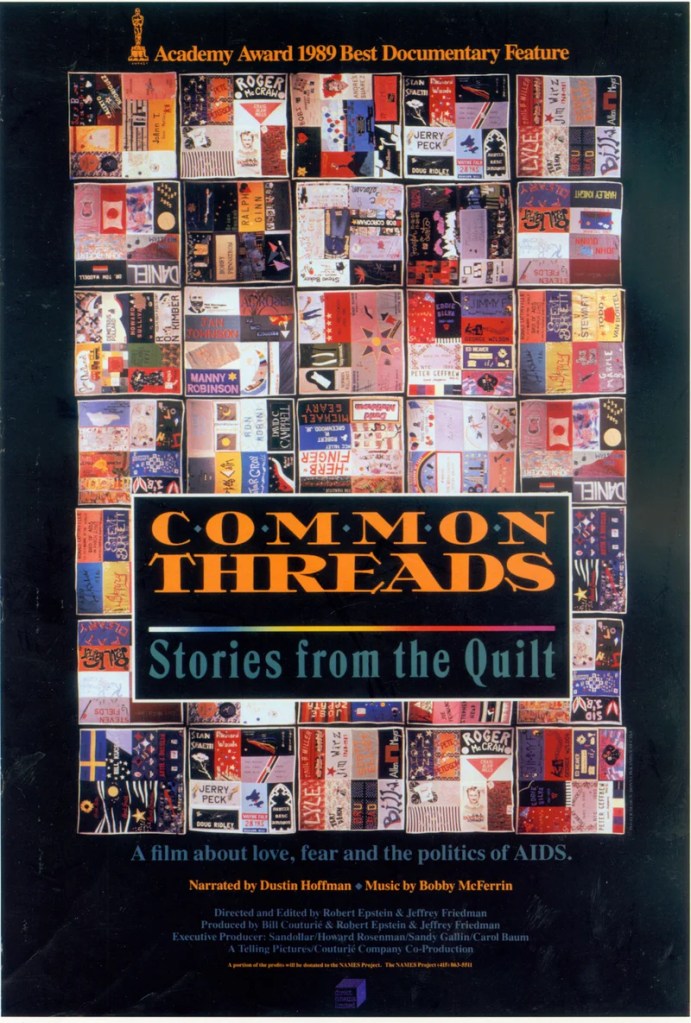
The Plot: In the early 1980s, a large number of Americans started being diagnosed with the human immunodeficiency virus (HIV), leading to acquired immunodeficiency syndrome (AIDS). Because a majority of these cases involved gay men, most of America (including the US government) turned a blind eye to this growing epidemic, and by 1985 over 13,000 Americans had died from AIDS. That same year, the National AIDS Memorial began the NAMES Project AIDS Memorial Quilt, with handmade panels honoring those who had died from the virus, creating the largest communal art project in the world. “Common Threads” tells the story of five people whose names are memorialized on the Quilt, as told by their surviving family, friends, and partners, some of whom were also dying of AIDS at the time of filming.
Why It Matters: The NFR praises the film for being both “a heart-breaking record” of the AIDS crisis and “an extraordinary monument” to the activism it spawned. The write-up also includes a link to the Library of Congress page about the AIDS Memorial Quilt.
But Does It Really?: Watching “Common Threads” was easily one of the most emotional experiences I’ve had for this blog. Although I was alive for the AIDS crisis, I didn’t really become aware of it until after its peak in the mid-90s, and this film compellingly showed me the immediacy of AIDS in the ‘80s. I was deeply moved by this film’s tribute to not only those who died from AIDS, but to their communities that stepped up to fight it. “Common Threads” captures an important moment in American history with love and strength, honoring those affected by the virus without becoming manipulative or insincere. I’m glad the film has finally joined the NFR ranks, and I can’t recommend it enough.
Everybody Gets One: While this is one of three NFR entries for director Rob Epstein, this is the only NFR entry directed by his longtime collaborator Jeffrey Friedman. Originally an actor in his native New York, Jeffrey Friedman pivoted to editing in the 1970s, working in the editorial department for such films as “Raging Bull”. Friedman was inspired to become a documentarian after seeing “Word Is Out” (another NFR entry), and moved to San Francisco, where he met Rob Epstein at a party. “Common Threads” was Friedman’s second directing credit after 1987’s “Faces of the Enemy”, and his first with Epstein.
Wow, That’s Dated: The only giveaway is the original score by Bobby McFerrin. Anyone who was alive when “Don’t Worry, Be Happy” hit the airwaves will instantly clock McFerrin’s unique a cappella sound (accompanied here by his ten-person Voicestra). Understandably, McFerrin’s work here is much more subdued than his famous hit song, and always respectful and reverent to the topic.
Seriously, Oscars?: At the 1990 Academy Awards, “Common Threads” won the Oscar for Best Documentary Feature. Due to eligibility rules, only the producers (Rob Epstein and Bill Couturié) received the award, although Jeffrey Friedman did go on stage and accept with the producing team. Friedman’s first and so far only Oscar nomination came in 2019 for the documentary short “End Game”. Side note: The Red Ribbon for AIDS awareness, synonymous with award ceremonies throughout the 1990s, wouldn’t make its first appearance until the 1991 Tony Awards thanks to the efforts of Broadway Cares/Equity Fights AIDS.
Other notes
- The NAMES Project AIDS Memorial Quilt was conceived by Cleve Jones, co-founder of the San Francisco AIDS Foundation and friend/former intern of Harvey Milk. During a 1985 candlelight march commemorating the anniversary of Milk’s assassination, the names of people who had died of AIDS were written on signs taped to the walls of the San Francisco Federal Building. The display reminded Jones of a patchwork quilt, and the rest is history. As seen in this film, the Quilt was unveiled at the National Mall in Washington D.C. on October 11th, 1987 with 1,920 panels. Among those who saw the Quilt was Kathy Couturié, who suggested to her husband Bill that it would make a good subject for his next documentary. Epstein and Friedman also saw the Quilt in D.C. and were inspired to make a documentary, and it was while meeting with Cleve Jones about the project that they partnered with Bill Couturié and HBO to make “Common Threads”.
- Shoutout to co-writer Cindy Ruskin, whose book “The Quilt: Stories from the NAMES Project” helped Epstein and Friedman in their research.
- If you had asked me to guess who narrates a documentary about the AIDS Quilt, I would not have guessed Dustin Hoffman. The filmmakers wanted someone “unassailably straight” to narrate the film to make it accessible for straight viewers. When James Stewart turned the project down, Dustin Hoffman, fresh off his second Oscar win for “Rain Man”, agreed to provide narration in exchange for, and this is true, bananas to maintain energy during the recording session. Hoffman’s work here is brief, but it does the job.
- Epstein and Friedman considered over 200 people memorialized on the Quilt before narrowing it down to the five in the final film, each with an accompanying “storyteller” interviewed by the filmmakers. In order of appearance, they are: Dr. Tom Waddell, physician and founder of the Gay Games (Storyteller: His widow Sara Lewinstein), David Mandell Jr., a 12-year-old hemophiliac (Storytellers: His parents David Sr. and Suzi), Robert Perryman, a former drug addict and the only African-American of the five (Storyteller: His widow Sallie), Jeffrey Sevcik, an openly gay activist (Storyteller: Vito Russo. More about him later), and David C. Campbell, a landscape architect (Storyteller: His partner Tracy Torrey, who sadly died of AIDS before the film was released).
- This being a film blog and all, I must give a special mention to Vito Russo, Jeffrey Sevcik’s partner who was fighting AIDS himself while being interviewed. Russo was a film critic, historian, and author of “The Celluloid Closet” which would be turned into a documentary by…Rob Epstein and Jeffrey Friedman! Unsurprisingly, Russo peppers in a few film references throughout his interview, including “Two for the Road”, “The Member of the Wedding”, and “I Want to Live!”. Vito Russo died from AIDS a little over a year after “Common Threads” was released, and would go on to be the subject of his own documentary in 2011.
- Among those making appearances in the film through archival footage are such ‘80s newscasters as Tom Brokaw, Bryant Gumbel, and Jane Pauley. We also get a brief appearance from Larry Kramer, the activist and playwright who gave us “The Normal Heart”. On a less enthusiastic note, Eddie Murphy makes an appearance thanks to his widely criticized, very homophobic stand-up routine about AIDS (which also shows up in another NFR entry: “Tongues Untied”).
- I’ve been mostly academic in this post because I’ve been trying to avoid discussing how emotional I got while watching this movie. The stories of these five unfolded in such an authentic way (told with obvious love from their storytellers) that I felt as if I knew them, making their diagnoses and deaths all the more real to me. My sadness was mixed with the anger I felt as the government continued to ignore the AIDS epidemic, as well as the miseducation and lies coming from those who dismissed AIDS as a “gay plague”. Despite all of this, I had a few moments of cathartic laughter in my viewing (whether or not the filmmakers intended them). The biggest laugh came from Vito talking about how Jeffrey coped with his AIDS diagnosis by filling his apartment with anything blue: “Blue is a healing color. Figure that out, alright?” My second big cathartic laugh came near the end of the film: Sara Lewinstein’s account of Tom Waddell’s “I let you win.”
- As the film progressed and the five subjects began accepting their inevitable deaths from AIDS, I could feel my tears welling up inside me. But you know what finally made me start crying? ALF. Yes, that ALF: the puppet alien from the ‘80s TV show. Turns out “ALF” was one of David Jr.’s favorite shows, and before he died, ALF (as performed by Paul Fusco) talked to him via a TV satellite hookup. Hearing ALF speaking sincerely to David and telling him to stay positive destroyed me. I’m tearing up again just typing this. From that point on in my viewing, I was a mess as I mourned all of these lost souls.
- Interestingly enough, the NFR movie I thought of while watching this was the Saul Bass short “Why Man Creates”. If you read my post you may remember that Bass’ final summation was essentially “creativity is a subconscious attempt at immortality.” The AIDS Quilt is a more conscious form of that: these aren’t just names on a quilt, they were real people, they existed, and they will not be forgotten.
- Keep a look out in the Special Thanks section of the credits for such big names as Danny Glover, Whoopi Goldberg, and Elizabeth Taylor, the latter who was one of the biggest champions for AIDS research and treatment during the ‘80s and ‘90s, and hosted a screening of this film at New York’s MOMA upon its release.
Legacy
- “Common Threads” played an Oscar-qualifying run in L.A. in October 1989 before airing on HBO shortly thereafter. The film was a critical success, earning an Oscar as well as a Peabody.
- Rob Epstein and Jeffrey Friedman continue to collaborate on films to this day; their most recent is a 2023 film about performance artist Taylor Mac.
- Sadly, the number of AIDS-related deaths in the United States continued to climb after the release of “Common Threads”. These numbers would not begin to decrease until the late 1990s with the establishment of the National AIDS Strategy and the uptick in high active antiretroviral therapy (HAART). As of this writing, over 700,000 Americans have died of HIV/AIDS since the 1970s, with 13,000 AIDS related deaths every year. There is so much more to discuss beyond the scope of this blog, and the SF AIDS Foundation is a good place to start.
- Since its unveiling in 1987, the NAMES Project AIDS Memorial Quilt has toured across the country, and as of this writing resides in San Francisco. The Quilt now has over 50,000 panels, which have been digitized and can be viewed online at the AIDS Memorial website.
 The Horse's Head
One thought on “#788) Common Threads: Stories from the Quilt (1989)”