
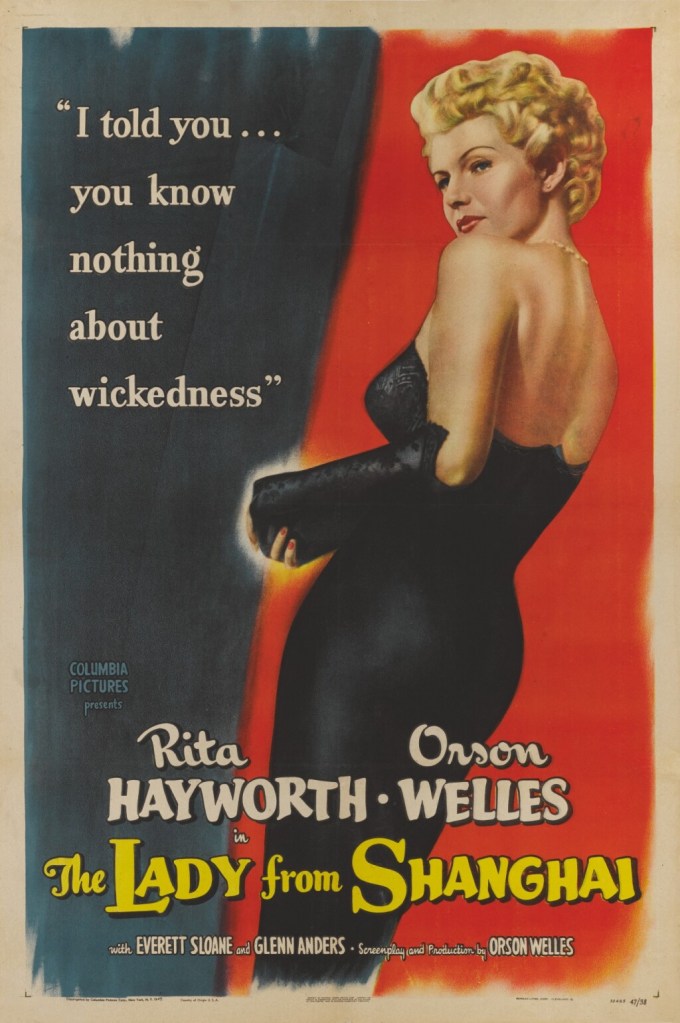
#813) The Lady from Shanghai (1947)
OR “Orson Goes for Brogue”
Directed & Written by Orson Welles. Based on the novel “If I Die Before I Wake” by Raymond Sherwood King.
Class of 2018
The Plot: While in New York, sailor Michael O’Hara (Orson Welles) meets and falls for Elsa Bannister (Rita Hayworth), who has just returned to New York from Shanghai. Michael soon learns that Elsa is married to famous criminal defense attorney Arthur Bannister (Everett Sloane), who offers Michael a job on his yacht. As things become complicated between Michael and Elsa, Michael meets Arthur’s business partner George Grisby (Glenn Anders) who, knowing of Michael’s criminal past, offers him $5000 to confess to murdering Grisby so that Grisby can fake his own death and disappear. That’s all I’ll reveal for now, not because I’m worried about spoilers, but rather because the plot becomes so confusing at this point that I genuinely couldn’t explain it to you even if I tried. It ends in a hall of mirrors, that much I can confidently tell you.
Why It Matters: The NFR states the film “is renowned for its stunning set pieces…baroque cinematography and convoluted plot.”
But Does It Really?: As much as I’ve enjoyed watching and studying Welles’ other NFR films, “Lady from Shanghai” threw me for a loop. Welles’ movies are off the beaten path; you either lean into their chaos or let them drive you mad. I could go along with “Citizen Kane” (and to an extent “Magnificent Ambersons” and “Touch of Evil”), but “Shanghai” is a whole other animal. Part of that is its film noir crypticness, and muddling of its source material, some of that is (say it with me) studio meddling of Welles’ original film. Still, it has the hall of mirrors scene, which has become so much of a trope it’s incredible to realize it came from a single movie. “The Lady from Shanghai” is iconic enough that its NFR induction is understandable, but man alive is it weird.
Wow, That’s Dated: Grisby’s entire plan hinges on corpus delicti; Michael can’t be convicted of murdering Grisby if the police can’t find his body. While still a rarity, advancements in forensic science have since made it possible to convict someone of murder using circumstantial evidence.
Title Track: The film at one point shared a working title with its source novel: “If I Die Before I Wake”. Other titles considered included “Black Irish” and “Take This Woman” before the final, more mysterious “The Lady from Shanghai”.
Other notes
- Following his firing from RKO in 1942, Orson Welles primarily returned to radio and the stage, though he did direct the 1946 film “The Stranger”. While directing the Broadway musical “Around the World” (an elaborate adaptation of “Around the World in Eighty Days”), financing fell through. Desperate for money, Welles contacted Harry Cohn at Columbia (where Welles’ then-wife Rita Hayworth was under contract) and offered to write, direct, and star in a movie for Cohn in exchange for helping finance “Around the World”. Although Cohn lent Welles the money, the show closed after only 21/2 months. Welles claims he picked “If I Die Before I Wake” to adapt at random, though producer William Castle claims he was had already purchased the film rights to the book and convinced Welles to make it (I’m inclined to believe Castle’s version; Welles loved to embellish his accomplishments and leave other people out).
- Welles originally wanted either Barbara Laage or Ida Lupino to play Elsa, but Harry Cohn insisted on Rita Hayworth, which bumped up Welles’ proposed “B picture” to a much more expensive A picture for Columbia. Welles and Hayworth had been married for about three years during production, though at this point they were separated, with Hayworth only agreeing to play Elsa so that their daughter Rebecca would benefit from their royalties for the film. Welles and Hayworth’s divorce was finalized shortly after production wrapped on “Lady from Shanghai”, though they remained friends afterwards.
- The first thing to throw me off about this movie is Orson Welles’ attempt at an Irish accent. It’s not the worst Irish accent in film history, but it starts off strong and wanes as the film progresses. You don’t expect a singular screen personality like Welles to try a character affectation like an accent.
- In my research for this post, everything specifically about Rita Hayworth’s performance centered around her hair, famously cut short and bleached blonde for this film. And who says no one took her seriously? I think she does the best she can with a very constricted part. Like many a “dame” in film noir, Hayworth’s Elsa has to play everything close to the chest, not allowing her much to do outside subtle glancing. She gets better as the film progresses, but you hate to see a good actor get upstaged by her own hair.
- Bannister’s yacht was “played” by Zaca, owned at the time by actor Errol Flynn. As per his contract, Flynn was always present during the Zaca shoots, skippering the boat between takes. Also blink and you’ll miss Flynn in the background of the Acapulco cantina scene. As of this writing, Zaca is still active, though given the amount of refurbishment it takes to keep a nearly 100 year old ship going we may have a Ship of Theseus situation on our hands.
- When Elsa goes swimming of the Acapulco coast, she returns to the boat with immediately dry hair, which then becomes wet in her next close-up and then dry again in the next shot. What is in that water?
- And then Grisby arrives and things take a turn for the weird(er). Part of that is Glenn Anders’ unrestrained performance (Anders was a stage actor and “Lady from Shanghai” was a rare film performance), and part of that is the juxtaposition from Welles’ original vision for the film and Columbia’s mandated reshoots. Side note: the $5000 Grisby offers Michael would be over $75,000 in today’s money.
- And then Bannister and his crew make port in Saulsalito and the film becomes a nice travelogue of late ‘40s San Francisco. The first notable filming location is Michael and Elsa’s secret rendezvous at the Steinhart Aquarium at the California Academy of Sciences. The aquarium has changed quite a bit in the last 80 years, but seeing it here was a pleasant surprise (even if they use optical trickery to make the fish look bigger).
- [Spoilers] This movie gets real confusing real quick once Michael tries to pull off the murder plot. Without revealing too much, I’m no expert on this sort of thing, but when you’re trying to kill someone to stop them from talking, you gotta make sure they’re actually dead! Come on people, is this your first film noir?
- The film’s third act becomes a real circus with several plot revelations colliding into each other (including a few that only make sense if you’ve read the book). First we get an extended courtroom drama as Arthur tries to defend Michael, with lots of overdubbed expository dialogue (I’m guessing in an attempt to clear up the plot. Didn’t help). This is followed by a chase through Chinatown, and finally the film’s legendary showdown inside a hall of mirrors. It’s easily the most visually engaging sequence in the whole movie, seemingly the only time Welles’ vision made it onto the big screen (although Columbia cut it down from its initial 20 minutes to under 5). Speaking of the finale, pour one out for Playland, the gone but not forgotten amusement park that once resided next to Ocean Beach.
Legacy
- Production wrapped on “The Lady from Shanghai” in February 1947, but Harry Cohn hated what he saw and ordered a month of reshoots (which caused the film to go over-budget). Following these reshoots, over an hour of Welles’ footage was cut from the film. Although “The Lady from Shanghai” premiered in France in December 1947, the film’s U.S. release was postponed until April 1948, when it was savaged by critics who found the whole thing a confusing mess. As with so many NFR titles unsuccessful in America, the film fared better in Europe, and has since gotten a reappraisal and is considered a classic.
- Following the disappointing performance of “Lady from Shanghai”, Orson Welles headed off to Europe, starring in “The Third Man” and directing “Othello” and “Mr. Arkadin”. Welles would return to America in the mid-50s and made one more movie for a major Hollywood studio: “Touch of Evil” at Universal.
- But the film’s most enduring legacy is its Hall of Mirrors finale. Many a film and TV show has featured a climactic shootout in a hall of mirrors, including another NFR entry: “Enter the Dragon”.


6 thoughts on “#813) The Lady from Shanghai (1947)”