
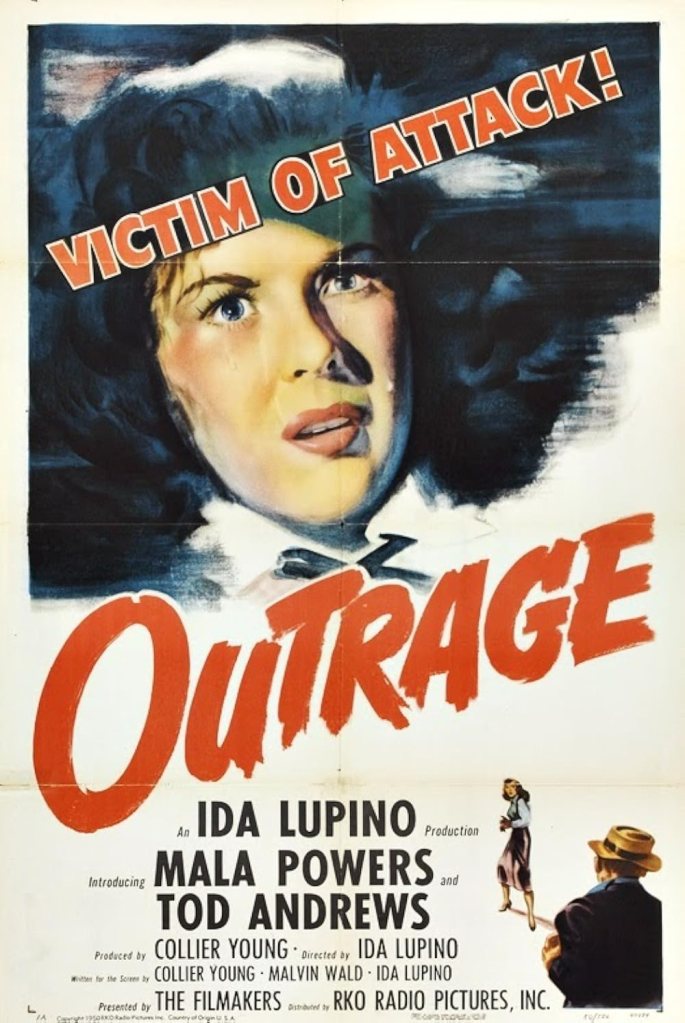
#818) Outrage (1950)
Directed by Ida Lupino
Written by Lupino, Malvin Wald & Collier Young
Class of 2020
The Plot: Ann Walton (Mala Powers) lives a perfectly normal life in Capital City with her parents (Raymond Bond and Lilian Hamilton) and her boyfriend Jim (Robert Clarke), made even better once Jim receives a raise and has enough money to marry Ann. One night on her way home from work, Ann is followed by a man who works at a nearby concession stand (Albert Mellen). Ann tries to escape him, but eventually the man catches up and rapes her. Although her family is sympathetic to her situation, and the police are eager to find her rapist, Ann is traumatized by the event and runs away to Los Angeles. On her way there, she ends up at an orange farm, forming a close bond with Rev. Bruce Ferguson (Tod Andrews), but the memory of her past life is never too far behind. “Outrage” is a daring look and a heretofore unmentionable film topic, directed by the rare female director of the era.
Why It Matters: The NFR write-up is primarily a love letter to Ida Lupino and her work as “Hollywood’s only woman director of the period”.
But Does It Really?: “Outrage” is another one of those films the NFR is all about, the little unappreciated gems that stand on their own unique piece of ground. Watching a film discuss rape from 1950 is quite a surprising viewing experience, and while the results are a little melodramatic, it’s still groundbreaking nonetheless. In only her third feature, Ida Lupino confidently directs the proceedings with a visual flair and a lot of sympathy for her leading lady. “Outrage” isn’t the most incredible film of its time, but it holds up well enough over 75 years later, and its sensitive handling of the main topic certainly makes it stand out among its contemporaries. A yes for NFR inclusion for “Outrage” and for getting a second Ida Lupino film on the list.
Title Track: According to the American Film Institute, “Outrage” went by the working titles “Nice Girl” and “Nobody’s Safe”.
Seriously, Oscars?: No Oscar nominations for “Outrage”. In fact, no Oscar nominations for any of Ida Lupino’s films. Ms. Lupino’s awards record consists of three Primetime Emmy nominations, two stars on the Hollywood Walk of Fame, and several critics awards, all for her acting.
Other notes
- I covered this all the way back in my post for “The Hitch-Hiker”, but to recap: Ida Lupino had been acting in Hollywood for more than 15 years when she decided she wanted to direct, founding The Filmmakers Inc. with her then-husband Collier Young, with a mission to make films dealing with modern social issues. Lupino initially co-wrote and co-produced “Not Wanted” (about unwed pregnancy), but she took over as an uncredited director when original director Elmer Clifton had a heart attack. Her first credited film as a director was 1949’s “Never Fear”, based on her own experience battling polio as a teenager, followed by “Outrage” in 1950. “Outrage” was only the second mainstream film to tackle the delicate subject of rape, following 1948’s “Johnny Belinda”, a film coincidentally produced by Jerry Wald, brother of “Outrage” co-producer and co-writer Malvin Wald.
- As you can imagine, the topic of rape and assault was a difficult one to get past the Hays Code, and the screenplay of “Outrage” was initially rejected by the Production Code offices. A revised draft was finally accepted in February 1950, mere weeks before filming began, following the elimination of the words “rape” and “rapist”, as well as any references to the rapist’s “sexual nature”.
- I was very tough on Mala Powers when she last appeared in this blog as Roxanne in “Cyrano de Bergerac”, but I liked her a lot more in “Outrage”. Maybe her acting style was too contemporary for Roxanne?
- A pretty big installment of “We Suck at Inflation”: Jim’s making $90 a week (about $1250 in today’s money) and that’s enough for Annie to quit her job and marry him? God, we suck at inflation.
- If nothing else, they get the rape scene out of the way early. Fortunately, you don’t see the actual assault, but you do spend a long, very tense time with Ann as she tries to evade her rapist. It’s all wonderfully orchestrated by Lupino for maximum effect, lots of shadows, quick editing, and an almost entirely silent soundtrack. Side note: The Rapist is played by Albert Mellen in his first and only film appearance.
- Unsurprisingly, any conversation about rape in this film is a trip to Euphemism City; she was “brutally attacked” in “a criminal assault”, etc.
- Equally tense is the sequence of Ann insisting on going back to work. The whole scene wonderfully plays into Ann’s paranoia as she thinks everyone is talking about her.
- When Ann goes to the police station to identify her rapist, the criminal line-up’s in the same room!? Where’s the two-way mirror or any form of protection for Ann?
- With more than half of the movie’s runtime left to go, I figured we had another plot point to cover, and that becomes Ann running away to Los Angeles and ending up at the ranch. Once we’re at the ranch it’s a slightly different movie that takes its sweet time, but it’s a nice reprieve from the trauma of the first half. We also get a nice performance from Tod Andrews, who has a pleasant leading man quality about him.
- Side note: Although the opening credits state that this film is “Introducing” Mala Powers and Tod Andrews, they had both made other films. “Outrage” was Powers’ third film and Andrews’ twenty-first! (Though all of Andrews’ previous film credits were under the stage name Michael Ames)
- Whoa, this movie took a turn. While at the fall harvest, a local named Frank tries to kiss Ann, who is triggered by the event and hits Frank with a wrench! Didn’t see any of that coming. Also, if Frank looks familiar, he’s Jerry Paris, aka Jerry Helper on “The Dick Van Dyke Show” and a prolific TV director in his own right.
- Things end as tidily as they can given the subject matter, but the movie still feels a need to stand on its soapbox, proclaiming “our generation has produced too many neuroses”, with a plea for “more hospitals, more clinics”. It’s all well and good, but does end the film on a preachy note.
Legacy
- “Outrage” premiered in the fall of 1950 and was praised by critics for its daring portrayal of assault. Like many a B picture, “Outrage” more or less disappeared until Ida Lupino’s directing career started to get a reassessment decades later.
- Ida Lupino directed three more films under The Filmakers Inc., including fellow NFR entry “The Hitch-Hiker”. Her primary medium after that was television where she directed over 100 episodes of such shows as “The Twilight Zone” and “Bewitched”. Lupino’s last theatrical film was 1966’s “The Trouble with Angels”, but she continued acting on film and TV into the late 1970s. Ida Lupino died in 1995 at age 77.
- And of course, if you or someone you know is the victim of sexual assault, you are not alone, and there is help.

