#779) Gaslight (1944)

#779) Gaslight (1944)

OR “Ingrid Goes Nuts”

Directed by George Cukor

Written by John Van Druten, Walter Reisch, and John L. Balderston. Based on the play “Gas Light” by Patrick Hamilton.

Class of 2019

The Plot: In 1880s London, newly married Gregory and Paula Anton (Charles Boyer and Ingrid Bergman) move into the townhouse of Paula’s Aunt Alice, who was mysteriously murdered 10 years earlier. While everything starts well for the couple, Gregory becomes more possessive of Paula as time goes on, to the point of keeping her in the house all day and not admitting visitors. Gregory implies that Paula is going crazy and dismisses all of her concerns, especially her claim that the house gaslights start dimming whenever Gregory goes away at night. Scotland Yard Inspector Brian Cameron (Joseph Cotten) becomes suspicious of Gregory’s behavior and reopens the investigation of Alice’s murder, discovering many secrets along the way, as well as a new term for psychological abuse.

Why It Matters: The NFR praises the film for being “as suspenseful as the day it was made”, singling out Cukor’s direction, Bergman’s “spellbinding performance”, and the longevity of the term “gaslighting”.

But Does It Really?: In any other time, “Gaslight” would have made the NFR solely for its standing as a classic movie thriller. But no, we live in a time where “gaslighting” has crossed-over into the mainstream, and we have to give the film its due for originating the term. Future historical context aside, “Gaslight” holds up very well after all these years, with genuinely suspenseful moments aided by Cukor’s taut direction and lead performances by Boyer and especially Bergman. “Gaslight” is still in the “minor classic” category, but its recent resurgence (for better or worse) has helped make this film an NFR no-brainer.

Everybody Gets One: Despite his extensive Classic Hollywood resume, this is the only NFR appearance for Charles Boyer. A leading stage actor in his native France, Boyer pivoted to film in the 1920s, first in uninteresting supporting roles and later romantic leading roles with the advent of sound. A trip to Hollywood in 1930 found Boyer getting work with MGM and Paramount, often appearing in both the English and French language versions of the same film! Among his most famous roles was jewel thief Pepe Le Moko in 1938’s “Algiers”, a performance that served as the inspiration for Looney Tunes’ Pepé Le Pew.

Title Track: The original play was titled “Gas Light” (two words) when it premiered in England, but for unknown reasons the title was changed when it performed in America: first as “Five Chelsea Lane” in Los Angeles in 1941, and then “Angel Street” on Broadway later that same year. Following the play’s stateside success, MGM bought the film rights, with one of the conditions being that the film retain the play’s original title (albeit as one word instead of two).

Seriously, Oscars?: At the 1945 Oscars, “Gaslight” received seven nominations, including Best Picture. Although the film lost most of its awards to “Going My Way”, it did walk away with two wins: Best Art Direction (Black-and-White) and Best Actress for Ingrid Bergman, the first of her three eventual wins. Coincidentally, when Bergman won Best Actress, she was in the middle of filming “The Bells of St. Mary’s” — the sequel to “Going My Way”.

Other notes 

  • Interesting note in the opening credits: Right after the main title we get “Miss Bergman and Mr. Cotten through Courtesy of David O. Selznick”. Turns out Bergman and Cotten were under contract at Selznick’s studio at the time, but were loaned out to MGM for “Gaslight”. Much has been made about Selznick’s stipulations for letting Bergman make this movie, because even in movies he’s not involved with, Selznick needed to push his weight around, apparently.
  • In addition to toning down some of the more British aspects of the play, the film of “Gaslight” adds its own elements to the story, particularly the opening prologue showing us Paula and Gregory’s courtship. One change that I appreciated was making the murder victim Paula’s aunt, rather than a random woman. Giving Paula a connection to the victim raises the stakes and adds further justification to Paula’s trepidation of living in the murder house.
  • I’m used to seeing Ingrid Bergman play more stoic, independent characters, so it’s a refreshing change of pace to see her play someone more meager and helpless. She’s so good in this you start to go crazy right along with Paula. As much as that Oscar probably should have gone to fellow nominee Barbara Stanwyck for “Double Indemnity”, you can’t begrudge anyone for giving the prize to Bergman’s sympathetic performance here.
  • [Spoiler? Maybe?] One thing that’s confusing me: Are we supposed to know out the gate that Gregory is the murderer? Like, I get that we obviously shouldn’t empathize with him given his treatment of Paula, but did this movie intend to play its hand that early? The reveal of Gregory’s motives is a bit more gradual in the play, and there is still a bit of mystery regarding that in this film; I guess I thought they would draw it out longer. I wouldn’t be surprised if the studio mandated Gregory’s intentions be moved up to the beginning, avoiding the kind of moral ambiguity that was frowned upon in the Hays Code era.
  • On a related note, this movie gave me some serious “Rebecca” vibes. Both films are period pieces about a newly married woman, her husband’s mysterious past, and a deceased woman who haunts everything (metaphorically). I’m not the only one to compare these two films: critic Emanuel Levy includes them in a sub-genre of movie dubbed “Don’t Trust Your Husband”, which includes such other films of the era as “Suspicion”, “Notorious”, and “The Spiral Staircase”.
  • One addition I found a bit jarring: the Anton’s nosy neighbor Miss Bessie Thwaites, played by British acting legend and MGM contract player Dame May Whitty. There is some comic relief in the original play, but it’s much more subdued and…British. Having this proto-Mrs. Kravitz pop in throughout the movie feels like another Hollywood diluting of the source material, as well as a supreme waste of Dame May’s talents.
  • The Anton’s Cockney maid Nancy is none other than Dame Angela Lansbury in her film debut! Lansbury arrived in America with her family in 1942 to escape the Blitz in London, and she landed “Gaslight” (and an MGM contract) thanks to family friend John Van Druten, one of this film’s screenwriters. In only a few scenes, Lansbury gives us a sample platter of her many talents: foreboding drama, playful comedy, and even a song! No wonder multiple reviews singled her out as a promising newcomer.
  • Side note: Angela Lansbury was 17 when she began filming, and a scene of Nancy smoking a cigarette had to be postponed until Angela turned 18 during production. 
  • The gaslighting begins almost immediately, and as tough as it is to watch, Bergman and Boyer play their sides expertly; Boyer in particular showcasing some excellent restraint in his performance. According to Ingrid Bergman, despite their on-screen relationship, she and Boyer got along well during filming.
  • Shoutout to the film’s cinematographer, MGM staple Joseph Ruttenberg. At a time when film noir was permeating the art form but hadn’t been labeled as such yet, “Gaslight” follows the genre’s aesthetics, with shots of shadows on the wall enhancing the film’s suspense. Ruttenberg also makes it a point to keep the gas lamps in frame, even when the scene doesn’t call attention to them.
  • Another major change from stage to screen: In the original play, the third lead is G.W. Rough, an older British detective. For this film, Rough becomes Brian Cameron, a young American working with Scotland Yard. Once again, I assume this alteration was to make the film more palatable to an American audience. I couldn’t find anything to confirm if MGM wanted Cotten for the part or if he was thrown in as part of their deal with Selznick. Either way, he works well for the film, so I have no objections.
  • “Gaslight” includes one of my biggest pet peeves in old movies: rear projection walking shots. It’s always so jarring. Like, you couldn’t just film two people walking in an actual park? You had to do it in studio on some sort of treadmill?
  • “You’re not going out of your mind. You’re slowly and systematically being driven out of your mind. If only there was a term for that…”
  • [Semi-Spoiler] After almost two hours of tension and paranoia, Paula’s final confrontation with Gregory is such a relief. She finally has the upper hand on her husband and it is wonderful. This triumphant climax is slightly undercut by the ending, which tacks on an implied relationship between Paula and Brian, topped off with one more punchline from Dame May Whitty. What is happening?

Legacy 

  • While not a runaway hit upon release, “Gaslight” was well-received by critics and made a small profit at the box office. Like many of its contemporaries, “Gaslight” found a second life on TV.
  • “Gaslight” got its share of references and parodies over the years; the most notorious was an extended parody on “The Jack Benny Program” in 1953 with Barbara Stanwyck. Shortly before the episode was supposed to air, “Gas Light” playwright Patrick Hamilton and MGM parent company Loew’s sued Benny for “infringement and unfair competition”. The court ruled in favor of Hamilton and Loew’s (stronger parody protection laws were still a few decades away), but the episode finally aired in 1959 after Benny made a licensing deal with MGM. Benny would later make fun of the lawsuit on his show.
  • Some movies have an iconic scene or a quotable line, but“Gaslight” has made a huge impact on our culture with just one word. The use of “gaslighting” as a term for psychological manipulation can be traced back as early as the 1950s, with many a TV show referring to “the ‘Gaslight’ treatment”. Medical essays started to use “gaslight” as a clinical term around the 1970s, and its usage saw a massive surge in 2016, a newfound popularity that has continued for the last decade. Hmmm, I wonder what happened in 2016?

Further Viewing: MGM’s “Gaslight” was the second film adaptation of the play; the first was made in 1940 by British National Films. When MGM bought the American film rights, there was a rumor that the studio had also purchased the 1940 “Gaslight” and destroyed all prints. This turned out to be false, as the British “Gaslight” began airing on TV in the 1950s, and is still widely available for viewing. The British “Gaslight” hews closer to the original play, and is an overall more streamlined and subtle version of the American film. Side note: To avoid confusion with the MGM “Gaslight”, the British original was re-titled “Angel Street” when it arrived stateside.

The NFR Class of 2002: Lose Yourself

December 16th 2002: The Library of Congress announces 25 more films added to the National Film Registry, bringing the total to 350 films. With all 25 films finally under my belt, let’s take a look back at the NFR Class of 2002:

Star Theatre (1901): “time-lapse photography is neat, and someone had to introduce it to the American mainstream.”

Wild and Woolly (1917): “[Douglas] Fairbanks is entertaining, but we’ve already got three of his later iconic movies on the list.”

Lady Windermere’s Fan (1925): “impressive as an exercise in translating a very wordy play into a much more visual film.”

Theodore Case Sound Test: Gus Visser and His Singing Duck (1925): “technically it has historical significance, but…there weren’t any other films to choose?”

From Stump to Ship (1930): “Thanks to this 30-minute documentation, I feel wholly qualified to be a 1930s logger”.

Punch Drunks (1934): “checks all the boxes you want from a Stooges short”.

Melody Ranch (1940): “a perfect encapsulation of the all-in-good-fun type of movies [Gene] Autry specialized in.”

La Perla [The Pearl] (1947): “Not a classic, but not a relic of its time either.”

The Bad and the Beautiful (1952): “a well-made tale of corrupt Old Hollywood”

This Is Cinerama (1952): “essentially the birth of the widescreen movie as we know it.”

All My Babies: A Midwife’s Own Story (1953): “the kind of unique film the NFR was made for…Just don’t eat before watching it.”

From Here to Eternity (1953): “A well made film with good performances all around, but that’s about it.”

Sabrina (1954): “iconic enough for eventual NFR inclusion, but not tops on anyone’s list.”

Wild River (1960): “an engaging examination of time and place, but as an NFR entry it doesn’t pass muster.”

The Endless Summer (1966): “If you’re going to have one surf film on the Registry, this is a fine choice.”

Navajo Film Themselves (1966): “a specific glimpse into an Indigenous culture…courtesy of the culture itself.”

In the Heat of the Night (1967): “A top-notch film that shows us where we were, where we are, and where we’re going. Now that’s a classic.”

Why Man Creates (1968): “I have no objections to including a film by Saul Bass, whose praises I have sung in many previous posts.”

Fuji (1974): “highlights what experimental animation is capable of.”

Alien (1979): “There’s no way [the NFR] could ignore a move as iconic, as memorable, or as perennially exciting”.

The Black Stallion (1979): “set the template for kids-and-animal films for the next two decades.”

Stranger Than Paradise (1984): “a perfect representation of [Jim Jarmusch’s] work.”

This Is Spinal Tap (1984): “one of the most consistently funny movies ever made.”

Beauty and the Beast (1991): “a spectacular feat of animation, an incredible piece of musical theater, and an overall outstanding film.”

Boyz n the Hood (1991): “a realistic, sincere movie with a strong message.”

Other notes

  • The NFR Class of 2002 has “minor classic” written all over it. While these 25 movies do cover a diverse array of both films and their filmmakers, none of them feel like absolute essentials. Even some of the NFR write-ups can’t be bothered to fully endorse their selections, peppering in the occasional caveat or back-handed compliment. Most of my write-ups fall into this “minor classic” qualification, the most succinct version coming from my “Wild River” post: “It’s good, but is it NFR good?” The only films in this group that receive unconditional praise from me are the smaller independent projects I could discover for myself or the more recent inductees whose cultural legacy has continued to grow in the last two decades. On a related note: Shoutout to “Beauty and the Beast” and “Boyz n the Hood” for making the NFR in only their second year of eligibility!
  • While not as prevalent as it will be in future NFR inductions, the Class of 2002 still has its share of “What’s not on the list yet?” entries. There’s canonized Hollywood classics like “From Here to Eternity” and “Sabrina”, but we also get a Three Stooges short, a Gene Autry movie, films by Ridley Scott and Rob Reiner, a Mexican co-production, and the first entry from the Disney Renaissance. Most surprisingly, “In the Heat of the Night” is the first Sidney Poitier movie on the list. How the NFR managed to go 13 years without Poitier representation is anyone’s guess. And to top this all off, the NFR found room for a sound experiment in which a man forces a duck to quack on cue. Still not sure what to make of that one.
  • The Library of Congress’ press release for these films is your standard Billington-era comments: “This is not a ‘best-of’ list”, “We must preserve our film heritage”, etc. One interesting addition is the first mention of the National Audio-Visual Conservation Center in Culpeper, Virginia, under construction at the time and scheduled to open in 2005 (it opened in 2007).
  • Another interesting note from the press release: The National Film Preservation Board considered “nearly 1000 films nominated by the public.” Compare that to the over 6700 films publicly nominated in 2024. Looks like us film nerds are growing in numbers.
  • When the Class of 2002 was announced, “Maid in Manhattan” had just won the weekend box office in the U.S. Future NFR entry “Real Women Have Curves” was still playing in theaters, as was a special IMAX re-release of “Apollo 13”. Speaking of IMAX, “Beauty and the Beast” was re-released on IMAX screens earlier in 2002, which no doubt helped the film’s NFR chances.
  • I believe my “In the Heat of the Night” post is my first usage of “the vic”, a term I use to describe the minor character whose death serves as the focus of many an NFR murder mystery. I guess I picked it up from all those years of my mom watching “Law & Order”.
  • We have a smaller crop of double-dippers this year; I could only confirm three, all of them actors: Billy Bletcher, Francis X. Bushman, and Montgomery Clift. 
  • Thematic double-dippers: Modern cowboys, beach activities, irrigation projects, high society love triangles, Southern racial tensions, references to T. E. Lawrence, diegetic musical numbers, international travel, adaptations with major alterations, and two different Clevelands (Ohio and Tennessee).
  • Favorite of my own subtitles: Lie With Your Boots On, Wilde Abandon, The Maine Event, Million Dollar Curly, Local Cowboy Makes Good, Captain Kirk, Curve Appeal, and Mock & Roll.
  • And finally, it’s worth noting that just a few weeks after the Class of 2002 announcement, the Library of Congress announced the first 50 inductees in their National Recording Registry. Like its older sibling, the NRR continues to this day, and as of this writing has 675 recordings on the list. Will I ever make an attempt to listen to all of them while maintaining a corresponding blog? No.
  • To end on a much more positive note: once again, here’s the Curly Shuffle.

#778) Wild River (1960)

#778) Wild River (1960)

OR “By a Dam Site”

Directed by Elia Kazan

Written by Paul Osborn. Based on the novels “Dunbar’s Cove” by Borden Deal and “Mud on the Stars” by William Bradford Huie

Class of 2002

The Plot: In 1937, Tennessee is in a transitional phase as the Tennessee Valley Authority (TVA) builds several dams across the state’s rivers to prevent flooding, as well as purchasing nearby land and relocating families residing within the flood zones. TVA bureaucrat Chuck Glover (Montgomery Clift) heads to Garthville, Tennessee when one family refuses to sell their land on Garth Island within the Tennessee River. Glover is unable to reason with the family matriarch Ella Garth (Jo Van Fleet), but forms a mutual attraction with her widowed granddaughter Carol Baldwin (Lee Remick). At the same time, Glover runs into trouble with the locals when he proposes hiring Black workers to help with the land clearing and paying them equally to their White counterparts. With its liberal leanings and a cast of Actors Studio alum, this film has all the earmarks of an Elia Kazan production.

Why It Matters: The NFR calls the film “often overlooked and visually stunning”. Their brief write-up does, however, contain two factual errors: they state the film’s year of release as 1961, and refer to Lee Remick’s character as Ella’s daughter-in-law.

But Does It Really?: This one baffles me. There’s nothing wrong with “Wild River”, it’s a well-made film with good work on both sides of the camera, but no one has made a compelling argument to me for its NFR inclusion. “Wild River” is not an important movie in Kazan’s body of work, had a brief and unremarkable theatrical run, and has rarely been referenced or discussed in the ensuing 65 years, even within the confines of Kazan’s filmography. As a standalone movie, “Wild River” is an engaging examination of time and place, but as an NFR entry it doesn’t pass muster.

Shout Outs: Some of the historical flooding footage at the beginning comes from “The River”, the government-sanctioned documentary about how great the TVA is.

Title Track: I think it would be easier to list the working titles this film didn’t go by. Originally taking its name from its source material “Mud on the Stars”, the film’s multiple screenplay drafts contained such titles as “Time and Tide”, “God’s Valley”, “The Swift Season”, and “As the River Rises” before settling on “Wild River”. After the film’s initial box office disappointment, the title was changed again to “The Woman and the Wild River” with a promotional re-emphasis on the love story.

Seriously, Oscars?: No Oscar nominations, but “Wild River” was named one of the top 10 films of 1960 by both Cahiers du Cinéma and the National Board of Review.

Other notes 

  • Elia Kazan had been wanting to make a film about the TVA ever since visiting Tennessee in 1937 as assistant director on “People of the Cumberland”. “Wild River” is the rare movie that is adapted from two novels, both set in the Tennessee Valley in the 1930s. “Dunbar’s Cove” is about a farmer refusing to move from his land before it becomes flooded, while “Mud on the Stars” focuses more on the era’s race relations, including the TVA’s hiring of Black labor. The only other movie I can think of that was adapted by merging two novels by different authors was “The Towering Inferno” (and no, that is not a joke). 
  • Filming of “Wild River” took place in the fall of 1959 in Bradley County, Tennessee, primarily in the towns of Charleston and Cleveland. Interior sets were filmed in Cleveland’s National Guard Armory, and over 100 locals were hired as bit players, extras, and crew members.
  • I’m not Montgomery Clift’s biggest fan, but I liked him in this. Critics at the time dismissed his performance as too stiff, but I think it works for the character, a stranger in a strange land. Granted, critics would have been comparing this performance to all of Clift’s work before his near-fatal car crash in 1956, but I don’t have that baggage and can more easily judge the performance on its own merits. Also, Clift kinda looks like Edward Norton. Well, I guess it’s the other way around.
  • Chuck’s secretary Betty is played by Barbara Loden, future writer/director/star of “Wanda”. Loden and Elia Kazan met during filming, and would marry seven years later. I assume the sparks started flying immediately, because Loden gets several close-ups and cutaways despite her limited screen time.
  • In addition to being Barbara Loden’s film debut, “Wild River” is the first screen appearance for Bruce Dern! As local townsperson Jack Roper, Dern doesn’t get much to do in his handful of scenes, mainly just running in, saying a line, and leaving. We don’t even get to see his face in his first scene.
  • As the elderly Ella Garth, Jo Van Fleet gives an impressive performance; even more impressive when you learn that she was 45 during filming! Bonus shoutout to credited makeup artist Ben Nye: that is some of the most natural old-age makeup I’ve ever seen in a movie.
  • For the role of Carol, Fox pushed for Marilyn Monroe, but Kazan’s first and only choice for the part was Lee Remick, his breakout discovery from “A Face in the Crowd”. Carol doesn’t have a lot to do for the first third of the movie, but Remick keeps her very present in her scenes, even when she’s just in the background observing Chuck and Ella’s back-and-forth. When Carol begins her relationship with Chuck, both Remick and Clift help make the situation more believable by injecting tons of subtext. The dialogue is about the land and the river, but those eyes are telling a different story.
  • We learn from his tombstone that the name of Carol’s deceased husband is James Baldwin. The author and Civil Rights activist of the same name was already an established writer by 1960, so if that’s meant as a nod to him, having it on a White guy’s tombstone is a weird choice. Speaking of Civil Rights; Kazan keeps his progressive streak going by casting a large number of Black actors in the film, including Robert Earl Jones, father of James Earl Jones.
  • While at Carol’s house, Chuck uncovers her deceased husband’s shotgun. Upon the gun’s reveal, I wrote down the note “Chekov’s shotgun” and continued with my viewing.
  • My problem with this movie is how it was shot; not the compositions of cinematographer Ellsworth Fredricks, but rather the initial choice of how to shoot the film. “Wild River” was filmed in De Luxe color and widescreen CinemaScope, but I think the film would have worked better in black-and-white and a more standard aspect ratio. Perhaps color and widescreen were mandated by the studio (this was only Kazan’s second film in color after “East of Eden”), but the color makes the Tennessee landscape too beautiful, and the CinemaScope gives the whole thing an unnecessarily epic feel. Maybe I just associate the Depression with black and white, but I kept thinking how much better this film would have been without the distracting aesthetics.
  • One scene near the end features Chuck drunkenly confronting Ella late one night. This scene is notable due to Clift’s well-known alcohol problem following his car crash. Apparently Kazan made Clift promise he wouldn’t drink during the shoot, and whether or not Clift kept his word depends on who you ask.
  • As I’ve said before on this blog, “It’s not a movie about racial tensions until a White male lynch mob shows up”. As the locals start surrounding Carol’s house and things take a violent turn, I kept an eye out for the inevitable return of Chekhov’s shotgun. Not only does the shotgun fail to make an appearance here, it’s never mentioned again. They brought it up earlier with no pay off. Come on!
  • I don’t have much else to say about this movie. It’s good, but is it NFR good? The film doesn’t waste too much time reaching its inevitable conclusion (and I appreciated the ongoing rain as a metaphor for the impending flood), but I wasn’t too attached to the story or its characters, and by the end I was ready to move on and go about the rest of my day. And I have say that despite the title, that river wasn’t wild at all. Maybe they’re thinking of that Meryl Streep/Kevin Bacon movie?

Legacy 

  • “Wild River” was released in May 1960, and while critics were mostly positive, the film didn’t catch on with audiences and 20th Century Fox quickly pulled the film from theaters. Kazan always blamed Fox for the film’s failure, and often listed “Wild River” among his favorites of his own films.
  • Kazan’s next film was “Splendor in the Grass” with Natalie Wood, a film that as of this writing isn’t on the NFR, but would make more sense there than “Wild River”.
  • Although “Wild River” is largely forgotten, it is still highly regarded by Southerners, especially those whose families were directly impacted by the floods. Perhaps the biggest fans of “Wild River” are the people of Bradley County, Tennessee, where most of the movie was filmed. In 2010, Cleveland, Tennessee held “Wild River Days” celebrating the film’s 50th anniversary. The festivities are included in the 2011 documentary “Mud on the Stars”, along with interviews from locals who witnessed the production first-hand.

#777) Navajo Film Themselves (1966)

#777) Navajo Film Themselves (1966)

Directed by Mike Anderson, Susie Benally, Al Clah, Alta Kahn, John Nelson, and Maxine & Mary J. Tsosie.

Class of 2002

While not currently available for streaming, “Navajo Film Themselves” is available for purchase on DVD through the Penn Museum website. All profits from the DVD sales go to the filmmakers and their families.

My immense thanks to the Internet Archive for preserving the Penn Museum’s original “Navajo Film Themselves” website, where most of my information about these films comes from.

The Plot: In the summer of 1966, professors Sol Worth and John Adair traveled to Pine Springs, Arizona with a grant from the National Science Foundation for an anthropological project: Teaching local Navajo residents how to make films. Over the course of two months, Worth and Adair taught six students of varying age and experience the fundamentals of filmmaking, and asked them to each make a film about something important to them.  The result is a collection of seven films focusing on Navajo customs and traditions: from rug weaving to a medicine man ceremony to a local silversmith to…more weaving.

Why It Matters: Not a lot of superlatives in the NFR write-up for “Navajo”, just some historical context, which we’ll delve into throughout this post.

But Does It Really?: “Navajo Film Themselves” is certainly the kind of unique filmmaking I’ve come to expect from the NFR. Not only do we get a specific glimpse into an Indigenous culture, we get that glimpse courtesy of the culture itself. The individual films are interesting on their own, but the historical context I found in my research definitely enhances the experience. I’m glad “Navajo Film Themselves” has made the NFR, and equally glad that the film is once again available for individual purchase.

Everybody Gets One: Sol Worth was a communications professor at the Annenberg School for Communication, University of Pennsylvania; John Adair was an anthropology professor at San Francisco State College (now San Francisco State University, my alma mater!). Richard Chalfen was a former student of Worth’s who joined the two in Arizona and would go on to be a successful Visual Anthropologist in his own right. “Navajo Film Themselves” came to be as an experiment in a new type of anthropology Worth dubbed a “bio-documentary”: filmmaking by the subject to get a better sense of how they see the world. The Navajo were chosen for this experiment for a number of reasons, but primarily as an exercise in giving the oft-studied community free agency to film what they deemed important or significant without any outside influences.

Title Track: In 1972, Worth, Adair, and Chalfen published a book about their experience with the Navajo called “Through Navajo Eyes”. Since then, the book’s title has been used interchangeably with “Navajo Film Themselves” as the film series’ title.

Other notes 

  • The NFR should include more “give someone a camera and see what happens” movies. As best I can tell it’s just this and “The Jungle”, with an honorable mention to “Uksuum Cauyai: The Drums of Winter”.
  • Each student was financially compensated for their participation in “Navajo Film Themselves” at the rate of $1.25 an hour (About $12.50 an hour in today’s money).
  • As great as it is that these films exist, I go back and forth on whether this filmmaking project is empowering or condescending to the Navajo. There is a lot more nuance to this whole experience I can’t get into here, but the aforementioned archived pages from the Penn Museum website are a good place to start, as is the book “Through Navajo Eyes”.

Intrepid Shadows by Alfred “Al” Clah

  • Al Clah (19) was a student at the American Indian School of Art in Santa Fe, New Mexico. He was the only filmmaker not from Pine Springs, hailing from the nearish Indian Wells. He also seemed to be the only one of the students who had studied filmmaking prior to this experience.
  • Given Clah’s background, it is no surprise that “Intrepid Shadows” is the only one of the seven films that attempts a narrative. It’s also the only one of the films with any sound, in this case Clah himself reciting a poem he had written about motion, time, and of course, shadows.
  • In addition to its use of shadows and a metal hoop to illustrate the opening poem, “Intrepid Shadows” also utilizes a Yeibichai mask to comment on Navajo tradition. The Yeibichai mask resembles the ones used in a Navajo healing ceremony, and is impressively articulate, complete with moving eyes! I don’t think I’m supposed to see the stick holding it up, but what are you gonna do?

A Navajo Weaver by Susie Benally

  • Susie Benally (26) had been helping her mother Alta Kahn weave since she was eight years old, and her film is a detailed documentation of her mother weaving a rug. Adair and Worth later noted that while Benally was the shyest of their students, she was also the best filmmaker.
  • I guess I’ve never given much thought to how exactly a rug is weaved together, so I found this one fascinating. You really get a sense of how much work and attention to detail goes into making a single Navajo rug, especially when you’re making the whole thing by hand! 
  • That’s Susie’s little brother Alfred on his horse taking care of the sheep.
  • The credits for this film are weaved into the rug. Very cute.

Second Weaver by Alta Kahn

  • At first I found it odd that two of these films are about weaving, until I learned the story behind this second film. Alta Kahn was not a student in this program, but was taught filmmaking from her daughter Susie while she was making “A Navajo Weaver”, and Kahn turned the tables by filming her daughter weaving a belt. I’m sure Worth & Adair were thrilled when they got a bonus movie out of their project, especially if they didn’t have to pay Alta.
  • Given the similarities to “Navajo Weaver”, there’s not much else to say about “Second Weaver”. Same process, same location, basically same movie. Next!

Spirit of Navajos by Maxine and Mary Jane Tsosie

  • The initial group of students consisted of Anderson, Bennally, Clah, and Nelson, but Worth and Adair were encouraged by the students to recruit more female participants, leading to the inclusion of the Tsosie sisters: Mary Jane (21) and Maxine (17). Mary Jane was less interested in getting paid for this experience as she was getting school credit (which I’m still not sure she got).
  • The Tsosie sisters focus their film on Sam Yazzie, their grandfather and a renowned local medicine man. The film is primarily Yazzie gathering roots and herbs, later using them in a ceremony.
  • That is assistant Richard Chalfen as Yazzie’s “patient” (The Tsosies did not want to film an actual ceremony as they considered it sacrilegious). Chalfen is very aware of the camera, making more eye contact than Jim Halpert.
  • Perhaps the most interesting thing about this film is the subsequent controversy regarding its depiction of the sand painting ceremony. In the lead-up to the series’ DVD release, it was determined that the ceremony in “Spirit of Navajos” was inauthentic and therefore potentially offensive to the Navajo community. The Navajo Nation Museum opted to delete these moments from “Spirit of Navajo”. These cuts are brief and unnoticeable, and the Museum has made it clear that the uncut version is still preserved by the Library of Congress.

Shallow Well Project by John Nelson

  • John Nelson (33) had known Adair from his previous anthropologist work with the Navajo in the 1950s. Nelson was involved in many local political activities, and used his connections to help Adair find students for this project.
  • Nelson had been asked to supervise the construction of a shallow well in the community, and while he originally turned down the offer due to the filmmaking classes, he soon realized this could be his film.
  • There’s not much here beyond the construction of the well, but I appreciate how many of these films have some sort of structure (and how many of them deal with natural resources). We also get a return to irrigation as a plot point in an NFR film, following “Our Daily Bread” and “Lost Horizon”. 
  • One of the bonus features on the “Navajo Film Themselves” DVD is the mini-documentary “Pine Springs: Then and Now”. Many of the locations in these films are revisited, including the shallow well. Although the well ran dry sometime in the 1970s, the well itself was still standing as of 2011.

The Navajo Silversmith by John Nelson

  • Nelson is the only filmmaker who made two movies for this project, though I’m uncertain as to how that came about or which one was made first. Like many of these films, Nelson chose a silversmith as his topic because he wanted “the outside world” to see and learn more about Navajo culture.
  • Much like the “Weaver” films, I found the metal-forging process interesting, from collecting silver nuggets in the rocks of a nearby silver mine, to melting them down to complete the filing on a Yeibichai figurine.
  • In later interviews, Nelson stated that he had recorded audio tracks for both of his films, but those seem to have disappeared over time.

Old Antelope Lake by Mike Anderson

  • This one has the least amount of information regarding its filmmaker and the film itself. We know that Mike Anderson (24) was a Pine Springs native, returning for the summer after three years in San Francisco, and that he wanted to use the money from this project to go to barber’s school. So little is known about this film that I don’t even know what lake that is; there’s no lake officially known as Old Antelope Lake in the Pine Springs area. Any leads?
  • If nothing else “Old Antelope Lake” is another entry in the NFR’s “Staring at Water” collection. And thanks to a few extended shots of the lake with nothing else happening, I think we can count Old Antelope as the 14th lake.

Legacy 

  • The first two completed films — “Intrepid Shadows” and “A Navajo Weaver” — were screened at the Flaherty Seminar in New York in August 1966, with the remaining films being screened upon their completion at a number of colleges and film festivals throughout 1967. Each of the filmmakers received a copy of their film, screening them at many a public lecture and family function.
  • Upon completion, the original negatives of “Navajo Film Themselves” were stored in the Annenberg 16mm film archives. After the archives’ closure in 1991, the negatives were moved to the Penn Museum, who donated them to the Library of Congress in 2007.
  • While the individual “Navajo” films receive a screening every now and then, all seven were shown at a 2011 screening at the Navajo Nation Museum in Window Rock, Arizona. It was the first screening of “Navajo Film Themselves” in the Navajo Nation since their creation 45 years earlier. Susie Benally and John Nelson were in attendance, as were the surviving family members of the other filmmakers.

Listen to This: The National Recording Registry also includes documentation of Navajo traditions, with ethnomusicologist David McAllester’s 1957-1958 recordings of a Navajo Shootingway ceremony, the nine day event that often uses Yeibichai masks like the one from “Intrepid Shadows”. Anthropology professor Charlotte Frisbie pens a very detailed essay about the recordings, and you can listen to a brief excerpt on the NRR website.

Further Reading: The companion book “Through Navajo Eyes” is a treasure trove of information regarding this project. If any of this interests you I can’t recommend this book enough. Read it for free on Internet Archive!
#776) George Stevens’ World War II Footage (1943-1946)

#776) George Stevens’ World War II Footage (1943-1946)

Filmed by George Stevens and the Special Coverage Unit

Class of 2008

“George Stevens’ World War II Footage” can be viewed on the Library of Congress website. For those of you who don’t have 6 1/2 hours to spare, I recommend 1994’s “George Stevens: D-Day to Berlin”, a 45 minute documentary by Stevens’ son George Stevens Jr. For those with even less time, Stevens Jr.’s other documentary about his dad, 1984’s “George Stevens: A Filmmaker’s Journey” contains about 10 minutes of the footage.

As always, this post is about the film, and not the war it is documenting. This write-up is a massive oversimplification of major WWII events, and I encourage you to do further research if any of this interests you.

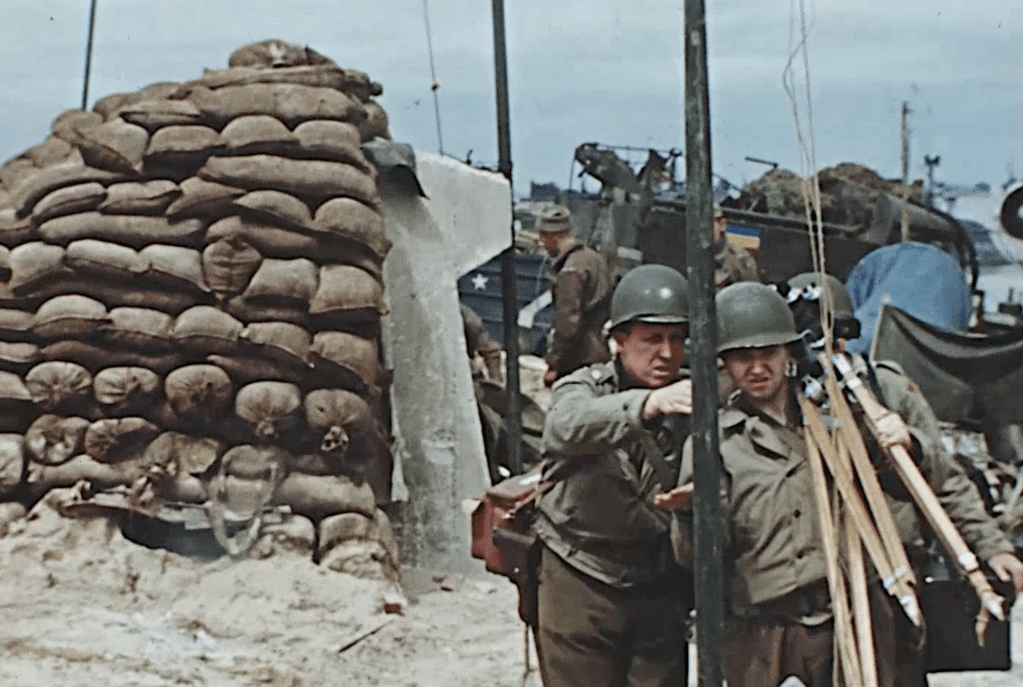
The Plot: Like many of his Hollywood contemporaries, director George Stevens contributed to the war effort by making films for the US military during World War II. In 1943, Stevens was ordered by General Dwight Eisenhower to recruit 45 people (primarily Hollywood cinematographers and screenwriters) for a Special Coverage Unit (SPECOU) to capture raw footage of the war. Armed with 16mm cameras and Kodachrome color film, Stevens and his team (nicknamed the “Hollywood Irregulars” or the “Stevens Irregulars”) captured over six hours’ worth of footage of the war as it was happening. Highlights of their documentation include the D-Day invasion in Normandy, the liberation of Paris, footage of the Dachau concentration camp a few days after its closure, and the streets of Berlin shortly after the end of the war. “George Stevens’ World War II Footage” is the most comprehensive color documentation of the war known to exist.

Why It Matters: The NFR gives the footage its proper historical context, and declares it “an essential visual record of World War II”.

But Does It Really?: Oh yeah. I am not a WWII expert by any means, but even I can appreciate the rare historic value of this footage. Most WWII footage I’ve seen is in grainy black-and-white, creating a distance between me and the footage, as if to say, “This all happened a long time ago.” But seeing the war in color makes the whole thing more immediate, more alive. It’s also refreshing after watching so much edited propaganda to see raw footage of the war without context or government-sanctioned narratives. This is as close as we’ll ever get to seeing the war as it actually was, and for that alone “George Stevens’ World War II Footage” is an indispensable addition to the NFR.

Other notes

  • Before the war, George Stevens was an up-and-coming director with such hits as “Swing Time” and “Gunga Din” under his belt. Shortly after production wrapped on his comedy “The More the Merrier” in December 1942, Stevens attended a screening of “Triumph of the Will”, and upon seeing the film’s unflinching depiction of Hitler’s power was persuaded to join the war effort. In January 1943, Stevens enlisted with the US Army Signal Corps and was sworn in as a Major (by the end of the war he would achieve the rank of Lieutenant Colonel). 
  • Prior to his SPECOU assignment, Stevens spent the spring of 1943 in Africa, primarily Egypt and Algiers. His brief footage of Africa consists mainly of the sights (including the Sphinx and the pyramids) with some basic training and staged military action mixed in. Stevens transferred to Persia (now Iran) in June, and if he filmed any of his time there, it is not included in the Library of Congress’ online viewing collection.
  • Once SPECOU had been assembled in early 1944, their first major assignment was to film the Normandy landings (aka the D-Day invasion) on June 6th, 1944. Stationed aboard the HMS Belfast, Stevens and his team documented the only known color footage of D-Day, primarily their voyage to and eventual arrival at Normandy. SPECOU also filmed black-and-white footage of the invasion, which was later edited into American newsreels covering D-Day. While nowhere near as frenetic as later reenactments in “Saving Private Ryan” and “The Longest Day”, seeing this footage of D-Day as it really happened is truly a sight to behold.
  • Side note: There are many sources (including George Stevens Jr. in his documentaries) claiming that the Stevens WWII footage is the only color footage of the war in Europe. While color footage of the war is a rarity, let’s not forget William Wyler’s “The Memphis Belle”.
  • On July 4th, 1944, SPECOU covered a ceremony awarding medals to survivors of D-Day attended by several high ranking officers, including Field Marshal Bernard Montgomery, General Omar Bradley, and General George S. Patton! I don’t think I’ve ever seen the real Patton before, and I must say George C. Scott did his homework.
  • Speaking of cameos and guys named George: George Stevens and his fellow filmmakers make several appearances throughout this footage. Stevens can be easily identified: He’s the tall one smoking a pipe and/or instructing the cameraman what to film.
  • After D-Day, Stevens and his team joined up with the 2nd Armored Division headed by General Philipe Leclerc, en route to Paris following news of the city’s successful uprising against the Germans. Upon Leclerc’s arrival in Paris, Nazi Commander Dietrich von Choltitz surrendered to the French, ending Germany’s four year occupation of Paris. A large chunk of “George Stevens’ World War II Footage” is of the liberation of Paris on August 25th, a day Stevens later called “the greatest day of my life”. In addition to footage of Parisians celebrating in the streets, we witness General Charles De Gaulle’s return to Paris for the first time in four years, as well as sniper fire from the handful of Germans who refused to acknowledge the surrender. As far as the Allies were concerned, the Liberation of Paris was the beginning of the end, with SPECOU member Irwin Shaw betting Stevens the war would be over by October. But a surprise attack from the Nazis that December (the Battle of the Bulge), extended the war for the time being.
  • Stuck in Germany in December 1944, Stevens filmed his unit celebrating Christmas, making this one of the last NFR titles I expected to add to my “Die Hard Not-Christmas” list. Of note is a shot of soldiers hanging grenades on their Christmas tree like ornaments, as well as a sequence of Stevens receiving a care package from his family, including letters and plenty of candy. This scene shows Stevens doing something we don’t see him do in any of the other footage: Smile.
  • After a reassignment to London in early 1945 to help with the propaganda film “The True Glory”, Stevens returned to SPECOU in April to document the meeting of US and Soviet soldiers on the Elb river near Torgau. It’s an enjoyable bit of levity in the midst of all this darkness, but it’s still weird to see Americans and Russians getting along. Enjoy it while it lasts, boys.
  • As with any war footage, there are plenty of unsettling images in this collection, including violent attacks and abandoned corpses. Unsurprisingly, the most disturbing, sobering section of this footage is the unit’s documentation of the Dachau concentration camp in late April 1945, mere days after its liberation. As with the rest of the footage, seeing Dachau in color makes the tragedy all the more real, with shots chronicling piles of corpses and the few gaunt survivors, as well as the bodies of Nazi soldiers who had been beaten to death by the inmates following the liberation. Stevens later recalled that the sights at Dachau made him realize the potential of evil hiding inside all of us; that anyone under the right circumstances is capable of the inhumanities the Nazis perpetrated. Stevens spent the rest of 1945 in Germany compiling concentration camp footage to be used as evidence in the Nuremberg trials.
  • Shortly after the surrender of Germany on May 8th 1945 (V-E Day), Stevens and his team reached Berlin. Their footage of Berlin in the immediate aftermath of the war is fascinating. When I think of the end of WWII, I think of big celebrations, of sailors coming home and kissing random women. What this footage showed me was the aftermath of a city that had actually been in battle: streets covered in debris and a city divided into allied occupation, and the seeds of what will one day become the Cold War. The Stevens footage ends with the realization that even when war is over, it’s never over.

Legacy 

  • George Stevens returned to Hollywood in March 1946, stating that “Films were much less important to me, and in a way, perhaps, more important”. Not counting a segment of the anthology film “On Our Merry Way”, Steven’s first post-war film was 1948’s “I Remember Mama”, which took place in 1910s San Francisco, the time and place of Stevens’ childhood. 
  • Steven’s post-war filmography was devoid of the kind of light comedies and adventure pictures he was known for in the 1930s, opting instead for serious fare that examined human ideals. His next three films after “Mama” have all been inducted into the NFR: “A Place in the Sun”, “Shane”, and “Giant”. Among the names found in the credits of these films are screenwriter Ivan Moffat and cinematographer William Mellor, two of the many men who served with Stevens in SPECOU. 
  • Stevens’ only post-war film that dealt directly with the war was 1959’s “The Diary of Anne Frank”. While other war films were considered, Stevens found himself most drawn to “Diary”, especially once he learned that at one point during the war he and his unit were only 100 miles away from the attic in Amsterdam where Frank and her family were hiding.
  • Following Stevens’ death in 1975, his son George Jr. oversaw the restoration of his father’s WWII footage at the American Film Institute. Stevens Jr. would later use this footage in the two documentaries I mentioned at the top of this post.
  • Here’s a recent, weird coda to the “George Stevens: D-Day to Berlin” documentary. It turns out that the film was an edited version of a 1985 special produced for the BBC similarly titled “D-Day to Berlin” by Paul Woolwich and Robert Harris. In 2019, Woolwich and Harris learned of the 1994 “D-Day to Berlin” and sent a request to the Television Academy to launch an investigation of how closely Stevens’ film copied theirs. The Television Academy determined that Steven’s version was indeed a slightly altered version of the BBC documentary, and made the rare decision to rescind the three Emmys and four nominations Stevens’ version received in 1994. (Stevens has never commented publicly about the Academy’s decision).

Further Viewing: I have somehow covered this much NFR wartime propaganda without mentioning “Five Came Back”. Based on the book by Mark Harris, “Five Came Back” is a three-part documentary by Laurent Bouzerau about five Hollywood filmmakers — Frank Capra, John Ford, John Huston, George Stevens, and William Wyler — and their experiences on the front lines making films for the war effort, and how those experiences effected their films after the war. Of the five, John Ford is the only one who doesn’t have at least one of his wartime films on the NFR, which means I should mentally prep myself now for the inevitable inclusion of “The Battle of Midway” or “December 7th“.