
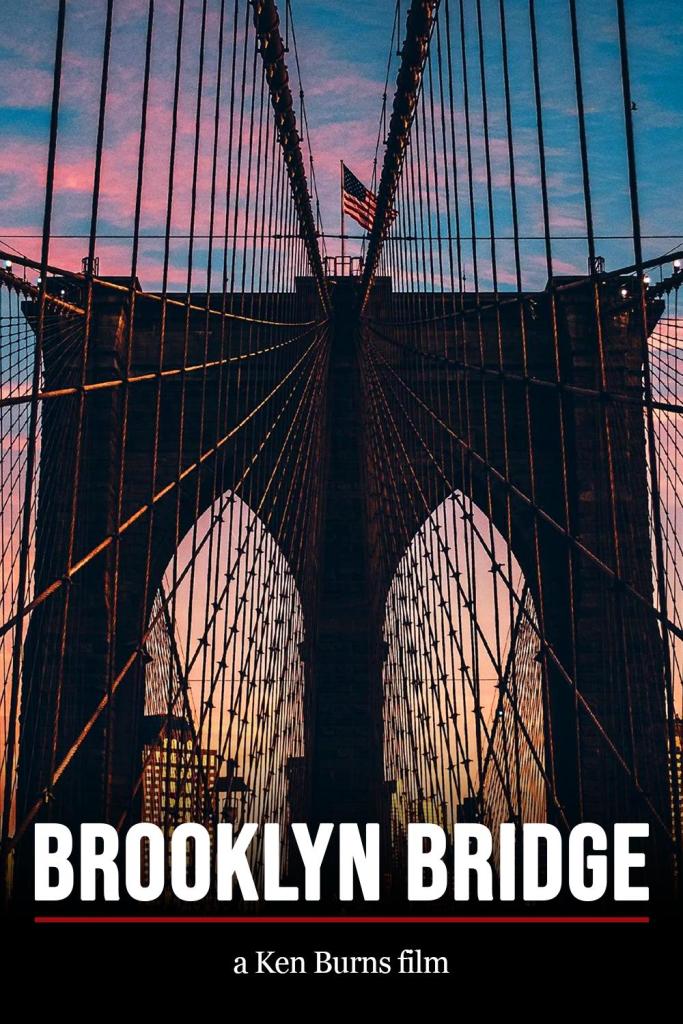
#810) Brooklyn Bridge (1981)
OR “The Docs of New York”
Directed by Ken Burns
Written by Amy Stechler. Based on “The Great Bridge” by David McCullough.
Class of 2025
The Plot: New York’s famous Brooklyn Bridge finally gets its due in Ken Burns’ first documentary. Presented in two halves, “Brooklyn Bridge” chronicles the bridge’s lengthy and dangerous construction as well as its legacy and impact on pop culture and architecture. And even at this early stage in Ken Burns’ career, we get plenty of zoomed-in historical photos with accompanying voice-overs.
Why It Matters: The NFR gives some background for the film and praises Ken Burns as “a trusted public historian”. The write-up includes an interview with Ken Burns for the Library of Congress upon the induction of “Brooklyn Bridge” into the NFR. Did you know Ken Burns nominates films for NFR consideration too? Looks like I’m in esteemed company.
But Does It Really?: Because he’s known primarily for television, I didn’t realize Ken Burns has a few theatrical documentaries, and given Burns’ impact on documentary film of course one of them should be on the NFR. Like so many of Burns’ documentaries, “Brooklyn Bridge” quite impressively makes history come alive, turning what could have been bland engineering history into something much more personal and cinematic. I learned a lot about the Brooklyn Bridge thanks to this film, though to be fair I didn’t know anything about it going in; but still, it’s an informative, entertaining watch. Ken Burns is one of the most influential documentarians in American film, so having “Brooklyn Bridge” on the NFR is a natural choice to honor the man.
Everybody Gets One: Ken Burns knew he wanted to be a filmmaker since childhood, but it wasn’t until studying at Hampshire College that he decided on documentary filmmaking, fascinated by figuring out a way to “wake up American history”. In the late ‘70s, Burns received a copy of “The Great Bridge”, David McCullough’s book about the construction of the Brooklyn Bridge, and knew he had to make a documentary based on it. “Brooklyn Bridge” was Ken Burns’ first documentary feature, and his first collaboration with PBS.
Seriously, Oscars?: “Brooklyn Bridge” was nominated for Best Documentary Feature at the 1982 Oscars, losing to Arnold Schwartzman’s “Genocide”, which…yeah this movie was not going to beat the Holocaust. Although Ken Burns didn’t win an Oscar for “Brooklyn Bridge” (or for his subsequent nomination for “The Statue of Liberty”), he has received five Emmys, four Peabodys, and a Grammy for his TV documentaries.
Other notes
- We start with some genuinely beautiful compositions of the Brooklyn Bridge and the New York skyline, shot by Burns over the course of two years. It’s just like “Manhattan” except it’s in color and significantly less problematic.
- We do get plenty of what has been dubbed “the Ken Burns effect”, in which the camera zooms in on a still photo. I don’t recall it being so frequent to the point of distraction, but then again maybe it’s just been done so often in the last 45 years I didn’t notice. Shoutout to Burns and his team for applying the Ken Burns effect manually; they went to dozens of film archives and filmed each photograph on an easel, complete with zoom-ins. Who needs Final Cut Pro?
- Burns assembled quite the eclectic cast for this film’s first person voiceovers. First off is narrator David McCullough, author of the original book that inspired Burns, who is also interviewed throughout. Washington Roebling (who oversaw most of the bridge’s construction) is voiced by his own great-grandson Paul Roebling, and his wife Emily is voiced by the great Julie Harris making her second NFR appearance. Most surprising among the voice cast, author Kurt Vonnegut and playwright Arthur Miller! I assume Vonnegut is the one voicing the Mark Twain quote about Roebling’s Niagara Falls Suspension Bridge.
- Again, I didn’t know anything about the Brooklyn Bridge before watching this film, so all the information was new to me. For starters I didn’t realize it took 14 years to build! The other major point is that the original engineer John Roebling died a month into construction, with his son Washington taking over, though he quickly developed Caisson disease (aka “the bends”) and had to supervise the entire construction from home. Man, the past was brutal.
- On a related note, you could not pay me to walk on a bridge while it was still under construction.
- Things really take off in Part Two, which celebrates the bridge as an icon. We begin with numerous paintings and sketches of the bridge from a variety of artists and styles. They’re all wonderful to see, but most notable to me was Georgia O’Keeffe’s 1949 painting of the bridge, which somehow takes the bridge’s rigid structure and molds it into O’Keeffe’s…um, anatomical aesthetic.
- Also included among the tributes are plenty of film clips that either feature the bridge or prominently reference it. The films included are “The Bowery” with George Raft, “Way Out West” with Laurel and Hardy, “It Happened in Brooklyn” with Frank Sinatra, “Bowery Bugs” with Bugs Bunny, and “Tarzan’s New York Adventure” with…Tarzan.
- There are several references throughout to people being conned into buying the Brooklyn Bridge. While never explicitly mentioned within the documentary, this is a reference to George C. Parker, a con man in the early 20th century who would allegedly convince naive immigrants fresh off the boat that he constructed the Brooklyn Bridge and would sell it to them for everything they had. While it’s disputed that Parker ever actually did that, the idea of buying the Brooklyn Bridge became synonymous with gullible acts of stupidity. And if you believe that I got a bridge I can sell you.
- Playwright Arthur Miller makes an on-camera appearance at the end to provide his introspection about what the Brooklyn Bridge symbolizes. Though not directly referenced, Miller wrote the play “A View from the Bridge” about Italian-Americans in Brooklyn, so I assume that’s why he’s here.
Legacy
- “Brooklyn Bridge” premiered at the Brooklyn Museum in late 1981 before playing the film festival circuit and a brief theatrical run. The film was first broadcast on PBS on the Brooklyn Bridge’s 99th birthday: May 24th, 1982.
- The Brooklyn Bridge has gone through a number of refurbishments over the last 45 years, including a complete replacement of its cable system and the addition of protected bike paths. The bridge is still one of the most popular tourist attractions in New York, hosting over 115,000 cars, 30,000 walkers, and 4,000 cyclists a day.
- “Brooklyn Bridge” should not be confused with “Brooklyn Bridge”, the high-quality yet low-rated 1990s sitcom about Gary David Goldberg’s childhood in Brooklyn. Still, when am I ever going to get another chance to reference that show on this blog?
- David McCullough would go on to write two presidential autobiographies that would become prestige HBO projects: “Truman” and “John Adams”.
- Ken Burns’ follow-up to “Brooklyn Bridge” was a documentary about Shakers, but he came into prominence in 1990 with the success of his nine part series “The Civil War”. Other notable Ken Burns documentaries include “Baseball”, “Jazz”, and “The War”. As of this writing, Burns’ most recent series was his six-parter “The American Revolution” in 2025. In the aforementioned Library of Congress interview, Burns stated that he was “over the moon” about “Brooklyn Bridge” being added to the National Film Registry.

