
The NFR Class of 2019: My Ballot

REUTERS PICTURES OF THE DECADE

As 2019 (and the decade!) winds down, the National Film Preservation Board meets to discuss which 25 American films are worthy of NFR recognition. Now that the submission deadline has passed, it’s time for me to divulge the 50 movies I chose for consideration this year. Eight films from my previous selections have made the cut, so the odds are good you’re looking at a few soon-to-be-minted classics here.

My 50, Plus My Reason Why

I’m still surprised they haven’t made the cut yet: Carrie (1976), A Clockwork Orange (1971), Grease (1978), The Great Escape (1963), Harvey (1950), The Lord of the Rings: The Fellowship of the Ring (2001), What Ever Happened to Baby Jane? (1962)

They are Minor Classics, but classics nonetheless: Cat on a Hot Tin Roof (1958), Key Largo (1948), Mutiny on the Bounty (1935), The Odd Couple (1968), White Christmas (1954), The Wild One (1954)

They have at least one Iconic Moment: Big (1988), Creature from the Black Lagoon (1954), Fiddler on the Roof (1971), Lady and the Tramp (1955), Return of the Jedi (1983), Royal Wedding (1951), The Seven Year Itch (1955)

I dunno, I just like them: 20,000 Leagues Under the Sea (1954), Clue (1985), Home Alone (1990), It’s a Mad, Mad, Mad, Mad World (1963), Rope (1948), A Thousand Clowns (1965), Waiting for Guffman (1996), Witness for the Prosecution (1957)

They’re newly eligible: Avatar (2009), The Dark Knight (2008), There Will Be Blood (2007), Up (2009)

Bad Movies are people too: The Bad Seed (1956), Plan 9 from Outer Space (1959), The Poseidon Adventure (1972)

This one’s for Mom: The Miracle Worker (1962)

The Library of Congress just restored it, so…: Frankenstein (1910)

Its sequel inexplicably made the list, but the original hasn’t: The Sheik (1921) [“Son of the Sheik” was added in 2003.]

“The Other Side of the Wind” isn’t eligible for a while: F for Fake (1973)

“Green Book” won Best Picture: Driving Miss Daisy (1989)

“Documentary Now!” can do no wrong: Original Cast Album: Company (1970)

“He hates these cans! Stay away from the cans!”: The Jerk (1979)

These talented artists STILL aren’t on the list:

Jane Fonda: 9 to 5 (1980)

Eddie Murphy: Eddie Murphy Raw (1987)

Robin Williams: Mrs. Doubtfire (1993)

Glenn Close (and hasn’t she been through enough already?): Fatal Attraction (1987)

Tim Burton: Edward Scissorhands (1990)

Mr. Magoo: When Magoo Flew (1955)

The Amazing RANDO!: Mystery Science Theater 3000: The Movie (1996)

And finally: Because I dare you, National Film Registry. I fucking dare you: Song of the South (1946)
#378) Chinatown (1974)

MV5BOGMwYmY5ZmEtMzY1Yi00OWJiLTk1Y2MtMzI2MjBhYmZkNTQ0XkEyXkFqcGdeQXVyNzkwMjQ5NzM@._V1_

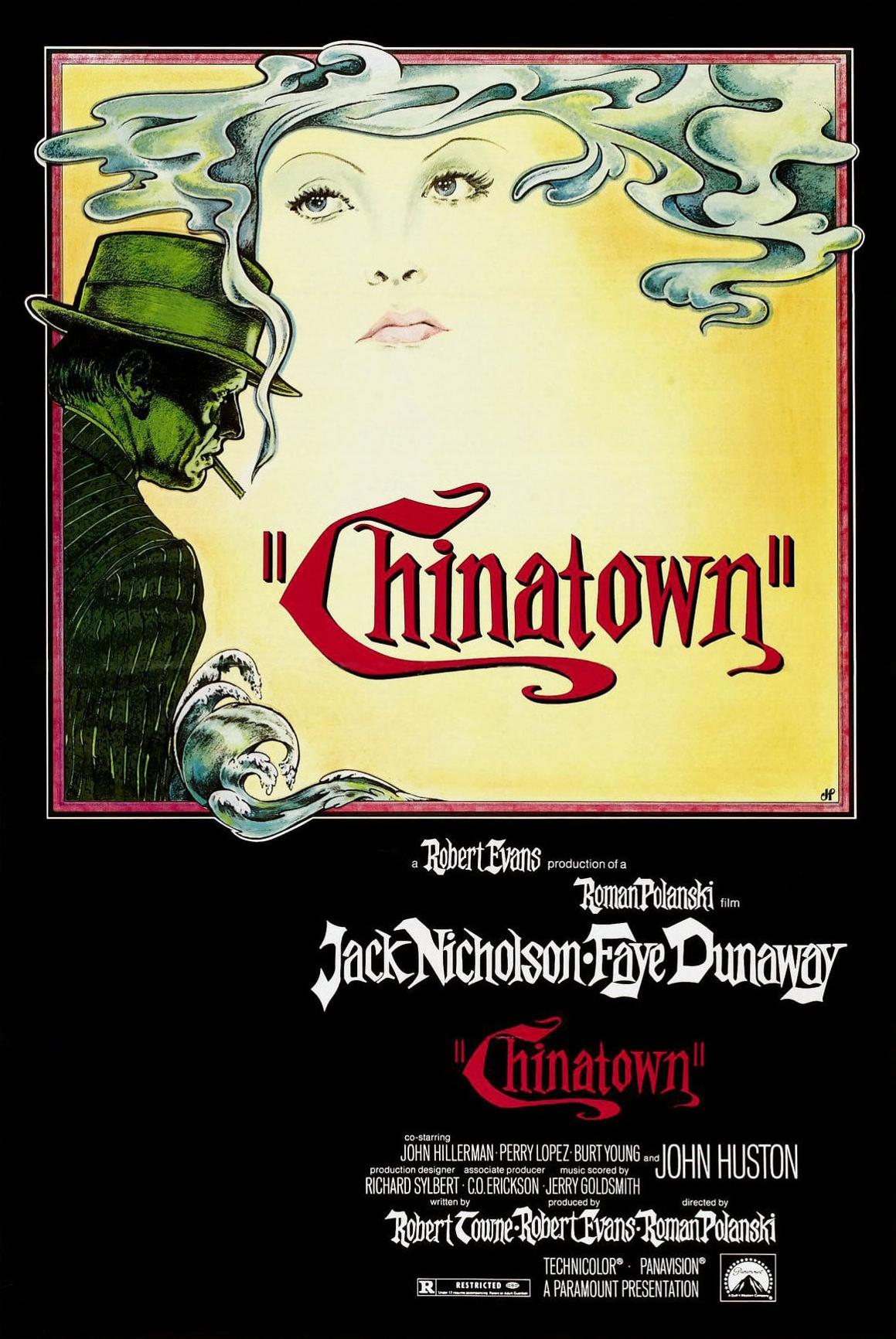
#378) Chinatown (1974)

OR “Like a Dick Takes to Water”

Directed by Roman Polanski

Written by Robert Towne

Class of 1991

The Plot: Private investigator Jake Gittes (Jack Nicholson) is hired to find out if L.A. Water and Power engineer Hollis Mulwray (Darrel Zwerling) is having an affair. Photos of Hollis with a younger woman make front-page news, and his wife Evelyn (Faye Dunaway) sues Gittes for libel. When Hollis’ dead body is found in a reservoir, Evelyn drops the suit and has Gittes investigate the potential murder. Along the way, Gittes uncovers a massive plot to divert L.A.’s water supply from the nearby farmland and annex that land for cheap, and all fingers point to Hollis’ former business partner/Evelyn’s father Noah Cross (John Huston). The plot thickens a lot more from here, but trust me, it’s worth it.

Why It Matters: The NFR calls it a “compelling whodunit reminiscent of Raymond Chandler or Dashiell Hammett”, and throws superlatives at Nicholson, Dunaway, Huston, Polanski, Towne, and cinematographer John A. Alonzo. An essay by film critic James Verniere dissects the film’s symbolism, much of which both Towne and Polanski have admitted was unintentional.

But Does It Really?: “Chinatown” is as close to a perfect movie as you can get. Everything about this movie works, from Robert Towne’s brilliantly structured screenplay, to Polanski’s dark perspective of 1930s LA, to performances from Nicholson, Dunaway, and Huston that reward you with each viewing. “Chinatown” may be the greatest film mystery of all time, and the rare film noir homage that can stand alongside the real thing. “Chinatown” continues to be one exhilarating ride 45 years later, and is a no-brainer for NFR inclusion.

Everybody Gets One: Though they both did uncredited work on “The Godfather”, this is the only credited NFR appearance for producer Robert Evans and screenwriter Robert Towne. Evans had just stepped down as head of Paramount Pictures, and “Chinatown” was his first film as a hands-on producer. He originally commissioned Towne to adapt “The Great Gatsby” to film, but Towne felt he could not improve on the novel (Side note: No one can), and instead offered to write an original screenplay for less money. “Chinatown” was inspired by Towne’s interest in the California Water Wars that permanently affected his home town of Los Angeles. And special mention to Darrel Zwerling as Hollis Mulwray, aka the vic.

Wow, That’s Dated: Oh geez, I don’t know, maybe the “Screwin’ like a Chinaman” joke?

Seriously, Oscars?: A critical and commercial success, “Chinatown” led the Oscar pack with 11 nominations, tied with that year’s eventual big winner “The Godfather Part II”. “Chinatown” faced a near-shutout from “Godfather”, and walked away with only one Oscar: Original Screenplay for Towne. Among its losses, Nicholson lost to Art Carney for “Harry and Tonto”, Dunaway to Ellen Burstyn in “Alice Doesn’t Live Here Anymore”, and the film lost in several categories to ‘70s disaster flicks “Earthquake” and “The Towering Inferno”. That’s gotta sting.

Other notes

  • Shoutout to Jerry Goldsmith, whose haunting score sets the mood of the film far greater than any dialogue could. And he wrote and recorded the whole thing in 10 days! Bonus shoutout to Uan Rasey, who provided the trumpet solos, and can also be heard on the soundtrack of pretty much every MGM film from the ‘50s and ‘60s.
  • It’s always nice to see Jack Nicholson before he became a caricature of his persona. His Jack Nicholson-ness helps ensure the dialogue comes off as natural smart-alecky talk, as opposed to clever writing.
  • Wow, this movie is a plethora of recognizable performers. Diane Ladd, Burt Young, Rance Howard, John Hillerman; I’m one Eileen Brennan away from ‘70s Character Actor Bingo!
  • Despite her infamous diva persona, I’ve always enjoyed Faye Dunaway as an actor. Evelyn may be her crowning achievement: a woman whose cold exterior is stripped away to its tragic, fraught center. Dunaway plays it marvelously, and I wish she would stop slapping stagehands and keep cranking out good work.
  • There are a lot of “golden hour” shots in this movie; everything takes place either at sunrise or sunset. Must have been hell getting those shots down.
  • He gives Oscar caliber performances AND he jumps his own fences. Jack Nicholson can do anything!
  • That’s director Roman Polanski as the thug that cuts Jake’s nose. “You know what happens to nosy fellas?” …They flee the country after being convicted of statutory rape?
  • I feel like sleuthing is a lot easier these days, what with the internet and all. But who wants to watch Jack Nicholson Google “Los Angeles reservoirs” or “Northwest Valley real estate”?
  • John Huston is to this movie what Orson Welles is to “The Third Man”: he makes a maximum impact with minimum screen time. And with that rich bass I could listen to him talk all day.
  • This is another one of those movies where the major twists were spoiled for me prior to my first viewing. Although I missed out on discovering this movie’s secrets for myself, it does allow me to appreciate the quality of the screenplay, as well as the performance subtleties from Dunaway, Huston, and everyone else who knows the truth.
  • “Politicians, ugly buildings, and whores all get respectable if they last long enough.” God damn this screenplay is good.
  • Shoutout to Perry Lopez as Lt. Lou Escobar. It takes a powerful actor to push Jack Nicholson around and get away with it.
  • Ultimately this movie isn’t really about solving the mystery, but rather about the corrupt forces that we are powerless to change. That being said, it is still a fun mystery to unravel. It’s like “All the President’s Men”, except everyone’s immoral!
  • The “She’s my sister, she’s my daughter” scene is equal parts terrifying and heartbreaking. Apparently Nicholson is actually slapping Dunaway (at Dunaway’s request), and this violence stands out far stronger than any of the punches throughout the film.
  • What a horribly poetic nightmare that final scene is. Towne and Polanski fought over the ending: Towne’s original scene had a few uplifting qualities, but Polanski insisted on something more tragic. Polanski eventually got his way, and Towne later admitted that it was the right choice.

Legacy

  • “Chinatown” was Roman Polanski’s last American film before fleeing to France to escape criminal charges (still pending, by the way). Sure, he gave us “The Pianist” and his victim (Samantha Gailey) has publically requested the charges be dropped, but still…
  • There are some movies on this list you don’t expect to have a sequel, and “Chinatown” is one of them. After a difficult production, 1990’s “The Two Jakes” saw Gittes uncovering a mystery about land and oil ownership in 1948 L.A. The film was a box office disappointment, and was Nicholson’s third and final film as a director.
  • Either there was going to be a third Jake Gittes movie as part of a planned trilogy or there wasn’t. Sources vary. Allegedly the third movie would have involved corporations buying up public transit to phase them out and build freeways. This plot point, along with several neo noir elements, was utilized in NFR entry “Who Framed Roger Rabbit”, which takes many a cue from “Chinatown”.
  • But the main legacy of “Chinatown” is its immortal closing line. Everyone has done some variation on “Forget it Jake, it’s Chinatown.” They even reference it in “Inside Out” for crying out loud!

Further Viewing: Despite the film’s title, only the final scene takes place in Chinatown, and the only Asian Americans depicted are Evelyn’s domestics. But Los Angeles’ Chinatown neighborhood is so much more than a metaphorical contemplation of when protecting someone becomes harmful. Please enjoy this video walkthrough. Be on the lookout for the statue of Bruce Lee!

#377) The Treasure of the Sierra Madre (1948)

MV5BOTJlZWMxYzEtMjlkMS00ODE0LThlM2ItMDI3NGQ2YjhmMzkxXkEyXkFqcGdeQXVyMDI2NDg0NQ@@._V1_

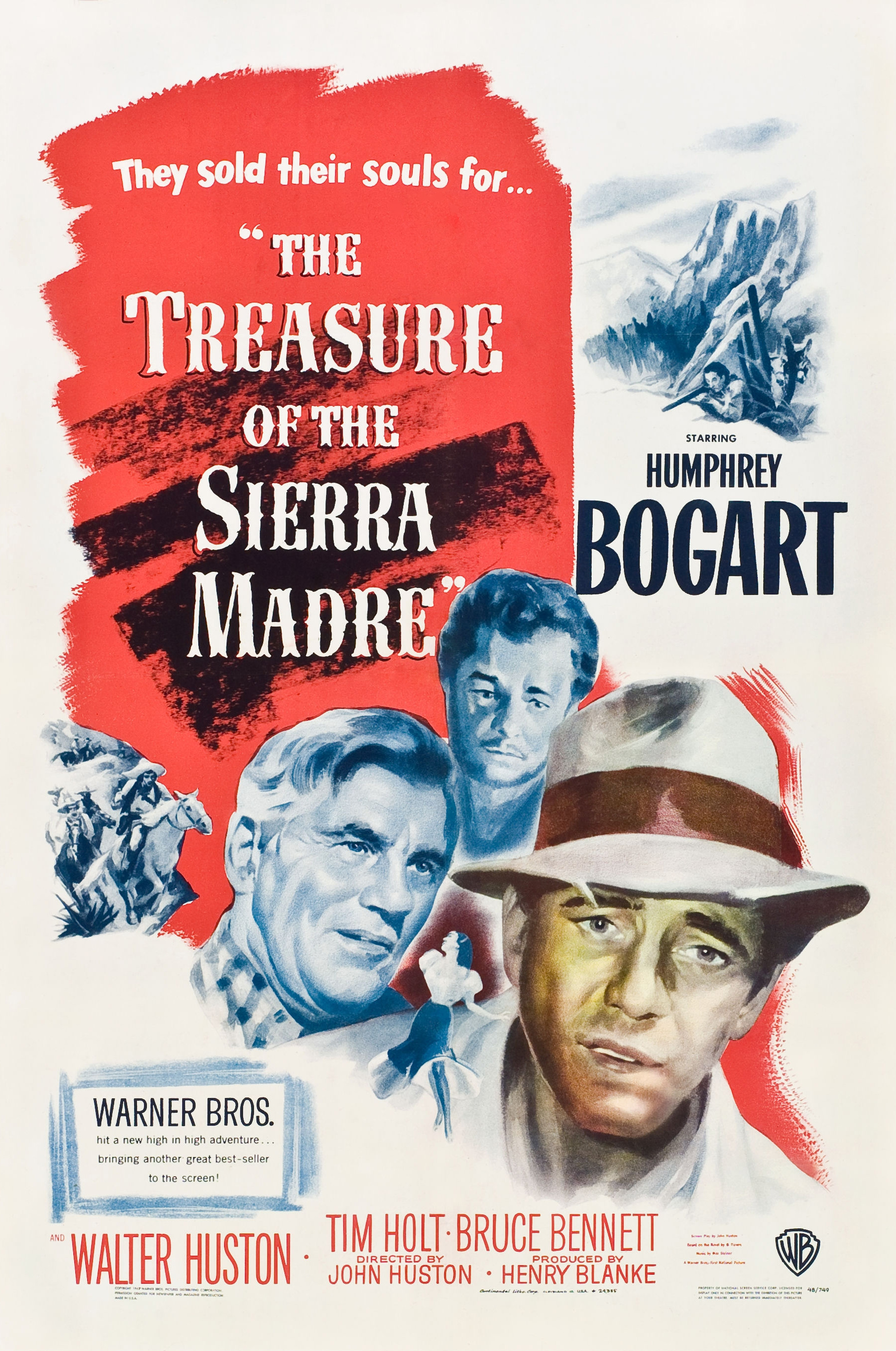
#377) The Treasure of the Sierra Madre (1948)

OR “Gold Diggers of 1925”

Directed & Written by John Huston. Based on the novel by B. Traven.

Class of 1990

The Plot: American Fred C. Dobbs (Humphrey Bogart) is a drifter in 1925 Tampico looking for work. He meets fellow ex-pat Bob Curtin (Tim Holt!) and veteran prospector Howard (Walter Huston), who talks about the blessing and curse connected with striking gold. After winning a small jackpot in a lottery, Dobbs convinces the two men to join him on a prospecting expedition in the Sierra Madre Mountains. When the group finds a large supply of placer gold, tensions start to rise between them, just as Howard predicted. Even with a suspicious Texan (Bruce Bennett) and a group of banditos on their trail, the men’s biggest threat may turn out to be each other.

Why It Matters: The NFR calls the film an “intense character study” and praises Bogart’s “outstanding” performance.

But Does It Really?: “Treasure of the Sierra Madre” is one of those movies that I knew was a classic before knowing anything else about it. I liked the film, and I understand and agree with its status among the classics, but it didn’t wow me the way I had hoped it would. Perhaps the film’s reputation raises expectations a little too high. That being said, “Sierra Madre” is a well-crafted character study with strong performances from Bogart and Huston, and has aged far better than many other films of the era. My indifference cannot dent “Sierra Madre” or its ongoing influence on film.

Everybody Gets One: “Sierra Madre” novelist B. Traven is one of the literary world’s most elusive characters. His true identity has never been verified, though the most widely accepted theory is that he was German socialist Ret Marut. During production of “Sierra Madre”, John Huston corresponded with Traven’s attorney Hal Croves, who served as the film’s technical advisor. Many, including Huston’s wife Evelyn Keyes, speculated that Croves was really B. Traven, but this could never be confirmed.

Wow, That’s Dated: While the Mexican characters are far more diverse here than in other movies of the era (and are played by Mexicans and Mexican-Americans), everyone still sounds like a Speedy Gonzales cartoon.

Seriously, Oscars?: A critical and commercial hit, “The Treasure of the Sierra Madre” received four Academy award nominations, and took home three. It was a big night for the Huston family: John won Best Director and Adapted Screenplay, and Walter won Best Supporting Actor, making them the first Oscar-winning father and son duo. In a surprise win, 1948’s Best Picture was Laurence Olivier’s “Hamlet”, the first non-American film to win the top prize, and another step towards the fall of the studio system.

Other notes

  • “Sierra Madre” was among the first Hollywood films to shoot outside of the United States, in this case Durango, Mexico, with additional shots in Tampico, the novel’s setting. Production was briefly shut down in Tampico when a newspaper article suggested the film was slanderous to Mexico. It was soon revealed that the story was completely fabricated by a newspaper editor accustomed to receiving bribes from visiting businesses.
  • John Huston cast himself as the American who gives Dobbs money. It’s a peek at Huston’s future second career as a character actor specializing in powerful figures.
  • Speaking of cameos: the young boy selling lottery tickets is future actor/alleged murderer Robert Blake.
  • How many film directors would cast their dad in a key role? Cries of nepotism are unnecessary with a performance as good as Walter Huston’s. John had to convince his father not only to play the part, but also to do so without his false teeth.
  • During the trio’s trek to the Sierra Madre, you can clearly hear the oft-used Kookaburra noise. For the record, the kookaburra is native to Australia and New Guinea, not Mexico.
  • I think Walter Huston’s goal was to say all his lines as quickly as possible. It definitely spices up the proceedings. And look at him dance!
  • Bogie was pushing 50 during production, closer in age to Walter Huston than to Tim Holt, despite referring to Huston’s character as an old man. This supports my theory that Dobbs was written as a younger man.
  • With its themes of greed and the power of wealth, this movie would make a good companion piece to “La Perla”.
  • Athlete turned actor Bruce Bennett can be a little wooden in his scenes, but his natural stiffness works far better here than it did in “Mildred Pierce”.
  • Mexican born Alfonso Bedoya emigrated to Texas in 1918, and after a series of odd-jobs, made it to California and became a character actor. After 15 years of steady film work in both Hollywood and Mexico (mostly playing banditos), Bedoya was cast as Gold Hat and uttered the immortal line, “Badges? We ain’t got no badges. We don’t need no badges. I don’t have to show you any stinkin’ badges!”
  • The juxtaposition from on-location shooting to studio reshoots is quite jarring.
  • Humphrey Bogart nails Dobb’s descent into paranoia; a full 180 from his usual cool, stoic persona. Bogie’s lack of an Oscar nomination is still considered one of the Academy’s biggest oversights.
  • Shoutout to Tim Holt, who is…also in this movie? It’s not that Holt is bad, his character just doesn’t get much to do. And placed alongside such powerhouses as Bogart and Huston, Holt is easily overshadowed.
  • Just a reminder that this movie has virtually no female characters, and the ones it does have speak minimal, inconsequential dialogue.
  • Uh-oh, Dobbs’ obsession is making him monologue in the desert. He’s gone full “Emperor Jones”!
  • I’m very disappointed that during Dobbs’ final confrontation with Gold Hat he doesn’t say, “I don’t have to show you any stinkin’ matches!”
  • “Treasure of the Sierra Madre” is one of those classic movies whose ending was spoiled for me long before I saw it. Perhaps this prevented my viewing experience from being more positive. Fortunately, the final shot still surprised me.

Legacy

  • “The Treasure of the Sierra Madre” continues to be hailed as a classic and an inspiration to filmmakers, but its primary legacy is a line that’s not in the movie. “We don’t need no stinkin’ badges” first appeared in, of all things, a 1967 episode of “The Monkees”, and is now one of filmdom’s most iconic mis-quotes.
  • A final reminder that John Huston, the Oscar-winning writer/director of “The Treasure of the Sierra Madre”, would go on to direct “Annie”.

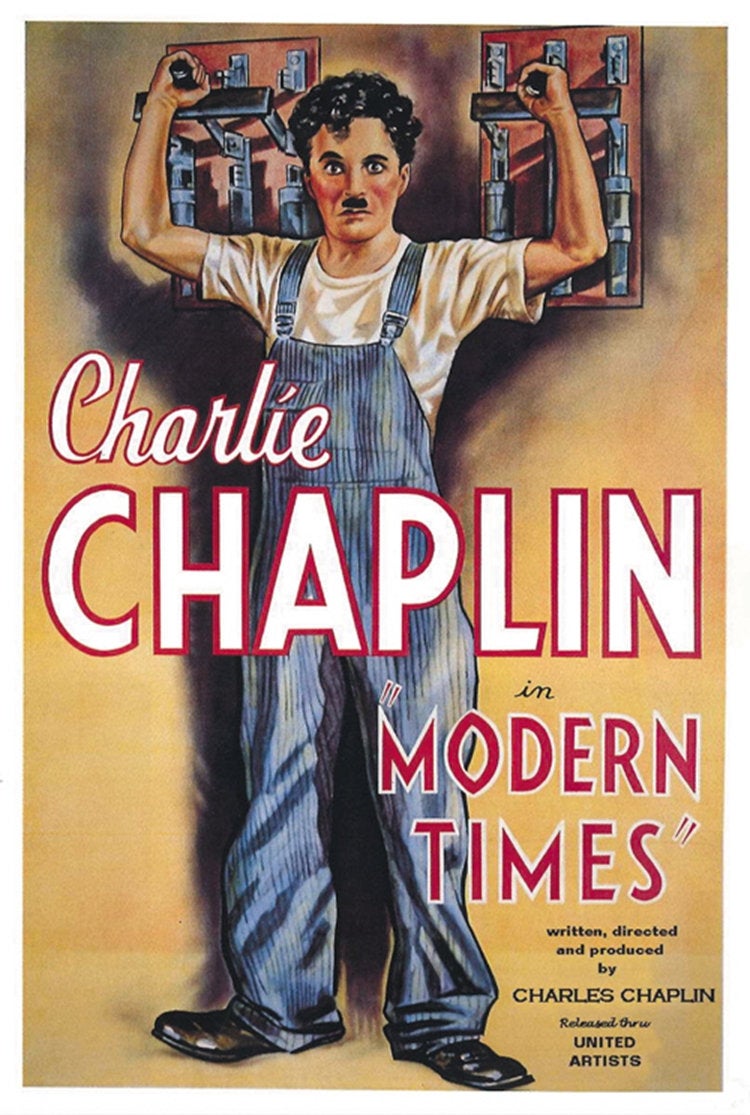
#376) Modern Times (1936)

il_fullxfull.1546317831_ii7m

#376) Modern Times (1936)

OR “Charlie and the Clockwork Factory”

Directed & Written by Charlie Chaplin

Class of 1989

The Plot: “Modern Times” finds our lovable hero the Tramp (Charlie Chaplin) trying to make sense of an age where machinery and efficiency is favored over the well being of people. The Tramp’s adventures find him having a breakdown on an assembly line, going in and out of prison for comic misunderstandings, falling in love with feisty gamin Ellen (Paulette Goddard), and struggling to find work in Depression-era America. Despite this plot synopsis, “Modern Times” is considered one of the funniest movies ever made.

Why It Matters: The NFR praises Chaplin for achieving “a near-balance of humor and pathos”, and also singles out his work with Goddard. There also an essay by Jeffrey Vance, described in his bio as “one of the world’s foremost authorities on Charles Chaplin”. But who has the authority to call him that?

But Does It Really?: No argument here: “Modern Times” is an essential choice for the NFR. The film features Chaplin at the height of his filmmaking career, blending his trademark silent comedy style with an inspired soundtrack and his most socially conscious screenplay yet. “Modern Times” has every right to be on this list, but if I had to pick one essential Chaplin film for the initial 25 NFR roster, I’d go with “City Lights”, but that’s comparing the tastiest apple to the tastiest orange. “Modern Times” holds up quite well for an 80-plus year old movie, thanks to its memorable visuals, strong lead performances, and perennially relevant commentary.

Wow, That’s Dated: As previously stated, “Modern Times” is deeply rooted in the plight of the average American during the Great Depression. Despite illustrating the hardships of finding stability during our country’s worst economic setback, Chaplin still manages to find the silver lining and end on a hopeful note.

Seriously, Oscars?: As always, Chaplin’s status as an industry outsider prevented “Modern Times” from being a serious Oscar contender, failing to receive a single nomination (though the National Board of Review did name it one of the top 10 films of the year). Among the films United Artists opted to promote instead was Best Picture nominee and fellow NFR entry “Dodsworth”.

Other notes

  • After “City Lights”, Chaplin was hesitant to transition from silent films to the now established sound pictures. Unsure of what to do, he traveled through Europe for 16 months, meeting with influential figures ranging from Winston Churchill to Mahatma Gandhi. Chaplin was inspired by his conversations with these figures to tackle a film about more contemporary issues, and “Modern Times” is the result.
  • Chaplin originally planned to make “Modern Times” a full-sound feature, and even wrote a complete screenplay. After filming one scene in sound, Chaplin scrapped the footage and rewrote the entire film to be silent, albeit with a synchronized soundtrack. Chaplin is very strategic with his use of sound in his first outing: the musical score carries most of the dramatic weight, effects are only used when needed, and the only spoken dialogue comes from technology (the radio, the phonograph, etc.).
  • Look no further than the feeding machine to understand the film’s satire: even the basic process of consuming food is too inefficient in modern times. We can’t be too far away from that technology. That being said, Chaplin gives us cinema’s first automated pie-in-the-face gag.
  • The shot of the Tramp being fed through the gears is one of the most iconic moments in film history, and certainly one of Chaplin’s more absurdist. Despite Chaplin’s penchant for multiple re-takes, he would only go through the machinery once; the shot of the Tramp going backwards is the same shot in reverse.
  • The Tramp gets arrested after being mistaken for a Communist agitator. Chaplin, if you only knew how weirdly prescient that was…
  • Paulette Goddard is a breath of fresh air compared to previous Chaplin leading ladies. It helps that Ellen actually contributes to the plot, and is allowed to have, ya know, an actual personality. Ellen also benefits from Goddard’s naturally charismatic screen presence. Fun Fact: Goddard was very close to being cast as Scarlett O’Hara. She even did a screen test. (But hey, who didn’t?)
  • Wow, I was not expecting this movie to have a joke about “nose-powder”. Did the average American moviegoer even know what cocaine was?
  • Just a reminder that this film, routinely considered among the greats, is about a vagrant who falls in love with an underage street urchin.
  • Ah yes, back when we also gave a crap about rehabilitating our prisoners back into civilian life. Simpler times indeed.
  • The roller-skating sequence is always fun to watch. Like all of his movies, it’s incredibly satisfying to see a Chaplin bit that you know has been meticulously choreographed to seem spontaneous and effortlessly funny.
  • Classic Movie Law #18: All drunks must be accompanied by the song “How Dry I Am”.
  • Did the Tramp and Ellen move into the “Gold Rush” house? It’s in pretty bad shape; they should get Buster Keaton to fix it up.
  • Surprise guest star Geppetto as the mechanic.
  • Chaplin was very hesitant to have the Tramp speak, fearing it would weaken the character’s universality, so he devised a compromise: the Tramp would sing, albeit in gibberish that borrows from several languages.
  • I don’t care how uplifting or perfect that ending is; never tell a woman that she needs to smile!

Legacy

  • “Modern Times” was Chaplin’s final film to feature his Tramp character, and his last “silent” film. Chaplin’s next feature would double down on this film’s topicality by tackling no less than Hitler in “The Great Dictator”.
  • Like many eventual classics, “Modern Times” was met with mixed reception and its share of controversy. For starters, German studio Tobis Film sued Chaplin, claiming the assembly line sequence was lifted directly from their 1931 René Clair film “À nous la liberté”. The first lawsuit was dropped, but a second suit in the 1940s was settled out of court. For the record, René Clair was honored that Chaplin might have been inspired by him, and did not participate in either suit.
  • Many critics considered the film to be Communist propaganda, so much that Joseph Goebbels banned the film from being screened in Germany once the Nazis took power. A little more fuel for the “Great Dictator” fire.
  • Chaplin married leading lady Paulette Goddard a few months after the release of “Modern Times”, though their individual career goals led to their divorce six years later. Goddard’s post-Chaplin career doesn’t have a lot of classics, but she managed an Oscar nomination for the wartime drama “So Proudly We Hail!”
  • The assembly line sequence has been spoofed or referenced many times over the years, notably by Donald Duck and Lucille Ball.
  • And finally, in 1954, John Turner and Geoffrey Parsons took the romantic theme from “Modern Times”, added lyrics based on the final scene, and called it “Smile”. The song was first recorded by Nat King Cole and has been a standard ever since.

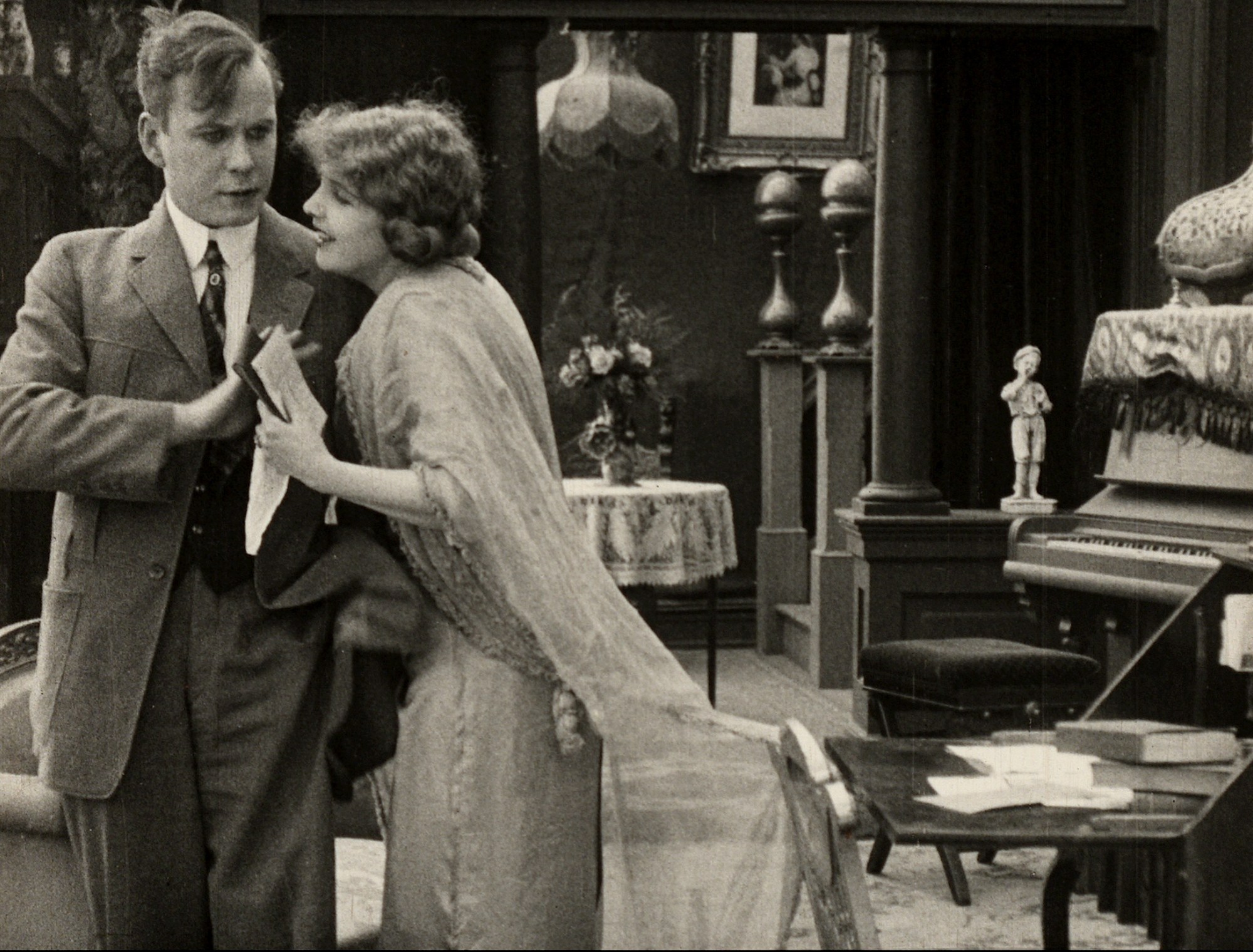
#15) Matrimony’s Speed Limit (1913)

MATRIMONYS-SPEED-LIMIT

#15) Matrimony’s Speed Limit (1913)

OR “Alice in Movieland”

Directed (and possibly Written) by Alice Guy-Blaché

Class of 2003

This is a revised and expanded version of my original post on “Matrimony’s Speed Limit”, which you can read here.

The Plot: Fraunie (Fraunie Fraunholz) refuses to accept money from his girlfriend Marian (Marian Swayne), even after his fortune takes a dive in the stock market. Tired of waiting for his proposal, Marian sends Fraunie a fake telegram stating he will inherit his late aunt’s fortune if he marries by noon that day. It’s a mad comic dash as Fraunie proposes to every woman he runs into, and Marian grabs a Justice of the Peace (Actor Unknown) to perform an impromptu wedding.

Why It Matters: The NFR praises both the “deft, ironic” film as well as “[p]ioneering woman filmmaker” Guy- Blaché. There’s also an essay by film professor Margaret Hennefeld, whose “research focuses on issues of comedy, gender, [and] silent film history”, making “Matrimony’s Speed Limit” a direct bull’s-eye in her niche Venn diagram.

But Does It Really?: This film is definitely on here for what it represents rather than what it is. “Matrimony’s Speed Limit” is a dated piece of light comedy that, while not very entertaining today, is one of a handful of surviving films from Alice Guy-Blaché, who is among the first (if not the first) female directors in film history. Honestly, researching Alice Guy and her amazing film career was more interesting than rewatching this movie. A slight pass for “Matrimony’s Speed Limit”, but a definite yes to Alice Guy-Blaché.

Everybody Gets One: In 1894, 21-year-old Alice Guy was hired at L. Gaumont et Cie (later the Gaumont Film Company) as a secretary. Guy was in attendance at the Lumière Brothers first demonstration of film (1895’s “Workers Leaving the Lumière Factory”), and recognized that film could be used as a creative storytelling medium, rather than just reportage of daily life. Within a year, Guy directed her first short film (See “Further Viewing”). In 1907, Guy and her newlywed husband Herbert Blaché moved to the U.S. and founded Solax Studios in Flushing, New York, with Herbert as production manager and Alice the creative director. Over the next decade Alice directed hundreds of film, all the while experimenting with such then-revolutionary techniques as synchronized sound and interracial casting.

Wow, That’s Dated: Well for starters, the societal norms of the day surrounding gender roles and marriage (A woman who takes the initiative in her relationships!? Scandalous!) You also get standard ‘20s fare like telegrams and ticker tape, plus “hilarious” jokes about miscegenation and suicide.

Other notes

  • “Matrimony’s Speed Limit” was filmed in Fort Lee, New Jersey. Fort Lee became the new home of Solax Studios when their operation became too big for their New York offices. Sadly, a fire in 1919 destroyed the Solax film laboratory and with it, a majority of its library.
  • I am well aware that my modern lens prohibits me from viewing this film as originally intended, but I got a lot of problems with “Matrimony’s Speed Limit”. For starters, at no point does Marian’s telegram give the name of Fraunie’s aunt, the dollar amount of the fortune, where or when he can receive it, or how exactly it can be determined that Fraunie did indeed get married before noon.
  • And while we’re at it, why only give Fraunie 15 minutes to run and find a bride? Why not give him an extra hour or, hell, an extra day? Maybe that extra time would help him come to his senses and propose to his long-suffering girlfriend. Why must you rush things for comic effect, Marian?
  • Okay, one more nitpick: How close/far away is the distance between Marian’s house and Fraunie’s office? It takes Fraunie five seconds to run over to her place, but it takes Marian the whole movie to drive to him. Was Fort Lee designed by M.C. Escher? But then again, I’m poking holes in a 106-year-old film whose sole purpose was to entertain. Kicks just keep getting harder to find.
  • And now we get to the “Wow” in “Wow, That’s Dated”. Fraunie proposes to a woman wearing a veil and gloves. She is receptive, and lifts her veil to reveal that she’s black. Sure, miscegenation was still quite taboo in 1913, but that joke does not age well at all. And this comes after Alice helmed the first movie with an African-American cast: 1912’s “A Fool and His Money” (great title, by the way). Surely she would have known better.
  • I feel like finding someone who would immediately marry a stranger is far easier nowadays, what with the dating apps and all. In fact, is there an app for that? If not, I call dibs on the copyright! 

Legacy

  • By the end of the 1910s, moviemaking had started migrating to Hollywood, and Alice Guy-Blaché found her film career (and her marriage) at an end. Alice sold the remains of Solax Studios to stave off bankruptcy, and never made another movie. Her sole return to public life came with the publishing of her memoirs in the late 1940s, to ensure that her place in film history would be well documented.
  • With the exception of a few lifetime achievement honors in her native France, Alice Guy-Blaché did not receive any recognition of her film work during her lifetime. This changed in the 2000s, when her work was resurrected and reappraised thanks to extensive film preservation efforts. Alice was posthumously inducted into the Directors Guild of America in 2011, and is the subject of the 2015 biography & 2018 documentary “Be Natural: The Untold Story of Alice Guy-Blaché”

Further Viewing: While Alice Guy-Blaché’s original 1896 version of “La Fée aux Choux” has disappeared, her remake from 1900 survives, and is considered the earliest known film directed by a woman. Literally translated to “The Cabbage Fairy”, the short is based on the European fantasy that children are born in cabbage patches. And now you know where the concept behind Cabbage Patch Kids comes from. You’re welcome.