#350) It Happened One Night (1934)

9e5170b8bed6df5b5a54f84e5353e787

#350) It Happened One Night (1934)

OR “Bus the Two of Us”

Directed by Frank Capra

Written by Robert Riskin (with an assist from Myles Connolly). Based on the short story “Night Bus” by Samuel Hopkins Adams.

Class of 1993


The Plot: Heiress Ellie Andrews (Claudette Colbert) has eloped with social climber King Westley (Jameson Thomas), despite the objections of her father (Walter Connolly). After Dad insists on the marriage being annulled, Ellie jumps ship (literally) and boards a Greyhound bus for New York, where King awaits. Also on the bus is recently unemployed reporter Peter Warne (Clark Gable), who recognizes Ellie when her disappearance makes headlines. After their bus leaves them behind, Peter agrees to help Ellie get to New York if he can have an exclusive interview. The two bus and hitchhike their way across the country, and while there is some initial friction, you won’t believe this, they start to fall for each other.

Why It Matters: The NFR calls the film “a classic” and gives a rundown of the film’s rocky production and eventual Oscar sweep. There’s also an essay by Ian Scott, who wrote a biography on screenwriter Robert Riskin, because someone had to.

But Does It Really?: “It Happened One Night” is an undisputed film classic, but some of its luster has worn off over the years. For the seminal romantic comedy, “It Happened One Night” isn’t as romantic or as hilarious as it used to be, but it still made me laugh quite a bit, and it set the template for practically every romantic comedy since then. The film’s simple premise helps it age well, as do committed performances from both Gable and Colbert (Well, seemingly committed. More on that later). It’s not one of the NFR’s untouchables, but “It Happened One Night” is more than deserving of its place among the best films.

Shout Outs: Peter briefly sings “Who’s Afraid of the Big Bad Wolf?

Wow, That’s Dated: I have been on a charter bus, and there is no singing or selling of candy and cigarettes. Also dated: telegrams, and not being able to instantly access your money.

Take a Shot: Not to split hairs, but “It” actually happens over the course of several nights. This of course all depends on your definition of “It”.

Seriously, Oscars?: At the 7thAnnual Oscars, “It Happened One Night” was nominated in five major categories, and was the first to win all five: Best Picture, Director, Actor, Actress, and Screenplay. Claudette Colbert was so convinced she would lose Best Actress to write-in candidate Bette Davis she arranged to leave town the night of the ceremony for a long vacation. When Colbert was declared the winner, her train was delayed so she could run to the Biltmore and grab her Oscar.


Other notes

  • “It Happened One Night” is just as famous for who ISN’T in the cast. First choice Robert Montgomery passed on Peter, while Ellie was rejected by no less than Myrna Loy, Carole Lombard, and Miriam Hopkins. This led to some retooling of the screenplay by Capra and screenwriter Myles Connolly, making the lead roles more sympathetic.
  • Both Clark Gable and Claudette Colbert were on loan to Columbia from their respective studios: MGM and Paramount. Neither particularly wanted to make the film; Colbert often clashed with Capra (they had worked together before) and Gable’s alleged words on the first day of shooting were “Let’s get this over with.”
  • One of the reasons for this film’s longevity: they’re both smart-asses, yet still relatable. It’s a testament to the work of Gable and Colbert; they help make sure these characters maintain their humanity amidst the one-liners.
  • The character of Shapeley is a series of ‘30s jargon disguised as a human.
  • During the scene where Peter demonstrates his undressing technique, Gable had difficulty getting the rhythm down. To help speed up the scene, Capra suggested that Gable not wear an undershirt. Film lore has claimed that this led to a steep decline in undershirt sales, but no one has ever been able to back up this story. No “Legacy” section for you, urban myth!


  • Several scenes in this movie are downright Seinfeldian in their observations of everyday life. Can’t you imagine Jerry and George debating the correct way to dunk a donut? “It’s one move, George! You don’t double dip!”
  • Best scene in the movie is Peter and Ellie pretending to be a squabbling couple to evade the detectives. They are both ridiculously over-the-top. Second favorite is a similar scene where Peter scares away Shapeley by posing as a gangster.


  • Like many of the greats, Capra knew the power of the close-up. Here he only uses them during choice moments of intimacy between Peter and Ellie to highlight their budding romance.
  • This movie is trying to do for carrots what “E.T.” did for Reese’s Pieces.
  • The hitchhiking scene is a classic for a reason. It’s two well-defined characters playing off each other, turning a mundane situation into something special. And check out the gams on Colbert!


  • Why is Ellie’s story front-page news? Was it a slow week? I feel like “America Still in Depression” should be your opener in 1934.
  • I didn’t realize that Peter and Ellie never kiss in this movie. You don’t even see them on screen together after they part ways during the third act. Not a very satisfying payoff if you ask me.

Legacy

  • “It Happened One Night” opened to mixed reviews and mild box office. Once the film was released in secondary movie houses, positive word-of-mouth spread, and the film became Columbia’s biggest hit, putting the fledgling studio on the map.
  • As previously stated, this film is responsible for every romantic comedy you’ve seen that involves two people from “opposite sides of the tracks” that are forced together and eventually fall in love. It’s a tale as old as at least 1934.
  • In addition to its influence on the romantic comedy genre, “It Happened One Night” is considered among the first “screwball comedies”, even though that phrase wouldn’t be coined until a few years later.
  • There have been two remakes of “It Happened One Night”, and interestingly enough, they’re both musicals. 1945’s “Eve Knew Her Apples” starred Ann Miller, while 1956’s “You Can’t Run Away from It” starred Jack Lemmon and June Allyson. I have tried – and failed – to watch the latter.


  • Perhaps the film’s most substantial legacy is its influence on one of filmdom’s most iconic characters. According to animators Friz Freleng and Bob Clampett, elements from Peter Warne and Shapeley were combined to create Bugs Bunny: from his smart-alecky demeanor to calling everyone “Doc”.

 

#349) Dog Star Man (1961-1964)

0x30507F1F0E3BC8069A39ECA01BAC912A

#349) Dog Star Man (1961-1964)

OR “Stan vs. Nature”

Directed by Stan Brakhage

Class of 1992

The “Plot”: A man (Stan Brakhage) and his dog climb one of Colorado’s picturesque snowy mountains to chop down a tree.

The Actual Movie: One hell of an experimental trip, complete with abstract imagery, recurring motifs, and full-frontal nudity. In Brakhage’s words, “Dog Star Man” is a “created dream” presented as a prelude and four parts.

Why It Matters: The NFR calls it “a masterpiece of experimental filmmaking” and praises the “innovative new techniques” that “ushered in a new age of experimental film”.

But Does It Really?: I’m always willing to give a pass to a film by an experimental filmmaker I’m not familiar with, but I’m embarrassed to admit that I was unaware of Stan Brakhage prior to this viewing. Turns out I was in the presence of perhaps THE experimental filmmaker, the one everyone in the experimental scene bows down to. “Dog Star Man” is one of those films that you can read literally anything into, making it a sort of cinematic Rorschach test. There are pros and cons to watching this film cold vs. doing some prior homework about Brakhage, but regardless, Brakhage’s unique style and ongoing legacy has earned him a place on the Registry, and “Dog Star Man” is worth a watch.

Everybody Gets One: Stan Brakhage started out as – of all things – a boy soprano raised in Denver, Colorado. After stints making his early experimental films in San Francisco and New York (where he briefly crashed at Maya Deren’s apartment), he returned to Denver, where he met writer Mary Jane Collom. They married, and the birth of their daughter Myrrenna became the subject of Stan’s film “Window Water Baby Moving”. Brakhage films were renowned for their (then) avant-garde techniques, such as time-lapse photography and multiple exposures. He also would tamper with the physical film itself, sometimes painting directly onto the frame or punching a hole in the image.

Before we get into “Other notes”: it occurred to me that there was very little point in me trying to decipher this film or determine its symbolism. So first, here’s a list of Things I Thought I Saw in the Prelude:

  • A leaf
  • A blood-shot eye
  • Definitely breasts
  • The corona of the sun (I assume the “Star” of the title)
  • Frank Zappa
  • A skin cell
  • “The Starry Night” by Vincent van Gogh
  • Atomic bomb footage
  • An Easter egg and/or Jelly Belly
  • The Ring! Don’t answer the phone!
  • A supernova
  • The moon
  • Snow covered trees (possibly footage from “Jack Frost”)
  • Bob Fosse’s open-heart surgery from “All That Jazz
  • The things Brakhage can do with his Spirograph
  • The San Andreas fault
  • The opening credits to a Bond movie, let’s say “The Spy Who Loved Me”.
  • God?

Other notes

  • “Dog Star Man” is presented without sound, so this time I opted for a David Bowie YouTube playlist to get me through this viewing. I think I picked Bowie because of the connection with his song “Starman”, which, ironically, didn’t play while I was watching the movie.
  • This is the film for everyone who thought “A MOVIE” was too coherent.
  • To the best of my knowledge, that’s Jane Brakhage doing the nudity. It takes a special kind of woman to allow her husband to film her naked AND film their child being born AND present both of those films publically for in the name of art.
  • Stan and his dog don’t show up until Part 1, about a half hour into the proceedings. At first I just thought it was yet another random image, and then I realized we’re sticking with this one.
  • Speaking of, anyone know if that was Stan’s dog or not?
  • A man trudging through the Colorado snow? Say hi to Jack Torrance for me.
  • Okay, I’m pretty sure that’s Stan’s junk I just saw in great detail. You know, when they say that a true filmmaker exposes themselves in their movies, this is not what they meant.
  • This whole movie would be worth it if at the end, the camera zooms out and Stan’s only about three feet away from the parking lot.
  • Each segment of “Dog Star Man” was completed every year between 1961 and 1964, with Parts 3 & 4 coming out in 1964. I guess my main question is how did this take four years to complete? You could knock out the on-location shots in a day.
  • I feel bad for Myrrenna. This baby did not sign up for any of this.
  • Okay Brakhage, enough with the extreme close-ups on body parts. I do not need to be that close to a lactating nipple. At least, I hope that’s what I just saw…
  • As I previously said, you can read anything into “Dog Star Man”. I know it’s pointless, but I’ll take a shot in the dark and say it’s the life cycle, possibly culminating in the death of the man on the mountain. Does that mean the prelude was intercourse and gestation? I have so many questions!

Legacy

  • “Dog Star Man” was the tip of the iceberg for Stan Brakhage, who continued making experimental shorts up until his death in 2003. Shortly after “Dog Star Man”, he started the “Songs” cycle, also considered among his best work.
  • Brakhage taught film at the University of Colorado for many years. Among his students were future “South Park” creators Trey Parker & Matt Stone. Brakhage appears as Noon Sr. in Parker & Stone’s student film “Cannibal! The Musical.”
  • Among those who have cited Brakhage as an influence are directors Martin Scorsese (see the crucifixion in “The Last Temptation of Christ”) and David Fincher (see the opening credits of “Se7en”).

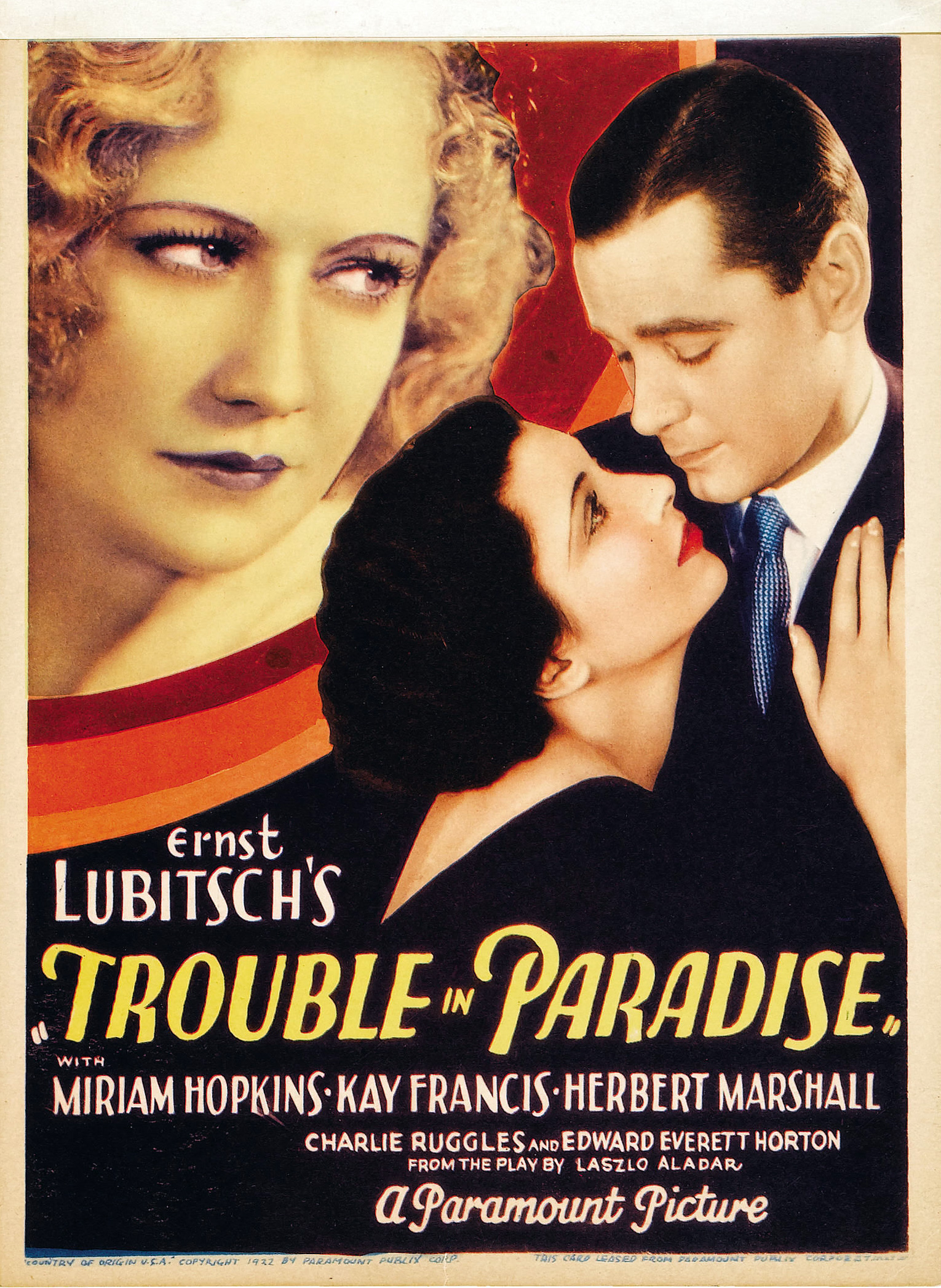
#348) Trouble in Paradise (1932)

MV5BY2E5ODgyYmQtY2Q0ZS00N2MyLWJhYzktYTliMWEyOWM2OGNiXkEyXkFqcGdeQXVyMDI2NDg0NQ@@._V1_

#348) Trouble in Paradise (1932)

OR “Thief Encounter”

Directed by Ernst Lubitsch

Written by Samson Raphaelson and Grover Jones. Based on the play “The Honest Finder” by Aladar Laszlo.

Class of 1991

No trailer, but here’s a clip

The Plot: Wealthy socialites Gaston Monescu (Herbert Marshall) and Lily Vautier (Miriam Hopkins) meet in Venice and are instantly attracted to each other. Gaston and Lily reveal to each other that they are both con artists, and decide to team up to rob Paris perfumery magnate Mariette Colet (Kay Francis). Things get complicated when Gaston starts to have feelings for Mariette, and he begins to question the con. Added to the mix are Mariette’s two suitors Francois Filiba and The Major (Edward Everett Horton and Charlie Ruggles), and the kind of light, sophisticated comedy Ernst Lubitsch has become known for.

Why It Matters: The NFR calls the film a “frothy gem” with “saucy dialog”. The write-up goes on to describe the “Lubitsch Touch” as “an easy comedic elegance which characterized the films of director Ernst Lubtisch”.

But Does It Really?: I had never seen “Trouble in Paradise”, and I was charmed by its light humor and risqué subject matter. That being said, I’m surprised that it’s not only on the NFR, but made it in its third go-round. The “Lubitsch Touch” was already represented on the NFR with “Ninotchka” the year prior, and I’m amazed “Trouble in Paradise” made the cut before “To Be or Not To Be” or “The Shop Around the Corner”. I’ll give “Trouble in Paradise” a “minor classic” designation: an enjoyable film that holds up well, but not in the same league as some of Lubitsch’s other classics.

Everybody Gets One: Both Herbert Marshall and Kay Francis were big stars in their day that are not well remembered today. Kay Francis was a stage actor who made her film debut in “The Cocoanuts” with the Marx Brothers, and was a few years away from becoming the biggest star on the Warner Bros. lot. Herbert Marshall also started on the stage, a career that was interrupted by WWI. During his service, Marshall was shot in his right knee by a sniper, and his entire leg was amputated. After the war, Marshall returned to the stage, and transitioned to film in the late ‘20s, all the while keeping his prosthetic leg out of the limelight.

Wow, That’s Dated: It was a lot easier to be an international thief before the internet. In addition, this film features switchboard operators, radio programs, and a then-current reference to the Stock Market Crash.

Take a Shot: No one says the title, but we do get a title song performed by noted tenor Donald Novis.

Seriously, Oscars?: No Oscar love for “Trouble in Paradise”, but the film did make the National Board of Review’s year-end Top Ten list. Ernst Lubitsch received three Best Director nominations in his career, but never won. He did, however, receive an honorary award from the Academy in March 1947, eight months before his death.

Other notes

  • “Trouble in Paradise” only bares a passing resemblance to its source material “The Honest Finder”. Lubitsch encouraged Raphaelson to not read the play and base the film on George Manolescu, a real-life con artist at the turn of the century. Co-writer Grover Jones contributed very little to the actual screenplay; his credit was a contractual obligation to Paramount.
  • This film is technically leaps and bounds ahead of other early sound films. For starters, there’s an underscore! It’s still early days, but it helps highlight the romanticism of the whole thing. We also get a couple of montages throughout “Paradise”, which means scene wipes a-plenty!
  • Miriam Hopkins strikes me as Lubitsch’s proto-Carole Lombard. She doesn’t quite have Lombard’s combination of funny and sexy, but she’s close. I suspect Lombard’s rise to prominence was the cause of Hopkins’ decline in the late ‘30s.
  • I must say Herbert Marshall is quite charming in this film. It’s a shame he doesn’t have more classics on the resume.
  • Speaking of Marshall: watch closely during the shots where Gaston runs up and down stairs. Because of Marshall’s aforementioned war injury, he used a double for any shots involving strenuous physical activity.
  • Oh man, that is the most suggestive dissolve I’ve ever seen. Gaston and Lili are holding each other on a chaise, followed by a dissolve to an empty chaise. Quel scandale.
  • Fun Fact: Both Charles Ruggles and Edward Everett Horton would go on to become regular voice actors on “Rocky & Bullwinkle”.
  • Oh Edward Everett Horton, how I’ve missed your double take.
  • Kay Francis doesn’t strike me as your sexy leading lady-type, but I’m happy to be proven wrong. My favorite line is her sultry reading of “Because I want to make it tough for you.”
  • Another risqué pre-code moment: Gaston and Mariette have an intimate moment while their shadows are projected onto a bed. The censor boards must have had a fit with that one.
  • Ultimately, I feel the same way about “Trouble in Paradise” as I did “The Thin Man”: it’s a well-crafted screenplay with charming performances, but overall the film has lost some of its initial luster. Still enjoyable, but not the first on anyone’s must-see list.

Legacy

  • “Trouble in Paradise” was successful in its day, but once the Hays Code went into full effect, the film more or less disappeared. The Production Code denied a potential 1935 re-release, as well as a planned musical remake in 1943. “Paradise” didn’t make the late night movie circuit until 1958, where it started to get rediscovered.
  • Everyone involved in “Trouble in Paradise” went on to bigger and better. As previously stated, Lubitsch had his share of classics coming up, and Kay Francis became Warner Bros.’ number one star, until Bette Davis came along and Francis was labeled “box office poison”. Herbert Marshall transitioned from dashing leading man to dashing character actor, most memorably as Bette Davis’ sickly husband in “The Little Foxes”.
  • Miriam Hopkins’ star also rose after “Trouble in Paradise”, leading to an Oscar-nominated performance in “Becky Sharp”, the first film made in three-strip Technicolor. Like Marshall, she transitioned to supporting turns, most notably as Olivia De Havilland’s aunt in her other NFR entry: “The Heiress”.
  • Wes Anderson listed “Trouble in Paradise” among the influences on “The Grand Budapest Hotel”, particularly with Ralph Fiennes’ character. Yeah, I see it.
  • And of course, the film’s long-gestating drastic departure of a sequel: “Stranger Than Paradise”. Fact: Before I started this blog I could not have told you the difference between these two films. Talk about night and day.

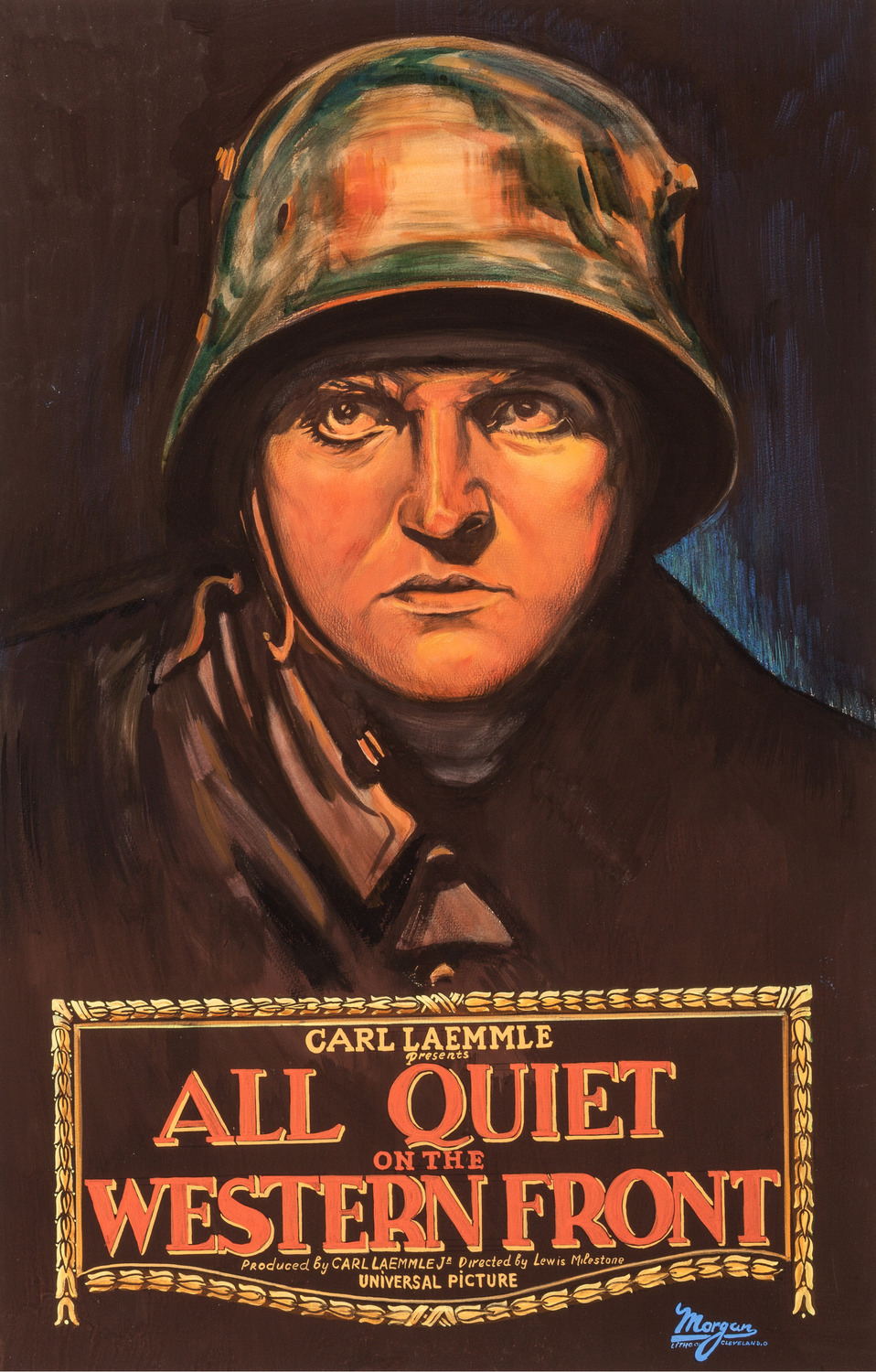
#347) All Quiet on the Western Front (1930)

all_quiet_on_the_western_front_xlg

#347) All Quiet on the Western Front (1930)

OR “Milestone’s Milestone”

Directed by Lewis Milestone

Written by Maxwell Anderson, George Abbott and Del Andrews. Based on the novel by Erich Maria Remarque.

Class of 1990

NOTE: “All Quiet on the Western Front” is currently available in its restored cut, which, while the most exhaustive known print of the film, is 20 minutes shorter than its original release. Check your attics.

The Plot: The Great War has broken out, and a group of German students are motivated to enlist when their professor (Arnold Lucy) gives an impassioned speech about “saving the Fatherland”. Told primarily from the point of view of young Paul Bäumer (Lew Ayres), the boys’ idealistic view of war is immediately shattered following a series of unforgiving battles and harsh living conditions. Although older unit member “Katz” Katczinsky (Louis Wolheim) takes the boys under his wing, nothing can protect them from the mental and physical anguishes of war. “All Quiet on the Western Front” was the first major piece of literature to show World War I from the perspective of the Germans, many just as patriotic and naïve as their American counterparts.

Why It Matters: The NFR calls it “among the greatest antiwar films ever made” and praises director Milestone. There’s also talk of the film’s production value and subsequent controversy (see “Legacy” below). An essay by Garry Wills discusses the film’s restoration.

But Does It Really?: “All Quiet on the Western Front” seems to have gotten lost in the shuffle of classic movies, which is a shame because it is still one of the greats. Every anti-war film since 1930 has taken a page from “Western Front”, and much of the film still holds up remarkably well. Kudos to Lewis Milestone and his team for making a war movie that can still elicit an emotional response from its audience almost a century later.

Everybody Gets One: Most of the supporting cast, notably Louis Wolheim. Born in New York City, Wolheim started in film with some encouragement from John and Lionel Barrymore. Thanks to a nose injury sustained in his youth, Wolheim was usually relegated to playing thugs and lowlifes, but director Lewis Milestone enjoyed casting him against type in such films as this and “Two Arabian Knights”.

Take a Shot: Weirdly, they don’t say the title in the movie, even though it’s one of the final lines of the novel and is, ya know, the whole crux of the damn thing!

Seriously, Oscars?: “All Quiet on the Western Front” was one of the biggest hits of the year and received four Oscar nominations at the 3rd annual ceremony. “Western Front” became the first movie in Oscar history to win both Best Picture and Best Director, which ended up being its only two victories. Most egregious: the film wasn’t even nominated in the brand new Best Sound category, and Arthur Edeson lost Cinematography to a documentary! A documentary for God’s sake!

Other notes

  • For you theater geeks out there, screenwriter George Abbott is the legendary theater director/producer of such shows as “The Pajama Game” and “Damn Yankees”. He lived to be 107 years old!
  • Cinematographer Arthur Edeson earned his Oscar nomination. There’s a lot of powerful storytelling being told with that camera. Also, either Edeson or Milestone really liked shots that start outdoors and move indoors. We get several such shots throughout the film.
  • Holy crap these boys were really whipped into a frenzy by Professor Kantorek’s speech. “Dead Poets Society” this is not.

https://www.youtube.com/watch?v=dxitujxRS-s

  • I don’t know much about WWI, but I’ve always wondered: how many accidents did the German soldiers have with those helmets?
  • This must be that section of Germany where only one out of every hundredth person has an accent.
  • Katczinsky seems like a cross between Alan King and Teddy from “Bob’s Burgers”. I see why they cast Ernest Borgnine in the remake.
  • Just a reminder that every effect in this movie is practical. Those are real explosions with real actors. It’s effects like these that help the film remain relevant.

https://www.youtube.com/watch?v=Ciq9ts02ci4

  • Speaking of, the film’s first casualty got to me. Not bad for a 90 year old movie.
  • The battles scenes are an impressive feat of filmmaking. In addition to the aforementioned practical effects, the sheer scope of this production is a sight to behold. Coordinating these scenes could not have been easy.
  • I’m gonna complain about the film’s lack of a Best Sound nomination a bit more. “Talkies” had only been around for three years at this point; surely “Western Front” was one of the first movies to understand the importance of sound effects as a storytelling device. The sound of machine guns and biplanes punctuate the battle scenes more than any musical score could. I see you, recording supervisor C. Roy Hunter.
  • The whole sequence of Paul trying to keep the French soldier alive is really intense. It’s the kind of psychological warfare amidst the physical warfare that never gets into war movies.

https://www.youtube.com/watch?v=mw96cSYo9dU

  • I was not expecting to see any brief nudity in this movie. And I definitely wasn’t expecting to see a potential “shrinkage” joke. I was in a pool!
  • Film comedian ZaSu Pitts was originally cast as Paul’s mother, but test audiences automatically laughed at her appearance, and Milestone re-shot her scenes with stage actor Beryl Mercer. Pitts can still be seen in the original trailer.
  • The final scene with the butterfly was an afterthought, and Lewis Milestone’s hand subs for Lew Ayres. It’s still one of filmdom’s true “precious images”, and is immediately followed by one of the most haunting final shots ever.

https://www.youtube.com/watch?v=nMlDPsRwZE4

Legacy

  • “All Quiet on the Western Front” opened to a positive reception in America, but Europe was a different story. Poland wouldn’t screen the film due its perceived pro-German stance, while Germany banned it for its perceived anti-German stance. I guess you see what you look for.
  • Once the Nazis took power in Germany, the film was met with disruptive protests during screenings, and subsequently banned from theaters. Moreover, copies of the original novel were among the first to be burned by the Nazis.
  • Lewis Milestone’s next movie was a little more light-hearted and far less controversial: the comedy (and fellow NFR entry) “The Front Page”. Louis Wolheim was all set to play Walter Burns, but died of stomach cancer before filming began, and was replaced by Adolphe Menjou.

https://www.youtube.com/watch?v=yd279jTd9HQ

  • The original novel got a semi-sequel with “The Road Back”, which Universal made into the 1937 film of the same name. Directed by James Whale and featuring only a handful of returning characters, the film’s more anti-Nazi stances were deleted to ensure box office success overseas.

https://www.youtube.com/watch?v=jgQJxBkW8SQ

  • The novel was adapted into a TV Movie in 1979 with Richard “John Boy” Thomas as Paul and Ernest Borgnine as Katz. Another remake has been languishing in development hell for longer than the war it’s trying to replicate. [2023 Update: Don’t know if it’s the same adaptation that was in development hell, but another film of “All Quiet” is out and apparently very good. Like, surprise Oscar contender good.]

https://www.youtube.com/watch?v=DX1PW2n8POg

#346) Dr. Strangelove (1964)

dr_strangelove_xlg

#346) Dr. Strangelove (1964)

OR “How I Learned to Stop Worrying and Love the Bomb” (Alright, a freebie!)

Directed by Stanley Kubrick

Written by Kubrick & Terry Southern & Peter George. Base on the book “Red Alert” by Peter George.

Class of 1989

The Plot: At the height of the Cold War, the United States Air Force has B-52 bombers in the air at all times, always within two hours of their Russian targets. Overcome with Communist paranoia, General Jack D. Ripper (Sterling Hayden) issues an air strike without permission, and locks himself and RAF Captain Lionel Mandrake (Peter Sellers) in his office. President Merkin Muffley (Peter Sellers) is briefed on the situation by both the war-hungry General Buck Turgidson (George C. Scott) and nuclear scientist/former Nazi Dr. Strangelove (Peter Sellers). Eventually all bombers are notified to abort the mission, except for one piloted by Major Kong (Slim Pickens) who is hell-bent on going “toe-to-toe with the Rooskies”. World War III hangs in the balance in the darkest comedy ever made.

Why It Matters: The NFR praises the film’s “edgy satire” and “outrageously funny performances”. There’s also an essay by film studies Professor Wheeler Winson Dixon, author of “Dark Humor in Films of the 1960s”.

But Does It Really?: No question about it: “Dr. Strangelove” is filmdom’s definitive black comedy. Only a skilled filmmaker like Stanley Kubrick can simultaneously illuminate the very real danger of nuclear war and the inherent ridiculousness of political and military power. “Strangelove” is one of the rare movies where every department is firing on all cylinders, and more importantly, the rare comedy where everyone’s in on the joke. “Dr. Strangelove” seems to only get better with age, continuing to be laugh-out-loud funny while still maintaining its dire warning about human unpredictability. An undisputed classic, and a natural for the NFR.

Everybody Gets One: Original “Red Alert” author Peter George, and editor Anthony Harvey, who went on to direct “The Lion in Winter”.

Wow, That’s Dated: While still easy to follow today, the plot of “Strangelove” contains numerous references to Cold War paranoia that is lost on modern viewers. One example: Ripper’s conspiracy theory about Communist water fluoridation was a real conspiracy theory at the time!

Seriously, Oscars?: “Dr. Strangelove” was set to premiere in December 1963, but was delayed until January 1964 in response to America’s somber mood following the Kennedy assassination. “Strangelove” went on to be a hit, and received four Academy Award nominations: Picture, Director, Actor (for Sellers), and Adapted Screenplay. The film lost in the first three categories to that year’s big winner “My Fair Lady”, while Adapted Screenplay went to “Becket”. Not surprising for a British co-production, “Strangelove” did far better at the BAFTAs.

Other notes

  • Kubrick and Peter George had intended to adapt “Red Alert” into a straightforward drama, but found some aspects of the nuclear arms race utterly ridiculous. Writer/satirist Terry Southern was then brought on board to help shape the film into a black comedy.
  • Just from the opening credits you know something is going to be different about this movie. Not every Cold War drama begins with suggestive footage of refueling jets.
  • Thanks to this blog, I now get why it’s funny having Sterling Hayden play Jack D. Ripper. Hayden is essentially doing what would be perfected in “Airplane!”: playing to his previous dramatic typecasting in a ridiculous comedy.
  • That’s James Earl Jones (in his film debut!) as one of the bomber pilots. Jones is one of a handful of artists with two films in the NFR inaugural class.
  • This whole post can be me gushing about Peter Sellers, right? None of his three characters are individually incredible, but the fact that Sellers pulls off all three is a testament to his talent. Strangelove is Sellers’ chance to show off broad yet disciplined physical comedy, while both Muffley and Mandrake let him play more low-key, reactionary humor. Plus that’s a solid American accent he’s got there: flat, yet colorful.
  • Sellers was originally cast in a fourth role as Major Kong, but sprained his ankle (some suggest intentionally to get out of the part), with Slim Pickens becoming his 11th hour replacement. No one told Pickens the film was a comedy, so he played it “straight”, and the rest is film history.
  • Shout out to Tracy Reed as Miss Scott. She’s the only woman in the movie and she’s treated like a sex object the whole time. Look how far we’ve come!
  • George C. Scott has better performances on his resume, but he’s never been funnier. It helps that Kubrick essentially tricked Scott into playing the role over-the-top during “rehearsal” takes, which infuriated Scott upon seeing the final film.
  • Shout out to Ken Adam for that War Room set. An iconic set piece from the man who gave you the iconic set pieces of the Connery-era Bond films.
  • This film is definitive proof that comedy is drama plus details. There’s nothing funny about nuclear annihilation, but once you add details like “precious bodily fluids” and a Coca-Cola machine, you find the film’s humorous dark streak.
  • You may have noticed a lot of quick cuts during Muffley’s phone call with the Soviet Premier (and later during Strangelove’s monologues). My assumption is that the film cuts away right before the cast and crew break-up from one of Peter Sellers’ ad-libs. You can even see Peter Bull as the Soviet ambassador starting to crack a smile in some takes.
  • Turgidson falling and getting back up mid-sentence is still one of my favorite moments in any film.
  • Nice to see you Keenan Wynn, but why are you saying “prevert” instead of “pervert”? Was there a typo in the script?
  • Another “Wow, That’s Dated”: Mandrake’s climactic moment hinges on him having enough change for a pay phone.
  • Major Kong riding the bomb. It’s just one of those perfect film moments where everything clicks. I agree with Roger Ebert that the film should have ended there.
  • That being said, a montage of bombs going off set to Vera Lynn’s “We’ll Meet Again” is an inspired choice. It is the perfect dark button to a perfectly dark film.

Legacy

  • This film is so good even its trailer has a legacy. Designed by Pablo Ferro (who also did the opening credits), the trailer’s quick jump cuts and avant-garde style was revolutionary in the early ‘60s, and changed the studio’s approach to promoting their coming attractions.
  • The making of “Strangelove” is covered in “The Life and Death of Peter Sellers”, with Geoffrey Rush as Sellers and Stanley Tucci as Kubrick.
  • “Dr. Strangelove” has had its share of parodies and references over the years, primarily allusions to the “bomb riding” shot. Here’s “The Simpsons” with more.
  • Believe it or not, Kubrick briefly entertained the idea of a “Strangelove” sequel in the mid-90s. Terry Southern returned to write “Son of Strangelove” about the Doctor’s time in the bunker, but died shortly after beginning the script. Kubrick apparently had Terry Gilliam in mind to direct.

Further Viewing: Sidney Lumet’s “Fail Safe” explores many of the same topics as “Strangelove”, albeit in a far more dramatic tone. Once Kubrick learned that “Fail Safe” was also in production, he, Peter George, and Columbia sued the film, claiming it was too similar to “Red Alert”. There was a settlement, and “Fail Safe” was released eight months after “Strangelove”. It was successful, but it ain’t on the list.