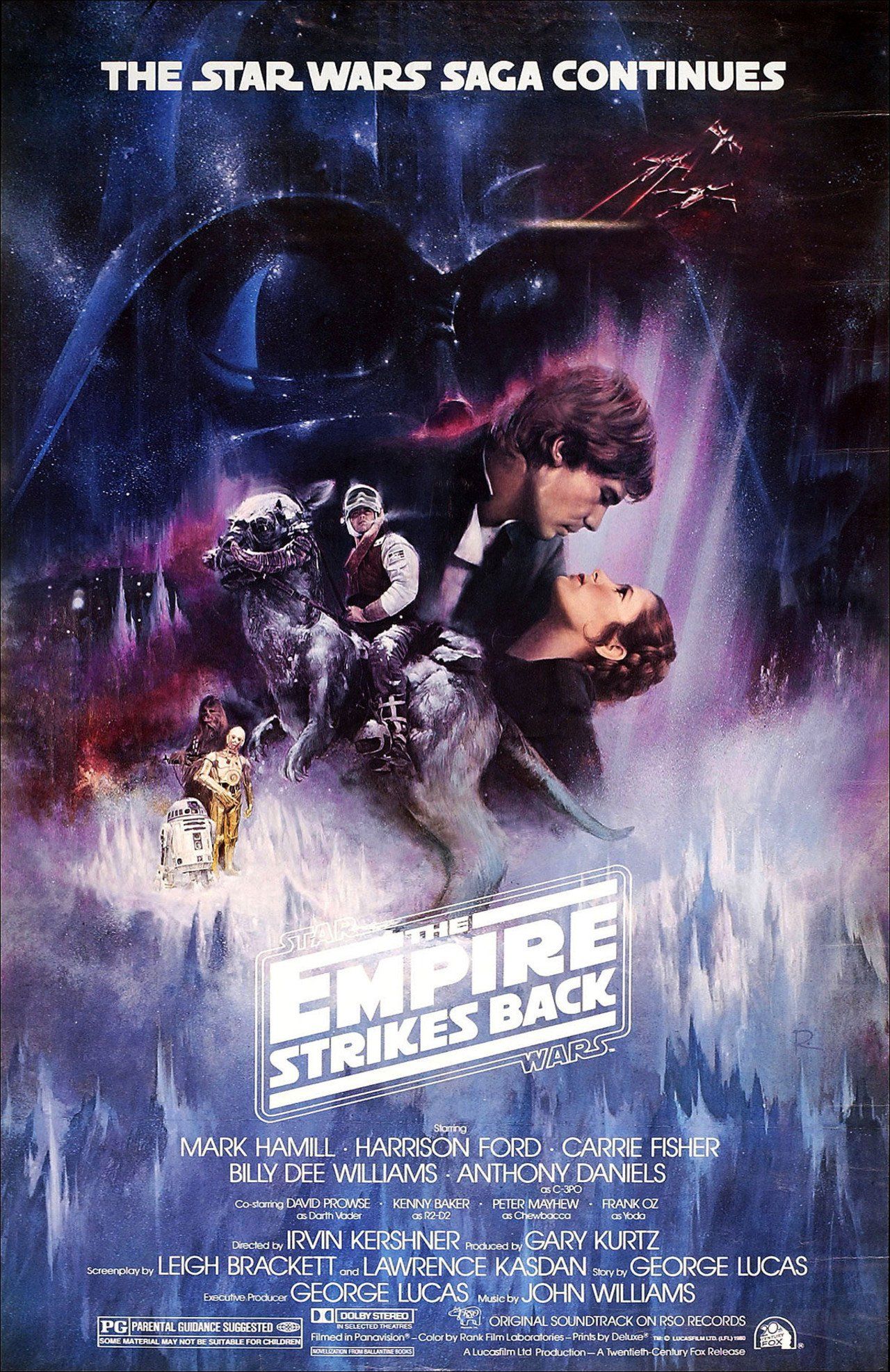
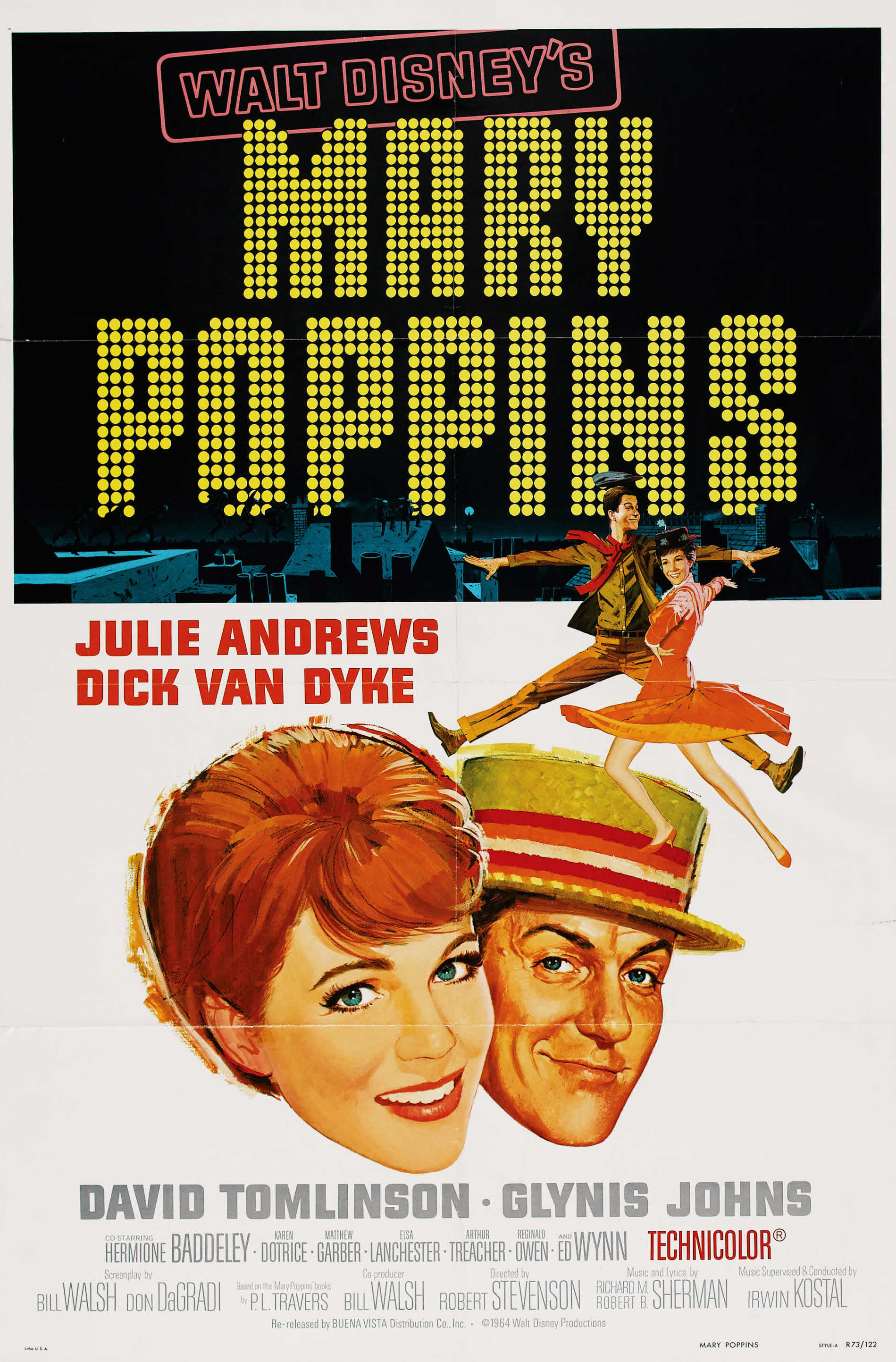
#340) Mary Poppins (1964)

MV5BNmJkODczNjItNDI5Yy00MGI1LTkyOWItZDNmNjM4ZGI1ZDVlL2ltYWdlL2ltYWdlXkEyXkFqcGdeQXVyMDI2NDg0NQ@@._V1_

#340) Mary Poppins (1964)

OR “The Umbrella Movement”

Directed by Robert Stevenson

Written by Bill Walsh & Don DaGradi. Based on the books by P.L. Travers. Songs by Richard & Robert Sherman

Class of 2013

The Plot: In Edwardian London, George & Winifred Banks (David Tomlinson & Glynis Johns) are having difficulty hiring a nanny for their children Jane & Michael (Karen Dotrice & Matthew Garber). One day the east wind brings the arrival of Mary Poppins (Julie Andrews), a no-nonsense woman full of surprises in her bottomless carpetbag. Accompanied by resident jack-of-all-trades Bert (Dick Van Dyke), Mary and the children have several magical adventures/catchy musical numbers. But can Mary’s magic bring the Banks family back together?

Why It Matters: Someone at the NFR really likes “Mary Poppins”, praising, among other things, “a witty script, an inventive visual style and a slate of classic songs”.

But Does It Really?: As with many a Disney movie, it’s hard for me to be completely objective with “Mary Poppins”. It’s been years since I’ve seen it, but I’m happy to say that I watched most of the movie with a big grin on my face. “Poppins” still works as an entertaining family fantasy, aided by a surprisingly smart script, appealing lead performances by Andrews and Van Dyke, and a song score with no weak link. “Mary Poppins” is an iconic musical that only gets better with age, and another no-brainer for the NFR.

Everybody Gets One: This is the only NFR appearance for longtime Disney staples Stevenson, Walsh, DaGradi, and the Sherman Brothers. Among the cast members: Comedy legends Dick Van Dyke and Ed Wynn, Oscar nominee Hermione Baddeley, and fish and chips namesake Arthur Treacher.

Wow, That’s Dated: Shoutout to Peter Ellenshaw: those matte paintings might date this film, but they are works of art.

Seriously, Oscars?: “Mary Poppins” was the biggest hit of Walt Disney’s career, and found itself in direct competition at the Oscars with another Edwardian era musical: Warner Bros.’ “My Fair Lady”. “Poppins” led with 13 nominations, with “Lady” close behind with 12. “Lady” was the big winner of the night with eight Oscars, including Best Picture, but “Poppins” still took home five. Being passed over for “My Fair Lady” helped Julie Andrews win Best Actress, and “Poppins” won additional prizes for Editing, Special Effects, Original Score, and Original Song (“Chim-Chim-Cheree”).

Other notes

  • The entire song score is justifiably iconic, but special mention must go to orchestrator Irwin Kostal, who turns the songs into character motifs that enhance and enrich the film.
  • It’s a good thing Dick Van Dyke is so charming, because that atrocious Cockney accent lives up to its notoriety. Were none of the film’s British cast members willing to give pointers?
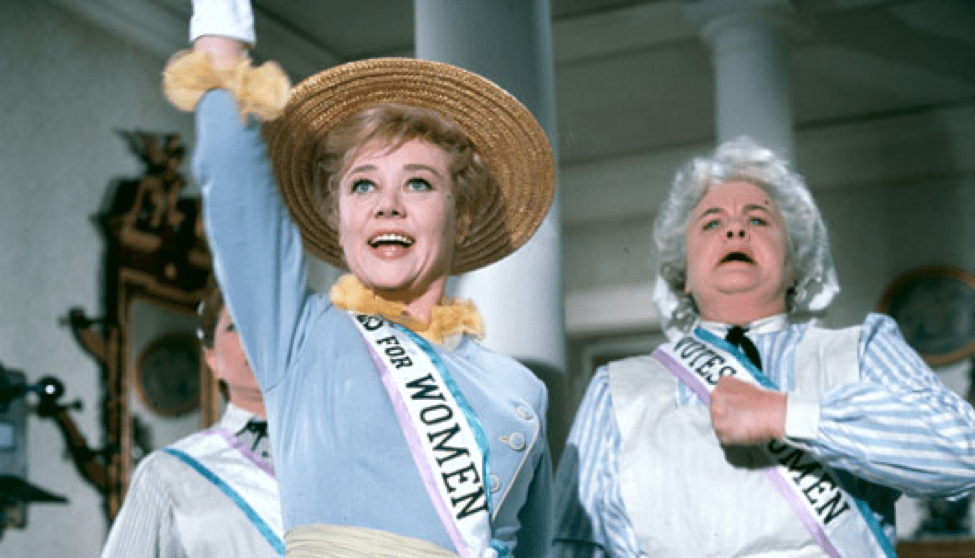
  • Not primarily known as a singer, Glynis Johns is nevertheless best remembered for her performance of “Sister Suffragette” (and a certain oft-covered show tune). But why is the song cut off? There were literally two notes left!
  • It’s a slight departure from Travers’ characterization, but Julie Andrews has a nice handle on Mary Poppins. Julie’s performance is remembered as sweet, but she’s more strict and curt than people seem to remember. It’s only at the end that Disney gives Mary some uncharacteristic sentimentality.
  • It’s mostly process shots, but the effects in “Spoonful of Sugar” are still a lot of fun to watch.
  • How can you not love “Jolly Holliday”? A catchy song topped off with inspired animation and an enchanting penguin dance number. That being said, the verse about Mary and Bert being platonic isn’t fooling anyone. Those two did it and you know it.
  • “Supercalifragilisticexpialidocious” is not only the film’s most iconic number; it’s also the word to say when you can’t think of what superlative to give “Mary Poppins”. Julie and Dick sell the song, but they’re no DJ Jazzy Jeff and the Fresh Prince.
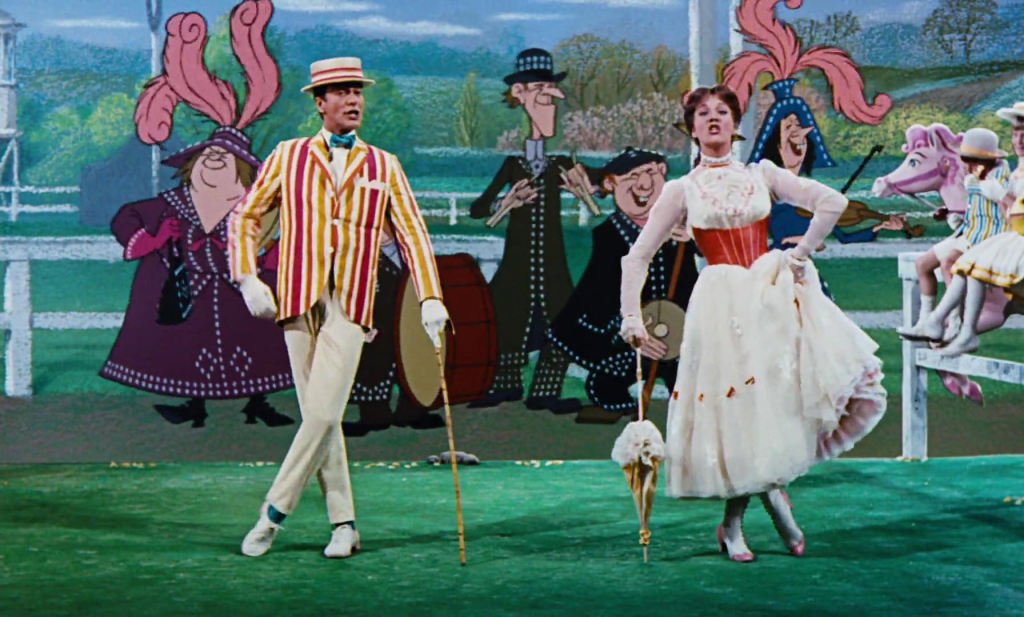
  • Damn it Mary, stop gaslighting the kids!
  • That’s Jane Darwell (Ma Joad from “The Grapes of Wrath”) in her final film role as the Bird Woman. Walt Disney personally coaxed Darwell out of retirement to play the part. Oddly enough, her one line of dialogue is dubbed.
  • Dick Van Dyke successfully lobbied Walt to play a second role, bank chairman Mr. Dawes Sr. The old-age makeup is quite convincing (to the point where the child actors didn’t know who it was), and more peculiar, Van Dyke’s British accent is far less obtrusive than his Cockney one.
  • “Chim-Chim-Cheree” is a fun song and Bert’s unofficial motif, but the Oscar for Best Song? There are at least three other songs in the score I would have given the award to over this one.
  • Why is all the furniture covered during the final part of “Step in Time”? Are the Banks moving?
  • David Tomlinson is clearly relishing Mr. Banks’ Scrooge moment at the end. As they say, cast for the third act.
  • Has anyone else noticed that Mary Poppins doesn’t have much to do in the third act? She has the day off, her only song is a brief duet with Bert, and it’s Bert who helps Mr. Banks see the error of his ways, not Mary. And once we get to “Let’s Go Fly a Kite”, all Mary does is leave. Poppins is doing the bare minimum I expect from my title character.

Legacy

  • “Mary Poppins” was a runaway hit for Disney, and both Julie Andrews and Dick Van Dyke became overnight movie stars. In fact, Andrews secured her next movie, “The Sound of Music”, during “Poppins” when Robert Wise and Ernest Lehman saw some early rushes.
  • Walt Disney used the profits from “Poppins” to start secretly purchasing land in Orlando, Florida; the eventual site of the Walt Disney World resort.
  • Several fantasy family musicals were made in the ensuing years with the hopes of being the next “Mary Poppins”. Many, including “Chitty Chitty Bang Bang” and “Bedknobs and Broomsticks”, hired much of the “Poppins” creative team, but none hit the “Poppins” bulls-eye.
  • P. L. Travers was very critical of the film and consistently vetoed any further “Poppins” projects from Disney, including a sequel and a stage musical. Travers’ passing in 1996 led to some more civil negotiations between Disney and the Travers estate. The eventual results were a stage show co-produced with Cameron Mackintosh, and a sequel with Emily Blunt as Mary.
  • Everyone has spoofed this movie over the years, but “The Simpsons” and Shary Bobbins are still the gold standard. I found myself singing “Cut Every Corner” during “Spoonful of Sugar”.
  • The reluctant collaboration between P.L. Travers and Walt Disney is dramatized in the film “Saving Mr. Banks” with Emma Thompson and Tom Hanks. “Banks” was released in December 2013, the same month “Mary Poppins” was added to the NFR. What an amazing coincidence I’m sure Disney had nothing to do with.
  • Although the message of “Feed the Birds” is still an important one, please do not actually feed the birds in front of St. Paul’s Cathedral. It is illegal thanks to this movie.
  • And of course:

Further Viewing: The Sherman Brothers’ prolific songwriting career and tumultuous personal relationship is chronicled in the heartening documentary “The Boys”.

#339) Uncle Tom’s Cabin (1914)

lossy-page1-1200px-Uncle_Tom's_Cabin_featuring_Irving_Cummings_LCCN2005679771.tif

#339) Uncle Tom’s Cabin (1914)

Directed by William Robert Daly

Written by Edward McWade. Based on the novel by Harriet Beecher Stowe and the stage adaptation by George L. Aiken.

Class of 2012

In the alleged words of Clark Gable, “Let’s get this over with.”

The Plot: Tom (Sam Lucas) is a slave on a Kentucky plantation who is sold to the benevolent St. Clair (Garfield Thompson) when his owner (Walter Hitchcock) must pay off his debts. Once in New Orleans, Tom finds himself bonding with St. Clair’s daughter Eva (Marie Eline) over their shared Christianity. Following the tragic deaths of both Eva and St. Clair, Tom is sold to the vicious Simon Legree (Roy Applegate) in Louisiana. Only Tom’s faith in God keeps him going in this increasingly problematic American story.

Why It Matters: The NFR brings up this version’s main talking point as “the first feature-length American film that starred a black actor” and how this “set an important milestone in American movie history.” There’s also an extended essay by English professor Stephen Railton.

But Does It Really?: This…is a tough one. The novel “Uncle’s Tom Cabin” is a Pandora’s box of American race relations. On the one hand, the book helped spark the abolitionist movement, but on the other hand, it inadvertently prolonged the negative African-American stereotypes of the day (some would argue to the present). I will not try to defend the book and its place in our history; I’m just here to watch the movie. This “Uncle Tom’s Cabin” is one of several made during the silent era, and having Sam Lucas as the lead is a point in its favor. I don’t believe in censoring art or sweeping our national mistakes under the rug, so sooner or later we have to confront “Uncle Tom’s Cabin”, and this version might as well be the one to start the conversation. If you’re going to watch this “Uncle Tom’s Cabin”, make sure to do your homework first.

Everybody Gets One: The son of former slaves, Sam Lucas found fame by performing blackface in minstrel shows, using his success to pursue more dramatic avenues. In 1878, Lucas became the first African-American to play Uncle Tom in a serious stage version of “Uncle Tom’s Cabin”. Nearly 40 years later, Lucas reprised the role in this film version, a role previously played by white actors in blackface. Speaking of…

Wow, That’s Dated: This is one of the movies I had in mind when I came up with the BLACKFACE WARNING. Uncle Tom is the only major African-American character in the film actually played by an African-American. All the others are played by white actors either in blackface (Topsy) or with no makeup, with the explanation that they’re mulatto (Eliza and George). And that’s just scratching the surface of what’s dated about this movie.

Other notes

  • Before we go any further, there are a few things you need to know about “Uncle Tom’s Cabin”. The original 1852 novel was staunchly anti-slavery, though Harriet Beecher Stowe’s solution to the problem seemed to be…Christian love? The book was a success, but raised a lot of ire from the pro-slavery population. Copyright laws were more lax back then, and several stage productions of “Uncle Tom’s Cabin” appeared throughout the country. Many of these were re-written to give the story a pro-slavery tint, relying on many of the African-American stereotypes of the day, including “Uncle Tom”; the African-American always subservient to their white master. These “Tom shows” became better known than the original novel, leading to today’s somewhat misguided notion that the book is pro-slavery.
  • Off the bat, this film version is closer to Stowe’s original intent, referring to the slave owners as “heartless traitors” in the first intertitle. It helps that this film was made over 60 years after the book was first published, and over 50 years after the Emancipation Proclamation. Hindsight is 20/20. The opening intertitle also says that this story “will live forever”, which is true, just not for the reasons they thought it would.
  • One of the things I noticed is how few intertitles are in this film. The assumption was that a 1914 audience was familiar with “Uncle Tom’s Cabin” and didn’t need a refresher course. Do yourself a favor and at least read a plot synopsis before attempting to watch this movie.
  • Apparently Eliza escaping across the icy river is an iconic moment, but this version just glosses over it. That might be an artistic decision, but it also might be the result of a choppy print.
  • This whole movie is problematic for a variety of reasons, but wait until we get to Topsy. One of St. Clair’s younger slaves, Topsy is essentially every bad stereotype in one character: lazy, ignorant, prone to stealing, and on top of all this, she’s portrayed by a white actor in blackface. Topsy dares you to watch this movie.
  • “Uncle’s Tom Cabin” is a faithful, if streamlined, adaptation of the novel, with the major exception of the ending. Following Tom’s fatal whipping, an unnamed slave takes revenge by shooting and killing Simon Legree. And no, I’m not worried about spoiling the ending to the 105-year-old film version of a 167-year-old book.
  • If the new ending wasn’t enough evidence of the film’s abolitionist leanings, the final intertitle is a selection from the actual Emancipation Proclamation, with an illustration of Lincoln in the background just in case you haven’t figured it out yet.
  • This may be the one instance in film history where the book is not better.

Legacy

  • There were nine feature-length film versions of “Uncle Tom’s Cabin” between 1903 and 1927. Since the silent era ended, only one full film version has been made: a 1987 TV-movie for Showtime starring Avery Brooks, Phylicia Rashad, Paula Kelly, and a then-unknown Samuel L. Jackson.
  • Want to see something really unsettling? Here’s the 1933 Mickey Mouse cartoon “Mickey’s Mellerdrammer”, in which Mickey and friends put on a production of “Uncle Tom’s Cabin”. Three words: Mickey is Topsy.
  • Perhaps the best-known variation of the book is “The Small House of Uncle Thomas” from the increasingly problematic “The King and I”.
  • As for the cultural influence of “Uncle Tom’s Cabin”, it’s still a part of the cultural dialogue about African-American stereotypes, whether we know we’re referencing the book or not. You don’t have to watch this film version, but you should at least look up the book and learn about its history. Context doesn’t excuse anything about “Uncle Tom’s Cabin”, but it does put things in perspective.

#338) Growing Up Female (1971)

GUF-2

#338) Growing Up Female (1971)

Directed & Written by Julia Reichert and Jim Klein

Class of 2011

No footage of “Growing Up Female” that I could embed here, but this is a tribute to Julia Reichert that includes footage from the documentary.

NOTE: “Growing Up Female” is about the feminist movement of the early ‘70s and the patriarchy’s oppression of women in America. As a straight white male, I am the last person anyone needs to hear address this topic. There’s a wealth of information out there about feminism, starting with this article about second-wave feminism as seen in “Growing Up Female”. To learn more about feminism in 2019 America, turn on the news and cry.

The Plot: “Growing Up Female” is an examination of five women at different stages in their lives. Janelle is 11 and prefers playing games with boys and wearing pants instead of a skirt. Terry is a 16-year-old beauty school student who enjoys dressing up for her boyfriend than for herself. Tammy is 21 and her “independent” lifestyle may be a product of materialistic advertising. Jessica is also 21 and is raising a five-year-old daughter whose father has become unreliable. Mrs. Russell is a 34-year-old housewife who expresses her daily frustration with raising three daughters. All five of these women are serving other people in their lives while ignoring their own needs and wants. Seeing as this is 1971, perhaps a change in our national attitude towards women is in order.

Why It Matters: The NFR calls it “[a]mong the first films to emerge from the women’s liberation movement” and mentions the “cooperative of female filmmakers” who helped the film get distributed across the country.

But Does It Really?: Absolutely. “Growing Up Female” is a fascinating time capsule of binary gender norms, when a woman’s role was in service to the man in her life. At the same time, the film is gently provoking you to look a little deeper and question that perception, a concept that must have been radical in 1971. It’s an oversimplification of the feminist agenda, but “Growing Up Female” shows the little things you can change about your attitudes towards women that can start the ripple effect.

Everybody Gets One: Outside of their filmographies, there isn’t a lot of information about either Julia Reichert or Jim Klein, other than they met while attending Antioch College in the late ‘60s. “Growing Up Female” was a student project of Julia’s, and the two spent most of the 1970 spring semester producing this film.

Wow, That’s Dated: The perception of women in society solely as homemakers and mothers. “Growing Up Female” can be an encouraging viewing experience.

Wow, That’s Not Dated: The perception of women in advertisements as sex symbols and playthings. “Growing Up Female” can be an infuriating viewing experience.

Seriously, Oscars?: To the best of my knowledge, “Growing Up Female” never played an Oscar qualifying run, and was therefore ineligible. Reichert and Klein would be nominated for their later films “Union Maids” and “Seeing Red” (with Reichert receiving an additional nod for “The Last Truck: Closing of a GM Plant”) but both filmmakers have yet to take home an Oscar (2020 Update: See “Legacy” below).

Other notes

  • Once again, “Growing Up Female” was Reichert’s student project at Antioch College. Believe me, none of my student films are making the NFR any time soon.
  • It always fascinates me in these movies that no matter what time period it is, kids playing always looks and sounds the same. That’s a major pro-nurture bullet point in the “nature vs. nurture” debate.
  • I can see how Reichert and Klein were able to get such candid responses from their subjects: Julia is very conversational and down-to-earth in her interviewing, putting everyone at ease to truly speak their mind.
  • It doesn’t take long to figure out the pattern between all of these women. Just from Janelle and Terry you can learn that this movie is about women who feel oppressed by the patriarchy, but aren’t able to articulate these feelings. Terry even mentions moving to California. In other words, as far away from her current life as possible.
  • Having been born long after the feminist movement of the ‘70s, it’s easy for me to describe ‘60s sexism in its broadest “go back to the kitchen” stereotypes. What this film opened my eyes to is how much of that sexism towards women was presented by other women, typically of the older generation who obeyed their husbands without question.
  • Oh god, the Advertising Executive. Obviously, he’s there to set up the sexist attitudes of ‘60s advertising and its effect on the younger generation, but does he have to be such a dick about it? And stop calling women “chickies”!
  • The most memorable moment in the film is the extended amount of time we spend learning about Tammy, her personality, and her aspirations, only to get the reveal that she’s a secretary. That stings quite a bit.
  • Jessica’s story is the closest this film gets to dealing with the racial aspect of being a woman in America. An examination of our treatment of African-American women is a task for someone far more qualified than I. Perhaps we need a documentary called “Growing Up with Institutional Racism”.
  • All you really need to know about this movie’s stance of feminism is that all of the subjects are addressed by their first names, except for Mrs. Russell the housewife.
  • I became so caught up in these women’s stories, I actually got upset during the end credits when I realized the film was co-directed by a man. No offense to Jim Klein, who I’m sure is a lovely guy.

Legacy

  • Reichert and Klein knew that a pro-feminist film in 1971 wouldn’t get a big distribution deal, so they handled it themselves, sending 16mm copies to churches and libraries all across America. The two were later joined by fellow filmmakers Amalie Rothschild and Liane Brandon, and founded New Day Films, a company that is still going strong today.
  • Both Julia Reichert and Jim Klein are still making documentaries, though Klein seems to be focusing more on the editing side. Reichert’s most recent documentary “American Factory” premiered at this year’s Sundance Film Festival, and was acquired by Netflix.
  • 2020 UPDATE: “American Factory” won the Oscar for Best Documentary! Yay, Julia!
  • As far as I can tell, besides the title and general concept, the 1974 book “Growing Up Female: A Personal Photo-Journal” by Abigail Heyman is not directly connected to this film.
  • Does anyone know what happened to any of the women in this film? If I find out they all became unsatisfied housewives, I’m gonna be real upset.

#337) The Empire Strikes Back (1980)

842314cb211182f591e3bffc964d280f

#337) The Empire Strikes Back (1980)

OR “The Dark Father Part II”

Directed by Irvin Kershner

Written by Leigh Brackett and Lawrence Kasdan. Story by George Lucas.

Class of 2010

NOTE: As with my “Star Wars” write-up, this post is about the original, unaltered “Empire Strikes Back”.

The Plot: A slightly less long time ago in a galaxy far, far away, Darth Vader (David Prowse, voiced by James Earl Jones) is in pursuit of Luke Skywalker (Mark Hamill) and the Rebels, and has tracked their base to the ice planet Hoth. After the Empire’s attack, Luke travels to the swamp planet Dagobah and begins his Jedi training with the wizened yet wise Yoda (Frank Oz). Meanwhile, Han Solo (Harrison Ford) and Princess Leia (Carrie Fisher) escape onboard Han’s ship with the Empire in hot pursuit. They seek shelter on Cloud City, run by Han’s old buddy Lando (Billy Dee Williams). Will our heroes escape the clutches of evil? Will Vader lure Luke to the dark side of the force? And why does everyone have a bad feeling about everything?

Why It Matters: The NFR praises Kershner and states that the film is often cited as the best of the original trilogy.

But Does It Really?: No sequel can top its predecessor, but “Empire Strikes Back” comes pretty damn close. “Empire” manages to avoid all the pitfalls of a sequel and successfully expands the worlds and characters of the original. Many NFR films have sequels, but rare is the one worthy of Registry recognition. “Empire Strikes Back” justifiably ranks on this list not only as a great sequel, but a great movie, period.

Everybody Gets One: Irvin Kershner was baffled when his former USC pupil George Lucas approached him about directing the “Star Wars” sequel, having been primarily known for helming low-budget character studies like “Eyes of Laura Mars”. Kershner finally accepted the job, and started meeting with screenwriter Lawrence Kasdan to find the humanity underneath the hardware.

Seriously, Oscars?: The highest-grossing film of 1980, “Empire” received three Oscar nominations, winning Best Sound (over “Raging Bull”, which I gripe about in that post). In addition, “Empire” received a Special Achievement Oscar for its visual effects.

Other notes

  • With this viewing, I paid close attention to the intentional differences between “Star Wars” and “Empire”. The main characters are all pushed beyond their original archetypes, and all of the first film’s reliable machinery (the Falcon, the droids) malfunctions at some point. Amazingly, the film takes a full 180 from the original’s optimism without betraying the characters or their universe. It speaks volumes of Kasdan’s screenplay, as well as the strong foundation of Lucas’ original character work.
  • Speaking of the screenplay, film noir legend Leigh Brackett wrote the first draft of “Empire”, but died shortly thereafter. Lucas was unsatisfied with Brackett’s work, and “Raiders of the Lost Ark” screenwriter Lawrence Kasdan was brought onboard. Despite still receiving screen credit, Brackett’s contributions to the final film are disputed.
  • The opening Wampa attack was NOT added to explain Mark Hamill’s reconstructed face after a car accident, which occurred a full two years before “Empire” started shooting. Besides, it was only a broken nose.
  • Han and Leia are at each other’s throats the whole film. What happened between the two movies? This is one of filmdom’s more extreme “We’re in love, but we hate each other” tropes, to the point where it actually made me uncomfortable watching it.
  • Despite his dislike of “Star Wars”, Alec Guinness agreed to return as Obi-Wan for “Empire”, on the condition he receive a small percentage of the film’s profits. Guinness completed his scenes in one day.
  • You can never convince me that George Lucas had this whole trilogy mapped out from the beginning. Exhibit A:
  • The battle of Hoth is stop-motion animation’s final hurrah before the movies switched over to computers. I blame the California Raisins.
  • Yes, Yoda has jumped around and had lightsaber battles, but Senile Muppet Yoda will always be my favorite. Kudos to Frank Oz, as well as the entire team of puppeteers.
  • I always found it hilarious that despite an infinite amount of alien species in the Star Wars universe, Dagobah is home to lizards and snakes.
  • With all this interplanetary travel, everyone in this galaxy must be extremely jet-lagged. It’s a wonder Han and Leia didn’t take a nap when they got to Cloud City.
  • Continuing the film’s theme of subverted expectations: Lando Calrissian, the series’ first morally complex character. Billy Dee Williams does a wonderfully subtle job of navigating Lando’s duality. Works every time.
  • Of course Lando is untrustworthy; he keeps mispronouncing Han’s name! Some friend he is.
  • Yoda speaks of another. Is it Rey? Was she a Kenobi this whole time? “Episode IX” hasn’t come out yet, I need to know!
  • “I love you.” “I know.” I don’t care if Harrison Ford ad-libbed it or not, that exchange is perfect.
  • Everyone gives Mark Hamill crap for his dramatic “Noooooo” once Luke learns the truth about his father. To be honest, so did I, until I finally saw this movie on a big screen as intended. The revelation is an operatic crescendo in an unapologetic space opera, and Hamill’s emotional reaction is perfect for the moment.
  • In my head canon, while Han was in carbon freeze he had very vivid hallucinations of being on Earth as both an adventurous archeologist and a jaded cop/not a robot. 

Legacy

  • “Empire” was a smash hit and work began immediately on the saga’s final chapter. “Return of the Jedi” can’t live up to its predecessors, but judged on its own merits provides a satisfying conclusion.
  • The biggest influence “Empire” had was actually behind the scenes. George Lucas left the Writers Guild and Directors Guild over a dispute involving credit placement (A film with no opening credits was a rarity in 1980). This made Lucas’ hiring pool of writers and directors for future projects much more limited.
  • John Williams’ “Imperial March” is second only to the main theme as the most iconic “Star Wars” music. Like the Wicked Witch of the West theme, the march has become shorthand for impending evil.
  • Lawrence Kasdan has continued penning Star Wars scripts, including “Return of the Jedi”, “The Force Awakens” and “Solo: A Star Wars Story”.
  • I’d like to point out that “Empire” has had the least amount of changes made to it for the Special Editions and video releases.
  • Like “Star Wars”, many moments and characters from “Empire” have found their way into pop culture. Mel Brooks as Yogurt in “Spaceballs” immediately comes to mind.
  • Despite his limited screentime, Boba Fett is the film’s breakout star. Seriously, he does nothing in this movie. I haven’t even mentioned him until now.
  • “Ben….Leia….Tom Selleck….”
  • Bad Lip Reading is always enjoyable, but man oh man do I love “Seagulls! (Stop It Now)”.

Further Viewing: Turns out Peter Mayhew would deliver Chewbacca’s dialogue on-set during production. You will never hear Chewbacca without a Surrey accent again.

#337) Good Burger (1997)

good_burger_xlg

#337) Good Burger (1997)

OR “All That and a Side of Fries”

Directed by Brian Robbins

Written by Dan Schneider and Kevin Kopelow & Heath Seifert. Based on the novel by James Joyce.

Class of 2010

The Plot: Ed (Kel Mitchell) is the likeable yet simple-minded cashier at local fast food establishment Good Burger. New hire Dexter Reed (Kenan Thompson) is forced to take a summer job at the restaurant to pay off his debt with his teacher (Sinbad). As the summer starts, Good Burger faces stiff competition from corporate chain Mondo Burger and its intense owner Kurt (Jan Schweiterman). When Dexter samples Ed’s surprisingly delicious homemade sauce, they strike a business deal and start using the sauce on their burgers. Business picks up, but is it enough to save Good Burger?

Why It Matters: The NFR calls the film a “comical character study” that “holds up impeccably today”. Special mention goes to the film’s “deft, innovative” screenplay, as well as Thompson and Mitchell being “[a]s gifted in their repartee as they were in their physical antics”.

But Does It Really?: Oh of course. While not as infallible as the NFR will lead you to believe, “Good Burger” is cinema’s definitive buddy comedy. A strong combination of farce and pathos, the film’s well-founded structure is aided by the undeniable chemistry between Kenan and Kel. A film whose seismic impact has already been felt by every comedy since 1997, “Good Burger” is still an enjoyable romp, and an obvious choice for the NFR.

Shout Outs: Brief allusions to “Shaft” and “One Flew Over the Cuckoo’s Nest”, as well as obvious homages to “Raging Bull” (the mini-golf double date) and “Citizen Kane” (Dexter’s yo-yo as a symbol of his lost childhood).

Everybody Gets One: Kenan Thompson had already made a handful of movies (including fellow NFR entry “Heavy Weights”) when he joined the cast of Nickelodeon’s sketch comedy show “All That”. There, Thompson met fellow actor Kel Mitchell, and the two collaborated on a sketch that would evolve into “Good Burger”, originally performed in the “ten-to-one” slot on an episode hosted by Leslie Nielsen.

Wow, That’s Dated: I will disagree with the NFR’s stance that “Good Burger” is timeless. The main giveaways are the film’s ska soundtrack and quick references to “American Gladiators”, Blockbuster Video and the UPN network.

Take a Shot: “Welcome to Good Burger, home of the Good Burger, can I take your order?”

Seriously, Oscars?: Despite mixed critical and box office reception, “Good Burger” managed an Oscar nomination in its most deserving category: Adapted Screenplay. The writing team lost to odds-on favorite “L.A. Confidential”, though many insiders dismissed that film’s victory as “typical Oscar snobbery”.

Other notes

  • Right from the beginning, the film expands upon the original in the right places. The world of Good Burger is given more texture and dimension, while Ed’s opening dream delves deep into our protagonist’s uncharted psyche.
  • For the record, “Good Burger” is the Sinbad movie that does exist.
  • The other ‘90s giveaway: the use of Kool & The Gang’s “Celebration”, which we would often play to celebrate good times come on.
  • A tip of my hat to the film’s sound department. The strategic use of cartoon sound effects aids the film’s comedy, rather than detracts.
  • I’m still holding out for a “Sweeney Todd” reveal that Ed’s secret sauce is made from murdered customers.
  • Surprise guest star Shaquille O’Neal: newly signed to the Lakers and star of the 1996 genie movie “Kazaam”, not to be confused with “Shazaam”, the non-existent Sinbad genie movie.
  • Ed teases Dexter by “mooing” like a chicken, which begs the question: Has anyone in this movie ever even seen a chicken?
  • Another cameo; this time by “All That” alumni Lori Beth Denberg as the bubbly Connie Muldoon. This has been more Vital Information for your everyday life.
  • Ed and Dexter’s drag scene is a comic highlight, but it turns out Kenan’s cross-dressing days were numbered.
  • That’s Linda Cardellini (eight years away from “Brokeback Mountain”) in her film debut as Heather the mental patient. Side note: Was this her “Girl, Interrupted” audition tape?
  • Just when you think this film could not possibly top itself, along comes George Clinton, “(Not Just) Knee Deep”, and some questionable safety procedures from a mental institution.
  • Don’t worry, Sinbad; I appreciated your “This Old Homie” joke.
  • “I need a hot jacuzzi!” Genius. Pure genius.
  • But seriously, why so much property damage directed at Mr. Wheat? Is this all because he administered a test on the last day of school? Seems a bit extreme, don’t you think?
  • An entire film starring Kel Mitchell, and they don’t once mention his love of orange soda? What a rip-off!

Legacy

  • Talks for a “Good Burger” sequel began soon after the film’s release. “Good Burger 2 Go” would have followed Ed and Dexter in another attempt to save Ed’s secret sauce recipe from landing in the wrong hands. The film never came to pass (for now), but there is a novelization out there.
  • Kenan Thompson joined the cast of “SNL” in 2003, and is currently its longest-serving castmember.
  • While Kel Mitchell hasn’t achieved Kenan’s level of post-“Good Burger” acclaim, he has steadily worked in both TV and film in the past 20 years (including the underrated “X’s and O’s”).
  • Kel reprised his role of Ed (along with Kenan as a different character) for a 2015 sketch on “The Tonight Show Starring Jimmy Fallon”.
  • Kenan & Kel recently announced they will be co-producing a revival of “All That”, set to debut in mid-2019. Mark your calendars!
  • And the greatest news of all: Kel Mitchell is still not dead!

Listen To This: “We’re All Dudes” by Less Than Jake (featuring Kel Mitchell) made the 2016 NRR cut, with the Registry hailing the song as “a work of incredible honesty” that “ultimately dramatizes the value of human life”. The song’s “painstaking recording session” is also highlighted.

In case you haven’t figured it out yet, Happy April Fools Day! Here’s the REAL #337.

Tony