#332) San Francisco Earthquake & Fire, April 18th 1906 (1906)

1906-earthquake

#332) San Francisco Earthquake & Fire, April 18th 1906 (1906)

Class of 2005

Today’s Oversimplified History Lesson: the 1906 San Francisco Earthquake. There’s a lot of information out there about the earthquake, so please educate yourself beyond this post. Easily the most fun way to research this: the earthquake simulation room at a San Francisco science museum whose name escapes me.

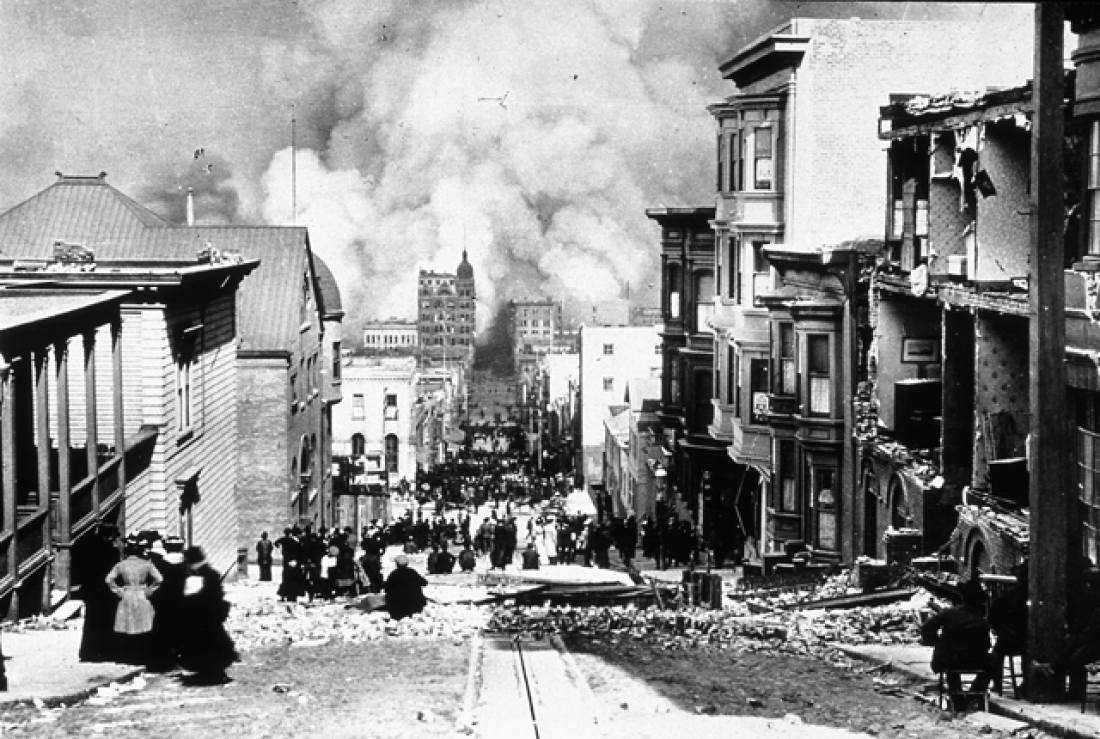
At 5:12 am on April 18th, 1906, a 7.9 magnitude earthquake hit just offshore of San Francisco. The initial destruction to most of the city’s buildings was exacerbated by the ensuing fires, which lasted the next four days. When everything finally settled, over $400 million dollars of damages had accumulated, and 80% of San Francisco’s buildings were completely destroyed. While accounts vary, the death toll is in the wide estimated range of between 700 and 3000 people, making it one of the most fatal earthquakes in world history.

While no footage exists of the actual event, this film depicts its aftermath. In 14 minutes, silent footage captures the ruins of downtown San Francisco, the immediate motions to feed and house the survivors, and the transportation of thousands of citizens by ferry to Oakland. The actual scenes might be played up a bit for the cameras, but the footage is nevertheless welcome in the National Film Registry for its historical significance.

Why It Matters: The NFR gives an overview, theorizes that some shots were “almost certainly staged”, and states that the intertitles “overdramatized and sentimentalized” the events.

Somebody Gets One: This is one of the rare NFR entries with no surviving record of who actually made it. And that’s why you always put your name on your things!

Wow, That’s Dated: Intertitles refer to “Man’s faithful friend the horse” and “odd looking automobiles”, plus…oh God, they actually say “Chinamen”.

Other notes

  • As a longtime resident of San Francisco, I realized that I’ve never really looked into this earthquake (I had just moved here during the centennial in 2006). It is a sobering experience watching streets I have travelled down many times completely covered in rubble and debris.
  • The more research I do about the 1906 earthquake, the more I have to confront this town’s longtime prejudice towards Chinatown and its inhabitants. The reason no one knows the earthquake’s actual death toll is because no one bothered to document Chinatown’s damage. Even worse, several city officials tried to use the earthquake as an excuse to get rid of Chinatown entirely.
  • Exhibit A that some of these shots were staged: several of the evacuees wave to the camera as they pass by.
  • What a dark companion piece this film must make with the other early 1900s San Francisco NFR entry: “A Trip Down Market Street”, filmed just four days before the earthquake.

Legacy

  • Many accounts of the day categorize San Francisco’s mood post-earthquake not as “devastated”, but rather “determined to rebuild” (though part of this was a business strategy to prevent companies from leaving). The cityscape of San Francisco as we know it today was created in the immediate aftermath of the earthquake. Reconstruction was more-or-less completed in time for the 1915 Panama-Pacific International Exposition, which celebrated the city’s literal rise from the ashes.
  • Perhaps the largest influence the earthquake had on San Francisco: many of the city’s major trade businesses moved to Los Angeles, causing L.A. to usurp San Francisco’s title as the largest city in California. L.A. holds that distinction to this day.
  • It should go without saying that San Francisco got really into earthquake awareness after 1906. When the Loma Prieta earthquake hit in 1989, while the structural damage was still massive, the death toll went down significantly (63, compared to 1906’s 700+). Part of that was the earthquake proofing that happened in the previous 80 years, and part of that was everyone staying home to watch the World Series (played by two Bay Area teams: the San Francisco Giants and the Oakland A’s).
  • Thousands attended the earthquake’s centennial commemoration in 2006, including 11 of the original survivors. The footage below was captured by the only friend of mine crazy enough to be in downtown San Francisco at 5am on a Tuesday.

Video courtesy of Heather Orth. Thanks, Heather!

Further Viewing: I can’t remember the name of it, but there’s a movie set in San Francisco that recreates the San Francisco earthquake. And it has a song called “San Francisco”, which later became the official song of San Francisco. What was it called? Oh man, this is gonna drive me nuts.

Listen to This: The City by the Bay’s other official song: “I Left My Heart in San Francisco”, as immortalized by Tony Bennett, and inducted into the National Recording Registry in 2018. I’m not crying, you’re crying.
#331) Eraserhead (1977)

Eraserhead

#331) Eraserhead (1977)

OR “David Lynch’s Adventures in Babysitting”

Directed & Written by David Lynch

Class of 2004

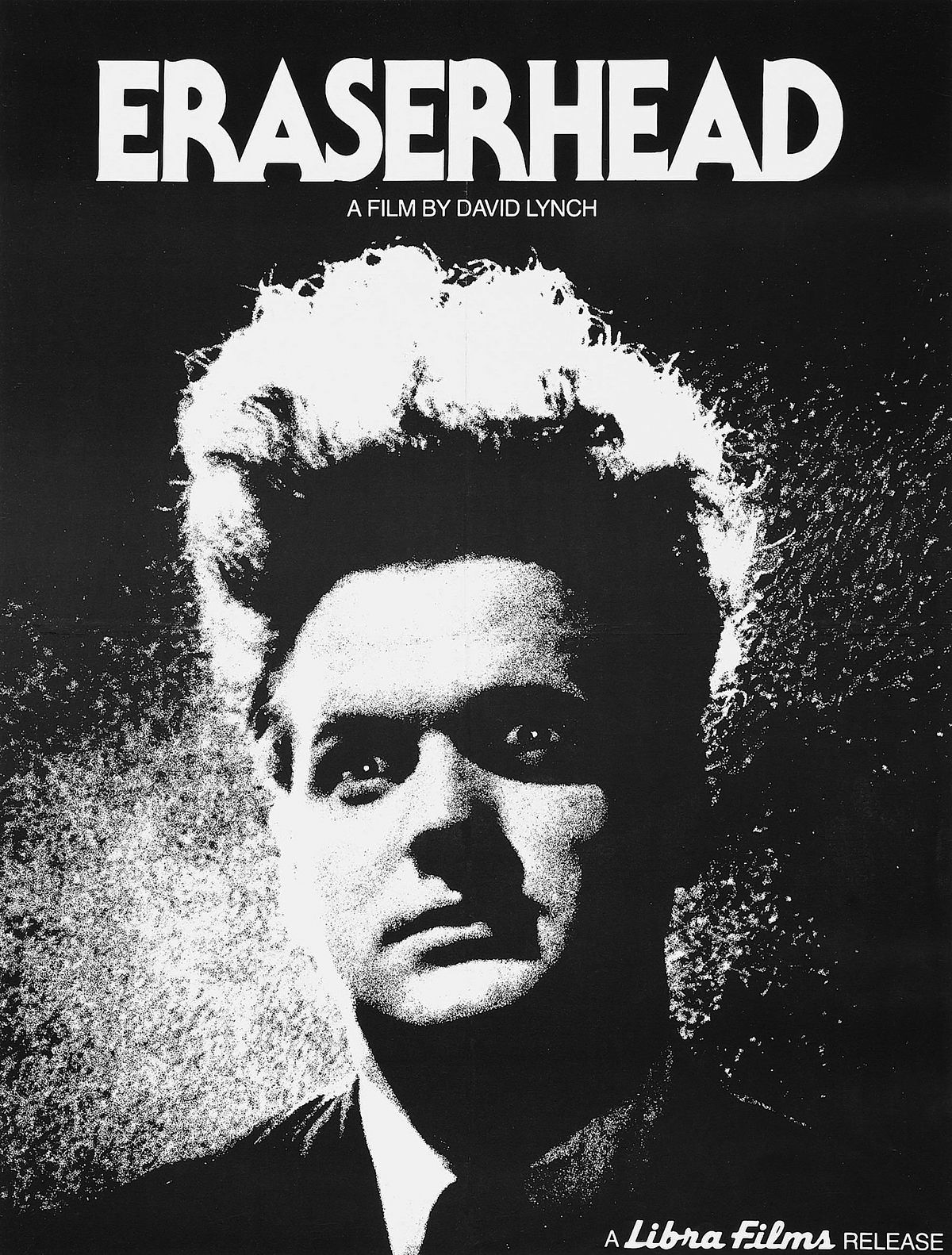
The Plot: Henry Spencer (Jack Nance) learns that his girlfriend Mary (Charlotte Stewart) has given birth to their child. At the insistence of Mary’s mother (Jeanne Bates), Henry and Mary wed, and raise the child together. Mary, however, cannot take the stress of motherhood, and abandons Henry and the baby. Sure, this all sounds like a straightforward, “Kramer vs. Kramer”-esque family drama, but it’s David Lynch, so it contains visual storytelling and imagery both offbeat and creepy as hell.

Why It Matters: The NFR calls the film “visually stunning” and praises Lynch’s “unique, surrealistic style” as well as his cult status for those “craving unorthodox filmmaking.” There’s also an essay by film critic/cult movie enthusiast David Sterritt.

But Does It Really?: Well that was the most disturbing 90 minutes of my life. Even writing about “Eraserhead” after the fact makes me a bit squeamish. Despite its occasional repellence, Lynch achieves what all the great filmmakers should; he tells a story visually and leaves a majority of it up to your interpretation. “Eraserhead” is a movie whose visuals linger in your brain long after it’s over. I’m in no rush to see this movie again, but David Lynch should definitely be on the NFR, and “Eraserhead” is a natural choice.

Everybody Gets One: David Lynch originally planned on being a painter, but his time at Boston’s School of the Museum of Fine Arts left him uninspired. At the Pennsylvania Academy of Fine Arts, a plan to turn one of his paintings into an animated short fell through, but that was enough to convince Lynch to become a filmmaker. He successfully got funding for “Eraserhead” through a grant from the American Film Institute, who thought that his 20 page script would result in a 20 minute movie. This lapse in communication led to the film’s extensive production troubles.

Seriously, Oscars?: What I would not give for “Eraserhead” to have been nominated alongside the likes of “Annie Hall” and “The Turning Point”. Mainstream America still isn’t ready for that. Although some of Lynch’s later films became Oscar nominees, none of his movies have ever won, nor has the man himself**.

Other notes

  • Lynch was inspired to write “Eraserhead” following the birth of his daughter Jennifer, who needed corrective surgery for her clubfoot. “Eraserhead” is, among other things, an expression of David Lynch’s parenting fears. Nothing strengthens the bond between father and daughter like a movie that says, “Your birth terrified me!”
  • Production was delayed several times due to lack of funds, with everyone taking on side-jobs and other projects to help pay for “Eraserhead”. Filming continued on and off from 1971 to 1976. Jack Nance stayed with the film for its entire shoot, and even maintained Henry’s iconic hairstyle the entire time.
  • Oh boy, hunker down: this opening is already quite unsettling. And what the hell is that thing? Sea monkey? Uncooked sausage? Oh…never mind, I figured it out.
  • The Man in the Planet seen throughout the film is played by Lynch’s longtime friend Jack Fisk. Fisk helped with funding when he could, as did his wife, Sissy Spacek. This movie was possibly financed by “Carrie” money.
  • Did David Lynch base Henry’s hair off of his own? And is it weird that it’s giving me “Beakman’s World” flashbacks?
  • I just want to know how David Lynch pitched any movie before anyone knew what a “David Lynch movie” was.
  • I’m not a vegetarian, but this man-made chicken scene is definitely making me reconsider.
  • Shoutout to sound designer Alan Splet. Part of this film’s consistently off-putting mood is its consistently off-putting white noise soundtrack.
  • Not only does David Lynch refuse to discuss his interpretation of “Eraserhead”, he won’t even acknowledge how the baby was created, cryptically saying it was either “born nearby” or “found”. Regardless, I am equal parts fascinated and disgusted by “Spike”, as it was named by the crew.
  • And then we get to the Lady in the Radiator. Given the bizarreness of everything we’ve already seen in this film, Lynch steps it up for the dream sequences. Side note: Is she storing nuts for the winter?
  • What do you suppose David Lynch’s dreams are like? I hope he dreams about really mundane things like yard work or data entry.
  • “Eraserhead” has broken the record for most times I’ve uttered my “weirded-out noises” during a movie. I believe “It” was the previous record-holder.
  • And now a little bit of stop-motion! Very Tim Burton-esque. Though I guess Tim Burton is actually very David Lynch-esque.
  • If you want to know where the title comes from, have I got a scene for you. The Eraserhead dream sequence raises a question I often pose: when someone’s decapitated in a movie, is that actor allowed to keep their own severed head?
  • Despite how weird and unsettling viewing this movie is today, it can only pale in comparison to watching this film in 1977, without the foreknowledge of Lynch’s filmography and aesthetics.
  • I’m no parent, but I think there’s more to parenting than just ignoring your child and hoping they’ll stop crying. I think physical contact/affection is involved at some point.
  • The less said about that ending, the better. I was disturbed throughout the entire film, but that’s not necessarily a bad thing. Dare I say it was what Lynch was going for?

Legacy

  • “Eraserhead” premiered at the L.A. Filmex festival to low attendance, but the film’s distribution company successfully lobbied to get the film a midnight screening at L.A.’s Cinema Village. Gradually, “Eraserhead” became a cult midnight movie, leading to similar screenings in New York, San Francisco, and eventually Europe.
  • “Eraserhead” developed a cult following not only among filmgoers, but filmmakers as well. Among its early devotees was Stanley Kubrick, who used the film as inspiration for the mood and tone of  “The Shining”.
  • After watching this film, I completely understand how David Lynch’s next project ended up being “The Elephant Man”. It’s “Eraserhead” with a budget.
  • Lynch has been steadily working for the last 40 years, either in film or whatever other media he chooses to creep me out in. Highlights include “Dune”, “Blue Velvet”, “Twin Peaks”, and “Mulholland Drive”.
  • Jack Nance would continue to be a staple of David Lynch’s work up until his death in 1996.
  • It is okay to mention Lynch’s guest appearance on “Louie”? He’s really good in it.

** 2019 Update: FINALLY!

#330) The Chechahcos (1923)

MV5BNDhhNGNkNDAtYTBiMy00ZmU5LTgyYjgtMWZlOTM1YzRmYTdjXkEyXkFqcGdeQXVyNTEyODQ1NjM@._V1_SY1000_CR0,0,1200,1000_AL_

#330) The Chechahcos (1923)

OR “Fear and Loathing in Los Anchorage”

Directed & Written by Lewis H. Moomaw

Class of 2003

The Plot: A ship headed towards the Klondike Gold Rush of the late 1890s catches on fire and all onboard must abandon ship. Passenger Margaret Stanlaw (Eva Gordon) loses her young daughter Ruth (Baby Margie) in the ensuing panic, and is informed by shady gambler Richard Steele (Alexis B. Luce) that she did not survive. In actuality, Ruth is saved by prospective prospectors “Horseshoe” Riley and Bob Dexter (William Dills and Albert Van Altwerp). This new makeshift family arrives in Anchorage and almost immediately strikes gold. 15 years later Ruth is now a young adult (Gladys Johnson), who is having an inexplicable attraction to Dexter, the man who helped raise her and is essentially her father. When Margaret and Richard come into town to run the local saloon, secrets will be revealed, pasts will be confronted, and the Alaskan terrain will be filmed for the first time.

Why It Matters: The NFR references the film’s main bullet point as “[t]he first feature film produced in Alaska” and highlights the “spectacular location footage of the lonely and unfathomable Alaskan wilderness”. There’s also an essay by Anchorage film historian Chris Beheim.

But Does It Really?: Its Alaskan production claim might be this film’s sole reason for making the NFR (that, and it’s a silent movie that was presumed lost). “The Chechahcos” is certainly a step above a lot of the other silent films I’ve endured on this list, but it just didn’t grab me the way I wanted it to. I will admit, however, that the version of “The Chechahcos” I watched was without a score, and while I tried to listen to appropriate music during my screening, I definitely didn’t watch this film as completely intended. The film includes a few genuinely exciting moments and, as the NFR points out, beautiful shots of the tundra, but overall it’s the film’s novelty rather than its artistic merits that has given “The Chechahcos” noteworthy value. I can give this a very slight pass for NFR induction, but perhaps a second screening with an accompanying score would change my mind.

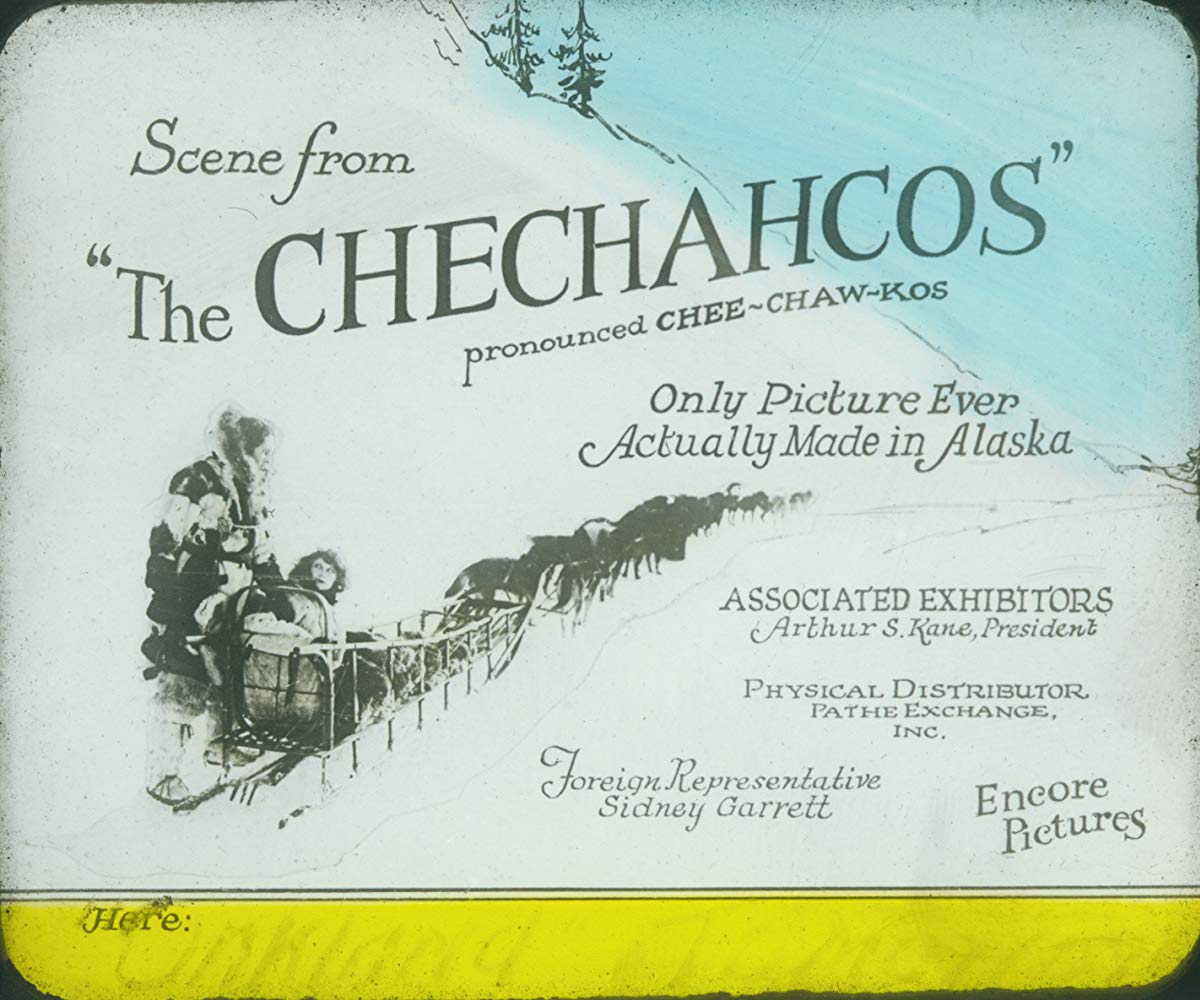
Everybody Gets One: Portland-based film producer George Edward Lewis joined forces with prominent Alaska entrepreneur Austin Lathrop in 1922 to found the Alaska Moving Pictures Corporation and produce the first film shot entirely in Alaska (Hollywood usually travelled only as far as Northern California to film sequences set in Alaska). Director/writer Lewis H. Moomaw was George Edward Lewis’ business partner at American Lifeograph. With the exception of Eva Gordon, the principle cast members were all stage actors with little or no film experience.

Wow, That’s Dated: There’s only one Inuit in the entire film and she’s played by a white woman. Oy.

Take a Shot: As mentioned at the beginning of the film, “cheechakos” (pronounced “chee-chaw-kos”) is a Chinook word that literally translates to “tenderfoot”, and is used to describe a newcomer to the territory.

Other notes

  • Full disclosure: there is not a lot of information out there about “The Chechahcos” or its creators. My knowledge of the film’s production comes primarily from the aforementioned Beheim essay. Thanks to some extensive research, Beheim knows more about “The Chechahcos” than the people who actually made it.
  • Among the essay’s highlights: the citizens of Anchorage eagerly anticipated production of “The Chechahcos”, even greeting the cast and crew upon their arrival. Filming in Alaska took place over the course of three months and hundreds of miles of locations. The bulk of it was filmed in the summer of 1923, and fake snow was used for a few sequences.
  • …And that’s pretty much all I have to say about this movie. Again, there are some beautiful visuals of Alaska throughout, but as a whole the film just sat there for me. Perhaps those of you with more knowledge and appreciation for Alaska (and/or not-incestuous-but-morally-unethical relationships) will get more out of “The Chechahcos” than I did.

Legacy

  • Associated Exhibitors purchased “The Chechahcos”, changed the title’s spelling from its original “The Cheechakos” for unknown reasons, and launched one of their largest advertising campaigns in anticipation of the surefire hit they had on their hands. After a successful premiere in Anchorage in December 1923, “The Chechahcos” played New York, where it was met with favorable reviews, but the audience never showed up. The film lost money and was the only production from the Alaska Moving Pictures Corporation.
  • After its premiere engagement, “The Chechahcos” more or less disappeared until being rediscovered by the University of Alaska in 2000. The film was restored with support from the National Film Preservation Foundation, and wouldn’t you know it, they added the film to their National Film Registry three years later. What are the odds?
  • While the actual film of “The Chechahcos” was found and restored, the original score remains lost. A new score was composed by Eric Beheim to commemorate Anchorage’s centennial in 2015. And Eric’s brother Chris Beheim just happened to mention this new score in his essay. Again, what a small world it is.
  • I can’t prove that this film inspired Charlie Chaplin’s “The Gold Rush” (which started production a year after the premiere of “The Chechachcos”), but I can’t not prove it either.
  • I will also label this film the forefather to the “tough guys with cute kids” sub-genre of movies, which would eventually be perfected with “Kindergarten Cop”.

#329) This Is Cinerama (1952)

8ba2d31505d6320fec2c011056ad66df

#329) This Is Cinerama (1952)

OR “Curve Appeal”

Directed by Merian C. Cooper and Gunther von Fristch (with Ernest B. Schoedsack and Michael Todd Jr.)

Class of 2002

No original trailer, but here’s one for the 2017 HD restoration.

The Plot: It’s 1952 and television is keeping people away from the movies in droves. “This Is Cinerama” is a feature-length demonstration of the new three-camera widescreen process that will bring audiences back to the theater. Introduced by broadcaster/producer Lowell Thomas, “This Is Cinerama” takes us around the world with its curved wide screen and stereophonic sound. Highlights include a roller coaster at Rockaways’ Playland, a performance by the Vienna Boys’ Choir, the La Scala production of “Aida”, the water ski show at Cypress Gardens, and a bird’s eye view of practically every American landmark. You won’t see any of this on Sullivan, that’s for sure.

Why It Matters: The NFR gives a synopsis and history of Cinerama, plus a detailed essay by film expert Kyle Westphal.

But Does It Really?: “This Is Cinerama” is a benchmark for film techniques, and essentially the birth of the widescreen movie as we know it. The spectacle of Cinerama still comes across over 65 years later, and the film is an entertaining and effective demonstration of what widescreen can accomplish. “This Is Cinerama” is a pivotal moment in film history, and more than worthy of preservation by the NFR.

Shout Outs: The prologue features clips from such early films as “The Kiss”, “The Great Train Robbery” and “The Son of the Sheik”.

Everybody Gets One: Before “This Is Cinerama”, Lowell Thomas was already a well-known author, broadcaster, and world traveler. He famously interviewed and photographed T.E. Lawrence while in Arabia, which he later turned into a stage show that escalated Lawrence’s notoriety. Look for a portrait of Lawrence during one of Lowell’s on-camera appearances.

Seriously, Oscars?: Although it premiered in New York in September 1952, “This Is Cinerama” didn’t play Los Angeles until 1953, and received one Oscar nomination. The film’s score lost to the Leslie Caron film “Lili”. Nominee Louis Forbes is credited with composing the score, but was in reality the musical director, with the actual score being penned by an uncredited Max Steiner. Steiner was under contract with Warner Bros. at the time, and any outside work would have been a violation.

Other notes

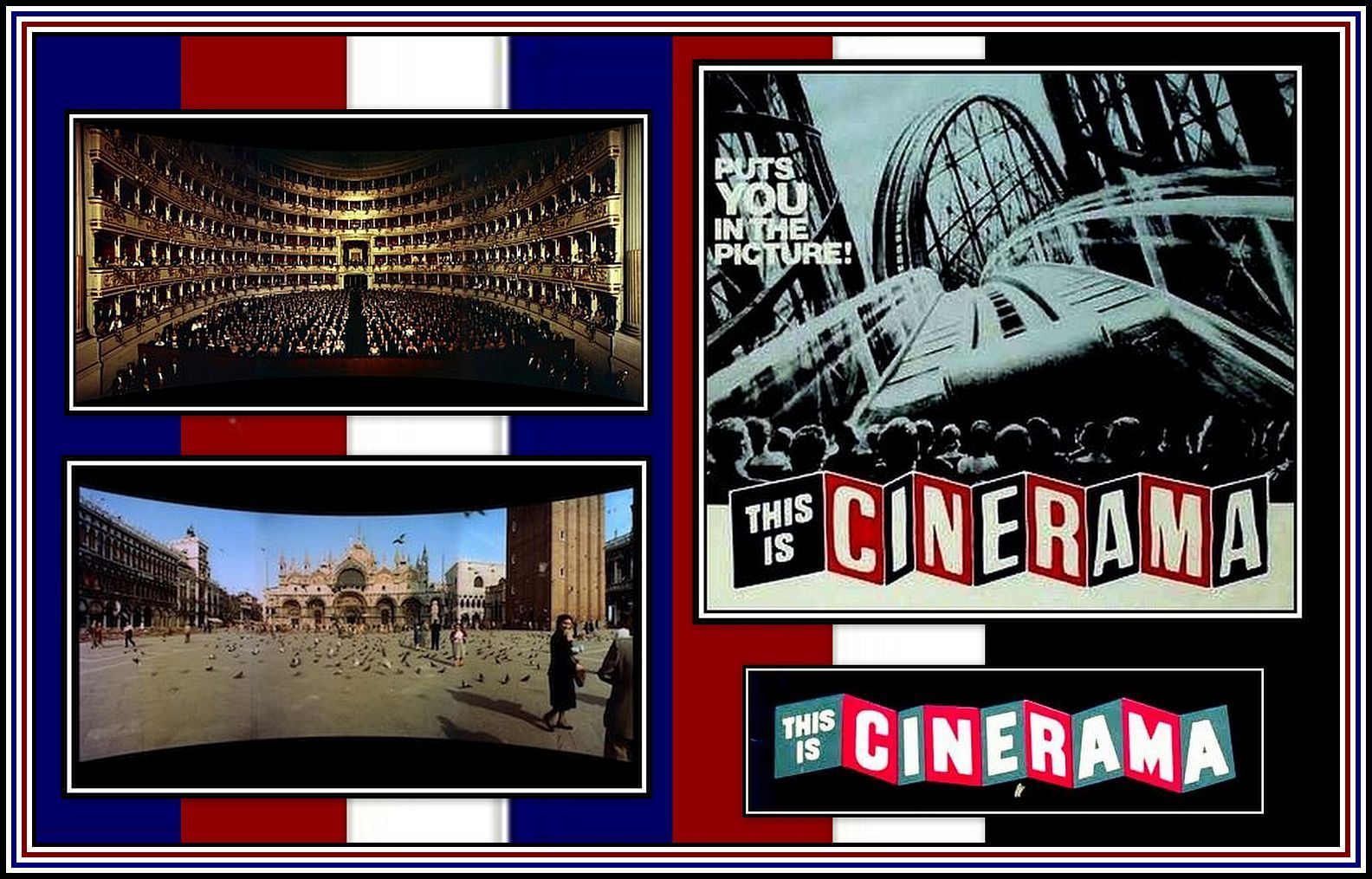
  • Before we go any further, what exactly is Cinerama? Well I’m glad you asked. Cinerama is a widescreen process that was filmed using three cameras simultaneously. These three films were then projected on a screen that was three times wider and twice as tall as the average movie screen. In addition, this screen was curved at 146 degrees, approximating peripheral vision. The result was a film that seemingly surrounded the audience, creating a unique immersive experience.
  • Cinerama co-creator Fred Waller had tinkered with widescreen film using multiple cameras for decades. His 11-projector “Vitarama” was first demonstrated at the 1939 New York World’s Fair. Waller received a technical Oscar for his work on Cinerama, but passed away two months later.
  • In addition to co-creating Cinerama, Merian C. Cooper is best remembered for writing and directing the original “King Kong”. Coincidentally, the King Kong musical is currently playing at the Broadway Theatre, the same venue “This is Cinerama” premiered at!
  • Kudos to the team behind the film’s 2012 restoration. “This Is Cinerama” is presented in its original roadshow version, and in the curved “Smilebox” widescreen format. There’s even a digitally added curtain to give the full effect of being in the theater.
  • The on-ride footage of the Atom Smasher roller coaster was originally intended for the finale, but Merian C. Cooper convinced the producers to make it the first sequence to draw the audience in. It’s the right choice, and an exhilarating opening.
  • For all of Cinerama’s early achievements, on-set sound wasn’t one of them. Lowell Thomas sounds a bit muted once his introductions go from the standard Academy Ratio to Cinerama.
  • The church choir’s performance of “Hallelujah” from “The Messiah” fares much better in the sound department, though the acoustics help. This choir definitely has a Handel on the material. Thank you!
  • One of Cinerama’s ongoing issues was the blending of the three cameras onto the screen. The “seams” between the frames were always visible, though it is fun watching people squash and stretch as they cross the screen.
  • I assume all of these members of the Vienna Boys’ Choir turned down “The Sound of Music”. Also, did you know the “Blue Danube Waltz” has lyrics? I sure didn’t.
  • Oh man, the La Scala performance of “Aida” goes on forever. Please, Elton John, have mercy.
  • Cypress Gardens was a Florida attraction known for its botanical gardens, water ski shows, and…Southern Belles? Still can’t figure that one out. After a change in ownership, the site closed in 2009, and is currently the home of Legoland Florida.
  • Why so much screen time devoted to water skiing? Fred Waller held a patent on water skis. It’s all connected, people!
  • The last segment of the movie is essentially ‘50s-style “Soarin’”, with too many American landmarks to mention them all. I can only imagine what a stirring, moving viewing experience this must have been in 1952. Television was tiny and black-and-white, there was no home video or streaming, so seeing this much of the country in widescreen and color was an once-in-a-lifetime event.

Legacy

  • “This Is Cinerama” only played in one theater in 1952 – the Broadway Theatre in New York – but was so popular it became the highest grossing film of the year!
  • The Hollywood studios weren’t quick to take on three-camera Cinerama for their upcoming epics, but this film inspired every studio to take a crack at their own one-camera widescreen process. Within a year there was Panavision, CinemaScope, and Todd A-O (created by Michael Todd, one of this film’s producers). Widescreen very quickly became the standard for film going forward.
  • Cinerama was the precursor to IMAX, as well as Disney’s Circle-Vision, which also specialized in uber-patriotic panoramas.
  • A few more films were made in Cinerama over the next decade, primarily travelogues such as “Cinerama Holiday”. The technology was impressive, but costly, making Cinerama difficult to catch on as the next big thing. A few narrative features were produced (including NFR entry “How the West Was Won”), and although several standard widescreen films bare the Cinerama name, the three-camera process was discontinued in the mid-60s.
  • Cinerama’s expensive operating has also prevented the revival many of its creators had hoped for. Although the Blu-Ray release tries its best to recreate the experience, there’s nothing like seeing “This Is Cinerama” on a big curved screen.

#328) Hoosiers (1986)

17585

#328) Hoosiers (1986)

OR “Hackman Fever”

Directed by David Anspaugh

Written by Angelo Pizzo

Class of 2001

The Plot: Loosely based on real events, former college basketball coach Norman Dale (Gene Hackman) arrives in the farming town of Hickory, Indiana to coach the high school team. His methods are unorthodox and he clashes with the townspeople, but ultimately his coaching leads to the Hickory Huskers’ surprise winning streak and a place in the finals.  There are obstacles along the way, including one player’s alcoholic father (Dennis Hopper), and an intelligent schoolteacher (Barbara Hershey) with information regarding Norman’s past.

Why It Matters: Another brief synopsis from the NFR, the only descriptor being when they call the film “at times bleak and at others inspiring”.

But Does It Really?: The best movies are powered not by logic, but rather by emotions. “Hoosiers” is the textbook example: the plot points and character development are rudimentary at best, but once you understand what is at stake in these basketball games, you feel for these characters, and that emotion carries you all the way to the end. “Hoosiers” has its flaws, but its inspirational spirit and love of the game is flawless. I think the NFR jumped the gun a bit on its induction (the film had only been eligible for five years), but “Hoosiers” is definitely preservation-worthy, and one of the greats of the feel-goods.

Everybody Gets One: Director David Anspaugh and writer Angelo Pizzo both hail from Indiana, were in the same fraternity at Indiana University, and later attended film school at USC. The idea for “Hoosiers” originated in their frat days when they were discussing the 1954 Milan High basketball team and their surprise win at the state championships.

Wow, That’s Dated: I know it’s an intentional juxtaposition, but Jerry Goldsmith’s use of synthesizers in the score always sticks out to me. The rest of the movie is relatively timeless, so hearing electronic music out of nowhere seems anachronistic.

Take a Shot: Amazingly, despite Indiana being officially nicknamed the Hoosier State for over 150 years, no one definitively knows the origin of the word “hoosier”.

Seriously, Oscars?: “Hoosiers” played a one-week Oscar qualifying run in December 1986, and quickly expanded once it received two Oscar nominations. Dennis Hopper was nominated for Best Supporting Actor (though he believed he should have gotten the nod for “Blue Velvet”), but lost to an overdue Michael Caine in “Hannah and Her Sisters”. Jerry Goldsmith’s score was also nominated, losing to jazz legend Herbie Hancock for “’Round Midnight”. Notable among its precursor nominations, “Hoosiers” was up for the Independent Spirit Award for Best First Feature, and lost to Spike Lee’s “She’s Gotta Have It”.

Other notes

  • As if having two Hoosiers as director and writer wasn’t enough, the entire film was shot on location in Indiana. Production headquarters were set in Indianapolis, and scenes were filmed in Ninevah, Knightstown, Danville and Lebanon. Also worth noting: there’s a city in Indiana named Lebanon.
  • Oh great, Norman and Myra’s meet-cute is not only a “we hate each other for now”, but also an expositional dump. The relationship doesn’t get much better (more on that later).
  • Only one of the Huskers basketball players was an actor (David Neidorf). The rest were all locals who were selected after an audition/basketball game. These are definitely basketball players who do their own acting, and not the other way around.
  • How many scenes in this movie are going to be townspeople telling Hackman that they don’t like change? And why are these guys getting confrontational with Hackman? Don’t mess with him, he’s Lex Luthor!
  • Shooter Flatch is not Dennis Hopper’s greatest performance, nor his most iconic, but it’s an effective performance in one of his rare forays into a quote-unquote mainstream film. And no matter what movie he’s in, something about Hopper’s acting style always makes me ask, “What the hell is he saying?”
  • Barbara Hershey’s performance in this movie is 50% clunky dialogue, 50% looking disappointed in the bleachers. Several additional scenes were filmed that showcased a more dimensional Myra, but Orion wanted a 2-hour movie, and this subplot suffered the most. Neither Hershey nor the filmmakers were pleased with these cuts.
  • This is another movie that would have been significantly shorter if these characters had the internet. One Google search of “Norman Dale” would have revealed everything about his past.
  • The slow clap may be one of my top five favorite movie scenes. I get a big smile on my face every time I see it.
  • The first half of this movie has a lot of set-up, but once we hit the second half, the payoffs start coming and you find yourself rooting for everyone. It’s the equivalent of having to eat your least favorite vegetable before getting to the tastiest dessert.
  • Why do the Huskers cut every game so close? The score is always tied in the fourth quarter. Didn’t they ever play the Indiana equivalent to the Washington Generals?
  • This film’s drinking game is every time Gene Hackman does his quick chuckle that he sneaks into most of his movies.
  • I freely admit the scene where Shooter takes over as coach makes me cry every time.
  • What I wouldn’t give to see Norman Dale go toe-to-toe with Gene Pingatore (aka the “Hoop Dreams” coach).
  • The final game was shot at Butler University’s Hinkle Fieldhouse, the site of the 1954 Indiana state championship game that inspired this movie. I can only imagine how insane it must have been to coordinate a staged basketball game with hundreds of extras.
  • That final shot is what I call a “Reverse Shining”.

Legacy

  • Anspaugh, Pizzo and Goldsmith reunited to do the other great inspirational sports movie based on a true story: 1993’s “Rudy”.
  • The gym used as Hickory’s home court is still in operation. Now known as the Hoosier Gym, the site is a popular tourist attraction, hosting several games throughout the year.
  • Steve Hollar (Rade) came under hot water with the NCAA after “Hoosiers” was released. Hollar was playing basketball at DePauw University, and college players are not allowed to receive payment for playing basketball. After an investigation, it was determined that Hollar was paid for acting in the movie, not playing basketball. He did however, have to give 5% of his payment to DePauw, and he was suspended for three games.
  • “Hoosiers” fandom has grown over the years, and it consistently ranks among the best sports films. Vice President (and former Governor of Indiana) Mike Pence recently called the film “the greatest sports movie ever made”, which may be the only time I agree with our Vice President on something.