#201) High School (1968)

high-school-1968-frederick-wiseman-documentary

#201) High School (1968)

OR “Most Likely to Impede”

Directed by Frederick Wiseman

Class of 1991

No trailer, but here’s an excerpt. 

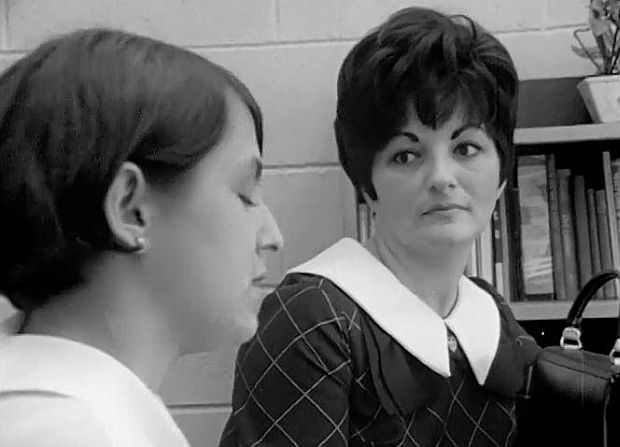
The Plot: Following his documentary on a state facility for the criminally insane (1967’s “Titicut Follies”), Frederick Wiseman chose a logical follow-up for his second film: high school. Philadelphia’s Northeast High School is the subject of this documentary, as the camera goes from class to class and observes our education system in full swing. Is this faculty molding my parents’ generation strongly enough for the future? Are they bogging them down with too much discipline? It’s direct cinema, so that’s your call.

Why It Matters: The NFR gives a general overview and quotes Richard Schickel’s review, which called the film a “wicked, brilliant documentary”. There’s a thought-provoking essay by Canadian film professor Keith Grant, which focuses on the film’s theme of conformity, but manages to misspell “principal” as “principle”. So close.

But Does It Really?: If you ever went to high school, this film is going to strike a chord with you. As with many of Wiseman’s film, this is “direct cinema”: no commentary from the filmmaker, you fill in your own blanks. Like any documentary, “High School” has obviously been edited to create a certain narrative flow that didn’t exist in the raw footage, but even that is open to interpretation. I enjoyed the film a lot as both a time capsule of a moment in America and as a checkpoint for how far (or not) high school has evolved in the last 50 years. Definitely worth a watch.

Everybody Gets One: We’ll see more of Frederick Wiseman when I cover his follow-up film “Hospital”. This film’s cinematographer is Richard Leiterman, who started off filming stock footage for the CBC before filming several Canadian documentaries. Among his later work is the original TV movie version of “It”.

Wow, That’s Dated: Filmed in the spring of 1968, “High School” comments on such topical issues as Vietnam, the MLK assassination, the ongoing space race, and the debate over miniskirts as formal wear. Plus you get this peppy little tune from bubblegum group 1910 Fruitgum Company.

Seriously, Oscars?: No Best Documentary nod for “High School”. That year the winner was the inspirational “Young Americans” “Journey Into Self”. None of Frederick Wiseman’s documentaries were ever nominated for an Oscar. Wiseman did, however, eventually win a lifetime achievement Oscar in 2016.

Other notes

  • “(Sittin’ on) The Dock of the Bay”. Now THAT’S how you open a documentary!
  • These kids are all in their mid-to-late 60s now. One wonders what their reunions are like.
  • I took three years of French in high school. Very little of it stuck. But I met my senior prom date in that class, so that’s something.
  • The extreme close-ups throughout the piece are an interesting choice. Are you watching this, Chick Strand?
  • My favorite person in the whole movie is a man I’ve dubbed “Counselor Crewcut”. He dispenses detention along with really bad life advice.
  • Speaking of disciplinary types, it seems Northeast had their own Strickland-esque hall monitor. Doesn’t this guy have anything better to do?
  • This English teacher is not doing “Casey at the Bat” any favors. Not exactly Jerry Colonna, is she?
  • We really need to start teaching Home Economics in school again. So many life skills I missed out on.
  • This school’s sex education is a bit confounding. They’re strongly anti-promiscuity, but also for birth control. Seems like mixed signals.
  • And then we get to the English teacher who uses Simon & Garfunkel’s “The Dangling Conversation” as an example of poetry. She’s the cool teacher. Wait until rap becomes a thing.
  • For a film set in a high school, the emphasis is primarily on the teachers and parents. Virtually none of the film is from a student’s point of view. Another point in favor of Keith Grant’s “schools are factories, students are products” thesis.
  • Do yourself a favor: skip the part where they discuss how much college tuition was in 1968. I almost punched my TV in anger.
  • Northeast High’s Space Research program was one of the first in the country, and is still going. Please donate; their funding keeps getting cut.
  • That’s “Hey Look Me Over!” being played by the marching band towards the end. Wow, that’s dated.

Legacy

  • Northeast faculty was divided over how the film portrayed their school. Facing what he referred to as “vague talk” of a lawsuit, Wiseman agreed not to show the film in Philadelphia. While it did play elsewhere in the country, the City of Brotherly Love wouldn’t get a public screening of “High School” until 2001.
  • At the age of 88, Frederick Wiseman is still going! His latest film is 2017’s “Ex Libris – The New York Public Library”.
  • Wiseman returned to the subject of high school with 1994’s “High School II”, this time covering New York City’s Central Park East Secondary School. I couldn’t find footage from that film, so here’s 1994’s “Ski School 2”.
  • Northeast High School would allow cameras onto campus again in 2009 for the reality series “Teach: Tony Danza”, which followed the “Who’s the Boss” star as he taught high school English. Production was halted when the footage was deemed “not dramatic enough”. And if you can’t find the inherent drama of being a teenager (or a People’s Choice Award winner), you’re not doing it right.
  • Oh god, must we musicalize everything?

Listen to This: Amazingly, Otis Redding’s rendition of “(Sittin’ On) The Dock of the Bay” is nowhere to be found on the National Recording Registry. The song is, however, included on the Registry by way of The Staple Singers’ cover. Otis Redding appears on the list thanks to his performance of “I’ve Been Loving You Too Long (To Stop Now)”.

#200) Duck Soup (1933)

1933_-_Duck_Soup_Movie_Poster

#200) Duck Soup (1933)

OR “Say the Secret Word and Democracy Comes Down”

Directed by Leo McCarey

Written by Bert Kalmar and Harry Ruby. Additional dialogue by Arthur Sheekman and Nat Perrin.

Class of 1990

The Plot: Freedonia is bankrupt and in need of a new leader. Socialite/financial aid Mrs. Teasdale (Margaret Dumont) insists on Rufus T. Firefly (Groucho Marx) for the job. Firefly takes over, and tries to woo Teasdale in order to get her late husband’s inheritance. Meanwhile Sylvanian ambassador Trentino (Louis Calhern) wants to annex Freedonia, and sends spies Chiccolini and Pinky (Chico & Harpo Marx) to follow Firefly. In true Marx Brothers fashion, the plot falls apart in favor of rapid-fire gags, the occasional musical number, and some of the boys’ most iconic bits. Oh, and Zeppo’s there too.

Why It Matters: The NFR calls it “the brothers’ masterpiece”, and praises the boys, director McCarey, and the “reliably clueless” Margaret Dumont. There’s also a lengthy essay by film critic William Wolf.

But Does It Really?: No one can argue the inclusion of a Marx Brothers film on this list. The Marx Brothers are one of the rare film comedians that effortlessly mixed puns and wordplay with physical shtick, and it’s that “everything but the kitchen sink” mentality that has ensured the boys’ longevity. I’ll argue that “Duck Soup” isn’t the brilliant political satire it’s hailed as (none of their other films get anywhere near social commentary), but their humor comes with a strong enough viewpoint that, mixed with this film’s premise, makes the connection plausible. “Duck Soup” is still laugh-out-loud funny 85 years later, and how many other comedies can you say that about?

Shout Outs: The music box that Harpo knocks over plays “Who’s Afraid of the Big Bad Wolf” for some reason.

Everybody Gets One: We’ll see more of Groucho, Harpo, and Chico when they jump ship to MGM (and a crowded stateroom) in “A Night at the Opera”, but this is the only NFR film for Zeppo, the fourth Marx Brother. The youngest of the five children, Herbert “Zeppo” Marx was the straight man of the group for their stage performances as well as their early films. He left the group after “Duck Soup”, but he spent some time afterwards as the brothers’ agent, and later made a fortune as an engineer and inventor. So you don’t have to feel too bad for Zeppo.

Wow, That’s Dated: Lots of references to such popular songs as “Ain’t She Sweet”, “Goodnight, Sweetheart” and…oh god, do I have to? [Deep inhale] Okay, here we go: “That’s Why Darkies Were Born”. [Deep exhale] Why, Groucho, why?

Seriously, Oscars?: No Oscar love for “Duck Soup”. Perhaps Paramount didn’t want to put money in a campaign for stars that had already left the studio. Paramount’s comedy of choice at that year’s ceremony was fellow NFR entry “She Done Him Wrong”.

Other notes

  • Other than a current slang term for an easy task, the title “Duck Soup” has nothing to do with the film. It doesn’t matter anyway, because I ordered the Duck Salad.
  • The “additional dialogue” credit at the beginning is attributed to Sheekman and Perrin, who wrote for Groucho and Chico’s radio show “Flywheel, Shyster, and Flywheel”. They lifted enough jokes from the radio show to warrant a credit for the two writers.
  • The film was made by Paramount, and was part of their film library that was sold to Universal in the ‘50s. The version I watched began with two separate Universal logos, followed by the original Paramount logo. Somewhere, Cinema Sins is shaking its head.
  • Ah yes, that point in ‘30s cinema where people just broke into song.
  • Margaret Dumont is clearly not listening to a word Firefly is saying. I guess that helps make you a great foil.
  • Harpo’s doghouse tattoo is super creepy. One of the boys’ rare forays into the surreal. Also, who has a tattoo of themselves?
  • Teasdale’s room seems to take its cue from Mrs. Robinson’s rumpus room.
  • There are some pretty big continuity errors in this film. I suspect a lot of material hit the cutting room floor. Apparently, among the deleted material were a piano number from Chico and a harp number by Harpo (ohhhh, now I get it).
  • The best line no one quotes from this film: “Let me out of here or throw me a magazine.”
  • The mirror scene is still the highlight of the movie. It’s also the only scene in a sound comedy I can think of that’s executed in complete silence.
  • And now an “All God’s Chillun Got Wings” parody? About guns? Oh Christ.
  • I do love me some repurposed stock footage.
  • I never realized that “Airplane!” lifted the “horse in bed” gag from here.
  • The Wolf essay about the film praises the political satire, and cites how that is a rarity in film, even today. Give it a decade.
  • Speaking of, Groucho attributed the film’s political edge to Leo McCarey, a director the boys never worked with before or again.

Legacy

  • Not quite the “flop” as some historians refer to it as, “Duck Soup” was popular, but not as popular as their previous film: “Horse Feathers”. When their contract with Paramount ended with this film, the brothers moved on to MGM, and their other NFR entry “A Night at the Opera”.
  • Everyone and their mother has done the mirror bit, but the best homage will be the one Harpo did 22 years later with Lucille Ball.
  • Woody Allen considers “Bananas” a “spiritual sequel” to “Duck Soup”. Yeah, Woody believes a lot of things.

Listen to This: A recent addition to the National Recording Registry is the 1972 album “An Evening with Groucho”. It’s an hour of Groucho saying pretty much whatever he wants, and it’s the best. Because it’s Groucho in the ‘70s, Dick Cavett makes an appearance.

200 films already? Seems like only a few days ago we were talking about movie #199.  I’m a little over a quarter of the way through my journey, and I thank you for making it this far with me. Promise me you’ll go outside at some point.

Tony

#199) The Best Years of Our Lives (1946)

1947-the_best_years_of_our_lives_1

#199) The Best Years of Our Lives (1946)

OR “This Civilian Life”

Directed by William Wyler

Written by Robert E. Sherwood. Based on the novella “Glory for Me” by MacKinlay Kantor.

Class of 1989

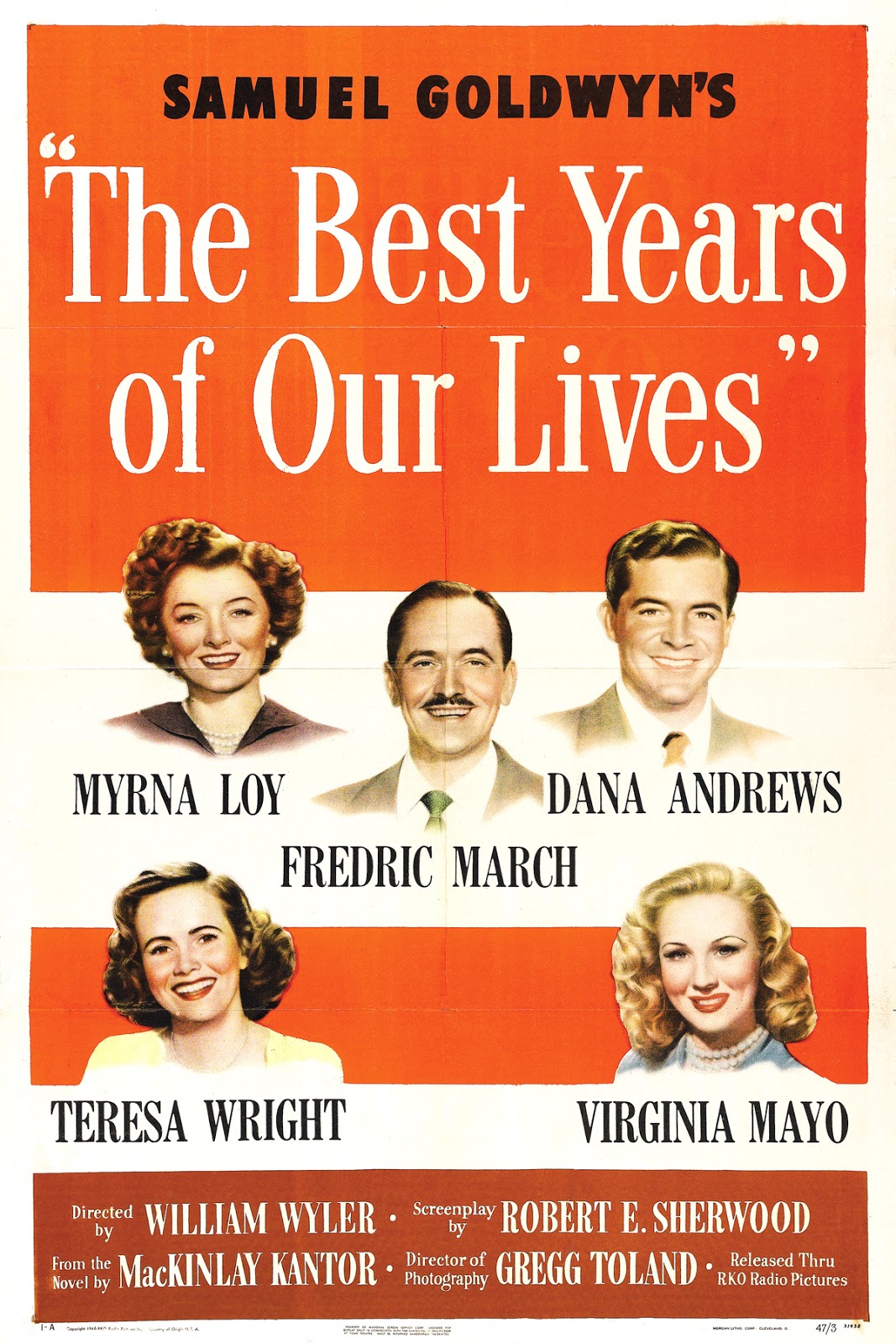
The Plot: Three WWII servicemen – bombardier Fred (Dana Andrews), platoon sergeant Al (Fredric March) and petty officer Homer (Harold Russell) – all return home to Boone City after the war. Each struggles in their own way to adapt back to their pre-war life. Al returns to his understanding wife Milly (Myrna Loy), but clashes with his employers at the bank about loans for veterans. Fred resumes his strained relationship with his materialistic wife Marie (Virginia Mayo), but finds himself attracted to Al’s daughter Peggy (Teresa Wright). Homer lost both of his hands in the war and worries how his new prosthetics will go over with his fiancĂŠe Wilma (Cathy O’Donnell). Some food for thought about life for American veterans, plus Hoagy Carmichael in a key supporting role!

Why It Matters: The NFR calls it “[a] moving and personal story” and praises the cast and cinematography. There’s also a detailed essay by English professor and William Wyler biographer Gabriel Miller.

But Does It Really?: â€œThe Best Years of Our Lives” is an all-around fine film. Some of the entertainment value has been lost over the years, and its almost 3-hour runtime can drag in some places, but “Best Years” is expertly made, and the first major film to tackle the problems our veterans face head-on. It’s a wonderful ensemble, aided by a nuanced, grounded script, and photography that I’ll gush about later on. It wouldn’t make my first 25, but “Best Years” deserves to be on here, and still holds its own 70 years later.

Everybody Gets One: Despite a 50-plus year film career and five Academy Award nominations (with two wins), this is Fredric March’s only NFR appearance. Also along for the ride is Hoagland “Hoagy” Carmichael, who composed many a famous song, including “Georgia On My Mind”, “Up the Lazy River”, and “Heart and Soul”.

Wow, That’s Dated: Wartime boarding procedures, swing music, and the lost profession of soda jerk.

Title Track: No exact matches, but Marie does say that she gave up “the best years of my life” during the war.

Seriously, Oscars?: The hit of the year, “The Best Years of Our Lives” led the 1946 Oscars with eight nominations and seven wins, including Picture, Director, Actor for March, and Adapted Screenplay. Harold Russell was not favored to win Best Supporting Actor against four professionals, so the Academy gave him an honorary Oscar instead. When he did win, he became the only person to receive two Oscars for the same performance. This film’s sweep was deserved, but also meant that “It’s A Wonderful Life” went home empty-handed. And we know what that movie’s like when it gets depressed…

Other notes

  • Where is Gregg Toland’s Best Cinematography nomination? There were only two nominees that year, and he wasn’t either of them. See me after class, Academy.
  • Perhaps this film’s smartest decision is that we never see what these men’s lives were like before the war. We are right alongside them trying to understand these familiar yet foreign surroundings.
  • Homer and Wilma have names that were once commonplace but are now forever associated with cartoon characters.
  • And then Al and Milly see each other from across the hallway and I’m crying. We’re only 20 minutes in, but I really felt for both of them in that moment.
  • If I were an Oscar voter in 1946, I would have put Dana Andrews on my ballot over Fredric March. No knock against March, who gets more chances to grandstand, but Andrews is the glue that holds the film together. It’s an ensemble to be sure, but Dana Andrews is at the center of it.
  • Al is offered $12,000 a year! Laughable now, but that’s about $150,000 in today’s money.
  • So retail work has always been a living hell. Got it.
  • This film is a waste of Myrna Loy. She nails every scene, but her moments in the spotlight are few and far between. I’m sure she recognized how important this film was going to be, but I expect more from the person with top billing.
  • The powder room scene between Peggy and Marie is great to watch. It all happens in one take, provides engaging visuals, and proves my long-standing theory that the women’s restrooms are way nicer. All this being said, I’m pretty sure I saw the cameraman’s arm in one of those mirrors.
  • But seriously, where is Toland’s Oscar? There is so much storytelling going on in every shot, thanks in part to Toland’s choice of deep focus. The “Chopsticks” scene alone is worthy of recognition.
  • For being a non-professional actor, Harold Russell more than holds his own with his established co-stars. When he’s allowed to be warm and friendly, he’s perfect. When he has to be a little more dramatic, you can sense the assistance from Wyler and composer Hugo Friedhofer. They help carry some of the emotional weight for him.
  • You can tell the seismic influence William Wyler’s time in the Air Force had on him. Compared to his earlier war film, “Mrs. Miniver”, “Best Years” is more realistic and far less sentimental. With this film, Wyler argues that the fight to return to the way things were is more challenging than the war itself.

Legacy

  • William Wyler followed this up by directing four more films that would end up on the NFR: “The Heiress”, “Roman Holiday”, “Ben-Hur”, and “Funny Girl”, like you do.
  • The film was remade as the 1975 TV movie “Returning Home”. I can’t even find a clip of it on YouTube, so that bodes well for how good it is. Come on, Internet. No one has footage of Dabney Coleman and young Tom Selleck?
  • Harold Russell took William Wyler’s advice and left show business to get his business degree from Boston University. He became a public advocate for the handicapped as well as veterans, and didn’t return to screen acting until 1980’s “Inside Moves”. Later in life he sold one of his Oscars at auction to pay for his wife’s surgery. If only crowdsourcing had been invented yet.

Further Viewing: â€œDiary of a Sergeant” is the 1945 instructional short that brought Harold Russell to the attention of William Wyler. Wyler was impressed with Russell’s natural ease in front of the camera and rewrote the role of Homer to accommodate Russell’s wartime experience.

#198) Interior New York Subway, 14th Street to 42nd Street (1905)

t1-interior-new-york-subway-1905-image-normal

#198) Interior New York Subway, 14th Street to 42nd Street (1905)

OR “The Talk of the Midtown”

Directed by G.W. Bitzer

Class of 2017

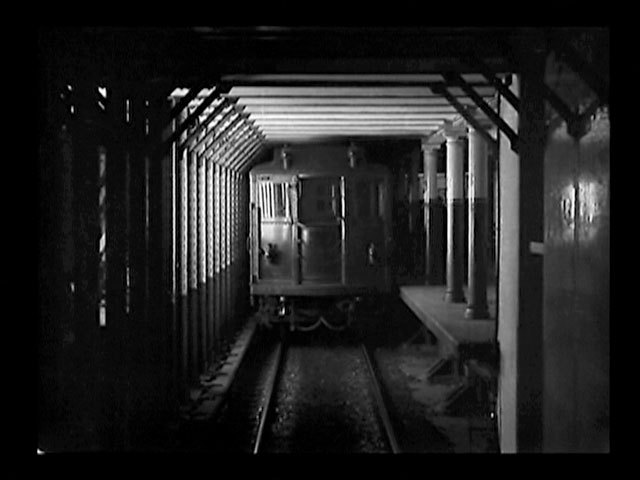
The Plot: That’s a pretty self-explanatory title. Follow one of the earliest subway trains on its 28-block journey under Manhattan. This train makes all stops.

Why It Matters: The NFR highlights the film’s technical feats (it required three trains to film this) and praises the “artistic flair” of G.W. Bitzer.

But Does It Really?: Historical significance, sure. It’s an interesting watch, but I don’t know if I can argue the need for preservation. It’s harmless enough, so I give it a pass. Perhaps it’s my own jaded experience with the New York subway system that tarnishes my thoughts on this film. I will conquer you yet!

Everybody Gets One: The only name connected to this film is G.W. Bitzer, who was three years away from his first of many collaborations with D.W. Griffith. At this point in time, Gottfried Wilhelm had made several “actuality films” with Biograph and was starting to branch out into narrative films. He also invented the “fade out”, so he’s got that legacy going for him.

Wow, That’s Dated: The Interborough Rapid Transit (IRT) line had been open for seven months when this was filmed.

Other notes

  • As previously mentioned, this shoot required three trains: the train being filmed, the train behind it with a camera mounted on the front, and a third train on a parallel track lighting the first train.
  • There’s a great meta moment at the beginning when you can see the train with the lighting equipment on it. This is followed by a fun moment at the end where the first train gains speed and the others have to catch up.
  • Speaking of, how fast are these trains going? They don’t seem to be going that fast, but maybe that’s just the frame rate playing tricks on me.
  • The 42nd Street station is Grand Central, but not the one you’re thinking of. The current Grand Central wasn’t built until 1913.
  • We get a lovely sample of 1905 fashion while at the 42nd Street station.
  • Just a reminder that this film was added to the National Film Registry the same year as “The Goonies”, meaning that these two films are equally significant in the eyes of the NFR. Think about it, won’t you?

Legacy

  • Bitzer and Mutoscope followed this up with a narrative short that was also filmed at the 14th Subway station: “2 a.m. in the Subway”.
  • The IRT line is still in operation today, and will take you from 14th St Union Square to 42nd Street Grand Central in about eight minutes. It’ll run you $2.75.

Further Viewing: The most famous IRT train in film history is the titular subway car in 1974’s “The Taking of Pelham One Two Three”. It’s an exciting action film populated by smart-ass New Yorkers, what more could you ask for? The film was so popular (and the premise so real) that it’s still considered bad luck to run a Pelham train at exactly 1:23.

#197) The Birds (1963)

birds_xlg

#197) The Birds (1963)

OR “SEAGULLS! (Stop It Now)”

Directed by Alfred Hitchcock

Written by Evan Hunter. Based on the novelette by Daphne du Maurier.

Class of 2016

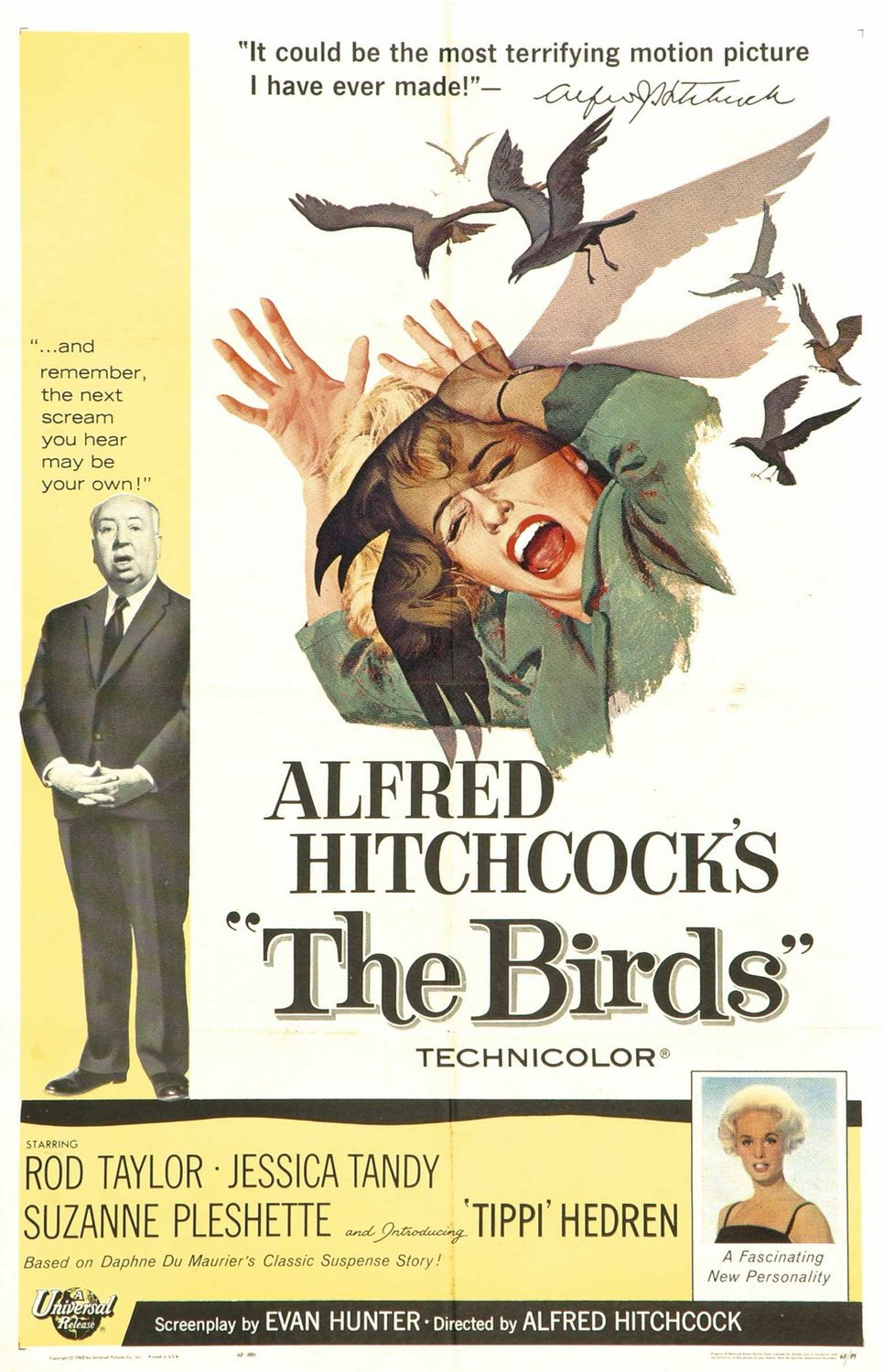
The Plot: Socialite Melanie Daniels (Tippi Hedren) is the butt of a prank by lawyer Mitch Brenner (Rod Taylor). She gets her revenge by sending a pair of lovebirds to Mitch’s family home in Bodega Bay, California (you had to be there). She is caught, but ends up spending the weekend with Mitch, his mother Lydia (Jessica Tandy), his sister Cathy (Veronica Cartwright), and local schoolteacher/Mitch’s ex Annie (Suzanne Pleshette). There’s a lot of complicated emotions going on, but then several species of birds start attacking the town and it’s still quite chilling so who cares?

Why It Matters: The NFR praises Hitch for “deftly moving from anxiety-inducing horror to glossy entertainment and suspense, with bold forays into psychological terrain.”

But Does It Really?: This is another one of the “Wasn’t This Already on the List?” films. How one of the most suspenseful films ever made didn’t make the cut before “Top Gun” I’ll never know. Hitchcock knew how to prey on people’s primal fears. Birds will never not be scary, and the film survives on that simple idea. The main cast members do fine work, but as is the case with most of Hitch’s projects, the star is the premise and Hitchcock himself. “The Birds” doesn’t stand up next to Hitch’s earlier films, but it’s the best of his post-“Psycho” work and a film whose lasting iconic status earns it a place on the list.

Everybody Gets One: Tippi Hedren, as well as supporting players Jessica Tandy and Suzanne Pleshette.

Wow, That’s Dated: Rear projection. Rear projection for days.

Take a Shot: The phrase “the birds” is said occasionally throughout. Keep a drink at the ready, but pay attention.

Seriously, Oscars?: One of the biggest hits of 1963, “The Birds” received one Oscar nomination: Visual Effects. Despite bringing in longtime Disney legend Ub Iwerks to oversee the revolutionary sodium vapor process, the film lost to “Cleopatra”, known for its outstanding…matte paintings? That win was mostly 20th Century Fox buying votes in the hopes of making their money back (the budget for “Cleopatra” was literally 10 times the budget for “The Birds”).

Other notes

  • The original short story is the same basic premise, but set in du Maurier’s native Cornwall, England and with a whole different set of characters.
  • Tippi Hedren’s real name is Nathalie. Her family gave her the nickname “Tippi” as a variation on “tupsa”, a Swedish word for “little girl” or “sweetheart” (sources vary).
  • Cute dogs, Hitch.
  • Ah, the Union Square of the early ‘60s. You know it’s a work of fiction because Mitch finds street parking with no problem.
  • Like Gig Young before him, Mel Cooley is here to deliver a huge clunky case of exposition.
  • So everyone in Bodega Bay is from Maine?
  • The shrewdest part of the film is that Hitchcock knew what audiences expected from “a Hitchcock film”. If you’d never seen one of his films before you’d think that the first half hour or so is incredibly boring, but Hitch knew his audience was expecting a bird attack, so delaying it for as long as possible provided him with maximum suspense.
  • This seems like a long way to go for a prank. Melanie wouldn’t rather be jet-setting or something like that?
  • Is every one of Veronica Cartwright’s lines dubbed? I didn’t realize that when they say your voice changes, they meant in post.
  • Annie Hayworth may be operating the first Airbnb.
  • Mitch has a clingy, possessive mother? Cool your jets, Hitch. Perhaps Lydia would lighten up if she had a charismatic, worldly-wise chauffeur.
  • The characters in this movie may be Hitchcock’s ultimate MacGuffin. There’s no plot for any of them to advance, nor any happy ending or resolution. The stars of the film are the birds themselves and everything else is filler.
  • Cathy is having the worst birthday.
  • Speaking of, Cathy turns 11 in this film. Veronica Cartwright was 13 during filming, Rod Taylor was 32, Jessica Tandy was 53. Biologically, this could all happen, but it’s weird they never mention the massive age-gap between Cathy and Mitch.
  • And now I have “Risseldy, Rosseldy” stuck in my head for the next six months. Thanks movie.
  • Surprise cameo by Miss Marple. Is anyone in this town actually from California?
  • All I will say about the bird attack in the diner is “Boy, that escalated quickly.” And where would the phone booth attack happen now? A charging station?
  • Does Mitch have some sort of natural bird repellent? He doesn’t have a mark on him the whole time. He’s like Tony Curtis during the “Great Race” pie fight.
  • “The Birds” is not without its flaws, but it’s still very nerve-wracking to watch. Hitch, you were a garbage human, but a hell of a director.

Legacy

  • Tippi Hedren worked with Hitch on his next picture, “Marnie”. After a work relationship that I’ll understatedly call “tense”, Hitch and Tippi never worked together again, and Hitch used his clout to bring her career to a halt.
  • Tippi’s relationship with Hitch became the 2012 TV movie “The Girl” with Sienna Miller and Toby Jones. The real Tippi Hedren gave her eventual approval, stating that it was accurate, though never highlighted her positive experiences with the director.
  • This is the film that started what I call “The Hedren Dynasty”. Every 25 years or so we get another generation of this acting family, as well as excellent proof that patriarchies are overrated.
  • “The Birds” has a sequel for some reason. Tippi’s in it as a completely different character so why even bother?
  • Hollywood occasionally threatens us with a remake, but it keeps getting postponed, so we’re safe for now.
  • Lots and lots of parodies. We’ll start with “High Anxiety” and “The Simpsons”.