#114) The Great Train Robbery (1903)

great-train-robbery-1903-granger

#114) The Great Train Robbery (1903)

OR “The One-Reeler Six-Shooter”

Directed & Written by Edwin S. Porter. Based on the stage play by Scott Marble.

Class of 1990

The Plot: There’s a train robbery, and it’s pretty great.

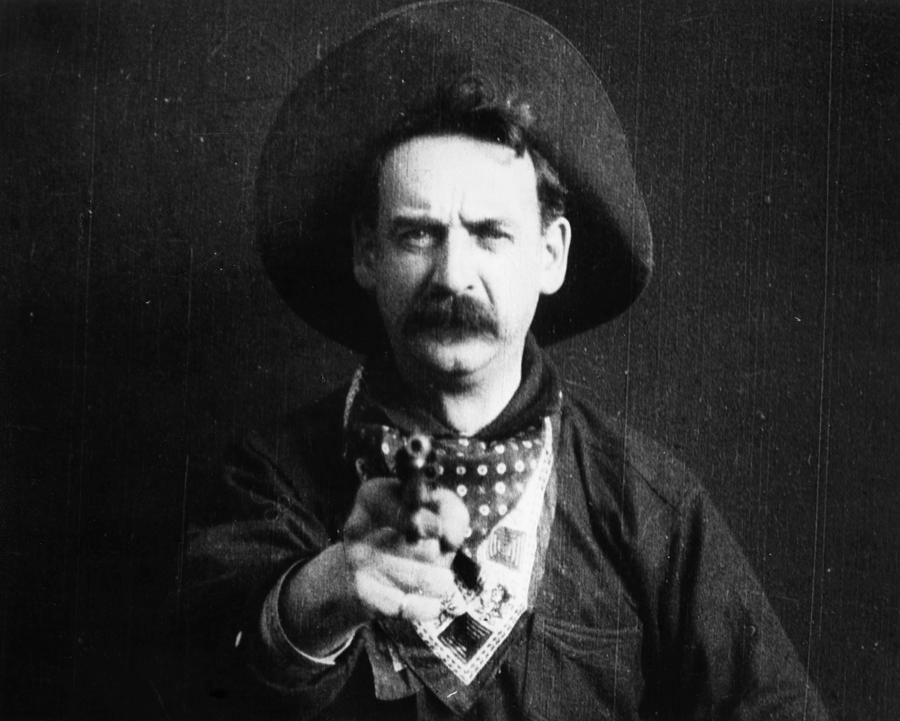
Why It Matters: The NFR calls it “the first narrative feature” and praises the iconic final shot (or first shot depending on your distributor).

But Does It Really?: Historically yes. It was one of the most successful films of its day and included such technological breakthroughs as cross-cutting, on-location shooting, and get this, camera movements. It’s all very tame by modern standards, but it’s a breezy 12 minutes and worth a watch if you want to see an important piece of film history.

Everybody Gets One: One of the robbers is Gilbert Anderson, who shortly afterwards would become “Bronco Billy”, the first Western star of the silent era. Over 50 years after this film’s release Anderson received a lifetime achievement Academy Award. The bandit who shoots at the camera is Justus D. Barnes. He became a regular player with the Tanhouser Film Company until budget cuts led to his dismissal. But don’t worry, he was compensated with film immortality.

Wow, That’s Dated: Train robberies. That’s a big one.

Other notes

  • This was based on a stage play? How? I guess this film wins for best “opening up” of a play-to-film adaptation.
  • I just watched the bandits tie up the train station clerk in real time. I know it’s early cinema, but someone please invent editing!
  • How many people are on that train? I keep waiting for clowns to start piling out.
  • Is the clerk saved by a tiny Angel of Death?
  • Nope, just ignore the tied-up clerk removing one hand from the rope to help himself up. Just look away.
  • There’s a scene in a dance hall for some reason. Don’t know why it’s here, but it’s fun to watch that very western thing of shooting the floor to make people dance.
  • That last shot is pretty great, and made even more exciting when you learn that blanks had not been perfected and they had to use real bullets. I just hope the cameraman got out of the way in time.

Legacy

  • Several films have been made with the title “The Great Train Robbery”. Not necessarily remakes, but the title is an obvious tribute.
  • An entire episode of the ‘60s “Batman” involved the Riddler trying to steal a rare print of “The Great Train Robbery”. Holy film preservation!
  • The famous final shot has been referenced occasionally, most notably at the end of “Goodfellas”.

Further Viewing: Here’s something you don’t see every day. Two years after “The Great Train Robbery”, Edwin Porter did a remake called “The Little Train Robbery”. It was essentially the same film, but with children in all the roles. Make of that what you will.

#113) Mr. Smith Goes to Washington (1939)

mr-smith-goes-to-washington

#113) Mr. Smith Goes to Washington (1939)

OR “Graft Dodger”

Directed by Frank Capra

Written by Sidney Buchman. Story by Lewis R. Foster. Based on his unpublished story “The Gentleman from Montana”.

Class of 1989

The Plot: After the unexpected death of a U.S. Senator, Senior Senator Joseph Paine (Claude Rains) and political boss Jim Taylor (Edward Arnold) select a replacement with Jefferson Smith (James Stewart), a naïve scout leader who they believe will be easy to manipulate. Smith is a patriotic American with a sincere commitment to his new position. When a boys camp proposed by Smith is to be placed on land owned by Taylor, Smith sees his party’s political corruption firsthand. With help from his secretary Saunders (Jean Arthur), Smith takes on the political system and filibusters for his life.

Why It Matters: The NFR calls it an “[e]ngaging slice of Americana” (one of their go-to phrases) and includes an essay by National Film Preservation Board member Robert Sklar.

But Does It Really?: You honestly think I’m going to say no to this film? “Mr. Smith” isn’t as controversial as it was in its day, but its political commentary still packs a punch almost 80 years later. Stewart and Arthur give career-defining performances, and at the film’s heart is Capra’s trademark optimism, mixed with a healthy dosage of cynicism. “Mr. Smith Goes to Washington” is one of the true classic films that this list would not be complete without.

Everybody Gets One: Not surprisingly, most of the cast and crew of this film will show up in other Capra films on the Registry. The only major actor with only one NFR appearance is ‘30s leading man-turned-character actor Edward Arnold as Jim Taylor.

Wow, That’s Dated: “Brain” as a verb, references to 48 states, pre-CSPAN Senate coverage, prayer at the beginning of a Senate session…wait what? THAT’S still a thing?

Seriously, Oscars?: Despite its initial controversy with the Washington elite, “Mr. Smith Goes to Washington” had a strong showing at the 1940 Oscars; 11 nominations, second only to the 13 for “Gone with the Wind”. Due to its seemingly anti-American stance and the strong popularity of “Gone with the Wind”, “Mr. Smith” only took home one Oscar: Best Story. Most egregious is James Stewart’s star-making turn losing Best Actor to Robert Donat’s flashier performance in “Goodbye, Mr. Chips”.

Other notes

  • Just to give you an idea of where James Stewart’s career was at this point, he gets second billing to Jean Arthur, despite playing the title character and having significantly more screen time than her.
  • One of the actors playing Hopper’s children is credited as “Baby Dumpling”. What a time to be in the movies.
  • I get the sense that Claude Rains eventually evolved into James Mason. Is it any wonder they were both Mr. Jordan?
  • Smith says he “will do nothing to disgrace the office of U.S. Senator”. [Insert your own political sex scandal joke here]
  • This film features a rare use of “Auld Lang Syne” for an event other than New Year’s Eve.
  • When Smith arrives at the D.C. station it’s obvious that most of the extras are in the rear projection right behind him, which makes it look like they are trapped in another dimension.
  • This film jumped on the Hamilton bandwagon 76 years before it was popular.
  • One of the reporters suggests that Smith’s pet causes include “Save the Buffalos”. How’s that going?
  • The Senate page that Smith befriends is Dickie Jones, the voice of Pinocchio. He gives Smith his real name when introducing himself.
  • Holy cow, that Senate set is amazing!
  • Turns out I’m not the only person on the internet baffled by the phrase “Christmas Tiger”. Any leads on this one? (UPDATE: As best as the internet can tell, a Christmas Tiger is an early version of the those bobble-head dogs people put on their dashboards. In this context, calling Smith a “Christmas Tiger” implies he will say yes to anything.)
  • This is the second film I’ve covered in which Jimmy Stewart plays a senator from an unnamed state. For the time being let’s say Smith is from the great state of West Dakota.
  • And then Smith goes around punching members of the press. He ain’t getting invited to the White House Correspondents Dinner, that’s for sure.
  • I do love the scene where Smith visits Susan Paine and fumbles with his hat. It’s just so endearing.
  • Can someone please invent “Schoolhouse Rock!” so Jean Arthur doesn’t have to explain all of this to Jimmy?
  • Jean Arthur’s reaction to Smith’s story about the boys’ camp is priceless. It’s a shame she didn’t get a Best Actress nod.
  • Why does Smith have a rifle on his wall?
  • I’m a little baffled as to how Harry Carey got an Oscar nomination as the President of the Senate. It’s a small part and all he does is hide his amusement of Smith from the senators. I suspect it was more of a lifetime achievement nod for Carey, a leading man from the silent film era over 30 years earlier. And no, he’s of no relation to Harry Caray.
  • Wow, a montage devoted to two different printing presses. You don’t see that anymore.
  • Yes, back when you could just walk into a room and slap any kid you want.
  • My main question: Where’s FDR during all of this?
  • Wait, that’s it? The film ends so abruptly. Apparently there was a longer ending, but Capra cut it, ending right at the climax. You can see a little bit of the original ending in the trailer.
  • So…nothing has changed?

Legacy

  • After attempts at a sequel never got off the ground, the film was turned into the short-lived 1962 TV series starring Fess Parker.
  • The film got a remake in 1977 as “Billy Jack Goes to Washington”, the fourth film in the “Billy Jack” series. It transplants the story into the even more jaded political scene of post-Watergate 1970s. It was produced by Frank Capra Jr.
  • Mel Gibson did a self-spoofing guest spot on “The Simpsons” in which he and Homer ruin the ending of a proposed remake. All in favor…say die.
  • James Stewart did eventually go to Washington in 1987, via letter, to protest the colorization of black-and-white films.

#112) The Princess Bride (1987)

princess_bride

#112) The Princess Bride (1987)

OR “Build Me Up, Buttercup”

Directed by Rob Reiner

Written by William Goldman. Based on the novel by S. Morgenstern.

Class of 2016

The Plot: As told by a grandfather (Peter Falk) to his sick grandson (Fred Savage), “The Princess Bride” is a romantic fairy tale about the beautiful Buttercup (Robin Wright) and her love for farm boy Westley (Cary Elwes). When pirates break them apart, Buttercup becomes engaged to the evil Prince Humperdinck (Chris Sarandon) and is kidnapped by a trio of bandits (Wallace Shawn, Mandy Patinkin & Andre the Giant). There’s swordplay, wordplay, magic and yes, a few kissing parts.

Why It Matters: The NFR calls the film “one of the decade’s most beloved…feel-good movies”. And then, like a true “Princess Bride” fan, they just keep quoting the film.

But Does It Really?: This is one of those great “something for everyone” films. It’s romantic, and adventurous, and funny in just the right amounts. The film skewers classic tropes in just the right places, and is perfect homage without ever becoming spoof. Films like these always look simple, but are actually quite difficult to pull off. Reiner, Goldman, and the entire team not only accomplish this, but also create a classic that holds its own alongside the real thing.

Everybody Gets One: Broadway legend Mandy Patinkin, future TV star Fred Savage, British comedians Peter Cook and Mel Smith, and Andre the Giant, possibly the only professional wrestler on the Registry. And although this is Cary Elwes’ only film on the registry, I suspect they’ll put “Glory” on here sooner or later.

Wow, That’s Dated: A soundtrack performed almost entirely on keyboards is the film’s most ‘80s quality.

Title Track: Peter Falk says the name of the book only once at the very beginning.

Seriously, Oscars?: “The Princess Bride” received one Academy Award nomination; Best Original Song for “Storybook Love”. The song is buried in the second half of the credits and is easily the least awards-worthy aspect of the entire film. “Storybook Love” got its forgettable butt handed to it by the category’s winner; “(I’ve Had) The Time of My Life” from “Dirty Dancing”.

Other notes

  • The first sound heard in this romantic swashbuckling fairy tale is that of a child coughing.
  • So if this book has been read by father to son for generations, why isn’t Fred’s dad reading it? Is he dead or just deadbeat?
  • The romantic tension between Cary Elwes and Robin Wright is palpable from their first scene together. It really does help propel the film.
  • Ah, the pre-Internet days when you could cast a Chicago-born man of Jewish descent as a Spaniard. Good luck getting away with that today.
  • What is it with William Goldman and characters that can’t swim?
  • I mentioned it before, but I really do not like this synthesizer score. It just doesn’t sound right.
  • Cary Elwes must have been so happy when he realized he looked like Errol Flynn.
  • Those ROUSs are creepy as hell. Well done, design team.
  • ‘80s Chris Sarandon kinda looks like Mark Ruffalo.
  • Shoutout to Margery Mason’s brief but memorable turn as The Ancient Booer. She lived to be 100 years old!
  • Odd that Count Rugen didn’t set his torture device to 11.
  • In his cameo as Miracle Max, Billy Crystal fulfills his destiny as America’s elderly Borscht Belt comedian. As his wife Valerie, Carol Kane gives us a preview of her character Lillian from “Unbreakable Kimmy Schmidt”.
  • Speaking of cameos, Peter Cook man. Talk about a strong choice.
  • Although she gets an “Introducing” credit at the end, this is actually Robin Wright’s second film. Her first was 1986’s “Hollywood Vice Squad”.

Legacy

  • A day where no one relentlessly quotes this film? Inconceivable!
  • Rob Reiner followed up “The Princess Bride” with such iconic films as “When Harry Met Sally…”, “Misery” and “A Few Good Men”. And then… “North” happened.
  • Cary Elwes as a dashing leading man never went further than “Robin Hood: Men in Tights”.
  • Someone turned this film into a video game. The only other Registry entry that can make that claim is “Chinatown”.

#111) Black and Tan (1929)

Screen Shot 2017-09-21 at 8.05.38 PM

#111) Black and Tan (1929)

OR “The Gospel According to Duke”

Directed & Written by Dudley Murphy

Class of 2015

The Plot: Duke (Duke Ellington) is an aspiring pianist who can’t catch a break. His girlfriend Fredi (Fredi Washington) lands a gig at a nightclub and arranges it so Duke and his band can perform there too. But Fredi’s heart condition rears its ugly head during the performance, and this look into the Harlem Renaissance gets real depressing real fast.

Why It Matters: The NFR singles out “Black and Tan” as “one of the first short musical films to showcase African-American jazz musicians”.

But Does It Really?: I give it a pass for Duke Ellington’s film debut, as well as its brief but important insight into the beginnings of the Harlem Renaissance. But be warned; for a short featuring several of Duke’s songs, it’s a real downer.

Everybody Gets One: Most of the creatives behind “Black and Tan” appear in Dudley Murphy’s fellow NFR entries “The Emperor Jones” and “St. Louis Blues” (the latter which was shot concurrently with this film).

Wow, That’s Dated: Four words: The Cotton Club Orchestra.

Title Track: The song “Black and Tan Fantasy” appears throughout the short, and is referenced by name before its reprise in the finale.

Other notes

  • Edward Kennedy Ellington got the nickname “Duke” as a child when his mother insisted on him dressing well and having good manners. His elegant appearance did not go unnoticed by his classmates.
  • Duke’s leading lady Fredi Washington was by all accounts a very talented actress and performer, but had trouble finding work due to being a light-skinned African-American. She is probably best remembered for playing the mixed-race daughter of the maid in the original version of “Imitation of Life”. Her career also included appearing in the original production of “Shuffle Along” and touring with Josephine Baker.
  • Speaking of, Fredi and Duke actually dated at one point, though I’m not sure whether it was before, during or after “Black and Tan”. Washington ended up marrying Ellington’s trombone player, Lawrence Brown, in 1933.
  • Arthur Whetsol can play a muted trumpet like nobody’s business.
  • You think it was hard for those two guys trying to move Duke’s piano out of the apartment? Wait till you hear about the two guys who pushed it up the stairway…
  • The only information I could find about the dance team in this film is that they were a specialty group called the Five Blazers. Such precision.
  • Well Cinematographer Dal Clawson clearly had fun with that kaleidoscope camera trick. Either Fredi is ill or those shots are from a fly’s point of view.
  • Okay Clawson, enough with the upskirt shot, thank you very much.
  • Wow this short is depressing. Now I know why they call it the blues.

Legacy

  • Duke Ellington didn’t make a lot of films after “Black and Tan”, but when he did he was either playing himself or providing the jazziest film scores. And sometimes, in the case of “Anatomy of a Murder”, both.

Listen to This: How could the National Recording Registry possibly pick one Duke Ellington song for its inaugural selection in 2002? The solution; pick them all. The Duke Ellington Orchestra’s RCA Victor recording sessions were all preserved in one fell swoop, highlighting his collaboration with bassist Jimmy Blanton and saxophonist Ben Webster from 1940 to 1942. Perhaps best known of their work is “Take the A Train”.

#110) Ferris Bueller’s Day Off (1986) [Original 2017 Post]

ferris_buellers_day_off

#110) Ferris Bueller’s Day Off (1986)

OR “The Best Von Steuben Day Movie Ever”

Written & Directed by John Hughes

Class of 2014

UPDATE: This is the original “Ferris Bueller” post. You can read the revised and expanded version here.

The Plot: Ferris Bueller (Matthew Broderick) is a high school senior who fakes an illness to spend the day with his girlfriend Sloane (Mia Sara) and his best friend Cameron (Alan Ruck). An eventful day through Chicago is almost thwarted by Ferris’ sister Jeannie (Jennifer Grey) and the high school’s borderline psychotic Dean of Students Ed Rooney (Jeffrey Jones). Oh, and it’s John Hughes, so all the teens are complex and come of age by the end. Plus it’s got a kick-ass ‘80s soundtrack.

Why It Matters: The NFR calls the film “a career highpoint” for John Hughes and singles out Broderick’s performance.

But Does It Really?: Oh but of course. This film is so charming and innocently fun how could you possibly hate it? It’s not hyperbole; Matthew Broderick is giving the best performance of his career in “Ferris Bueller”. The whole thing is wonderfully performed, masterfully edited by Paul Hirsch, and of course beautifully helmed by John Hughes. The film is an infectious love letter to Chicago, and more importantly to that very magical window of your life right at the end of high school when anything is still possible.

Shout Outs: References are made to “Dirty Harry”, “Star Wars”, “Alien”, and Hughes’ previous film “The Breakfast Club”.

Everybody Gets One: This is the only film on the Registry for pretty much everyone except Matthew Broderick and John Hughes. I’ll give a shout out to Charlie Sheen (though I suspect some of his other ‘80s fare will make the cut eventually) and the blink-and-you’ll-miss-it appearance by a young Louie Anderson.

Wow, That’s Dated: Like so many ‘80s films, “Ferris Bueller” reeks of its decade of origin, most conspicuously the soundtrack and all of the technology in Ferris’ room. On a similar note, how much longer is extending your thumb and pinky going to be the universal symbol for “phone”?

Seriously, Oscars?: No Oscar nominations for anyone, but Broderick did get a Golden Globe nod for Best Actor in a Comedy or Musical. He lost to Crocodile Dundee.

Other notes

  • Matthew Broderick was briefly engaged to his on-screen sister Jennifer Grey. So that’s how it is in their family…
  • In addition to being very clever and creative in his endeavors, Ferris benefits from having really oblivious parents.
  • What’s with the roll call in the economics class? There’s about six As, one B (Bueller…Bueller…) and then straight to the Fs (Frye…). How big/small is this class?
  • Everyone in this film is great, but Edie McClurg is the MVP.
  • Depending on your definition, Ferris’ claim that the (then) Sears Tower is the tallest building in the world might be incorrect, even in 1986.
  • This is one of many high school films in which none of the main actors were in high school. Mia Sara comes closest; she was 18 during filming.
  • Just a reminder that Alan Ruck was 29 when he played Cameron. That’s 29 years old. Carry on.
  • When all is said and done, I just don’t get modern art.
  • How the hell did they get the rights to a Beatles song? This was right after Michael Jackson bought the whole catalog and the songs became, to say the least, a bit pricey.
  • “Twist & Shout” is my favorite scene in the film, but then again isn’t it everyone’s favorite?
  • This is one of the rare times where knowing a little bit about a performer’s personal life makes their work much more interesting. If you know what Jeffrey Jones was arrested for in 2002, then watching him take repeated kicks to the face is just lovely.
  • And yes, that’s Charlie Sheen. Blah blah blah tiger’s blood, blah blah blah winning.

Legacy

  • An official attempt at a “Ferris Bueller” TV series, and its Fox bastardization “Parker Lewis Can’t Lose”.
  • We’re never getting a sequel, but we did get a Super Bowl commercial.
  • Not one, but two bands in the 90s.
  • Ben Stein’s acting career.
  • The reason the band Yello never has to worry about running out of money.
  • What became of Ferris? Well I hear he settled down with Patty from Weemawee High School.
  • And of course, every post-credits sequence ever.