#691) Bad Day at Black Rock (1955)

#691) Bad Day at Black Rock (1955)

OR “Tracy and Slow Burn”

Directed by John Sturges

Written by Millard Kaufman. Adaptation by Don McGuire. Based on the short story “Bad Time at Honda” by Howard Breslin.

Class of 2018

The Plot: There’s a strange occurrence in the small town of Black Rock, California one day in 1945: the train stops there for the first time in four years. Off the train comes John J. Macreedy (Spencer Tracy), a one-armed man looking for someone in the town named Komoko. The townspeople do not take kindly to Macreedy, preventing him at every step from learning anything about Komoko’s whereabouts. Reno Smith (Robert Ryan), who seems to have an unspoken grip on the other townspeople, informs Macreedy that Komoko was sent to a Japanese internment camp during the war, but Macreedy suspects there is more to the story. In a span of roughly 24 hours, secrets will be revealed, prejudices will be confronted, and we find out what exactly makes this such a bad day at Black Rock.

Why It Matters: The NFR states that despite its short runtime, the film “packs a punch”, praising its “standout” cast, as well as its cinematography.

But Does It Really?: “Bad Day at Black Rock” has a lot going for it, but I kept wondering “How did this make the NFR?”, especially in recent years with the NFR making a conscious effort to include movies by more diverse filmmakers, and not just classic studio pictures by White guys. My best guess is that whoever made the argument for this film’s inclusion emphasized its condemnation of anti-Asian and anti-Asian American hate crimes (still depressingly relevant, by the way). I’ll be nice and give “Bad Day” the “minor classic” designation: While nowhere near as iconic a movie as its contemporaries on the list, “Bad Day” is still an engaging movie that delivers its message uniquely and devoid of preachiness. Plus, it’s 81 minutes. You know how much I love a movie that doesn’t waste anybody’s time.

Everybody Gets One: Don McGuire was primarily an actor, but by the early ’50s he was also dabbling in producing and screenwriting. McGuire paid $15,000 (over $170,000 today) to adapt “Bad Time at Honda” into a screenplay, and successfully pitched the idea to producer Dore Schary of MGM. While Schary liked the story (his movies tended to tackle social issues of the day), he had writer Millard Kaufman do another pass at the screenplay. Ultimately, Kaufman got the final screenplay credit for the movie, with McGuire getting an “Adaptation by” credit. Side note: Technically, this is Millard Kaufman’s only NFR movie. He is credited as the screenwriter for “Gun Crazy” but was merely acting as a front for the recently blacklisted Dalton Trumbo.

Title Track: As noted above, the short story the film is based on was called “Bad Time at Honda”. MGM requested a title change to avoid confusion with the recent John Wayne movie “Hondo”. Millard Kaufman suggested the name Black Rock after a real town in Arizona (although the fictional Black Rock of this film is in California).

Seriously, Oscars?: A hit upon release, “Bad Day” received three Oscar nominations: Director, Screenplay, and Lead Actor for Spencer Tracy. Unfortunately, it was a bad night for “Bad Day”, losing all three awards to “Marty” (With the extra irony of Ernest Borgnine beating out his own “Bad Day” co-star for Best Actor).

Other notes

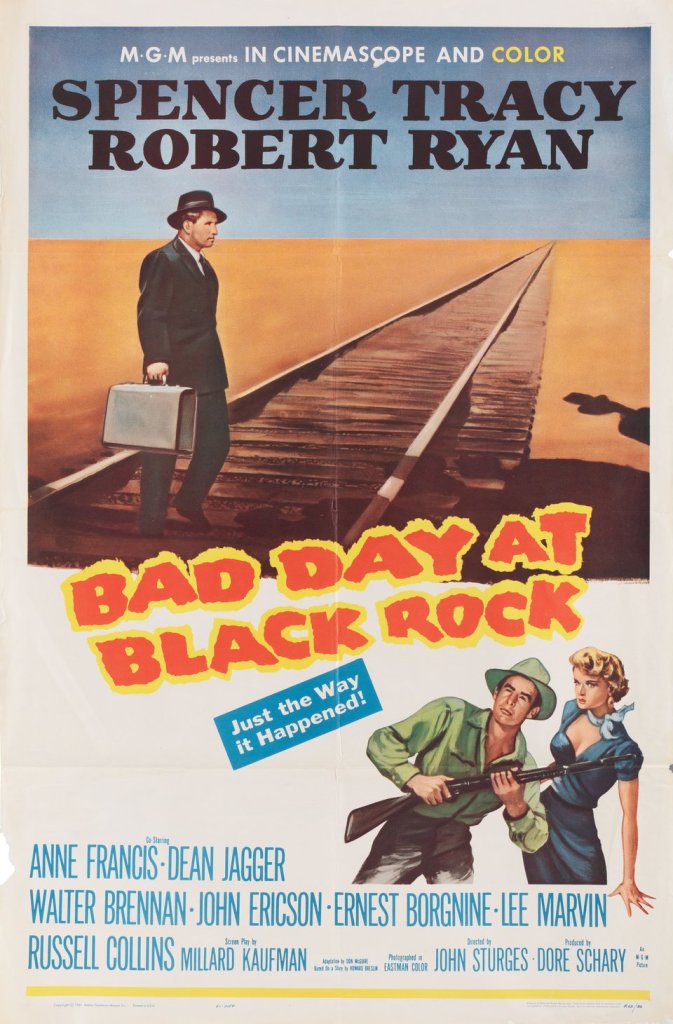
  • I’m intrigued by the tagline on the film’s poster: “Just the Way It Happened!” To the best of my knowledge, this movie and its source material are not based on a real-world event.
  • “Bad Day at Black Rock” was filmed in the then-new Cinemascope widescreen format. At first glance it feels like an odd match, the film’s subdued, intimate setting vs. Cinemascope’s inherent grandness, but it ultimately works in the movie’s favor. The widescreen helps highlight the expansive nothingness beyond the city limits, showing how isolated Black Rock is from the rest of the world, making it a perfect spot for a racist like Reno to reign supreme. There’s also plenty of low angle shots, making everyone in this town loom seemingly as large as the nearby mountain ranges. It should be noted, however, that cinematographer William C. Mellor was not nominated for an Oscar for his impressive work here. And they had two cinematography categories back then! Seriously, Oscars?
  • MGM built the entire town of Black Rock on location in Lone Pine, a census-designated place in Inyo County, California, wedged between the Sierra Nevada and Death Valley. Coincidentally, Lone Pine is not too far away from Manzanar, site of a Japanese internment camp that is the subject of another NFR film.
  • The opening credits sequence of the train speeding across the landscape was added late in post-production after test audiences felt the film began too abruptly. John Sturges was unavailable, so associate producer Herman Hoffman filmed the sequence, including the helicopter shot of the train heading right towards the camera, with the camera flying out of the way at the last second. Sturges allegedly said of the opening years later, “It’s a helluva shot, but I didn’t make it.”
  • Spencer Tracy is one of my favorite actors, so of course I got nothing but praise for him in this movie. Tracy was always the right balance of old-school Hollywood acting and modern Method acting: Natural without calling attention to it. As Macreedy, Tracy is giving a nuanced, disciplined performance; somehow always in control while simultaneously looking like he wandered onto the wrong movie set. Not bad for someone who tried on multiple occasions to back out of making this movie. Side note: Tracy is dressed almost identically to how he’ll be dressed in one of my favorite movies: “It’s a Mad, Mad, Mad, Mad World”, making “Bad Day” look like it could be a prequel.
  • And yes, Macreedy is a one-armed man, which Tracy plays by stiffening up his left arm and keeping his hand in his pocket for the whole movie. [Insert Your Own “The Fugitive” One-Armed Man Joke Here. Janssen, Ford, Daly: Dealer’s choice.]
  • I was not familiar with the works of Robert Ryan before watching this movie, though he shows up in two NFR westerns I will be covering eventually (“The Naked Spur” and “The Wild Bunch“). As Reno Smith, Ryan is cast as the type of bigoted heavy he always seemed to play in the movies. Rare is the actor who seems like a genuine threat to Spencer Tracy, but Ryan gives Smith the right amount of menace; one of those guys that doesn’t need to do the dirty work himself but can and will if the situation calls for it. I look forward to seeing Ryan’s other NFR performances.
  • In addition to Spencer Tracy and Robert Ryan, you get great supporting turns by Walter Brennan as the town doctor and Dean Jagger as the ineffective sheriff, plus early-career Ernest Borgnine and Lee Marvin as two of Smith’s thugs. Marvin in particular gets some good moments as the first townsperson to openly threaten Macreedy. Going toe to toe with Spencer Tracy this early in your career is a gutsy move. In fact, between this and Marvin’s latter intimidating of Jimmy Stewart and John Wayne in “Liberty Valance“, his early acting strategy is the equivalent of shivving the biggest guy in the prison yard.
  • Anne Francis doesn’t get a lot to do as the only woman in this movie, but she shares her scenes with Spencer Tracy admirably. Oh well, at least we all have her work in “Forbidden Planet” to look forward to.
  • [Semi-spoiler] Funny how the movie has been highlighted for its progressive tolerance of Japanese Americans, and yet the only Japanese people mentioned (Komoko and his son) are never actually seen on screen. Seems a bit backwards, but this is 1955: the mere mention of any non-White characters (and acknowledgement of the bigotry directed at them) is a step forward…I guess.
  • In another universe Spencer Tracy would have been a great Lou Grant. I know that has nothing to do with anything, but if “The Mary Tyler Moore Show” was somehow a ’50s workplace comedy, Tracy would have nailed it. I can just hear him saying “You’ve got spunk; I hate spunk.”
  • The one downside to all the natural performances in this movie: Mumbling. So much mumbling. Everybody is mumbling. It really says something when the most coherent actor in your movie is Walter Brennan. On a positive note, it’s a testament to everyone’s performances that I was still able to follow what was going on at any given time without resorting to subtitles.
  • Spencer Tracy was never really an action star, so it’s fun watching him (or a convincing stunt double) give Ernest Borgnine a near fatal karate chop to the throat. It’s one of the first genuinely surprising moments in the movie for me. Speaking of…
  • [Spoilers] That climax really takes things up a notch, with Spencer Tracy MacGyvering a Molotov cocktail and setting Robert Ryan on fire! Didn’t see any of that coming.

Legacy

  • Although he had already been directing film for a decade at this point, John Sturges hit his filmmaking stride starting with “Bad Day”. In the ensuing years he would make “Gunfight at the O.K. Corral”, “The Old Man and the Sea” (reuniting with Spencer Tracy), “The Magnificent Seven” (which is on the NFR), and “The Great Escape” (which isn’t). Despite his later achievements, Sturges named “Bad Day at Black Rock” his favorite of his own films.
  • “Bad Day at Black Rock” marked Spencer Tracy’s final film as a contract player with MGM after 20 years, opting to spend the rest of his career as a freelance agent. Tracy would, however, briefly return to MGM in 1962 to narrate “How the West Was Won“.
  • “Bad Day at Black Rock” still gets referenced every so often in pop culture, though mostly just the title (including by me in a real stretch of a subtitle for my “Pillow Talk” post). There have also been episodes of such TV shows as “Kojak”, “Remington Steele”, and “The X-Files” that take the film’s basic premise of a stranger in a small town with a secret. Ever the movie buff, Remington Steele even calls out the connection in his episode (though he calls it “A Bad Day at Black Rock” and gets the year wrong. But hey, there was no internet back then.)
  • And finally, although Don McGuire lost out on a screenplay credit for “Bad Day”, he would go on to write the play “Would I Lie to You?” and successfully got a story credit (and Oscar nomination) on its eventual film version: “Tootsie“.

#690) Letter from an Unknown Woman (1948)

#690) Letter from an Unknown Woman (1948)

OR “The Ophüls Truth”

Directed by Max Ophüls

Written by Howard Koch. Based on the novella by Stefan Zweig.

Class of 1992

A modern trailer

The Plot: In turn-of-the-century Vienna, former piano prodigy Stefan Brand (Louis Jourdan) is planning to skip town rather than participate in a duel with an unknown challenger. Before leaving, his butler John (Art Smith) hands him a recently delivered letter that opens with “By the time you read this letter, I may be dead.” From reading the letter, Stefan learns of its author Lisa (Joan Fontaine) who, as a teenage girl, first met and immediately fell in love with Stefan. Growing up, Lisa rejects all other romantic advances and marriage proposals, clinging to the fantasy of one day being with Stefan, who has barely taken notice of her. In her adult years, Lisa finally has an extended encounter with Stefan, culminating in a romantic evening together. Although Stefan promises to return to Lisa after a two-week concert engagement in Milan, he never returns. There’s plenty more heartbreak where that came from courtesy of one of Europe’s greatest directors on a brief detour to Hollywood.

Why It Matters: The NFR gives a little background on Ophüls, praising his “stylish trademarks” such as “fluid long takes, elaborate camera movements, opulent detail, and visual repetition”.

But Does It Really?: I suspect this is one of those NFR movies that serves as a loophole to get an acclaimed international director on the list. We’ve covered NFR movies from the likes of Fritz Lang and Sergio Leone that, while not their definitive work, are worthy enough to be included due to the filmmakers’ overall contributions to world cinema. This might be the case with Max Ophüls, with “Letter from an Unknown Woman” being a respected entry in his filmography, albeit in the shadow of his European films. While we’ve had a few entries like this over the years, it’s interesting that the NFR chose to induct “Letter” so early (it’s among the Registry’s first 100 movies). “Letter from an Unknown Woman” is largely forgotten but, if you’re willing to go along with it, is an enjoyable classic Hollywood melodrama and a fine representation of Max Ophüls.

Everybody Gets One: Max Ophüls started off as a theater actor and director in his native Germany, and by the early 1930s was making his first short films. Following the rise of the Nazi party in 1933, Ophüls moved across Europe continuing to make movies, arriving in America in 1941 and staying for the remainder of the decade. In his brief time in Hollywood, Ophüls made five films and directed such stars as Douglas Fairbanks Jr., James Mason, Joan Bennett, Barbara Bel Geddes, and of course Joan Fontaine. Fun Fact: Max was born Max Oppenheimer but changed his last name to Ophüls (after a prominent family in German aristocracy) so that his family name wouldn’t be tainted if he failed as an artist. Turns out that’s not something he had to worry about.

Seriously, Oscars?: No Oscar nominations for “Letter”, a semi-independent entry during the studio system’s dominance over the awards. Ophüls would eventually receive two Oscar nominations in his career: a Screenplay nod for “La Ronde” and Art Direction for “Le Plaisir”.

Other notes

  • Up until this viewing, I always got this movie mixed up with “A Letter to Three Wives“. Same era of movies, same basic framing device; can you blame me?
  • “Letter from an Unknown Woman” was one of a handful of movies made by Rampart Productions, an independent company formed by Joan Fontaine and her husband William Dozier, who served as this film’s executive producer. Neither their production company nor their marriage lasted too much longer after this film’s release.
  • Shoutout to “Letter” producer John Houseman: former Orson Welles associate, one-time Joan Fontaine paramour, and future Oscar-winning “Paper Chase” actor. Funnily enough, Houseman is only on the Registry as a producer (this and “The Bad and the Beautiful“). Side note: Every time John Houseman is mentioned I just hear Jerry Seinfeld’s impression of him; “Alec Beeeerg. Miss-tah Beeeerg.”
  • In the original novella, both Lisa and Stefan are unnamed (because, you know, the title). For those of you keeping score, that would have been two NFR entries in which Joan Fontaine plays an unnamed woman. We were so close to me reprising my Mulva runner from the “Rebecca” post. Hey, that’s two “Seinfeld” references in one post! Not bad for a 75-year-old movie.
  • I appreciate that the letter Lisa writes – which serves as the narration for the entire movie – is multiple pages front and back. All I could think of was the massive carpal tunnel she must have had while writing it.
  • This movie’s flashbacks begin with Lisa as a teenager, still played by Joan Fontaine. It’s a little weird, especially in Joan’s scenes with an actual teenage girl playing her friend, but I give her credit for this performance. You can see Joan really focus on the specific physicality of an awkward teenager, a chance for a movie star to show off their skills as an actor with range. Lisa’s character arc works because of Joan, but the teenager stuff is a bumpy start.
  • Stefon’s mute butler John is played by Art Smith, one of the many character actors in this movie who have been quietly popping up in multiple NFR movies without me noticing, aside from the occasional “Who’s that guy? He looks familiar.” And for you MST3K fans out there: Art Smith played Pile-On Pete!
  • While we’re talking about the butler, making him mute is unique to the movie, and I assume is there mainly as a plot device. I don’t know; I feel like at any moment John could have written to Stefon, “That’s the same woman, you moron!” But of course, there would be no movie if that happened, so back to the sidelines with you, Pile-On.
  • Stefon is a real bastard, but Louis Jourdan is very charming in the part. Even when you know Stefon is not going to reciprocate Lisa’s feelings, you’re still drawn to the guy. And I liked him a lot better in this than in “Gigi“, but that’s a low bar.
  • The cinematography by longtime Ophüls collaborate Franz Planer, as expected, is wonderful. It’s all very much the kind of stylish gliding associated with Ophuls, but never distracting or in disservice to the story. I particularly love the shot of Lisa and Stefon in their private booth at the restaurant. The camera zooms in on a part between the curtains, as if we are spying on their secret romance.
  • Another little detail I enjoyed: the occasional side commentary from different workers on Lisa and Stefon’s date, like the ride operators at the amusement park, or the women in the band. It’s all some much appreciated comic relief a la the animal appliances on “The Flintstones” (“It’s a living”). In fact, one of the bandmembers’ lines made me laugh-out-loud: “I like to play for married people. They’ve got homes.”
  • It’s not a melodrama until we get a “teary farewell at the train station” scene, which of course always makes me think of the parody version in “Airplane!” Speaking of, to my great disappointment, the Howard Koch that wrote the screenplay to “Letter from an Unknown Woman” is not the same Howard Koch that produced “Airplane!” That would have been too incredible for me to handle.
  • [Spoilers] Whoa, did not realize that Lisa has Stefan’s baby! That’s pre-marital sex and a child out of wedlock in one movie! But of course, this was approved by the Production Code, which we all know means that this won’t end well for anyone.
  • Shoutout to Marcel Journet as Lisa’s husband Johann, the rare “other man” in a Hollywood romance movie. He’s got the right mix where we understand his actions without hoping he succeeds instead of our protagonists.
  • Wait, there’s two train scenes? It’s an embarrassment of riches! Of course, this one is Lisa saying goodbye to her son and setting up the plot convenience that makes sure their Code-era sins are atoned for.
  • It’s hard to watch a melodrama like this without applying my 2024 sensibilities like, “Where the hell was Stefan?” and “Why does Lisa still love him?” It’s always a good reminder to try and meet these movies where they’re at. This movie doesn’t care about my logic-poking, it just wants you to get swept away in the romance of it all.
  • [Spoilers] The ending is quite effective, with Stefon having his Keyser Söze moment where he pieces together his memories of Lisa and realizes it was her all along, including seeing a ghostly apparition of her teenage self at the same spot where they met. It’s all very beautiful, and almost distracts you from the fact that he is still a real S.O.B. Also, the reveal that Johann is the man who challenged Stefon to a duel is an inevitable Code-enforced workaround, but it does the job.

Legacy

  • Following his work in America, Max Ophüls returned to Europe and made what are widely considered his best films, including “La Ronde”, “Le Plasir”, and “The Earrings of Madame de…”. Ophüls died in 1957 while working on “Les Amants de Montparnasse 19”, a film that would ultimately be completed by his friend Jacques Becker.
  • Max Ophüls’ filmography made a big impression on the French New Wave that was just getting started when he passed, which has led to new generations of film lovers discovering his work. “Letter from an Unknown Woman” got swept up in the reappraisal and is generally considered his best American film.
  • Following its box office failure and the subsequent dissolvement of Rampart Productions, “Letter from an Unknown Woman” was sold to Mundus Television in 1954 and started making the late show movie rounds. At some point the film lapsed into public domain and is currently available on several internet video sites and streaming services for free.
  • The original novella of “Letter from an Unknown Woman” has been adapted into other movies many times over the years, as well as a Russian opera in the ’70s.
  • Joan Fontaine’s film career stayed steady through the 1950s, and while some of them were popular with audiences, none have retained any significant legacy. Outside a few TV movies in her later years, Ms. Fontaine’s last movie was 1966’s “The Witches” for Hammer Films. Joan Fontaine died in 2013 at age 96.
  • And finally, because of course it’s worth mentioning: Executive producer William Dozier would pivot to television later in his career, most notably as the producer and narrator of the Adam West “Batman” TV show. “What’s this!? Lonely Lisa’s letter of lost love left lingering by loathsome lothario!?”

Further Viewing: Any of Max Ophüls’ later filmography mentioned above. I haven’t seen any of them, but I’m adding them to my ever-expanding list of international movies to get around to once I’ve finally caught up with all these American movies.

#689) Apollo 13 (1995)

#689) Apollo 13 (1995)

OR “Moon for the Missed-Their-Shot Men”

Directed by Ron Howard

Written by William Broyles Jr. & Al Reinert. Based on the book “Lost Moon: The Perilous Voyage of Apollo 13” by Jim Lovell and Jeffrey Kluger.

Class of 2023

The Plot: In April 1970, Apollo 13 becomes the latest NASA mission to the moon in the wake of 1969’s historic Apollo 11. After a few last-minute changes, the crew for the Apollo 13 mission are Commander Jim Lovell (Tom Hanks), Command Module Odyssey pilot Jack Swigert (Kevin Bacon), and Lunar Module Aquarius pilot Fred Haise (Bill Paxton). Lovell in particular is excited to finally fulfill his dream of walking on the moon, having orbited around it on Apollo 8. After a successful launch, a routine check of the oxygen tank stirring fans causes an electrical short, which depletes most of the ship’s oxygen and power. With the guidance of Mission Control in Houston led by Flight Director Gene Kranz (Ed Harris), the moon mission is aborted, and a race against time begins to get the astronauts back to Earth before they run out of oxygen. In other words: Now the story of several astronauts who lost power, and the Mission Control who had no choice but to bring them home. It’s “Apollo 13”.

Why It Matters: The NFR throws a ton of superlatives at everyone involved with “Apollo 13”, including Ron Howard’s direction (“equally meticulous and emotional”), the cast (“talented”), the script (“well-paced”), and the special effects (“crafty”).

But Does It Really?: I had never seen “Apollo 13” before this viewing, and I really enjoyed it. With “Apollo 13” Ron Howard takes an oft-overlooked bit of American history and turns it into an exciting, dramatic crowd pleaser. Key to this success is Howard’s balancing of technical and historical accuracy without compromising the human elements, keeping those of us with zero NASA knowledge engaged by these real people in real peril. “Apollo 13” also made me nostalgic for the kind of big-budget, well-crafted, non-IP studio movie that rarely gets made nowadays (outside of something like “Oppenheimer”). With its exceptional roster of talent both in front of and behind the camera, “Apollo 13” is a movie that works on every front and has stuck around long enough in pop culture that its NFR inclusion is more than justified.

Shout Outs: A quick reference to “2001” by Jim while inside the Odyssey, which makes sense.

Everybody Gets One: Ron Howard is already on the NFR as an actor, but this is his first Registry movie as director. Even in his child actor days Howard knew he wanted to direct, so in 1976 when Roger Corman approached the 22-year-old Howard about starring in the car movie “Eat My Dust!”, Howard agreed on the condition that Corman finance his directorial debut “Grand Theft Auto” (Corman also pops up in “Apollo 13” as a congressman touring NASA). After a run of TV movies, Howard returned to theatrical film in the 1980s with such hits as “Splash”, “Cocoon”, “Willow”, and “Parenthood”. Howard signed on to “Apollo 13” after his longtime business partner Brian Grazer secured the film rights to “Lost Moon”. Also making their NFR debuts are the movie’s screenwriters: William Broyles Jr. (former Marine Corps officer and creator of “China Beach”) and Al Reinert (director of the Apollo documentary “For All Mankind”).

Wow, That’s Dated: A credit that could only exist in the ’90s: “Vocal performance by Annie Lennox”.

Seriously, Oscars?: One of the biggest hits of the year, “Apollo 13” received nine Oscar nominations, one behind that year’s eventual Best Picture winner: “Braveheart”. “Apollo 13” lost in seven categories to seven different movies, but did win in two categories: Film Editing and Sound. The biggest outcry was reserved for Ron Howard, who did not receive a Best Director nomination.

Other notes

  • Our opening exposition dump comes courtesy of trusted news anchor Walter Cronkite, narrating a recap of NASA and the Apollo missions up to 1969. It’s the movie’s first bit of nostalgia, in this case for a time when you could trust your news anchor. Cronkite also re-recorded some of his original Apollo 13 news coverage for the film.
  • It must feel like you’ve won the lottery when Tom Hanks agrees to play you in a movie. As Jim Lovell, Hanks gives him a degree of charm and charisma that only he possesses as an actor. Hanks has subsequently brought that movie star appeal to such historical figures as Walt Disney, Fred Rogers, and Colonel Tom Parker (okay, maybe Parker’s a bad example).
  • I won’t go into every difference between the actual Apollo 13 mission and the film version. Suffice it to say that like many a historical movie, the main details are accurate, with some events streamlined or dramatized for a clearer narrative. Among the bigger divergences is the portrayal of Jack Swigert, who in real life was nowhere near as green as Kevin Bacon’s portrayal. In fact, the real Swigert wrote the malfunction procedures for NASA’s command modules, including the Odyssey. Side note: Despite his popular distinction as “Center of the Movie Universe”, this is only Kevin Bacon’s second NFR appearance (the other is “Animal House“).
  • Gary Sinise doesn’t get a heck of a lot to do as grounded pilot Ken Mattingly, but Sinise was offered any role he wanted and picked Mattingly, so I guess he knows what he’s doing. I’m just glad that Lieutenant Dan kept his word to Forrest Gump.
  • It’s hard not to watch this movie without making the inevitable comparisons to “The Right Stuff“. It helps, however, that the two movies are more companion pieces than direct remakes, each covering neighboring but different eras in NASA history. As best I can tell, the only historical figure in both movies is Deke Slayton, one of the original Mercury Seven astronauts and later NASA’s Chief of the Astronaut Office. Slayton is played by Scott Paulin in “Right Stuff” and Chris Ellis in “Apollo”.
  • Your movie isn’t set in the late 1960s until you play Jefferson Airplane’s “Somebody to Love”. It’s the law.
  • The launch sequence gave me genuine chills. Much like the send-off scene in “Titanic“, Howard conveys the sense of awe and wonder of this historic launch, mixed with the tension and uncertainty of the crew’s later problems.
  • This movie’s Mission Control is White Guy Character Actor Central. Led by the always great Ed Harris in a commanding yet understated performance, you also get the likes of Marc McClure, Joe Spano, Christian Clemenson, Loren Dean, Xander Berkeley, and Clint (brother of Ron) Howard. Special mention to Jim Meskimen, the real-life son of Ron Howard’s former TV mom Marion Ross. Does that make them stepbrothers?
  • Clint’s not the only member of the Howard family in this movie. Ron’s mother Jean plays Jim’s mother, Ron’s father Rance is the minister watching the mission with the Lovells, and among the background extras the night before the launch are Ron’s wife Cheryl and their then-14 year old daughter Bryce Dallas Howard.
  • Everything about this movie is A+, but the special effects are outstanding. Most early ’90s CG tends to stick out nowadays, but the effects of the modules in space still hold their own. This movie is also famous for partially filming in a reduced-gravity aircraft for several shots of the astronauts floating inside the modules. By the way, “Apollo 13” was Oscar-nominated for its Visual Effects, but you know what it lost to? “Babe”. That’s right, the talking pig movie. Seriously, Oscars?
  • This movie’s most iconic line is a prime example of Screenplay Adaptation 101. In real life, Lovell repeated Swigert’s communication to Ground Control, “Houston, we’ve had a problem”. The screenplay punch-up is Jim alone telling them, “Houston, we have a problem”, a more dramatic version of the same thing.
  • Shoutout to Kathleen Quinlan, who gets more to do as Marilyn Lovell than all the wives in “The Right Stuff” combined. Most of Quinlan’s performance is reacting to updates on her husband’s mission, but she nails it, giving the movie its beating heart. Quinlan’s first movie role was in “American Graffiti“, and I’m glad Ron remembered his old castmate.
  • I don’t know why, but the fantasy sequence of Jim walking on the moon reminded me of that moon song Ernie used the sing on “Sesame Street”. Anyone else?
  • The movie’s other iconic line, Kranz’s declaration that “Failure is not an option”, was created specifically for the film. The screenwriters interviewed flight controller Jerry Bostick (played in the movie by Ray McKinnon) about his experience during Apollo 13. Bostick informed them that during this entire mission, “we just calmly laid out all the options, and failure was not one of them.” The real Gene Kranz liked the line so much he used it as the title of his memoir.
  • Serving as a wonderfully cinematic counterpart to the launch sequence, the re-entry of the Odyssey is wonderfully tense. Even with the knowledge of how it ended in real life, I caught myself holding my breath, with an immediate cathartic exhale once we finally hear from the astronauts. Also, keep an eye out for the real Jim Lovell as the captain of the USS Iwo Jima who shakes movie Jim Lovell’s hand.
  • Nice workaround with the obligatory epilogue text; Tom Hanks narrates it in character as Jim, giving us a rundown of what happened to everyone, and wondering if we will ever get back to the moon. Who wants to break it to him that the only people going to the moon nowadays are self-indulgent tech billionaires having the most expensive mid-life crisis ever?
  • I’ve said it before and I’ll say it again: Where were the “Hidden Figures” ladies during all of this? I bet they would have solved this whole thing in about 20 minutes.

Legacy

  • Ron Howard’s directing career has steadily continued over the last 30 years with such films as “How the Grinch Stole Christmas”, “Frost/Nixon”, the underrated “EDtv”, and “A Beautiful Mind” which won him his Best Director Oscar.
  • Tom Hanks would go on to play another real-life pilot who helps land a vehicle in a life-or-death situation in 2016’s “Sully”.
  • While NASA has never done another Apollo-level mission to the moon, we did get the Mission: Space ride at EPCOT, which features Gary Sinise in the pre-show, so that’s something.
  • Clint Howard would spoof his own “Apollo” performance in all three “Austin Powers” movies. “In many ways, the Big Boy never left, sir. He’s always offered the same high-quality meals at competitive prices.”
  • “Apollo 13” still gets mentioned quite a bit in pop culture, with one of the more recent homages coming from none other than Bryce Dallas Howard. A terrific director in her own right, Ms. Howard has helmed – among other things – an episode of “The Mandalorian” which has a re-entry scene that is almost shot for shot the “Apollo 13” re-entry scene.
  • The film’s main legacy is, of course, the quote “Houston, we have a problem.” Anything even vaguely connected to astronauts and/or space travel has referenced that line. Heck, I’ve quoted it on this very blog!
  • Perhaps the film’s biggest unintentional impact on our culture: In 1997, computer scientist Reed Hastings returned his Blockbuster-rented VHS of “Apollo 13” six weeks late, accruing a $40 late fee. Theorizing there must be a better way to rent movies, he and co-worker Marc Randolph created a video rental-by-mail system they dubbed “Netflix”. And now you know the rest of the story!

Further Viewing: “Marooned”, John Sturges’ drama also about three astronauts potentially stranded in space, released four months before the Apollo 13 mission (In fact, “Marooned’ won the Oscar for its Visual Effects four days before the Apollo 13 launch). It’s the movie that gave Marilyn Lovell nightmares about her husband’s mission, as depicted in “Apollo 13”.

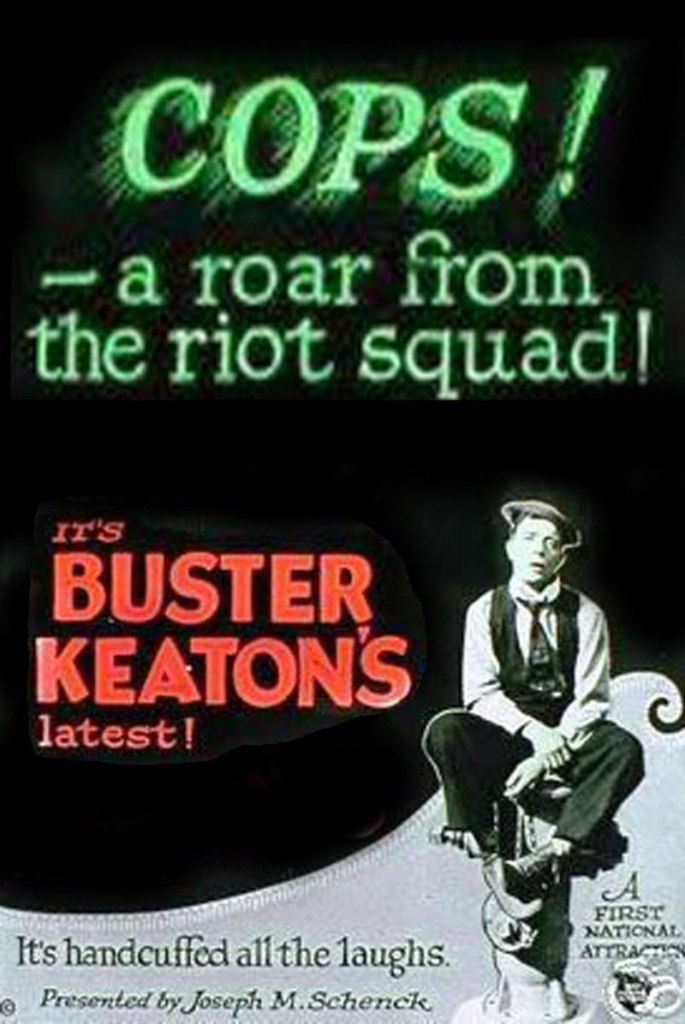
#688) Cops (1922)

#688) Cops (1922)

OR “Law & Disorder”

Directed & Written by Buster Keaton and Edward F. Cline

Class of 1997

The Plot: Buster Keaton plays – as usual – a lovelorn sad sack trying to woo a young woman (Virginia Fox), who won’t be with him until he has become “a big business man”. Within a few short scenes, Keaton steals a rich man’s wallet, is conned into buying furniture from a seemingly destitute man (Steve Murphy), buys a horse and carriage that aren’t for sale, gets mistaken for a mover by the man who actually owns the furniture (Joe Roberts), crashes a policemen parade, sets off a bomb, and is chased through town by hundreds of cops. And all in 18 minutes!

Why It Matters: The NFR calls it “one of Buster Keaton’s best short films”, praising his “popular blending of athleticism and his unique stone-faced comedic style.” An essay by AMPAS archivist Randy Haberkamp is a love letter to the short, with an encouragement to see it on a big screen as intended.

But Does It Really?: I’ll try not to make this another gushfest, but this may be the funniest short I’ve gotten to watch for this blog. Keaton has quickly become my favorite of the silent film comedians, and “Cops” once again delivers a generous helping of his trademark inventiveness and laugh-out-loud gags. There’s definitely a lot of Keaton on the Registry (five features, two shorts, plus his cameo in “Sunset Boulevard“), but “Cops” shows us just how good he was right from the start. No argument from me for the NFR inclusion of “Cops”.

Wow, That’s Dated: The one joke that I needed to have explained to me is when Buster accidentally takes his horse to a “Goat gland specialist”. This is a reference to John R. Brinkley who was – according to the first sentence of his Wikipedia page – “an American quack.” Brinkley’s claim to fame was promoting the use of goat glands to cure erectile dysfunction, which got him nationwide notoriety despite the abundance of scientific evidence proving this procedure was a load of crap. Brinkley came to Los Angeles in 1922, so the reference to him in “Cops” is extremely topical.

Other notes

  • A quick word on Buster Keaton: Buster was born to vaudeville-performing parents, and by the time he was three was recruited to join the act, learning how to perform comedy (both verbal and physical) at a young age. By the late 1910s, the slow death of vaudeville (mixed with his father’s alcoholism) threatened to end the Keaton family’s act, and Buster knew a career pivot was in order. While in New York, Buster met Roscoe Arbuckle, who convinced a reluctant Buster to act in short comedy films. Arbuckle’s producer Joseph Schenck was so impressed with Keaton that in 1920 he gave Keaton his own independent film unit: Buster Keaton Productions. From 1920 to 1923, Keaton wrote, directed, and starred in 19 shorts. The first was fellow NFR entry “One Week” in 1920, and “Cops” was the twelfth.
  • Interestingly, Buster Keaton is credited here as “Buster” Keaton. Born Joseph Keaton (like his father), he earned the nickname “Buster” as a child (the word “buster” has had several meanings at various times; its usage here could be to describe an extraordinary occurrence, a bad fall, or a very sturdy child). It’s interesting that someone felt the need to put Buster in quotation marks, as if to tell audiences, “Don’t worry, he has a Christian name, too.”
  • While it’s easy to give Keaton all the credit, we can’t forget his collaborator Edward F. Cline. Cline started off as a gagman for Mack Sennett and was hired by Keaton to work with him once he got his own production unit. The two co-wrote and co-directed all of Keaton’s shorts, as well as his first feature, “Three Ages”. Post-Keaton, Cline had a successful solo directing career, including several films with W.C. Fields. Cline and Keaton reunited in the 1950s when Keaton made the move to television.
  • I’ve been holding off writing about “Cops” in more detail because what is there to say? I found the whole thing unequivocally funny. The opening bit with the wallet? Funny. Keaton buying a horse and taking the family’s stuff? Hilarious. Keaton inventing a turn signal with a boxing glove and accidentally punching a cop? Side-splittingly funny. It all works. Well, except the goat gland bit that had to be explained to me. But now even that part is funny…in theory.
  • Admittedly, things slow down a bit in the middle, but once Keaton wanders into the police parade and inadvertently sets off a bomb, the short goes into full Keystone Cops mode. This also prompts the best line in the short: “Get some cops to protect our policemen!”
  • I won’t spoil the ending, but it’s a fun twist for an old comedy short. Just watch it. Seriously, the whole thing is only 18 minutes and very easy to find online. What else are you doing?

Legacy

  • Within a year and a half of “Cops” being released, Keaton would make the jump to feature films, with his first feature – “Three Ages” – being released in September 1923.
  • As with most of Buster Keaton’s other iconic works, “Cops” is primarily remembered as part of the collective Buster Keaton filmography rather than as an individual entity. If you’ve seen one clip from this movie, it’s either Keaton being chased by a mob of police officers (as seen in “Precious Images“) or quickly grabbing hold of a moving vehicle and being whisked away (a bit emulated in many a film and TV show since).
  • And finally, “Cops” is of no relation to “COPS” the FOX TV show. But hey, it’s a good excuse for me to play “Bad Boys”. 

“Cops” was filmed on location with the men and women of Buster Keaton Productions. All fictional protagonists are innocent until proven guilty in a court of law.

#687) Fuentes Family Home Movies Collection (c. 1928 – c. 1938)

#687) Fuentes Family Home Movies Collection (c. 1928 – c. 1938)

OR “Deep in the Heart of Tex-Mex”
Filmed by Antonio & Josefina Fuentes

Class of 2017

My thanks to the Texas Archive of the Moving Image (TAMI) for preserving these home movies. You can view them on the TAMI website.

The Plot: Filmed in the border town of Corpus Christi, Texas, the Fuentes family home movies are…well, home movies. As portable cameras were starting to become more accessible, Antonio and Josefina Fuentes spent the 1920s and 1930s documenting various holidays and trips, almost all of them with their adorable kids running around being cute. At face value these home movies are no different than many other families of the time, but historically they showcase a Mexican-American community forming and growing on the border of the Lone Star state.

Why It Matters: The NFR calls this collection “a priceless snapshot of time and place” that are “among the earliest visual records of the Mexican-American community in Texas”.

But Does It Really?: I was definitely on the fence about this one. We have plenty of home movies on this list already (heck, there’s another home movie filmed in Texas on the list), do we need another one? But as usual, my research led me to the Center for Home Movies, which features an essay by TAMI founder Dr. Caroline Frick that makes a compelling argument for this collection’s inclusion. As with so many movies on this list, the Fuentes family home movies are on the NFR not for what they are, but what they represent: in this case a documentation of a Mexican-American community in a Texas border town in its early stages, presented in a positive light, free from the harmful stereotypes of mainstream media. A very slight pass for “Fuentes Family” on the NFR, but I think I’ll take a break from home movies for a while. 

Everybody Gets One: Once again, my thanks to the Frick essay which has the most thorough information about the Fuentes family I could find online. Born in Montemorelos, Nuevo León, Antonio Fuentes moved to Texas some time in the early 1900s, settling in Corpus Christi in the 1910s. While working as the town’s Mexican consulate, Antonio met Josefina Barrera, and the two married in 1918. They had five children: Ruben, Ophelia, Mercedes, Antonio Jr., and Carmen, all of whom show up in the home movies. At some point in the late 1920s, Antonio purchased a Pathe Baby 9.5mm camera, one of the first portable and affordable movie cameras, and started filming his family.

Other notes

  • All told, the Fuentes family home movies are six reels totaling 16 minutes in runtime. The Frick essay mentions that there are 15 reels, but all my other research indicates that the Fuentes collection is just the six films available online. I’m grateful for how short this collection is (compared to the other home movies on this list) but who knows; This may turn out to be a placeholder post after all.
  • Interestingly, almost every film ends with the Pathe logo. Was it imbedded into their film stock? Or was it added after the film got processed?
  • Thanks to the Fuentes documentation of Christmas morning 1928, this movie qualifies for my “Die Hard Not Christmas List“. Always fun to give that an update.
  • A good chunk of these home movies is devoted to the 1929 4th of July parade in downtown Corpus Christi. Among the local organizations represented with floats and/or marchers are two Mexican-American civil rights groups: The League of United Latin American Citizens (LULAC), and the Order of the Sons of America. The appearance of LULAC is especially interesting, considering that it had only been founded five months earlier (but I guess that early publicity worked: they’re still around). Antonio and Josefina were active with LULAC throughout their lives, as well as other local civic organizations, including Obreros y Obreros, which also shows up in one of these parades.
  • No home movie collection would be complete without some vacation footage, in this case the Fuentes family’s 1938 trip to Antonio’s parent’s ranch in Montemorelos. While Corpus Christi wasn’t exactly a hustle-and-bustle metropolis at the time, the ranch visit is a nice change of scenery, with all sorts of chickens, horses, cows, and other livestock roaming around.

Legacy

  • Antonio and Josefina Fuentes continued to be active members of the Corpus Christi Mexican-American community until their deaths in, respectively, 1988 and 1993. In 1992, their daughter Mercedes Fuentes Peck donated their papers to the Special Collections and Archives at Texas A&M University-Corpus Christi, with their home movies being donated in 1995.
  • In 2002, the Texas Archive of the Moving Image was founded by University of Texas, Austin Associate Professor Caroline Frick to collect and preserve all film pertaining to Texas. Among these films is, of course, the “Fuentes Family Home Movie Collection”, which has been digitized thanks to TAMI’s collaboration with Texas A&M. Not-so-coincidentally, Dr. Frick was an “at-large” member of the National Film Preservation Board in 2017, and is no doubt the reason these home movies made it into the NFR.