#197) The Birds (1963)

birds_xlg

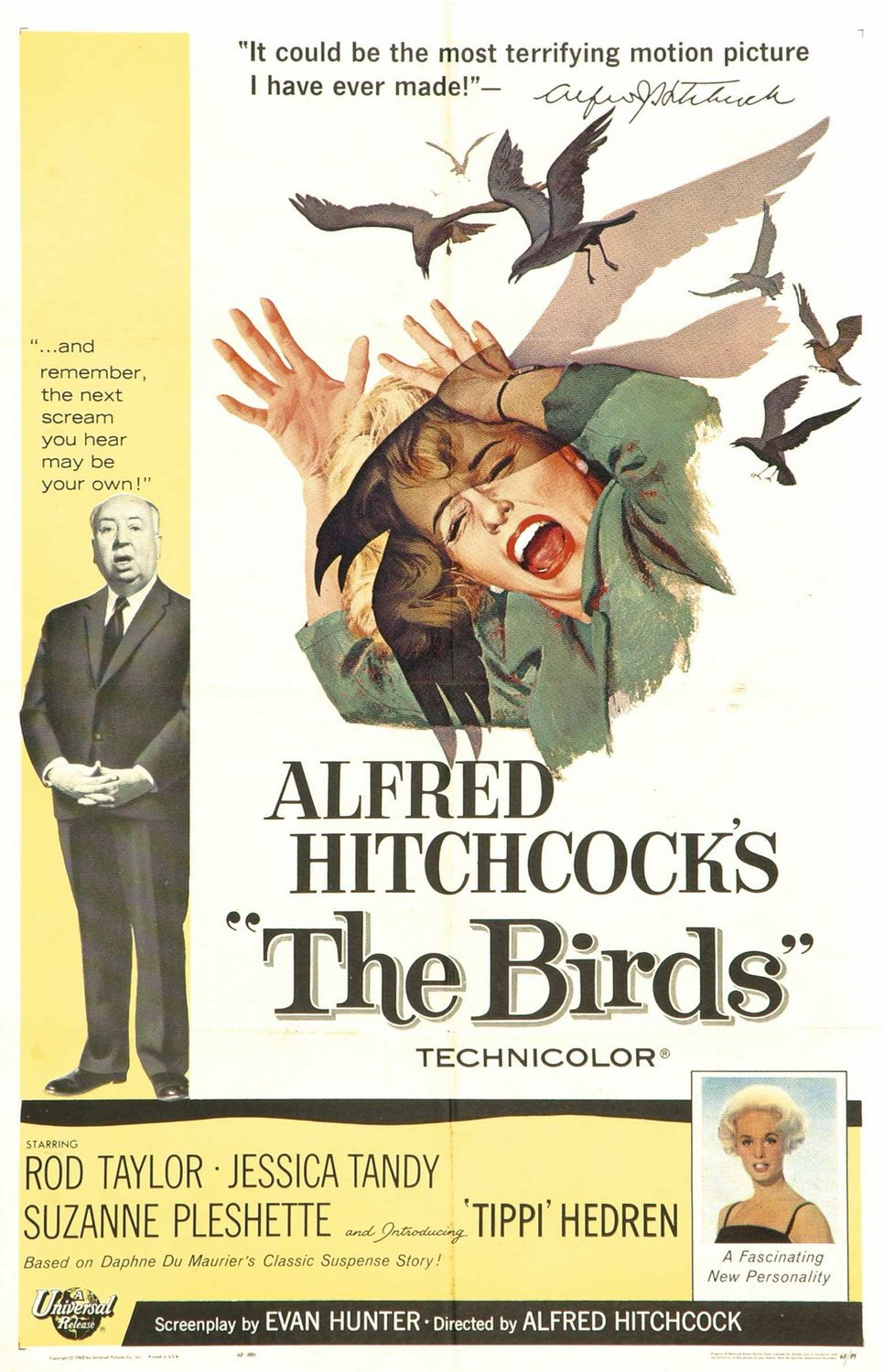
#197) The Birds (1963)

OR “SEAGULLS! (Stop It Now)”

Directed by Alfred Hitchcock

Written by Evan Hunter. Based on the novelette by Daphne du Maurier.

Class of 2016

The Plot: Socialite Melanie Daniels (Tippi Hedren) is the butt of a prank by lawyer Mitch Brenner (Rod Taylor). She gets her revenge by sending a pair of lovebirds to Mitch’s family home in Bodega Bay, California (you had to be there). She is caught, but ends up spending the weekend with Mitch, his mother Lydia (Jessica Tandy), his sister Cathy (Veronica Cartwright), and local schoolteacher/Mitch’s ex Annie (Suzanne Pleshette). There’s a lot of complicated emotions going on, but then several species of birds start attacking the town and it’s still quite chilling so who cares?

Why It Matters: The NFR praises Hitch for “deftly moving from anxiety-inducing horror to glossy entertainment and suspense, with bold forays into psychological terrain.”

But Does It Really?: This is another one of the “Wasn’t This Already on the List?” films. How one of the most suspenseful films ever made didn’t make the cut before “Top Gun” I’ll never know. Hitchcock knew how to prey on people’s primal fears. Birds will never not be scary, and the film survives on that simple idea. The main cast members do fine work, but as is the case with most of Hitch’s projects, the star is the premise and Hitchcock himself. “The Birds” doesn’t stand up next to Hitch’s earlier films, but it’s the best of his post-“Psycho” work and a film whose lasting iconic status earns it a place on the list.

Everybody Gets One: Tippi Hedren, as well as supporting players Jessica Tandy and Suzanne Pleshette.

Wow, That’s Dated: Rear projection. Rear projection for days.

Take a Shot: The phrase “the birds” is said occasionally throughout. Keep a drink at the ready, but pay attention.

Seriously, Oscars?: One of the biggest hits of 1963, “The Birds” received one Oscar nomination: Visual Effects. Despite bringing in longtime Disney legend Ub Iwerks to oversee the revolutionary sodium vapor process, the film lost to “Cleopatra”, known for its outstanding…matte paintings? That win was mostly 20th Century Fox buying votes in the hopes of making their money back (the budget for “Cleopatra” was literally 10 times the budget for “The Birds”).

Other notes

  • The original short story is the same basic premise, but set in du Maurier’s native Cornwall, England and with a whole different set of characters.
  • Tippi Hedren’s real name is Nathalie. Her family gave her the nickname “Tippi” as a variation on “tupsa”, a Swedish word for “little girl” or “sweetheart” (sources vary).
  • Cute dogs, Hitch.
  • Ah, the Union Square of the early ‘60s. You know it’s a work of fiction because Mitch finds street parking with no problem.
  • Like Gig Young before him, Mel Cooley is here to deliver a huge clunky case of exposition.
  • So everyone in Bodega Bay is from Maine?
  • The shrewdest part of the film is that Hitchcock knew what audiences expected from “a Hitchcock film”. If you’d never seen one of his films before you’d think that the first half hour or so is incredibly boring, but Hitch knew his audience was expecting a bird attack, so delaying it for as long as possible provided him with maximum suspense.
  • This seems like a long way to go for a prank. Melanie wouldn’t rather be jet-setting or something like that?
  • Is every one of Veronica Cartwright’s lines dubbed? I didn’t realize that when they say your voice changes, they meant in post.
  • Annie Hayworth may be operating the first Airbnb.
  • Mitch has a clingy, possessive mother? Cool your jets, Hitch. Perhaps Lydia would lighten up if she had a charismatic, worldly-wise chauffeur.
  • The characters in this movie may be Hitchcock’s ultimate MacGuffin. There’s no plot for any of them to advance, nor any happy ending or resolution. The stars of the film are the birds themselves and everything else is filler.
  • Cathy is having the worst birthday.
  • Speaking of, Cathy turns 11 in this film. Veronica Cartwright was 13 during filming, Rod Taylor was 32, Jessica Tandy was 53. Biologically, this could all happen, but it’s weird they never mention the massive age-gap between Cathy and Mitch.
  • And now I have “Risseldy, Rosseldy” stuck in my head for the next six months. Thanks movie.
  • Surprise cameo by Miss Marple. Is anyone in this town actually from California?
  • All I will say about the bird attack in the diner is “Boy, that escalated quickly.” And where would the phone booth attack happen now? A charging station?
  • Does Mitch have some sort of natural bird repellent? He doesn’t have a mark on him the whole time. He’s like Tony Curtis during the “Great Race” pie fight.
  • “The Birds” is not without its flaws, but it’s still very nerve-wracking to watch. Hitch, you were a garbage human, but a hell of a director.

Legacy

  • Tippi Hedren worked with Hitch on his next picture, “Marnie”. After a work relationship that I’ll understatedly call “tense”, Hitch and Tippi never worked together again, and Hitch used his clout to bring her career to a halt.
  • Tippi’s relationship with Hitch became the 2012 TV movie “The Girl” with Sienna Miller and Toby Jones. The real Tippi Hedren gave her eventual approval, stating that it was accurate, though never highlighted her positive experiences with the director.
  • This is the film that started what I call “The Hedren Dynasty”. Every 25 years or so we get another generation of this acting family, as well as excellent proof that patriarchies are overrated.
  • “The Birds” has a sequel for some reason. Tippi’s in it as a completely different character so why even bother?
  • Hollywood occasionally threatens us with a remake, but it keeps getting postponed, so we’re safe for now.
  • Lots and lots of parodies. We’ll start with “High Anxiety” and “The Simpsons”.

#196) The Shawshank Redemption (1994)

Les_Evades

#196) The Shawshank Redemption (1994)

OR “The Internet’s Favorite Movie”

Directed & Written by Frank Darabont. Based on the novella “Rita Hayworth and Shawshank Redemption” by Stephen King.

Class of 2015

The Plot: Andy Dufresne (Tim Robbins) arrives at Shawshank State Penitentiary in 1947 after being convicted of murdering his wife and her lover. Andy keeps to himself for the first month or so, but finally starts talking to fellow inmate “Red” Redding (Morgan Freeman), who is responsible for smuggling items into the prison. Over the next 20 years, the two men form a lasting friendship, while Andy makes the most of his time in Shawshank, revitalizing the library following the release of Brooks (James Whitmore) and staying on the good side of corrupt Warden Norton (Bob Gunton). And somehow a rock hammer and a Rita Hayworth poster feature prominently in all of this.

Why It Matters: The NFR highlights the score by Thomas Newman, as well as the performances of Freeman and Robbins, “highlighting the abiding resilience of the human spirit”.

But Does It Really?: Oh yeah. In less than a quarter century “Shawshank” has gone from commercial flop to cult favorite to all-time classic. “Shawshank” may be the best adaptation of a Stephen King work ever. The film is “just people talking” for 2 ½ hours, but everything from the acting to the directing to the cinematography holds your interest. The film lures you in with Robbins’ enigmatic performance and Freeman’s warmth, and the further along you go, the more compelling and gratifying the viewing experience is. “Shawshank” is one of the rare films that deserved a second chance, and got it. Kudos to everyone involved.

Shout Outs: Frank Darabont cites “Goodfellas” as an influence on the film. But the most notable NFR reference is the clip from “Gilda” that sets a plot point in motion.

Everybody Gets One: Almost everyone, primarily Frank Darabont and composer Thomas Newman. Amazingly, this is the only one of Stephen King’s film adaptations to make the Registry (though I’m still holding out for “Carrie”**).

Seriously, Oscars?: Despite its now-legendary tank at the box office, “The Shawshank Redemption” managed seven Oscar nominations, including Best Picture. But “Forrest Gump” was the film to beat that year, and “Shawshank” went home empty-handed.  In addition to “Gump”, “Shawshank” lost Sound to “Speed” and Cinematography to “Legends of the Fall” (the first of Roger Deakins’ 13 unsuccessful bids before finally winning this year). And although Morgan Freeman garnered a well-deserved Best Actor nomination, Tim Robbins equally impressive (if somewhat more restrained) work didn’t make the cut. And where’s the Best Supporting Actor nods for James Whitmore and Bob Gunton?

Other notes

  • The film is quite faithful to the novella. The main difference is that the multiple wardens in the book are condensed into one character for the film.
  • Speaking of, the only major Stephen King trope this film has is its Maine setting. No alcoholic writers or unexplained psychic powers to be found here.
  • This week on “Hey, It’s That Guy!”: Jeffrey DeMunn as the prosecuting attorney in the opening credits. Yeah, that guy! He also wins the Best Timing award; his name shows up in the credits while he’s on screen.
  • That’s Morgan Freeman’s son Alfonso as young Red in his file photo. In addition to being Morgan’s assistant on this film, Alfonso appears as a prisoner during the “fresh fish” scene.
  • The character of Red was written as white, with the likes of Harrison Ford and Paul Newman being considered. Thanks to some colorblind casting, Morgan Freeman is an inspired choice in the role that defined his screen persona. It’s refreshing to see an African-American in a role in which his race isn’t a factor, and whose casting was not some mandated Affirmative Action. (Pssst, you should do that again, Hollywood. A lot.)
  • I assume James Whitmore is in prison on a count of being too adorable.
  • Having recently filed my taxes, I feel Byron Hadley’s pain.
  • Doesn’t this just feel like a movie Michael Shannon should be in? What was he up to back then?
  • The film is episodic to be sure, but it works because every episode builds upon the last one. It has a very organic flow from one to the next.
  • And then we arrive at the “Marriage of Figaro” scene. It’s just perfect. And perhaps the greatest scene in any film to end with a record scratch.
  • Man, all of that punishment for Dufresne because the Warden won’t admit he doesn’t know what the word “obtuse” means.
  • The ending makes me laugh with joy every time. I just feel sorry for whoever had Andy’s cell before him. If only he had spent more time carving into the walls.
  • 500 yards is not “just shy of half a mile”, but Morgan Freeman said it with such natural conviction that you didn’t even notice.
  • Do I believe the Christ allegories that the Internet keeps pushing on this film? Well, I got a lot of “Cool Hand Luke” vibes throughout my viewing, so by proxy I kinda see it.

Legacy

  • “Shawshank” became a hit on home video when Warner Bros. sent a large amount of videocassettes to distributors following the film’s Oscar nods. The film’s status was also boosted by frequent cable airings due to its relatively inexpensive broadcast rights. To this day, TNT plays it at least 12 times a day. In fact, the odds are pretty good it’s playing on TNT right now. Go ahead, check your local listings.
  • Frank Darabont has only directed two films since “Shawshank”, and they’re both Stephen King adaptations: “The Green Mile” and “The Mist”.
  • This film is the reason Morgan Freeman is now required to narrate every film he’s in.
  • Tim Robbins followed this up by directing his own look at the prison system, “Dead Man Walking”.
  • The “Shawshank Tree” in Lucas, Ohio was a popular tourist spot for many years until it was finally blown down by strong winds in 2016.
  • “Family Guy” can be hit or miss, but their “Shawshank” spoof is pretty great, especially the last joke.

Listen to This:The National Recording Registry announced their 2017 selection a few weeks ago. Among the 25 entries was “If I Didn’t Care” by The Ink Spots, which, coincidentally, appears in the opening moments of “Shawshank”.

** 2018 Update: They went with “The Shining“. I should’ve seen that one coming. 2022 Update: “Carrie” finally made it.

#195) Luxo Jr. (1986)

luxo

#195) Luxo Jr. (1986)

OR “What If Desk Lamps Had Feelings?”

Directed & Written by John Lasseter

Class of 2014

The Plot: Ohhhhh, that’s where the lamp and the ball come from!

Why It Matters: The NFR calls the short “charming” and that Lasseter and animator Bill Reeves “manage to bring to joyous life these two inanimate objects and to infuse them both with personality and charm”.

But Does It Really?: Oh sure. It was revolutionary in its day, and it’s the Pixar logo for crying out loud! It’s cute, it’s short, it’s historically significant, what’s not to like?

Everybody Gets One: Almost every credited member of the film’s crew is either still with Pixar, or at least stuck around for fellow NFR entries “Tin Toy” and “Toy Story”. The one exception is Paul Heckbert, credited here as “Additional Modeler”. He would go on to teach Robotics at Carnegie Mellon University (known for their Robotics department) and was a software consultant at Duke University. Carnegie Mellon lists a lot of his stats in what is possibly the least impressive webpage ever.

Wow, That’s Dated: Early CG, but you knew that one already.

Seriously, Oscars?: A breakthrough among the animation community, “Luxo Jr.” was nominated for Best Animated Short in 1986, the first computer animated short to do so. They lost to some Belgian thing called “A Greek Tragedy”. It’s fine, if you like that 2D junk. Lasseter and Reeves would win the Oscar two years later with “Tin Toy”.

Other notes

  • The whole driving force behind this film was to show that Pixar could stand by itself as a company. Prior to 1986, Pixar was a division of the special effects company Industrial Light and Magic. In February 1986 Steve Jobs (yep, that one) invested $5 million into Pixar becoming its own corporation. George Lucas, still financially strapped from his divorce, took the money and sold off Pixar. Six months and countless man-hours later, “Luxo Jr.” premiered at the SIGGRAPH conference to great acclaim amongst the CG geeks in attendance.
  • Lasseter has said that the hardest aspect to animate was Luxo’s cord. It’s the only part of the film that sticks out; the cord movement looks a little too much like stop-motion.

Legacy

  • “Luxo Jr.” didn’t quite put Pixar on the map, but it got their name out there. It would be another decade of shorts until “Toy Story” made them a force to be reckoned with.
  • In addition to being the logo for Pixar Animation, Luxo Jr. and his famous yellow ball make brief appearances in many a Pixar film.
  • Before Pixar found worldwide success, Luxo made appearances in a handful of shorts featured on “Sesame Street”.
  • Though he never gets the media attention Lasseter does, Bill Reeves is still with Pixar as one of their technical directors.
  • This film is responsible for the strong run of Pixar shorts that precede their features. My favorite continues to be “Geri’s Game”.
  • There was an animatronic Luxo at Disney Studios for a while.
  • The Luxo ASA company seems to be amused by “artistic renditions” of their product, although they did sue Pixar in 2009 when they learned Pixar was planning to sell Luxo Jr. lamps with the Blu-ray release of “Up”. Pixar stepped down.
  • What’s John Lasseter up to these days? Let me just do a search for…oh dear.

#194) Wild Boys of the Road (1933)

Les_enfants_de_la_crise

#194) Wild Boys of the Road (1933)

OR “The Boxcar Children”

Directed by William Wellman

Written by Earl Baldwin. Based on the story “Desperate Youth” by Daniel Ahern.

Class of 2013

No trailer, but here is a dramatic clip. Truly, these are the most wild boys of the road.

The Plot: In the midst of the Great Depression, a quarter of a million children were on the streets; abandoned by their families, riding the rails from city to city in search of a job. “Wild Boys of the Road” is a dramatic recreation of this time. After their parents lose their jobs, friends Eddie and Tommy (Frankie Darro and Edwin Phillips), jump on a train bound for Chicago in hopes of work. Joining them is Sally (Dorothy Coonan), a tomboy who hopes to reside with her aunt (Minna Gombell). There are setbacks, personal struggles, and cops around every corner in this stark, dangerous tale.

Why It Matters: The NFR praises Wellman and the cast, and calls the film an “exemplary model of the gritty ‘social conscience’ dramas popularized by Warner Bros. in the early 1930s.” There’s also a thorough essay by film studies Professor Gwendolyn Audrey Foster.

But Does It Really?: I must say this film grew on me. Films that are 100 percent a reflection of their time either age very well or not at all. I’m happy to say this film is the former. “Wild Boys” showcases a small section of the Great Depression in an honest, realistic way and holds your interest the whole time. It never gets mentioned among the classics, but it is definitely worth a viewing and I’m glad the NFR brought it to my attention.

Shout Outs: Most of the incidental music heard throughout is from “Gold Diggers of 1933”. The film Eddie runs into at the end is “Footlight Parade”. Like this film, both “Gold Diggers” and “Footlight” were Warner Bros. releases. Turns out synergy is almost as old as the movies themselves!

Everybody Gets One: Earl Baldwin was under contract as a screenwriter for Warner Bros., and “Wild Boys of the Road” was just another assignment. He switched over to United Artists later in his career, penning the script for the Abbott & Costello vehicle “Africa Screams”.

Wow, That’s Dated: The entire thing – but in a good way.

Title Track: No exact matches, but Sally tells her Aunt Carrie that she “picked up these boys on the road”. Close-ish.

Seriously, Oscars?: Nothing. It must have been too real for the Academy. William Wellman would soon become an Oscar favorite, receiving three nominations for directing and a win for the screenplay of the original 1937 “A Star is Born”.

Other notes

  • This Sophomore Frolic is giving me some “Andy Hardy” flashbacks.
  • Ah yes, back in the days when you could lift a car!
  • This strikes me as a “TCM, 4am on a Wednesday” kind of movie.
  • That’s Charley Grapewin (aka Uncle Henry) as the junk dealer. Life was tough after the twister.
  • Dad kinda looks like James Cagney (who coincidentally shows up in the “Footlight Parade” clip at the end).
  • The scene between Eddie and his dad is very sweet. Well done, everyone.
  • I don’t know why Eddie and Tommy didn’t just tell their folks they were going to a Grammar Rodeo.
  • Eddie, your nosebleed looks like you have a Hitler moustache.
  • Another Sterling Holloway sighting! He was 28 when he filmed this. Seems a little out of place amongst the mostly teenage cast.
  • Did Sterling just call milk “cow juice”? I’ll have to remember that one.
  • Why is everyone making fun of Sally’s squint smile?
  • Another phrase I want to hang on to is “Railroad Dicks”.
  • A young woman in her bra. How scandalously Pre-Code of this film.
  • Speaking of Pre-Code, that’s an uncredited Ward Bond as the railroad worker who rapes Lola. It’s done off-camera, and no one says the actual word or a synonym, but you are fully aware of what happened.
  • I’m pretty sure that’s the actual kids jumping out of the moving train. So much for child labor laws.
  • Traveling by montage is the fastest way to get across country.
  • The ending lays on the message pretty thick (and Wellman was allegedly against it), but it helps encapsulate the feelings of the eras. Besides, you can’t be too dour with a National Recovery Act poster right behind you.
  • Apparently Alan Hale Jr. is in this film somewhere. Some sources say he is “one of the boys” whose role was deleted from the final cut, others say his photo is the one seen on the judge’s desk at the end. Further research is needed, little buddy.

Legacy

  • Dorothy Coonan retired from films not too long after this picture’s release to marry her director, William Wellman. She made occasional appearances in his subsequent work. Although Wellman had been married three times prior (all of them brief unions), he and Coonan were married for 40 years, and had seven kids together!
  • Sadly, Eddie resorted to a life of crime after this. Under the alias “Lampwick”, his last known whereabouts were at the amusement park Pleasure Island.

#193) Anatomy of a Murder (1959)

anatomy_of_a_murder_ver2_xlg

#193) Anatomy of a Murder (1959)

OR “Serial – ‘50s Style”

Directed by Otto Preminger

Written by Wendell Mayes. Based on the novel by Robert Traver (aka John D. Voelker).

Class of 2012

The Plot: In a story ripped from the headlines, Michigan lawyer Paul Biegler (James Stewart) takes on a controversial case pertaining to Lt. Frederick Manion (Ben Gazzara) murdering a local innkeeper who allegedly beat and raped Manion’s wife Laura (Lee Remick). Biegler opts for the temporary insanity defense, but D.A. Mitch Lodwick (Brooks West) knows all of Biegler’s tricks, and hires the Attorney General’s prosecutor Claude Dancer (George C. Scott) to aid with the case. Presided over by visiting Judge Weaver (Joseph N. Welch), this trial not only shocked the Upper Peninsula, but also moviegoers with its candid language regarding rape and assault.

Why It Matters: The NFR calls it a “gripping” film with “daring dialogue and edgy pacing”. The write-up goes on to praise Preminger, the cast, composer Duke Ellington, and title designer Saul Bass. You know a movie is good when even the opening credits earn high marks.

But Does It Really?: I did not anticipate just how much I enjoyed this film. “Anatomy of a Murder” has earned its reputation as one of the greatest courtroom dramas ever. The case itself has so many shades of gray that you never know who to trust, and Preminger showcases all of it in an immensely entertaining and compelling way. It’s 160 minutes, but I was enthralled the whole time. The entire cast is top-notch: Jimmy Stewart is giving arguably a career-best performance (yeah, I said it), old pros like Arthur O’Connell and Eve Arden help ground the film, and newcomers George C. Scott, Ben Gazzara, and Lee Remick more than hold their own against the veterans. “Anatomy of a Murder” tends to get lost in the shuffle of great films (It took almost 25 years of eligibility to make the NFR), but it still feels fresh and exciting almost 60 years later, and will keep you guessing right up to the verdict.

Wow, That’s Dated: This kind of frank discussion about rape and assault is nowhere near as shocking as it was in 1959. Though I will argue that this film can still surprise viewers because you don’t expect Jimmy Stewart to ever say the word “sperm”.

Seriously, Oscars?: “Anatomy of a Murder” received seven Oscar nominations, including Best Picture. But the Academy was going through their “epic” phase, and the historic “Ben-Hur” sweep completely shut out “Anatomy”. Not even nominated were director Otto Preminger and composer Duke Ellington (although he did win the very first Grammy for Best Score Soundtrack). Noteworthy among the film’s losses is George C. Scott in the Best Supporting Actor category. A first time nominee (for only his second film), this defeat may have led to Scott’s future refusal of nominations and wins from the Academy.

Other notes

  • John D. Voelker was an actual attorney in Michigan. His novel (and this film) closely follows an actual case he worked on in 1952. To add to the realism, this film shot entirely on location in Big Bay, Michigan. In some instances, scenes were shot at or near the actual scene of the crime.
  • A 1958 Hollywood Reporter article noted that Gregory Peck was considered for the lead role. Hmmm, Gregory Peck playing a small-town lawyer who becomes the defense attorney of a major case involving rape. I don’t know…
  • I will join the masses that love Saul Bass’ opening title sequence. It’s simple, effective, tells you everything you need to know, and the Duke Ellington jazz score takes it up a notch.
  • The camera movements tend to be a bit shaky during an early scene in Biegler’s office. I know they were filming in John Voelker’s actual office, but were there speed bumps on the carpet or something?
  • In addition to composing the score, Duke Ellington has a cameo as “Pie-Eye” (Any relation to “Hog-Eye”?).
  • Joseph Welch was a real life lawyer who is best known for asking Senator McCarthy “Have you no sense of decency?” I don’t know how or why he caught the acting bug, but I’m glad he did.
  • Among this film’s daring taboos: Arthur O’Connell may be the first person to belch on screen.
  • The role of the prosecuting attorney turned out to be the most difficult to cast. The first choice was injured and the second choice left to do a play. Ultimately cast in the part was Brooks West, Eve Arden’s husband.
  • That’s Howard McNear (aka Floyd the Barber) as one of the doctors brought in as a witness. I just heard Floyd the Barber say “sperm” too!
  • George C. Scott has a brilliant low-key theatricality to his role. Claude is an attorney who knows exactly when and how to strike. It’s a fascinating performance, and I’d be pissed too if I didn’t win an Oscar for it.
  • Among the (then) controversial words this film uses are: “rape” “contraception”, “orgasms”, “bitch”, and the phrase “army slut”. That last one is now the name of a show on ABC.
  • The film’s final and greatest masterstroke is that we’re never quite sure if Manion is innocent or guilty. Like the jury, we’re given all the facts and can come to our own conclusions. Kudos to Ben Gazzara and Lee Remick for playing it so cryptically (and so real) that my loyalties kept shifting.

Legacy

  • The film’s largest legacy is its victory in the fight against film censorship. The National Catholic Legion of Decency had some reservations about a movie with such obscene verbiage in the dialogue. The Production Code Association, however, approved the film for distribution because the language was used in proper legal context and did not promote such vulgarities. This was the first of many cracks that would lead to the dissolve of the Hays Code in the mid-1960s.
  • John D. Voelker was able to retire on the royalties received from the novel and the film. He continued writing, including a book about his favorite hobby, “Anatomy of a Fisherman”.
  • The band Great Lakes Myth Society composed this bizarre little ditty about the making of the film called “Marquette County 1959”.
  • “Panties, panties, panties, panties…”