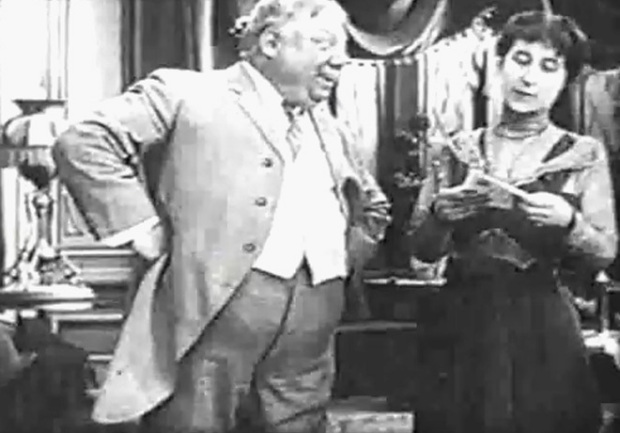
The Plot: Bunny Sharpe (John Bunny) has a gambling problem, and when his wife (Flora Finch) pleads with him to stop, he vows never to play poker with the boys again. Later, his wife finds out that he’s still going to his weekly poker games in the guise of a fraternal meeting. She gets her cousin Freddie (Harry T. Morey) and his bible study group to infiltrate the club dressed as police officers. Hilarity ensues.
Why It Matters: The NFR gives the film its historical significance, and then devotes a lot of the write-up to a New York Times editorial calling for film preservation after Bunny’s death in 1915. Yeah, we get it; it’s prescient. An essay by go-to silent film expert Steve Massa provides more insight into Bunny and Finch, but is weirdly cut off at the end.
But Does It Really?: Oh sure. It’s not a masterpiece or a laugh riot, but it’s one of the rare surviving pieces of film depicting one of America’s earliest silent comedy duos.
Everybody Gets One: John Bunny and Flora Finch will show up elsewhere on this list, but this film is their only moment in the spotlight. Both were stage actors who made the transition to film with Vitagraph in the early 1910s. Despite their alleged dislike for each other, their films together (affectionately known as “Bunnyfinches”) were Vitagraph’s most popular shorts.
Wow, That’s Dated: Mainly the immoral stigma of poker playing.
Other notes
Wow, John Bunny is 90% face. He looks like if Winston Churchill got stung by a bee.
Flora is so lucky that online poker isn’t a thing yet.
When did we stop using “Geo” as a nickname for George?
Could the Keystone Kops sue these guys?
A group of men dressed as police officers come into a room of unescorted ladies. This is so close to being a bachelorette party.
Wait that’s it? That is a long, confusing final shot.
Legacy
After John Bunny’s death in 1915, the film was re-released as “A Sure Cure for Pokeritis”. Although there were many who predicted that future generations would love the “Bunnyfinches”, these films fell into obscurity, with many of them presumed lost.
Flora Finch found some success in the sound era in small supporting roles. She appears in the Laurel & Hardy film “Way Out West” and fellow NFR entry “The Women”.
Scientists have yet to find a cure for pokeritis. They have, however, been able to confine the symptoms to what experts refer to as “Poker Face”.
Written by Norman Wexler. Based on the story “Tribal Rites of the New Saturday Night” by Nik Cohn.
Class of 2010
The Plot: Young hothead Brooklynite Tony Manero (John Travolta) lives with his dysfunctional family and works a dead-end job. He spends his weeks waiting for Saturday, when he goes to the local discotheque and is the undisputed king of the dance floor. One Saturday he sees an impressive dancer named Stephanie (Karen Lynn Gorney) and eventually convinces her to be his dance partner in an upcoming dance contest. They clash instantly and constantly, but Tony keeps at it because Stephanie represents what he wants, a life better than his current one and a chance out of Brooklyn.
Why It Matters: The NFR highlights Travolta and the Bee Gees, and states that the “crossover between music and movies set the pace for many films to follow.”
But Does It Really?: I saw this movie for the first time a few years back, and hated it. Watching it again…I still don’t care for it. There’s some good work going on here, but the film’s characters (especially their attitudes towards women) are repulsive and indefensible. I completely understand that this film is capturing a specific time for a specific subculture, so I guess I just hate this specific subculture. Ultimately this film is about a young man coming into his own and trying to leave this life behind, but they layer on the more reprehensible aspects of his life real thick. I guess you just had to be there. Regardless, there’s a well-crafted film under all of this crap, and the historical impact alone is worthy of recognition. The film warrants inclusion on this list, but as I’ve said before, Disco (and everything it stands for) Sucks.
Shout Outs: Tony has posters of “Rocky” and “Enter the Dragon” in his room, goes to a club called “2001 Odyssey”, walks past a marquee advertising “Network”, and makes a “Dog Day Afternoon” reference in his underwear, the kind of tribute the prisoners of Attica had in mind when they rioted.
Everybody Gets One: Almost everyone, most notably the Brothers Gibb, legendary producer/manager Robert Stigwood, actor Donna Pescow, and director John Badham. Fun Fact: John’s brother Mary was Scout in “To Kill a Mockingbird”.
Wow, That’s Dated: Everything. From the aesthetics to the attitudes, everything about this movie is America’s unfortunate disco phase.
Title Song: We get a title song so good they changed the title of the movie.
Seriously, Oscars?: “Saturday Night Fever” received one nomination: Best Actor for breakout star John Travolta. He was a new face with a movie the older Academy members didn’t get, so he lost to veteran Richard Dreyfuss’ more endearing work in “The Goodbye Girl”. But the major controversy that year was that none of the Bee Gees’ music made the cut for Best Song or Best Score. But hey, “You Light Up My Life”, am I right? The Best Song winner the following year – the disco hit “Last Dance” – probably got some help from this oversight.
Other notes
The opening credits are an excellent set-up to Tony and his world. Take note, “Baby Driver”.
“You can’t fuck the future.” Wait until they see “The Terminator”.
It’s difficult watching John Travolta criticize someone’s religious beliefs.
But seriously, am I supposed to like these guys? The only thing they haven’t done yet is punch an orphan.
Can you imagine a world where one of the other Sweathogs made it big? Two-time Oscar nominee “Boom-Boom” Washington? Epstein butchering Idina Menzel’s name? Horshack as Robert Shapiro?
That is a really fast centrifuge Tony and Stephanie have going. Any faster and they’ll time travel…and fuck the future!
After their rehearsal, Tony and Stephanie walk down Brooklyn’s landmark “ADR Boulevard”.
What’s that sound I hear? Why it’s Modest Mussorgsky rolling over in his grave.
And then they start attacking David Bowie. This movie goes too far! To add insult to injury, Stephanie pronounces his last name as “Boo-ie”.
This film almost does a precursor to the “Manhattan” shot.
Would you like a healthy sprinkling of homophobia and racism to go with your misogyny? Say when…
As much as I don’t care for this film, the dance sequences are pretty great. The contest in particular is wonderfully choreographed; they actually managed to make disco dancing look graceful. Where is Lester Wilson’s honorary Oscar for choreography? If it’s good enough for “Oliver!” it’s good enough for this film.
And then the boys take Annette for a car ride. Aaaaaaand fuck this movie.
Legacy
Disco was waning by 1977, but this film brought it back even bigger than before.
John Travolta: Act I
A sequel that removes everything you liked about the first one and replaces it with two Stallones and something called “Satan’s Alley”.
Oh god, I forgot there was a stage version. And I guess it’s still touring. Why won’t you die?
Everyone has spoofed this film’s iconic disco scenes, but we’ll stick with “Airplane!” for now.
“The Barry Gibb Talk Show”
This is the reason “Welcome Back, Kotter” jumped the shark.
The 2004 documentary “Get Down Tonight” features Karen Gorney recreating her climactic dance scene with “Dance Fever” host (and this film’s uncredited dance instructor) Deney Terrio.
Something called “Saturday Night Glee-ver”
And of course, “Flashbeagle”!
Listen to This: The prime example of a soundtrack being more popular than its film, the Bee Gees’ “disco masterpiece” was added to the National Recording Registry in 2012. Check out this essay by special guest poster David N. Meyer.
Written by John Taintor Foote. Story by Garret Fort and Bess Meredyth. Based on “The Curse of Capistrano” by Johnston McCulley.
Class of 2009
No trailer, but here’s a sample.
Thanks, Allison
The Plot: Don Diego Vega (Tyrone Power) is Zorro, a masked outlaw who robs from the rich and gives to the poor (like that other, less exciting folk hero). At night Zorro takes on Los Angeles’ corrupt alcade Luis Quintero (J. Edward Bromberg) and Captain Esteban Pasquale (Basil Rathbone). By day Diego plays up his foppishness to divert suspicion, and still finds time to woo Luis’ niece Lolita (Linda Darnell). Action! Romance! Z carvings!
Why It Matters: The NFR praises director Rouben Mamoulian as well as the “thrilling duel between Rathbone and Power”.
But Does It Really?: Eh, I guess. I wasn’t able to get too excited about this one. We’ve got other swashbuckling epics on this list. Hell, we’ve got another Zorro film on this list. I give this “Mark of Zorro” a slight pass for the popularity of Tyrone Power, and not much else. I kinda wish I had just watched the Antonio Banderas Zorro movie instead.
Everybody Gets One: Tyrone Power was unable to find success in Hollywood, despite the connection to (and same name as) his father, legendary silent film star Tyrone Power. The younger Power eventually found success on the Broadway stage, which finally caught the attention of Hollywood. After years of playing swashbuckling types, Power returned to the stage to hone his craft (one of the few movie stars of the time to do so). His last film features one of his best performances, and is a film I’m surprised isn’t on this list yet: 1957’s “Witness for the Prosecution”.
Wow, That’s Dated: Today on “Whitewashed Casting”, the native Californians/Mexicans of “Zorro” are played by people who are Irish/English mix (Tyrone Power) English (Basil Rathbone, Montagu Love), Danish-American (Gale Sondergaard), Romanian (J. Edward Bromberg), German (Janet Beecher) Greek (George Regas), and even Texan (Linda Darnell). The highest billed actor who is playing the correct ethnicity is Mexican born Chris-Pin Martin (10thbilling).
Take a Shot: Diego says the title once, about 50 minutes in.
Seriously, Oscars?: “The Mark of Zorro” was one of 17 nominees in the Best Original Score category in 1940. Alfred Newman’s work lost to the score from another future NFR entry: “Pinocchio”.
Other notes
“The fine and fashionable art of killing.” Woof. Different times, indeed.
You’re not seeing things: Basil Rathbone and Eugene Pallette are playing essentially the same characters from “The Adventures of Robin Hood” two years earlier: Rathbone as Sir Guy of Gisbourne (complete with swordfight) and Pallette as Friar Tuck.
Gale Sondergaard has two claims to fame: She was the first Best Supporting Actress winner in 1936 for “Anthony Adverse”, and she passed on playing the Wicked Witch of the West in “The Wizard of Oz”. She made the NFR list eventually, but in a film nowhere near as iconic.
So crime and corruption has always been a problem in L.A.
Hey, Lolita is 17! Knock it off, Zorro! In fact, just steer clear of anyone named Lolita.
I am so bored with this film. Screw this; I’m switching over to “The Mask of Zorro”…
That opening sequence has more Mexicans than all of “Mark of Zorro” combined.
You can’t convince me that Anthony Hopkins did his own stunts.
Speaking of, there’s an obvious attempt to make the casting more culturally appropriate, and yet a Welsh man as Don Diego? Was Edward James Olmos not available? Or marketable?
And his daughter is Welsh too? Catherine Zeta-Jones, who doesn’t have an ounce of Mexican blood in her, plays Don Diego’s daughter Elena. No one in the states knew who she was back then, and the last name Zeta is just vague enough you can get away with this if no one’s paying attention.
God this is taking forever. How much longer until the next action sequence?
I guess I remember “Mask of Zorro” being better than it actually is. Antonio Banderas is everything you could ask for in a Zorro, and that’s the most sexual tension in a swordfight that a PG-13 can handle, but man is this thing bloated. Lemme check back with “Mark of Zorro”…
Well, the Power/Rathbone swordfight is fun, but don’t think I didn’t notice the under-cranking going on to speed it up a little.
“Mark of Zorro” isn’t that spectacular either, but at least it’s short. Will we ever have a good “Zorro” movie? You’re my last hope, 1920 version I will have to watch eventually.
Legacy
Tyrone Power would spend most of the ‘40s playing Zorro-esque action heroes, including a 1941 follow-up with Linda Darnell, “Blood and Sand”.
Jury’s still out on whether or not this version (or the 1920 version) is the “Mark of Zorro” that Bruce Wayne watches the night his parents are murdered. Either way, he took notes.
Many films of Zorro over the years, but the only direct remake of this film is the 1974 version with Frank Langella. At least in this one the main bad guy is Ricardo Montalban.
I’ll always enjoy the ‘90s version “The Poke of Zorro” best. With James Earl Jones as the voice of the Magic Taco.
It’s not directly connected to this film, but here’s the “Zorro” TV theme anyway.
OR “Oh Dad, Poor Dad, Mamma’s Framed You in the Cabin and I’m Feelin’ So Sad”
Directed & Written by James Young Deer
Class of 2008
The Plot: British settler Combs (James Young Deer) resides in America with his Native American wife White Fawn (Lillian St. Cyr[?]) and their daughter (Actor Unknown). When Combs learns he has an inheritance waiting for him in England, White Fawn fears he will desert his family. Overcome with sadness at the prospect of losing her husband, White Fawn stabs herself. Combs enters too late, but does manage to be holding his wife’s body and the knife when their daughter returns. This misunderstanding leads to some good old mob mentality.
Why It Matters: The NFR’s write-up is entirely about James Young Deer, rather than the film. The essay by author Scott Simmon gives a quick plot summary, but mostly focuses on Young Deer and the film’s historical context.
But Does It Really?: It’s very clear that “White Fawn’s Devotion” is here because of James Young Deer, the first recorded Native American filmmaker. It gets a pass on cultural significance, plus its status as the rare Young Deer film to survive gives it “Belloq Film” status as well. It barely passes my standards for preservation, but hey, so do a lot of movies on this list.
Everybody Gets One: James Young Johnson was of the Nanticoke people of Delaware. I’m not sure of the significance of Young Deer, but he started using the name when he appeared in Wild West shows in the 1900s. This led to Young Deer acting in, and eventually directing, many a silent western. He used his tenure with the Pathé Frères Studio to further the positive depiction of Native Americans in film. The jury is still out over whether or not that’s Yong Deer’s wife Lillian St. Cyr (aka Princess Red Wing) as White Fawn, but regardless, she was his partner on and off-screen, leading many to call them the first Native American Hollywood power couple.
Other notes
If the filmmaker is Native American, is it okay to refer to the cast as “Red Indians”?
The letter addressed to Combs says they live in “Far Ridge, Dakota”. Is that West Dakota?
The take of Combs explaining his inheritance to White Fawn goes on forever. Not exactly the opening shot of “Boogie Nights”, is it?
Are we sure their daughter isn’t Linda Hunt?
It’s nice to be able to watch Native Americans wearing their traditional regalia without having to cringe at some sort of cultural appropriation.
If Combs is looking for a fall guy for his wife’s murder, might I suggest the one-armed man?
When the tribe gets ready to kill Combs, it may be early cinema’s very first “trial by stone”.
Wait, that’s it? Apparently the last shot of Combs and his family returning home is lost. The current print seems to end with the implication that they were kicked out of the tribe.
Legacy
James Young Deer followed this film up with 1911’s “Red Deer’s Devotion”, which is very similar to this film, except it’s a white woman romantically involved with a Native American man. Proving that there were double standards even then, “Red Deer” was not as successful as “White Fawn”. “Red Deer” is believed to be lost.
Young Deer got into some hot water in 1913 when he was accused of assaulting a 15-year-old girl. He fled to England (there was no Twitter to nopologize on in those days) and made a few films there. When he returned to the states, westerns were no longer fashionable, and he struggled to find work for the remainder of his life.
Native Americans were quite commonplace in film through the early 1910s. They were often depicted as noble and sage, and equal to their white peers. And then…John Ford showed up.
Written by Charles MacArthur and Ben Hecht. Based on the novel by Emily Brontë.
Class of 2007
The Plot: Wuthering Heights is the gothic farmhouse near the moors of Yorkshire where Cathy Earnshaw (Merle Oberon) lives. Her father (Cecil Kellaway) brings home an orphan boy named Heathcliff (Laurence Oliver), who soon becomes close with Cathy. As they grow up their love for each other blossoms into passion, but ultimately drives them apart. Cathy weds the wealthy Edgar Linton (David Niven), while Heathcliff starts to court Edgar’s sister Isabella (Geraldine Fitzgerald) out of spite. And the healthy little relationship between Cathy and Heathcliff just gets more distressing from there.
Why It Matters: The NFR calls it “one of cinema’s great romances”, praises Gregg Toland’s cinematography, and points out the heated collaboration between director William Wyler and producer Sam Goldwyn.
But Does It Really?: Meh. “Wuthering Heights” is certainly not one of the greatest films (romantic or otherwise) ever made, but another one of those films whose lasting reputation would get it on this list sooner or later. This film is by no means a bad movie, it’s just not as incredible as I’ve been led to believe. Part of the problem is that the main love story isn’t romantic, despite what the score and the performances are telling you. I suspect this is as close to a good film adaptation of the novel as we’ll ever get, so I’ll shrug my shoulders, give “Wuthering Heights” a pass for its legacy, and move on with my life.
Everybody Gets One: Leading lady Merle Oberon, and Flora Robson, my pick for the definitive Queen of Hearts.
Wow, That’s Dated: The term “gypsy” doesn’t fly today, unless you’re talking about the musical. On the same page, Laurence Olivier is definitely not Romani.
Take a Shot: Like most movies where the title is a location rather than the main character, the estate of Wuthering Heights gets mentioned often enough to make a good drinking game.
Seriously, Oscars?: “Wuthering Heights” garnered eight Oscar nominations, third behind “Gone with the Wind” and “Mr. Smith Goes to Washington”. The former dominated the ceremony, but “Wuthering” managed one win: Best Black-and-White Cinematography for Gregg Toland. Toland has a lot of classic films on his resume, but it’s a shame he won for good work on this film compared to his great work on “Citizen Kane” or “The Best Years of Our Lives”. Olivier received his first of 13 nominations with this film, while Oberon missed out on a Best Actress nod.
Other notes
The film is actually an adaptation of the first half of the novel. The second half involves the children of Heathcliff, Catherine and Hindley, who were written out of this film. Professional screenwriters know this adaptation process as the “Reverse ‘East of Eden’”.
If you’re like me, you’ve never heard the word “wuthering” without it being immediately followed by “heights”. By itself, “wuthering” describes a strong, roaring wind, but “Windy Heights” just doesn’t have the epic romanticism you’re looking for.
This adaptation transposes the time period from the late 1700s to the mid 1800s, simply because Sam Goldwyn liked that era’s costumes better. This infuriates my girlfriend/personal Regency expert to no end.
Heathcliff and Cathy are names I forever associate with comic strip characters.
Shout-out to Sarita Wooton and Rex Downing as Young Cathy and Young Heathcliff. They didn’t have much of a career outside of this film, but they are perfectly cast.
The romantic tension between Merle Oberon and Laurence Olivier is palpable, which is incredible considering their well-documented dislike for each other during filming.
I will never see David Niven in a movie without thinking of his line from “Murder by Death”: “Saved only by the fact that I am enormously well-bred.”
This is the film where Geraldine Fitzgerald runs over a peacock.
That’s Mozart’s “Rondo alla Turca” being played on the harpsichord. Given the original novel’s time period, this would have been a Top 40 hit.
Everybody in this film slaps people on the chin. Not very convincing, but I suppose no one wanted to go full “Chinatown” on this one.
I try not to spoil movies in these posts, but it’s a 79-year-old film based on a 171-year-old novel. You’ve been warned. Cathy’s death takes for-ev-er. This is very much the “dying in a key light” cliché most movies make fun of. Francisco Franco died faster.
Legacy
There have been many film adaptations over the years, most eliminating the second half of the book as well. The rare exception is the 1992 version with Ralph Fiennes and Juliette Binoche.
The best adaptation, however, is this 1970 version that translates the dialogue into semaphore.
Perhaps the film’s largest impact is the ending, tacked on at the insistence of Sam Goldwyn and the extreme reluctance of William Wyler. The new scene gives the film a happier ending, and has led most people to think that the novel is more romantic than Brontë intended.
Laurence Olivier and Flora Robson would reunite years later for… “Clash of the Titans”?
“Wuthering Heights” was referenced occasionally on “Frasier”. Yeah, that scans.