‘Twas the week before Christmas, when all through the blog
Not a crea—
Ah, screw it I’m not doing this whole thing in rhyme. Hey, we got more NFR films!
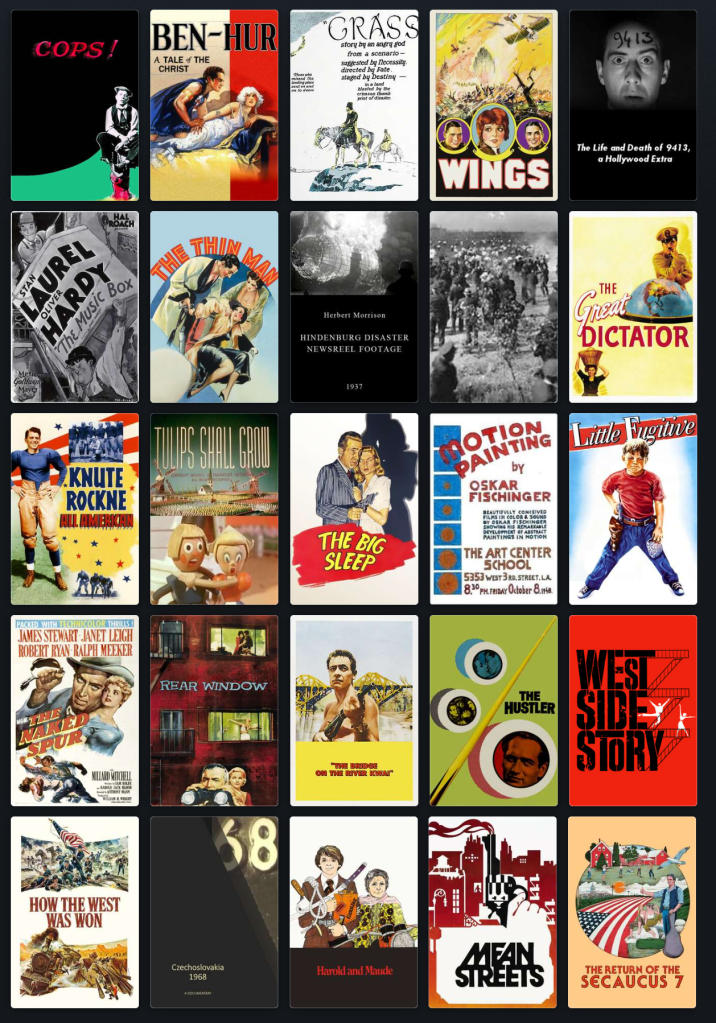
Here is your National Film Registry class of 2024, bringing the total number of NFR films to a nice and even 900. As always, movies with * are ones I submitted this year, movies with + are ones I have submitted in previous years. In chronological order, they are:
Annabelle Serpentine Dance (1895)
KoKo’s Earth Control (1928)
Angels with Dirty Faces (1938)
The Pride of the Yankees (1942)*
Invaders from Mars (1953)
The Miracle Worker (1962)*
Chelsea Girls (1966)
Ganja and Hess (1973)
The Texas Chain Saw Massacre (1974)
Uptown Saturday Night (1974)
Zora Lathan Student Films (1975-1976)
Up in Smoke (1978)+
Will (1981)
Star Trek II: The Wrath of Khan (1982)+
Beverly Hills Cop (1984)+
Dirty Dancing (1987)+
Common Threads: Stories from the Quilt (1989)
Powwow Highway (1989)
My Own Private Idaho (1991)
American Me (1992)
Mi Familia (1995)
Compensation (1999)
Spy Kids (2001)
No Country for Old Men (2007)+
The Social Network (2010)+
Other notes
Two of my submissions made the cut this year: “The Pride of the Yankees” and “The Miracle Worker”. The latter is particularly satisfying because I have been submitting it for years, and it’s one of my mom’s favorite movies. I believe this qualifies as being a good son.
Even by NFR standards the 2024 class is a very broad spectrum of movies. These 25 films span 115 years (across three centuries!) and cover practically every genre or type of film possible, created by filmmakers from all walks of life. In addition to celebrating this diversity of films and creatives, the NFR write-ups also go out of their way to highlight the lasting impact of these movies, citing recent film and TV inspired by these inductees.
While I try not to focus on the other 48 movies on my ballot that didn’t make the cut, I take comfort in the fact that this year there were 6,744 movies publicly nominated for NFR consideration. Put another way, it would take 270 years for the NFR to induct every movie nominated in 2024, so the fact that two of my picks made it is pretty good.
The NFR erroneously states that “Beverly Hills Cop” and “Up in Smoke” are the first NFR titles for, respectively, Eddie Murphy and Cheech Marin. While this is technically the first on-screen appearance for both, they have lent their voices to previous NFR entries; Murphy can be heard as Donkey in “Shrek”, Marin as one of the hyenas in “The Lion King”.
Speaking of Cheech Marin, thanks to “Up in Smoke” and “Spy Kids”, Marin is one of this year’s NFR double-dippers. Also double-dipping this year are producer Lou Adler and actor/director Edward James Olmos, who now has eight movies on the NFR! Watch your back, Ward Bond.
Alright, another Warhol movie! I feel like it will be harder to accidentally watch a fan-made recreation of “Chelsea Girls”. Although given my brief internet search this morning it might be hard to watch the real “Chelsea Girls”.
This roster also includes a few “What I really want to do is direct” movies with films helmed by art director William Cameron Menzies, the aforementioned Edward James Olmos, and the legendary Sidney Poitier. I have heard of but never seen “Uptown Saturday Night”, so let me refresh my memory and look up who else is in the cast – Oh my god!
It is increasingly bizarre to see more and more movies from my lifetime making it onto the NFR. On one hand there’s “No Country for Old Men”, one of my favorite theater-going experiences back in 2007, and on the other hand: “Spy Kids”. No knock against the movie or Robert Rodriguez, but I have lived long enough that “Spy Kids” has been deemed a historically significant American film. I’m gonna go lie down for a bit.
Those are my thoughts for now, I will begin tackling the class of 2024 in January (Up first: “The Social Network”). My thanks to everyone who has stopped by and visited “The Horse’s Head” this year. 2024 was the year with the highest view count for this blog, and it was the year we hit the important milestones of 700 movies and 100,000 all-time views! And special thanks to the small NFR community I have been adopted into this year; you know who you are. As we gear up for whatever the hell 2025 is going to be, I leave you with the most iconic moment from this year’s NFR entries:
The Plot: “Love & Basketball” follows two childhood friends and aspiring basketball players as they grow up and fall in love through the 1980s. Monica Wright (Sanaa Lathan) keeps playing despite the insistence of her mother (Alfre Woodard) that “girls shouldn’t play basketball”. Quincy “Q” McCall (Omar Epps) is following in the footsteps of his NBA star dad (Dennis Haysbert) but uncovers some tough truths along the way. During their senior year of high school in 1988, Monica and Q both get accepted to play basketball at USC, and sleep together for the first time. While their romantic relationship blossoms in college, their separate career paths threaten to tear them apart, proving that all’s fair in love and basketball.
Why It Matters: The NFR calls the film “[u]nforgettable and inspiring”, highlighting its “ongoing resonance with women athletes and young people”.
But Does It Really?: I had never seen “Love & Basketball” before this viewing, and I was quite charmed by it. “Love & Basketball” is another prime example of why we need more women and people of color directing movies. This film could have been riddled with sports and rom-com cliches had it been directed by a White person, but by telling her own story, Gina Prince-Bythewood guarantees a fresh dynamic to the proceedings: What could be contrived and obvious plays here as authentic and realistic. Prince-Bythewood’s commitment is matched by a very strong cast, led by the charismatic Lathan and Epps. “Love & Basketball” continues to not only entertain, but also inspire a generation of female athletes finally seeing themselves represented on the big screen. “Love & Basketball” is a modern classic, and I’m glad it has taken its rightful spot on the Registry.
Everybody Gets One: Raised in Pacific Grove, California, Gina Prince played high school basketball, and later ran track at UCLA, where she received her film degree. One of her first professional jobs was as a writer for “A Different World”, where she met her future husband, fellow writer Reggie Rock Bythewood. Although several other TV jobs followed, Gina Prince-Bythewood walked away from TV to focus on writing a semi-autobiographical screenplay she declared would be “a Black ‘When Harry Met Sally’.” After being turned down by multiple studios, “Love & Basketball” received a reading at the Sundance Institute, which caught the attention of Spike Lee, who would produce the film under his company 40 Acres and a Mule Filmworks. Thanks to Spike Lee’s clout, Prince-Bythewood was able to direct the film herself, marking her feature film debut.
Title Track: The title is a riff on the idiom “All’s fair in love and war”, which I always assumed was a Shakespeare quote; turns out it’s John Lyly from his novel “Euphues”. In the category of “Lines that sound weird but inexplicably work in this movie”, the line “All’s fair in love and basketball” is spoken twice in the film.
Wow, That’s Dated: Monica’s dream of being the first female NBA player stems from the fact that there was no WNBA in the 1980s. The league would not be founded until 1996, while Gina Prince-Bythewood was writing the screenplay.
Seriously, Oscars?: No Oscar nods for “Love & Basketball”, though Gina Prince-Bythewood did win the Independent Spirit Award for Best First Screenplay. The film also cleaned up at that year’s Black Reel Awards.
Other notes
We open with Al Green’s “Love and Happiness” over the opening credits, which automatically places this film as a contender for Greatest Movie Ever Made.
Casting the role of Monica came down to two actors: Sanaa Lathan – a professional actor with no basketball experience – and Niesha Butler – a professional basketball player with no acting experience. Both trained for months to prepare for the role, and Gina Prince-Bythewood went back and forth on who to cast. Prince-Bythewood ultimately realized that she was making a love story first and foremost (adding “You could fake a jump shot, but you can’t fake a close-up.”) and cast Lathan in the role. To her credit, Niesha Butler bares no ill will towards Prince-Bythewood or the final film, stating she’s just glad the movie was made.
Both leads are incredible in this, but you all lucked out with Sanaa Lathan. Thanks to Lathan’s performance (with support from a charming Kyla Pratt as young Monica), we immediately empathize with Monica and root for her every step of the way. While this film is primarily Monica’s story, Q gets his share of the spotlight, and Epps gives a wonderfully nuanced performance, sharing plenty of chemistry with Lathan. It helps that Lathan and Epps were dating during production, a fact they attempted and failed to keep a secret from their director.
Shoutout to the actors playing the parents; all of whom do not age at any point in this movie’s 12-year timeline. Oscar nominee/perennial Emmy winner Alfre Woodard is the standout to me, popping up sporadically in the film, but delivering a powerful monologue near the end. For those of us who know Dennis Haysbert as the President on “24”, it’s great seeing him play a much more despicable, yet still likeable, character; though admittedly every time Haysbert spoke all I could hear was “That’s Allstate’s stand. Are you in good hands?” Also appearing in smaller but no less important roles are “Eve’s Bayou” standout Debbi Morgan as Q’s mother, and Spike Lee staple Harry J. Lennix as Monica’s supportive dad.
The scene where young Monica fights with young Q on his front lawn was re-written to incorporate the real-life scar on Sanaa Lathan’s cheek, which begs the question: Just how sharp is that grass?
Two of this film’s supporting actors were on the cusp of their own stardom. Both Regina Hall (as Monica’s sister Lena) and Gabrielle Union (Q’s high-school date Shawnee) were a few months away from their breakout performances in, respectively, “Scary Movie” and “Bring It On”. Side note: Gabrielle Union originally auditioned for Monica, and despite playing Varsity basketball in high school was told by Gina Prince-Bythewood that she didn’t look like a basketball player.
I especially loved how bad Monica is at being flirty or sexy. Watching Monica not know how to sit down while wearing a dress is her most endearing moment.
Once again, the MPA’s double-standard with Black sex scenes rears its ugly head. “Love & Basketball” originally received an R rating, but Gina Prince-Bythewood was adamant the film be PG-13 so that young girls could see it. Several trims were made to the sex scene, even though there is no nudity and very little movement depicted. I get the feeling that this was somehow Jack Valenti’s fault; I have no evidence to support this claim, it just seems right.
After such a tender love scene, what could be a better mood killer than an overenthusiastic cameo by longtime college basketball announcer Dick Vitale? Vitale is one of several real-life sportscasters and athletes who appear as themselves in the film, including Robin Roberts, Stu Lantz, and Chick Hearn. Conspicuously absent is “Magic” Johnson, whose career highlights are weaved throughout the film (Johnson does appear via archival footage).
For those of us ignorant to the rules and positions of basketball, I can vouch that this is a love story first and a sports movie second, so you can still follow along with relative ease (although my wife did have to explain to me what a point guard is). Also, I believe this, “Hoosiers”, and “Hoop Dreams” are the only basketball movies on the NFR. I can’t think of any more that should be on the list, other than joke answers like “Air Bud” or “Space Jam”.
Yes, that is Tyra Banks near the end of the film as Kyra. Truly, everybody gets one.
“Love & Basketball” gives me one of my favorite movie tropes of all time: the “Everyone is sad” montage that happens in a film’s third act (or in this movie’s case its fourth quarter). The montage song of choice is Angie Stone’s cover of Simply Red’s “Holding Back the Years”.
It was during Alfre Woodard’s monologue that I realized I have unintentionally bookended this year’s blog posts with Alfre Woodard movies (She also makes an appearance in “12 Years a Slave”).
The final one-on-one match between Monica and Q is great. Yes, the “For your heart” line is cheesy, but after everything you’ve gone through with these characters you really don’t mind. And I love how many of these shots are clearly the actors themselves making the basket in one uninterrupted take.
Stick around after the credits for one final shot. Also, this film’s copyright reminded me that 2000 is the easiest Roman numeral year to remember (MM; I recall a certain candy brand using this to their marketing advantage at the time).
Legacy
“Love & Basketball” was a critical hit and did good if not amazing box office. The film found a second life on home video and cable, boosted by the success of its soundtrack album. By the mid-2000s “Love & Basketball” was being re-evaluated as a great under-appreciated movie and continues to be a cult classic.
Practically every major player in the WNBA has cited “Love & Basketball” as an influence and inspiration. One oral history alone features quotes from Sheryl Swoopes, Diamond DeShields, Nneka Ogwumike, Cheyenne Parker, and Napheesa Collier, as well as writer/director Lena Waithe, who worked as Gina Prince-Bythewood’s assistant early in her career.
Gina Prince-Bythewood’s next film was 2008’s “The Secret Life of Bees”. Her subsequent filmography includes “Beyond the Lights”, “The Old Guard”, and “The Woman King”, with a healthy dose of writing and producing credits in both film and TV. And despite several pleas over the years, she refuses to make a sequel to “Love & Basketball”, declaring “I told the story I wanted to tell.”
And with that defiant stance against sequels, we conclude Year Eight of The Horse’s Head. My thanks to each and every one of you for making 2024 the blog’s most successful year ever! I’ll be back later this month to cover the Class of 2024, and after that taking some time off for the holidays. Until then, Happy Viewing, and may your nominations finally make the cut this year.
The Plot: “Broadcast News” centers on the personal and professional triangle between three employees at the Washington D.C. bureau of a network news program. Producer Jane Craig (Holly Hunter) lives and breathes the news, letting her professional drive completely hijack any personal wants. Intelligent but uncharismatic reporter Aaron Altman (Albert Brooks) is not-so-secretly in love with Jane, who sees him solely as a close friend. Newly hired anchorman Tom Grunick (William Hurt) excels at his job despite his ignorance of the news and its production. As the three of them work together on both taped and live broadcasts, Tom and Jane develop an attraction for each other, though they can never agree on what they should do about it, while an increasingly agitated Aaron sweats it out (literally). There are plenty of clever observations on love and news, plus the kind of adult complexities that have become James L. Brooks’ hallmark in his sophomore outing as a filmmaker.
Why It Matters: The NFR praises the film’s cast, as well as its “smart, savvy and fluff-free story whose humor is matched only by its honesty.” An essay by Brian Scott Mednick is an ode to the film and its preservation of a bygone era in TV journalism.
But Does It Really?: The NFR inclusion of “Broadcast News” checks off a lot of boxes: we get our first James L. Brooks film on the Registry (though I will argue “Terms of Endearment” is his more iconic film), another entry in the underrepresented year of 1987, and another NFR movie that serves as a snapshot of a specific time and place. I enjoyed “Broadcast News”, particularly its writing (both dialogue and structure) as well as the winning performances of our three leads playing very flawed, borderline unlikable characters. “Broadcast News” is never a first draft pick for classic film comedies, but once it enters the conversation it’s an undeniable choice, and I have no objection to its NFR induction.
Everybody Gets One: James L. Brooks started off as a copywriter for CBS News in New York. A move to L.A. saw him writing for several sitcoms, eventually co-creating such hit TV shows as “Room 222”, “The Mary Tyler Moore Show”, and “Taxi”. After writing and co-producing the 1979 film “Starting Over”, Brooks made his directorial debut with his adaptation of “Terms of Endearment”, which went on to win five Oscars: three of them for Brooks. By 1984, Brooks wanted his next film to be a romantic comedy, feeling he could bring something new to the genre. While at the 1984 Democratic National Convention, Brooks recognized that TV journalism had greatly evolved in the 20 years since he was a part of it and decided to set his rom-com in the world of, well, broadcast news. Fun Fact: The L stands for Lawrence.
Wow, That’s Dated: As previously mentioned, this film is set in that long ago age of broadcast journalism; when everything was analog and cable news was a non-threatening niche. We also get references and allusions to such ‘80s news stories as Muammar Gaddafi, the Robert Hansen murder cases, and the Bradley Fighting Vehicle.
Seriously, Oscars?: A hit upon release, “Broadcast News” received seven Oscar nominations, second to “The Last Emperor” for most nominations of the year. Given that this was only four years after Brooks’ “Terms” sweep, there was no rush to give him more Oscars, and the film went home empty handed. William Hurt, Holly Hunter, and Albert Brooks lost their acting nominations to, respectively, Michael Douglas, Cher, and Sean Connery. Adding insult to injury, although James L. Brooks was doubly nominated as a writer and producer, he missed out on a directing nomination.
Other notes
Shoutout to Susan Zirinsky, the real-life CBS News producer that served as the film’s technical advisor. Both Zirinsky and Brooks have stated that while there are elements of Zirinsky in Jane, the character is a composite of several women that Brooks interviewed during his research. Zirinsky is credited as one of the film’s associate producers, and appears onscreen as one of the senior news officials on the control room monitors.
In true classic movie tradition, all three of our leads are charming enough to distract from how awfully their characters behave. First off, Holly Hunter was cast in this movie two days before production began (Debra Winger bowed out due to pregnancy). Hunter filmed this after her other breakout role in “Raising Arizona”, and anyone who saw both performances could tell you we had a star on our hands, with Hunter gamely navigating the broad comedy of “Arizona” and the subtler dramatics in “Broadcast”. William Hurt brings a Golden Retriever energy to Tom; dumb as a brick but eager to please. And Albert Brooks threads the smallest needle of the three; Aaron is simultaneously relatable and repellant, and Brooks keeps him watchable even at his lowest points. It’s also worth noting that while Albert Brooks is in the NFR as an actor (this and “Taxi Driver”), his work as a director or writer has yet to be included. And no, Albert Brooks is of no relation to James L. Brooks: Albert’s real last name is Einstein (no relation to him, either).
I first attempted to watch “Broadcast News” about 15 years ago, and I turned it off; I just couldn’t get through it. Watching it again now, I think what threw me the last time was the subtlety of it all. Everything about this movie is opaque; no one ever says what they want to say, they talk around it and struggle to articulate anything. It also helps that I am now about the same age as these characters and have experienced some of the personal and professional growing pains that they have. I could relate to the subtleties much more easily this time.
This film boasts a terrific supporting cast; from Robert Prosky as the fatherly bureau chief to Joan Cusack as the harried assistant director frantically running through the halls to get a video delivered by airtime. And of course, that is Jack Nicholson lending his star power to an extended cameo as the national news anchor. He’s clearly doing this as a favor to Brooks; going uncredited until the end and allegedly playing the part for free. I appreciate the restraint Nicholson gives in this performance; he knows that just him being there carries enough dramatic weight.
Tom’s first live broadcast is an exhilarating watch, with Jane guiding Tom through the chaos from the control booth, while Aaron drunkenly calls in from home (“I say it here, it comes out there.”). This scene is also a tour-de-force for the film’s sound team, with dialogue and technology crisscrossing throughout the sequence.
Let the record show I recognized composer/Oscar parody lyricist Marc Shaiman on sight during his quick appearance as the musician (along with Glen Roven) who pitches an intro theme for the news. Big finish!
The height difference between Holly Hunter (who is about 5’ 2”) and every other actor in the movie comes across in a few scenes; Joan Cusack in particular seems to tower over Hunter at 5’ 9”. As the film goes on you start to notice all the little cheats to get Hunter at eye-level with her co-stars (standing on a stairwell, sitting down while William Hurt is on his knees, etc.)
The funniest (and most relatable) scene in the movie is Aaron, finally getting his chance to anchor the news, sweating profusely under the studio lights. Having done my share of theater, I know what it’s like to be upstaged by your own biology, and the scene plays it for the right amount of laughs; funny without being torturous. The scene also produces my favorite line in the movie: one of the technicians watching the broadcast declaring, “This is more than Nixon ever sweated.”
The third act is when things start to lose momentum for me. Aaron and Jane have a big confrontation scene that shifts into full-on drama a little too jarringly (though we do get the second-best line in the movie: “How do you like that? I buried the lede.”). Then the layoffs start happening at the station and it all plays out like a more somber variation of the “Mary Tyler Moore” finale. Also making their NFR debut in this scene: the back of John Cusack’s head as the messenger who shouts, “Sons of bitches!” as he is laid off.
According to Brooks, “Broadcast News” was filmed sequentially and without a scripted ending, allowing Brooks to decide who Jane would end up with based on his performers’ natural chemistry. A semi-improvised ending of Jane and Tom getting together was filmed but scrapped, so Brooks quickly wrote the film’s eventual ending, an epilogue where our leads, having gone their separate ways personally and professionally, reunite seven years in the future. I have been racking my brain trying to figure out why this ending didn’t work for me, and I think it’s the paradoxical answer of nothing being resolved, even though that kind of ending would have been a complete betrayal of the rest of this movie. While I ultimately justified this ending in a “life goes on” kind of way, it still doesn’t jive with the rest of the movie. On the plus side, shoutout to Holly Hunter’s hairstylist for presciently nailing what a circa 1994 haircut would look like.
My last bit of disappointment was that despite this being a Gracie Films production (its first, in fact), “Broadcast News” doesn’t end with their logo and the “Shh” lady.
Legacy
“Broadcast News” opened in December 1987 and was a financial and critical hit. The film grossed over four times its budget and appeared on more critics’ year-end top ten lists than any other movie in 1987. Since then, “Broadcast” has appeared on the AFI list of 100 funniest movies and is widely considered James L. Brooks’ best film.
James L. Brooks’ follow-up to “Broadcast News” was 1994’s “I’ll Do Anything”; a movie whose production woes are too elaborate to mention here but worth looking into. Brooks would go on to direct “As Good as It Gets”, “Spanglish”, and “How Do You Know”, with his next film – “Ella McCay” – slated for release in 2025. Brooks has kept busy over the years with his production company Gracie Films, producing among others “Big”, “Say Anything…”, “Bottle Rocket”, and his biggest money maker, “The Simpsons”.
Speaking of “The Simpsons”, my introduction to “Broadcast News” came from the show’s occasional ribbing of its co-creator. Two “Simpsons” episodes derive their titles from “Broadcast News”, and an early episode mentions an adult film titled “Broadcast Nudes”.
Interesting recent bit of “Broadcast” news: NPR White House correspondent Tamara Keith hosted the 2023 White House Correspondents Dinner wearing a replica of the dress Holly Hunter wears in this movie’s Correspondents Dinner scene. Keith has cited Jane Craig as an inspiration of her own work, and the dress was a tribute to that influence.
Directed by Charles Lamont Written by Jean Bart and Miguel de Zárraga
Class of 1996
The Plot: On the eve of a Columbus Day festival in New York’s Spanish Harlem, the Vargas family celebrate the sudden return of Mateo (Fernando Soler), paroled after eight months in prison. Mateo’s Mamita (Pilar Arcos) and sister Lola (Cecilia Callejo) are happy he’s home, but Mateo’s wife Blanca (Luana Alcañiz) faints upon seeing him return. While Blanca is in bed recuperating, her doctor (Danton Ferrero) lets it slip that Blanca is recently pregnant, and it doesn’t take Mateo long to figure out that he’s not the father. Mateo becomes despondent, turning down a promising return to his boxing career to find out who this other man is, and why his wife is spending so much time with Lola’s fiancé Claudio (Juan Torena). “Verbena Tragica” is a film whose subject matter was downright scandalous in 1939 and is the rare Spanish language film produced by a Hollywood studio.
Why It Matters: The NFR gives a history of Hollywood studios producing foreign language versions of their films and cites “Verbena” as “unusual” because there was never an English version made. An essay by Mexican film history expert Carl J. Mora also covers Hollywood’s foreign language productions, while still parsing out the little information we have about “Verbena Tragica”.
But Does It Really?: “Verbena Tragica” is on here to represent the long-lost practice of Hollywood studios filming multiple versions of the same movie in different languages. Sadly, most of these films are lost or only survive in part, so finding one like “Verbena Tragica” in its entirety is worth celebrating. As a film it’s okay: not really noteworthy outside of its taboo storyline, but quick and harmless enough that you don’t mind its inherent B movie rough edges. The film’s NFR inclusion is more on the curio side of things, but it is certainly unique among other NFR films of the era, and therefore more than deserving of its spot on the list.
Everybody Gets One: Charles Lamont started off as a stage actor, then as a silent film actor before moving behind the camera as a director. Lamont spent most of the ‘20s and ‘30s directing shorts, including some of Buster Keaton’s sound comedies. While scouting a dance school for potential child actors for the “Baby Burlesk” series, Lamont discovered a four-year-old named Shirley Temple and gave her her first film role. Lamont started directing features in 1934, and by 1937 he had moved to Columbia Pictures, where among his film assignments was “Verbena Tragica”.
Title Track: “Verbena Tragica” roughly translates to “Tragic Festival”; verbena being a type of fair/dance party common in Spanish-speaking cultures. Apparently, the film also went by the English title “Block Party”, which implies a much more lighthearted movie than this actually is.
Wow, That’s Dated: Primarily the celebration of Columbus Day, which has mostly been replaced by Indigenous Peoples’ Day here in the U.S. There are still, however, plenty of Columbus Day celebrations, including one in San Francisco’s North Beach district, which means I had to listen to those goddamn Blue Angels roar past my apartment again. This is my tax dollars at work? But I digress…
Other notes
For those of you unfamiliar with a Multiple-Language Version (MLV) of a film: In the early days of sound film, studios would often shoot multiple versions of the same film in different languages, often using the same sets, costumes, and in some cases actors (this recycling was much easier to do in the studio system days when everything was in-house). The most famous example of all these is Universal’s Spanish-language version of “Drácula”, which would eventually be added to the Registry in 2015. Spanish language versions were the most common MLV thanks to the abundance of Spanish speakers both in and outside America (European languages fared okay until the rise of Nazism throughout the ‘30s). As previously mentioned, “Verbena Tragica” is unique in that no English language version was ever made, most likely owing to the film’s themes of adultery (which was permitted under the Hays Code as long as it wasn’t “treated attractively”). MLVs were already outdated by 1939; dubbing technology had come a long way, and studies showed that international audiences didn’t mind reading subtitles if it meant seeing Hollywood stars (and not their foreign language counterparts) on the screen. A film like “Verbena Tragica” was one of the last of a dying breed of movie.
I had been warned prior to my viewing that the versions of “Verbena Tragica” available online do not have an English dub or subtitles. What I ended up doing was watching the film on the Library of Congress’ YouTube channel, with the Spanish subtitles auto translated into English. It wasn’t pretty, but it was better than nothing. For the most part, the subtitles gave me a general idea of what was happening, and since most of the film is expository dialogue and not visual storytelling this was quite helpful. There were of course a few parts where a character’s regional phrases or fast talking threw the subtitles for a loop, and it’s times like this that I really regret taking French in high school. Do yourself a favor and learn a little Spanish; not just for watching this movie, but for life in general. It really comes in handy. [UPDATE: the version embedded at the top of this post now features English subtitles! Thanks to Eric from filmregistry.net for sharing.]
There is not a lot of information out there about this cast. Probably the best known of this group is the lead, Fernando Soler, who was a mainstay of the Golden Age of Mexican Cinema. The rest of the cast seem to have been primarily international actors, with “Verbena” being a brief pit-stop in Hollywood; only Cecilia Callejo (Lola) had a lengthy career in America. Fun Fact: Prior to being an actor, Juan Torena (Claudio) was a footballer in Barcelona! It’s one of the better athlete-turned-actor performances on the Registry, and I don’t recall him using his hands that much.
As usual with my Registry viewings, I went into “Verbena Tragica” cold, and given its ‘30s production period, I definitely wasn’t expecting adultery to be part of this. It’s all handled delicately; you never see the affair, and characters generally talk around it, but the mere acknowledgement of it from a ‘30s film is quite daring. Between this and the Spanish, watching “Verbena Tragica” was like watching a telenovela (cine-novela?).
One more cast member shoutout: Manuel (Mateo’s manager) is played by Carlos Villarías, who played Dracula in the aforementioned Spanish language “Drácula”. I guess Hollywood only had so many Spanish speaking actors.
I cannot fathom an English language version of this movie given the Production Code of the time. How do you tone down adultery without completely compromising this story? And who were they going to cast in the English language version? Since Columbia’s track-record was mostly low-budget B pictures in 1939, the odds are very good that this would have been handed off to actors no one has heard of before or since.
Is it just me or does Mateo kinda looks like Broderick Crawford? Hey, Crawford was floating around the studios back then, maybe he could have played “Matt” in the English version!
Let’s take a breather from all this family drama and have us a song! Mamacita breaks out her guitar and sings “Gitanerias”, written by Mamacita’s actor Pilar Arcos. It has nothing to do with nothing, but this is back when movies were still general entertainment and no one was paying attention to the B picture, so why not have a few songs in there? Plus, if it weren’t for the musical numbers, I think this movie would technically be considered a short subject.
After a few more dramatic scenes of Mateo, Blanca, and Claudio we get club singer Luis performing not one, but two more songs! Musician Sergio de Karlo plays Luis, and he is definitely not playing that guitar.
[Spoilers] Well this movie took a turn, but I guess this was to be expected (the word “Tragica” is in the title after all). Mateo and Claudio’s fight on the fire escape starts promisingly, but then Claudio goes down with one punch, so that’s disappointing. The climax features my favorite performance in the entire movie: the neighborhood police officer who comes to arrest Mateo; as played by the only White guy in the cast, clearly speaking his lines phonetically (“Lo see-en-tay Mah-tay-o, pair-o tee-en-ess ko ven-eer kon-mee-go.”)
Legacy
As best I can tell, “Verbena Tragica” premiered in Panama in December 1938 before playing New York and Los Angeles in March 1939. According to the UCLA film archive, the film was “very successful in the cinemas of Los Angeles’ Mexican neighborhoods”. The film was less successful in Mexico, which was making its own great movies without the aid of Hollywood, thank you very much.
Charles Lamont’s tenure at Columbia Pictures was short-lived, primarily due to his dislike of Harry Cohn (join the club, Charles). Lamont spent the rest of his directing career at Universal, making movies with such Universal mainstays as Abbott & Costello, Ma & Pa Kettle, and Francis the Talking Mule.
Since its NFR induction nearly 30 years ago, “Verbena Tragica” has maintained its unique spot in film history, with many a film school and museum holding screenings of the film (presumably with better English subtitles). The film is celebrated for its diverse cast of Spanish and Mexican artists, and for its representation of an oft-forgotten practice in Classic Hollywood filmmaking.
The Plot: “Boys Don’t Cry” is based on the true story of Brandon Teena, a transgender man who was raped and murdered in 1993, one of many cases in the 1990s that led to more state and federal laws against hate crimes. Upon his arrival in Falls City, Nebraska, Brandon (Hilary Swank) befriends ex-con John Lotter (Peter Sarsgaard) and his group of friends, including John’s ex-girlfriend Lana Tisdel (Chloë Sevigny). Brandon keeps his biological gender a secret, with his new social circle totally unaware of his previous life as a woman (and as a wanted criminal for check forgery). Things get complicated as Brandon begins a romantic relationship with Lana, and everyone gets closer to the truth…or as close to the truth as we were able to comprehend in 1999.
Why It Matters: The NFR calls the film a “searing docudrama”, singling out Swank’s performance. The write-up also acknowledges the issues regarding sexual identity and transphobia brought up by this movie and includes a snippet from Janet Maslin’s New York Times review which praised the film for its uplifting qualities.
But Does It Really?: Admittedly, I was apprehensive about watching “Boys Don’t Cry” given what I knew about the film’s tragic ending, but I was quickly won over, thanks to Swank’s commanding performance and Peirce’s sensitive, caring direction. “Boys Don’t Cry” somehow manages to take a very distressing historical event and focus on the person at the center, helping an audience recognize our transgender citizens for the dimensional humans that they are. “Boys Don’t Cry” makes the NFR for its refreshing and respectful approach to its subject matter, and for its reminder of how far we’ve come in terms of transgender representation, and how much we still have left to go.
Everybody Gets One: While working on her MFA at Columbia University in the mid-90s, Kimberly Peirce read a Village Voice article about Brandon Teena’s murder, and was inspired to make a short film about Brandon that went beyond the sensationalist media headlines and focused on Brandon as a person. Peirce conducted research by traveling to Falls City, Nebraska, interviewing Lana Tisdale, and even attending the trial of Teena’s murderers. The eventual short film (also titled “Boys Don’t Cry”) caught the eye of producer Christine Vachon, who helped Peirce develop it into a narrative feature film. Film production stalled when Peirce was unable to cast the role of Brandon after auditioning hundreds of cisgender women (as well as several transgender men), but was finally won over by Hilary Swank, then best known as “The Next Karate Kid” and freshly fired from “Beverly Hills, 90210”. Swank prepared to play Brandon by living as a man for a month prior to shooting, to the point where Swank’s neighbors thought her brother had moved in with her. Reflecting on the part 20 years later, Swank stated that if she were offered the role of Brandon today, she would turn it down, believing that the character should be played by a transgender actor.
Title Track: The film was written and filmed under its original title “Take It Like a Man” but was changed to “Boys Don’t Cry” late in production. The film takes its name from The Cure song of the same name, and while the song does appear in the final film, it’s a cover/soundalike by Nathan Larson, then-guitarist for Shudder to Think.
Seriously, Oscars?: Despite playing in only a handful of theaters when initially released, “Boys Don’t Cry” was a strong awards contender throughout the season, ultimately receiving two Academy Award nominations. Chloë Sevigny lost Best Supporting Actress to Angelina Jolie in “Girl, Interrupted”, but Hilary Swank prevailed in the Best Actress category, beating out more established actors Annette Bening, Janet McTeer, Julianne Moore, and Meryl Streep.
Other notes
First, let’s pour one out for Fox Searchlight Pictures, which dropped the “Fox” from its name after being acquired by Disney in 2019. “Boys Don’t Cry” is the first Fox Searchlight film on the Registry, joined four years later by “12 Years a Slave”.
One of Peirce’s goals with this film was not to mythologize or lionize Brandon Teena, and I feel she succeed on that front. The film always feels authentic; everyone’s dialogue sounds true to life (a very difficult feat to pull off), and all the performances are grounded and realistic. Even the moments where emotions run high never feel too forced or overly dramatic. It makes you trust the film and its portrayal of Brandon as a real person caught in a horrible situation.
Everyone in this movie is great, but Swank is the undeniable MVP. There is something quite compelling about Swank’s work; her Brandon is so instantly likeable that you accept his situation immediately and root for him, even if you know this story won’t end well for Brandon. On a lighter note, my favorite detail in Swank’s performance is the aggressive manspreading Brandon has while seated. It’s a nice subtle touch.
The rest of the ensemble rises to Swank’s level and delivers good work. Peter Sarsgaard is the right balance of charismatic and threatening without ever tipping over into cartoon villain territory. You recognize John (and his accomplice Tom as played by Brendan Sexton III) as a regular guy whose internal struggles led to some very bad decisions. I also really enjoyed Chloë Sevigny, playing Lana as troubled and contradictory, but always real and alluring. And no, you are not seeing things; Lana’s friend Candace is played by Lecy Goranson, aka Becky #1 from “Roseanne”. Goranson was cast based on her resemblance to Lisa Lambert, the real person the composite character of Candace is based on.
I don’t have a lot to say about the film itself, mainly because I was so engrossed with it during my viewing, but also because the film is just that good: there’s only so many ways I can complement any aspect of this film without becoming repetitive or breaking out my thesaurus. Also, as a cisgender male I do not feel qualified to discuss the nuances of transgender identity presented by this film. I will, however, give one more department their due and shoutout this movie’s cinematography. Kimberly Peirce started out as a photographer, which explains why she and cinematographer Jim Denault include several shots of the Nebraska night sky presented through timelapse photography (inspired by the work of Jan Staller). I’m not sure what it all means, but you can’t begrudge Peirce for wanting to add a bit of artistic flourish to the proceedings, especially something that doesn’t harm or disrespect the real story being told.
The sex scenes between Brandon and Lana are noteworthy because of the double standard that seemed to stem from them. Peirce has talked at length about how “Boys Don’t Cry” was initially rated NC-17 but was bumped down to an R after some trims. While most of these edits pertained to the rapes scenes later in the movie, Peirce was upset that it was the sex scenes between a cisgender woman and a transgender man that more concerned the MPAA, particularly the length of Lana’s orgasm. Peirce talks more about her issues with the MPAA rating system in the great documentary “This Film is Not Yet Rated”.
At some point I knew that “Boys Don’t Cry” was based on real events, but I forgot prior to this viewing, so it was a surprise to me when the film ended with text explaining what happened to John and Lana after Brandon’s death. The film mercifully doesn’t begin with some variation of “Based on a True Story”, which allowed me to get caught up in the lives of these characters rather than the historical accuracy of it all (I spent the last third of my viewing yelling at Brandon and Lana to get out of town like it was a horror movie). The end text was a sobering reminder that this all happened, and despite the progress made in the last quarter century, is still happening.
Legacy
After premiering at the New York Film Festival, “Boys Don’t Cry” opened in October 1999 in about 25 theaters across the country. The film went in a wider release following its two Oscar nominations, and by March 2000 (the same month of the Oscars) the film had grossed almost three times its production budget.
While “Boys Don’t Cry” was a hit with critics and award shows, one person who didn’t like it was the real Lana Tisdel, who sued Fox Searchlight for unauthorized use of her name, and for portraying her in the film as “lazy white trash” (Tisdel eventually settled out of court). While Brandon’s mother JoAnn Brandon never accepted Brandon’s lifestyle and refused to be interviewed by Peirce for the movie, she has since become more understanding of Brandon and those like him, and appreciates what “Boys Don’t’ Cry” has done to raise awareness for the transgender community.
“Boys Don’t Cry’ has gone on to be a landmark in queer representation in film, helping pave the way for larger conversations about our transgender community. While the film’s cultural footprint throughout the 2000s was primarily as a transphobic punchline on TV, that has thankfully lessened in more recent years, and the film and its subject matter continue to receive the respect they deserve.
Hilary Swank followed up “Boys Don’t Cry” with several big movies, including Clint Eastwood’s “Million Dollar Baby”, for which she won her second Best Actress Oscar. Peter Sarsgaard continues to grace our screens with reliable character work, as does Chloë Sevigny, whose work as an actor is matched by her work confusing the internet with her fashion choices.
Kimberly Peirce’s next film was 2008’s “Stop-Loss” based on the experience of American soldiers in the Iraq War. To date, Peirce has only made one other theatrical movie – a 2013 adaptation of Stephen King’s “Carrie” – but she continues to work frequently in episodic TV. Peirce is also an activist for queer and woman’s rights. Upon the NFR induction of “Boys Don’t Cry” in 2019, Peirce called the moment “a culmination, unimaginable and wonderful.”
Further Viewing: “The Brandon Teena Story”, the 1998 documentary by Susan Muska and Greta Olafsdottir which features interviews from many people that knew Brandon, including JoAnn Brandon and Lana Tisdel.