After devoting every week to this blog for over 10 months, I’m finally taking a quick break and going on vacation. We’ll return to the usual format next Monday, November 13th. I won’t disclose where I’m going, but this previous post provides a helpful hint.
….it’s Disneyland. I’m going to Disneyland. I couldn’t hide it anymore!
The Plot: Water. It’s 12 minutes of water in various forms (though mostly up-close and abstract). No music, no commentary, just water.
Why It Matters: The NFR calls the film a “cinematic tone poem” with “striking visual effects”.
But Does It Really?: I dunno. We got plenty of Ralph Steiner on this list, and I can’t find any direct influence that this film has had, but it’s nice to know that avant-garde filmmaking was happening as early as the late ‘20s. If nothing else, this film must be fun to watch while high.
Wow, That’s Dated: Nothing, for the natural ebb and flow of water is timeless, much like the endless ebb and flow of life.
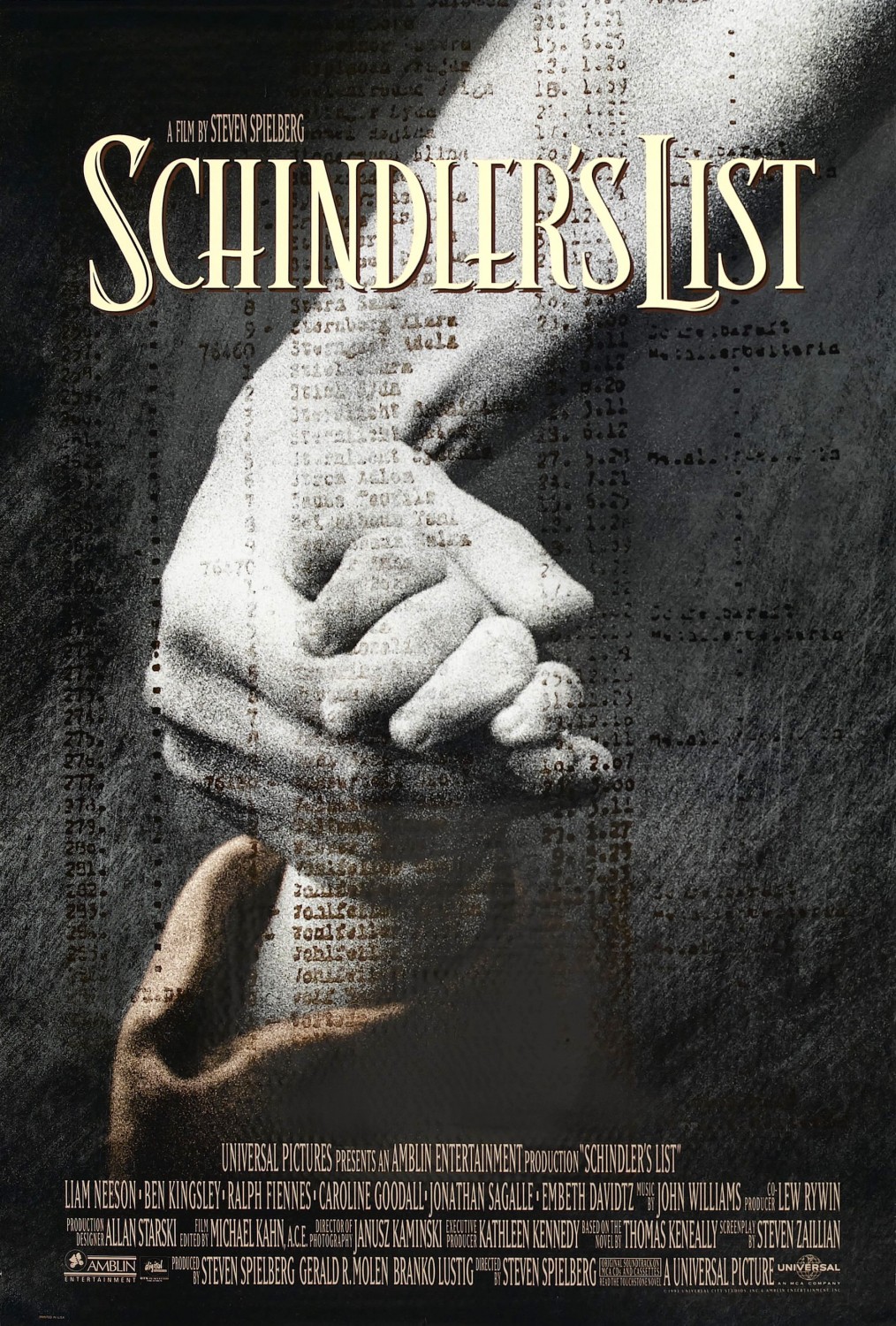
Written by Steven Zaillian. Based on the book “Schindler’s Ark” by Thomas Keneally.
Class of 2004
The Plot: Based on true events, Oskar Schindler (Liam Neeson) uses his status and connections within the Nazi Party to get a factory in Kraków. He uses Jewish labor to make a fortune on enamelware. As the Nazis, led by Amon Göth (Ralph Fiennes), start to take over and the Holocaust begins, Schindler, assisted by accountant Itzhak Stern (Ben Kingsley), works to save his employees from being shipped to concentration camps. What starts out as a business strategy turns into the rescue and survival of 1200 Jewish people, later dubbed the “Schindlerjuden”.
Why It Matters: The NFR gives a summary, but no specifics for its inclusion. An essay by late film critic Jay Carr is much more supportive, calling the film, among other things, “a stunning achievement”.
But Does It Really?: This is another one of the “untouchables” on this list. The degree of difficulty on this film was high, and “Schindler’s List” sticks the landing. It is an incredible film that excels in every department. There are minor historical qualms to be sure, but as a film it is flawless. Any attempt at recreating the Holocaust could veer dangerously into the manipulative, but Spielberg and his team treat every aspect of the events with respect and unapologetic realism. Special mention to Janusz Kamiński’s peerless cinematography, John Williams’ subtle yet powerful score, the masterful work of Liam Neeson and Ralph Fiennes, and of course, Spielberg solidifying his place as a director whose work will be remembered for years to come.
Everybody Gets One: Almost everyone, notably actors Neeson and Fiennes, and violinist Itzhak Perlman.
Wow, That’s Dated: Spielberg and cinematographer Janusz Kamiński wanted a timelessness to the film, and that’s exactly what they got. The only giveaways are the early ‘90s Universal logo, and the end credits’ mention of the original soundtrack available on “CDs and Cassettes”.
Seriously, Oscars?: A critical and commercial success, “Schindler’s List” did what no other Spielberg film had done before; it swept the Oscars. “Schindler” led with 12 nominations and won seven, including Picture, Adapted Screenplay, Score, Cinematography and, at long last, Best Director for Steven Spielberg. Notable among its losses, Neeson and Fiennes’ subtle performances lost to the more Oscar-friendly work of Tom Hanks and Tommy Lee Jones, the film lost Sound Mixing to Spielberg’s other 1993 film, “Jurassic Park”, and the film lost Makeup to, of all films, “Mrs. Doubtfire”.
Other notes
We have Kate Capshaw to inadvertently thank for this film. Spielberg was already attached to produce the film since the early ‘80s, but kept turning down the opportunity to direct, feeling he wasn’t “mature” enough. His then-fiancée Kate Capshaw insisted on converting to Judaism prior to their wedding, despite Spielberg considering himself not very religious. He credits Capshaw’s conversion with reconnecting him to his Jewish roots and leading to him directing “Schindler’s List”. Thanks Willie!
I won’t go over the historical details that may have been fabricated or exaggerated. Suffice it to say that the film is adapted from a book that, while based on interviews with many Holocaust survivors and Schindlerjuden, contains elements of historical fiction. Also, Oskar Schindler wishes he were as handsome as Liam Neeson.
Speaking of, what I would not give to see Liam Neeson’s take on Lincoln.
This film is a master class in scene work. You can dissect any scene in this film and learn how to effectively stage, frame and edit a scene. Especially impressive considering this is a 3-hour plus film of essentially just people talking. Kudos to everyone involved.
Not only does Ben Kingsley provide a bit of humanity during all of the proceedings, but he also gets to deliver the line “Bring your sister”, the film’s only joke.
It took a little over an hour, but the ghetto liquidation scene is what finally brought me to tears. It just got worse from there.
Is it weird for me to appreciate the use of squibs in this film? It’s just so terrifyingly realistic.
So crazy to think that the man responsible for the cartoonish Nazis in “Raiders of the Lost Ark” made this film.
Oh dear, I can no longer take Liam Neeson asking for “certain skills” seriously.
With this film you get one of Spielberg’s favorite trademarks: a close-up of someone in conversation while the other person is reflected in the mirror behind the first person.
It goes without saying, but Ralph Fiennes is excellent in a role you don’t get in most films: a dimensional Nazi.
Brief shout-out to Embeth Davidtz as Göth’s maid Helen Hirsch. I remember her best as Miss Honey from Danny DeVito’s film version of “Matilda”.
For the last half of the film my notes simply read “Not a lot of notes, too engaged.”
Legacy
The “Seinfeld” episode “The Raincoats” involves a subplot featuring Jerry and his date making out during “Schindler’s List”. Spielberg mentioned that he would watch “Seinfeld” to cheer him up after filming “Schindler”.
Turns out Oskar Schindler and Mr. Burns have a lot in common.
Ben Kingsley would go on to play another Holocaust survivor; Otto Frank in “Anne Frank: The Whole Story”.
Although Spielberg dropped out of Cal State Long Beach in his youth, he returned to finish his degree in 2002. The faculty allowed Spielberg to submit “Schindler’s List” as his film project. After winning a boatload of Oscars and accolades, “Schindler’s List” earned Spielberg what he wanted the longest: class credit.
OR “Polly Parker Pranks a Pair of Pickled Patrons”
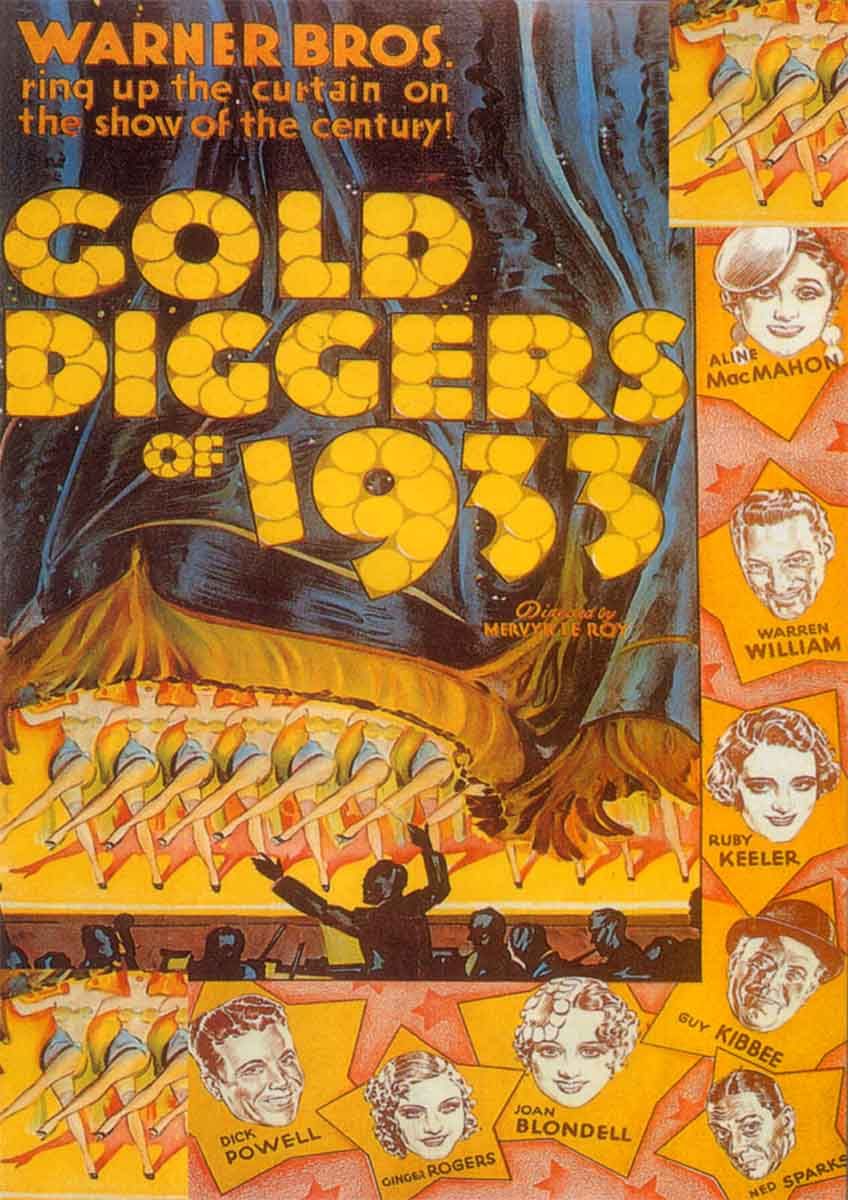
Directed by Mervyn LeRoy. Musical sequences by Busby Berkeley.
Written by Erwin S. Gelsey & James Seymour. Dialogue by David Boehm & Ben Markson. Based on the play “The Gold Diggers” by Avery Hopwood.
Class of 2003
The Plot: Backstage musicals don’t really need a plot, but this one’s got a doozy. Four actresses (Joan Blondell, Ruby Keeler, Aline MacMahon, & Ginger Rogers) strive for work during the Depression and find what may be the hit show they need. When the producer Barney (Ned Sparks) admits they have no funds, composer Brad (Dick Powell) delivers the money somewhat suspiciously. When it comes out that Brad actually comes from money, his brother Lawrence (Warren William) threatens to disown him and stop Brad’s marriage to Polly (Keeler). When Lawrence arrives, Carol (Blondell) poses as Polly and tries to bag him for herself. And in the midst of all of this are some of Busby Berkeley’s lavish production numbers.
Why It Matters: The NFR calls it “[a]rguably the definitive Depression-era musical” and praises the work of Busby Berkeley (but hey, how can you not?).
But Does It Really?: You can point to “42nd Street” as the definitive Busby Berkeley musical, but I give this film a pass out of sheer entertainment. The “book” scenes can weigh things down a bit, but the numbers more than make up for that. Unlike other backstage musicals of the era, “Gold Diggers” actually acknowledges the Depression, paying tribute with its powerful finale “Remember My Forgotten Man”. And how can you say no to the musical that gave us “We’re In The Money”?
Everybody Gets One: We’ll see most of this film’s major players again in “42nd Street” and “Footlight Parade”. Among the rest are go-to sassy confidante Aline MacMahon and a young Billy Barty!
Wow, That’s Dated: For starters, the title. But mainly, this film roots itself firmly in the Depression-era.
Seriously, Oscars?: “Gold Diggers” only received one nomination; Best Sound, losing to “A Farewell to Arms”. The only reason the film didn’t receive any Best Song nominations is that the category didn’t exist yet. If only it had been “Gold Diggers of 1934”.
Other notes
We start off strong with “We’re In The Money”. And then Ginger Rogers gets an extreme close-up as she sings a verse in Pig Latin. Am I having a stroke?
Look closely; one of the Gold Diggers is future Oscar winner (and future “Falcon Crest” star) Jane Wyman.
We’ll see more of character actor Ned Sparks throughout this blog. Needless to say, he’s one of those actors that leaves quite an impression.
Oh man, they fired Warren and Dubin! How meta.
Barney mentions that Brad and Polly would make a great team “like the Astaires”. Hey man, Ginger is right there.
Wouldn’t having the composer replace the lead cause problems with Actors’ Equity?
Ah yes, the great film trope of musical numbers that can’t possibly fit on the stage they are being performed on.
Polly tap-dances while wearing heels! Get it, Ruby Keeler!
It takes about 40 minutes before this film gives you its first of Busby Berkeley’s trademark overhead shots. As always, they are splendid.
That’s veteran character actor Charles Lane as the audience member who figures out who Brad is. You snitch.
This film perpetrates that theater women are gold diggers and that all theater people are “cheap and vulgar”. Well…
Pretty sure I just saw most of Joan Blondell’s boobs. Thanks, Pre-Code!
Disney voiceover legend Sterling Holloway makes a rare on-screen appearance as a delivery boy. You can clock that voice in a second.
Lawrence wants to be John Carradine so badly.
Cool neon effect in “Waltz of the Shadows”! I can only imagine what a pain that was given the technical limitations of the time.
Why is Joan Blondell Rex Harrison-ing her way through so much of “Remember My Forgotten Man”? Can’t she actually sing?
Don’t kid yourself, obviously dubbed soloist.
Legacy
This film spawned several films in the “Gold Diggers” series (though they were sequels in title only). Busby Berkeley and Dick Powell were on hand for most of them. The only real takeaway is the “Lullaby of Broadway” sequence from “Gold Diggers of 1935”.
“We’re In The Money” and “Waltz of the Shadows” found their way into the Broadway adaptation of “42nd Street”.
The opening of this film is featured prominently in “Bonnie and Clyde”.
And of course, everyone who’s ever sung “We’re In The Money”.
Listen to This: While on the subject of the Depression, let’s not forget the quintessential song of the era, “Brother, Can You Spare A Dime”, preserved here with recordings by Bing Crosby and Rudy Vallee.
#126) Theodore Case Sound Test: Gus Visser and His Singing Duck (1925)
OR “Duck and a Cover”
Directed by Theodore Case
Class of 2002
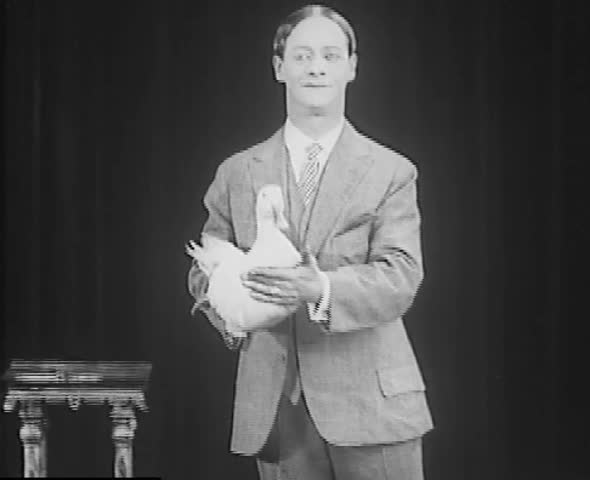
The Plot: The title says it all. Gus Visser helps test out Case’s new sound film by singing “Ma! He’s Making Eyes at Me”, with the assistance of a duck.
Why It Matters: The NFR admits this is “[o]ne of the Registry’s more unusual entries”, and includes a historical essay by UC Davis Professor Scott Simmon.
But Does It Really?: I…guess? It’s an early sound film, so technically it has historical significance, but…there weren’t any other films to choose?
Everybody Gets One:Theodore Case is one of the early pioneers in sound film, creating the Movietone sound system in the early ‘20s, and testing this technology by filming vaudeville performers. Unfortunately very little information is known about vaudeville performer Gus Visser, and even less information about the duck.
Wow, That’s Dated: This is one of those early sound films where you really can’t understand what the lyrics are. The aforementioned essay attempts to translate.
Other notes
Now that’s a hair part!
If this act were around today I don’t think it would get past that weird new version of “The Gong Show”.
Wait until PETA sees this.
That song again is “Ma! He’s Making Eyes at Me”; music by Con Conrad, lyrics by Sidney Clare.
In lieu of the typical “Legacy” section, I’m just going to list classic films that were added to the Registry AFTER “Gus Visser and His Singing Duck”:



 The Horse's Head