#613) The Sting (1973)

#613) The Sting (1973)

OR “The Wrath of Con”

Directed by George Roy Hill

Written by David S. Ward

Class of 2005

The Plot: Depression-era grifter Johnny Hooker (Robert Redford) and his partner Luther Coleman (Robert Earl Jones) successfully con a passerby (James Sloyan) out of $11,000. Unbeknownst to either of them, their victim was en route to deliver the money to crime boss Doyle Lonnegan (Robert Shaw), who has his goons track down and murder Luther. Hooker escapes, teaming up with one of Luther’s former associates Henry Gondorff (Paul Newman) to pull an elaborate con on Lonnegan involving a fixed horse race. There are many twists, turns, and double-crosses along the way, but this movie’s only real objective is that you have a good time watching it.

Why It Matters: The NFR write-up is mostly a rundown of the film’s plot and Oscar tally, but they do take the time to shout out Marvin Hamlisch’s “unforgettable” score as well as the film’s “strong supporting cast”.

But Does It Really?: This is another “minor classic” on the list. “Butch Cassidy and the Sundance Kid” is the natural choice for a Newman/Redford/Hill pairing, but “The Sting” is remembered well enough that an NFR designation isn’t too farfetched. On the whole, “The Sting” is still an entertaining movie, never taking itself too seriously, with an airtight script elevated by Hill’s lively direction and Newman and Redford’s natural chemistry. A pass for “The Sting”, appropriately joining the Registry two years after “Butch Cassidy”.

Wow, That’s Anachronistic: Despite composer Marvin Hamlisch’s effective use of ragtime music (especially Scott Joplin’s “The Entertainer”), that genre had its peak 20 years before the events of the movie. Today it would be like setting your movie in the late ’80s with a soundtrack of Beatles music.

Title Track: Within the context of this movie, the sting is the moment when a grifter completes their con and takes the mark’s money, ideally without the mark realizing their money is gone.

Seriously, Oscars?: Second only to “The Exorcist” at the box office, “The Sting” tied “Exorcist” for most Oscar nominations (10) and went on to win seven, including Best Picture, Director, Original Screenplay, and Score. Co-Producer Julia Phillips became the first woman to win the Best Picture Oscar, and Edith Head took home her eighth and final Oscar for Costume Design. Also worth noting: it was just before the Best Picture category announcement that artist Robert Opel streaked across the Oscar stage, still considered one of the most unexpected (albeit possibly staged) moments in Oscar history.

Other notes

  • While working on the screenplay for “Steelyard Blues”, David S. Ward was writing a scene involving pickpockets, and quickly fell down the research rabbit hole of con artists. Out of this research came “The Sting”, which was finally purchased by Universal after sitting in a slush pile for a few years. Ward was initially set to direct but waived this right in order to attract Robert Redford as the star. Redford got his former “Butch Cassidy” director George Roy Hill on board, who in turn brought in Paul Newman to play Gondorff, a supporting role subsequently expanded to give Newman more screen time. Hill gave “The Sting” a lighter tone than initially written, opting for a feel-good homage to the Hollywood gangster movies of the ’30s.
  • Oh yeah, this movie makes it very clear from the get-go that this is a love letter to ’30s studio films. From the period-appropriate Universal logo, to its presentation of the cast during the opening credits, “The Sting” announces its intentions loud and clear: “This is all pretend, folks. Just enjoy yourself.” Shoutout to Jaroslav “Jerry” Gebr, who designed the poster and the film’s interstitial cards in the style of The Saturday Evening Post, which explains why every drawing looks like if Norman Rockwell became a courtroom sketch artist.
  • Robert Redford strikes out with a beautiful woman? Clearly this is a work of fiction.
  • I’m enjoying Robert Earl Jones as one of my favorite tropes: the character that is killed off immediately but is mentioned in reverence for the rest of the movie. Fun Fact: Robert is the father of James Earl Jones, who inherited his father’s warm yet commanding tone.
  • Like Butch & Sundance before, Newman and Redford achieve the impossible and make lowlife criminals approachable and likable. It helps that they’re both charming as hell, and have that indefinable star quality that makes you believe even the most outlandish scenario. Side note: Hooker was written to be 19 years old, which explains why everyone keeps calling 37-year-old Redford “Kid”.
  • Get out your scorecards everyone, it’s time for another round of “70s Character Actor Bingo”! The NFR is right to single out this supporting cast; between Charles Durning, Eileen Brennan, Ray Walston, and Harold Gould, there really isn’t a weak link in this chain. Brennan in particular shines as the quintessential ’30s dame. Where’s her spin-off?
  • I realized during my viewing that I have never seen Robert Shaw in any movie other than “Jaws” (I fell asleep attempting to watch “A Man for All Seasons”). Obviously Quint is and will continue to be Shaw’s legacy, but anyone looking for an alternative won’t be disappointed in his Lonnegan. Shaw does a flawless Irish accent, and manages to convey his character’s weight and menace through moments of stillness; the tiger waiting to pounce if you will. Not Necessarily Fun Fact: Lonnegan’s limp in the film was real, added after Shaw injured himself on a handball court prior to filming.
  • The poker game between Gondorff and Lonnegan is the highlight of the movie, Newman in particular getting a chance to flex his rare comedy muscles. I was surprised to learn that “The Sting” was a comeback of sorts for Newman, whose last few films had been expensive flops, which explains why this is the rare Newman film in which he doesn’t play the lead.
  • Half the fun of watching “The Sting” is accepting that this movie is always one step ahead of you. Just when you think you can guess where it’s going, there’s another twist that pulls the rug out from under you. Eventually you accept the movie’s one-upmanship, and just relax and go along for the ride.
  • Shoutout to longtime character actor Dana Elcar as FBI Agent Polk, the only character who gets to say “the sting” in “The Sting”.  
  • The upside to covering movies I deem “minor classics” is that their endings aren’t famous enough to be spoiled in our popular culture. I genuinely did not know how this movie would end, and while it packs a lot in during its final 10 minutes, it does not disappoint. My note for the finale simply read, “Wow”.

Legacy

  • “The Sting” opened on Christmas Day 1973 and was a runaway hit with critics and audiences. This all came to a head in late 1974 when writer David S. Ward was accused of plagiarizing his screenplay from the 1940 book “The Big Con” by David W. Maurer. While Ward confirmed that “Big Con” was one of many books he read while researching the script, he remained adamant that his script was wholly original. Both the Writers Guild of America and the Writer’s branch of the Academy concluded that Ward did not plagiarize his screenplay, though by that point Universal had already paid Maurer a settlement, which led to bad blood between Ward and the studio. Side note: There is also a claim that “The Sting” lifted its plot from a 1951 episode of Orson Welles’ radio drama “The Lives of Harry Lime“, or possibly a 1958 episode of the TV series “Maverick“. Let the record show that Ward would have been 6 and 13 years old when these shows aired.
  • David S. Ward has continued working as a screenwriter and occasional director to this day, penning the scripts for such films as “Major League” and “Sleepless in Seattle”. Ward also wrote the 1983 sequel “The Sting II”, which featured none of the original cast (Newman and Redford were replaced by Jackie Gleason and Mac Davis) and was a critical and financial disappointment.
  • After the success of “The Sting”, Newman, Redford and Hill expressed interest in a third collaboration. Although Hill would go on to direct both stars separately (Redford in “The Great Waldo Pepper” and Newman in “Slap Shot”), and Newman and Redford continued to search for a suitable project following Hill’s death in 2002, the proposed third film never came to fruition.
  • Producer Richard D. Zanuck enjoyed working with Robert Shaw so much in this film that he recommended Shaw to Steven Spielberg during the casting of “Jaws”. And now you know the rest of the story!
  • Surprisingly, the person who got the biggest career boost from “The Sting” had been dead for over 50 years. Although a revival and appreciation of Scott Joplin’s ragtime music was already underway in the early ’70s, “The Sting” propelled Joplin’s music into the mainstream, with Marvin Hamlisch’s soundtrack reaching #1 on the US Billboard chart. Among Joplin’s posthumous honors was a special Pulitzer Prize in 1976, and a 1977 biopic starring Billy Dee Williams!

Listen to This: Scott Joplin is represented on the National Recording Registry twice: his ragtime compositions for piano roll in the 1900s, and a reorchestration of his opera “Treemonisha” by the Houston Grand Opera in 1976.

#612) Going My Way (1944)

#612) Going My Way (1944)

OR “Not Your Father’s Father”

Directed by Leo McCarey

Written by Frank Butler and Frank Cavett. Story by McCarey.

Class of 2004

The Plot: Father Chuck O’Malley (Bing Crosby) is a young priest from St. Louis transferred to New York to help out St. Dominic’s Church and its aging founder Father Fitzgibbon (Barry Fitzgerald). O’Malley’s youth and unconventional approach to religion clashes with Fitzgibbon’s more traditional style, O’Malley opting to “go my way” and teach a lighter, more positive message. In time he wins over his congregation, including young runaway Carol James (Jean Heather) and a gang of youth who O’Malley convinces to join his newly formed church choir. Can O’Malley save the church before the bank forecloses? And because it’s Bing Crosby, how many songs can we shoehorn into this?

Why It Matters: The NFR gives a plot overview and, while admitting that the film is “heavy on sentiment”, praises Leo McCarey, who “wisely tempers the sugary emotion with comedy and musical interludes.”

But Does It Really?: This is in the “historically significant” / “Minor Classic” ballpark. “Going My Way” is not a pivotal or groundbreaking movie, and is largely forgotten nowadays outside of an Oscar montage, but its entertainment value (as well as its “heavy sentiment”) still make for an enjoyable viewing 80 years later. I’ll admit to a bit of bias in favor of this movie (it was one of my dad’s favorites), but “Going My Way” is a welcomed addition to the NFR, if not an absolute essential in film history.

Title Track: I always forget that this movie has a title song. Written by Jimmy Van Heusen and Johnny Burke, “Going My Way” is one of three original songs in the film, and I’ll go ahead and rank it second, far behind “Swinging on a Star” and slightly ahead of the one Carol sings that I’ve already forgotten.

Seriously, Oscars?: The biggest hit of 1944, “Going My Way” tied wartime drama “Wilson” with 10 Oscar nominations, and went on to win 7, including Best Picture, Director, and Lead Actor for Bing Crosby. Interestingly enough, Barry Fitzgerald was nominated for both Lead and Supporting Actor for his performance in “Going My Way”. Fitzgerald prevailed in the Supporting category, and shortly thereafter the Academy rules were changed to prevent this oddity from occurring again.

Other notes 

  • Stay with me, this is going to get tricky. While working at RKO, Leo McCarey wrote a script based on his aunt, a nun who died of typhoid. The script, eventually titled “The Bells of St. Mary’s”, included a priest character that McCarey wanted Bing Crosby to play. Crosby liked the part, but couldn’t commit due to his contractual obligation with Paramount. An agreement was made that Crosby would be loaned out to RKO for “Bells”, but first McCarey had to make a movie for Paramount. McCarey agreed and wrote “Going My Way” as a sort of prequel that focused on Father O’Malley. Once again: “Going My Way” is technically a prequel, but was released before “Bells”, making that film technically a sequel.
  • As always with your ’40s studio fare, get out your “Character Actor Bingo” cards. In the first few minutes alone we get Gene Lockhart, Frank McHugh and Porter Hall (who receives prominent billing for one inconsequential scene). And no you’re not seeing things: The actor playing Ted Jr. in this movie is named James Brown. In later years, he would go professionally by “James L. Brown” (or sometimes “James B. Brown”) to differentiate himself from that other, significantly more famous James Brown.
  • Best line in the movie: “You even throw like an atheist.”
  • I’m enjoying Bing in this movie a lot. His natural breeziness helps give the character a friendly approachability, and it’s fun watching him try to win over crotchety old Barry Fitzgerald.
  • Shoutout to Jean Heather and her perfectly arched eyebrows. One of Paramount’s rising stars in the early ’40s (look for her as Barbara Stanwyck’s stepdaughter in “Double Indemnity“), Heather’s film career ended in 1947 when she received serious head injuries from a car accident. Thankfully she survived, and lived long enough to see this and “Indemnity” become classics.
  • I assume every kid in this movie is either one of the Bowery Boys or the Dead End Kids. Imagine the turf wars. Their leader, Tony Scaponi (love the name), is played by Stanley Clements, who I guess out-Brooklyned everyone else at the audition. And if the kid playing Herman looks familiar, it’s Carl Switzer, aka Alfalfa from “Our Gang”.
  • Thank god these kids all like baseball, otherwise Chuck would have nothing to relate to them with.
  • We all know Father Fitzgibbon will eventually warm up to Father O’Malley, but it’s still satisfying to watch Barry Fitzgerald show his softer side. The scene where Bing quietly sings “An Irish Lullaby” to Fitzgibbon is especially sweet, and may have hypnotized my cat while I was watching this.
  • This is what I call a “spinning plate movie”. The film has an episodic “hangout” vibe as we go from subplot to subplot every few minutes. Okay, things look good with Father Fitzgibbon, let’s see how the boys are doing. Now let’s check in on Carol and Ted… etc.
  • The film’s second half introduces us to opera singer Jenny Tuffel, played by Risë Stevens, credited with the impressive title “Famous Contralto of Metropolitan Opera Association”. It is strongly hinted that Jenny and Chuck were romantically involved before he joined the priesthood, which helps confirm my own skepticism believing Bing Crosby as celibate. Stevens of course has a dynamite voice, though in the role of Carmen she’s no Dorothy Dandrige…who in turn was no Marilyn Horne.
  • Unlike the majority of wartime era films, “Going My Way” barely mentions the war, only giving it a proper acknowledgment when Ted Jr. signs up for the Air Force. Speaking of, what took you so long? Pearl Harbor was 2 1/2 years ago!
  • Man, they really were pushing “Going My Way” to be the breakout song from this film. It gets sung in its entirety twice; once by Bing and again by Risë Stevens and a choir of East Side Kids. No wonder everybody loves “Swinging on a Star”; it’s much catchier and is introduced at lower stakes. And of course, that’s William Frawley as the music executive, still a few years away from “I Love Lucy”, and about 78 years from getting J.K. Simmons another Oscar nomination.
  • The film’s Christmas Eve finale qualifies it for my “Die Hard” Not-Christmas list. With that out of the way, it’s a very sweet ending. I knew it was coming, but I still got a little teary eyed. I also appreciated the restraint of it; Father O’Malley pulls a Mary Poppins, quietly heading off to his next assignment as everyone rejoices in their happy ending.

Legacy 

  • “Going My Way” was an instant hit, and with his obligation to Paramount completed, McCarey immediately started work on “The Bells of St. Mary’s”. Released a year and a half after “Going My Way”, “Bells” saw Father O’Malley squaring up against Ingrid Bergman’s Sister Mary. “Bells” is still one of the only sequels to match or surpass its predecessor in both box office take and Oscar recognition.
  • Following “Going” and “Bells”, Leo McCarey’s film career started to produce more misses than hits, though he did give us 1957’s “An Affair to Remember”, which as of this writing still hasn’t made the NFR.
  • A TV adaptation of “Going My Way” aired on ABC in the 1962-1963 season, starring Gene Kelly as Father O’Malley and Leo G. Carroll as Father Fitzgibbon.
  • Much like its appearance here, “Swinging on a Star” surpassed the title number as the film’s breakout song, even winning the Oscar for Best Song. “Swinging” has been covered many times over the years, and my favorite will always be as the theme song to the ’80s sitcom “Out of This World”.

Further Viewing: This is as good a chance as I’ll ever get to reference Bing Crosby’s duet with David Bowie of “Little Drummer Boy” in his 1977 holiday special “Bing Crosby’s Merrie Olde Christmas”. It’s required viewing for me every holiday season.

Listen to This: Bing Crosby is represented twice on the NRR for his recordings of “White Christmas” and “Brother, Can You Spare a Dime?

#611) Princess Nicotine; or, the Smoke Fairy (1909)

#611) Princess Nicotine; or, the Smoke Fairy (1909)

OR “Alright, another freebie!”

Directed by J. Stuart Blackton

Class of 2003

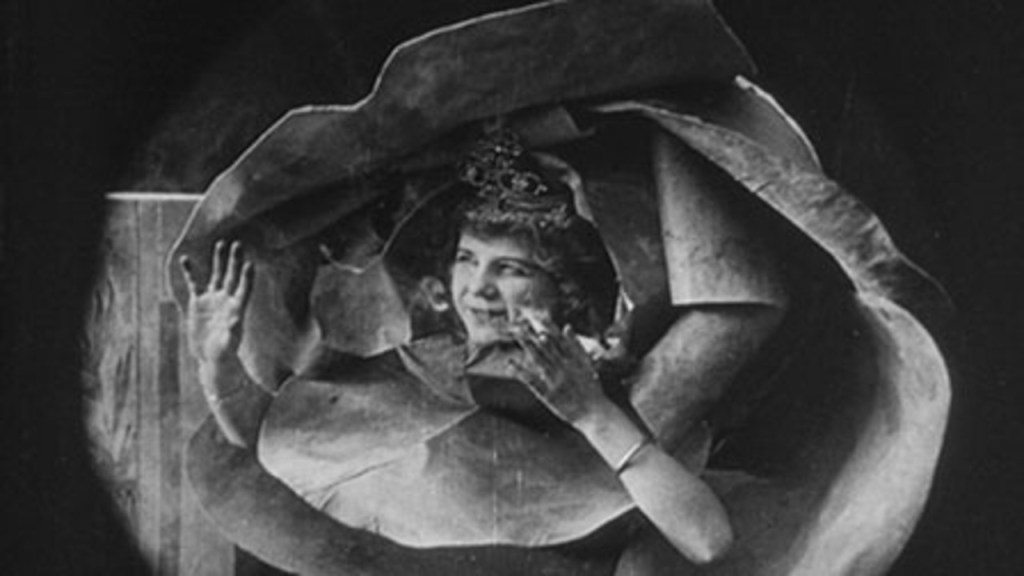
The Plot: A man (Paul Panzer) settles in for the evening with a pipe of tobacco. When he falls asleep, he dreams of two tiny fairies (Gladys Hulette and Actor Unknown) emerging from his cigarette box and playing tricks on him. Despite this odd premise, “Princess Nicotine” boasts some genuinely impressive special effects.

Why It Matters: The NFR calls the film a “fantasy tour de force” as well as “the most celebrated special effects film of its day.” An essay by film professor/NFR stalwart Scott Simmon is taken directly from his program notes for the “Treasures of the American Archive” DVD. 

But Does It Really?: What the hell did I just watch? Like many of these early silent shorts, “Princess Nicotine” is confusing, but man are those special effects a sight to behold. At one point I literally asked the question “How did they do that?” “Princess Nicotine” makes the NFR for its incredible effects, as well as representation of J. Stuart Blackton, a pioneer of early film.

Everybody Gets One: J. Stuart Blackton was a reporter for the New York Evening World when he was assigned to interview Thomas Edison about his new invention the Vitascope. Blackton was so impressed and won over by Edison that he pivoted to filmmaking, adding short films to his stage performances with magician Albert Smith. In 1897 Blackton and Smith founded the American Vitagraph Company (later Vitagraph Studios), and their immediate success led to more creativity and experimentation with their films. Inspired by Georges Méliès, Blackton’s films started to include optical and in-camera effects, as well as stop-motion animation. In addition to its noteworthy effects, “Princess Nicotine” may have been an advertisement for Sweet Caporal Cigars. Speaking of…

Wow, That’s Dated: While the dangers of smoking tobacco were known and documented throughout the early 20th century, advertisements for tobacco products were quite common, only coming to a head in 1964 when a 386-page report by the U.S. Surgeon General Dr. Luther Terry undeniably linked smoking to cancer. Since then, more rules and regulations have been put into place banning the advertisement of tobacco products in various forms, especially anything geared towards children. According to the CDC, while cigarette smoking is still the number one cause of preventable disease and death in the United States, as of 2020 the total population that smokes is 12.5%, down significantly from 42% in 1964.

Other notes

  • My main takeaway from this short was, naturally, the special effects. At first, I assumed the fairy on the table was achieved using double exposure, and while that technique was used for a few shots, most of those effects were achieved in-camera. The actors playing the fairies performed next to the camera, with their movements reflected onto a mirror several feet behind the table which, when viewed through the camera lens, made it appear that they are tiny figures on top of the table. Over 110 years later, it still looks great.
  • Paul Panzer was a silent film actor who transitioned to bit parts in talkies. He is one of Rick’s waiters in “Casablanca“, and we’ll see more of him when I finally get around to covering “The Perils of Pauline“.
  • This feels like a good time to shout out cameraman Tony Gaudio, who would go on to be the cinematographer for such future NFR entries as “Little Caesar“, “The Life of Emile Zola“, and “The Adventures of Robin Hood“.
  • Nothing to see here, just a child smoking a cigarette. Go on about your business.
  • I’m always tempted to try and delve into these films on a deeper level, with the hope of discovering some hidden meaning or metaphor, but sometimes a film about a cigar is just a film about a cigar.

Legacy

  • According to the aforementioned Simmon essay, audiences immediately took notice of the special effects in “Princess Nicotine”, leading to an article in Scientific American that called them “so startling that it defies explanation by the initiated.”
  • Vitagraph would continue making shorts until 1925 when the company was sold to Warner Bros. The company’s early developments with sound film were picked up by Warner for their features, which culminated in “The Jazz Singer” in 1927.
  • J. Stuart Blackton lost most of his Vitagraph fortune in the 1929 Stock Market Crash and spent the remainder of his life working odd jobs and showing his old movies on the lecture circuit. Blackton was working on a color film project with Hal Roach when he died of complications from a car accident in 1941 at the age of 66.

Further Viewing: J. Stuart Blackton’s experimentation with stop-motion animation led to 1906’s “Humorous Phases on Funny Faces”, widely considered the first animated film. I’ve nominated this film for NFR consideration in the past and, as of this writing, the granddaddy of all animation has yet to make the cut.

The Horse’s Head Goes to Washington!

Hi-ho readers!

Normally I don’t talk about my personal (aka “real”) life on the blog, but I felt that my recent trip to Washington warranted an exception. Last week the GF and I took a much needed vacation, recharging our batteries out in beautiful Maryland. It was my first time visiting the Old Line State, and my time there was both pleasant and relaxing (except for a brief detour in downtown Baltimore, but that’s another story).

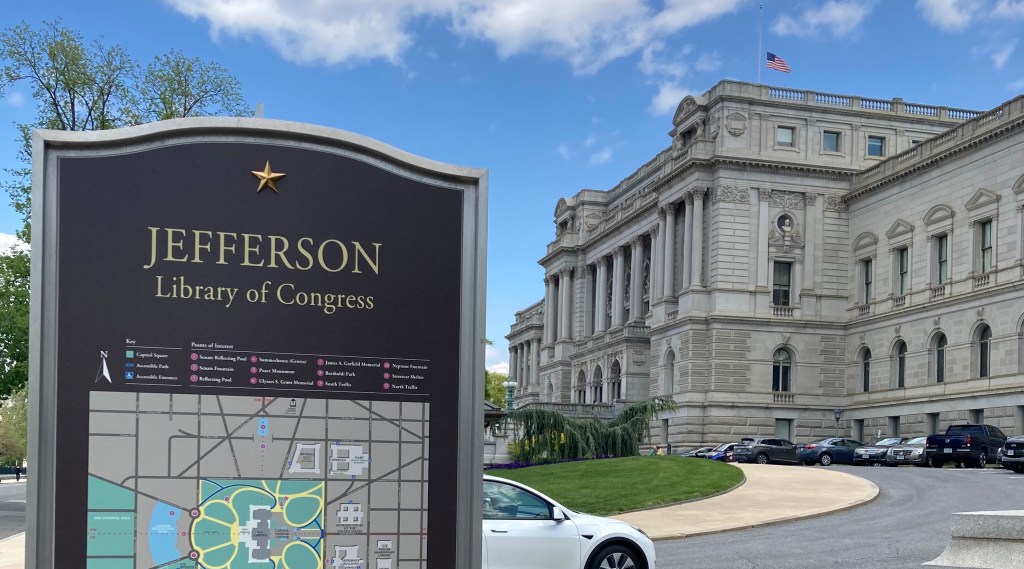
As a native Californian, east coast geography still baffles me (You drive for 20 minutes and then you’re…in another state?) so I didn’t realize until planning this trip that we were a short drive away from Washington D.C. Having never been there before in my life, the GF and I planned a day trip to Our Nations’s Capital. With no real agenda at hand, we had a fun day moseying around the National Mall, taking in the city’s major landmarks, and speculating which business-attired pedestrians were “those fat cats” I associate with political corruption. We saw most of the big icons – the White House, the US Capitol, the spot where Forrest Gump reunited with Jenny – but the highlight of our trip was by and large a stop at my own personal Mecca: The Library of Congress, birthplace of the National Film Registry.

[Insert delighted squeal noises here]

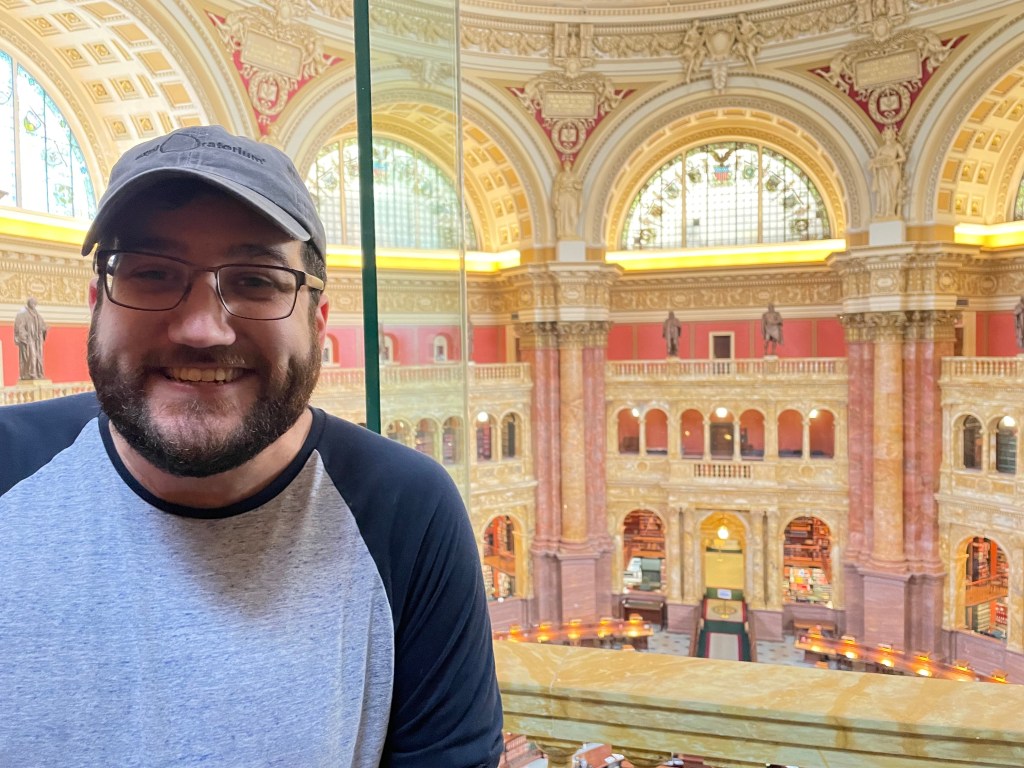
We started at the Thomas Jefferson Building, home of the main reading room and all the public exhibitions. I’m not sure what exactly I was expecting, but I was blown away by the sheer beauty of the place. From its marble staircases to its endless line of murals, that building is gorgeous. The exhibits are worth the trip out (especially the Rosa Parks exhibition currently housed there), and I geeked out pretty hardcore when I laid eyes on the the Reading Room (as seen in “All the President’s Men“). Naturally, our self-guided tour ended at the gift shop, where we bought our fair share of swag from an employee who was just as grateful as we were that the field trips were starting to die down for the day. I feel you, bro. I feel you.

Look at that happy little film geek. Photo Credit: The GF.

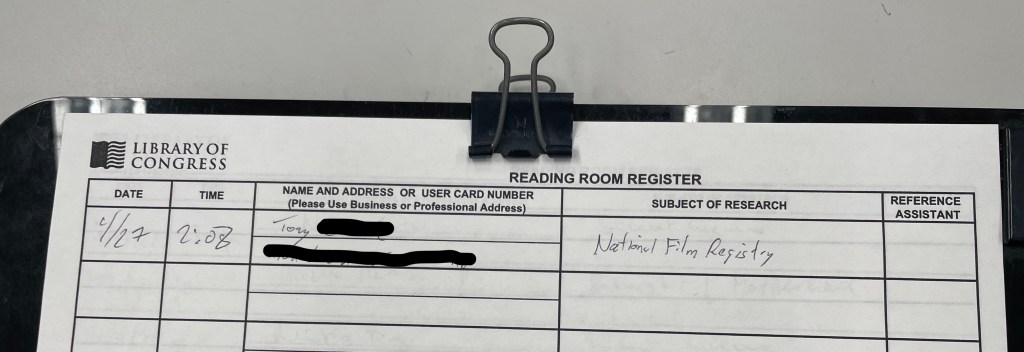
But our time with the Library of Congress didn’t stop there. In my pre-trip research, I found that the Library’s Moving Image Research Center is in the James Madison building, across the street from the Jefferson building. Thankfully, the library is open to any inquiring researcher (appointments preferred, of course), and the GF and I headed across the street to pay a visit. Our time there was brief, but incredible. Sitting in the serenity of the Moving Image Research Center, surrounded by books on every conceivable film and TV topic, sitting among people who have devoted their lives to preserving film history, was a dream come true and surprisingly moving. Shout out to Dorinda, one of the Moving Image Research Center’s viewing technicians who helped me find what I was looking for, sent me a follow-up email with more resources, and even loaned me a quarter for the locker! If the Library has an Employee of the Month program, she gets my vote.

Photo Credit: The GF, who feels that the “Reviews, Etc.” sign in the background works as an alternate title for this blog.

When I started this blog five years ago, I never thought I would find myself momentarily researching film history in the honest-to-god Library of Congress. Much like the 600+ movies I’ve chronicled over the years, life itself boils down to moments; people and places and feelings and connections we hold onto long after we’ve forgotten everything else. I will always remember and cherish those moments sitting in that research library with my GF, my own personal slice of heaven on Earth.

Happy Viewing, and keep taking care of each other.

Tony

And now I’m on their registry. Full circle! Photo credit: The GF

P.S.: While visiting family in Maryland, we went to the movies and saw “The Unbearable Weight of Massive Talent” with Nicolas Cage. It was good. Not amazing, but an enjoyable, entertaining movie. If you’re a fan of Mr. Cage or just a general movie geek, there’s plenty of details you will find rewarding. Cage is great as usual, and his chemistry with Pedro Pascal is wonderful. If the movie had just been the two of them forging their bromance it would have been perfect.

#610) Why Man Creates (1968)

#610) Why Man Creates (1968)

OR “Better Call Saul”

Directed by Saul Bass

Written by Bass and Mayo Simon

Class of 2002

The Plot: Iconic title designer Saul Bass takes a turn behind the camera to try and explain “Why Man Creates”. In his signature style, Bass takes millennia of human creativity and boils it down to the common threads: the inspiration, the experimenting, the successes, the failures. All of this is told through a series of vignettes that range from fun animation to avant-garde presentations to the simple act of writing. Saul Bass successfully takes all of these big ideas and compresses them into one 25-minute film that is endlessly – forgive me – creative.

Why It Matters: The NFR write-up is mostly an overview of both Bass and the film, but the accompanying essay by archivist and Bass expert Sean Savage dives into more detail.

But Does It Really?: “Why Man Creates” is in the NFR subcategory I call “But What I Really Want To Do Is Direct”. This list contains several movies directed by people whose filmmaking talents were in other departments (Haskell Wexler, Cedric Gibbons, and Busby Berkeley, to name a few), so I have no objections to including a film by Saul Bass, whose praises I have sung in many previous posts. “Why Man Creates” is probably the best known of Bass’ short films, and its universal themes have aided in its longevity and accessibility. A yes for both “Why Man Creates” and Saul Bass on the Registry.

Everybody Gets One: While this is far from his only NFR appearance, a quick word on Saul Bass. Born and raised in the Bronx, Saul Bass started his showbiz career designing movie posters. His commission for Otto Preminger’s “Carmen Jones” so impressed the director, Preminger hired Bass to design the opening credits in the same aesthetic. Throughout the ’50s and ’60s, Bass designed several eye-catching opening title sequences for such directors as Billy Wilder, Stanley Kramer, Robert Wise, and of course, his legendary collaborations with Alfred Hitchcock. By the mid-60s, Bass was focusing more on filmmaking, helming a number of corporate-sponsored shorts for such events as the 1964 New York World’s Fair. “Why Man Creates” was commissioned by Kaiser Aluminum as a recruiting film for scientists and engineers.

Title Track: Saul Bass actually hated the title “Why Man Creates”, which, according to the aforementioned Savage essay, was imposed by Kaiser. The title itself never appears in the film, which opens with the handwritten introduction, “A series of explorations, episodes, and comments on creativity.” For the rest of Bass’ life, he always referred to this film as “the creativity film”.

Seriously, Oscars?: “Why Man Creates” won the Oscar for Best Documentary Short Subject in 1969. Although I question the film’s categorization, this was Saul Bass’ only Oscar win, so I can’t gripe too much. Bass received two more nominations in the ’70s, both in the more appropriate category of Live Action Short Subject.

Other notes

  • Not a lot of information out there about co-writer Mayo Simon, other than he collaborated with Saul Bass on a number of projects, and wrote several plays, teleplays, and screenplays throughout his career, including the script to “Futureworld”.
  • After a flashy, fast-cut opening was rejected by Kaiser, Bass reshot all the title sequences as someone writing out each title by hand with a pencil. I’ll do the note writing around here, thank you very much.
  • The film’s opening segment begins with cavemen creating hunting tools, followed by the cave painting of their first prey. This begins a lengthy vertical pan up a seemingly never-ending tower populated with every major civilization and technological advancement in the history of the human race. No easy task, but in true Bass fashion its stylized minimalism speaks volumes. 
  • Among the discoveries made in this segment: the integer 0, depicted here as being discovered by a Muslim scholar. I guess someone had to find it. Coincidentally: my research shows that ancient Egyptians visualized their zero equivalent baseline using their word for beautiful: nfr
  • One segment features public reactions to creativity, consisting of “man on the street” reactions from real people, most of whom hate the final results (unseen by the viewer). One man says it represents “the decline of the west”. No, that comes later. One of the few positive responses comes from an unseen voice, and I’m pretty sure that’s prolific voiceover actor June Foray giving her approval. Now that’s something I really like.
  • Another segment about a ping pong ball that bounces higher than all the others is titled “A Parable”. It’s been done.
  • Either the most dated or least dated segment is one chronicling scientists who have spent years tackling such various big concepts as a cure for cancer and an alternative to the Big Bang Theory. This must have been the Kaiser mandated “hard sell” section. One of those scientists, Renato Dulbecco, went on to win the 1975 Nobel Prize in Physiology or Medicine for his cancer research. 
  • Ultimately, while Bass never intended this film to be the be-all-end-all discussion of creativity, “Why Man Creates” does end up having a thesis statement. In addition to the film’s emphasis on individuality and thinking outside the box, Bass answers the titular question with “I Am”. Humans create as an outward expression of self, which this film views as a subconscious attempt at immortality. Years from now, people can see our creativity as it says for us “I was here.” For example, my blog posts are a subconscious way for me to say “I am here, I am unique, and Josef von Sternberg is overrated.”

Legacy

  • According to Sean Savage, “Why Man Creates” is the most viewed educational film of all time. The film was a staple of classroom viewings and art exhibitions, and an edited version aired as part of the premiere episode of “60 Minutes” in September 1968.
  • Saul Bass continued his pivot towards filmmaking and away from title design throughout the ’70s and ’80s, including his only feature-length film, 1974’s sci-fi thriller “Phase IV”. Bass returned to title design on a semi-regular basis in the late ’80s and early ’90s, designing credit sequences for the likes of Martin Scorsese, Penny Marshall, and James L. Brooks. Saul Bass’ final title design was for Scorsese’s “Casino” in 1995 before his death the following year at age 75.
  • And finally, I would be remiss if I didn’t mention that Saul Bass also designed a number of company logos, including the AT&T blue globe and, most importantly, the logo for the National Film Registry.

Further Viewing: One of many video essay appreciations out there for Saul Bass, courtesy of The Royal Ocean Film Society.