#30) Fantasia (1940) – Part 1

#30) Fantasia (1940)

OR “A Little Mice Music”

Directed by Samuel Armstrong (Toccata and Fugue, The Nutcracker Suite), James Algar (The Sorcerer’s Apprentice), Bill Roberts and Paul Satterfield (The Rite of Spring), Ben Sharpsteen and David D. Hand (Intermission/Meet the Soundtrack), Hamilton Luske, Jim Handley and Ford Beebe (The Pastoral Symphony), T. Hee and Norman Ferguson (Dance of the Hours), Wilfred Jackson (Night on Bald Mountain/Ave Maria)

Composed by Johann Sebastian Bach, Pyotr Tchaikovsky, Paul Dukas, Igor Stravinsky, Ludwig van Beethoven, Amilcare Ponchielli, Modest Mussorgsky, and Franz Schubert

Class of 1990 

This is a revised and expanded version of my original “Fantasia” post, which you can read here.

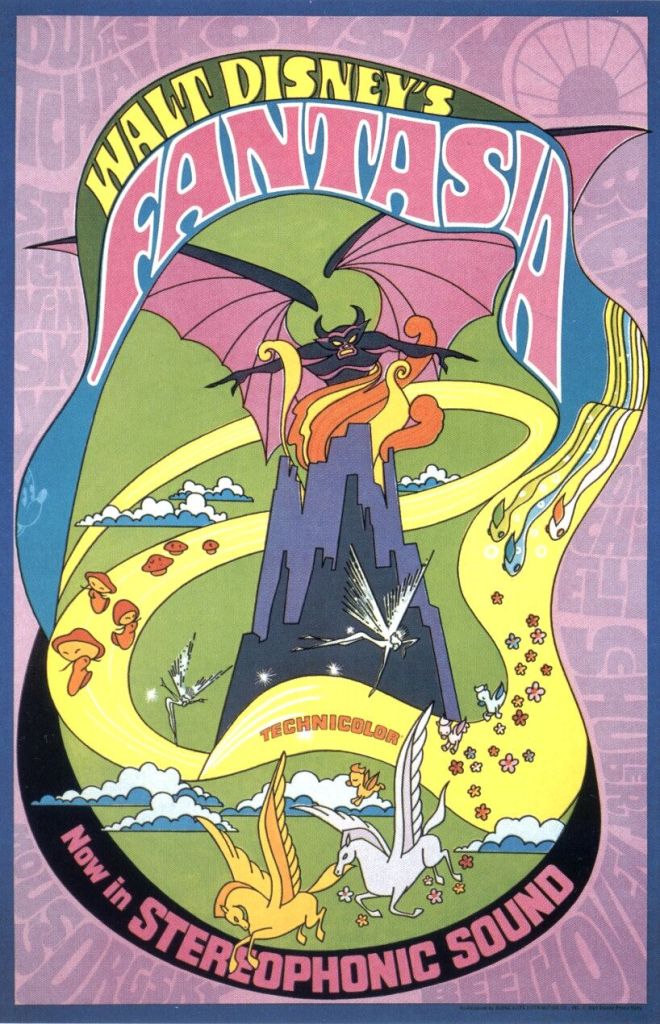
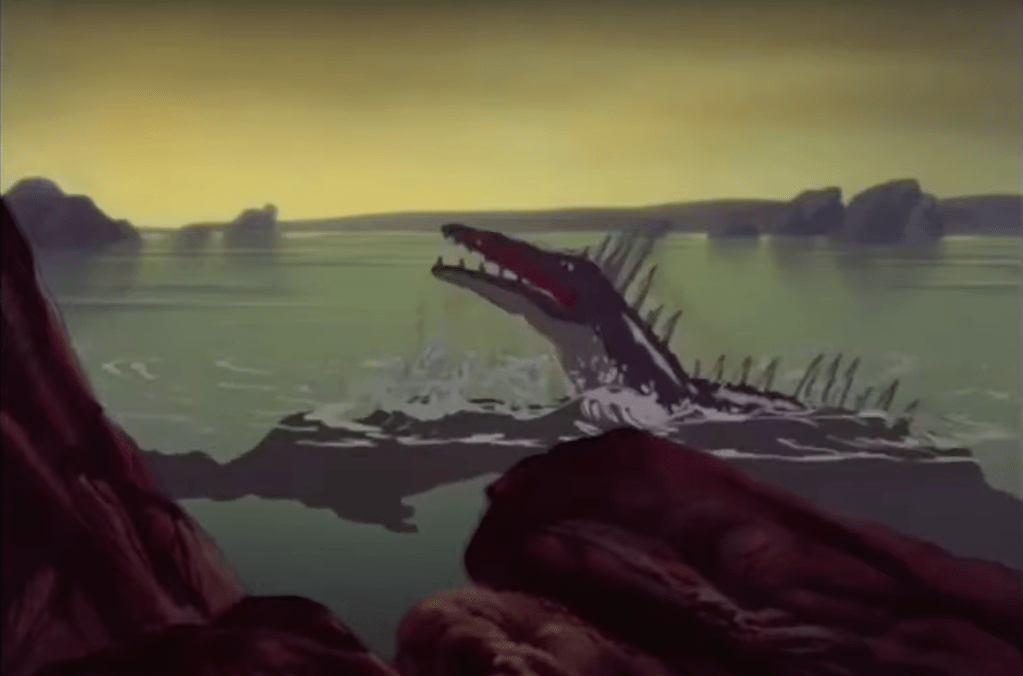
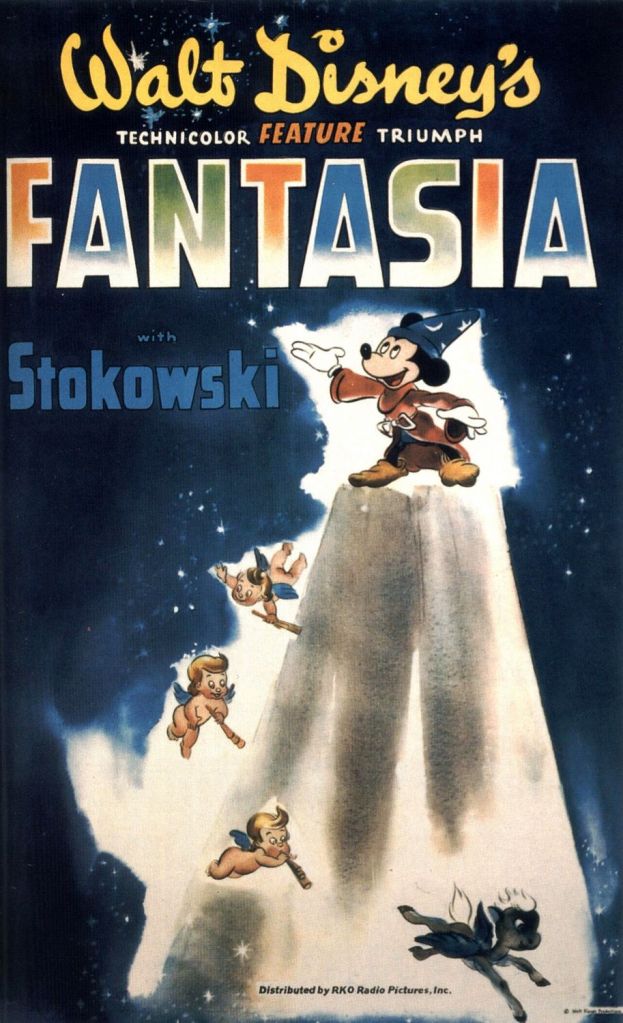
The Program: Performed by the Philadelphia Orchestra under the conduction of Leopold Stokowski, “Fantasia” is an artistic marriage between classical music and Disney animation. Walt’s animators visualize Bach’s “Toccata and Fugue” with abstract shapes, Tchaikovsky’s “Nutcracker Suite” with fairies and dancing flora, Dukas’ “The Sorcerer’s Apprentice” with Mickey Mouse, Stravinsky’s “Rite of Spring” with dinosaurs, Beethoven’s “Pastoral Symphony” with characters from Greek mythology, Ponchielli’s “Dance of the Hours” with dancing hippos and ostriches, Mussorgsky’s “Night on Bald Mountain” with some terrifying devil worship, and Schubert’s “Ave Maria” with…mostly multiplane backgrounds and tracking shots.

Why It Matters: The NFR calls it “Disney studios’ most ambitious animated feature”, and opines that the segments range from “elegant” to “kitschy”.

But Does It Really?: As a piece of film history, “Fantasia” is a game changer in its exploration of what an animated feature could be. In a way, “Fantasia” is the anti-Disney movie, with its dark themes and emphasis on mood over character, two wells that Disney has rarely gone to since. As a film for modern day viewing, “Fantasia” is…fine. It’s a treat for classical music/animation buffs to watch, but like an actual symphony concert, a little patience is required to appreciate “Fantasia” and its two-hour running time. “Fantasia” is a no-brainer for NFR inclusion, though I’m still on the fence if it holds up well enough to entertain a modern audience with no nostalgic attachments.

Everybody Gets One: Leopold Stokowski had been conductor for the Philadelphia Orchestra for 25 years when approached by Walt Disney to conduct a Mickey Mouse short based on “The Sorcerer’s Apprentice”. Stokowski was known for his bucking of orchestra traditions (he conducted without a baton!) and his controversial re-orchestrations of classical music that strayed from the composer’s intentions. Music critic and radio commentator Deems Taylor was chosen to serve as the film’s emcee, as well as to help Disney and Stokowski select which pieces would be performed.

Wow, That’s Dated: Like a lot of early Disney animation, “Fantasia” would be perfect if it weren’t for the racial stereotyping. The “Chinese Dance” from “The Nutcracker” is performed here by mushrooms drawn with slanted eyes and their caps doubling as conical hats. And although later versions have removed the most offensive Black stereotype centaur from “Pastoral Symphony” (more about her in Part Two), two Black centaurs with zebra legs somehow survived. Like an early COVID test, these moments are uncomfortable, but brief.

Title Track: From the word meaning a composition (usually musical) combining different forms and styles, “Fantasia” was one of over 1700 proposed titles from Disney staff members to replace the working title “The Concert Feature”. No one knows for sure who suggested “Fantasia”, but it was an early favorite of the directors that stuck around.

Seriously, Oscars?: “Fantasia” premiered in New York in November 1940, but was deemed ineligible for the 1940 Oscars because it had not played in Los Angeles (it opened at L.A.’s Carthay Circle in January 1941). Walt was so upset by this, he removed his animated shorts from Oscar consideration that year (“Pinocchio“, however, remained as a contender and eventual winner). At the 1941 Oscars, “Fantasia” still wasn’t nominated, but did receive two Special Oscars: to Leopold Stokowski for his “unique achievement in the creation of a new form of visualized music”, and to Walt Disney, William Garity, John N.A. Hawkins, and RCA for their creation of Fantasound, a precursor to surround sound that played with the movie. Disney also won that year’s Irving G. Thalberg Award for his producing career.

Other notes

  • As previously mentioned, “Fantasia” began as the standalone Mickey Mouse short “The Sorcerer’s Apprentice”. Disney was determined to revive Mickey’s declining popularity with filmgoers, hiring Leopold Stokowski and assigning his top animators to the project. When the short’s budget ballooned to $125,000 (Three to four times the usual short budget), Walt realized the only way to make his money back was if “Sorcerer’s” was included as part of a feature, thus inspiring him to make a film consisting of several shorts set to classical music.
  • Two of the originally proposed nine segments didn’t make the final cut of “Fantasia”. Claude Debussy’s “Clair de Lune” was fully animated before being cut for time, while Gabriel Pierné’s “Cydalise et le Chèvre-pied” (roughly translated “Cydalise and the Satyr”) was swapped out for Beethoven’s “Pastoral Symphony”, which retained the Greek mythology aesthetic of “Cydalise”.

Intro/Toccata and Fugue

  • I will take this time to express my displeasure with the current version of “Fantasia” made available by Disney. In 2000, “Fantasia” was restored to its original roadshow presentation, and while all of Deems Taylor’s extended on-camera introductions were reinstated, the audio of these additional moments had deteriorated beyond repair. Rather than keep Deems Taylor’s original audio and supplement it with subtitles or ADR, Disney chose to redub all of his dialogue, meaning that at no point in the current version do you actually hear Taylor’s real voice. And no offense to Corey Burton, one of Disney’s most prolific voice actors, but couldn’t they get someone who actually sounds like Deems Taylor?
  • Man, they make you wait for the animation. After a lengthy opening, and live-action shots of the orchestra performing the beginning of “Toccata and Fugue”, the first actual animation appears 7 1/2 minutes into the film. This is where that patience really comes in handy.
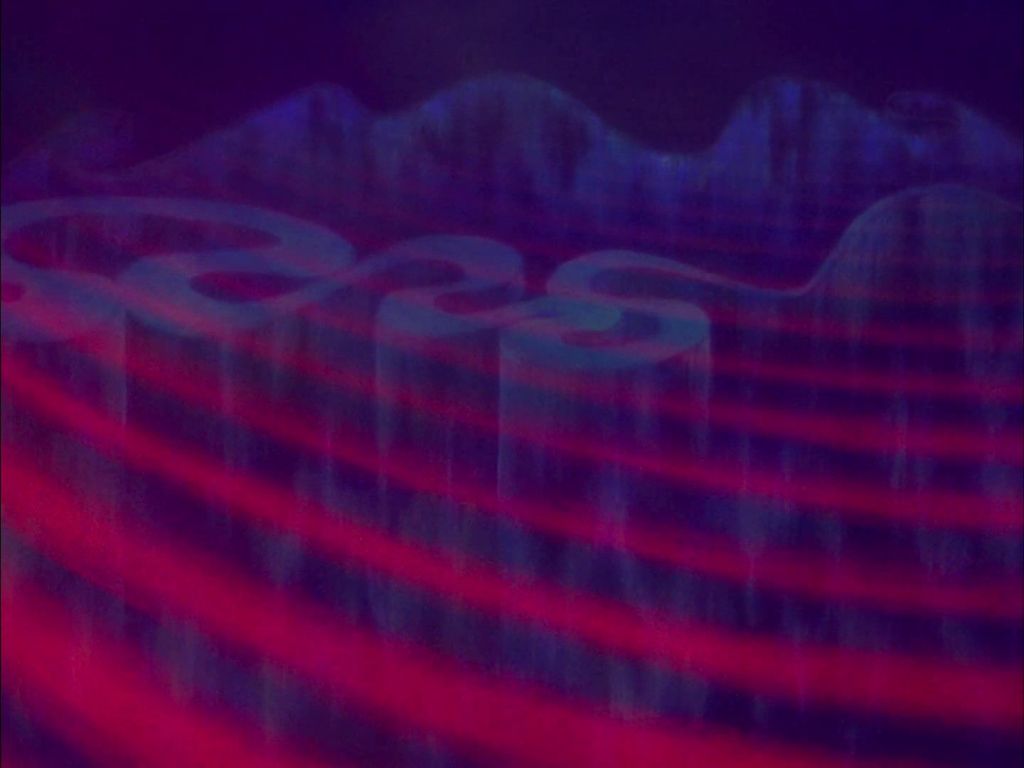
  • A lot of “Toccata” reminded me of some of the NFR’s more abstract pieces of animation, and it turns out Oscar Fischinger, the man behind “Motion Painting No. 1“, briefly worked on this segment. Fischinger quit before the segment had been animated, but you can definitely see his influence: a series of complex patterns formed by simple shapes.

The Nutcracker Suite

  • Deems Taylor mentions in his intro that “nobody performs [the “Nutcracker” ballet] nowadays”. Turns out this 1892 composition was a few years away from several productions that renewed public interest in the piece, making it a holiday staple. Whether or not “Fantasia” had anything to do with this revival is anyone’s guess.
  • The fairies in “Dance of the Sugar Plum Fairy” begin a motif in this movie I call “Full-frontal nothing”. These fairies’ human form appears to be nude, but there is no detail that warranted any censorship (though the censors made the “Pastoral” centaurettes cover up anyway).
  • My favorite part of the segments are the koi fish during the “Arabian Dance” who seemed to be startled at the sight of a camera being pointed at them.
  • And now you know where 90% of all Christmas commercial music comes from.

The Sorcerer’s Apprentice

  • In another anti-Disney move, “The Sorcerer’s Apprentice” is extremely faithful to the poem it’s adapted from – except for the mouse part.
  • As part of Disney’s attempt to revive Mickey’s popularity, the mouse was redesigned, getting pupils for the first time, as well as an overall rounder, “cuter” look.
  • Mickey brings a broom to life to help it carry water? Wouldn’t you enchant a broom to make it, ya know, sweep by itself? I guess it’s naturally doing that by walking.
  • Mickey Mouse has gone through a lot of phases in his career, but I think axe-wielding Mickey is my favorite. Speaking of, I did not realize brooms have the same regenerative properties as earthworms.
  • Everyone’s favorite piece of trivia: the sorcerer that Mickey is apprenticing for is named Yen Sid – Disney backwards. The animators even snuck in Walt’s trademark raised eyebrow.
  • Speaking of Walt, Disney lends his voice to Mickey Mouse in this segment’s tag with Leopold Stokowski. It’s one of the last times Walt voiced the mouse himself.

Rite of Spring

  • Just imagine if Disney tried to do anything today based purely on scientific evidence. Some of the more hardcore (re: Christian) Disney fans would throw a fit.
  • This segment was made long before scientists found evidence of dinosaurs evolving into birds, so Deems Taylor’s comments about some dinosaurs being “the size of a chicken” or containing “the brain of a pigeon” are a pretty outstanding coincidence.
  • I admired the animation of the fish swimming past various predators and evolving into the first creature to crawl onto land. A surprisingly beautiful moment in this movie.
  • I always forget how vicious the T-Rex battle with the stegosaurus is, and how quickly one-sided and gruesome it becomes. That being said, I can’t watch that scene – or most of this segment – without thinking of Primeval World at Disneyland.
  • In 1940, scientists had not yet adopted the now-common theory that a meteor wiped out the dinosaurs, so this segment concludes with the dinosaurs extinction from – as Taylor puts it – a “gigantic dust bowl”. “Rite of Spring” may be the biggest downer to come from Disney that doesn’t involve a parent’s death. Still, it’s better than “The Land Before Time”.
  • And on that note: Intermission! One of the many lessons this blog has taught me is that if a movie offers you an intermission, take it. Pause the film, get up, stretch, go to the bathroom, whatever you need to do. In a way, you’re simply adding to the authenticity of the film’s original theatrical experience.

We’ll take our own intermission here, and continue this deeper dive into “Fantasia” in Part 2!

The NFR Class of 2021: My Ballot

Hi-ho Readers!

It’s been a minute. Real life continues to keep me from devoting more time to this blog, but with the major hurdle of moving to a new apartment behind me, I have a moment to come up for air and post an update. My hiatus isn’t fully over yet, but the plan is to start the regular postings again before the end of the year. 

In the meantime, here’s my annual submission to the National Film Registry of 50 films I have nominated for their consideration. As always, my picks are a mixture of movies that I consider culturally significant enough for inclusion, as well as my own curation of favorites.

My Ride-or-Die Movies That I Will Always Nominate: The Miracle Worker (1962), What Ever Happened to Baby Jane? (1962), It’s a Mad, Mad, Mad, Mad World (1963), Carrie (1976), 9 to 5 (1980), Big (1988)

Personal Favorites: Babes in Toyland (1934), Witness for the Prosecution (1957), Original Cast Recording: Company (1970), Hardware Wars (1978), Victor/Victoria (1982), Clue (1985), Home Alone (1990), Mystery Science Theater 3000: The Movie (1996), Little Miss Sunshine (2006)

Pop-Culture Movies: Creature from the Black Lagoon (1954), Plan 9 from Outer Space (1959), Beach Blanket Bingo (1965), Star Trek II: The Wrath of Khan (1982), Return of the Jedi (1983), The Karate Kid (1984), Beetlejuice (1988)

Cult Movies: The Man Who Laughs (1928), Heathers (1988), The Sandlot (1993), Best in Show (2000), Hedwig and the Angry Inch (2001)

Movies By/About People of Color: Jungle Fever (1991), What’s Love Got to Do With It (1993), Monster’s Ball (2001)

Wow, I Submitted a Whole Bunch of Animation This Year: Humorous Phases of Funny Faces (1906), Alice’s Wonderland (1923), Der Fuehrer’s Face (1943), Rudolph the Red-Nosed Reindeer (1948), Gumbasia (1955), One Hundred and One Dalmatians (1961), Winnie the Pooh and the Blustery Day (1968), The Little Mermaid (1989), WALL-E (2008)

Grab Bag: The Adventures of Sherlock Holmes (1939), The Odd Couple (1968), Alice Doesn’t Live Here Anymore (1974), Fatal Attraction (1987), Boogie Nights (1997)

Because I Should Have at Least One Robin Williams Movie on the List: Good Morning, Vietnam (1987)

How Long Before the NFR Meets The MCU?: Iron Man (2008)

I Don’t Necessarily Want to Watch This Movie, But Come On, John Waters Should Be On Here Somewhere: Pink Flamingos (1972)

Let Me Be the First to Nominate These Movies from 2011: Bridesmaids (2011), Hugo (2011)

And Last But Not Least, Because Rep. Joaquin Castro Said I Had To: Selena (1997)

And there you have it: another year, another 50 movies. The NFR will make their official selection of 25 in December, and until then I can only hope one of them stumbles upon my suggestions. Keep surfing that web, NFR members!

Happy Viewing,

Tony

Gone Fishin’

Hello devoted readers,

First of all, thank you. I’ve spent the last 4 1/2 years watching almost 600 movies deemed “significant” by a panel of experts, and many of you have stuck it out with me the whole time. I’ve been fortunate to hear from a few of you (including two of the filmmakers on this list!) and I appreciate the support.

As I slowly start to figure out what “normal” looks like in these crazy times, and in the interest of upholding a certain level of quality on this blog, I have chosen to take a break from “The Horse’s Head” for the rest of the summer. Rest assured that this journey is far from over, as there are still 212 movies left to cover, and I got another 25 coming in December!

In the meanwhile, you can always reach out to me via email: thehorsesheadblog@gmail.com. Additionally, please check out my fellow NFR bloggers: I’ve covered “The Film Patrol” and “The NFR Completist” in a previous post, and since then I’ve learned about two more! “Registering the Registry” and “Merry Watches Movies” are out there and also worth a read. Obviously, none of us are close to watching every movie on the NFR, but I figure this break will be a good time for my colleagues to catch up 🙂

Thanks again for taking the time to read this, as well as everything else we’ve covered on “The Horse’s Head”. As Jerry Springer used to say, “Take care of yourself, and each other.”

Happy Viewing,

Tony

For Your NFR Consideration: Robin Williams

FYNFRC: Robin Williams

Last week would have been Robin Williams’ 70th birthday. Like many of my generation, I grew up watching and admiring the man: my childhood hearing his voice-work in “Aladdin” and “Ferngully”, my teenage years enjoying his talk show appearances and raunchy stand-up, and my adult years discovering his more serious fare such as “Good Will Hunting” and “Dead Poets Society”. From his high energy comedy to his subtle dramatic chops, and everything in between, Robin Williams left his mark on the world, and I am one of many who miss him immeasurably. 

For someone so ingrained in our popular culture, it’s amazing that Robin Williams doesn’t have a single movie on the National Film Registry. Here are a few of Robin Williams’ more significant movies that I feel would fit right in on this list of noteworthy American films:

Good Morning, Vietnam (1987): Yes, there’s “Popeye” and “The World According to Garp” if you want an early Robin appearance, but “Vietnam” is when Robin Williams went from stand-up/sitcom actor trying to be in the movies to bona-fide movie star. Playing real life Armed Forces DJ Adrian Cronauer, Williams is offered the perfect vehicle to display his rapid-fire comedy style on the big screen. Plus, an NFR designation for “Vietnam” would serve as representation for director Barry Levinson, also conspicuously absent from the list (and God help us all if “Rain Man” makes the cut)

Dead Poets Society (1989): This is where all that Julliard training comes in handy. With “Dead Poets Society”, Williams still gets to do funny voices and era-appropriate impressions (at last, an excuse for his Brando in “Julius Caesar”), but he also effectively highlights his dramatic skills as an unorthodox professor who inspires a group of prep school students, including Ethan Hawke, Robert Sean Leonard, and Josh Charles. “Dead Poets Society” still resonates with anyone who ever had a great teacher, and “carpe diem” is the only Latin most people will ever know.

Aladdin (1992): While not quite at the same level of “Beauty and the Beast” or “The Lion King“, “Aladdin” is still an undeniable classic from the Disney Renaissance of the early ’90s, and a lot of that credit goes to Robin Williams. The marriage of Williams’ energetic voice-over and Eric Goldberg’s Hirschfeld-inspired animation is truly one of the holiest matrimonies, and makes this movie a rewatchable experience for multiple generations, even if your kids don’t know who William F. Buckley was.

Mrs. Doubtfire (1993): The last of the truly great classic drag comedies, “Mrs. Doubtfire” is another great showcase for Robin Williams, this time as a divorced, unemployed voice-over actor who poses as an elderly Scottish woman and gets a job as his kids’ nanny. Williams’ improvisational energy carries over to the rest of this strong ensemble (even the usually serious Sally Field is hilarious), and “Doubtfire” is still one of the funniest, and most quotable, movies ever made. And if that weren’t enough, at its core “Doubtfire” is also a genuinely sweet movie that destigmatizes the impact divorce has on a family.

The Birdcage (1996): Like “Doubtfire”, “Birdcage” is an instantly quotable comedy classic (“Sweetie, you’re wasting your gum.”). Unlike “Doubtfire”, it takes the drag comedy to its next evolutionary step, where the drag isn’t a comic device, but rather a way of life for these characters. The film is a plea of tolerance for our LGBTQ+ community, and while Nathan Lane and Hank Azaria have the showier parts, Williams is the straight man (if you will) in the center keeping it all together. With a sharp script from Elaine May, “Birdcage” may not be the most nuanced take on homosexuality in American film, but it is an important (and hilarious) stepping stone.

Good Will Hunting (1997): You like apples? How about the movie that finally nabbed Robin Williams his Oscar, made overnight stars of Ben Affleck and Matt Damon, and gave Gus Van Zant the confidence to remake “Psycho”? How do you like them apples?

Other Robin Williams movies I would consider NFR worthy, but only after the above movies make the cut:

  • The World According to Garp (1982)
  • Awakenings (1990)
  • Hook (1991)

NFR worthy movies that Robin Williams appears in, but that I wouldn’t label a “Robin Williams Movie”:

  • To Wong Foo, Thanks for Everything! Julie Newmar (1995)**
  • A.I.: Artificial Intelligence (2001)
  • The Aristocrats (2005)

Bonus Consideration: Equally shocking, Robin Williams isn’t on the National Recording Registry either! In a list that includes stand-up recordings from Bob Newhart, Richard Pryor, George Carlin, and Steve Martin, any of Williams’ albums would feel right at home in the NRR. His 1979 debut album “Reality…What a Concept” is a natural choice, and I have a fondness for his “Live 2002” recording, but 1986’s “A Night at the Met” is the definitive Robin Williams stand-up performance.

As always, you – yes YOU – can be the change you want to see in this scenario. It is your God-given right as a human with internet access to submit movies for National Film Registry consideration (as well as the National Recording Registry). Once you’ve submitted all of Robin’s great work, check out this list of notable movies not yet on the list and see if any of your other favorite stars could use some representation. As Robin Williams once said, “God gave men a brain and a penis, and only enough blood to run one at a time.” I know that has nothing to do with any of this; I just really like that line.

** “To Wong Foo” actually predates “The Birdcage” in its appreciation of drag culture, but for our purposes here “Birdcage” works better as a Robin Williams NFR contender.

#45) Toy Story (1995)

#45) Toy Story (1995)

OR “Pixar Upper”

Directed by John Lasseter

Written by Joss Whedon and Andrew Stanton and Joel Cohen & Alec Sokolow. Story by Lasseter & Stanton & Pete Docter & Joe Ranft.

Class of 2005

This is a revised and updated version of my original “Toy Story” post, which you can read here.

The Plot: “Toy Story” is, well, a story about toys, specifically the ones who belong to Andy (voice by John Morris), and come alive when he’s not around. Led by pull-string doll Sheriff Woody (voice by Tom Hanks), the toys are anxious when Andy receives a new toy for his birthday: spaceman Buzz Lightyear (voice by Tim Allen), a somewhat delusional action-figure who quickly surpasses Woody as Andy’s favorite. Woody’s jealousy causes him and Buzz to become stranded in the outside world, falling into the hands of Andy’s sadistic neighbor Sid (voice by Erik von Detten). Together, Woody and Buzz must set aside their differences, return home to Andy, and finally answer the question “What if toys had feelings?”

Why It Matters: The NFR gives “Toy Story” its credit as the first full-length computer animated feature, and that it “changed animation’s face and delivery system”.

But Does It Really?: I always forget just how great a movie “Toy Story” is. There’s a certain high-level of quality that we’ve become accustomed to with Pixar, but it all started here, with a creative story that tapped into our collective imagination, aided by a clever script, some outstanding performances (both vocal and animated), and some major breakthroughs in computer technology. Not since “Snow White” has one animated film been such a big game changer, and “Toy Story” hits all of the NFR’s requirements for its cultural, historical, and aesthetic significance.

Everybody Gets One: Among those making their only NFR appearance are Pixar mainstays Pete Docter and Andrew Stanton, screenwriter Joss Whedon (yes, that Joss Whedon), actors Tim Allen, Don Rickles, Jim Varney, Laurie Metcalf and Penn Jillette, and – most surprisingly – composer Randy Newman.

Shout Outs: References and allusions to fellow NFR movies “The Wizard of Oz“, “Night of the Living Dead“, “The Exorcist“, “Star Wars“, “Alien“, “The Shining“, “Raiders of the Lost Ark“, “The Lion King“, and fellow Pixar films “Luxo Jr.” and “Tin Toy“.

Wow, That’s Dated: Mostly the early CGI look of the mid-90s, and the plug for the film’s CD-ROM tie-in during the end credits. Also: themed restaurants, remember those?

Seriously, Oscars?: The highest-grossing film of 1995 at the US box office, “Toy Story” received three Oscar nominations: Best Original Song, Original Musical or Comedy Score, and Original Screenplay (the first animated film to receive a writing nomination). While it lost all three awards (two to Disney’s “Pocahontas”), John Lasseter received a Special Achievement Oscar for “the development and inspired application of techniques” that created “Toy Story”.

Other notes

  • The success of Lasseter’s short “Tin Toy” caught the attention of Disney, whom Lasseter had worked for a decade earlier. Through a series of tense negotiations between the two companies (exacerbated by Disney Studios chairman Jeffrey Katzenberg’s self-confessed “tyrant” behavior), an agreement was made for Disney to distribute a film made by Pixar. With computer technology finally reaching a point in the ’90s where a feature length film was feasible, a proposed “Tin Toy” TV special morphed into what became “Toy Story”. While Katzenberg was the one who suggested the film be an odd-couple buddy picture, he also pushed for edgier humor, and for Woody to be more mean-spirited. This culminated in a disastrous November 1993 screening dubbed the “Black Friday Incident” by those in attendance. Production was shut down, and the next three months were spent extensively re-working the movie more to Lasseter’s original version. Pixar’s then-owner Steve Jobs (yes, that Steve Jobs) funded production with his own money during the shutdown.
  • For starters, “Toy Story” succeeds on sheer premise alone. Stories of toys coming to life are nothing new (even Hans Christian Andersen wrote about them), but “Toy Story” brings it into a modern setting. There’s no “Once Upon a Time” or magic spell; it’s 1995 and toys are alive, let’s go. 
  • If Randy Newman’s songs seem out of place, that’s because they stemmed from a compromise Pixar made with Disney. Disney wanted the film to be a full-blown musical (they were in the midst of the Disney Renaissance after all), but Pixar felt that it would feel out of place for these characters to sing. An agreement was reached in which Randy Newman would compose and perform songs that would comment on the action, a la Simon & Garfunkel in “The Graduate“. Apparently Newman wrote the film’s most iconic song “You’ve Got a Friend in Me” in one day.
  • Yeah, you can definitely see the Katzenberg influence on this movie. With its share of wordplay and adult innuendo (most of it involving Annie Potts’ Bo Peep), “Toy Story” acts as a presage to the kind of animation Dreamworks would be cranking out in a few years time.
  • All of the supporting roles are cast with performers whose typecasting is played to the movie’s advantage: Wallace Shawn as a neurotic, R. Lee Ermey as a drill sergeant, Jim Varney as a well-meaning redneck, John Ratzenberger as a vaguely-Bostonian know it all, Don Rickles as…Don Rickles (I barely get the hockey puck reference).
  • It’s funny how many little references in this movie that were put in for world building now read as foreshadowing to the sequels: Mrs. Potato Head, Al’s Toy Barn, and Combat Carl come to mind.
  • “Toy Story” also succeeds in its presentation of scope. There’s plenty of POV shots and wide angles to suggest that the toys’ world is far larger than just a kid’s bedroom.
  • Wow, Woody really is a jerk in this movie. You’re lucky Tom Hanks is so charming, smoothing out the character’s envy to make him more the Salieri to Buzz’s Mozart.
  • We have a Wilhelm! “Toy Story” is one of at least eight films on the NFR to feature the famous Wilhelm Scream.
  • It’s so odd trying to watch this movie as its own entity, and not part of a larger franchise. Even the aliens in the claw machine are iconic! 
  • I’ve known my share of kids who were similar to Sid, and while they’re not as goody-two shoes as Andy, they’re more fun to hang out with.
  • Tim Allen as Buzz Lightyer drunk on Darjeeling is possibly my favorite moment in the movie: “You see the hat? I am Mrs….Nesbitt!”
  • It’s so interesting to watch a Pixar movie that hasn’t quite fallen into the tropes. There’s no big ugly cry moment, though Woody’s impassioned “You are his toy” monologue comes close, as does the cathartic climax of our two leads flying.
  • Honestly, I didn’t take a lot of notes towards the end, mainly because I was just enjoying the movie. The screenplay is so well constructed. The stakes are always clearly conveyed (typically through inventive visuals), and once we hit the third act it starts rainin’ payoffs!
  • Thanks to his duet with Randy Newman in the closing credits, this counts as an NFR appearance for Lyle Lovett. Also noteworthy in the credits: Pixar’s tradition of listing “Production Babies”, who are now all Gen Z-ers in their mid-20s.

Legacy

  • “Toy Story” exceeded all expectations, becoming a runaway hit with audiences and critics, and plans for a sequel began immediately. Like many Disney sequels at the time, “Toy Story 2” was going to be released direct-to-video, but early story reels (as well as the return of the original cast) indicated that this should be a theatrical release. The result is one of the rare sequels arguably better than the original.
  • Like every Disney product (then and now), “Toy Story” was placed in the Mouse House’s perpetual synergy machine, with tons of merchandise and promotional tie-ins upon its release. In the ensuing quarter century, the “Toy Story” characters have continued to appear in a countless array of theatrical shorts, TV specials, theme park attractions, video games, and other media. The phrase “To infinity and beyond!” has also endured as a catchphrase and popular movie quote.
  • The contentious relationship between Pixar and Disney (specifically Steve Jobs and Disney CEO Michael Eisner) continued until the mid-2000s, when Pixar announced that it would no longer distribute its films through Disney. When Eisner stepped down and Bob Iger became Disney’s President and CEO, one of Iger’s first tasks was to patch things up with Jobs, culminating in Disney’s purchase of Pixar in 2006. These business deals delayed “Toy Story 3” for several years, with Disney’s original version being scrapped entirely.
  • 2010’s “Toy Story 3” and 2019’s “Toy Story 4” both did the impossible and were sequels worthy of their successors. And I’m willing to admit that both of them made me ugly cry upon my first viewing.
  • Pixar is still thriving today (albeit without John Lasseter after some sexual misconduct allegations in 2017), cranking out plenty of high-quality animated movies that continue in the “Toy Story” vein of good characters, strong writing, and making you feel all the feels.
  • No need for a remake, because in 2012, Jonason Pauley and Jesse Perrotta made a shot-for-shot fan recreation of “Toy Story” using real toys. An impressive feat two years in the making!
  • And thank god, in 2022 we will receive a Buzz Lightyear movie, specifically the Buzz Lightyear movie in the “Toy Story” universe that the action figure was created for. Hollywood has officially run out of ideas.