#522) The Cry of the Children (1912)

#522) The Cry of the Children (1912)

OR “Kid Row”

Directed by George O. Nichols

Based on the poem by Elizabeth Barrett Browning

Class of 2011 

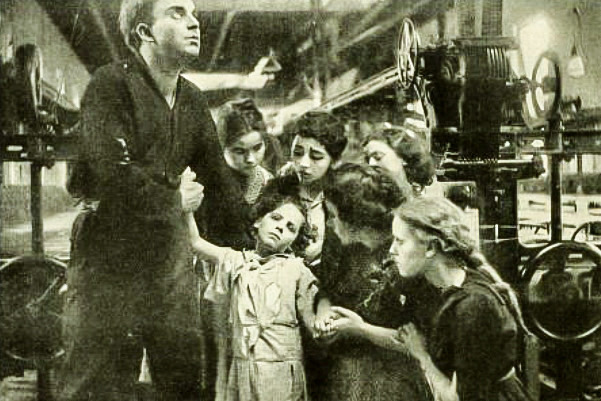
The Plot: With Elizabeth Barrett Browning’s poem as inspiration, “The Cry of the Children” centers on hazardous child labor, a major issue of the 1910s. A poor family all work at the same textile factory, except for youngest daughter Alice (Marie Eline), spared by her parents (Ethel Wright & James Cruze) to protect her. When the factory owner’s wife (Lila Chester) sees Alice, she wishes to adopt the little girl, but her offer is rejected. Shortly thereafter, wages at the factory are reduced and the workers go on strike. When the family’s money runs out, Alice is forced to work in the factory. It’s a cautionary tale about the perilous ramifications of child labor, because apparently that’s a thing we had to debate over?

Why It Matters: The NFR gives the film its historical context, and praises the film’s “fatalistic, uncompromising tone of hopelessness”. Once again, Edwin Thanhouser’s grandson Ned is on hand with an essay detailing this film and his family legacy.

But Does It Really?: We have arrived at another NFR impasse: two entries that more or less cover the same ground. Both “The Cry of the Children” and “The Evidence of the Film” are here to represent the popular yet short-lived Thanhouser film studio. “Children” is on here as a dramatization of a major issue of the day, whereas “Evidence” is more a lost-and-found silent movie that I deemed “unmemorable” in a previous write-up. If forced to choose, I’d pick “Children” over “Evidence” as the NFR’s Thanhouser entry, and that’s more than enough.

Wow, That’s Dated: Like many films of the early 1910s, “The Cry of the Children” tackles an important social issue of the day. The film was released in April 1912, one year after the Triangle Shirtwaist Factory fire that brought national attention to sweatshop working conditions, as well as two months after a textile worker strike in Lawrence, Massachusetts very similar to the one in this film. Child labor was also a topic of discussion in the 1912 presidential election, and Theodore Roosevelt’s stance against it was widely quoted in advertisements for this film. For the record, Roosevelt lost his re-election bid to Woodrow Wilson, who felt child labor was a state issue the federal government should not meddle in.

Other notes 

  • I covered the rise and fall of Thanhouser in my “Evidence of the Film” post. Long story short, Thanhouser had an 11 year run with several hits, but a massive fire and company mismanagement led to its liquidation.
  • The saddest part about the Elizabeth Barrett Browning poem is that it was written 70 years before this movie came out. That’s how long child labor has been a topic of debate in this country. Not that working conditions are perfect now, but yikes.
  • Perhaps the worst case for this movie’s legacy: Even while researching this movie I can’t remember its name. At various points I’ve mistakenly Googled “A Cry for the Children”, “Where Are My Children” and “Won’t Somebody Please Think of the Children!?
  • To add to the movie’s realism, the factory scenes were filmed in a real factory. Par for the course today, but seeing actual factory labor on film was an eye-opener in 1912.
  • As Alice, Marie Eline is really hamming it up, but she’s so cute! I see why she was dubbed “The Thanhouser Kid”.
  • So back in the 1910s, rich people could just walk up to any family and offer to adopt their child? Is this a “Citizen Kane” scenario?
  • A labor strike over wages and working conditions? Quick, someone call Barbara Kopple!
  • “It is good when it happens, say the children, that we die before our time.” WHAT!?
  • Thank god this is melodrama, otherwise this movie would be thoroughly depressing.
  • Hey, you can’t have a flashback in a short! We just saw this!

Legacy 

  • Numerous bills and congressional acts were proposed throughout the 1910s and 1920s to combat child labor, but were typically shot down by the mostly Republican Supreme Court. A potential amendment in 1924 was approved by Congress, but didn’t get past the state legislatures, and is still pending almost 100 years later. Today, while there are significantly more laws regarding child labor, it is still considered – you guessed it – a state issue the federal government shouldn’t meddle in.
  • As for “The Cry of the Children”, critics loved it upon release, but it was somewhat eclipsed by “Children Who Labor”, an Edison film that covered the same subject matter and source material. Wow, Edison really does not come across looking good in movie history. Or history in general for that matter.
  • Like “Evidence of the Film”, “Cry of the Children” is one of the few surviving films from the Thanhouser Studio, and lacks any major influence on modern film beyond its “historical significance”.

#521) The Exorcist (1973)

#521) The Exorcist (1973)

OR “The Regan Doctrine”

Directed by William Friedkin

Written by William Peter Blatty. Based on his novel.

Class of 2010

This post is based on my viewing of the Theatrical Cut. To this day I have never seen “The Version You’ve Never Seen”.

The Plot: While filming a movie in Georgetown, actress Chris MacNeil (Ellen Burstyn) notices that her 12-year-old daughter Regan (Linda Blair) has started acting strangely. Regan’s behavior becomes more violent and verbally abusive, but medical evaluations show nothing wrong with her. When one of the doctors casually mentions exorcism as an option, Chris consults Father Damien Karras (Jason Miller), a psychiatrist dealing with his own crisis of faith. Convinced that Regan has been possessed by an unholy spirit, Karras calls on the expertise of Father Lankester Merrin (Max von Sydow), who performed the last church sanctioned exorcism 25 years earlier. These two have a devil of a time in a movie that will scare the hell out of you and make your head spin. There, I got all the bad puns out of the way early.

Why It Matters: The NFR calls it “one of the most successful and influential horror films of all time” and singles out the film’s Oscar wins and cultural impact.

But Does It Really?: I had never seen “The Exorcist” until this viewing, and I’m happy to report it lives up to its notoriety. There’s plenty of terrifying moments and disturbing imagery, but Friedkin never forgets to keep the characters and their development front and center. Devoid of your standard horror movie tropes and clichés, “The Exorcist” still feels fresh almost 50 years later, and continues to make a massive impact on horror films and pop culture. How “The Exorcist” took 20 years to make the NFR is anyone’s guess.

Everybody Gets One: William Peter Blatty started writing while still working his day job in USC’s PR department, but was able to quit after winning $10,000 (about $87,000 today) on “You Bet Your Life“. After a series of successful novels (as well as a few screenplays), Blatty wrote “The Exorcist”, based on a real-life exorcism he had heard about while still a student at Georgetown. The novel was a hit, and Blatty successfully lobbied to write and produce the inevitable film version. This is also the only NFR appearance for actors Linda Blair, Jason Miller and, most surprisingly, Max von Sydow.

Seriously, Oscars?: “The Exorcist” was the biggest hit of 1973, and received the most Oscar nominations of the year (10), tied with its box office rival “The Sting“. “The Sting” took home Best Picture, but “Exorcist” prevailed with wins for Adapted Screenplay and Sound.

Other notes 

  • After the likes of Arthur Penn and Mike Nichols turned down the chance to direct, Warner Bros. hired Mark Rydell to helm “The Exorcist”. William Peter Blatty, however, preferred William Friedkin, wanting the film to have the same frenetic energy as “The French Connection“. Blatty eventually won out.
  • This whole post could be about the film’s troubled production. Long story short: it was not pleasant for anyone. An on-set fire caused film delays, two actors died during production, and Ellen Burstyn and Linda Blair were permanently injured during the shoot (Burstyn’s accident and reaction are in the final film!).
  • I am a self-professed scaredy-cat, and put off viewing “The Exorcist” for as long as I could. Turns out that because “The Exorcist” was made in the ’70s, it takes its sweet time getting started. Nothing remotely scary happens for the first 45 minutes, just a whole lot of character establishment and atmosphere. If nothing else, this helped ease me into the really scary stuff.
  • Fresh off her turn in “The Last Picture Show“, Ellen Burstyn got cast as Chris when Audrey Hepburn, Anne Bancroft, and Jane Fonda all turned it down. Burstyn lobbied hard for the part, and she does not disappoint. Like the rest of the cast, Burstyn plays it very real. You are always aware of the pain this woman feels watching her own child turn evil.
  • Stacy Keach was all set to play Father Karras, but a chance meeting with playwright Jason Miller led to Friedkin buying out Keach’s contract and casting Miller. It’s a remarkably good performance from a first time actor.
  • Shoutout to editors Norman Gay and Evan Lottman. There’s an inherent rhythm to their cutting. As soon as something unexpected happens in a scene, we cut to the next one with no time to breathe. It helps keep the audience off-balance and alert during the proceedings.
  • As always, Dick Smith’s makeup job on this film hits it out of the park. The gradual change to Regan’s possessed appearance is always singled out, but don’t forget that he turned 44 year old Max von Sydow into the 70 year old Father Merrin. How did the Oscars not have a makeup category in 1973?
  • I was prepared for the quote-unquote scary parts of this movie, but no one warned me about the realistic angiography scene. I can do makeup and practical effects all day, but watching a full-on medical procedure with lots of blood being drawn is too much. Side note: the x-ray technician is future convicted murderer Paul Bateson, who was released on parole in 2003, and whose current whereabouts remain unknown. Good night.
  • Those bed shaking scenes are intense; I sure hope child labor laws were a thing back then.
  • The film’s only lightness comes with Lee J. Cobb as Lt. William Kinderman in one of his final film appearances. Cobb lends a nice air of old school charm to the proceedings. I also like that Kinderman is a movie buff. Nice touch.
  • The further and darker this movie gets, the more I understand its reputation. Some of Regan’s more graphic scenes are still intense by today’s standards. I completely understand reports at the time of moviegoers fainting and vomiting during screenings.
  • Shout out to Mercedes McCambridge, the voice of the demon Pazuzu as it takes over Regan’s body. A versatile radio actor, McCambridge spent hours in a recording session drinking whisky and eating raw eggs to get the right demonic sound to her voice. Initially uncredited, McCambridge sued to receive an on-screen credit, which may have cost Linda Blair an Oscar. As a bonus, it’s fun to hear Oscar winner McCambridge say things like “Your mother sucks c**** in hell!”
  • After disappearing for the bulk of the movie, Max von Sydow makes a good closer as “the old priest”. Side note: Kerrin’s arrival (which doubles as the film’s poster) was inspired by René Magritte’s “Empire of Light” paintings.
  • Perhaps the most iconic moment in the movie was a misinterpretation. In the novel, Regan’s head is described as turning “almost” all the way around. According to Blatty, Friedkin misread this and had the dummy of Regan’s head rigged to rotate a full 360 degrees.
  • “The Exorcist” is essentially the Upside Down version of “Miracle on 34th Street“: both are about a family’s faith (or lack thereof) being tested under extraordinary circumstances. In a similar vein, how come “The Exorcist” is never mentioned among great Catholic movies like “Going My Way” or “Rudy”? It is ultimately a positive (albeit unorthodox) portrayal of the church.

Legacy 

  • “The Exorcist” was the runaway hit of the year, and talks of a sequel began immediately. Friedkin, Blatty, and Burstyn all immediately declined to participate, while Blair and von Sydow had to be coaxed into appearing. The result – 1977’s “Exorcist II: The Heretic” – started the real “Exorcist curse” of bad sequels.
  • In 1983, Blatty wrote his official sequel “Legion”, which would eventually be adapted to film as “The Exorcist III”, with George C. Scott filling in for the late Lee J. Cobb, and Jason Miller reprising his role of Father Karras (who I guess didn’t die at the end?).
  • Stay with me on this one: “The Exorcist” has two prequels from the early 2000s that are technically the same movie about Father Merrin’s first exorcism in the 1940s. Paul Schrader directed “Exorcist: The Beginning”, but the studio shelved the film for fear it wouldn’t be successful. Schrader was replaced with Renny Harlin, and a majority of the film was re-written and re-shot. After “Beginning” flopped, Warner Bros. gave Schrader a small budget to finish and release his version. Now retitled “Dominion: Prequel to the Exorcist”, Schrader’s film was released nine months after “Beginning”, and was an even bigger flop.
  • The most recent mainstream continuation of the “Exorcist” story was a television series that lasted two seasons on Fox, with Geena Davis as a grown-up Regan dealing with the possession of her daughter.
  • As for the original film, practically every moment of “The Exorcist” has been referenced or parodied in pop culture; head-spinning, pea-soup vomiting, Mike Oldfield’s “Tubular Bells”. Special mention to Linda Blair’s self-parody in 1990’s “Repossessed” with Leslie Nielsen.
  • “The Exorcist” is also responsible for pretty much every supernatural horror movie of the ’70s, “The Omen” and “The Amityville Horror” immediately come to mind.
  • And finally, the “Exorcist steps” in Georgetown are a popular tourist spot, and were named an official D.C. landmark in 2015. But it’s nowhere near the scariest thing in Washington at any given time.

#520) The Incredible Shrinking Man (1957)

#520) The Incredible Shrinking Man (1957)

OR “Let’s Get Small”

Directed by Jack Arnold

Written by Richard Matheson and Richard Alan Simmons. Based on the novel “The Shrinking Man” by Matheson.

Class of 2009 

The Plot: While on vacation, Scott Carey (Grant Williams) encounters a mysterious mist on the ocean. Six months later, Scott notices his clothes all seem too big on him. After a few medical examinations, it is determined that this mist, mixed with a pesticide exposure, is causing Scott to shrink at an inhuman rate. Initially supported by his wife Louise (Randy Stuart), Scott becomes more isolated and miserable as he continues to shrink with no clear remedy. After an altercation with his cat, the now three-inch tall Scott ends up trapped in the cellar, fighting such adversaries as a spider, while Louise assumes that he has been killed. Will Scott go on shrinking into the infinite universe of inner space?

Why It Matters: The NFR praises the film’s “intelligent script and imaginative special effects”, as well as Jack Arnold’s “sparse” direction. There’s also an informative essay by film Professor Barry Keith Grant.

But Does It Really?: Oh sure. “The Incredible Shrinking Man” is not the first ’50s sci-fi film that comes to mind, but the shrinking/growing subgenre definitely got a boost from this movie, even if people don’t know they’re referencing this film directly. “Shrinking Man” continues to hold up thanks to a good script, committed performances, and some genuinely impressive special effects. A pass for “The Incredible Shrinking Man” and its NFR standing.

Everybody Gets One: Director Jack Arnold had helmed a successful run of sci-fi films before “The Incredible Shrinking Man”, including “It Came from Outer Space” and “Creature from the Black Lagoon”. When sci-fi started going out of fashion, Arnold pivoted to other genres, including the Peter Sellers comedy “The Mouse That Roared”. Arnold was also an Oscar nominee for his 1950 documentary “With These Hands” about the International Ladies Garment Workers Union.

Wow, That’s Dated: Besides the typical ’50s suburban elements (the Careys have a milkman), the main dated aspect is a doozy. At one point when Scott is about three feet tall, he befriends Clarice, a little person traveling with the circus. She is referred to as a “midget” and is played by April Kent, a woman who is clearly not a little person. It’s brief, but nevertheless cringe-worthy. My note for this scene was “Oh Christ”.

Seriously, Oscars?: While “The Incredible Shrinking Man” received no Oscar nominations, it did win the very first Hugo Award for Best Dramatic Presentation.

Other notes 

  • Richard Matheson got the idea for “The Shrinking Man” when watching the 1953 comedy “Let’s Do It Again” (a remake of “The Awful Truth“). In one scene, Ray Milland puts on the wrong hat and it sinks down to his ears. Matheson wondered what would happen if Milland had actually shrunk, and inspiration struck. Matheson was able to sell the film rights to Universal prior to the novel’s publication, on the condition that he also write the screenplay. After submitting his screenplay, Universal added the word “Incredible” to the title, and hired Richard Alan Simmons to do re-writes, as well as a major restructuring (the novel was told in flashbacks). Matheson believed that these changes weakened the final film.
  • Wait, this movie is actually good. Grant Williams and Randy Stuart didn’t have much of a career outside of “Incredible Shrinking Man”, but they make a convincing married couple with some obvious chemistry, aided by some smart dialogue from Matheson’s script that treats them as equal partners. Anyone expecting your typical ’50s sci-fi nonsense will be pleasantly surprised.
  • What the hell is in that mist? Glitter? Asbestos?
  • The first doctor Scott goes to is played by William Schallert, aka Poppo from “The Patty Duke Show“. This is one of at least five NFR movies Schallert appears in!
  • Once Scott starts shrinking, you can fully appreciate the film’s special effects. There’s a little bit of everything: forced perspective, optical process shots, scale models, and a special shoutout to Universal’s Giant Props department. It’s rudimentary by today’s standards, but still works. For the record, the 1957 Visual Effects Oscar went to the WWII U-Boat drama “The Enemy Below“. Come on!
  • The nice thing about this movie is that everyone takes it seriously. No winking at the camera or corny “small” jokes (you leave those to me). Like any good sci-fi, everyone plays the situation as if it could really happen.
  • The highlight of the movie is when Scott, now only a few inches tall, is attacked by the family cat. It’s an impressive mix of special effects and still gets the pulse racing over 60 years later. Fun Fact: Butch the cat is played by Orangey, a few years away from his iconic work as “Cat” in “Breakfast at Tiffany’s“.
  • Once Scott ends up in the cellar, the second half becomes what I call the “Cast Away” part of the movie: A man stranded in isolation, fending for himself against the elements, making fire, with a wife who assumes he’s dead. It’s no wonder the first choice for Scott was Dan O’Herlihy, who had received an Oscar nod a few years earlier for playing Robinson Crusoe.
  • Movie fans and arachnid lovers alike are quick to point out that the “spider” that Scott fights in the cellar is clearly a tarantula. Turns out tarantulas are much easier to coordinate than spiders, so the substitution was made without changing the script. Besides the obvious physical differences, tarantulas don’t make webs.
  • I don’t care how big that spider is, you set it free outside instead of killing it.
  • [Spoilers] Despite concerns from studio executives and preview audiences, Richard Matheson and Jack Arnold successfully lobbied to keep the original ending, in which Scott does not return to his original size or reunite with his wife. Instead our hero accepts his fate and…finds religion? “To God, there is no zero. I still exist.” What a weird ending.

Legacy 

  • “The Incredible Shrinking Man” paved the way for a whole slew of size-changing science fiction adventures in film, including “The Amazing Colossal Man”, “Honey, I Shrunk the Kids”, and “Little Women”.
  • There have been a few proposed remakes over the years (Eddie Murphy was attached to one in the early 2000s), but so far the only official remake was the Lily Tomlin comedy “The Incredible Shrinking Woman”.
  • Among Richard Matheson’s other writing projects are fellow NFR entry “The House of Usher“, the “Twilight Zone” episode “Nightmare at 20,000 Feet”, and the novel “I Am Legend” which spawned the Will Smith movie as well as Charlton Heston’s “The Omega Man”.
  • At the time of his death in 2013, Richard Matheson was working on a new updated adaptation of “The Shrinking Man” with his son Richard Christian Matheson.

#519) Free Radicals (1958/1979)

#519) Free Radicals (1958/1979)

OR “Len’s Lens”

Directed by Len Lye

Class of 2008

The Plot: Set to percussive music from the Bagirmi tribe of central Africa, “Free Radicals” is an experimental piece of animation consisting of scratches on the film creating “figures in motion”. 

Why It Matters: The NFR gives a rundown of Len Lye and this film, but no superlatives or reasoning behind its NFR inclusion. Come on, NFR, back up your picks!

But Does It Really?: “Free Radicals” hits my trifecta for NFR experimental entries: It’s engaging, it’s representative of an important artist (Len Lye), and above all, it’s short. An easy viewing experience and worthy of its NFR status.

Everybody Gets One: Born in New Zealand, Len Lye was a bit of a renaissance man. In addition to being a kinetic sculptor, photographer and poet, Len’s primary medium was direct film: animation that is drawn directly onto the film stock. For “Free Radicals”, Lye used “various kinds of needles” to create the film scratches, as well as “arrowheads for romanticism”. Despite much of his early work being made in New Zealand (and later England), Len Lye moved to America in 1944, becoming a naturalized citizen six years later.

Seriously, Oscars?: No Oscar attention for any of Len Lye’s films. For the record, 1958’s Best Animated Short winner was “Knighty Knight Bugs“, the first (and so far only) Bugs Bunny cartoon to win this award.

As always, it’s futile of me to try and overanalyze the images in this film, so it’s time for another round of Things I Thought I Saw During “Free Radicals”:

  • A seismograph reading
  • The opening of “The Outer Limits
  • Mt. Fuji. Oops, wrong movie.
  • My stocks? Sell! Sell!
  • The Line from “The Dot and the Line
  • Someone’s heart rate. We’re losing him, Doctor!
  • A bendy straw
  • My signature
  • The Phoenician alphabet
  • A couple of real film scratches posing as art. Nice try, general film wear.
  • An asterisk. Does this movie have footnotes?
  • The poster for the original Off-Broadway production of “Assassins“.
  • One of those Chinese characters that Americans get tattooed on their lower back without knowing what it means.
  • A credit for the New Zealand Film Commission? Excuse me?

Legacy

  • “Free Radicals” was completed in 1958, but Len Lye revisited the film in 1979, shortening the runtime from five minutes to four. This was one of Lye’s last projects, as he died in 1980 at the age of 78.
  • Most of Len Lye’s filmography has been preserved by the New Zealand Film Archive, and you can learn more about the man himself at The Len Lye Foundation’s website

#518) The Naked City (1948)

#518) The Naked City (1948)

OR “True-ish Detective”

Directed by Jules Dassin

Written by Albert Maltz and Malvin Wald

Class of 2007

The Plot: With a reminder of the eight million stories that take place every day in New York City, we zero in on one of them: the murder of model Jean Dexter, and the detectives (Barry Fitzgerald & Don Taylor) who take the case. Over the course of the next few days, the mystery begins to unravel as more clues are revealed, lies are exposed, and the innocent appear more guilty. But all of this serves as the backdrop for the movie’s real star: New York City itself; not a recreation on a Hollywood soundstage, but the real streets with real people.

Why It Matters: The NFR calls the film a “cutting-edge, gritty crime procedural [that] introduced a new style of film-making”. The film’s unique production is highlighted, along with its Oscar wins and “heart-pounding resolution”.

But Does It Really?: Oh sure. “Naked City” is not the first on anyone’s list of essential films, but it does stand out thanks to its on-location production and unique approach to the crime genre which, while on-par with any procedural TV show of the last 70 years, was revolutionary in its day. Producer Mark Hellinger, director Jules Dassin, and cinematographer William Daniels all help create a movie that, while a bit dated now, still has a vibrancy that warrants a viewing, and eventual NFR inclusion.

Everybody Gets One: Jules Dassin started off as an actor, before becoming an assistant director at RKO and eventually a director at Universal. Dassin’s Hollywood career was cut short because of the Blacklist (he was briefly a member of the Communist party), but a move to Europe led to his best known films, including “Rififi” and “Never on Sunday“.

Wow, That’s Dated: Pretty much everything about the crime and its solving would have to get a major overhaul for a modern remake, but the big question is: could “The Naked City” be remade at all? With modern America deeply divided on how exactly the police should protect and serve, the time for a movie in which the cops are the undisputed good guys cracking down on clear-cut criminals is definitively over.

Title Track: Originally titled “Homicide”, “The Naked City” gets its title from the 1945 photography book of the same name by Arthur Fellig, better known as “Weegee”. Although the movie was connected to the book in name only, Weegee was hired to serve as the film’s visual consultant, as his stark photos of New York’s seedier side were exactly what Dassin and Hellinger were trying to convey. Fun Fact: Weegee later served as still photographer on “Dr. Strangelove“, and Peter Sellers based the voice of the titular character somewhat on Weegee’s unique Austrian-by-way-of-Lower East Side accent.

Seriously, Oscars?:  A surprise hit for Universal, “The Naked City” received three Oscar nominations, and won two of them: Black-and-White Cinematography for William Daniels and Editing for Paul Weatherwax. The film’s original story by Malvin Wald was also nominated, losing to Fred Zinnemann’s “The Search”.

Other notes 

  • Despite the title, this movie contains zero nudity.
  • Right from the start, this movie told me how it got on the NFR. In lieu of traditional opening credits, “The Naked City” begins with the narrator (producer Mark Hellinger) announcing that the film you are about to see was filmed on the real streets of New York, and everyone besides the principles are real people. From frame one the real star of this movie is the groundbreaking Neorealism portrayal of the Big Apple.
  • “The Naked City” was filmed in New York during the summer of 1947. To efficiently film on-location, William Daniels and his camera were hidden in the back of an indiscreet moving van. Allegedly Jules Dassin also hired a juggler to distract pedestrians from the shoot.
  • Shoutout to the anonymous blonde woman playing the corpse of Jean Dexter, aka “the vic”.
  • Ah Barry Fitzgerald, Classic Hollywood’s greatest Irish stereotype. Side Note: In keeping with his leprechaun demeanor, Fitzgerald was 5’3″, with all of his co-stars towering over him and making two-shots nearly impossible.
  • A fun example of how our lexicon evolves over time: at two different points in the movie a woman is described as “handsome”.
  • This film would obviously make a good double-feature with Mark Hellinger’s other NFR crime drama “The Killers“, but it would also pair well with Fritz Lang’s “The Big Heat“. Both films deal with the dichotomy of a police detective’s brutal career and their angelic home life in the new suburbia of the late ’40s/early ’50s.
  • As impressive as the on-location shooting is, 1948 Hollywood still hadn’t mastered effective audio recording. Most of the dialogue in this movie is either dubbed in post, or not being picked up clearly by the boom mikes.
  • In order to preserve the reality of the film, a majority of the cast were stage and radio actors in their film debut. None of them went on to become big stars (like their director, a number of them were blacklisted), but among the new faces are Paul Ford (later of “Sgt. Bilko”) and Kathleen Freeman (later of “And I cahn’t stahnd him“).
  • Mark Hellinger is not a very helpful narrator. He’s constantly commenting on the case’s dead ends, and is of no help when one of the criminals tries to escape. This is why narrators shouldn’t get involved in their stories.
  • As for that finale on the Williamsburg bridge: effective and satisfying, sure, but one of the greatest in film history? I don’t think so.
  • While the narrator’s closing line “There are eight million stories in the naked city. This has been one of them.” has definitely been quoted over the years, I suspect most people don’t know what it’s from, even though if you quote it correctly you say the title.

Legacy 

  • Sadly, producer Mark Hellinger died of a heart attack three months before the film’s release, shortly after watching the final cut. A veteran theater critic back in New York, Broadway’s Hollywood Theatre was renamed the Mark Hellinger Theatre in his honor. The theater closed in 1989, and is now the site of the Times Square Church.
  • The main legacy of “The Naked City” is the TV show of the same name (well, minus the “The”). Originally a direct follow-up to the movie, “Naked City” was cancelled after one season, but the producers and sponsors convinced ABC to revive the show. The revamped hour-long version ran for three additional seasons. Every episode ended with the film’s final line, and I’ll argue that more people know it from the TV show than from the movie.
  • Here’s a weird one: “The Naked City” is the name of a standalone mission in the 2011 video game “L.A. Noire”, and is beat-for-beat the plot of this movie, but set in 1940s Los Angeles. So…that’s something.
  • There are almost 800 movies in the National Film Registry. This has been one of them.