#474) Pinocchio (1940)

#474) Pinocchio (1940)

OR “Wood I Lie To You?”

Directed by Hamilton Luske and Ben Sharpsteen

Written by Ted Sears, Otto Englander, Webb Smith, William Cottrell, Joseph Sabo, Erdman Penner, and Aurelius Battaglia. Based on the story by Carlo Collodi. Songs by Leigh Harline, Paul J. Smith, and Ned Washington.

Class of 1994

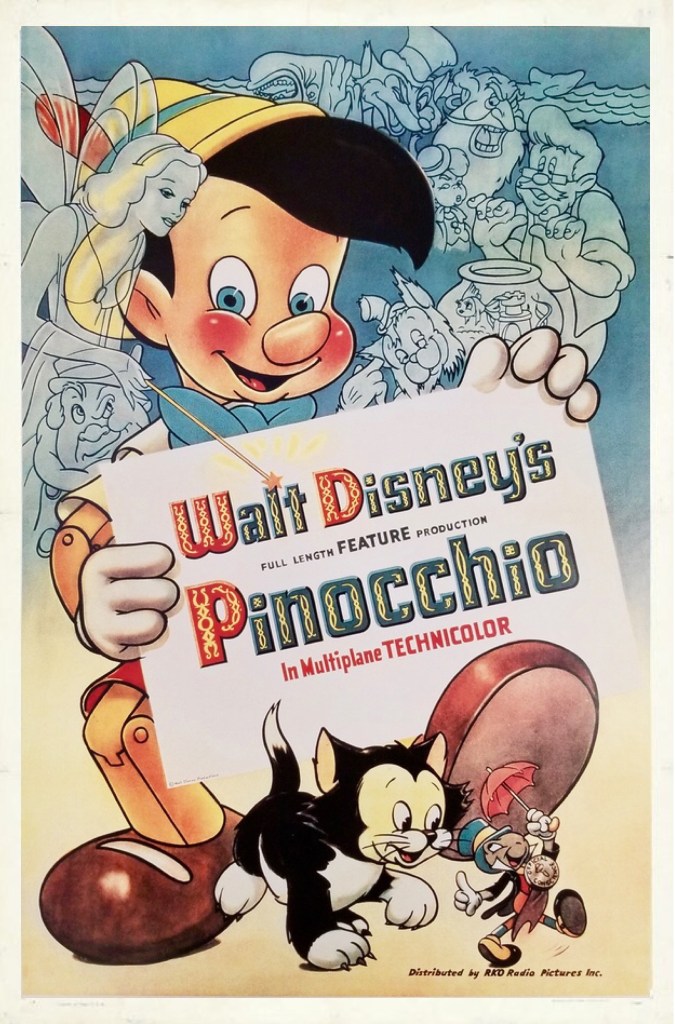
The Plot: Kindly woodcarver Geppetto (voiced by Christian Rub) wishes upon a star that his marionette Pinocchio become a real boy. The Blue Fairy (voiced by Evelyn Venable) grants his wish…well sorta. Pinocchio comes to life (voiced by Dick Jones) but must learn to be brave, truthful and unselfish to truly become human. Aided by his appointed conscience Jiminy Cricket (voiced by Cliff Edwards), Pinocchio gets into trouble at a puppet show, the mysterious amusement park Pleasure Island, and even at the bottom of the sea. It’s the classic Collodi story, minus most of the things from the Collodi story.

Why It Matters: The NFR calls it a “Disney classic” and singles out “When You Wish Upon a Star” as “[o]ne of the film’s most lasting contributions.” There’s also an essay by Disney expert J.B. Kaufman.

But Does It Really?: Who’s going to say no to “Pinocchio”? Even if this quintessential movie fantasy isn’t your cup of tea, you at least have to admire the stunning animation and the lasting impact of the songs. While it falls short when compared to breakthrough “Snow White“, “Pinocchio” is a landmark for both Disney animation and top-tier family entertainment.

Everybody Gets One: Many of the voice actors (all uncredited, by the way) were character actors and radio personalities. In addition to voicing the Blue Fairy, Evelyn Venable was the live-action reference for the original Columbia logo. Actor Christian Rub was called in to replace the original voice of Geppetto, who was coming across as too unlikable. The animators even based Geppetto’s facial features on Rub.

Wow, That’s Dated: Between Stromboli being both an Italian stereotype and a Romani “gypsy”, Disney+ is right to warn me that this movie “may contain outdated cultural depictions” (he literally eats garlic at one point!). There’s also a reference to the Trylon and Perisphere from the then-current New York World’s Fair. That’s all well and good, but where’s Elektro?

Seriously, Oscars?: A critical hit but a box office miss (more on that later), “Pinocchio” won Oscars in both of its nominated categories: Best Score and Best Song for “When You Wish Upon a Star”. “Pinocchio” was the first animated feature to win a competitive Oscar (“Snow White” received an honorary Oscar two years earlier).

Other notes 

  • Production of “Pinocchio” began in late 1937, but after five months of storyboards and rough animation, Walt scrapped the entire production, feeling that the character of Pinocchio lacked sympathy. The animators started from scratch, making Pinocchio more naïve than mischievous. The biggest addition to this revised version was a cricket – a minor character in the Collodi story – to serve as Pinocchio’s sounding board. Jiminy’s design was scaled back so much, animator Ward Kimball joked the only way you could tell he was a cricket was “because the other characters say he is.”
  • Despite its status as an iconic movie song, “When You Wish Upon a Star” plays over the static opening credits, with no visuals until the last stanza.
  • Cliff Edwards was a popular musician in the ’20s and ’30s, and as Jiminy Cricket became the first established star to lend his voice to a Disney character.
  • It’s interesting to watch this film as a direct follow-up to “Snow White”. Disney continues to push the boundaries of animation, but is also aware of what audiences liked about “Snow White”. You liked Dopey? Here’s three silent sidekicks! You liked the songs? Here’s more from the same team!
  • Dick Jones was 11 years old when he started recording “Pinocchio”. Unlike most child actors, he continued to work steadily in Hollywood well into his mid-40s. Jones makes an on-camera appearance in “Mr. Smith Goes to Washington” as a page befriended by Jimmy Stewart.
  • For those of you keeping score, that’s two Disney movies in a row that feature a song about whistling.
  • “Pinocchio” makes an intriguing double feature with the thematically similar “Blade Runner“. What I wouldn’t give to hear Pinocchio say, “I want more life, father.”
  • Honest John is voiced by Walter Catlett, an actor and comedian best known for his work in “Bringing Up Baby” and “The Front Page“. Warner Bros. voiceover legend Mel Blanc initially provided the voice of Gideon, but it was later decided to make him mute, and all that survives of Blanc’s work is a single hiccup.
  • For an Italian story this movie is not very Italian. Geppetto seems to be German, Pinocchio is straight-up American; the only person who has an Italian accent is Stromboli, and aggressively so.
  • All the fantasy elements lend themselves well to animation, but Pinocchio’s nose growing is the most memorable, providing great character animation for him and Jiminy.
  • Jiminy Cricket is bad at his job. He spends most of the movie complaining about Pinocchio, or straight up abandoning him. And when he does help, Jiminy tends to rob Pinocchio of moments of actual growth. I think Disney spent a little too much time developing this movie’s sidekick.
  • So, Pleasure Island is the kid version of The Purge?
  • The transformation of Lampwick into a donkey is still terrifying. Everyone forgets that the early Disney films didn’t shy away from scary.
  • The entire Monstro the Whale sequence is an impressive undertaking of animation, especially when you consider that all of those underwater effects were drawn by hand.
  • Am I the only person who’s kinda weirded out by Pinocchio’s “real boy” look? I think it’s the nose that’s throwing me.
  • Yes, Pinocchio learns the right lesson in the end, but it’s done in a very “boys will be boys” manner. You don’t see Snow White and Cinderella getting to be flawed or make mistakes or grow as people. It’s a double standard that plagues most of Disney’s work.

Legacy 

  • “Pinocchio” opened in February 1940, five months after World War II was declared in Europe. As a result, most of the film’s international market was cut, and “Pinocchio” only made half of its budget back. Turns out “Pinocchio” was the “Onward” of its day.
  • “Pinocchio” finally turned a profit following its 1945 re-release, and the film returned to theaters every few years for the next five decades.
  • In 1985, Disney tentatively agreed to release “Pinocchio” on home video, but only for a limited time, thus establishing the “Disney Vault”.
  • “When You Wish Upon a Star” has become the official Disney anthem, and you’ll be hard-pressed to find a major Disney event or program that doesn’t feature it.
  • Some of the film’s other songs get shoutouts from time to time. “I’ve Got No Strings” is a motif in “Avengers: Age of Ultron”, sung half-assedly by James Spader.
  • Cliff Edwards reprised the role of Jiminy Cricket several times, including the film “Fun and Fancy Free” and the “I’m No Fool” shorts from “The Mickey Mouse Club”.
  • “Pinocchio” gets its share of representation in the Disney parks, most prominently as a Fantasyland dark ride.
  • “Now you be-a good, Pinitchio, and don’t-a you lie.”
  • The original Collodi story has been remade several times over the years, with Pinocchio being played by everyone from Paul Reubens to Roberto Benigni. Filmation’s 1987 pseudo-sequel “Pinocchio and the Emperor of the Night” veered close enough to Disney’s version to warrant legal action (the court ruled in favor of Filmation).
  • Looks like “Pinocchio” is taking the live-action remake route, with Tom Hanks as Geppetto and Robert Zemeckis directing. Here’s hoping Pinocchio doesn’t end up in the Uncanny Valley.

Listen to This: Cliff Edwards’ rendition of “When You Wish Upon a Star” made the National Recording Registry in 2009. The song gets TWO essays, one by Cary O’Dell and one by James M. Bohn.

#473) Blade Runner (1982)

#473) Blade Runner (1982)

OR “Repli-can’t Stop the Feeling”

Directed by Ridley Scott

Written by Hampton Fancher and David Peoples. Based on the novel “Do Androids Dream of Electric Sheep?” by Philip K. Dick.

Class of 1993

First, a confession: I’ve never seen “Blade Runner”, which makes me a godless heathen in the eyes of many. After much deliberation, this post is based on my viewing of the Final Cut from 2007.

The Plot: In November 2019 (aka our Old Future), “Blade Runners” are a special police force tasked with hunting down lifelike androids called replicants. Retired Blade Runner Rick Deckard (Harrison Ford) is called back to the Los Angeles force to track down four especially dangerous replicants (Rutger Hauer, Daryl Hannah, Joanna Cassidy and Brion James), who are illegally hiding on Earth. His investigation leads him to replicant creator Dr. Eldon Tyrell (Joe Turkel) and his secretary Rachael (Sean Young), who doesn’t realize she’s a replicant. Long jaded from his work, Rick finally confronts the complexity of what makes a human truly human. Also he might be a replicant. Jury’s still out.

Why It Matters: The NFR mentions the film as a “box-office and critical flop when first released” (not entirely true, but go on) and gives a detailed plot description. An essay by journalist David Morgan is a more extensive appreciation for the film.

But Does It Really?: “Blade Runner” has been built up quite a bit during my lifetime, and while I liked the movie, I wasn’t blown away by it. It’s a well-crafted piece of science fiction with effective, imaginative world building, but it’s easy to lose track of the story amongst all the bells and whistles of this universe. “Blade Runner” is a movie I respected more than I enjoyed, but it is also unquestionably a great movie that survived a rocky beginning to become a classic, and deserves its well-earned spot on the NFR.

Shout Outs: The Millennium Falcon from “Star Wars” is hidden in one of the skyscraper models, and the Original Cut’s ending features unused helicopter footage from “The Shining“.

Everybody Gets One: Actors Rutger Hauer, Sean Young and Daryl Hannah, cinematographer Jordan Cronenweth, and composer Vangelis. Speaking of…

Wow, That’s Dated: The main giveaway is the iconic synthesizer-heavy soundtrack by Vangelis, fresh off his Oscar winning work in “Chariots of Fire”.

Title Track: At one point “Do Androids Dream of Electric Sheep?” was to retain its title for the film adaptation, with alternates like “Dangerous Days” and “Android” in consideration as well. Ridley Scott and screenwriter Hampton Fancher liked the title of “The Bladerunner“, a completely unrelated sci-fi book by Alan E. Nourse (split into two words for William S. Burroughs’ proposed film adaptation), and got permission to use the name. Both Nourse and Burroughs get a special thanks in the credits. And now you understand why this title makes absolutely no sense.

Seriously, Oscars?: “Blade Runner” was met with mixed critical reception, and was lost in a crowded summer movie landscape that included “Poltergeist”, “Star Trek II”, and megahit “E.T. the Extra-Terrestrial“. Despite this, “Blade” managed two Oscar nominations, losing Art Direction to “Gandhi” and Visual Effects to “E.T.”. Despite nominations at the Golden Globes and Baftas, Vangelis’ score failed to receive an Oscar nod.

Other notes 

  • By all accounts, “Blade Runner” was a difficult shoot, preceded by the original backers pulling their funding 10 days before filming began. This was Ridley Scott’s first film in an American studio, and he clashed often with a crew unaccustomed to a British directing style. In addition, Scott and Harrison Ford argued constantly regarding their interpretations of Deckard (though in more recent interviews, both speak highly of the other). The only person who seemed to enjoy the film was Philip K. Dick, who enthusiastically approved of the screenplay as well as Douglas Trumbull’s special effects. Dick died three months before the film’s release, and “Blade Runner” is dedicated to his memory.
  • It’s easy to see why this film works. In addition to the excellent foundation of the source material, the choice of film noir as the movie’s genre is inspired. Everyone in traditional film noir plays things cryptically, emotionless; not unlike this movie’s replicants.
  • Another factor I caught early on: not a lot of dialogue, but plenty of subtle non-verbal communication. I had to keep on my toes for this one.
  • Shoutout to James Hong, M. Emmet Walsh, and Edward James Olmos, three character actors in the “They’re In Everything” category making supporting appearances here. They don’t get much to do, but it’s always a pleasure seeing these three.
  • Everyone’s great, but Rutger Hauer is on another level. He is wonderfully ruthless as Roy Batty, yet simultaneously charming. Hauer lures you in to empathizing with Roy’s complex motives.
  • Wait, is this where everyone gets the “Zoom in, Enhance” trope from? “Blade Runner” was so prescient, other movies and TV shows just assumed this technology was real!
  • If you only know Joanna Cassidy from “Who Framed Roger Rabbit“, have I got a movie for you. Not only does Joanna kick butt (literally) as Zhora, she also kicked butt 25 years later for Final Cut reshoots. Side note: The snake is hers.
  • Sean Young’s work in this movie tends to be eclipsed by her later controversies ([cough] Catwoman), but she gives a nicely disciplined performance here as Rachael. And while we’re talking about Rachael; silence is not consent, Deckard!
  • This is one of Daryl Hannah’s first movies and breakout performances. Pris seems to be going for a glam rock/”Cats” audition look?
  • Roy definitely says “father” in this cut; I don’t know what you all are hearing.
  • Yes, this movie predicted lifelike AI and voice command technology, but it also predicted that PanAm and the Bell System would still be around in 2019. And no matter how bleak a sci-fi future is, they always have flying cars.
  • Roy’s one design flaw: the standard “don’t kill the protagonist immediately” rule. Is that an Asimov thing?
  • Feeling that Roy’s final monologue had too many extraneous details, Rutger Hauer rewrote it himself by halving its length, and adding the final “tears in the rain” simile. Ridley Scott approved, and the result is a wonderfully profound movie moment.
  • But of course, all that really matters is this film’s ongoing debate: Is Deckard a replicant? Ridley Scott says yes, Harrison Ford says no. Personally, I side with Ford; Deckard’s taxing job and life have rendered him incapable of showing real emotion, making him indistinguishable from a replicant. That being said, the film presents enough content in favor of either answer, making for an engaging discussion and an appreciation of Ford’s performance.

Legacy 

  • “Blade Runner” was met with indifference at the box office, but the new advent of home video helped earn the film a cult following. Ridley Scott also cites MTV as responsible for the film’s resurgence, noting how many ’80s music videos feature “Blade Runner”-inspired dystopian futures.
  • Practically every major piece of science-fiction media of the last 40 years can trace its aesthetic back to “Blade Runner”. Hell, without “Blade Runner”, there’s no steampunk!
  • “Blade Runner” led to a reexamination of Philip K. Dick’s work, and several of his other stories have been turned into movies, notably “Total Recall”, “Minority Report”, and “A Scanner Darkly”.
  • Among the many filmmakers who have listed “Blade Runner” as an influence on their careers include Christopher Nolan, Guillermo del Toro, and Denis Villeneuve, which really worked out in his favor.
  • Talk of a sequel dragged out for decades, but one finally arrived in the form of 2017’s “Blade Runner 2049” by…Denis Villeneuve! Like its predecessor, it’s a well-made meditation on AI ethics that underperformed at the box office. Unlike its predecessor, “2049” actually won a few Oscars, including one for long-overdue cinematographer Roger Deakins.
  • The original novel has had several official sequels, which take the “Blade Runner” name for brand recognition.
  • Also of note is the 1998 film “Soldier”, written by “Blade Runner” co-writer David Peoples, who considers it a “sidequel”, occurring in the same universe as “Blade Runner”.
  • Oh, and I guess “Prometheus” (and therefore the entire “Alien” franchise) takes place in the “Blade Runner” universe? Not sure how deep the Ridley Scott Cinematic Universe goes.

And now a brief history of The Many, Many Cuts of “Blade Runner”.

  • An unsuccessful sneak preview of “Blade Runner” led to the producers adding a new “happy ending”, and voiceovers from Harrison Ford explaining the plot to the audience (Ridley Scott did not have final cut approval).
  • Sometime around 1990, Ridley Scott’s workprint cut of “Blade Runner” (without the studio mandated changes) was rediscovered, and after a successful run at a few film festivals, was released in 1992 as the “Director’s Cut”. That title is a bit of misnomer, as Ridley Scott did not feel that the workprint represented his true vision for the film. Although Scott gave notes to the restoration team, he did not personally oversee the Director’s Cut.
  • In the early 2000s, rumors of a definitive cut with Scott’s direct involvement began circulating, but licensing rights issues delayed the Final Cut until 2007. The Final Cut’s changes are mostly cosmetic – cleaning up picture quality, correcting continuity errors – and I can confirm that it makes for an unobtrusive first viewing.

#472) The Birth of a Nation (1915)

#472) The Birth of a Nation (1915)

Directed by D.W. Griffith

Written by Griffith and Frank E. Woods. Based on the novel and play “The Clansman” by Thomas Dixon Jr.

Class of 1992 

The issues raised by “The Birth of a Nation” cannot be “solved” overnight, nor extensively covered on this blog. This post is the beginning of the conversation we should be having about this movie, not the end. It should go without saying that I in no way, shape, or form endorse the KKK or any group with an ideology built on hate or bigotry.

And now, in the alleged words of Clark Gable, “Let’s get this over with.”

The Plot: The Civil War is seen from the perspective of two families, the Stonemans of the North and the Camerons of the South. The film’s first half follows both families as they send their sons off to fight, culminating with the Siege of Petersburg, followed by war’s end, and President Lincoln’s assassination. The second half shows a dramatized perversion of the Reconstruction Era. Following their freedom from slavery, African-Americans of the south seize power and begin bullying white citizens. Under this film’s viewpoint, the only solution is the foundation of the Ku Klux Klan, uniting white people against their new oppressors. Did that sentence make you cringe? Imagine three hours of that.

Why It Matters: From the NFR’s write-up: The racist and simplistic depictions of blacks [sic] in the film is difficult to overlook, but underneath the distasteful sentiment lies visual genius. Whatever you say, circa 1992 committee. Film critic David Kehr picked the short straw, and wrote an essay on the film.

But Does It Really?: “The Birth of a Nation” is even worse than you think it is. Yes, “Birth” may be the movie that elevated films to an art form, but that does not excuse the egregious amount of racism portrayed in the film. It’s “Gone with the Wind“, with even less sensitivity towards any non-Confederate viewpoint. To answer the all-important question: “Birth of a Nation” is significant enough for NFR inclusion based on its technical innovations and on-going controversy. The film should be kept available for viewing rather than being ignored (which I admit as a white male is a privileged opinion to have), but, and I can’t stress this enough, DO NOT WATCH THIS MOVIE UNLESS BY YOUR OWN CHOOSING. It should only be viewed by people genuinely curious about the film, and willing to stomach its offensive subject matter. “Birth of a Nation” is deeply problematic, but it is an important reminder of what we as a nation were willing to accept as popular entertainment, and how this film’s legacy has continued to harm our African-American communities.

Wow, That’s Dated: Unsurprisingly, this movie has a severe BLACKFACE WARNING. While there are African-American extras, the major African-American characters are played by white actors either in blackface or passing for “mulatto”. It is constant and unsettling.

Other notes 

  • Like its film adaptation, the original 1905 novel “The Clansman” was quite controversial in its day for its romanticizing of the (then defunct) Ku Klux Klan. Author Thomas Dixon Jr. adapted the novel into a play (also met with controversy; several cities banned it), and was adamant about making a film version. A 1911 version was abandoned, but film critic Frank E. Woods saw the footage and brought it to the attention of D.W. Griffith. A native Kentuckian whose father was a Confederate soldier, Griffith saw the cinematic potential of the novel immediately.
  • So I don’t have to deal with it later, here are this movie’s positive technical aspects. While Griffith was not the first person to see film’s potential as a storytelling art form, he was the first one to realize that vision on a big, successful scale. Among the film’s artistic achievements are Griffith’s pioneering usage of close-ups, fade-outs, large action scenes with hundreds of extras, color tinted film, and an original score composed specifically for a movie. Plus this was one of the first successful feature-length films (shorts were still the industry standard in 1915). This is all well and good, but we have much larger issues to acknowledge.
  • The movie makes a point at the beginning about being anti-war, but that message definitely gets lost after the next intertitle, in which the arrival of slaves from Africa is called “the first seed of disunion”. Oof.
  • Then-current President Woodrow Wilson gets a few shoutouts with quoted passages from his book “History of the American People” about the foundation of the Klan. While he did go on to denounce what the Klan had become, keep in mind that as president, Wilson was responsible for implementing white supremacist ideology into our government and our laws. It’s a very complicated subject, but definitely worth researching.
  • The second half of the movie ramps up the repulsiveness. Every African-American character goes mad with power, implementing reverse racism towards the white characters, including voter suppression. Every offensive stereotype about African-Americans is on display here, including Black men lusting after virginal white women. All of this is seemingly orchestrated by Republicans to punish former slave owners, with the gallant and heroic Klan acting as the film’s cavalry.
  • As previously mentioned, this movie was a difficult watch for me. I didn’t take a lot of notes, nor did I feel up to doing my usual amount of research on this film. Movies can be effective ways of creating empathy by seeing the world from another viewpoint, but at the end of the day, hate is hate, and you cannot empathize with a gross distortion of history that demeans an entire culture. While the film’s technical innovations are noteworthy, “Birth of a Nation” is totally indefensible.

Legacy 

  • Like its novel and theater predecessors, “The Birth of a Nation” was immediately met with condemnation. The NAACP organized protests in several major cities, urging film boards to ban the film (this was before the MPAA, every state had their own film board and censors). “Birth” was banned in a few places, but a screening at the White House (the first film to do so) caused several cities to reconsider following this “endorsement”. The film went on to become the most successful movie of all time.
  • D.W. Griffith was surprised by the negative reaction the film received, and his next movie was a response to his critics: 1916’s “Intolerance“. The sheer gall of that title aside, “Intolerance” is the monumental D.W. Griffith spectacle that film historians point to when they want to avoid “Birth of a Nation”. In addition, Griffith added an intertitle for the rerelease of “Birth” called A PLEA FOR THE ART OF THE MOTION PICTURE, which is essentially Griffith’s flowery way of hiding behind the First Amendment.
  • “The Fall of a Nation” was an immediate sequel directed and written by Thomas Dixon Jr., and was an attack of the U.S.’s pacifism towards the Great War. It was a commercial failure with no prints known to exist.
  • “Birth of a Nation” has been occasionally referenced in modern films, most recently in Spike Lee’s “BlacKkKlansman”.
  • In 2016, African-American filmmaker Nate Parker chose to name his film about Nat Turner’s 1831 slave revolution “The Birth of a Nation” to reclaim the title from the 1915 film and challenge white supremacy and systemic racism. Despite critical acclaim and early Oscar buzz, the movie was eclipsed by resurfaced sexual assault allegations regarding Parker and co-writer Jean McGianni Celestin, and disappeared amidst this controversy.
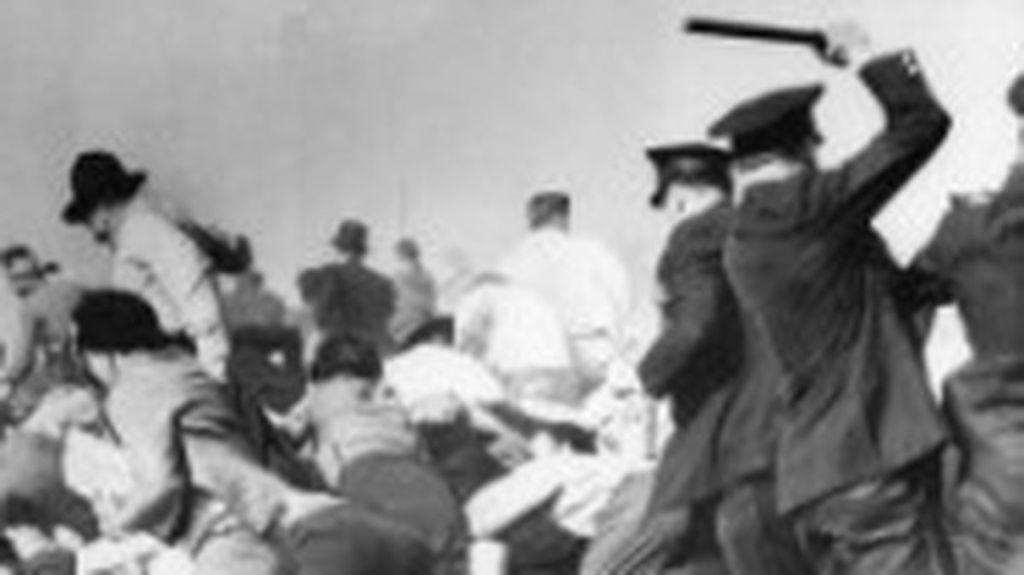
  • The film’s largest influence sadly goes beyond film. The Klan movement as depicted here was over by the 1870s, but the overwhelming popularity of “Birth of a Nation” caused a revival of various Klan organizations across the country. While this iteration died out by the early 1920s, its third incarnation in the ’50s is still active today. In addition, violence towards Black communities by white people were spurred by screenings of the film. There is a century’s worth of hate and brutality in this country that can trace its lineage back to “The Birth of a Nation”.

Further Viewing: When the NFR added “Birth of a Nation” in 1992, they also inducted 1920’s “Within Our Gates” by Oscar Micheaux, filmdom’s first African-American director. “Within Our Gates” was Micheaux’s response to “Birth of a Nation”, showing how little progress had actually been made since the Civil War regarding racial equality and freedom. If we’re going to continue to discuss “The Birth of a Nation”, it’s only fair to include “Within Our Gates” in that conversation.

#471) Greed (1924)

#471) Greed (1924)

OR “McTeague Fatigue”

Directed by Erich von Stroheim

Written by June Mathis Erich von Stroheim. Based on the novel “McTeague” by Frank Norris.

Class of 1991 

NOTE: “Greed” exists today in two versions: the original studio cut of around two hours, and a 1999 restored four hour cut by Rick Schmidlin with Turner Classic Movies. Because I love you, this post is based on my viewing of the four hour restoration.

The Plot: San Francisco dentist John McTeague (Gibson Gowland) is infatuated with Trina Sieppe (ZaSu Pitts), the cousin/girlfriend (yeah…) of his best friend Marcus Schouler (Jean Hersholt). Upon seeing McTeague’s genuine affection for Trina, Marcus agrees to step aside for the two. Shortly after McTeague and Trina’s engagement, Trina learns she has won a lottery of $5,000. Upon hearing the news, Marcus becomes resentful of McTeague, feeling the money should be his. As their marriage disintegrates, McTeague and Trina lose trust in each other over their use of the money. Will these relationships be destroyed by…greed? That answer, in about four hours.

Why It Matters: The NFR write-up indicates that “Greed” is “notorious for both its production difficulties…and its post-production”. Oddly, there’s no mention of the influence “Greed” had on generations of filmmakers (see “Legacy”).

But Does It Really?: “Greed” has a lot going for it (von Stroheim’s powerful imagery, his innovative use of editing and deep focus), but I found the history of the film more interesting than the film itself. The two available cuts offer an interesting trade-off: the studio cut is shorter, but you lose a lot of nuance and texture. The restored cut is the better movie, but is also four hours of silent film, text, and photos. “Greed” continues to hold a very prominent place in film history, but ultimately its current entertainment value is reserved for film buffs putting together cinema’s most intriguing puzzle.

Wow, That’s Dated: The $5000 Trina wins would be about $75,000 today!

Wow, That’s Oddly Anachronistic: Von Stroheim went out of his way to ensure that his film of the 1899 novel was a faithful recreation of the era…even though the film’s timeline was bumped up to present day (1923).

Other notes 

  • Already notorious for going over-budget and defying studio heads (see “Foolish Wives“), Erich von Stroheim was unceremoniously fired from Universal in October 1922. Less than a month later, von Stroheim signed with Goldwyn Pictures, who favored artistic freedom over commercialism, and thought they could reign in von Stroheim’s excessive spending. “Greed” was given a budget of $175,000, and ultimately cost almost $600,000, still down from the $1,000,000 von Stroheim spent on “Foolish Wives”.
  • Von Stroheim’s major cost cutting effort: filming entirely on location, without having to build sets in-studio.
  • Shoutout to still photographer Warren Lynch. His extensive documentation of “Greed” and its production is what makes any restoration possible and palatable.
  • The one upside to editing in the silent era: any continuity issues can be covered with re-written intertitles.
  • All the major cast members were part of von Stroheim’s unofficial repertory company. Gilbert Gowland did mostly bit and supporting parts until von Stroheim cast him in “Blind Husbands”. Eliza Susan “ZaSu” Pitts was an ingenue who would get a second career during the sound era as a comic character actor. Jean Hersholt’s acting career has been mostly eclipsed by his humanitarian efforts, primarily for his work with the Motion Picture Relief Fund. After his passing, the Oscars named their Humanitarian Award in his honor.
  • A majority of the film’s deletions center around two subplots meant to serve as counterpoints to McTeague and Trina’s relationship: The tumultuous marriage between custodian Maria and junk dealer Zerkow, and elderly neighbors Mr. Granis & Mrs. Baker, who are smitten with each other, despite having never met. Ultimately, anything not directly pertaining to the main plot was cut, with these four characters relegated to background extras.
  • Yeah, this relationship is doomed from the start. McTeague kisses Trina while she’s under anesthetics, and he pretty much throws himself at her after that despite her obvious objections. No means no, McTeague!
  • “Greed” adheres to the silent film immigrant rule: All broken English must be spelled out phonetically. “Doktor…pe goot to her! Pe vairy goot to her…von’t you?”
  • A funeral procession happening at the same time as a wedding? I don’t like where this symbolism is going. This is immediately followed by the reception feast, in which everyone gorges on dead animals with their skulls still intact! Truly the most distressing wedding banquet this side of “Freaks“.
  • The deleted Maria/Zerkow plotline is definitely the darkest: spousal abuse, an infant death, a murder-suicide. I agree with editor Grant Whytock, who called the plot “very distasteful”.
  • The film intercuts Marcus’ final visit to the McTeagues with a cat ready to pounce on two lovebirds. Get it?
  • Once the greed of the title takes over, suddenly the film becomes “Treasure of the Sierra Madre“, but much longer and with women in it.
  • Whoa, I just saw ZaSu Pitts show a little skin. It’s pre-code, anything goes!
  • The finale in Death Valley is quite amazing, I found myself on the edge of my seat. It is almost worth the four hour runtime to get there. Almost.
  • I get it: this film’s extensive length helps us feel as worn down by the character’s greed as they are. You can still get there in two hours, but it doesn’t pack the same punch. That being said; To anyone who complained about “The Irishman” being too long: watch “Greed” and then tell me where you stand.

Legacy 

  • The first rough cut of “Greed” was screened in January 1924 and ran approximately 8-9 hours! After two months of pruning, von Stroheim turned in a five hour cut to Goldwyn Pictures with the hope it could be released in two parts. The studio rejected this offer, and von Stroheim-approved editor Grant Whytock got the film down to under four hours. It was around this time that Goldwyn officially merged with Metro Pictures and Louis B. Mayer Productions to become Metro-Goldwyn-Mayer (MGM). “Greed” fell under the supervision of Irving Thalberg, who had fired von Stroheim from Universal two years earlier, which did not bode well for this movie. The film was taken over by executive June Mathis, and she and editor Joseph W. Farnham pared it down to under two hours. This was the cut that ultimately made it to theaters.
  • Critics were divided on “Greed”; Exceptional Photoplays called it “a terrible and wonderful thing”. Mixed with MGM’s poor job advertising the picture, “Greed” made less than half of its budget back at the box office.
  • Von Stroheim resented the final cut of “Greed”, and his relationship with MGM continued to sour. While his next film for MGM, “The Merry Widow”, was commercially successful, von Stroheim’s frequent outbursts with cast, crew, and studio heads effectively ended his Hollywood directing career.
  • In 1952, “Greed” started getting reappraised when both the Festival Mondial du Film and Sight and Sound ranked it among the best films ever made (these two lists are generally considered the first “Greatest Movies” lists). Filmmakers who have cited “Greed” as an influence include Sergei Eisenstein, Jean Renoir, Ernst Lubitsch, Orson Welles, and Billy Wilder.
  • Following Erich von Stroheim’s death in 1957, his partner Denise Vernac approved the publishing of his uncut screenplay for “Greed”, which spurred attempts to locate and restore the missing footage. Although over 600 still photos of the deleted scenes have resurfaced over the years, the original footage was destroyed by MGM to recycle the film’s silver nitrate.
  • Turner Classic Movies released a reconstructed version of “Greed” in 1999, using von Stroheim’s script and hundreds of still photos to reinstate all the deleted subplots. While no new footage was located, this is still the most complete version of “Greed” we will most likely ever have.

#470) Rebel Without a Cause (1955)

#470) Rebel Without a Cause (1955)

OR “Angst for Nothing”

Directed by Nicholas Ray

Written by Stewart Stern. Story by Nicholas Ray. Adaptation by Irving Shulman.

Class of 1990

The Plot: Jim Stark (James Dean) is a mixed-up teenager, constantly rebelling against his misunderstanding parents (Jim Backus & Ann Doran). In 24 hours, Jim gets arrested for public drunkenness, runs afoul of teen gang leader Buzz Gunderson (Corey Allen) on a field trip at the Griffith Observatory, partakes in a knife fight and a deadly game of chicken, and closely bonds with Buzz’s girlfriend Judy (Natalie Wood) and social misfit Plato (Sal Mineo). “Rebel Without a Cause” flouts convention to suggest that teenage delinquency can happen in any neighborhood to any family.

Why It Matters: The NFR calls it “wretchingly powerful, despite some dated elements” and goes on to praise director Ray, screenwriter Stern, and the cast. An essay by the late film critic Jay Carr analyzes the film’s themes.

But Does It Really?: The legacy of “Rebel” is two-fold: the definitive entry in the ’50s teen drama subgenre, and James Dean’s commanding central performance. The key to the film’s success is Nicholas Ray et al focusing on the teen characters, making them the dimensional, complex protagonists over their authoritative parents. “Rebel” may not be an untouchable essential, but, aided by a strong cast of rising talent and several iconic moments, continues to be a memorable classic.

Title Track: In 1946, Warner Bros. bought the screen rights to the 1944 book “Rebel Without a Cause: The Hypnoanalysis of a Criminal Psychopath” by Dr. Robert M. Lindner. Various adaptations were written, but all were abandonded, and the project was dropped. In 1954, Warner Bros. purchased Nicholas Ray’s treatment about teenage rebellion called “The Blind Run”. Irving Shulman’s script adaptation bared the title “Juvenile Story”, and Stewart Stern’s re-writes lifted “Rebel Without a Cause” from the unrelated Lindner book.

Seriously, Oscars?: Despite mixed reviews, “Rebel Without a Cause” was one of Warner Bros.’ biggest hits of the year. The film, however, failed to win any of its three Oscar nominations: Supporting nods for Wood and Mineo, and Best Story for Nicholas Ray (Side Note: “Best Story” is a now retired category specifically for a movie’s treatment, not its screenplay, hence Ray’s nomination as opposed to Stern). The only reason James Dean wasn’t nominated was because he was already up for Best Actor for “East of Eden” (sadly, Dean is the category’s first posthumous nominee).

Other notes

  • “Rebel Without a Cause” was originally slated to be a black and white B-movie with a small budget. Production began in March 1955, the same month “East of Eden” was released. Recognizing Dean’s rising star (and the popularity of teen movies), Jack Warner bumped up “Rebel” to an A-movie in Technicolor and CinemaScope.
  • This classic opens with a screen legend in the making…playing with a cymbal monkey? Have I never seen this movie from the beginning?
  • Natalie Wood had been a child actor for 12 years before successfully making the transition to young ingenue thanks to this movie. Judy’s promiscuity was all but eliminated from the script, but Wood still gets in some emotional shading when she can.
  • “You’re tearing me apart!” A moment that big so early in a movie could come across as over the top, but Dean pulls it off.
  • Shoutout to classic Hollywood cinematographer Ernest Haller. An Oscar winner for “Gone with the Wind“, Haller makes excellent use of the CinemaScope widescreen camera. Multiple characters comfortably fill the screen, and there’s plenty of storytelling packed into each shot.
  • Primarily known then as the voice of Mr. Magoo, Jim Backus shines in easily his best live-action performance. Equally impressive is Ann Doran as Jim’s mom, domineering but never cartoonish.
  • Although the Production Code made the filmmakers tone down Plato’s obvious homosexuality, there are still a few references hidden in the film. Exhibit A: the photo of Alan Ladd in Plato’s locker.
  • Wow, what a nihilistic planetarium show. Life goes on, man’s problems don’t matter, go forth young graduates!
  • Buzz’s friend Goon is played by a young Dennis Hopper! Unfortunately Hopper is given nothing to do: Goon and the other teen characters were de-emphasized in favor of James Dean.
  • The knife fight at the Observatory confirms my theory that field trip chaperones are useless.
  • To fully understand his leading man, Nicholas Ray allowed Dean free-reign to improvise his dialogue. This is most evident in Jim’s conversation with Dad before the chicken run. Dean does a great job of conveying the inarticulate confusion of a teenager, and Backus follows wherever Dean is going.
  • If the abandoned mansion Jim, Judy and Plato hang out in looks familiar, it’s J. Paul Getty’s “Phantom House”, a.k.a. Norma Desmond’s mansion from “Sunset Boulevard“. Sadly, the house was completely demolished just two years later.
  • While impersonating Jim’s dad, James Dean sneaks in a surprisingly spot-on Mr. Magoo voice. I learned it from you, dad!
  • Shoutout to Sal Mineo, who is just perfect as a lost soul yearning to connect. Bonus shoutout to the film for not using Mineo’s Italian ethnicity to define the character.
  • Despite some truly exciting action scenes, the film’s finale loses momentum. This is not helped by the film’s unsympathetic portrayal of the police. It’s true to the rest of the film’s view of adults, but nowadays we really don’t need the reminder.

Legacy 

  • After production wrapped on “Rebel Without a Cause”, James Dean headed off to Texas to film “Giant“. Upon his return to California, Dean resumed his fascination with auto racing, and was en route to a race in Salinas when he was killed in a car accident on September 30th 1955. He was 24. “Rebel” was released in theaters less than a month later on October 26th.
  • “Rebel” was a hit, and continued the ’50s trend of movies targeted towards/dealing with the teen market. Some, like “Blackboard Jungle“, tackled real life issues, but as the decade went on, the genre started getting more fanciful (see “Gidget” and “I Was a Teenage Werewolf”).
  • Griffith Observatory got a major tourism boost thanks to “Rebel”, becoming a historical landmark in 1976. A bust of James Dean can be viewed on the Observatory’s lawn.
  • “Rebel Without a Cause” is definitely one of those movies where people know the title more than the actual movie. A typical allusion to the movie focuses on the title and Dean’s iconic wardrobe rather than any specific scene.
  • One “Rebel” moment that does get referenced: Jim’s line “You’re tearing me apart!” is uttered by James Dean uber-fan Tommy Wiseau in “The Room”, quite possibly the worst movie ever made.

Bonus Clip: In 1947, Warner Bros. used a draft from one of the unproduced versions of “Rebel” in a screen test for 23-year-old stage actor Marlon Brando. Warner Bros. passed on Brando, who went back to New York to do some new Tennessee Williams play…