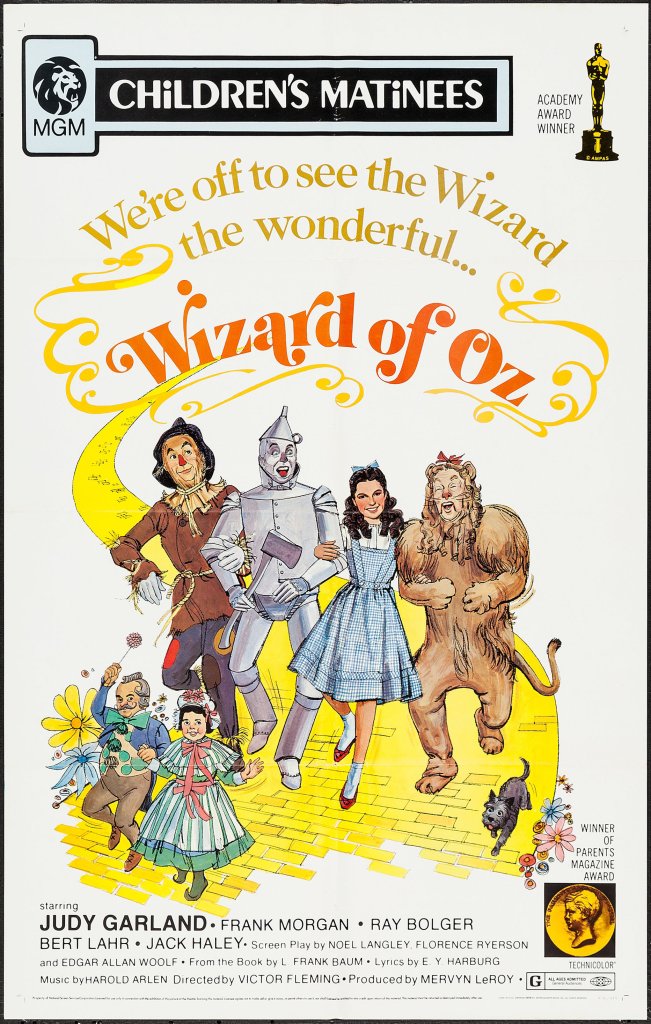
#469) The Wizard of Oz (1939) – Part 2 (Other Notes)

Previously on #469) The Wizard of Oz (1939)…

Other notes

  • The main difference between “Oz” and other movies of the era is money. The film’s budget was a then-record $2.8 million, and it’s clear that no expense was spared. Even the early Kansas scenes have a quiet scope about them; the landscape seemingly goes on forever, and the Gale farm looks and feels like a real place rather than a set on a soundstage.
  • “Over the Rainbow”, what can I say? It’s the ultimate “I Want” song, sung with perfect earnestness by Judy. And to think they were going to cut this song from the film.
  • I’ll take this moment to single out Judy Garland’s genuine, sincere performance. This performance is the reason the film still resonates emotionally with audiences 80 years later, and because her Dorothy believes in the fantasy elements, so do we. Now if only Garland was treated better on and off the set.
  • Miss Gulch is what we would today call a “Karen”. Too bad Aunt Em and Uncle Henry don’t have a manager she could talk to.
  • The twister is the pinnacle of practical special effects. Shoutout to A. Arnold Gillespie and Douglas Shearer for this and all the other effects in this movie that hold up better than most CG effects today.
  • That transition from sepia tone to Technicolor? [Chef’s kiss] Best shot in the movie.
  • I appreciate that Billie Burke, who was 54 at the time she played Glinda, is repeatedly referred to as beautiful.
  • “Ding Dong, The Witch is Dead” is catchy (even I sang along this time), but wow is it morbid. Most of the song consists of Munchkins discussing just how dead the Wicked Witch of the East is (“She’s really most sincerely dead.”). And listen to that chorus: “She’s gone where the goblins go/below, below, below”. They are celebrating that she is in Hell.
  • Fun Fact: Among the 124 Munchkin performers are Harry and Daisy Earles, aka Hans and Frieda from “Freaks“. Harry is the Lollipop Guild member in the blue shirt. As for the other 122, rumors of their debauchery on-set are greatly exaggerated.
  • Everyone’s great, but Margaret Hamilton is this movie’s MVP. She does not hold back, giving you the quintessential classic fairy tale villain. Shoutout to Jack Young not only for his work on Hamilton’s makeup, but also for saving her life when an on-set malfunction gave her second and third degree burns.
  • Toto is the movie’s secret weapon. Sure, it’d still be scary if the Witch just threatened Dorothy, but “and your little dog too”? That’s evil.
  • Everyone loves the yellow brick road, but my brother and I always wondered where the red brick road led to. My guess: the crafts services table?
  • “Some people without brains do an awful lot of talking, don’t they?” [Insert Your Own Political Joke Here]
  • Ray Bolger’s theatricality and “eccentric dancing” lend themselves quite well to the Scarecrow. It helps that playing the Scarecrow was a childhood dream of Bolger’s (his idol, actor Fred Stone, had played the Scarecrow on stage in the 1900s). Bolger was initially cast as the Tin Man, but successfully lobbied to switch roles with Buddy Ebsen.
  • As mentioned in my “Breakfast at Tiffany’s” post, Buddy Ebsen was the original Tin Man, but was hospitalized following his reaction to the aluminum powder makeup. Jack Haley was quickly called in to replace Ebsen, and the makeup was changed to an aluminum paste. While Ebsen doesn’t appear in the final film, his voice can still be heard during group numbers on the soundtrack.
  • It’s a crane. Moving on.
  • Arlen & Harburg wrote a song about the dangerous woods of Oz called “Lions and Tigers and Bears”, but the song was eliminated, save for the famous, seemingly out-of-nowhere repetition of the title. Oh my.
  • Like Bolger, Bert Lahr’s larger-than-life theatricality makes him an ideal Cowardly Lion. Watch closely during his first scene and you can see Judy Garland starting to break character. I will also take this time to recommend “Notes on a Cowardly Lion“, John Lahr’s touching tribute to his father.
  • As great as Bolger, Haley, and Lahr are as their characters, Dorothy does tend to take a backseat to their antics. Garland’s sheer star power prevents Dorothy from being totally overshadowed.
  • “Oz” is one of the first truly integrated movie musicals (preceded only by “Snow White“) . Songs in movies of the time were typically “performed” by the characters, and had little bearing on the story, but the “Oz” songs are all about character.
  • My dream has always been to have the “Merry Old Land of Oz” work schedule: Get up at 12, start to work at 1, an hour for lunch…
  • “If I Were King of the Forest” is another highlight, though it does weirdly reference hottentots, a derogatory term for the Khoikhoi people of South Africa. We’ll see how long before the internet latches onto that one.
  • In the book, the Wizard’s request to Dorothy is to kill the Wicked Witch of the West. This was toned down for the movie: now all he wants is the Witch’s broomstick (although the Tin Man points out they’d “have to kill her to get it”). What a giant disembodied head wants with a broomstick I have no idea.
  • Why does the Wicked Witch send a neverending army of flying monkeys to get Dorothy et al? There’s only four of them, just send in the A team.
  • They really do ramp up the scary in the third act; flying monkeys, menacing guards, the Witch’s truly terrifying appearance in the crystal ball. This is all offset by the Scarecrow, Tin Man, and Lion suddenly turning into the Three Stooges as they raid the castle.
  • Night on Bald Mountain” is just one of many pieces of classical music sampled in the “Oz” soundtrack. Other featured compositions include “The Happy Farmer“, “Gaudeamus Igitur“, and of course, “Home! Sweet Home!“.
  • One detail I never noticed until this viewing is the massive bags under the Wicked Witch’s eyes. Maybe she’d be less evil if she got more sleep?
  • The Witch’s downfall is her arbitrary “let’s not kill the good guys immediately” stance. Also: keeping a random bucket of water in her castle. It’s like Superman keeping a box of kryptonite in the Fortress of Solitude.
  • Another thing I noticed this time: There are some major continuity errors throughout the film; characters switching positions, props coming and going. Turns out most of them were created by cuts made during previews (the original cut was 2 hours long).
  • Many big names were considered to play the Wizard of Oz. Ed Wynn deemed the part too small (hence the addition of the Wizard also playing other characters), and W.C. Fields was bypassed when he kept haggling for more money. MGM contract player Frank Morgan landed the part, and his trademark befuddlement endears him to the role, whereas a bigger name would distract from the fantasy.
  • As any fan of the Oz books will tell you, the “it was all a dream” ending is specifically for the movie. It was believed audiences were too sophisticated to accept the book’s canon of Oz as a real place. Could have been worse; could have all been in a giant snowglobe.
  • In the end, Dorothy learns that “there’s no place like home”. I’m still in quarantine: there’s no place but home.

And now for Part Three and the Legacy of “The Wizard of Oz”.
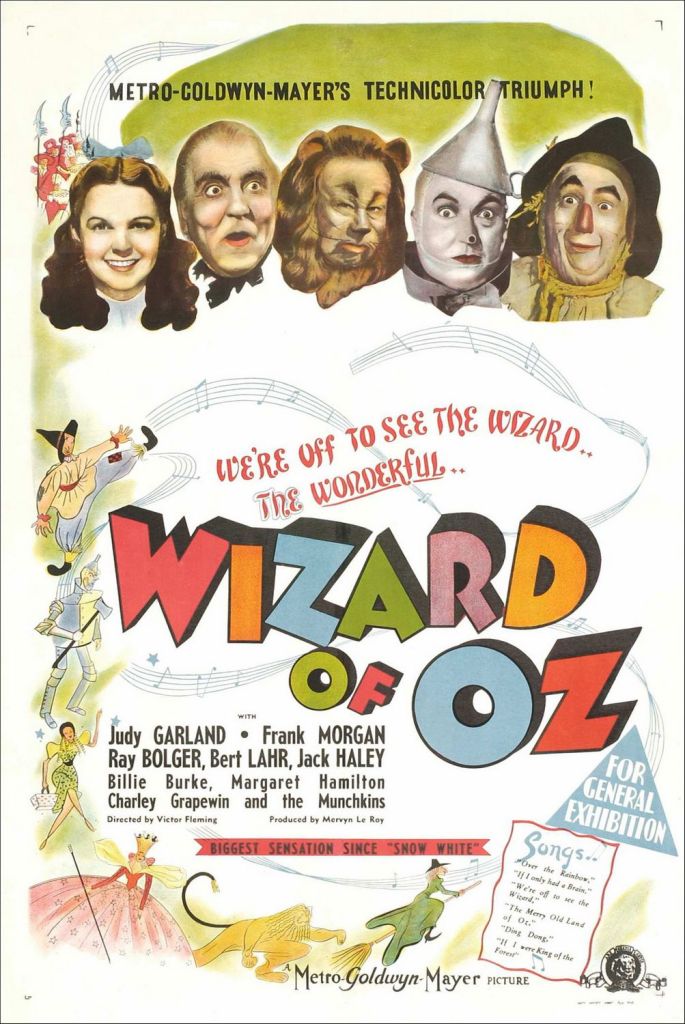
#469) The Wizard of Oz (1939) – Part 1

#469) The Wizard of Oz (1939)

OR “Friends of Dorothy”

Directed by Victor Fleming

Written by Noel Langley & Florence Ryerson and Edgar Allan Woolf. Based on the book by L. Frank Baum. Songs by Harold Arlen & E.Y. Harburg.

Class of 1989

There’s no way I can cover every aspect of “The Wizard of Oz” in one post, so we have another Horse’s Head three-parter!

The Plot: Kansas farmgirl Dorothy Gale (Judy Garland) and her dog Toto (Terry) are swept up in a tornado that drops their house in the Technicolor fantasy world of Oz. Dorothy learns that her house has crushed the Wicked Witch of the East, and East’s sister the Wicked Witch of the West (Margaret Hamilton) vows revenge. Glinda the Good Witch (Billie Burke) aids Dorothy and recommends that she follow the yellow brick road and seek help from The Wizard of Oz (Frank Morgan) to return to Kansas. Dorothy is befriended along the way by a Scarecrow who wants a brain (Ray Bolger), a Tin Man who wants a heart (Jack Haley), and a Cowardly Lion who wants courage (Bert Lahr). And if I have to explain any more of this plot, I welcome you to our planet.

Why It Matters: The NFR calls the film “[a] genuine American classic”, citing the film’s “[o]utstanding performances – particularly by Judy Garland – fanciful sets and an unforgettable score”. An essay by film critic Peter Keough crams as much dissection of the film’s possible symbolism into two pages, and reveals the author’s surprising attraction to Margaret Hamilton.

But Does It Really?: There are untouchable classic movies, and then there’s “The Wizard of Oz”. The film stands out thanks to its memorable characters, emotional songs, stunning production design, and an attention to detail that bypasses most routine studio fare of the time, with the result being a classic that continues to hold up. “Oz” has gone beyond its status as a classic Hollywood movie to become a cultural touchstone (practically every element within the film’s brisk 100 minute runtime has become a perennial icon), and possesses a magical quality beyond the wizardry on the screen. No movie is guaranteed to live forever, but “The Wizard of Oz” may be the one American film that becomes the exception.

Everybody Gets One: All three of Dorothy’s on-screen companions started out as vaudeville performers, then moved to Broadway, and were just getting started in the movies when “The Wizard of Oz” came into their lives. Of the trio, Ray Bolger was the only MGM contract player; Bert Lahr signed a specific contract for this movie, and Jack Haley was on loan from Fox, famously replacing Buddy Ebsen two weeks into filming (more on that in Part 2). The three of them never had another movie that matched the impact of “Oz”, but as Bolger once said about their takeaway from the movie: “No residuals, just immortality”.

Wow, That’s Dated: The only aspect of “The Wizard of Oz” that dates it is the Emerald City’s art deco aesthetic. The film originally attempted to court the teen demographics with a “Jitterbug” number, but the song was cut after previews, never to be seen again.

Seriously, Oscars?: One of the biggest hits of 1939, “The Wizard of Oz” entered the 1940 Oscars with six nominations, including Best Picture. The film lost in most of its categories to “Gone with the Wind” (and egregiously lost Visual Effects to forgotten disaster film “The Rains Came”), but ultimately took home two well-deserved statuettes: Original Score and Original Song for “Over the Rainbow”. In lieu of a Best Actress nomination, the Academy gave Judy Garland a special Juvenile Oscar for her performance.

Production Notes

  • Film adaptations of the Oz books were nothing new: there had been at least six silent versions predating the 1939 film, many of them produced by L. Frank Baum himself. By the 1930s, Samuel Goldwyn held the film rights to “Oz”, with the hope of making a vehicle for Eddie Cantor (the singer ultimately passed). Meanwhile, MGM was eager to make a big-budget fantasy musical in an effort to cash in on the mega-success of Disney’s “Snow White“. MGM purchased the “Oz” rights from Goldwyn in January 1938, just one month after the release of “Snow White”.
  • “The Wizard of Oz” is notorious for having five directors and 14 writers, but these numbers weren’t too incredible for a film from the studio era. All of these people were under contract with MGM, and could be assigned and re-assigned on a whim. Of the screenwriters, Noel Langley gets most of the credit for the final film, deleting the extraneous comic subplots of earlier drafts, always steering the story back to Baum’s original. But Langley’s most important change: converting the silver slippers of the book to ruby slippers, capitalizing on the film’s Technicolor cinematography.
  • As for those five directors: Norman Tauroug was reassigned after only filming a few color tests. Richard Thorpe filmed for two weeks before the producers became dissatisfied with his footage. George Cukor was a “creative advisor” with a few days off from the pre-production of “Gone with the Wind”, and although he didn’t shoot a frame of “Oz”, he is responsible for much of the film’s final look, particularly Dorothy’s hair and makeup. Victor Fleming helmed the bulk of the movie, filming for three months before somewhat ironically being called in to replace Cukor as director of “Gone with the Wind”. Fifth and final director King Vidor took over for the final month of shooting (mostly the Kansas sequences), and out of respect for his predecessor requested that Victor Fleming receive the final credit. The film’s bonus sixth director was producer Mervyn LeRoy, who oversaw the film’s reshoots.
  • Let’s get this whole Shirley Temple thing out of the way. Yes, Shirley Temple was considered to play Dorothy in “The Wizard of Oz”, BUT Judy Garland was always the first choice. Producers Mervyn LeRoy and Arthur Freed lobbied for Garland, but Loew’s Inc. (which owned MGM at the time) felt that a bigger box office draw was needed and suggested Temple. There was an informal audition at Fox (Temple’s home studio), and it was quickly determined that Temple was not up to the vocal demands of the songs. This story tends to get conflated with an unrelated “Oz” project in 1937 that Temple was also considered for. Shirley Temple would go on to appear in an “Oz” adaptation as Princess Ozma in a 1960 episode of “Shirley Temple’s Storybook”.
  • Not really a production note, but still worth thinking about: Can you imagine if a movie came out today based on a beloved children’s book from 40 years ago that took as many liberties with its source material as this movie does? Message boards everywhere would be furious! All Caps for days!

On to Part Two and the movie itself!

#29) Gone with the Wind (1939) – Part 3 (Legacy)

For those who have lost their way, here’s Part 1 of this “Gone with the Wind” write-up, and Part 2 for good measure.

The Legacy of “Gone with the Wind”

  • “Gone with the Wind” opened in December 1939 and immediately became the biggest blockbuster in movie history. The film’s original run lasted almost two years; first as a prestige roadshow engagement, followed by a general release in 1941 at “popular prices”. In 1942, David O. Selznick liquidated Selznick International and sold his share of “Gone with the Wind” to his partner John Whitney, who immediately sold it to the film’s distributor MGM. Now raking in 100% of the profits, MGM re-released the film in 1942.
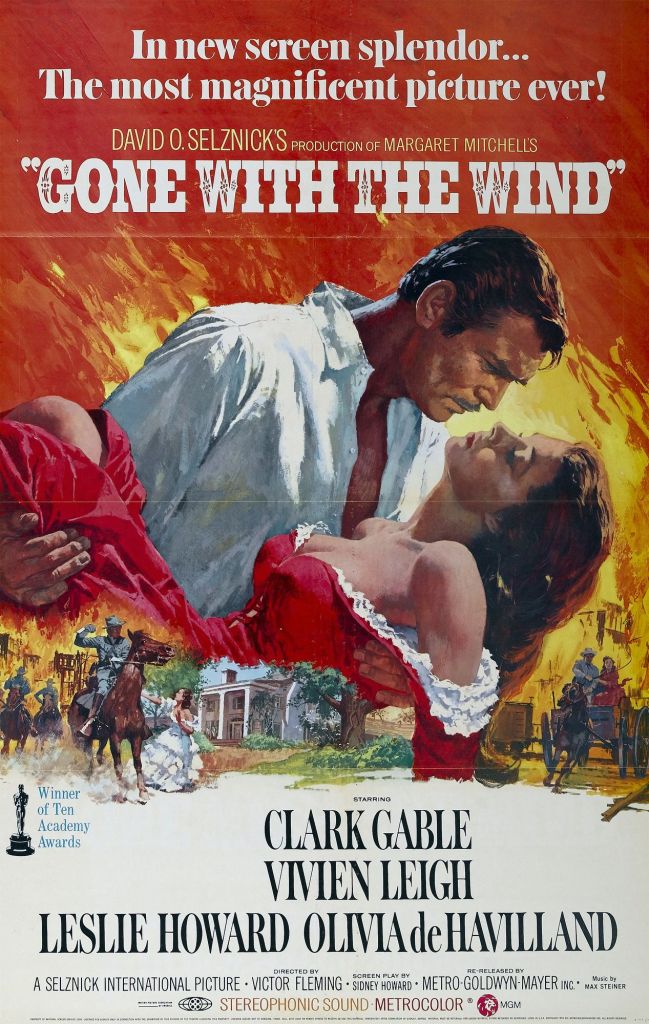
  • There have been a few other re-releases of “Gone with the Wind” over the years, most notably in 1961 to celebrate the Civil War’s centennial. Interestingly enough, it’s the poster for the 1967 re-release (as seen at the top of this page) that is most associated with the film.
  • Even before “Gone with the Wind” was made, readers were clamoring Margaret Mitchell for a sequel, but Mitchell always declined, saying she “left [Scarlett & Rhett] to their ultimate fate”. 25 years after Mitchell’s passing, her estate commissioned Anne Edwards to pen “Tara”, a novel that would concurrently be adapted for film. MGM was not happy with the final manuscript, and neither book nor film saw the light of day.
  • The Mitchell estate’s eventual sequel novel – 1991’s “Scarlett” by Alexandra Ripley – was a critical disaster, but a commercial success, and spawned a TV miniseries adaptation in 1994 with Joanne Whalley and Timothy Dalton.
  • Other novels have shown the events of “Gone with the Wind” from the perspective of other characters. The Mitchell estate approved of 2007’s “Rhett Butler’s People” by Donald McCaig, and definitely did not approve of “The Wind Done Gone“, Alice Randall’s 2001 novel from the slaves’ point of view. The Mitchell estate sued Randall and her publisher, but the case was settled when Houghton Mifflin (the publisher) agreed to make a donation to Morehouse College.
  • There have been at least three major attempts to turn “Gone with the Wind” into a musical. While they all remained true to the source material, and played around the world with the intention of coming to Broadway, none of them fared well in the shadow of the movie, and a musical of “Gone with the Wind” has yet to play New York.
  • Back to the movie: “Gone with the Wind” is so iconic, even its backstage story has a legacy. The casting call for Scarlett O’Hara has become so ingrained in Hollywood history, it eventually became a TV movie starring Tony Curtis as David O. Selznick.
  • NBC spent $5 million for a one time airing of “Gone with the Wind”, which aired in two parts on November 7th and 8th, 1976, and were the highest rated broadcasts in television history up to that point. Five nights later, CBS’s “The Carol Burnett Show” aired an extended parody skit “Went with the Wind!”. It’s a bit lengthy, and Vicki Lawrence’s take on Prissy is hard to swallow, but costume designer Bob Mackie’s send-up of Scarlett O’Hara’s makeshift curtain dress (with curtain rod still intact) is still one of the biggest laughs in television history. Carol Burnett’s immediate follow-up “I saw it in the window and just couldn’t resist” is the perfect button.
  • Speaking of parodies, IMDb lists over 1400 movies and TV shows that have referenced or spoofed “Gone with the Wind” at some point. The earliest comes from 1939’s “Second Fiddle”. Released six months before “Gone with the Wind”, “Fiddle” is about a publicity agent who falls for an actress during a nationwide search to cast the lead in a film version of a popular novel. Some veils are only so thin.
  • As for the other 1399 entries, some go after the movie’s iconic visuals, but most take a pass at the film’s famous dialogue. While I’m tempted to go with yet another classic “Simpsons” clip, let’s give “Clue” the final say this time.
  • But unfortunately this film’s most seismic legacy is its romanticizing of Civil War era south, and therefore the Confederacy and the white supremacy inherent. Although various organizations such as the NAACP were vocally opposed to this film’s racial depictions from day one, the topic didn’t seriously start being addressed until the mid-1990s, with nuanced discussion from many a film and history scholar. In more recent years, the Orpheum Theatre in Memphis cancelled its annual screening of the film due to public outcry, and of course HBOMax temporarily removed the film from its streaming service in light of the protests surrounding the murder of George Floyd. As someone who doesn’t believe in censoring art, I applaud HBOMax’s updated presentation of “Gone with the Wind” with appropriate historical context. To remove the film from the conversation entirely would be to ignore all the harm it has done. As I’ve said before on this blog, context excuses nothing, but does provide an opportunity to learn from the mistakes of the past.

As always, this blog post can only scratch the surface of the impact -good and bad – that this movie has had on our culture, but thanks for taking the ride with me. As much as I would love to “solve” the problem that is “Gone with the Wind”, it’s not up to one person; it’s up to all of us, as well as future generations who will continue to determine this film’s place in history. We can do better, and we must do better. After all, tomorrow is another day.

But wait, there’s more! As an added bonus, here’s Other Notes From the First Version!

  • “Gone with the Wind” was the first film shown on Turner Classic Movies, and was no doubt introduced by a young, bright-eyed Bobby Osborne.
  • This film features a man named Leslie playing a man named Ashley.
  • Yes, the sweeping romanticism of marrying your cousin. Cue the Steiner!
  • Love that intermission music. Sounds like an all-skate. Everybody on the rink!
  • This film was made the same distance from the end of the Civil War as we are currently from the end of World War II. Think about that, won’t you?
  • But of course, none of my original 2017 musings sums up my frustration with this movie better than “Goddamn you, ‘Gone with the Wind’.”

Further Viewing: That guy who did all those “premakes” I love so much also turned “Gone with the Wind” into a horror trailer. Please enjoy “Gone with the Wind…with Vampires”.

#29) Gone with the Wind (1939) – Part 2 (Other Notes)

Previously on “#29) Gone with the Wind (1939)”

Okay, got all that out of the way, on to “Other Notes

  • Right out the gate I got problems with this movie. The first shot is slaves toiling away in the cotton fields, with superimposed text heralding Mitchell’s novel as a “story of the Old South”. It’s gonna be a long four hours.
  • As previously stated, this film’s overall story is trash, but it’s well-made trash. Shoutout to cinematographer Ernest Haller (as well as Lee Garmes and Rey Rennahan) for the film’s Technicolor compositions, and composer Max Steiner for the best epic music score this side of “Lawrence of Arabia“.
  • There’s so much to unpack with Hattie McDaniel’s performance as Mammy. It’s certainly on par with the stereotypical black maid performances of the era, though McDaniel/Mammy is allowed some subtle nuance, actually interacting with the white characters on a personal level (by today’s standards it’s virtually nothing, but by 1939 standards it’s revolutionary). McDaniel got flak from the NAACP and other African-American groups of the day for playing an offensive stereotype, but McDaniel always commented “I’d rather play the maid than be one.” Side note: Although McDaniel did win an Academy Award for this performance, it was a segregated ceremony where she had to sit in the back. Despite the supposedly progressive stance the Academy took with this win, it would be another decade before another African-American was nominated in any category, and 24 years before the next competitive win.
  • I can’t stress enough that both Rhett and Scarlett are awful people. Sure they both evolve a lot as people by movie’s end, but man are they both rotten to each other in the process. The only compliment I can give is that Vivien Leigh has movie history’s definitive eyebrow arch.
  • While Leigh was able to successfully turn her British accent into that of a native Georgian, her fellow countryman Leslie Howard…not so much. Howard is either failing at his accent attempt or not attempting one at all. I honestly can’t tell.
  • I do not need a four hour movie telling me “Do Not Squander Time”.
  • On one hand, I think it’s important to acknowledge and learn about the Confederate’s perspective of the Civil War, but it shouldn’t be through the glossy rose-colored glasses of this movie. Add into the mix a persistent “happy slaves” trope, and you’ve got a movie with more gaslighting than “Gaslight“. You want a more nuanced look at the war, stick with Ken Burns.
  • Then known as the romantic lead in a series of adventure movies with Errol Flynn, Olivia de Havilland gets a chance to play slightly against type as the goody-two-shoes Melanie. A lesser actor would have made her too syrupy to the point of annoyance, but de Havilland plays her as a woman who conciously chooses to focus on the positive aspects of her life and those around her, turning her sunniness into her biggest strength. Also worth noting: At the time of this post, Olivia de Havilland is still alive, and turns 104 this week!
  • THERE’S A LARGE POSTER OF JEFFERSON DAVIS AT THE CHARITY DANCE! ALRIGHT I’LL TALK, JUST MAKE IT STOP!
  • Also hurting the film is the fact that every Black character in the movie is comic relief. Look no further than Thelma “Butterfly” McQueen as Prissy, the O’Hara house servant who famously “don’t know nothin’ ’bout birthin’ babies.” “Gone with the Wind” was McQueen’s first feature (although “The Women” was released first), and while she took the part as a stepping stone to better roles, she found the character demeaning and became frustrated when she became typecast. Although McQueen never got another role that surpassed Prissy in the mind of filmgoers, she worked steadily in film, television and theater for the next 50 years.
  • As I often state on this blog, Melanie Hamilton is the first recipient of the “Melanie Hamilton Award for Most Quiet Childbirth”. Even the baby doesn’t raise his voice, and he survived the burning of Atlanta!
  • Oh my god, everyone stop saying “darky”! It’s an uncomfortable moment every time someone says it, but the NAACP successfully lobbied the filmmakers to use that word as a substitute for…something else.
  • “We didn’t treat [slaves] that way. Besides, I’d have freed them all when father died, if the war hadn’t already freed them.” Oh, so NOW you want to backpeddle your depiction of slavery? Ashley’s “we were the good kind” dialogue is too little, too late.
  • Oh, and the “political meeting” Rhett and Ashley go to before raiding the shanty town is a Klan meeting. Even in the 1930s, they knew better than to explicitly mention that little detail.
  • If the film’s racist issues aren’t enough for you, this movie also offers you some marital rape. Rhett spends most of the movie telling Scarlett that he knows what’s good for her, and it’s easy to just assume he means in terms of life skills and common sense. Turns out he meant sex, and in a moment of drunken anger, forcibly carries Scarlett up the stairs and rapes her off-screen. As if that weren’t bad enough, the next shot is Scarlett in bed the next morning giving a satisfied sigh. WHY DID WE REVERE THIS MOVIE FOR SO LONG?
  • And now we arrive at perhaps THE line from this movie: “Frankly my dear, I don’t give a damn.” It’s definitely one of the best exit lines in movie history, and totally justified given how horribly Scarlett has treated Rhett throughout this movie (to say nothing of the vice versa situation). Stories of Selznick having to pay a fine to the Hays Office for the word “damn” are almost correct. One month before the film’s release, the Hays Office amended their stance on the words “hell” or “damn”, allowing instances in which the words are, among other examples, “a quotation from a literary work”.
  • For those of you who might not get the overall message of the movie, they really hit you over the head with it at the end. Scarlett hears several voice-overs of other characters reminding her that the Tara plantation (and its land) is the most important thing. “Gone with the Wind” has what I call a Rolling Stones ending: Scarlett doesn’t get what she wants (the love of Rhett or Ashley), but she gets what she needs (the land, and a more mature sense of self). Turns out there’s a well-crafted character arc underneath all this unpleasantness.

The legacy of “Gone with the Wind” (and a few bonus musings) can be found in Part 3!

#29) Gone with the Wind (1939) – Part 1

#29) Gone with the Wind (1939)

OR “A Movie Divided”

Directed by Victor Fleming

Written by Sidney Howard. Based on the novel by Margaret Mitchell.

Class of 1989

In the three years since I wrote my original “Gone with the Wind” post, the tone of this blog has evolved, and I’ve wanted to revise and expand this post to reflect that change. Also, in light of recent national events (as well as this film making headlines again), I felt that now was the best time to rewatch “Gone with the Wind” through the lens of our national dialogue about systemic racism. As always, this is a reminder that no single write-up can answer every question that this movie raises. Consider this post the beginning of a longer conversation we as a nation need to have about race relations and the continued impact of the Confederacy.

Also, brace yourselves: This is the Horse’s Head’s very first three-parter!

The Plot: In 1861 Georgia, spoiled plantation daughter Scarlett O’Hara pines over her neighbor Ashley Wilkes (Leslie Howard). Upon learning that Ashley is to be engaged to his cousin Melanie Hamilton (Olivia de Havilland), Scarlett throws a passive aggressive tantrum at their announcement party, much to the amusement of fellow guest Rhett Butler (Clark Gable). When the Civil War breaks out, Scarlett’s world is turned upside down, and through her hardship is forced to mature into an independent, shrewd business woman. This growth occurs simultaneously with her on-again, off-again attractions to Rhett Butler, which complicates her feelings for Ashley. There’s plenty of drama in this iconic, masterful…love letter to the Confederate South!? To quote another movie, fasten your seat belts.

Why It Matters: The NFR calls it “one of the most popular and influential American films produced” and “possibly the definitive example of filmmaking in the Hollywood studio era.” The work of composer Max Steiner, as well as the main cast, are highlighted. An essay by author Molly Haskell briefly touches upon the film’s problems, but is mostly of celebration of Scarlett O’Hara’s subversion of the female movie character tropes of the day.

But Does It Really?: It seems that in recent years “Gone with the Wind” has finally been removed from the “Casablanca“/”Citizen Kane” list of quintessential classic films and added to the “Birth of a Nation” list of important yet increasingly problematic American movies. “Gone with the Wind” is still the pinnacle of studio system filmmaking (ironic since it was a co-production with independent producer David O. Selznick), with an epic scope that no other movie from the era can match, and it spent the majority of the 20th century as an oft-referenced, oft-parodied cultural icon. This all being said, “Gone with the Wind” is a romanticized take on the Confederacy that due to its phenomenal success continues to create issues in our culture today, and its racist overtones permeate the entire film, even in scenes that don’t explicitly involve the slave characters. While the film’s entertainment value has plummeted in recent years, its historical and cultural significance is still being felt with a strength that very few movies of the era still possess. No argument for NFR inclusion, but the days of “Gone with the Wind” as one of the greatest movies of all time are, well….gone with the wind.

Everybody Gets One: Like many British movie stars of the era, Leslie Howard first found success on the London stage, followed by a transition to Broadway, and eventually Hollywood. When approached for “Gone with the Wind”, Howard felt he was all wrong for Ashley Wilkes, but David Selznick enticed him with an additional offer to produce and star in another movie (1939’s “Intermezzo”). Howard was devoted to the Allied cause during WWII, and was tragically killed in action when the aircraft carrying him was shot down over the coast of Spain.

Wow, That’s Dated: Oh, we will talk about what’s dated in this movie; you just keep reading.

Title Track: Margaret Mitchell chose the title “Gone with the Wind” from a line in a poem by Ernest Dowson: “I have forgot much, Cynara! gone with the wind”. Mitchell used the line as a reference to the loss of the Southern way of life (and/or lost love). Side note: the more flowery explanation of the title in the film’s opening segment was written for the movie, and was not featured in the original novel. Allegedly, Margaret Mitchell did not appreciate this addition.

Seriously, Oscars?: The last major release of the Greatest Year in Movies, “Gone with the Wind” opened to blockbuster business, becoming the most successful film of all time (and adjusted for inflation, still is). Two months later “Wind” entered the Oscar race with a record-breaking 13 nominations. The film won eight Oscars (also a record), plus an additional two tech awards. Among its wins: Best Picture, Director, Actress, and Supporting Actress for Hattie McDaniel (the first African-American to win or even be nominated for an Oscar). The “Gone with the Wind” sweep was such a foregone conclusion that first-time emcee Bob Hope jokingly dubbed the ceremony “a benefit for David Selznick”.

Before we get to “Other notes”, I felt that a few of the film’s production notes deserved their own section called…Production Notes.

  • Margaret Mitchell based “Gone with the Wind” on her family’s recollections of growing up in the Civil War/Reconstruction Era. The novel caught the eye of several studios before it was published. David Selznick was initially skeptical about the novel’s film possibilities, but his story editor Kay Brown convinced him of the potential.
  • Pre-production lasted 2 1/2 years! Playwright Sidney Howard was hired to write the screenplay, and George Cukor signed on to direct. When Howard refused to fly out to Hollywood for rewrites, subsequent drafts were penned by playwrights Ben Hecht, Jo Swerling, and John Van Druten, among others.
  • The film’s other delay came from waiting for popular choice Clark Gable to become available. Gable initially had no interest in playing Rhett Butler, but finally agreed when Selznick offered him enough money that he could divorce his wife and marry Carole Lombard.
  • The search for Scarlett O’Hara is still the biggest casting call in movie history (though most of it was exaggerated for publicity). Mitchell wanted Miriam Hopkins, Cukor lobbied for Katharine Hepburn, and popular opinion sided with Tallulah Bankhead. Practically every actress in Hollywood auditioned for the part, but only the two finalists auditioned in Technicolor: Paulette Goddard and Vivien Leigh. Goddard was very close to winning the role, but her then-unconventional common law marriage to Charlie Chaplin proved too controversial. 25 year old unknown British actor Vivien Leigh was in Hollywood while her partner Laurence Olivier was filming “Wuthering Heights“, and was introduced to David Selznick by his brother Myron (Leigh’s theatrical agent at the time). Leigh won over David on the strength of her performance in “Fire Over England“, as well as a reading and screen test with Gable. Leigh joined the cast in January 1939, a month after the film started production!
  • The film’s biggest setback occurred three weeks into filming when Selznick fired director George Cukor. Selznick felt that Cukor’s work wasn’t dynamic enough (and there is speculation that Gable didn’t like working with an openly gay director). MGM’s Victor Fleming was hired to replace Cukor, leaving “The Wizard of Oz” midway through its production (but that’s another story). Vivien Leigh and Olivia de Havilland were both devastated by the replacement, and secretly continued to meet with Cukor on weekends to develop their characters. Fleming filmed the bulk of the movie (and reshot most of Cukor’s work), but was temporarily replaced by Sam Wood when he took a hiatus due to exhaustion.

Okay, now we can get to the film proper….in Part Two!