#132) One Week (1920)

12b4d37c988be206e475f751454db983

#132) One Week (1920)

OR “Keaton’s Curb Appeal”

Directed & Written by Eddie Cline and Buster Keaton

Class of 2008

The full short, along with an original score by The Lucky Dog Picturehouse and a live audience.

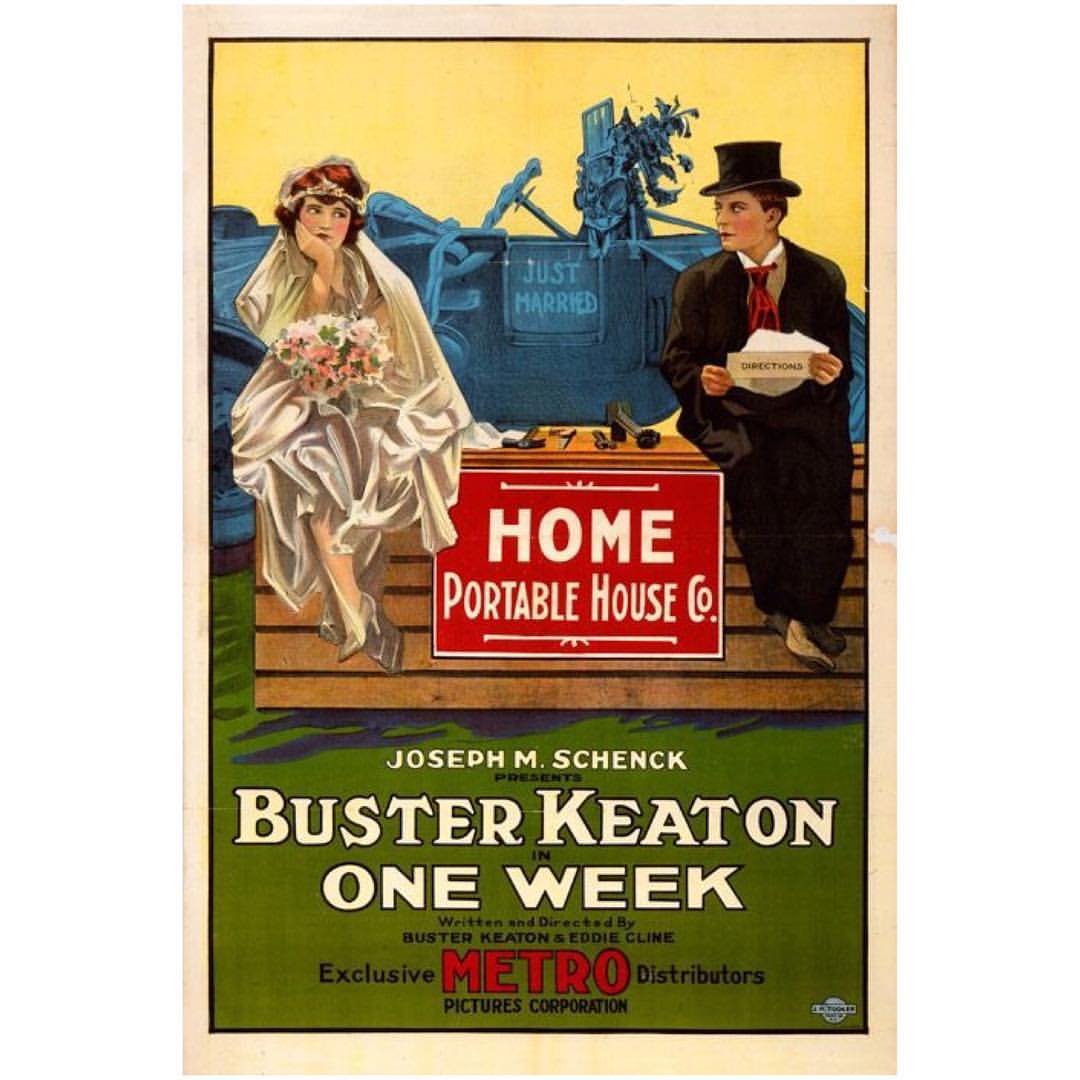
The Plot: A newly married couple (Buster Keaton & Sybil Seely) assembles their home from a build-it-yourself kit. After some tampering by the bride’s jilted ex, Hank (Actor Unknown), the completed house is filled with mistakes, from doors that lead nowhere to rooms with no ceiling. This arrangement is terrible for the newlyweds, but perfect for a young Buster Keaton showing off his comedic chops in his directorial debut.

Why It Matters: The NFR praises this film to the hilt, calling it “one of the greatest short comedies produced during the 1920s”. So…no pressure. There’s also a pretty thorough essay by film historian Daniel Eagan.

But Does It Really?: Yes, in the sense that any first step is important to document. Keaton’s just starting out with this film, but you can see how much of his comic genius was already on display from the get-go. Plus, this being a purely visual film, much of the humor still holds up today. Definitely worth a watch, even for you prudes who don’t want silent films.

Everybody Gets One: Not much is known about leading lady Sybil Seely, other than she did a few more films with Keaton before being replaced with Virginia Fox. Her film career ended in 1922 at the ripe old age of 20.

Wow, That’s Dated: This all takes place back when you could just buy someone a house for their wedding present. Also, are hobby-horses still a thing?

Other notes

  • “One Week” is noteworthy for being Keaton’s first film with his own production unit at Talmadge Studios after working under “Fatty” Arbuckle’s unit for three years. Let me look up what happened to Arbuckle after they…OH DEAR GOD!
  • This film is actually a parody of the 1919 educational short “Home Made”, right down to the “build-by-numbers” house design. Not sure if any print of “Home Made” still exists. Check your attics.
  • Who gets married on a Monday?
  • Handy Hank strikes me as the Biff Tannen in this situation.
  • Nice use of film reversal when Sybil throws Buster a hammer.
  • Surprise cameo by Captain Lou Albano as the piano mover.
  • Hank, Buster can’t hear your screaming. It’s a silent movie.
  • Keaton does the same thing I do when I ruin my carpet: just put a throw rug over it.
  • The scene of Sybil in the bathtub features what may be the best fourth wall joke in any movie ever.
  • Nope, definitely not a safety net under the ground that Keaton falls on. Why would you ever think such a thing?
  • Pretty sure the house collapses the exact same way the “Poltergeist” house did.

Legacy

  • Keaton would do the “house falling around a character” bit again (and to greater notoriety) in “Steamboat Bill Jr.
  • The dangers of expanding this joke to feature-length are on display in “The Money Pit”.
  • I’ll just assume this film inspired the Barenaked Ladies song.

#131) Dances with Wolves (1990)

dances_with_wolves_ver2

#131) Dances with Wolves (1990)

OR “White Savior: The Motion Picture”

Directed by Kevin Costner

Written by Michael Blake. Based on his novel (which was based on his unsold screenplay).

Class of 2007

The Plot: Union Lt. John Dunbar (Kevin Costner) is transferred to Fort Hays, Kansas to see the frontier before it disappears. He finds the fort deserted and sets camp by himself. He eventually makes contact with a neighboring Dakota tribe, who want nothing to do with him except for holy man Kicking Bird (Graham Greene) and Stands with a Fist (Mary McDonnell), a white woman raised by the tribe. As Dunbar begins to assimilate the Lakota, the threat of the Pawnee (as well as the white man) looms.

Why It Matters: The NFR praises the film’s cinematography and score, as well as its more sympathetic and diverse portrayal of the Lakota Sioux. There’s an all-encompassing essay by Angela Aleiss, who knows a thing or two about Native American portrayals in film.

But Does It Really?: As much as I don’t care for Kevin Costner, he did direct and produce a wonderfully executed western epic. It doesn’t fall into too many trappings (except for the aforementioned “white savior” complex), and the whole film has a masterful scope without feeling bloated. While not without its controversy and mixed response within the Native American community, the film’s diverse portrayal of the Lakota is a step in the right direction. I don’t know if “Dances with Wolves” is Best Picture-good (more on that later) but it is definitely NFR-worthy.

Everybody Gets One: Everybody, most notably Kevin Costner**, Mary McDonnell, former “Murphy Brown” actor Robert Pastorelli, and infamous “SNL” player Charles Rocket. And special mention to Teddy and Buck, the two wolves who played Two Socks.

Wow, That’s Dated: The only major giveaway is right at the beginning when the logo for gone-but-not-forgotten Orion Studios appears.

Title Track: “Dances with Wolves” is Dunbar’s Lakota name and doesn’t come up until about 110 minutes into the film.

Seriously, Oscars?: A movie projected to flop so badly it was dubbed “Kevin’s Gate”, “Dances” surprised everyone, particularly Costner, with its critical, commercial, and Oscar success. The film led the 1990 Oscars with 12 nominations, winning seven; including Picture, Director, Adapted Screenplay and Score. This is all well and good until you learn that they beat out “Goodfellas” in most major categories. The internet still won’t let the Academy live that one down.

Other notes

  • First off, I’ve always been a fan of John Barry’s work as a composer. He’s the man who gave us the James Bond theme, the score to “Out of Africa”, and perhaps the most epic music for an “Alice in Wonderland” adaptation ever.
  • No wonder the Confederacy lost the war; they can’t shoot for shit.
  • We all agree that Dunbar’s facial hair is fake, right?
  • This film is the answer to the trivia question: “Which Best Picture winner features Eldin from ‘Murphy Brown’ experiencing flatulence and being scalped alive?”
  • Ladies and Gentlemen, Kevin Costner’s butt! At least now we know how this film got financed.
  • As much as I enjoy John Barry’s score, every selection sounds like the music playing when they announce, “Winner of 13 Academy Awards”.
  • For a three-hour film, everything clips along at a good pace. I will grant the film that. I also applaud the film’s sparing use of dialogue. You are only told what is absolutely needed. Everything else is conveyed in the visuals.
  • That buffalo hunt scene is amazing, if just for the fact that there were still enough buffalo in 1989 to film it.
  • Dunbar dances just like 90% of all white men. Guilty as charged.
  • This is the second film I’ve covered on this blog that has some beef with a tribe of Pawnee. Turns out the Lakota weren’t as passive towards the Pawnee in real life.
  • How does one direct themselves in a sex scene?
  • The Lakota also call Dunbar “Busy Bee”, but that’s not as good a title.
  • Man, white people suck.
  • Stick around during the credits for such fun crew nicknames as “Sled”, “Dumbo”, “Living Legends”, and “BS”.

Legacy

  • Kevin Costner’s directing career never really took off after this film. He instead focused on producing and acting (and allegedly a little back seat-directing every now and then). Costner’s only other credited films as director are “The Postman” and “Open Range”.
  • We got a wide range of films in the ‘90s starring and/or about Native Americans, from a remake of “Last of the Mohicans” to “Smoke Signals” to “Pocahontas”. After that, not so much.
  • The novel of “Dances with Wolves” received a sequel in 2001: “The Holy Road”. Attempts at turning this sequel into a film with Viggo Mortensen taking over the role of John Dunbar have stalled over the years.
  • Since 2010, there have also been stabs at a musical theater adaptation. Don’t get me wrong; with the right people involved you can make a good musical about anything. I just think the degree of difficulty’s a bit higher on this one.
  • The Sioux Nation adopted Kevin Costner as an honorary member, because someone had to.
  • Graham Greene poked fun at his own performance on an episode of “The Red and Green Show”.
  • And of course, the film’s wildly successful 2009 remake: “Avatar”.

Further Viewing: Two movies with enough parallels with “Dances” to warrant some major complaints from their filmmakers, 1957’s “Run of the Arrow” and 1970’s “A Man Called Horse”. What do YOU think?

**2017 Update: Costner now has “Field of Dreams” as well. If you build it, he will keep showing up on this list.

#130) Notorious (1946)

notorious

#130) Notorious (1946)

OR “Went to a Nazi Party”

Directed by Alfred Hitchcock

Written by Ben Hecht. Based on the story “The Song of the Dragon” by John Taintor Foote.

Class of 2006

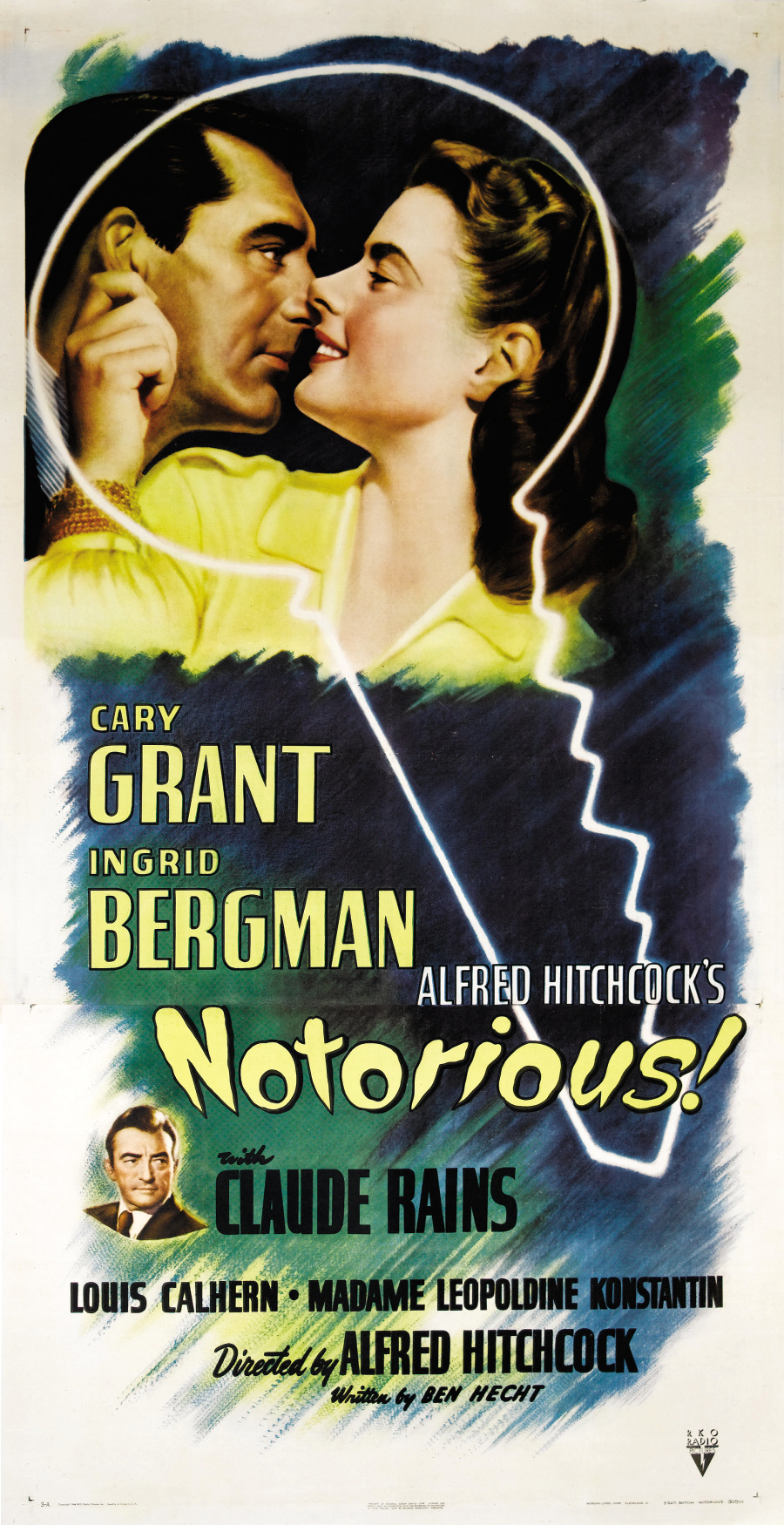
The Plot: Immediately following the conviction of her Nazi-spy father, Alicia Huberman (Ingrid Bergman) is recruited by American agent Devlin (Cary Grant) to track down a group of Nazis living in Brazil. While down there she has a rendezvous with Alex Sebastian (Claude Rains), alleged Nazi and former “playmate” of Alicia’s. There’s also a sub-plot about uranium, but who cares? This film is all about the suspenseful, dangerous, and surprisingly heated love triangle between Alicia, Devlin, and Alex.

Why It Matters: The NFR praises Hitchcock, Bergman, and Grant, and calls the film “[a]rguably Alfred Hitchcock’s best black-and-white American film”. Warranted praise for sure, but quite a few qualifiers there.

But Does It Really?: Oh yes. “Notorious” may not crack the top of people’s Best Hitchcock list, but it is still an excellent example of Hitch’s signature style. The first American film Hitch did without David O. Selznick as “the muscle”, you can see him start to blossom artistically with “Notorious”. The clockwork script and airtight direction are aided by the undeniable star power of Cary Grant and Ingrid Bergman. They both play their parts perfectly, but also exude the kind of radiance you can only get with classic movie stars. Of all the Hitchcock films, this one has earned its reputation as his most…infamous? Is that the word I’m looking for?

Everybody Gets One: Most of the supporting cast, most notably Leopoldine Konstantin, the renowned Austrian actor in her only American film. She was so revered that she’s listed in the credits as “Madame Konstantin”.

Wow, That’s Dated: For starters, this film literally dates itself as 1946 in the opening text. “Notorious” also gives us a classic “driving in front of rear projection” scene. And speaking of traveling, guests of “Notorious” fly Pan-Am!

Take a Shot: Wow, no one says the word “notorious” at any point in this film.

Seriously, Oscars?: “Notorious” only received two Oscar nominations: Original Screenplay, and Supporting Actor for Claude Rains. Rains lost to Harold Russell for “The Best Years of Our Lives”, while screenwriter Ben Hecht lost to the screenplay of “The Seventh Veil”. You know, that classic. Most egregious of the film’s Oscar snubs was Ted Tetzlaff for his brilliant cinematography.

Other notes

  • German worker? Were they not allowed to say “Nazi”? Or was it just too soon?
  • Right off the bat I love this movie because of Ingrid Bergman and Cary Grant. Here are two real movie stars doing what they do best. They know exactly where the camera is and how to play to it. These two performances are not only great acting, but also a full display of that indefinable star quality.
  • Devlin has Alicia’s conversation with her father recorded on vinyl. Very hipster.
  • Holy crap that kissing scene is pretty sexy. I don’t usually go for Old Hollywood romance, but you can feel the heat from these two! Also, if you’re reading this post, I assume you are familiar with how everyone snuck this kiss by the censors.
  • Speaking of, Hitch seems to be restraining himself in the sexual innuendo department. Either it’s so subtle I missed it, or Alma was around to keep Hitch in line.
  • Cary Grant really could do no wrong as an actor. He rarely played this dark or stoic a character, but it somehow fits his screen persona like a glove.
  • Oh Hitch, you and your mother issues. Alfred’s mother died in 1942, and he starts exorcising some demons with this film. And it just gets more cathartic from there.
  • Claude Rains is great as a man obsessively possessive over Ingrid Bergman. Wonder if he got any pointers from his director…
  • Once we get to Alicia retrieving the missing key, the film really kicks into high gear and we see the Master at work.
  • Speaking of that key, this is the best advertisement Unica ever got.
  • I love that crane shot so much all I can do is make the fingertips kiss gesture and type it out as “mwah!”
  • You know those phrases you’ve never heard before but once you do you start to hear them everywhere? That’s me and “his nibs” right now.
  • Hitchcock’s cameo is a little late in the film. Where you going, Hitch?
  • Is “Notorious” the reason TCM thinks they need a wine club? And while Devlin is looking for a bottle, might I recommend the ‘34 MacGuffin?
  • Alex and Alicia sleep in separate beds? Is this the Rob & Laura Petrie mansion?
  • Yes, the best part of waking up is your first morning cigarette in bed.
  • Why does Ingrid Bergman always marry men that want to kill her?

Legacy

  • “Notorious” was remade for TV in 1992 with John Shea and Jenny Robertson. Its Wikipedia page has been removed, so that tells you the film’s success rate right there.
  • The film was remade again in 2009. I haven’t seen it, but they seem to be taking a lot of liberties with the source material.
  • The plot of “Notorious” has been heavily alluded to in such diverse titles as “Mission: Impossible 2” and an episode of “Star Wars: The Clone Wars”.
  • Jimmy Stewart casually can’t remember the name of this movie in “Rope”.
  • Perhaps the film’s most touching legacy: after filming, Cary Grant kept the infamous wine cellar key. Years later he gave it to Ingrid Bergman, who presented it to Alfred Hitchcock in 1979 during his AFI Lifetime Achievement ceremony.

#129) H2O (1929)

H2O. 1929. Ralph Steiner.png-002

#129) H2O (1929)

OR “13 Lakes’ Great-Grandparent”

Directed by Ralph Steiner

Class of 2005

The Plot: Water. It’s 12 minutes of water in various forms (though mostly up-close and abstract). No music, no commentary, just water.

Why It Matters: The NFR calls the film a “cinematic tone poem” with “striking visual effects”.

But Does It Really?: I dunno. We got plenty of Ralph Steiner on this list, and I can’t find any direct influence that this film has had, but it’s nice to know that avant-garde filmmaking was happening as early as the late ‘20s. If nothing else, this film must be fun to watch while high.

Wow, That’s Dated: Nothing, for the natural ebb and flow of water is timeless, much like the endless ebb and flow of life.

Other notes

  • Great, now I really have to pee.

Legacy

  • Ralph Steiner would go on to be the cinematographer on future NFR entries “The Plow That Broke the Plains” and “The River”, as well as a co-director on “The City”.
  • Many avant-garde filmmakers cite Ralph Steiner as an influence, so he’s got that going for him.
  • “H2O” would be remade in 1998 starring Jamie Lee Curtis.