#255) The Decline of Western Civilization (1981)

tumblr_osymqiZIjh1u4wuupo1_1280

#255) The Decline of Western Civilization (1981)

OR “What’s the Matter With Kids Today?”

Directed by Penelope Spheeris

Class of 2016

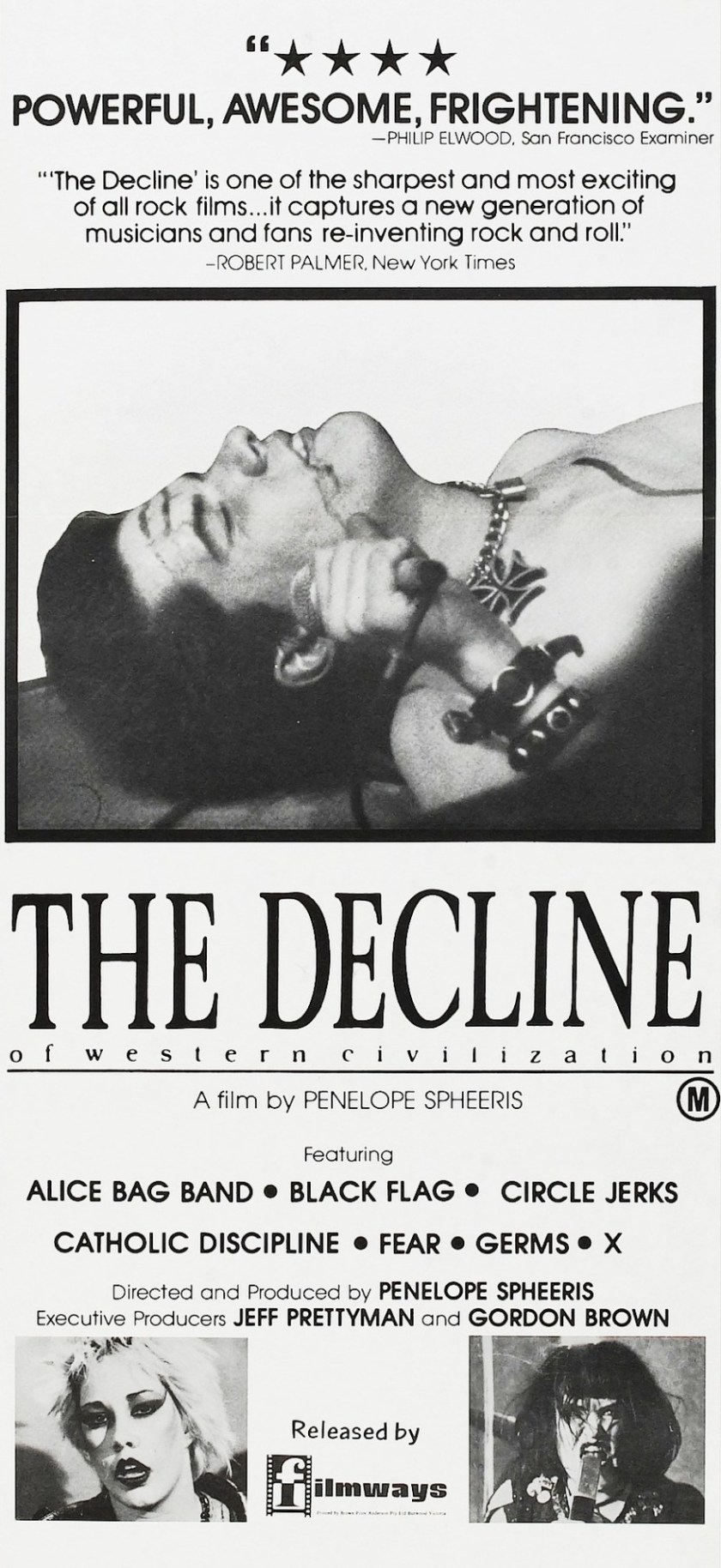
The Plot: It’s 1980 and the L.A. rock scene has evolved into the first wave of hardcore punk. Filmmaker Penelope Spheeris chronicles the era on and off-stage with such notorious bands as Black Flag, Germs, Catholic Discipline, X, Circle Jerks, Alice Bag Band, and Fear. Each band’s anarchic attitude towards music, L.A., and even their own fans is on full display. Also featured are the owners of L.A. clubs Masque and Club 88 coping with their new clientele, the bands’ fans articulating their devotion to this scene, and the editors of “Slash”, the first punk rock zine. Come for the insight into this burgeoning subculture, stay for the kick-ass soundtrack.

Why It Matters: The NFR calls it “a bracing historical and musical record” of the L.A. punk rock scene.

But Does It Really?: Maybe it’s because I’ve spent the last year and a half watching classic Hollywood fare, but “The Decline of Western Civilization” was a breath of fresh air for me. Despite what others might say, punk rock was the music that actually broke all the rules, and this film covers the chaotic energy of early punk perfectly. At no point does Spheeris attempt to explain or contextualize the music; she lets her subjects be their unapologetic selves. “Decline” is a documentary where the cameras were rolling at the perfect moment, and a welcome addition to the Registry.

Shout Outs: Black Flag lead Ron Reyes sings a snippet from “America” from “West Side Story”.

Everybody Gets One: Director Penelope Spheeris spent most of her childhood travelling the country with her father’s carnival, leading to her lifelong understanding of people on the margins of status quo. Spheeris was inspired to become a filmmaker by her cousin, Costa Gavras of “Z” and “Missing” fame. “Decline” was her feature debut.

Wow, That’s Dated: Besides the obvious dissection to the punk rock scene, this film references such ‘80s things as mullets, arguments about nuclear power, and the ancient art of editing a physical magazine.

Seriously, Oscars?: No Best Documentary nomination for “Decline”. The winner that year was “Genocide”, a film about the Holocaust. No room for mosh pits and atonal screaming at the 1982 Oscars.

Other notes

  • Full disclosure: The only bands I was familiar with prior to my viewing were Circle Jerks and Fear, and even then, I was aware of them in name only.
  • The lyrics for some of these songs appear on screen. Everybody sing along!
  • I learned about the punk dance craze pogo from, of all things, an episode of “Pee-wee’s Playhouse”. And who said that show wasn’t educational?
  • How many of these bands hated this movie?
  • Sadly, the main takeaway from this film is Germs lead Darby Crash, who died of an intentional heroin overdose at age 22. The film’s literal poster child passed away seven months before the film’s release, and the final cut is a telling look at the end of a tragic life.
  • Germs had been banned from practically every L.A. club by the time filming began. Penelope Spheeris had to rent a studio to film their performance.
  • Darby’s going for a Mick Jagger vibe, right?
  • Either fashion has not changed in the last 35 years, or the early ‘80s punk look is making a comeback nowadays.
  • Not a lot of screentime devoted to Catholic Discipline; probably because the group had already disbanded by the time the film was released. Also gone before the production wrapped was the fan zine “Slash”, which folded after their Summer 1980 issue.
  • Of all the featured groups, X seems like the most approachable band. They’re rebelling against everything, but you can still come over to their place for a beer. Lead vocalists John Doe and Exene Cervenka were married (and divorced) shortly after the film was made.
  • The club security meeting captured on camera is a bit rough, especially when they try to differentiate moshing with fighting. “She may be crying, but she may be into it.” Yikes.
  • No matter how you slice it, punk rock is still 90% white people trying to dance.
  • How cool can you really be when your name is Eugene?
  • This film is delightfully bookended by Wayne Mayotte, then owner of Club 88, trying to explain what punk is. It’s like watching your parents describe flossing.
  • The climax of the film is the Fear performance. They are every intense aspect of punk rock pushed up to 11.
  • After an hour and change of these bands screaming their vocals, it turns out Fear lead Lee Ving can actually sing! Side Note: You know Lee best as Mr. Boddy in the film version of “Clue”, where he was dubbed for some reason.

Legacy

  • Right off the bat, this film was causing problems. Fights between fans broke out at early screenings, prompting LAPD Chief of Police Darryl Gates to ban future screenings.
  • This is the first in a trilogy! “Part II” covers L.A.’s heavy metal scene in 1988, and “Part III” looks at homeless teens in the punk rock scene of 1998. Penelope Spheeris helmed all three, and was inspired during the third one to adopt one of the teens featured in the film.
  • I cannot stress enough that Penelope Spheeris went on to direct the film versions of “Wayne’s World”, “The Beverly Hillbillies”, and “The Little Rascals”.
  • Fear found a new fan in John Belushi thanks to this film. Belushi even managed to get them a gig at his old job, “Saturday Night Live”. Their infamous performance led to them being banned from SNL.
  • The filming of the Germs’ performance was recreated for the Crash Darby biopic “What We Do Is Secret”. Shane West’s performance as Crash led to him touring with the surviving members of Germs in 2006.
  • Of the featured bands, X and Fear are the only ones still performing with no interruptions. In addition to the aforementioned end of Catholic Discipline, Germs and Alice Bag Band both ended within a few years of this film’s release, Black Flag has reunited a few times, and Circle Jerks have been on hiatus since 2010.

Listen to This: None of the bands featured in this movie have made the National Recording Registry yet. Write to your congressperson.
#254) The Mark of Zorro (1920)

5105834152_459d39541a_b

#254) The Mark of Zorro (1920)

OR “19th Century Fox”

Directed by Fred Niblo

Written by Eugene Miller and Douglas Fairbanks. Based on the story “The Curse of Capistrano” by Johnston McCulley.

Class of 2015

The Plot: Don Diego Vega (Douglas Fairbanks) is Zorro, a masked swordsman who will defend anyone oppressed by the Alta California government. At night Zorro takes on corrupt Governor Alvarado (George Periolat) and Captain Juan Ramon (Robert McKim). By day Diego plays up his foppishness to divert suspicion and disappoint his father Don Alejandra Vega (Sidney De Gray), but still finds time to woo the young Lolita (Marguerite De La Motte). Action! Romance! Z carvings!

Why It Matters: The NFR contextualizes the film as the vehicle Douglas Fairbanks used to pivot from romantic comedies to his new more adventurous screen persona.

But Does It Really?: I’ll give it a pass for Fairbanks, but that’s it. Like the other NFR Zorro (not to mention the Antonio Banderas version), this Zorro is a bit bloated. Perhaps the Zorro stories work better in short spurts. No wonder the TV show was so popular.

Wow, That’s Dated: All together now: No one in this movie is actually Mexican.

Other notes

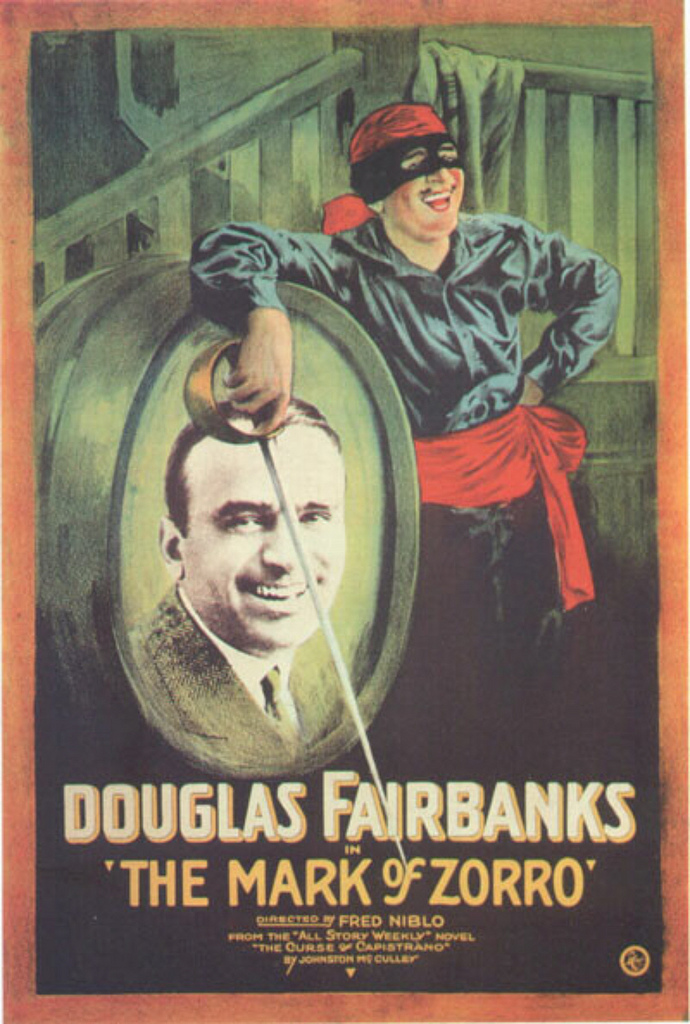
  • That…is a weird poster.
  • For some reason I thought the legend of Zorro has been around for a long time. “The Curse of Capistrano” was first published in 1919. Zorro’s less than a century old!
  • “Oppression – by its very nature – creates the power that crushes it.” Well that’s good stuff right there. That’s “Share If You Agree” worthy.
  • Noah Beery (Wallace’s brother) plays Sergeant Gonzales. Noah’s son, Noah Jr., makes his film debut here as one of the child extras. Noah Jr. would go on to play Jim Rockford’s dad on “The Rockford Files”.
  • That’s a fun reveal of Don Diego with the umbrella.
  • Zorro has a gun!? That’s cheating! Zorro’s main thing is being a great swordsman. You can’t give him a gun! How does he do a “Z” with a gun?
  • The opening swordfight is fun, but it helps that Gonzales follows the Movie Bad Guy Rule of letting the hero make the first move.
  • You can definitely see the influence Zorro had on Batman. Zorro’s even got his own Batcave in this movie (Zorro-cave? Fox Hole, that’s it).
  • To borrow from that other DC Universe character, I am calling Clark Kent BS on all this. How can anyone not know that it’s Don Diego under that mask? Especially you, Lolita.
  • Father Felipe is played by an actor named Walt Whitman. Obviously, not that Walt Whitman, but here’s his photo again anyway. Call him “ZZ Top”, because that is a sharp dressed man.

Walt_Whitman_-_George_Collins_Cox

  • Compared to the 1940 version, this “Zorro” has a little bit more of an emphasis on Zorro as a symbol of hope for an oppressed people. The Tyrone Power version has a much more helpless public waiting for their savior. As a result, the 1920 version ages better.
  • You have to wait about 90 minutes, but the climactic chase and fight showcase Fairbanks’ trademark stunts. It must have been thrilling to watch a guy only known for romantic comedies at the time kick some serious butt. This Zorro succeeds because of its James Bond “How’s he gonna get out of this one?” quality.

Legacy

  • This is the movie that brought Zorro to Mainstream America.
  • Five years after this film’s success, Fairbanks took the book “Don Q.’s Love Story” and re-worked it as the Zorro sequel “Don Q, Son of Zorro”. Fairbanks plays both title characters!
  • The original story was adapted for the sound era in future NFR entry “The Mark of Zorro” with Tyrone Power. It’s 15 minutes shorter but somehow slower.
  • “Let’s go to the movies,” my parents said. “It’ll be a great bonding experience,” they said.
  • And now I’ll just liberally steal from my other Zorro write-up:
  • Many films of Zorro over the years, but the only other one based on the original story is the 1974 version with Frank Langella.
  • I’ll always enjoy the ‘90s version “The Poke of Zorro” best. With Meryl Streep as the Stupid Nun.
  • It’s not directly connected to this film, but here’s the “Zorro” TV theme anyway.

#253) Saving Private Ryan (1998)

saving_private_ryan_ver2_xlg

#253) Saving Private Ryan (1998)

OR “Sorry About ‘Lost World’, Here’s a Classic”

Directed by Steven Spielberg

Written by Robert Rodat

Class of 2014

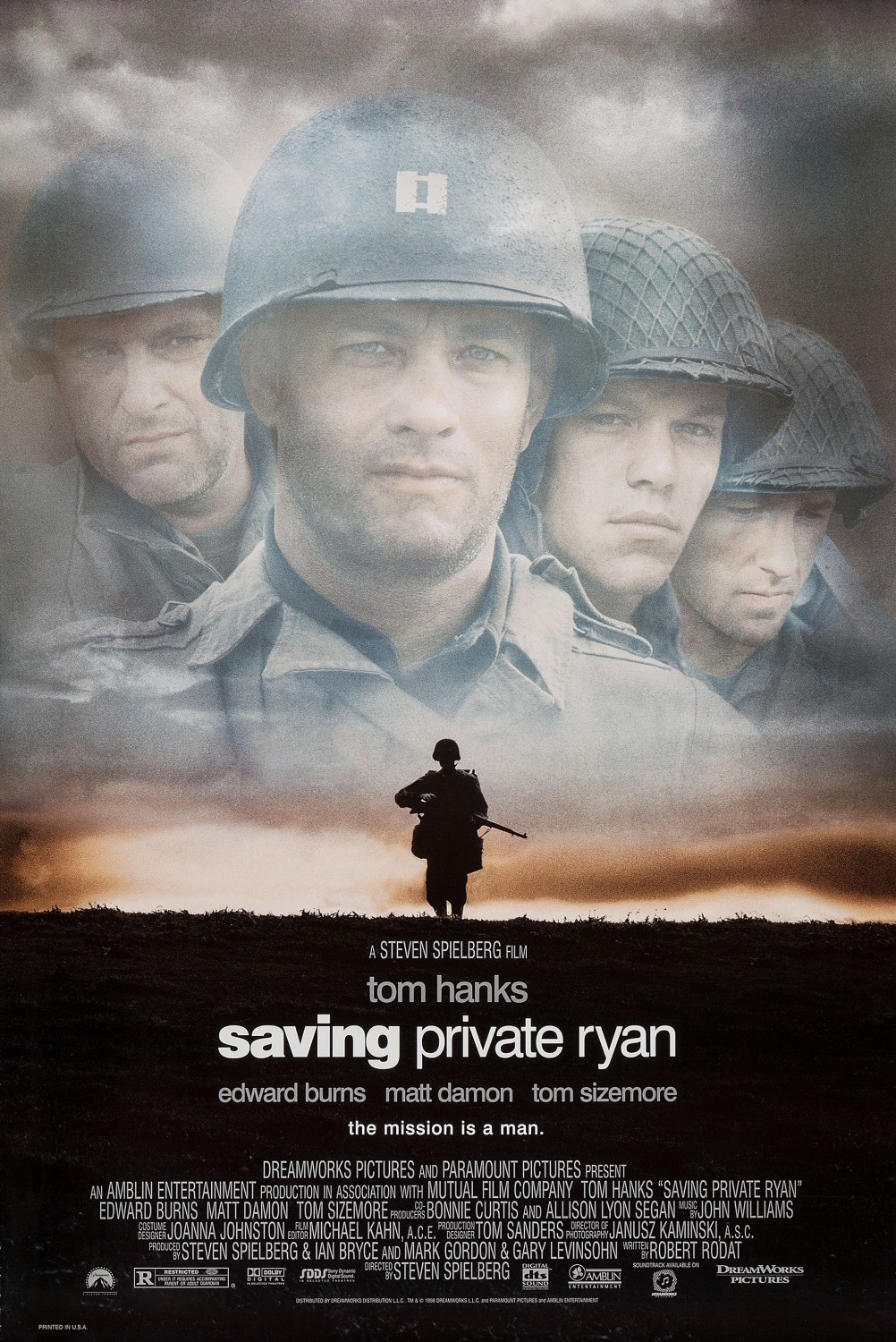
The Plot: While visiting the Normandy American Cemetery, an old man (Harrison Young) flashes back to his service in World War II. Following the chaotic, monumental Normandy Invasion on Omaha Beach, the 2nd Rangers Battalion is given the special assignment to find the missing Private James Ryan (Matt Damon) and send him home after the death of his brothers. The Rangers are incredibly skeptical about the mission, but their captain John Miller (Tom Hanks) insists that their journey will be worth it if they can bring Ryan back to his family. Through Spielberg’s unique point-of-view, World War II is a real and terrifying experience where there are no “good guys” or “bad guys”, just average people trying to hold onto anything while in the Hell on Earth that is war.

Why It Matters: The NFR praises Spielberg for “convey[ing] ultra-realism with harrowing intensity” and devotes about half of the paragraph to a Spielberg quote about not wanting to glamorize WWII.

But Does It Really?: This is another untouchable for me. Like its companion piece “Schindler’s List”, there are a few historical qualms, but as a film “Saving Private Ryan” is an achievement of the highest order. Spielberg and his team have made a war movie that doesn’t look or sound like any other war movie. “Ryan” is one of the rare epic films that doesn’t feel bloated or too self-important; Spielberg keeps you in the moment with these men at all times. Hanks nails a role that would prove to be a pivotal turning point in his career, and the entire ensemble of up-and-coming talent would go on to deliver on the promises they make in these performances. “Saving Private Ryan” is my vote for the last truly great film of the 20th century, and a no-brainer for NFR inclusion.

Shout Outs: The German soldier that the squad captures references “Steamboat Willie” and is listed by that name in the credits. And technically the film has an “E.T.” reference thanks to the Amblin logo.

Everybody Gets One: Like most recent entries, “Saving Private Ryan” is the single NFR appearance for a lot of the cast, many of whom have gone on to bigger and better things. Among them: Paul Giamatti, Vin Diesel, Barry Pepper, Edward Burns, Tom Sizemore, Giovanni Ribisi, Jeremy Davies, Nathan Fillion, and Bryan Cranston.

Wow That’s Dated: This film has occasional ‘90s CG throughout. Most of it blends in, but a few shots show their age.

Title Track: Tom Sizemore has the honor of saying that “saving Private Ryan” may be the good deed that gets them out of the war.

Seriously, Oscars?: The highest-grossing film of 1998, “Saving Private Ryan” scored 11 Oscar nominations and took home five: Cinematography, Editing, Sound Mixing, Sound Editing, and a second Best Director trophy for Steven Spielberg. The film was all but guaranteed to win Best Picture; the Academy even had longtime Spielberg-collaborator Harrison Ford present the category. And then, this happened…

Other notes

  • This is the first, and so far only, DreamWorks picture to be inducted into the NFR. Fingers crossed for “Shrek”.
  • Any doubts that this is a Spielberg film are immediately eliminated when the old man looks meaningfully at something off-camera.
  • This whole post can just be me analyzing the D-Day invasion sequence, yes? Here’s why it works: it doesn’t look like any other battle in any other war film. Part of that is Janusz Kaminski’s effective use of hand-held cameras and degraded color, and part of that is Spielberg’s unflinching use of violence. Late ‘90s audiences were already desensitized to violence by the time “Ryan” came out, but Spielberg brings you back to the reality and sheer horror of this war.
  • A Lincoln quote; nice foreshadowing Spielberg.
  • This is the movie where Tom Hanks became everyone’s dad. Miller is the first role where he gets to play a father figure, and you see him easing into that persona.
  • Kudos to casting director Denise Chamian. Practically every bit player in this movie has been successful. Even Matt Damon was an unknown when he was cast!
  • This is what I call a “Volume Up, Volume Down” movie: very quiet dialogue scenes, followed by very loud action scenes. My remote and I are inseparable during films like these.
  • Yep, that’s Ted Danson during that brief post-“Cheers” but pre-“Becker” period of his career. Way to go, Sam!
  • My favorite moment in the movie is when Mellish taunts the captured German soldiers with his Star of David. “Juden…Juden…Juuuuuuden.” The film has only a few light moments, but they’re all just the right amount.
  • Among the many things I appreciated about Kaminski’s cinematography is how much of the film is comprised of longer takes. They help keep you in the moment, whereas a lesser filmmaker would use quick cuts to convey wartime action.
  • For someone who’s been fighting in the trenches, Damon has the whitest teeth.
  • Why do we still not have an Oscar for stunt coordination? Someone should have won something for the stunts in this movie.
  • “Earn this.” And I’m crying.
  • An interesting piece of trivia: “Saving Private Ryan” was one of the last movies to be released on laserdisc. What a time to be alive.

Legacy

  • “Saving Private Ryan” is the first of five (and counting) collaborations between Spielberg and Tom Hanks. My personal favorite is “Catch Me If You Can”.
  • Spielberg and Hanks have also co-produced two TV projects about WWII: “Band of Brothers” and “The Pacific”.
  • “Saving Private Ryan” not only revived public interest in WWII, but also inspired several video games set during the war. See “Medal of Honor” and “Call of Duty” to name just a few.
  • Quentin Tarantino was inspired by “Ryan” to make his own WWII movie: “Inglorious Basterds”. Well, he got the violent part down.
  • Many parodies over the years, most memorably the “Imaginationland” episodes of “South Park” [Footage Not Available].
  • Hanks would appear in the film’s drastic departure of a sequel: 2013’s “Saving Mr. Banks”.
  • “Hey, is that Hitler over there?”

Listen To This: One of the most sobering listening experiences in the National Recording Registry is journalist George Hicks’ recording of the D-Day Invasion. Broadcast the evening of June 6th 1944, this was the first account of the landing to be heard by the American public.

#252) Decasia (2002)

DECASIA-2-960x732

#252) Decasia (2002)

OR “Weirdest Clip Show Ever”

Directed & Written by Bill Morrison

Class of 2013

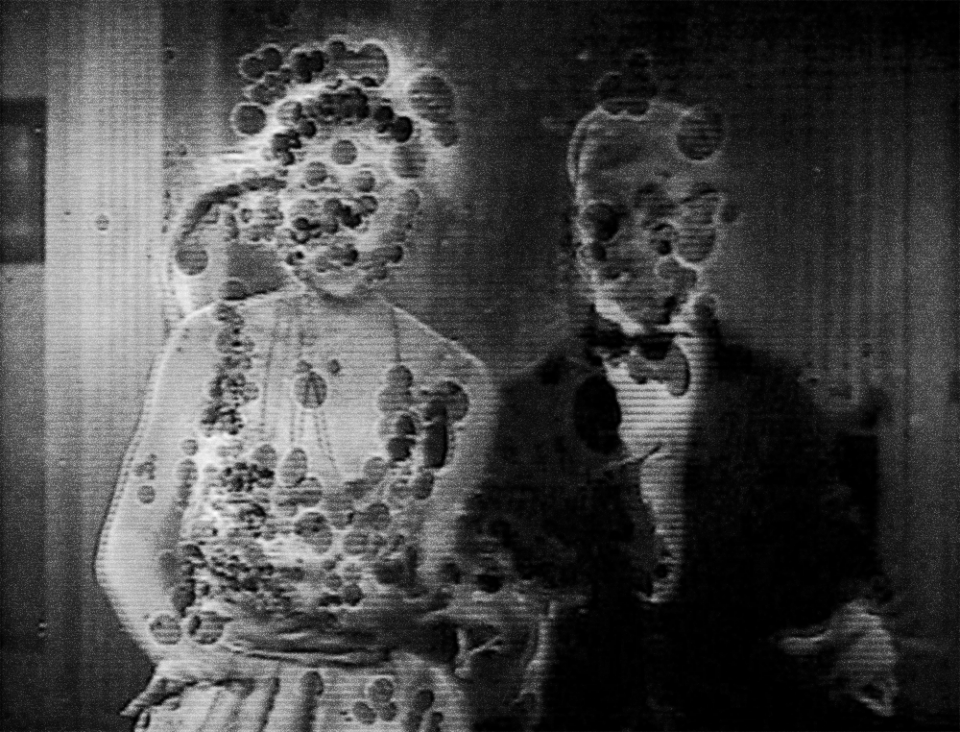
The Plot: Culling from dozens of silent films, with quality varying from deteriorating to unrecognizable, Bill Morrison creates a narrative that showcases these clips in their natural unrestored state, all set to a score by Michael Gordon.

Why It Matters: The NFR write-up is mostly a description of how Bill Morrison put this film together, mixed with critical praise, including from Errol Morris who said “[‘Decasia’] may be the greatest movie ever made.” There’s also an essay by silent film expert Daniel Eagan.

But Does It Really?: Well, it’s that experimental type of film I’m always on the fence about, but I can give this one a pass. Bill Morrison’s contributions to film preservation cannot be ignored, and here he has managed to salvage the unsalvageable and turn it into art. The footage is well-chosen, expertly timed to the music, and masterfully edited to create a unique narrative. This movie works on a lot of levels, with Michael Gordon’s slightly off-balance score keeping things interesting. A must-watch for film lovers, though I hope the Library of Congress realizes that preserving this film doesn’t automatically preserve the footage featured in it.

Everybody Gets One: Bill Morrison is known for utilizing old and decaying film footage in his art pieces. “Decasia” was commissioned to play alongside Michael Gordon’s already completed score of the same name. Morrison scoured multiple film archives to find the footage needed for “Decasia”, including…The Library of Congress! Now I’m getting a clearer idea as to how this film made the NFR cut so quickly.

Wow, That’s Dated: “Soundtrack available on CD”.

Seriously, Oscars?: No Oscar nomination, probably because how do you categorize this movie? Bill Morrison has yet to be nominated for an Oscar in any category, but he is the king of the festival circuit, I’ll tell you what.

Other notes

  • “Decasia” was the first film from the 21st century to be inducted into the NFR. And when you think about it, a movie about preserving film is a natural choice. Suck it, “Lord of the Rings” trilogy!
  • Among those films featured are: “Truthful Tulliver” staring western star William S. Hart, and “The Last Egyptian”, written by, of all people, L. Frank Baum!
  • My first thought while watching this movie was “Shouldn’t this be playing in the background at someone’s art show?” “Decasia” premiered at Sundance, so close enough.
  • The odd blurring between films is interesting to watch, but this may be the Registry title that finally gives me a seizure.
  • Among the lost footage I wish this film had included are the missing reels of “Magnificent Ambersons”, the pie fight ending from “Dr. Strangelove”, the other six hours of “Greed”, and the rest of “The Curse of Quon Gwon”.
  • Of all the movies featured, the one I’d most like to see is the…I’m gonna say horror movie where some guy pulls his buddy out of the water and they scream in terror. It looks promising.
  • Yep, just watched color negative footage of a baby being born, possibly by C-section. I cannot un-see that.
  • Sometimes the scratches on the film make it look like the “Take On Me” music video.
  • While watching “Decasia” you really get a sense of film as a series of images. Each frame has its own set of damages, which break the overall illusion of movement.
  • Then we get to a shot from the 1927 newsreel “Ritchie Trains”. We don’t know who Ritchie is, but thanks to deterioration he appears to be fighting the Tasmanian Devil.
  • This really is a great marriage of film and score. Gordon’s score always keeps you alert, as if something is just about to happen. Not an easy task for a film that is a hodgepodge of random images.
  • I hope those Baptists aren’t using the same body of water from that horror film.
  • In addition to the dervish footage that bookends the movie, we get multiple shots from presumably “The Last Egyptian” of camels traveling across the desert, followed by a sunset. It’s a reverse “Lawrence of Arabia”!
  • This is all well and good, but the greatest found footage will always be the Angela Lansbury workout tape.

In lieu of a “Legacy” section, I’d like to present my own Mini-“Decasia”comprised of Other Notes that were deleted from previous posts. Presented out of context and in no particular order.

  • This movie changes reels like a stick shift.
  • You don’t hear the word “harpy” too often.
  • What is that, a monkey?
  • Jack Valenti: Hollywood’s Rumpelstiltskin
  • For three drunk guys they sure can harmonize.
  • Do you kids know what astro-turf was?
  • One of the dinosaurs just mugged at the camera.
  • Bosco?
  • Back when you could manhandle a rabbit.
  • Man, the bible has a passage for everything. No wonder it’s so popular!
  • Gets married, has a baby, leaves her home, befriends a lamb?
  • Sorry we killed that guy, have some nudity!
  • He’s getting ahead of the tempo! Very “Les Mis”.
  • Not to get all Hitchcock, but is this a metaphor for sex?
  • Eggs! Our one weakness!
  • What the hell is happening?

#251) Sons of the Desert (1933)

Sons-of-the-Desert-Poster

#251) Sons of the Desert (1933)

OR “Comic-Con”

Directed by William A. Seiter

Written by Frank Craven

Class of 2012

No original trailer, but this fan-made one hits the spot.

The Plot: Stan Laurel & Oliver Hardy (Stan Laurel & Oliver Hardy) are members of the Sons of the Desert fraternal lodge who have taken an oath to attend the national convention in Chicago. Knowing their wives (Dorothy Christy & Mae Busch, respectively) won’t approve of them going, Oliver fakes an illness and gets a doctor (Lucien Littlefield) to prescribe a cruise to Hawaii, knowing full well that Mrs. Hardy hates travelling by boat. The ruse works, and the boys have a great time in Chicago. But they come home to discover that the cruise ship they were supposed to be on was hit by a typhoon and sank. With their wives on the verge of figuring out their ploy, the boys get into one fine mess after another.

Why It Matters: The NFR calls it “the duo’s finest feature film” and commend the boys for making the successful transition from shorts to features.

But Does It Really?: One of my notes simply read “Jesus this is funny.” Laurel & Hardy get my vote for filmdom’s best comedy duo, and this film’s reputation as their best is well deserved. “Sons” can feel like several shorts strung together at times, but Laurel & Hardy make it work, and prove they are more than capable of starring in a feature. The laughs come at a pretty strong pace, and the boys’ chemistry only improves with age. “Sons of the Desert” made me laugh out loud more than most modern comedies, and is a welcome (and long-time coming) addition to the Registry.

Everybody Gets One: Director William A. Seiter had been helming films since the silent era when “Sons of the Desert” came along. Although this was his only film with Laurel & Hardy, longtime L&H producer Hal Roach praised Seiter for being one of their best collaborators.

Wow, That’s Dated: This film has such 1933 things as a shoutout to the National Recovery Act, and our appropriation of Hawaiian culture once it became a U.S. territory.

Title Track: This movie makes a good drinking game. The boys’ fraternal order gets mentioned just enough throughout, including towards the end when Mrs. Hardy uses it as an expletive.

Seriously, Oscars?: The Oscars loved L&H when they did shorts, but once the boys jumped to features they stopped getting awards (though “Way Out West” was the exception that proved the rule).

Other notes

  • I love that this movie doesn’t even bother with character names. They are Stan Laurel & Oliver Hardy; it’s just easier on everyone that way.
  • Were Laurel & Hardy the first man-children of cinema?
  • Hardy’s takes to the camera will never not be funny. They kill me every time. It’s like he was physically incapable of not staring at the camera.
  • Laurel’s malapropisms are a fun running gag through all of their films. In this one he mentions the “exhausted ruler” of the lodge, and that their ship “floundered in a typhoid”.
  • A common thread throughout a lot of the comedies on this list is that the execution of a gag outweighs its cleverness. By themselves, each gag in “Sons of the Desert” isn’t particularly funny, but paired with our two well-defined main characters and impeccably delivered one right after the other, they’re a riot.
  • “You wax eater” is my new favorite insult.
  • Yes, both of their wives are particularly shrewish, but part of that is based on the boys’ real-life marital issues. Laurel was in the midst of a divorce during filming, and Hardy was estranged from his wife at the time (Don’t feel too bad for them; they were not lacking in female companionship. Laurel was already seeing his future second wife).
  • Oh right, hazing. That’s why I never joined a frat.
  • Longtime Laurel & Hardy collaborator and fellow film star Charley Chase plays the overly playful lodge brother at the convention. By all accounts, he was quiet and reserved when the cameras were off, but was also an alcoholic known to take sips between takes.
  • The “Honolulu Baby” number has a quick overhead shot of the dancers. Are we sure Busby Berkeley didn’t guest-direct this scene?
  • I suspect the boys would not be able to get away with their scheme if you were remaking this film today, what with cell phones and social media. They would have to be way cleverer about the whole thing.
  • Wow, a shoutout to the prophet Muhammad. Did not see that one coming.
  • If they had been born 20 years later, Laurel & Hardy could have had a sitcom that would have rivaled “Lucy”.
  • I appreciate that neither of the boys’ wives are completely stupid. They definitely hear L&H stumbling around in the attic.
  • Stan’s whimpering is also the best.
  • While not the first of their films to use the phrase, this may be the definitive reading of Hardy’s line “Well, here’s another nice mess you’ve gotten me into.”
  • Wow, this thing is more violent than a Three Stooges short.

Legacy

  • The Sons of the Desert is the name of a fraternal organization comprised entirely of Laurel & Hardy fans. Stan Laurel endorsed the first “tent” shortly before his death in 1965, and they are apparently still going strong.
  • I feel like several “Honeymooners” episodes followed this plot. And, by association, several “Flintstones” episodes as well.
  • Seems like as good a time as any to reference “A Fine Mess”, the Ted Danson/Howie Mandel vehicle so awful director Blake Edwards told people not to go see it.