
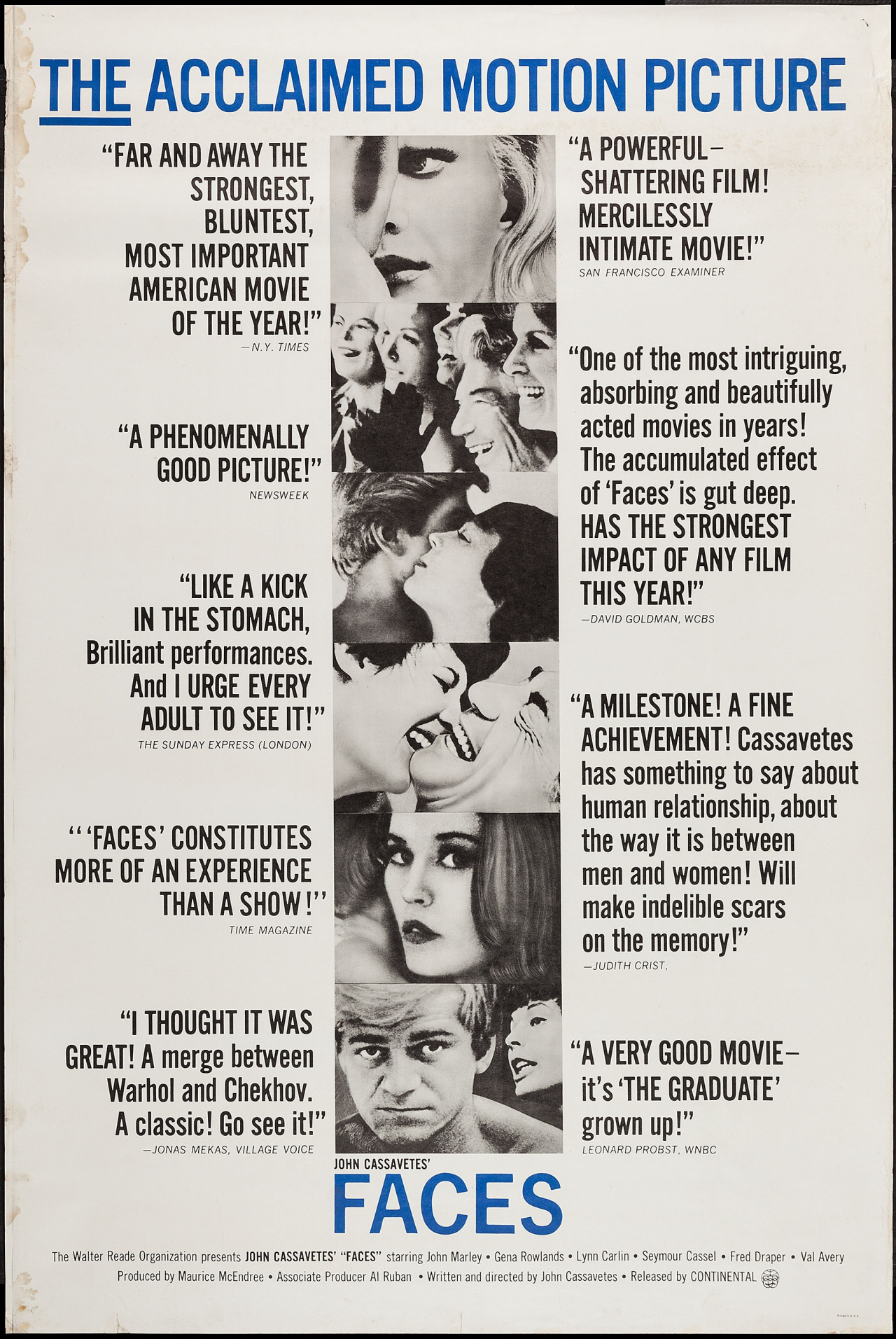
#250) Faces (1968)

MV5BOTUxZGVhNzctZDZkMS00NjMzLWJkNzgtZDA0OTJiNzA3NjM2XkEyXkFqcGdeQXVyMjI4MjA5MzA@._V1_

#250) Faces (1968)

OR “Mid-Life Crisis: The Motion Picture”

Directed & Written by John Cassavetes

Class of 2011

The Plot: Richard (John Marley) is the proverbial “tired businessman” barely maintaining his marriage to housewife Maria (Lynn Carlin). One seemingly uneventful evening suddenly takes an ugly turn, and Richard declares his intention to get a divorce. After a lengthy argument, Richard leaves the house and spends the evening with Jeannie (Gena Rowlands), a prostitute he had a previous encounter/connection with. Meanwhile, Maria and her circle of friends go to the Whiskey a Go Go and pick up young stud Chet (Seymour Cassel). In a documentary-style of filmmaking that was very unconventional for 1968, “Faces” takes the relationships we think we know well and forces us to examine things a little closer, and confront how empty and shallow it may all be.

Why It Matters: Despite calling the film “[a]n example of cinematic excess” (still not quite sure what that means), the NFR write-up praises Cassavetes, Rowlands, Marley, and Carlin.  There’s also an essay by Cassavetes expert Ray Carney, who casually mentions that he was the one who discovered the presumed-lost extended cut of “Faces”. Nice humble brag.

But Does It Really?: I have to confess that this is my first foray into the work of John Cassavetes, and I found “Faces” to be quite engaging. The cinema vérité style takes a minute to get used to, but once I did I found myself unable to turn away from the screen. Everything about this film seemed so natural and unscripted I legitimately did not know where it would go next. “Faces” is way ahead of its time in terms of its frank discussion of married life, gender politics, and even women’s lib. I don’t know where “Faces” stands among Cassavetes’ other films, but its bold storytelling and status as a truly independent film ensures an inevitable place in the NFR. I look forward to watching Cassavetes’ other entries.

Everybody Gets One: Lynn Carlin had a string of episodic TV on her resume, but “Faces” is where she knocks it out of the park, in her film debut no less. She spent the next 20 years playing everyone’s wife or mother before retiring. This is also the only credited NFR appearance for producer/editor/cinematographer Al Ruben (he did some uncredited camera work for “A Woman Under the Influence”).

Wow, That’s Dated: This thing is very 1965, especially once we head out to Whiskey a Go Go. “Faces” is also a pretty thorough examination of the dying breed that was the “tired businessman”.

Seriously, Oscars?: Despite their love for big-budget studio epics, the Academy managed to nominate limited indie release “Faces” in three different categories. Newcomers Seymour Cassel and Lynn Carlin lost the Supporting categories to established veterans Jack Albertson and Ruth Gordon (respectively), while John Cassavetes lost his only screenplay nomination to Mel Brooks for “The Producers”. If only the Independent Spirit Awards had existed back in 1969; this film would have cleaned up.

Other notes

  • First off, I would be remiss if I didn’t mention that this film’s lead actor is John Marley, whose most iconic role is as movie producer Jack Woltz in “The Godfather”. He’s the one who wakes up to find the horse’s head in his bed.
  • I was trying to figure out if Cassavetes made this film with “Dirty Dozen” money or “Rosemary’s Baby” money. It turns out the answer is neither. Production of “Faces” took place in 1965, before he was cast in either movie. Cassavetes and Gena Rowlands financed this film themselves, along with a loan from Bank of America. I presume Cassavetes’ pact with the devil in “Rosemary’s Baby” was to get this film’s distribution deal.
  • We have a major readout on the Michael Douglas Scale. During production in 1965, John Marley was 58, Lynn Carlin was 27. Gross gross gross. Gena Rowlands was 35, meaning this may be the only movie where the husband leaves his wife for an older woman.
  • To save money, most of the film was shot at the home of John Cassavetes and Gena Rowlands, as well as the home of Gena’s mother, Mary “Lady” Rowlands. Lady is credited as the film’s set decorator.
  • As is the case with any movie relying on natural on-set sound for the dialogue, Gena Rowlands’ handful of dubbed dialogue really sticks out.
  • The main difference between John Cassavetes and Ingmar Bergman is that Cassavetes’ characters know how to laugh. Almost everyone in this movie cracks a joke at some point, either to lighten the mood or to be ironic counterpoint.
  • I’m not an expert on Cassavetes, but shouldn’t Peter Falk and Ben Gazzara be in this at some point?
  • See the young blonde woman playing with coins at the bar? That’s Christina Crawford. Yeah, “Mommie Dearest”. That Christina Crawford.
  • As any Cassavetes expert will tell you, this film was not improvised. Cassavetes wrote every word of the dialogue, but the interaction among the characters solely belongs to the actors.
  • Gena Rowlands can say so much with just a look in her eyes. There are several scenes where she doesn’t have a lot of dialogue, but you are always aware of her presence in a way that enhances the scene rather than detracts.
  • And then we get to Seymour Cassel’s part of the movie. For those of you used to his more recent appearances in Wes Anderson movies, Cassel is young and vibrant and a little crazy in this film. I get the feeling he lost a lot of roles to Rod Taylor in his youth.
  • This movie lives up to its title; there are so many close-ups in this film. The screen is filled with faces.
  • With as few spoilers as possible, in the scene where one character revives another character after an overdose, the moment of the revived character being offered a cigarette is now unintentionally funny.

Legacy

  • Cassavetes was able to use the money from “Faces” to form his own distribution company: Faces International.
  • Many directors have cited “Faces” as an influence, from Woody Allen to Martin Scorsese to Robert Altman. Allen has the most transparent disciple of “Faces”: 1992’s “Husbands and Wives”.

#249) Study of a River (1997)

image-w1280

#249) Study of a River (1997)

OR “Hutton on the Hudson”

Directed by Peter Hutton

Class of 2010

The Plot: Independent filmmaker Peter Hutton takes a look at the famous Hudson River in this silent short. Filmed over the course of two years, Hutton observes all 315 miles of this landmark during and immediately after winter has placed ice all over the river.

Why It Matters: The NFR praises the work of Peter Hutton as “thoughtful and beautifully photographed” while also comparing his work to those of painter Thomas Cole. There’s also a very academic essay by the very academic Claudia Costa Pederson.

But Does It Really?: As representation of Peter Hutton’s filmography, this gets a pass. But how many more of these “staring at water” shorts are there on the list? Between this, “13 Lakes” and “H2O”, the NFR really likes their long, artistic shots of water. I’m beginning to think that this three-hour loop of a beach will make the cut eventually.

Everybody Gets One: Not a lot of info on Peter Hutton, other than he was also a painter, a sculptor, and at one time a seaman (possibly in the Marines). His other short films include such titles as “Time and Tide”, “Looking at the Sea”, and “Two Rivers”. I guess you could say all his movies tread the same water. Thank you!

Seriously, Oscars?: No nomination for “Study of a River” or any of Peter Hutton’s work. The film did, however, win the “Most Overlooked Short Film Award” at the 1997 Oberhausen International Short Film Festival, though I feel that winning that award automatically disqualifies you from being “overlooked”. For the curious, the 1997 winner of Best Documentary Short was “A Story of Healing”, a film about volunteer nurses at the Mekong delta in Vietnam. At least the Academy was interested in a body of water that year.

Other notes

  • The Hudson has gone by many names over time. The Iroquois called it Cahohatatea (“the river”), the Mohicans Muhhekunnetuk (“river that flows two ways”), but of course, we named it after the English guy who got lost while trying to find the Northwest Passage.
  • What music should go over silent footage of an ice flow? I don’t know why, but Oasis seems like a good fit.
  • 1997 was a good year for movies about big ships navigating ice-covered water. That’s a fun Netflix subgenre.

Legacy

  • Peter Hutton passed away in 2016, but his film legacy is being preserved not only at the Library of Congress, but also at his home base of Canyon Cinema.
  • I’ll just assume Hutton’s “Two Rivers” was meant to be a sequel to “Study of a River”.
  • As for the Hudson River, the most exciting thing to happen to it in recent years was when that 747 made an emergency landing. They even made a movie about it!

#248) Jezebel (1938)

jezebel-us-one-sheet-movie-poster

#248) Jezebel (1938)

OR “Belles Are Ringing”

Directed by William Wyler

Written by Clements Ripley & Abem Finkel and John Huston. Based on the play by Owen Davis Sr.

Class of 2009

The Plot: It’s New Orleans during the antebellum period and Julie Marsden (Bette Davis) is an independent but selfish southern belle. Julie’s engagement to mild-mannered banker Pres Dillard (Henry Fonda) is jeopardized when she insists on wearing a red dress to the highly important Olympus Ball, where unmarried women are expected to wear white. Embarrassed in front of high society by Julie’s actions, Pres calls off the engagement and heads north for work. When yellow fever breaks out near New Orleans, Pres returns to help, and spends the weekend at the country plantation of Julie’s Aunt Belle (Fay Bainter). Julie uses this time as a chance to win Pres back, but is it too late for Julie to change her spoiled ways?

Why It Matters: The NFR admits the film has “its melodramatic underpinnings” but praises Davis to the hilt, calling her performance “flawless” and “[c]ast to perfection”. There’s also an essay by William Wyler expert Gabriel Miller.

But Does It Really?: I’m all for more Bette Davis on this list (she’s only got three entries), and “Jezebel”, while not her breakthrough role, is certainly the first to solidify her standing as a major Hollywood player. On the whole, the film is fine. Davis is great of course, but “Jezebel” doesn’t quite gel the way it should. Julie’s character arc doesn’t hit the marks it needs to (especially towards the end), and to make matters worse, the film is swarming with “happy slaves” that tarnish any modern viewing. It’s also one of those pre-feminism films where the leading lady is strong and independent, but still defined by her man. “Jezebel” is iconic enough to warrant NFR inclusion, but it’s definitely on the list for what it represents rather than what it actually is.

Shout Outs: Not a direct shout out per se, but this film exists partially to cash in on the anticipation leading up to the film version of “Gone With the Wind”. GWTW producer David Selznick angrily wrote Jack Warner about the similarities between the two projects, and Warner was quick to point out that the stage version of  “Jezebel” preceded the original novel of “Gone With the Wind” by two years. Side note: Either Warner Bros. wouldn’t let Bette Davis be considered for Scarlett O’Hara or she was considered, only to be rejected by Selznick. Accounts vary.

Wow, That’s Dated: It’s the antebellum period and the film is a precursor to “Gone with the Wind”. As you can imagine, we’re in trouble right from the start.

Title Track: Aunt Belle references the famous biblical figure just once to prove a point to Julie.

Seriously, Oscars?: “Jezebel” was nominated for five Oscars, including Best Picture. The big winner that year was another film based on a play; “You Can’t Take It With You”, but Bette Davis managed to take home her second Best Actress Oscar for “Jezebel”. Fay Bainter won Best Supporting Actress for this film, no doubt aided by her Oscar-nominated lead work in that year’s “White Banners”. Bainter was the first performer in Oscar history to be nominated for both lead and supporting in the same year. Despite much of the “Jezebel” team (including Davis) singling out William Wyler for its success, Wyler missed out on a Best Director nod.

Other notes

  • The main story with this movie is its somewhat difficult production. Wyler demanded countless retakes, which both Davis and Fonda initially took issue with until they started seeing the dailies. Filming went anywhere from 25 to 30 days behind schedule.
  • For those curious about John Huston’s involvement on the screenplay, it was just another project when he worked at the Warner Bros. script department, all with the goal of ultimately writing and directing his own movies. Another one of Huston’s early projects was the screenplay for “Sergeant York”.
  • Why is everyone in New Orleans from Kentucky?
  • Bette Davis makes a hell of an entrance in this film: riding a horse side-saddle and using her riding crop to lift up her skirt. You flout those conventions!
  • Uh-oh, Fonda’s trying an accent. He’s okay, but it definitely wavers.
  • Speaking of Fonda, it was during production of “Jezebel” that Henry’s daughter Jane was born. And when is she gonna make this list?
  • Fay Bainter strikes me as a proto-Maureen Stapleton. She also seems to be stuck with Laurie Metcalf’s Resting Concerned Face.
  • All this talk about a red dress in a black & white movie. Seems a little weird, don’t you think?
  • Someone invent the phonograph so Julie’s entrance to the ball can have a record scratch.
  • One of the servants is named Uncle Cato? Does he attack the family without warning to keep their senses sharp?
  • Uggggggh, anti-abolition talk. This is why you never discuss politics at the table.
  • Contrary to what Preston says, “I disapprove of what you say, but I will defend to the death your right to say it” is not a Voltaire quote. It’s actually from Evelyn Beatrice Hall in her biography “The Life of Voltaire”.
  • Man, Davis and Fonda are just so…young in this film. I can’t get over it. I guess I’m used to their later work.
  • The duels in this film are not as exciting as “Hamilton” has led me to believe.
  • Amy’s going for the Elliot Page Record for Most Expository Questions per Minute.
  • Running down a spiral staircase in a hoop skirt must be difficult.
  • That ending goes where it needs to go, but as previously stated, it’s just not the bulls-eye it needs to be. Even the great Bette Davis can only do so much.

Legacy

  • “Jezebel” solidified Bette Davis as a leading lady to be reckoned with, and not just a flash-in-the-pan Hollywood starlet.
  • Bette Davis would collaborate with William Wyler on two more films based on plays, each leading to more Oscar nods for both of them: 1940’s “The Letter” and 1941’s “The Little Foxes”.
  • Some good came from the “Jezebel” vs. “Gone With the Wind” debate: Selznick liked Max Steiner’s score for “Jezebel” so much he hired Steiner to compose GWTW’s now iconic music.

#247) The Asphalt Jungle (1950)

asphalt_jungle

#247) The Asphalt Jungle (1950)

OR “Ocean’s Acht”

Directed by John Huston

Written by Huston and Ben Maddow. Based on the novel by W.R. Burnett

Class of 2008

The Plot: The Midwest crime world of the ‘50s gets an unexpected jolt when notorious thief Doc Reidenschneider (Sam Jaffe) is released from prison and wants to immediately pull off another heist. Backed by corrupt lawyer Alonzo Emmerich (Louis Calhern), Doc employs three hoods to steal half a million in jewelry. Dix Handley (Sterling Hayden) is a drifter with dreams of getting out of the racket, Gus Minissi (James Whitmore) is the getaway driver and Dix’s voice of reason, and safe-cracker Louie Ciavelli (Anthony Caruso) is…also there. The heist is a success, but there may be more than one joker in this deck. And that young actress playing Emmerich’s mistress is Marilyn Monroe. And now you know the rest of the story!

Why It Matters: The NFR calls the film a “brilliant crime drama” and mentions Marilyn Monroe’s performance.

But Does It Really?: I’m worried this film is only remembered today for Marilyn. To single out Ms. Monroe would be to completely ignore a film that is expertly crafted from top to tail. As film noir was going out of vogue, “The Asphalt Jungle” helped ease the transition into the grittier pulp crime dramas of the ‘50s. In the confident hands of John Huston, and quite possibly the best ensemble of ‘50s character actors in one film, “The Asphalt Jungle” is the rare crime film where the characters are just as interesting as the caper. A “minor classic” compared to Huston’s other entries, but worth a watch nonetheless.

Everybody Gets One: The only major players making their sole NFR appearance are Marc Lawrence as Cobby and Anthony Caruso as Louie. Both men were character actors who specialized in playing shady underworld types.

Wow That’s Dated: Lots of great ‘50s slang in this one, like “a bunch of swells” and “yipe”.

Seriously, Oscars?: “The Asphalt Jungle” missed out on a Best Picture nod, but did manage Oscar nominations in four major categories: Director, Adapted Screenplay, Supporting Actor (Sam Jaffe), and Cinematography. The film lost the first three categories to Best Picture winner “All About Eve” (Jaffe lost to George Sanders), while Cinematography went to a little British import called “The Third Man”.

Other notes

  • Is an Asphalt Jungle any relation to a Blackboard Jungle?
  • I can never see Sterling Hayden in a movie and not think of those three magic words: “Precious bodily fluids”.
  • Wow, young James Whitmore! He does exist!
  • Will #2 please step forward? That’s him, Officer! That’s Strother Martin in his film debut!
  • His name is Dix Handley? No, I’m not quietly giggling like a 10-year-old.
  • Commissioner Hardy is played by John McIntire, who you know as either Sheriff Chambers in “Psycho” or crotchety cat Rufus in “The Rescuers”. Hardy is easily his best film performance.
  • Like you need me to tell you that John Huston is a brilliant filmmaker. Look no further than the scene where Gus tries to convince Dix to lay low. Huston covers the entire scene in one uninterrupted take. He even gets the cat to hit its mark!
  • While we’re at it, shoutout to cinematographer Harold Rosson. Anyone who can film this, “The Wizard of Oz” and “Singin’ in the Rain” deserves high praise.
  • Cobby looks like if Laurence Olivier played Fredo Corleone.
  • No offense to Sam Jaffe, who is wonderfully restrained as Riedenschneider, but if I were an Oscar voter I would have put Louis Calhern on my ballot for Best Supporting Actor. It helps that Emmerich gets a stronger character arc, but Calhern gives him a lot of dimension. I suspect Jaffe’s nom was to reward his versatile career (and possibly to show support for his run-in with HUAC). Calhern didn’t go unnoticed by the Academy, however; he was nominated for Lead Actor that year for recreating his stage performance in “The Magnificent Yankee”.
  • Get it, Lina Lamont! Jean Hagen adds a nice touch of humanity as Doll, Dix’s live-in moll.
  • Thanks to this film’s 11-minute centerpiece heist, I now feel fully qualified to rob a ‘50s bank vault. It’s just a shame they blew up the vault while Burgess Meredith was still in there. 
  • Dead Man Blinking! We got a Dead Man Blinking!
  • Emmerich is not very convincing when he gives his alibi. Jon Lovitz is a better liar.
  • Fine, I’ll mention Marilyn. She’s good, and is everything the part asks of her. She’s not incredible, but it’s nice to see her in a performance from when she was still an actor and not an icon.
  • Perhaps my favorite character in the piece is Eddie the stereotypical Italian. He’s played by Puerto Rican actor Alberto Morin. Dat’s a spicy-a cultural appropriation!
  • Alright Huston, that’s enough shots of the dancing girl’s torso. Break it up, break it up.
  • Oh my god, a score! Miklos Rosza finally shows up five minutes before it’s over. He must have gotten lost on the way to the recording studio.

Legacy

  • While not the first in the genre, “The Asphalt Jungle” is the granddaddy of all heist movies where a guy is released from prison and pulls “one last job”. Immediate follow-ups in the genre include “Rififi” and “The Killing”.
  • The original novel also inspired such wide-ranging films as the Western “The Badlanders” and the Blaxploitation movie “Cool Breeze”.
  • “The Asphalt Jungle” TV series aired on ABC in the spring of 1961. The show starred Jack Warden, who may or may not have a role in the movie. Further research is needed.
  • Gus would eventually be transferred to Shawshank State Penitentiary. Going by the alias “Brooks”, he rehabilitated himself by maintaining the prison library.
  • Just a reminder that the director of this film would go on to helm the original film version of “Annie”.

#246) The Three Little Pigs (1933)

MV5BOTViY2Q5NGYtZDdhMi00NDdhLWJiMDAtNjkzNzAzNzNmOGI2XkEyXkFqcGdeQXVyNzY1NDgwNjQ@._V1_

#246) The Three Little Pigs (1933)

OR “The Original Property Brothers”

Directed by Burt Gillett

Written by Pinto Colvig, Albert Hunter, Boris V. Morkovin, Ted Sears, and Webb Smith. Based on the fable. “Who’s Afraid of the Big Bad Wolf?” by Frank Churchill and Ann Ronnell.

Class of 2007

The Plot: Two carefree pigs and their more reasonable brother are building their own homes. Fifer (voiced by Dorothy Compton) builds his house of straw, Fiddler (voiced by Mary Moder) builds a stick house, and Practical (voiced by Pinto Colvig), true to his name, builds a brick house. But the Big Bad Wolf (voiced by Billy Bletcher) is nearby, ready to huff and puff and blow their houses down. A cautionary tale on the importance of solid housing structures.

Why It Matters: Citing it as “among the best cartoons of all time”, the NFR write-up notes the popularity of the film (as well as the song), and contextualizes “Pigs” as an artistic stepping stone for Walt Disney on his way to making “Snow White”.

But Does It Really?: Oh sure. The film is an iconic piece of early Disney, and has stayed in the rotation long enough that multiple generations have grown up with it. “Three Little Pigs” is an important part of the Disney legacy, and it’s the kind of simple storytelling that Walt and company excelled at in the beginning. Why the pigs had to wait almost 20 years to make the NFR cut is anyone’s guess.

Everybody Gets One: Burt Gillett started off as an animator on the East Coast before moving to Hollywood in 1929 to join the up-and-coming Disney Studios. He quickly rose from animator to director, helming “Pigs” and “Flowers and Trees”. Burt may have been the director, but Walt still had the final say, occasionally arguing with Burt in front of the other animators. Shortly after the success of “Pigs”, Gillett left to run rival animation studio Van Beuren, although his constant bullying of staff (to the point of preventing them from unionizing) led to very low morale and a high turnover rate. Van Beuren Studios folded in 1937.

Wow, That’s Dated: Oh boy, here we go. If you stumble upon the original version of the short, you’ll find a brief scene of the Big Bad Wolf disguised as a Jewish peddler, complete with stereotypical Yiddish accent and a mask with a large nose. Disney would eventually rerelease the short with those shots reanimated and redubbed to remove anything offensive, though the derogatory music cue still remains.

Seriously, Oscars?: Easily the most successful short of the Depression era, “Three Little Pigs” became the second film to win the Oscar for “Short Subjects, Cartoons”. The only reason the equally popular “Who’s Afraid of the Big Bad Wolf” didn’t win Best Song is because the category wouldn’t be introduced until the following year.

Other notes

  • The full title card is “Mickey Mouse Presents Walt Disney’s Silly Symphony in Technicolor ‘Three Little Pigs’. The title gets fifth billing! Also, I didn’t realize Mickey was a producer on these shorts as well. Maybe he was the muscle this whole time.
  • Dorothy Compton and Mary Moder were radio actors and studio day players without a lot of confirmed credits to their names. Pinto Colvig was a storyboard artist for Disney who also lent his voice to such characters as Goofy and Grumpy. All three (along with cartoon legend Billy Bletcher) reprised their roles in the “Pigs” follow-up shorts.
  • So Fifer and Fiddler wear no pants but Practical wears overalls? Is that why he’s called Practical Pig?
  • The Big Bad Wolf must have borrowed his carpetbag from Mary Poppins, that thing is filled with an unlimited supply of props and costumes.
  • How good is the sound quality on a brick piano?
  • And now for some surprisingly morbid humor from this beloved Disney short: Practical has a framed photo on his wall of sausage links labeled “Father”. Who’s afraid of the big bad therapy session?

Legacy

  • “Pigs” was a huge success for Disney, and he followed up with three little sequels: 1934’s “The Big Bad Wolf”, 1936’s “Three Little Wolves” and 1938’s “The Practical Pig”. Walt learned the laws of diminishing returns with each sequel, and often dismissed any sequels to his other films with, “You can’t top pigs with pigs”.
  • “Who’s Afraid of the Big Bad Wolf?” was a hit song on its own, becoming a song of optimism for the Depression. It was later used to criticize America’s complacency during the Nazis’ rise to power in Europe.
  • This film’s main takeaway for animation was the advent of the storyboard. With more detailed stories and characters, Disney realized they needed a Story Department before going straight to animation, thus the storyboard was invented to help plan out their shorts and eventual features. To this day, storyboarding is an integral part of the animation process.
  • Some random drunkard wrote “Who’s Afraid of Virginia Woolf?” on the bathroom mirror in a New York bar, Edward Albee saw that, and it was all fun and games from there.
  • The home of each of the pigs (as well as the Wolf) can be seen in Storybookland at Disneyland. There’s also the Fiddler, Fifer & Practical Café in California Adventure that serves drinks, desserts and…a sausage breakfast sandwich!? You monsters!
  • If it were not for the success of “Three Little Pigs”, we probably wouldn’t have the jazzy Warner Bros. version, nor Tex Avery’s sexually aggressive cartoon wolf.
  • There have been many versions of “The Three Little Pigs” in the past 85 years, but nothing will top Jeff Goldblum’s interpretation of the wolf on “Faerie Tale Theatre”.
  • I’m gonna assume this was the Commodores’ inspiration for “Brick House”.