
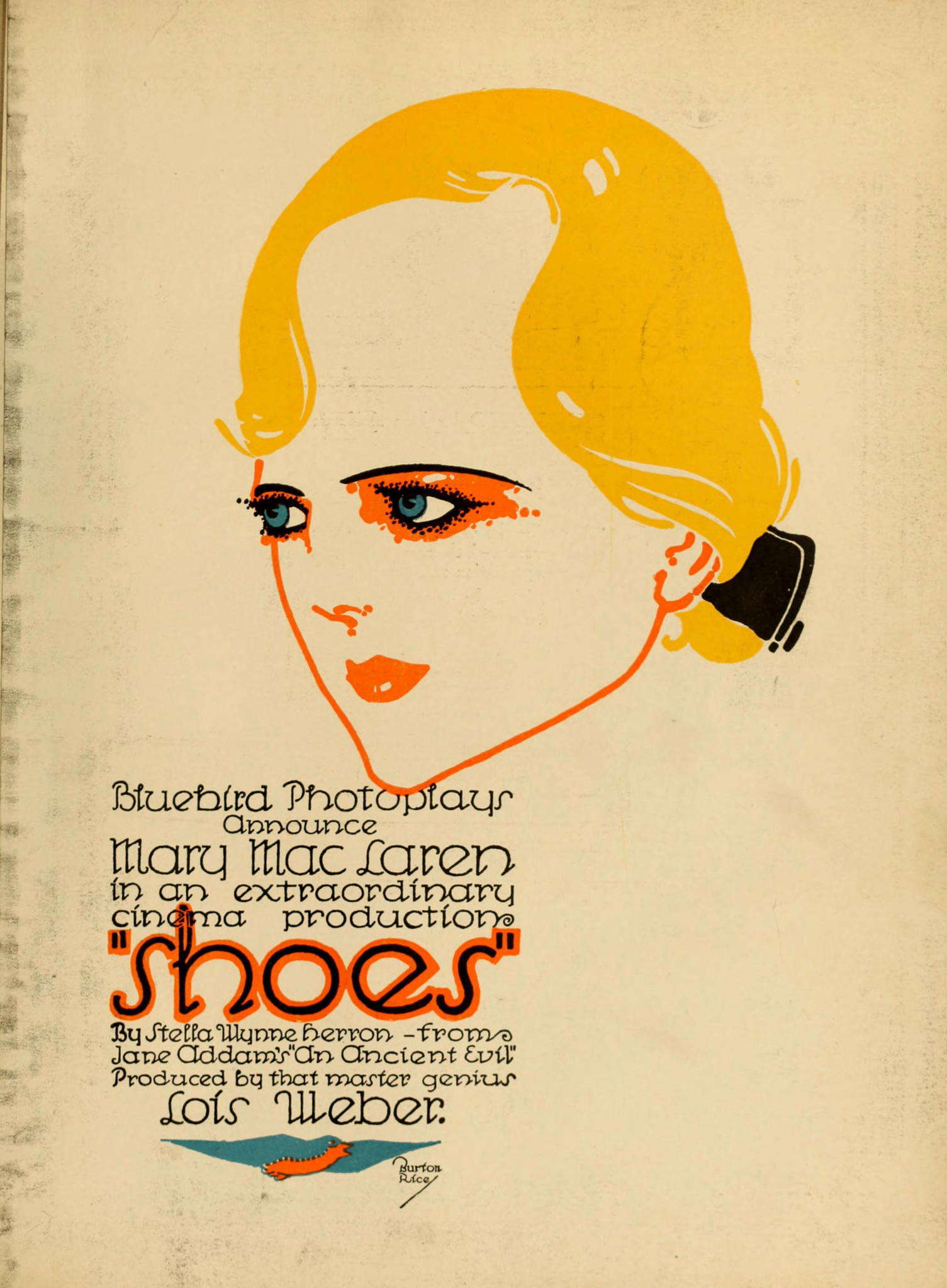
#401) Shoes (1916)

MV5BMTAxNjU3NTI5MTBeQTJeQWpwZ15BbWU4MDU0NDYyNTQx._V1_

#401) Shoes (1916) 

OR “The Agony of the Feet”

Directed & Written by Lois Weber. Based on the short story by Stella Wynne Herron, and the novel “A New Conscience and an Ancient Evil” by Jane Addams.

Class of 2014

No trailer, but here’s a clip

The Plot: Eva (Mary McLaren) is a poor shop girl who works to support her parents and siblings. She tries to save up money for a much-needed new pair of shoes, but her paycheck always ends up going to back rent or debts owed to local businesses. Day after day of standing on her feet and walking through the rain has made Eva’s current shoes damaged beyond repair, but a proposition from “Cabaret” Charlie (William V. Mong) might solve her problems. How much is Eva willing to do for a pair of…shoes?

Why It Matters: The NFR calls the film “a masterfully crafted melodrama” and praises Lois Weber to the hilt. There’s also a detailed essay by film professor/Lois Weber expert Shelley Stamp.

But Does It Really?: Sure, “Shoes” is preachy and its pacing is glacially slow by today’s standards, but it represents one of Hollywood’s few female directors, as well as a prominent social issue of the day. We have another Lois Weber movie on the list – 1916’s “Where Are My Children” – but given her limited surviving filmography, as well as her importance to the early days of Hollywood, there’s plenty of room on this list for another well-made morally-strong Lois Weber film.

Everybody Gets One: Born to a family of evangelical Christians, Lois Weber was a child prodigy on the piano, and quickly turned to performing. Weber and her husband, Phillips Smalley, found work at the Rex Motion Picture Company in New York, which merged with several studios in 1912 to become Universal Studios. Following a move to Hollywood, Weber found herself directing, writing, and acting in her own movies. With this level of creative control, Lois Weber felt that movies were “an outlet for my emotions and my ideals”. “Shoes” was influenced by Weber’s days as a missionary on the streets of New York, and the poverty-stricken living conditions she witnessed.

Wow, That’s Dated: “Shoes” is firmly steeped in its 1910s Progressive Era setting, but there’s still a lot of the film’s depiction of living below the poverty line that rings true today. Also dated: Five and Dime stores where items actually cost five and ten cents.

Other notes

  • “Shoes” begins with a direct passage from “A New Conscience and an Ancient Evil”, which ends with the infamous words about the woman who “sold herself for a pair of shoes”.
  • Poverty stricken family, a father who refuses to work: depressed yet?
  • Silent movies are always a good source for words and phrases that are no longer commonplace. Example: Lil mentions to Eva that “Cabaret” Charlie is the man who “rubbered at us” on the street the previous day. In this case, “rubbered” is a verb meaning to rubberneck. That’s far less filthy than what I originally imagined.
  • Mary McLaren kinda looks like Amy Schumer. What’s she up to these days?
  • And then we get to the shot in which Eva’s shoes are so worn, a nail pierces her exposed sole. We get a very close, albeit not graphic, shot of Eva’s foot. Somewhere Quentin Tarantino is taking notes.
  • I must admit, the performances in this film are uniformly good. There’s none of the “back of the house” theatrics I’ve come to expect from silent film acting; everyone plays it naturally. It’s a refreshing change of pace.
  • There is no worse feeling on God’s green Earth than when you get rainwater in your shoes.
  • This may be the only movie I’ve ever seen that makes my feet sore just from watching it. I assume that’s what Lois Weber was going for, so mission accomplished.
  • Weber shows her experimental side with a superimposed hand labeled “POVERTY” reaching out for Eva while she struggles to sleep. It’s way too on-the-nose, but you can’t spell “poverty” without “overt”.
  • Despite the film’s very impressive restoration by the EYE Film Institute Netherlands, that last reel is damaged beyond repair. Certain shots look like they were filmed during a sandstorm.
  • When Eva decides to sleep with “Cabaret” Charlie, she looks at her reflection in a cracked mirror. Get it?
  • Oooh, Eva’s showing off some of her undergarments. It’s 1916: we could all go to jail just for looking at this!
  • It definitely took me a minute to realize what was happening when Eva meets with “Cabaret” Charlie and suddenly we shift to Eva’s dreams of a better life for herself. This is how the movie implies sex without showing billowing curtains or a train speeding into a tunnel. It’s the cinematic equivalent of “close your eyes and think of England”.
  • Ultimately, “Shoes” holds up quite well, but even at less than 50 minutes in length, it still feels incredibly padded and is marred with slow (by modern standards) pacing. Perhaps Lois Weber’s original intent of a two-reeler (rather than the final five) would have been more effective.

Legacy

  • Lois Weber’s star continued to rise throughout the 1910s, to the point of forming her own studio: Lois Weber Productions. She continued to crank out hit after hit, but once the roaring ‘20s came along, audiences found her moral crusading tame and boring. After a hiatus, Weber spent the last 15 years of her life going from studio to studio, but nothing ever stuck. Her death in 1939 was largely ignored by Hollywood, and of her hundreds of movies, less than 20 are known to survive.
  • Thankfully, Lois Weber’s place in film history has been revisited and praised, starting with a posthumous star on the Hollywood Walk of Fame in 1960.
  • “Shoes” was a big hit for Universal, so technically “Shoes” is one of the reasons that we have movies like “Fast & Furious Presents: Hobbs & Shaw”.

#400) Judgment at Nuremberg (1961)

71UYvc5TCOL._SL1469_

#400) Judgment at Nuremberg (1961)

OR “The Tribunal Has Spoken”

Directed by Stanley Kramer

Written by Abby Mann. Based on his teleplay.

Class of 2013

As always, I am not your definitive guide to world history, in this case the Nuremberg trials and the aftermath of World War II. I’m just here to watch the movie, but I encourage you to learn more about what some have called “the greatest trial in history”.

The Plot: “Judgment at Nuremberg” is a fictional account of the Nuremberg trials, specifically the Judges’ trials that charged the officials who upheld Hitler’s eugenics practice in Nazi Germany. American Judge Dan Haywood (Spencer Tracy) is brought in as chief judge for the case, which prosecutor Col. Lawson (Richard Widmark) considers open-and-shut. German defense attorney Hans Rolfe (Maximilian Schell) makes the argument that the rest of the world is equally guilty of ignoring Hitler’s rise, and accused judge Ernst Janning (Burt Lancaster) maintains that the Germans went along with Hitler out of fear and patriotism. There’s many a complex shade of gray in this courtroom drama, but Stanley Kramer gets his message across in the end.

Why It Matters: The NFR highlights the film’s message regarding “the value of a single human being”, and details the film’s Oscar wins. The only superlative states that the film boasts “fine performances from its all-star cast.”

But Does It Really?: I’m surprised it took 25 years for a Stanley Kramer “message picture” to make the list (“Guess Who’s Coming to Dinner” arrived four years later). “Judgment at Nuremberg” has aged well, and is a well-crafted drama with an outstanding ensemble of actors, but after 60 years the film still hasn’t graduated from “great movie” to “classic”, and tends to be remembered as an “Important Movie” of its time. “Judgment” is a fine example of the dramas Stanley Kramer was known for, and is a worthy, but not essential, NFR entry.

Everybody Gets One: Maximilian Schell played Hans Rolfe in the original “Playhouse 90” production, and so impressed Abby Mann and Stanley Kramer that they both insisted on Schell reprising his role for the film, even when bigger names like Marlon Brando expressed interest. Also along for the ride are two unknown actors who would become TV stars by decade’s end: William Shatner and Werner Klemperer, aka Kirk and Klink.

Seriously, Oscars?: “Judgment at Nuremberg” tied “West Side Story” with 11 Oscar nominations, the most for any movie that year. “Nuremberg” ended up losing most of its categories to “West Side Story” (and a few to “The Hustler”), but still snagged two important wins. Abby Mann won for his Adapted Screenplay (the only category “West Side” lost), and Maximilian Schell beat out co-star Spencer Tracy for Best Actor.

Other notes

  • Prior to my viewing, I screened the original “Playhouse 90” production of “Judgment at Nuremberg”. The teleplay obviously lacks the star power and overall scope of the film, but there’s something to be said about a show that covers the same material in half the time. And you could not get two more drastically different interpretations of Judge Haywood than Claude Rains’ elegance and Spencer Tracy’s realism.
  • As with his work in the original teleplay, Maximilian Schell wipes the floor with his co-stars. It helps that the role is far more challenging and flashy than his counterpart Richard Widmark, but Schell helps you see a man whose vow to “do the right thing” is always a struggle. Side note: Schell’s role is not a lead one, but the cast is an ensemble with enough co-lead roles that the argument can be made.
  • The only major player whose performance sticks out in a bad way is Burt Lancaster as Ernst Janning. Lancaster’s about 15 years too young for the part, and while he is quite effective in the role, it’s still a Hollywood leading man overtly playing against type. First choice Laurence Olivier would have been a stronger choice, but his days of playing disgraced ex-Nazis weren’t too far away.
  • Marlene Dietrich’s subplot as Frau Bertholt was written specifically for the movie. A real-life German expat and prominent humanitarian for the American war effort, Dietrich had great difficulty saying some of her character’s dialogue about not all Germans being aware of Hitler’s intentions.
  • This movie has a lot of distracting zooms and 360-degree camera movements. Stanley Kramer later admitted he included these to spice up a potentially monotonous courtroom drama, and in hindsight considered them “a little indulgent”.
  • And then we get Montgomery Clift’s cameo as the sterilized Rudolph Peterson. You can’t help but consider the parallels between the aftermath of Rudolph’s sterilization and the aftermath of Clift’s car accident. Both are men who are a tormented shell of what they once were, which aids in sympathizing with Clift’s character.
  • Speaking of star cameos: Judy Garland is not the first person you think of when you think “German hausfrau”, but boy does she deliver on the character’s pain and vulnerability. Kudos to Kramer for the unconventional casting, and kudos to Judy for pulling it off so effortlessly.
  • As dramatic and impactful as this film can be at times, nothing compares to the sequence that utilizes actual footage from the concentration camps. It is a sobering, haunting moment in the film. Despite the film’s best efforts, this is the imagery that will stay with me from “Judgment at Nuremberg”.
  • Janning’s testimony contends that most Germans did nothing to stop Hitler because they knew it was just a phase the country was going through. Sound familiar?
  • The film ends with a major continuity error that I’m surprised no one has mentioned: The film has the German characters speaking English for obvious pacing/dramatic reasons, but stresses that everyone in the trial has a translator. At the end of the film, Haywood meets with both Rolfe and Janning outside of the courtroom, and everyone understands each other perfectly, even though it is never established that either Rolfe or Janning speak English. How did no one catch that?

Legacy

  • After the success of “Judgment at Nuremberg” (and fresh off his other dramas “On the Beach” and “Inherit the Wind”), Stanley Kramer challenged himself to make “something a little less serious”. The result: 1963’s “It’s a Mad, Mad, Mad, Mad World”, an epic comedy about as far away from Nuremberg as you can get.
  • Abby Mann adapted “Judgment at Nuremberg” once again for the theater, and this version played Broadway in the spring of 2001. Maximilian Schell returned, only this time as Ernst Janning, which he always felt was the best role in the show.

400 Movies! I can’t believe it either! Thanks for sticking it out with me for so long. Onto the next 400. 

Happy Viewing,

Tony

#399) Samsara: Death and Rebirth in Cambodia (1989)

1127900_landscape

#399) Samsara: Death and Rebirth in Cambodia (1989)

Directed & Written by Ellen Bruno

Class of 2012

DISCLAIMER: I am in no way shape or form an expert on Cambodia, its people, or its complex history, especially the era covered in this movie. I highly recommend researching the Khmer Rouge reign of Cambodia before watching “Samsara”.

In 1975, Cambodia’s communist party the Khmer Rouge (led by Pol Pot) overthrew the government and took command. Pol Pot ordered any who opposed him to be executed, resulting in the Cambodian genocide with a death toll anywhere from 1.5 to 3 million people. In 1979, Vietnamese soldiers invaded Cambodia and ended the Khmer Rouge’s reign. “Samsara” documents the struggles of Cambodian citizens in the immediate aftermath of these events. The Cambodians in the film are shown trying to return to normalcy while wrestling with the massive loss they have experienced, as well as being caught between the new self-appointed Vietnamese rulers and the remnants of the Khmer Rouge. Coming from the Sanskrit for “world”, Samsara refers to the inevitable rebirth that comes from death, and this film emphasizes that Cambodia will be reborn following these traumatic times.

Like many of the documentaries on this list, “Samsara” does not interfere with its subjects, allowing them to tell their own story. Those interviewed discuss their deep state of mourning, their survivor’s guilt, but ultimately their hope for the future of Cambodia. The film opened my eyes to a culture and history I only knew in passing, and gave me a better understanding on a deeper, more emotional level. In less than 30 minutes “Samsara” helps you begin to comprehend the atrocities Cambodia has faced, and still manages to resonate after 30 years and a completely overhauled Cambodia. No argument here for NFR inclusion.

Why It Matters: The NFR describes the film as “poetic, heartbreaking and evocative”. They also crib some of their text from the “Samsara” write-up found on Ellen Bruno’s official website.

Everybody Gets One: Not a lot of info out there about Ellen Bruno, other than she started out as an international relief worker in many of the countries she would later document in her films. Frustrated with direct service work, she got an MA in film at Stanford. “Samsara” was Ellen’s master thesis project.

Seriously, Oscars?: “Samsara” won in the Documentary category at the Student Academy Awards, but didn’t make it to the big room. Coincidentally, one of the other Student Academy Award winners that night was fellow future NFR entry “The Lunch Date”. For the record: the Documentary Short winner at that year’s Oscars was “Days of Waiting”, Estelle Ishigo’s account of her time in a Japanese internment camp.

Legacy

  • Ellen Bruno continues to make films, most of which are about oppressed people in such Asian countries as Tibet and Burma. Her most recent film, 2013’s “Split”, tackles divorce from a child’s perspective.
  • Shortly after the release of this film, the United Nations started overseeing peace talks, and in 1991, the Vietnamese withdrew their troops from Cambodia. The Cambodian People’s Party replaced its Communist ideologies with a combination of a monarchy and free market economy, which are still in effect to this day.

Further Activism: The Bruno Films’ website includes a page on how to take action and raise funds for the social issues chronicled in Ellen’s movies. Check it out here.

#398) The Lost Weekend (1945)

MV5BMTk4NDQ0NjgyNF5BMl5BanBnXkFtZTgwMTE3NTkxMTE@._V1_

#398) The Lost Weekend (1945)

OR “My Name Is Don B.”

Directed by Billy Wilder

Written by Wilder and Charles Brackett. Based on the novel by Charles R. Jackson

Class of 2011

The Plot: Over the course of six days, New York writer Don Birnam (Ray Milland) avoids his brother Wick (Phillip Terry) and girlfriend Helen (Jane Wyman) and succumbs to his chronic alcoholism. While confiding in bartender Nat (Howard Da Silva), we learn that Don’s drinking comes from his writer’s block and fear of failure. After a traumatizing night in Bellevue’s alcoholic ward, can Don control his demons? And is Hollywood ready for a serious look at alcoholics that doesn’t resort to cartoon stereotypes?

Why It Matters: The NFR praises the film for its “uncompromising look at the devastating effects of alcoholism” and cites “Lost Weekend” as the movie that “established [Billy Wilder] as one of America’s leading filmmakers.”

But Does It Really?: This is another one of Wilder’s “minor classics”: a triumph at the time, but Wilder’s best work was still ahead of him. Naturally, the film’s direction and screenplay are flawless, and while the film isn’t the emotional gut-punch it was in 1945, it still has enough powerful moments and prescient comments about alcoholism to warrant a view today. A pass for “Lost Weekend”, the key turning point in Billy Wilder’s legendary career.

Everybody Gets One: Alfred Reginald Jones chose the stage name Raymond (later Ray) Milland after being inspired by the mill lands he grew up near in Wales. By the end of the 1930s, Milland was one of Paramount’s top leading men, known for his romance and adventure pictures. Playing a dramatic role like Don intimidated Milland, but he recognized the chance to play against-type. To prepare for Don, Milland went on a crash diet, spent a night in Bellevue, and learned the hard way that he didn’t have the stomach for heavy drinking.

Wow, That’s Dated: Alcoholism is still very much a serious issue, but thankfully the stigma behind it has lessened in the last 75 years, and treatment has vastly improved beyond the “cold turkey” practices of this movie. Side note: AA was around in 1945, but wasn’t the nationwide powerhouse it is today.

Seriously, Oscars?: Despite pushback from Paramount, the Hays office, and the liquor industry, “The Lost Weekend” was a hit, and received seven Oscar nominations (one behind that year’s front-runner “The Bells of St. Mary’s”). “Lost Weekend” took home four big ones: Picture, Director, Adapted Screenplay, and Actor for Ray Milland. Miklós Rózsa’s score lost to…Miklos Rózsa’s score for “Spellbound”, though Rózsa always felt his “Lost Weekend” composition was better.

Other notes

  • Billy Wilder was inspired to make “Lost Weekend” during “Double Indemnity”, seeing the effect Raymond Chandler’s drinking had on the production. The movie is more or less faithful to the novel, except for the removal of a homosexual experience Don had in college; his repressed homosexuality being another reason for his drinking (shades of “Cat on a Hot Tin Roof”).
  • Miklos Rózsa’s score was among the first in Hollywood to prominently feature the Theremin. Known for its eerie, electronic sound, the Theremin was used in “Lost Weekend” to represent Don’s illness. The Theremin became a staple of ‘50s sci-fi soundtracks, making its use here sound retroactively out of place. It sounds like the aliens are in Don’s head!
  • I didn’t realize Ray Milland is Welsh, which explains why he sounds like low-rent Cary Grant. Is he even attempting an American accent?
  • Nat the bartender does a lot of enabling for Don and his drinking. Surely bartenders have their own version of “First do no harm”.
  • Ooh, a flashback. And back when you had to set up a flashback with a pan-dissolve and dialogue like “I remember when we first met…”. Today you could just cut to the flashback and make the audience piece it together.
  • For those of you playing along, that’s the Drinking Song from “La Traviata”.
  • “You drink too much, and that’s not fatal.” Umm…yes it is?
  • For added realism, Wilder filmed several travelling shots of Milland on the actual streets of New York, with a camera crew hidden in a truck. Allegedly one such shot was ruined when a passerby recognized Milland and asked for an autograph.
  • “One’s too many and a hundred’s not enough.” There’s your movie in a nutshell. This is followed by the film’s most heartbreaking shot: Don being so impaired from drinking he can’t even lift the shot glass, resorting to sipping the glass like an animal.
  • “The Lost Weekend” was the first movie permitted to film at the real alcoholics ward in Bellevue. After its striking appearance here, the hospital denied all future productions permission to film there. And I get it; this movie makes it appear that Bellevue is run by antagonistic nurses and inefficient security.
  • Shoutout to Milland’s performance. He makes sure you see the glimmer of Don’s sober charm, making it all the more devastating when he becomes a desperate drunk. Also worth shouting out is Jane Wyman’s work as Helen, a woman who supports the leading man without it being her sole defining trait. Wilder and Brackett were always good at writing strong, dimensional female leads.
  • Things get a bit meta at the end, where Don decides to make his lost weekend the subject of his novel “The Bottle”. I wonder if the film version of that is any good…

Legacy

  • “The Lost Weekend” opened the door for more films to seriously tackle alcoholism. “Days of Wine and Roses” and “Leaving Las Vegas” immediately come to mind.
  • Billy Wilder’s directing career picked up after “Lost Weekend”, and he and longtime partner Charles Brackett collaborated on three more screenplays before their falling out during production of “Sunset Blvd.”
  • While Ray Milland never repeated his “Lost Weekend” acclaim, he remained in-demand on film and television for the rest of his life. Highlights include “Dial ‘M’ for Murder”, “Love Story”, and that one where he shares a body with Rosey Grier.
  • “Lost Weekend” has become a cultural shorthand for either someone’s alcoholic bender, or for extended time “off the grid”. Wilder gives the phrase a shoutout in “The Apartment”.
  • Several scenes of Ray Milland from the film were repurposed in the Steve Martin comedy “Dead Men Don’t Wear Plaid”.
  • There have been two remakes of “The Lost Weekend”, both of them TV productions in the mid-‘50s. Surely it’s time to squeeze a few extra dollars out of this IP.

#397) Make Way for Tomorrow (1937)

e0db1527c46987f5759251e91aa89f4a

#397) Make Way for Tomorrow (1937)

OR “What a Drag It Is Getting Old”

Directed by Leo McCarey

Written by Viña Delmar. Based on the novel “Years Are So Long” by Josephine Lawrence and the play by Helen and Nolan Leary.

Class of 2010

The Plot: Barkley and Lucy Cooper (Victor Moore and Beulah Bondi), announce to four of their grown-up children (Thomas Mitchell, Elisabeth Risdon, Minna Gombell, Ray Meyer) that the bank has foreclosed on their home, and they must vacate immediately. With their fifth child unable to take them both in for three months, George (Mitchell) agrees to take in Mother, while Cora (Risdon) will house Father. Both parents become an instant burden on their children’s home, spouses, and lifestyles. It’s a reflection of complex family dynamics and ageism in America, courtesy of one of the Dream Factory’s more depressing trips to reality.

Why It Matters: The NFR praises the film for “[c]hallenging the tried-and-true conventions of late-‘30s films”, and gives specific mention to McCarey, screenwriter Delmar, and lead performers Bondi and Moore.

But Does It Really?: “Make Way for Tomorrow” isn’t an iconic classic, nor does it reach any technical or cultural milestones, but it does stand on its own piece of ground: a family drama that opts for a realistic, downbeat approach over the more audience-friendly optimistic style of the time. And it’s this against-the-grain take on the material, as well as its influence on future filmmakers, that allows “Make Way for Tomorrow” a slight pass for NFR inclusion. That being said, I highly advise you do your homework beforehand and know what you’re getting into.

Shout Outs: When the movie usher brings Rhoda up to speed on the movie she dropped Lucy off at, she mentions there being a newsreel and a “Betty Boop”.

Wow, That’s Dated: The film’s depression era definitely colors in most of this movie’s aesthetic. Also, our treatment of the elderly, while still not perfect, has definitely improved in the last 80 years. And by improved I mean sometimes we let them curse in movies.

Seriously, Oscars?: “Make Way for Tomorrow” was not successful with either critics or audiences in 1937, but Leo McCarey stood by the film, calling it his best. Upon winning the Oscar for Best Director for his other 1937 NFR entry, “The Awful Truth”, McCarey allegedly told the audience that he was receiving the award for the wrong movie.

Other notes

  • Leo McCarey was inspired to make “Make Way for Tomorrow” after two life-changing incidents: a near-death experience after becoming ill from contaminated milk, and the death of his father Thomas, whom he was very close to. McCarey stuck to his guns on this movie, refusing several pleas from Paramount to make something with a more traditional happy ending.
  • McCarey makes his thesis clear right from the beginning, with the giant title card “Honor Thy Father and Thy Mother”.
  • Beulah Bondi, Thomas Mitchell; did Frank Capra loan out his entire stock company for this movie?
  • If something seems off, that’s because both Victor Moore and Beulah Bondi are too young to be playing a couple in their early ‘70s; Moore was 61 in 1937, while Bondi was 48! She’s two years younger than Cora! That being said, Beulah Bondi was one of those actors who always played old.
  • It’s explained that Bark and Lucy’s fifth child, Addie, is not present at the beginning because she’s “way up there in California.” Up there? Where are they, Panama?
  • Once Ma moves in with George and Anita, I started to pick up on this movie’s vibe. This is not a family that will grow stronger through a series of comic episodes; this is a family whose failure to communicate will be their undoing. Seriously, the Coopers have the most uncomfortable family dynamic this side of “Ordinary People”.
  • Three years after her wonderful turn in “Imitation of Life”, Louise Beavers is back to playing the lead character’s maid who has little to do with the plot. Damn you, Hollywood.
  • Also dated: movie ushers actually doing their job.
  • Shoutout to Maurice Moscovich, giving a lovely performance here as Max Rubens, Bark’s only friend in Cora’s town.
  • Is it just me or does everyone in this movie hate each other?
  • There’s something you never see anymore: a “Man Wanted” sign, as opposed to a “Help Wanted” sign.
  • Bark says he and Lucy have been married 50 years. Which means they got married when Lucy was -2 years old! This is the first readout that has caused my Michael Douglas Scale to self-destruct.
  • It takes a while to get there, but Bark and Lucy’s goodbye at the train station is possibly the saddest such scene in history. These two are saying goodbye potentially for the last time, and they know it. I was not expecting this movie to stir up so much emotion in me.
  • Ultimately, that’s what I appreciated about this movie. Despite being a largely forgotten 82-year-old movie, it still managed to engage with me in a way many modern films can’t. I found myself sympathizing with almost every character, even during moments of conflict. This movie does not shy away from the topic of aging and how we all cope (or don’t) with it. These complex emotions run deep in everyone, therefore ensuring a film’s enduring legacy, even if it’s not one of the quote-unquote classics.

Legacy

  • “Make Way for Tomorrow” came and went in 1937, but its biggest fans included the likes of John Ford, Jean Renoir, and Orson Welles, who listed it among his influences for “Citizen Kane”.
  • Another admirer of “Make Way for Tomorrow” was Japanese filmmaker Yasujirô Ozu, who used this film as inspiration for his 1953 classic “Tokyo Story”.
  • Following the initial failure of “Make Way for Tomorrow” (and his refusal to take notes from the bosses), Leo McCarey was let go from Paramount. He bounced back at Columbia with “The Awful Truth”.