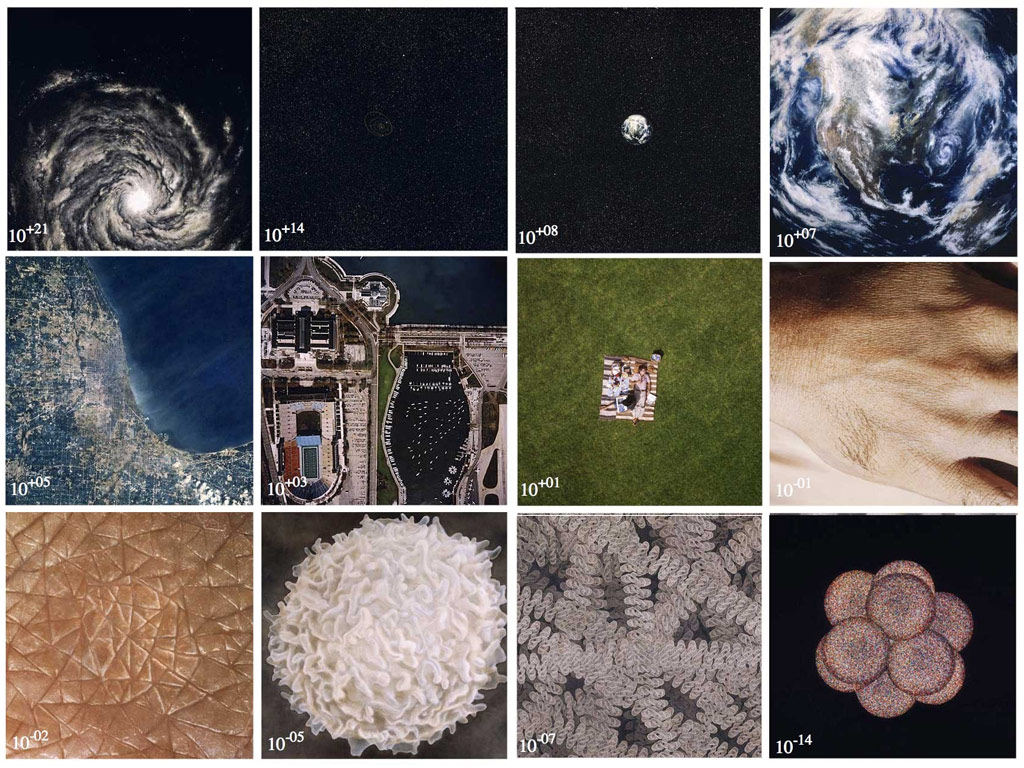
The Plot: What starts as a couple having a picnic near Chicago’s Soldier Field becomes perhaps the biggest (and smallest) movie ever made. We zoom above the couple, expanding our field of vision by powers of ten – past Chicago, past Earth, past our solar system – until we are 100 million light years (1024) from our starting point. After observing the vastness of space for a few moments, we propel back to Earth and the picnic, shrinking down to the surface of the man’s hand, down to his cellular structure at 0.000001 ångstroms (10-16). From the husband and wife team that also brought you the quintessential midcentury lounge chair and ottoman.
Why It Matters: The NFR describes the film as being “as much a math exercise as an avant-garde film”, praising it for its “excellent use of the film medium”. An essay by Eames expert Eric Schuldenfrei delves into the Eames’ ecological implications within the film, and enough scientific jargon to make my eyes glaze over.
But Does It Really?: This movie is, in a word, trippy. In less than 10 minutes, Charles and Ray Eames took me from the farthest reaches of space to the inside of an atom in an astonishing, engaging undertaking. We have got plenty of filmmakers on the list known for their work in other fields, but the Eames may be the definite part-time filmmakers, crafting this film as exquisitely as they would any of their trademark structures. A yes for “Powers of Ten” on the NFR, one of the few modern shorts to make the cut in the Registry’s first decade.
Everybody Gets One: While teaching industrial design at the Cranbrook Academy of Art in Michigan in the late 1930s, Charles Eames met Ray-Bernice Kaiser, an artist and graphic design student assisting Charles for a home furnishing competition sponsored by New York’s MoMA. After getting married in 1941, Charles and Ray spent the next 37 years excelling in a variety of fields, most notably modern architecture and furniture (you’ve probably sat in one of their chairs). Although Charles typically received sole credit in the press, he always stressed that his wife was an equal partner in their projects. In the 1950s, the Eames’ love of photography and theater evolved into filmmaking, with the couple making 125 short films. “Powers of Ten” was inspired by the book “Cosmic View” by Kees Boeke (who gets a special thanks in the credits), and is the Eames’ second attempt at adapting the book to film, the first being a a black-and white prototype (or “rough sketch” in their words) in 1968.
Seriously, Oscars?: I don’t believe “Powers of Ten” ever played an Oscar eligible run, usually reserved for museums and private screenings. For the record, 1977’s Documentary Short winner was “Gravity Is My Enemy” about abstract painter Mark Hicks.
Other notes
The film’s narrator is Phillip Morrison, a physics professor at MIT. He sounds a bit like Eli Wallach.
“Powers of Ten” touches upon practically every branch of science: mathematics, astronomy, quantum physics. And how about the chemistry between the couple at the beginning, am I right?
Recreating this film’s opening on Google Earth was significantly less exciting for me.
Shoutout, as always, to Pluto, which was demoted to a dwarf planet the same semester I was studying astronomy in college. Very big topic of discussion as I recall.
Looking out at the vastness of the universe makes me feel so small and insignificant. Ah well, back to my film blog, I guess…
The film’s adventure through inner space (if you will) is a fascinating journey even for someone as scientifically illiterate as myself. If we got any smaller we would probably run into the Incredible Shrinking Man.
Elmer Bernstein scored this? Between this movie, “The Magnificent Seven” and “Airplane!” Bernstein’s filmography was all over the place.
Legacy
“Powers of Ten” marked the end of the Eames’ collaborations, as Charles died in 1978 at age 71. Ray survived her late husband for a decade, dying in 1988 at age 75. The Eames have been honored and recognized through countless exhibitions and lifetime achievement awards, and their home in Los Angeles (which they designed themselves, of course) is a National Historic Landmark.
No film is too obscure for “The Simpsons” to reference, with “Powers of Ten” serving as influence for one of the show’s better known (and longer) couch gags.
In the 45 years since “Powers of Ten”, scientists have continued to explore the edges of the known universe. This 2021 video by the BBC pays tribute to the Eames as the soothing voice of Professor Brian Cox takes us 100 billion light years (1027) away from Earth.
The Plot: During the Great War, an unnamed Jewish barber (Charlie Chaplin) fighting for the country Tomainia suffers memory loss while saving a pilot named Schultz (Reginald Gardiner). 20 years later, the Barber is finally released from the hospital and returns to his barbershop in a Jewish ghetto. The Barber soon learns that Tomainia has been overtaken by fascist dictator Adenoid Hynkel (Charlie Chaplin), with Schultz as one of his commanding officers. When Hynkel orders a purge of the Jewish ghetto, the Barber leads the fight against persecution and tyranny. But underneath all this slapstick and satire is a heartfelt, urgent message for unity and compassion amongst all human beings.
Why It Matters: The NFR cites this as the film that allowed Chaplin “to mix politics with comedy”, culminating in his “impassioned plea for peace and tolerance”. As always, Chaplin expert Jeffrey Vance is on hand with an all-encompassing essay on the film.
But Does It Really?: For someone best remembered for silent pictures, Chaplin sure has a lot to say in this movie. With “The Great Dictator”, Chaplin doubles down on his fame as a comedy legend for a no holds barred political satire, and the results speak for themselves. Powerful, profound, and oh yes, it’s funny too. “The Great Dictator” endures thanks to the longevity of both its filmmaker and its subject matter, and while it can never fully match Chaplin’s pinnacle in the silent era, it stands next to those films as a classic, and proof that Chaplin could evolve with the times.
Wow, That’s Dated: In addition to the obvious jabs at Hitler, “The Great Dictator” takes time to razz Italian fascist leader Benito Mussolini (Dictator Napaloni), Hitler’s Minister of Propaganda Joseph Goebbels (Minster Garbitsch), and Nazi leader Hermann Goring (Field Marshal Herring).
Seriously, Oscars?: A hit upon release (though not without its share of controversy), “The Great Dictator” received five Oscar nominations, including Best Picture – the only Chaplin film ever to do so. Perhaps it was the film’s touchy subject matter, or Chaplin’s status as a Hollywood outsider, or maybe just the plethora of strong contenders that year (“The Grapes of Wrath“, “Rebecca“, “The Philadelphia Story“, etc.), but “The Great Dictator” failed to win in any category.
Other notes
No one knows definitively how Chaplin got the initial idea for “The Great Dictator”; some sources have producer Alexander Korda giving him the idea, others have Chaplin being inspired by a screening of “Triumph of the Will” at the New York Museum of Modern Art. Regardless, at some point during Hitler’s rise to power in the 1930s, Chaplin became aware of his physical and personal similarities to the dictator. In addition to their small physiques and toothbrush mustaches, both men were born in April 1889, rose from poverty to worldwide fame, and had an affinity for classical composer Richard Wagner. Chaplin wanted to make a film that would poke fun at these similarities, as well as raise awareness to the growing anti-Semitism he had witnessed and experienced (although Chaplin grew up with no religious affiliation and was a self-described agnostic, “The Gold Rush” had been banned in Nazi Germany on the assumption he was Jewish). “The Great Dictator” began filming in September 1939, shortly after the Nazi invasion of Poland and the beginning of World War II.
Although “Modern Times” was the first Chaplin film to have a soundtrack, “Great Dictator” was his first true sound film, complete with dialogue. That being said, most of the WWI prologue is presented visually, with sparse, utilitarian dialogue serving primarily as set-up for the sight gags. As the film progresses, the dialogue becomes more natural and character-driven.
Even with the prior knowledge that this movie is Chaplin making fun of Hitler, my reaction to Hynkel’s first appearance was “Well this is risky”. Chaplin was able to take this risk by financing the film himself ($1.5 million); removed from any studio interference, though still receiving a number of threats from Nazi sympathizers.
Hannah is played by Paulette Goddard, Chaplin’s romantic partner at the time. In the years since “Modern Times”, Chaplin and Goddard had started to grow apart, both focusing on their careers, and “Dictator” was their final collaboration before their amicable separation in 1942.
It’s interesting to watch Goddard’s energetic, feisty performance with the knowledge that she had recently been passed over for Scarlett O’Hara. Maybe I’m just so used to Vivien Leigh’s portrayal, but I can’t imagine Goddard in the role. “Gone with the Wind” would have been a completely different movie.
I know it’s the point, but every one of Hynkel’s stormtroopers looks and sounds like Curly Howard. I didn’t know Germany had a Brooklyn.
There is debate over whether or not Chaplin’s Jewish Barber is his iconic Tramp character. Officially, the Tramp had been retired in “Modern Times”, but the Barber is seen wearing the Tramp’s trademark outfit (complete with hat and cane) in a few scenes. I like to think it’s The Tramp, if just to make him canonically Jewish.
The score was composed by Meredith Willson, a young songwriter still 17 years away from his best-known work: Broadway’s “The Music Man“. Although receiving sole credit for this film’s score, Willson would later recall “the best parts of it were all Chaplin’s ideas.”
Shoutout to Maurice Moskovich, a Yiddish theater veteran appearing as the kindly Mr. Jaeckel. I recall enjoying his performance as a similar character in “Make Way for Tomorrow“. Moskovich died shortly after production wrapped, and “The Great Dictator” was his final film.
Henry Daniell is giving me some strong Basil Rathbone vibes as Hynkel’s right-hand man Garbitsch. If Daniell looks familiar, he’s the editor in “The Philadelphia Story” (the only character in the movie who actually says “the Philadelphia story”).
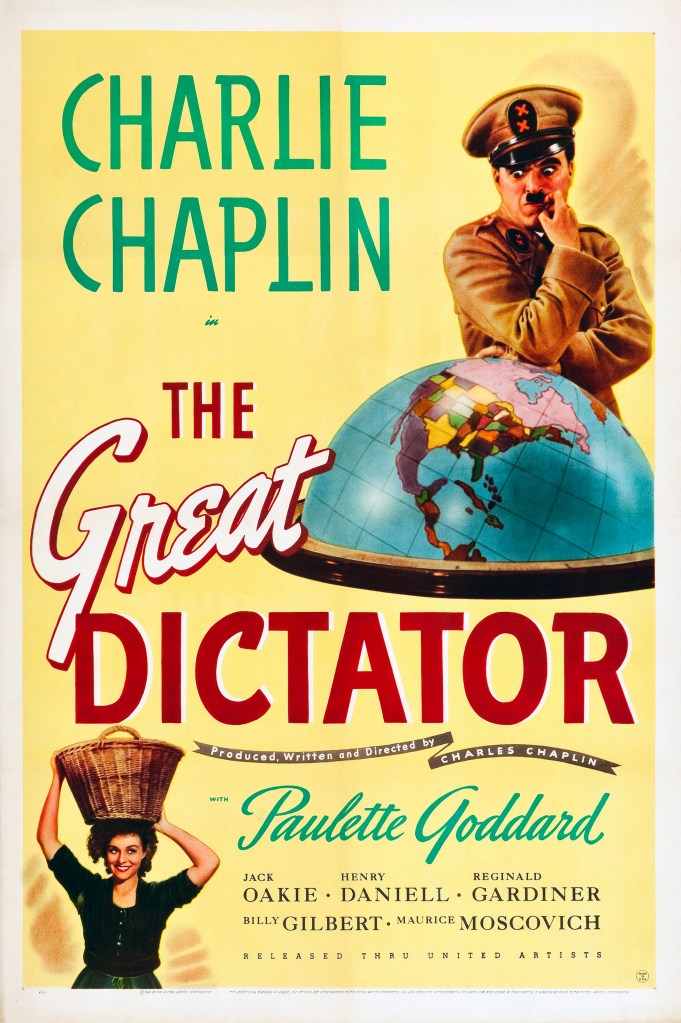
Easily the film’s most memorable scene is Hynkel, giddy with the prospect of world domination, joyfully playing with an inflatable globe, twirling and bouncing it with Wagner’s “Lohengrin” prelude playing in the background. It’s the perfect metaphor for how fragile the world is in the wrong hands, and it should surprise no one that the best moment in this Chaplin film is the one with zero dialogue.
This is easily Chaplin’s darkest film. With the stormtrooper raids and cold-blooded killings, “Dictator” definitely trades in its director’s signature pathos for a bleaker examination of the Nazis and their persecution of Jewish people. We’ll see a similar mix of satire and tragedy in another wartime comedy: “To Be or Not To Be“.
Of all the German gibberish Hynkel spouts in this movie, “pin-headden!” is my favorite.
Spicing things up during the film’s last third is longtime comedy veteran Jack Oakie as Benzino Napolini. Rare is the comedian who can go toe-to-toe with Chaplin, but Oakie succeeds with his bombastic energy and cartoonish Italian. While I’m surprised Oakie got an Oscar nod for Best Supporting Actor, I support the Academy’s decision to honor a purely comedic performance.
Funny how we go a whole movie with Chaplin playing dual roles and we don’t get the mistaken identity plotline until the very end. We don’t even get a “Parent Trap” style split-screen. This movie crawled so “Dave” could walk.
Maybe watching this movie a week after Russia’s invasion of Ukraine was a bad idea.
Oh boy, what an ending. Having been mistaken for Hynkel, the Jewish Barber is asked to address Hynkel’s supporters with a radio speech. Here Chaplin drops character, looks directly into the camera, and pleads with his movie-going audience to fight for their freedom and their right to democracy. While considered preachy in its day, it hits a lot closer to home now, when it feels like our democratic system will collapse at any moment. “The Great Dictator” – as well as Chaplin’s entire filmography – endures because the themes are evergreen. There will always (unfortunately) be brutal oppression somewhere in the world, and there will always be the need for a little guy like the Tramp to stand up for what’s right.
Legacy
“The Great Dictator” was released in October 1940, and was an immediate hit in the U.S. and England, becoming Chaplin’s most financially successful movie. The film did, however, have its share of detractors, with several Latin American countries banning the film, and a lawsuit from author Konrad Bercovici, who claimed he came up with the film’s concept years earlier.
According to the aforementioned Vance essay, while the movie was banned in Nazi-occupied countries for obvious reasons, Adolf Hitler still procured a print of the film and held two private screenings. Hitler’s reaction to the film has never been reported, with Chaplin once saying: “I’d give anything to know what he thought of it.”
In his later years, Chaplin admitted that had he known the full extent of Hitler’s atrocities at the time, he never would have made “The Great Dictator”.
Chaplin was invited by Franklin Roosevelt to recite the film’s final speech at FDR’s inauguration ceremony in 1941. The speech has also resurfaced in recent years, a close second to the globe scene in regards to iconography. And I can’t put my finger on it, but Chaplin’s speech about banding together and standing up to an easily mocked tyrant saw an uptick in views starting around 2017. Hmmm….
“The Great Dictator” marked the beginning of the end for Chaplin’s reign as a beloved movie star. The film’s strong political message (an unheard of concept in 1940) polarized some critics and viewers, leading to accusations of Chaplin’s Communist sympathy. This, mixed with an ongoing paternity suit, shattered Chaplin’s public image, culminating in his American re-entry permit being revoked in 1952. Although Chaplin made a handful of movies following “The Great Dictator”, none of them were as successful as his earlier films, and it wouldn’t be until the 1970s when Chaplin’s career would be reappraised and celebrated in America.
After the war, parodies of Hitler more or less disappeared, but were revived in the ’60s thanks to Mel Brooks’ “The Producers” and the end of the Production Code. Hitler has served as comic fodder/cautionary commentary for years, most recently in Taika Watiti’s “Jojo Rabbit”.
Further Viewing: “You Natzy Spy”, a 1939 Three Stooges short and the first major Hollywood production to openly mock Hitler, released nine months before “The Great Dictator”.
Written by Alfred A. Cohn and Jack Jarmuth. Based on the play by Samson Raphaelson, as well as his short story “The Day of Atonement”.
Class of 1996
The Plot: Jakie Rabinowitz (Bobby Gordon) grows up performing ragtime at a local beer garden, much to the disgrace of his father Cantor Rabinowitz (Warner Oland). After a falling out, Jakie leaves home, breaking the heart of his mother Sara (Eugenie Besserer). 10 years later, an adult Jakie (Al Jolson) is a jazz singer in California performing under the name “Jack Robin”. With the help of dancer Mary Dale (May McAvoy), Jakie finally gets his big break in show business, performing in a Broadway revue. Upon his return to New York, he reunites with his mother but continues to be a disgrace to his father, who wanted him to carry on the family’s tradition of being a cantor. But all of this family drama takes a back seat to the revolution of synchronized sound!
Why It Matters: The NFR focuses solely on the film’s “landmark technological achievement” as “the first feature film to include sequences with synchronized spoken dialogue”.
But Does It Really?: I only knew two things about “The Jazz Singer” before watching it: It was a game-changer for sound films, and it has a blackface number. The former item solidifies this film’s place in the NFR, while the latter helps you understand why no one talks about this movie at length anymore. For the first three-quarters of the movie, I enjoyed Jolson’s performance and the film’s unapologetic melodrama, but then you get to the goddamn blackface, and a modern viewing is instantly derailed. The Jazz Singer” will always have a place in the annals of film history, but for obvious reasons, it’s remembered more as an antiquated relic than as a piece of entertainment.
Everybody Gets One: The son of a rabbi, Asa Yoelson started his showbiz career singing with his brother Hirsch as “Al & Harry”. By the 1900s, the renamed Al Jolson was a hit on the vaudeville circuit, his career jump-started by his blackface numbers. By the 1910s, Jolson had reached Broadway and was dubbed “The World’s Greatest Entertainer”. His 1916 musical “Robinson Crusoe Jr.” inspired writer Samson Raphaelson to write the story “The Day of Atonement”, about a young jazz singer with parallels to Jolson. The story was eventually adapted to the play “The Jazz Singer”, and the film rights were purchased by Warner Bros. with George Jessel set to reprise his stage performance as Jakie. Once the decision was made to record “The Jazz Singer” with sound, Jessel asked for more money, and the role was handed off to Jolson instead.
Wow, That’s Dated: We all know what I’m gonna talk about here. Keep reading.
Seriously, Oscars?: “The Jazz Singer” was a runaway hit, becoming a contender at the first Academy Awards ceremony in 1929. The film lost its sole nomination (Adapted Screenplay) to “7th Heaven“, but Warner Bros. received one of the first special Oscars for producing “The Jazz Singer”, “the pioneer outstanding talking picture, which has revolutionized the industry.”
Other notes
Before we go any further, a quick history of sound on film, and where “The Jazz Singer” fits into this. The idea of synchronizing sound with film was as old as the medium itself (see “The Dickson Experimental Sound Film“), but the soundtrack was always played on a separate device from the film, leading to synch issues. The two major methods created and refined in the ensuing decades were “sound-on-disc”, in which a special phonograph player would automatically sync to the film projector, and “sound-on-film”, in which the image of the sound-wave was reproduced on the actual celluloid. Even with the advancements made by the early ’20s, the major studios failed to see the appeal of sound film other than as a gimmick. Sam Warner of Warner Bros. was able to convince his young studio to experiment with sound in their films after purchasing Vitagraph Studios, creators of Vitaphone, the most efficient of the sound-on-disc systems. After a series of experimental shorts, Warner’s first sound feature was the 1926 swashbuckler “Don Juan”, essentially a silent film with an added-on soundtrack of score and effects. “The Jazz Singer” took things one step further: although most of the film is still presented as a silent film (intertitles and all), the audio for Jolson’s songs was recorded live on set. “The Jazz Singer” was the first feature with synchronized dialogue (albeit only in two unplanned scenes) and – more importantly – was the first sound film to be a hit at the box office. Sound-on-film would eventually surpass sound-on-disc as the winning format, and “The Jazz Singer” had its Vitaphone soundtrack transferred onto the film itself in the 1930s.
On the surface, it’s hilarious that a 41-year-old man named Al was the biggest thing in jazz, but watching him in this movie, I get it. By the repressed standards of the early 20th century, Jolson is a rock star; his energetic movement and unconventional singing voice easily captivating his audience. Add to that the amplification of seeing (and hearing) him on a big screen, and it’s pretty easy to understand how “The Jazz Singer” became so popular. Plus, he’s not too shabby an actor, never overplaying the character’s more dramatic moments.
Of course, we must also acknowledge the problems of a White man popularizing a music genre created for and by Black artists. It’s a big quagmire, and I leave the more nuanced discussions for someone more cultured than myself. Suffice it to say that I blame this movie for “La La Land”.
Although only Jolson’s songs were to be recorded, Jolson ad-libbed some lines in-between his first two numbers. Sam Warner opted to keep these lines in the final cut, inadvertently making film history, with Jolson’s remark “Wait a minute, wait a minute, you ain’t heard nothin’ yet!” becoming the first line of synchronized dialogue in feature film history.
This is easily the most Jewish movie to come out of Hollywood in its time, and the last one we’ll get for another 40 plus years. I appreciate the infusion of Yiddish words like “shiksa”, as well as the running gag about everyone getting Jakie’s father a prayer shawl for his birthday. Plus there’s an appearance by Yossele Rosenblatt, widely considered one of the greatest cantors of his day, singing Kaddish.
Jolson continues the improvisation during his “Blue Skies” number, in which he sweet talks his loving mother. It starts as cute and then goes on long enough to be weird. Norman Bates wasn’t as close with his mother.
There’s plenty of classic music and popular songs interspersed throughout the score, but why are they playing Tchaikovsky’s “Romeo and Juliet” overture during the scene where Jackie fights with his dad? Related note: Is this movie where “I have no son!” comes from?
Everything goes smoothly in this film for the first hour or so, but then we get to the blackface number. Actually, the trouble starts before the blackface number. We get an extended dramatic scene in Jakie’s dressing room which takes place while he’s applying the blackface makeup to himself, and it drags on forever. Similar to the “White people stole jazz” discussion, there is a lot more to unpack here than I cover in a movie blog. As a White male I know that I am not directly responsible for the actions of a movie made 60 years before I was born, but I can still use “The Jazz Singer” as a reminder that we can always do better.
We get a brief reprieve from the blackface for a dramatic scene at his parents’ house where Jakie must choose between his career and his family. I was genuinely tense waiting for Jakie to make his decision, so this movie must be doing something right.
[Spoilers] In the play, Jakie chooses his family, and sings Kol Nidre at the Yom Kippur service in place of his dying father. In the film, he makes the same choice, but then we get a tacked-on ending where he performs another blackface number (“My Mammy”) at the Winter Garden with his mother in the front row. So…there were no consequences for his decision whatsoever? Takes the wind out of this movie’s sail if you ask me.
Legacy
“The Jazz Singer” was an instant box-office sensation and, while it didn’t kill silent movies overnight, it did signal that “talkies” were here to stay. Hollywood immediately took notice, reshooting silent films with sound, and adding soundtracks to finished films. Think of “The Jazz Singer” as the first nail in the coffin for the silent era, with the remaining nails following closely behind.
Jolson made a series of musicals for Warner Bros. in the ’20s and ’30s, including “The Singing Fool” and “Say It with Songs”, but these revue-style films quickly lost their audience in favor of bigger, grander Depression-era escapism. Jolson remained a popular figure on the stage, on radio, and at USO tours abroad before his death in 1950.
“The Jazz Singer” has been remade three times: a 1952 film with Danny Thomas, a 1959 TV movie with Jerry Lewis, and a 1980 film with Neil Diamond and Laurence Olivier. The latter was so awful even Olivier got bad reviews!
As for references, “The Jazz Singer” still gets mentioned primarily for its place in Hollywood history. Look no further than “Singin’ in the Rain“.
One of the more direct parodies comes, as it often does, from classic era “Simpsons”. Jackie Mason voiced Krusty the Clown’s estranged rabbi father, who disapproves of his son’s career in show business.
As for the film’s technological achievements, well..we still have sound in movies, so that’s pretty good.
Further Viewing: The plot of “The Jazz Singer” is tweaked for the 1936 Merrie Melodies cartoon “I Love to Singa”, with a swinging Owl Jolson and his disapproving father. I recall it being on Cartoon Network a lot when I was a kid.
Listen To This: Al Jolson makes the National Recording Registry with his 1920 rendition of “Swanee”, a song that remained synonymous with Jolson for his entire career. The NRR website offers this recording, as well as an essay by Cary O’Dell.
The Plot: Harry Caul (Gene Hackman) is a surveillance expert based in San Francisco. He is highly regarded as one of the best in the business and, somewhat ironically, is intensely private about his own life; rarely opening up about himself or volunteering personal information. Harry’s next assignment is to record a conversation between a couple (Frederic Forrest & Cindy Williams) walking through Union Square. Harry successfully pulls off the recording through three separate microphones, but while fine-tuning the results, suspects that the couple may be in danger. What starts as an uncharacteristic bit of curiosity leads to full-blown paranoia and a delve into Harry’s troubled past.
Why It Matters: The NFR calls it “one of the artistic high points of the decade and of Coppola’s career”. An essay by film critic Peter Keough tries a little too hard to qualify “The Conversation” as a B-Picture.
But Does It Really?: This is definitely in the “minor classic” category of NFR films. “The Conversation” isn’t Coppola’s definitive movie on this list, but those willing to seek it out will not be disappointed. The film is a taught thriller told from the perspective of what is seemingly the most inconsequential character, digging deep into what makes this kind of person tick, and the result is an exhilarating movie experience. With great performances, incredible sound design, and a tension that quietly builds throughout the movie, “The Conversation” is an underrated film that – while only referenced today in conjunction with Coppola’s other ’70s filmography – is more than deserving of its NFR designation.
Wow, That’s Dated: Of course, there’s the analog technology Harry is using, but the most dated aspect is the idea of being “off the grid” as a normal part of life. Not to turn all Andy Rooney on you, but with cell phones and computers these days everyone’s under some kind of surveillance. Imagine what this movie would be like with the advancements surveillance technology has made in the last 50 years.
Seriously, Oscars?: After winning the Palme d’Or at Cannes (one of the few NFR movies to do so), “The Conversation” received three nominations at the 1975 Oscars, but went home empty-handed. Coppola lost Original Screenplay to Robert Towne for “Chinatown” and Best Picture to…himself for “The Godfather Part II” (Coppola was the second director to helm two Best Picture nominees in the same year). Most egregiously, Walter Murch’s Sound Design lost to the team behind “Earthquake” and its gimmicky Sensurround system. Of the unnominated, the biggest outcry was reserved for Gene Hackman’s omission from the Best Actor category.
Other notes
Coppola wrote the screenplay for “The Conversation” in the late ’60s, inspired by (though some critics would say blatantly ripping off) Michelangelo Antonioni’s groundbreaking film “Blowup“, about a photographer who may have documented a murder in one of his photos. As an independent producer, Coppola was unable to get the film financed, but once “The Godfather” became a blockbuster hit, Coppola convinced Paramount to finance and distribute “The Conversation” as his next project. The film was produced in late 1972 by Coppola’s The Directors Company, shot on location in San Francisco and at Coppola’s American Zoetrope Studio (also in San Francisco).
Shoutout to Walter Murch who, in addition to his impressively intricate sound design, also supervised the film’s picture editing (with Richard Chew) when Coppola became busy with the production of “Godfather II”.
The legendary Haskell Wexler was originally tapped as the film’s cinematographer, but was fired after creative differences with Coppola and replaced by Bill Butler. All that survives of Wexler’s work is the opening sequence, which would have been too costly and complicated to reshoot. Wexler would go on to be the cinematographer for “One Flew Over the Cuckoo’s Nest“…where he was fired after creative differences with Miloš Forman and replaced by Bill Butler.
Speaking of that opening sequence, [chef’s kiss]. The first 10 minutes are a complex visual cacophony, with every element helping set up the jigsaw puzzle Harry spends the rest of the movie putting together. Plus, you can never go wrong with the grittiness of ’70s San Francisco. Added bonus: The background Christmas decorations qualify this film for my “Die Hard Not-Christmas List” (although Union Square is lacking its annual ice skating rink).
Hackman is, of course, crushing it with his performance. A lesser actor would make Harry a total cipher, but with Hackman you always get the danger element lurking under this character’s seemingly boring surface. I’d even argue this is Hackman’s best film performance, his restraint impressing me more than his usual explosive energy.
One of my notes reads “Okay, but something’s gonna happen, right?” Like many a ’70s movie, “The Conversation” takes its time getting started, and patience is truly a virtue.
This movie boasts several “before they were famous” stars in supporting roles. For starters, the couple being spied on are future TV star Cindy Williams and future Oscar nominee Frederic Forrest. Teri Garr shows up for one scene as Harry’s…girlfriend? It’s funny to think that both Garr and Hackman are a few months away from their 180-degree comic turns in “Young Frankenstein“. And of course, The Director’s assistant is played by a young Harrison Ford; the rare performance in his career devoid of his leading man sensibilities. We don’t even get a finger point!
I’m enjoying David Shire’s minimalist score, a single piano to symbolize Harry’s growing isolation. As is often the case with Coppola, it’s hard to cry nepotism when the results are this good (Shire was Coppola’s brother-in-law at the time).
This is the fifth and final NFR movie I’ve covered to feature John Cazale. His work here as Harry’s easygoing colleague Stan adds another dimension to his screen performances and is a reminder to be grateful that his work has been so well preserved.
I’m a fan of any movie that explores Catholic guilt, in this case the guilt that Harry’s religious upbringing still preys upon him.
The convention subplot detours the movie a bit, allegedly the only remaining subplot in the final film (the original cut was over 4 hours!). Allen Garfield delivers a nice, naturalistic performance as Harry’s former co-worker, and we come closest to seeing Harry at his most vulnerable. Now will someone please explain to me what a “Princess Telephone” is?
That’s an uncredited Robert Duvall as “The Director”. Duvall’s post-“Godfather” star status helps solidify the sense that Hackman is a minor character in someone else’s movie.
The Director’s office building is located at One Embarcadero Center, which I walk past on my way to work every morning. The exterior looks remarkably similar today; I recognized it before the camera pulled back to reveal the address.
I went into “The Conversation” unaware of any of the film’s plot points, so the ending was a pleasant surprise to me. I don’t want to spoil any of it for a first-time viewer, so I’ll just leave you with these very vague notes: 1) This is the second most intense movie scene to take place in a hotel bathroom, and 2) Hackman is definitely not getting his security deposit back.
Legacy
While not successful at the box office, “The Conversation” was well-received in its day by critics, and the one-two punch of this and “Godfather II” helped solidify Coppola’s standing as one of his generation’s best directors. Coppola’s next project: an adaptation of “Heart of Darkness”, which I’m sure went smoothly for everyone.
Both Francis Ford Coppola and Gene Hackman have reflected in recent years that “The Conversation” is one of their favorite movies from their respective careers.
After production wrapped on “The Conversation”, news broke of the Watergate scandal, and Coppola was surprised to learn that much of the technology he had used for the surveillance within the film was also used by Nixon’s team to spy on his enemies. “The Conversation” was released a few months before Nixon’s resignation as President, and many (then and now) have described the film as a reflection of Watergate-era paranoia, which Coppola repeatedly states is pure coincidence.
Coppola has attempted at two different times to adapt “The Conversation” to a weekly television series. A pilot shot in the mid ’90s for NBC starred Kyle MacLachlan but was never picked up to series. Another attempt in the mid-2000s, written by Christopher McQuarrie and updated to the present day, never made it past development at ABC.
Tony Scott’s 1998 political thriller “Enemy of the State” has been cited as a spiritual successor to “The Conversation”, particularly the casting of Gene Hackman as a former NSA agent. Photos of Hackman in “The Conversation” were used as the younger version of his “Enemy of the State” character.



 The Horse's Head