#673) The Cheat (1915)

#673) The Cheat (1915)

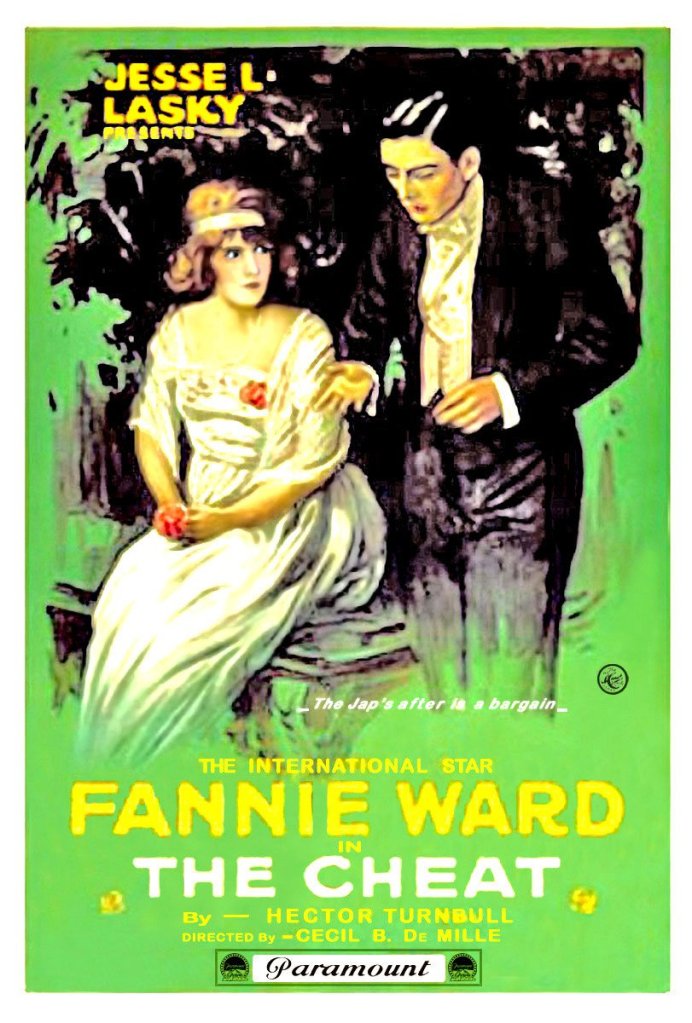
OR “Your Money or Your Wife”

Directed by Cecil B. DeMille

Written by Hector Turnbull and Jeanie MacPherson

Class of 1993

NOTE: The only surviving version of “The Cheat” is a 1918 re-release of the movie. More on this version’s importance later on.

The Plot: Socialite Edith Hardy (Fannie Ward) loves spending money on her extravagant lifestyle, even though that money belongs to her husband Richard (Jack Dean), who can’t pay off her debts until his stock investment comes through. Acting on a hot tip from one of Richard’s colleagues, Edith places $10,000 raised by her local Red Cross chapter for Belgian refugees into a new stock that will double her money. The next day, Edith learns the tip was a fake and that all her money is lost. Horrified, Edith goes to Japanese Burmese ivory merchant Hishuru Tori Haka Arakau (Sessue Hayakawa) for help. Haka agrees to loan Edith the money, in exchange for a sexual dalliance the next day. What follows is a small melodrama about three people directed by the man who will one day bring us epic spectacles with a cast of thousands!

Why It Matters: The NFR says the film features “some of the silent era’s most potent plot twists and elaborate production design”. The write-up also praises Sessue Hayakawa’s “subtle yet menacing” performance.

But Does It Really?: I didn’t realize until researching this film how underrepresented Cecil B. DeMille is on the NFR; with only this and “The Ten Commandments” making the cut (plus his acting cameo in “Sunset Boulevard“). DeMille is such an important name in the history of American film that one of his early successes should be on the list, but “The Cheat” feels like an odd choice, especially considering how early into the NFR it made the cut. “The Cheat” is the kind of moralistic melodrama I’ve come to expect from the 1910s; hardly the kind of film I’d associate with Cecil B. DeMille, and certainly not my first choice to represent him. “The Cheat” is one of those NFR movies that seems to have skipped the line; it’s deserving of its NFR status for sure, but more as the kind of “I guess” choice the NFR would make in the 2010s after selecting all of DeMille’s essentials, and certainly not in the same class as “It Happened One Night” and “Godfather Part II“.

Everybody Gets One: By 1915, Fannie Ward had been a popular stage actress for many years, her perpetually youthful looks giving her an extended life as a leading lady. It was also around this time that Fannie married her second husband, fellow actor Jack Dean, and the two accepted an offer to come to Hollywood and make films with Lasky Players. “The Cheat” was the second film for both Fannie Ward and Jack Dean, and their earliest surviving film.

Wow, That’s Dated: Adjusted for inflation, the $10,000 dollars Edith owes would be over $300,000 today. Those poor Belgians.

Other notes

  • First off, a little bit about Cecil B. DeMille. Born to a family of theater performers, DeMille started off as, naturally enough, a theater performer. Acting gave way to directing for the stage, and a screening of “Les Amours de la reine Elisabeth” in 1912 inspired a pivot to the new medium of film. Along with his theater colleagues Jesse L. Lasky and Samuel Goldwyn, DeMille cofounded the Jesse L. Lasky Feature Play Company, which would one day become known as Paramount Pictures. “The Cheat” was one of many films DeMille helmed in his first few years of making movies; it’s one of 13 films he made in 1915 alone! Fun Fact: The B in Cecil B. DeMille stands for Blount; his paternal grandmother’s maiden name (his maternal grandmother Cecilia was honored with his first name).
  • Both Fannie Ward and Jack Dean are clearly stage actors. Their performances are playing to the back of the house, especially Dean, gesticulating like crazy and wearing a little too much makeup. On the other hand, you have Sessue Hayakawa being one handsome bastard who knows how to make love to the camera.
  • This all being said, watching Sessue turn into a creep towards Fannie is very unpleasant. Damn you, Yellow Menace!
  • One thing I noticed during this movie is that the dates are way off. All of the film’s events supposedly happen within the span of a few days, but Haka’s check is dated in June, Richard’s check is from September, and the newspaper headline before the trial is from April. I guess they really didn’t care about continuity back then. To be fair, nobody in 1915 thought that 108 years later some dude would be able to watch and analyze this movie on a screen in their home.
  • So the moral of all this is don’t be impulsive? The closest this thing gets to a moral is an intertitle that quotes Rudyard Kipling: “East is East and West is West, and never the twain shall meet.” Not only is that thoroughly disappointing, but now I got “Buttons and Bows” stuck in my head.
  • A bit of foreshadowing to DeMille’s later spectacles is the third act courtroom scenes, which have a gallery packed with extras. And their ensuing lynch mob really showcases the kind of organized chaos that would become DeMille’s hallmark. There’s your cast of thousands.
  • [Spoilers] Richard claims that he shot Haka when he takes the stand in order to protect Edith, who actually shot Haka. After he is found guilty, Edith hysterically confesses to the shooting, the judge dismisses the verdict, and Richard is set free. Now I’m no fancy city lawyer, but shouldn’t Richard at the very least be fined for perjury? Whatever, you can have your happy ending, Cecil.

Legacy

  • “The Cheat” premiered in December 1915, and was an immediate hit with everyone – except for a large portion of the Japanese American community. Los Angeles based newspaper Rafu Shimpo objected to this film’s portrayal of its sole Japanese character as evil and manipulative, and waged a campaign against the film. When “The Cheat” was re-released in 1918, intertitles were re-written to make Japanese merchant Hishuru Tori into Burmese merchant Haka Arakau. Despite these changes, the film was banned in Japan and England, though did surprisingly well in France.
  • “The Cheat” received three remakes: a 1923 version with Pola Negri (now unfortunately lost), a 1931 version with Tallullah Bankhead, and a 1937 French version with Sessue Hayakawa reprising his role from the original 22 years later!
  • In 1921, French composer Camile Erlanger’s opera based on “The Cheat” – “La Fortaiture” – premiered in Paris (sadly, this was a posthumous premiere; Erlanger died in 1919). “La Fortaiture” is the first opera to be based on a film scenario, making “The Cheat” indirectly responsible for whatever movie turned musical is on Broadway right now. Let’s see, right now we’ve got “Aladdin”, “Lion King“, “Back to the Future“, “Some Like It Hot“, “Moulin Rouge!”…and coming up we’re getting “The Notebook” and “Days of Wine and Roses”. What a legacy.
  • Neither Fannie Ward or Jack Dean’s film careers lasted too much longer after “The Cheat”, though they stayed married until Dean’s death in 1950. As for Sessue Hayakawa, he became the film’s breakout star, but an increasing typecast as a sexually dangerous heavy (along with rampant anti-Asian sentiment in Hollywood) led to his departure from American film, returning for such later classics as “The Bridge on the River Kwai” and “Swiss Family Robinson”.
  • But of course, the biggest career boost from “The Cheat” was for Cecil B. DeMille, who spent the next 40 years producing bigger and bigger movies, culminating in his final, most famous movie: 1956’s “The Ten Commandments”.

Further Viewing: A selection of DeMille’s better known titles that have yet to make the Registry: “The Ten Commandments” (the 1923 version), “The King of Kings” (the 1927 version), “Cleopatra” (the 1934 Claudette Colbert version), “Samson and Delilah” (the 1949 version), and “The Greatest Show on Earth” (the…only version).
The NFR Class of 1991: Everybody Dance Now

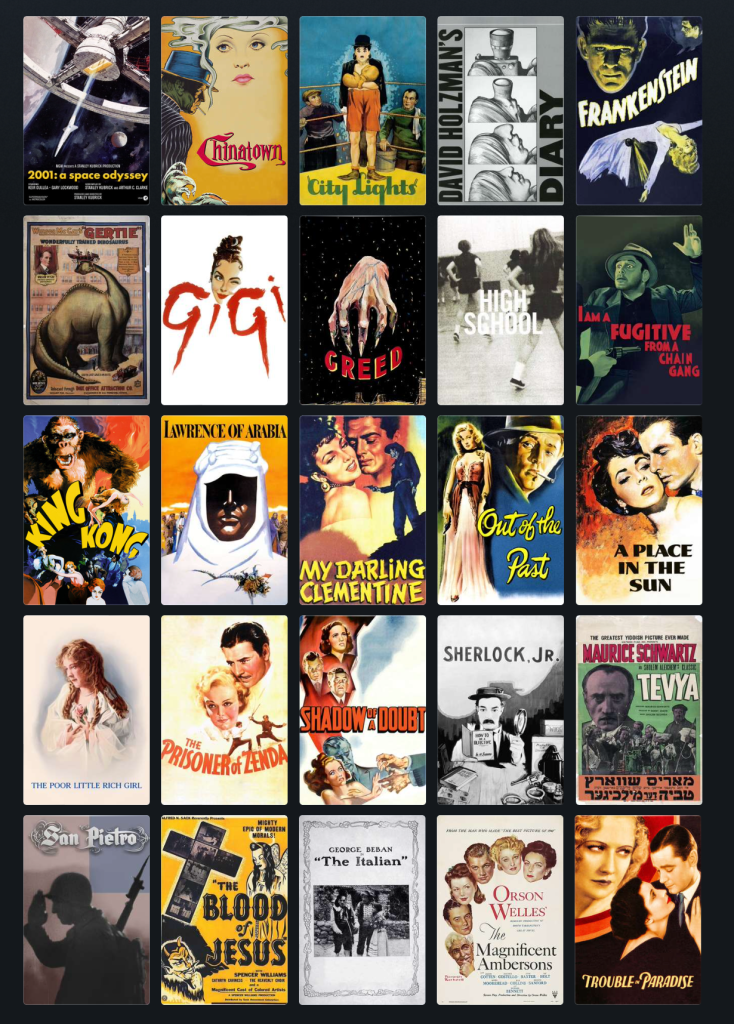
September 26th 1991: The National Film Registry announces its next (and potentially final – more on that later) batch of 25 films for induction. Having just finished watching the last of these 25 for this blog, it’s time to reflect on them as a collective viewing experience. Once again, here is your NFR Class of 1991:

Gertie the Dinosaur (1914) [“helped shape modern animation in a number of ways”]

The Italian (1915) [“holds up far better than you’d expect”]

The Poor Little Rich Girl (1917) [“enjoyable, if a bit plodding…surely there’s a more superior Pickford offering out there.”]

Greed (1924) [“I found the history of the film more interesting than the film itself…cinema’s most intriguing puzzle.”]

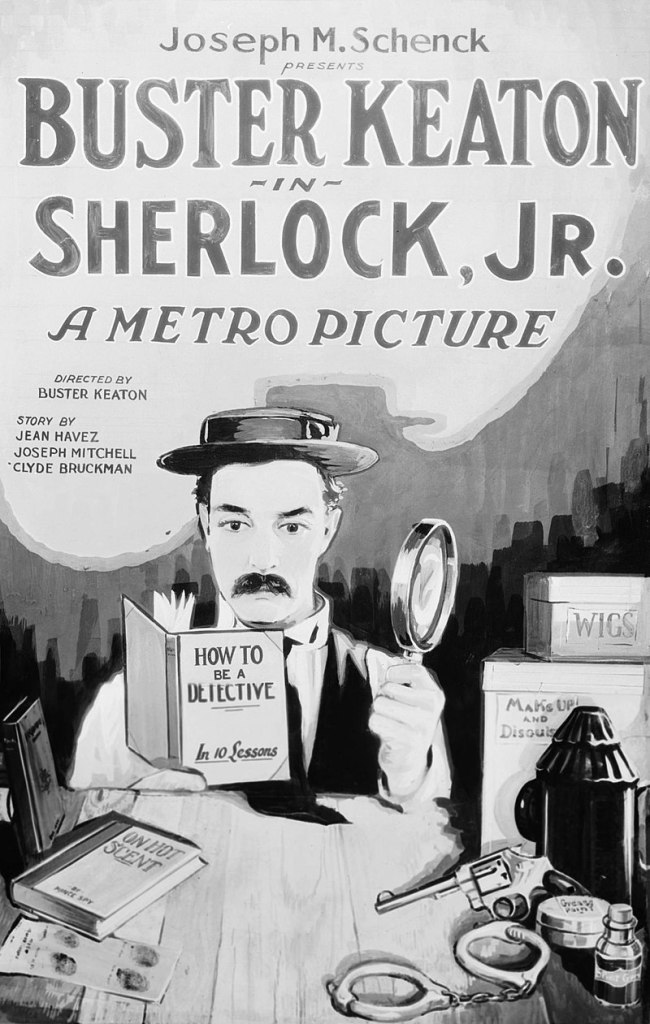
Sherlock Jr. (1924) [“uproariously funny…cannot be beat in terms of sheer ingenuity.”]

City Lights (1931) [“the perfect Chaplin film…flawless”]

Frankenstein (1931) [“an untouchable iconic moment in American film history, and the standard-bearer of horror movies to come.”]

I Am a Fugitive From a Chain Gang (1932) [“some great work being done throughout, especially by Paul Muni, but…this movie gets lost in the shuffle.”]

Trouble in Paradise (1932) [“an enjoyable film that holds up well, but not in the same league as some of Lubitsch’s other classics”]

King Kong (1933) [“not one of the untouchables on this list, but…a bona-fide classic.”]

The Prisoner of Zenda (1937) [“an entertaining example of a Classic Hollywood studio adventure…but I’d hardly call it a film essential”]

Tevya (1939) [“worth a watch for film/Yiddish theater buffs, but everyone else can just watch the musical instead.”]

The Blood of Jesus (1941) [“a well-meaning and at times touching expression of a community’s strong Christian faith.”]

The Magnificent Ambersons (1942) [“the greatest sophomore slump in movie history”]

Shadow of a Doubt (1943) [“a well-crafted suspense thriller…terrific underrated Hitchcock.”]

The Battle of San Pietro (1945) [“the first World War II documentary to be included in the National Film Registry, and its frank visuals are still a tough act to follow.”]

My Darling Clementine (1946) [“not the quintessential John Ford western, but serviceable”]

Out of the Past (1947) [ “has all the hallmarks of the great film noirs, but it’s lacking that extra ‘je ne sais quoi’”]

A Place in the Sun (1951) [“What was praised as a quality drama in 1951 comes across as a muddled melodrama in 2023.”]

Gigi (1958) [“sophisticated for its time, but quickly eclipsed”]

Lawrence of Arabia (1962) [“classic filmmaking at its finest…you are in the presence of greatness.”]

David Holzman’s Diary (1967) [“definitely pushes the limits of docufiction…a pass for its inventiveness”]

2001: A Space Odyssey (1968) [“arguably THE film experience…an undisputed classic”]

High School (1968) [“a time capsule of a moment in America and…a checkpoint for how far (or not) high school has evolved”]

Chinatown (1974) [“as close to a perfect movie as you can get”]

With this roster of films, we start to see the NFR make a transition of sorts. There’s still plenty of iconic heavy hitters in this round (“King Kong”, “Frankenstein”, “2001”, etc.), but we also start getting more obscure films from outside of Hollywood (“Tevya”, “Blood of Jesus”, “David Holzman’s Diary”). We also start seeing our first repeats, with Chaplin, Keaton, and Lubitsch each getting another film on the list. Most noteworthy for me are films like “I Am a Fugitive…”, “Place in the Sun”, and “Gigi” that may have been obvious choices in 1991 but whose reputations have faded over the last 32 years and probably wouldn’t crack anyone’s top 75 today. Proof that any film’s status as a classic isn’t a permanent designation.

Other notes

  • The overall thing I noticed with my own writing on these posts is that I include a caveat for almost every movie (It’s great, but…). It’s the beginning of a long run of NFR movies that understandably make the cut based on their reputation or historical importance, but don’t necessarily hold up on a modern viewing. 
  • According to the LA Times’s article about the NFR induction, the initial National Film Preservation Act that kickstarted the Registry expired that month (September 1991). The act was renewed in June 1992, meaning that for a solid nine months these 75 films might have gone down as the only films in the Registry.
  • At the time of the 1991 announcement, future NFR entry “The Silence of the Lambs” was wrapping up its nearly eight months long theatrical run. “Boyz n the Hood”, and “Thelma & Louise” had finished their runs at this point, and “Beauty and the Beast” would open in November. The sequel to a future NFR entry was number one at the weekend box office: “Freddy’s Dead: The Final Nightmare”.
  • This year’s double dippers include actors Joseph Cotten, C. Aubrey Smith, and Tim Holt (!), Actor/Director John Huston, screenwriter Michael Wilson, and composers Bernhard Kaun, Alfred Newman, and Dimitri Tiomkin.
  • This year’s thematic double dippers: Animated protagonists/title characters, extreme historical liberties, love triangles, movies drastically cut without their director’s approval, extended fantasy sequences, roadshows with an intermission, intertitles that spell out accents phonetically, Noir (both original and neo), people lost in the desert, and characters singing “The Man Who Broke the Bank at Monte Carlo”.
  • My favorites of my own subtitles: The Least Happy Fella, Who Wants to See a Millionaire?, Thief Encounter, Ape Fear, The Heir Apparent Trap, Fiddle Me This, Secrets & Liz, Ooh-La-Wha?, and [Citation Needed]: The Motion Picture.
  • A fun bit of useless trivia: According to the film version of “2001”, HAL 9000 was created in January 1992, so he made the NFR four months before he was born!
  • And finally, because I have no other place to put it, here’s a note I deleted from the “King Kong” post, but it still makes me laugh so I’m including it here. For the scene where Kong rips out part of the el train track, I originally had a fake quote from “12 Angry Men”: “According to the old man’s testimony, the train came roaring by his window, he heard the boy yell at his father ‘I’m going to kill you’, and then the whole track was destroyed by a giant ape.” I know it’s a deep cut, but it still tickles me.

The class of ’92 and NFR’s 100th movie will be coming up early next year. Until then, stay safe and happy viewing.

Tony

#672) A Place in the Sun (1951)

#672) A Place in the Sun (1951)

OR “Secrets & Liz”

Directed by George Stevens

Written by Michael Wilson and Harry Brown. Based on the novel “An American Tragedy” by Theodore Dreiser and the play by Patrick Kearney.

Class of 1991

The Plot: George Eastman (Montgomery Clift) hitchhikes from Chicago to upstate New York to work for his wealthy uncle Charles (Herbert Heyes) at his factory. Lonely and isolated from the high society of his family, George begins a romantic relationship with his homely but loving co-worker Alice Tripp (Shelley Winters). When George is finally invited to an Eastman social event, he immediately falls for glamorous socialite Angela Vickers (Elizabeth Taylor). The two begin their own affair as George tries to call things off with Alice, only to learn that Alice is pregnant. With Alice threatening to expose his affair to the Eastmans, George does the honorable thing and…plots to murder Alice by drowning her in the middle of a lake? Well this certainly took a turn.

Why It Matters: This is definitely one of the NFR’s weirder write-ups. There’s the usual plot recap and production rundown, but then it goes on a tangent about how modern audiences find the film “slow-paced and lacking in depth or social relevance.” I’ll never understand when the NFR doesn’t support its own choices.

But Does It Really?: “A Place in the Sun” is one of those movies where I get why it’s on the list, but I also get why it’s not as revered as it once was. Every individual element of the film works; the direction, the cinematography, the performances, but overall it just didn’t make a collective whole for me. What was praised as a quality drama in 1951 comes across as a muddled melodrama in 2023. “A Place in the Sun” is on the list as an Important Movie of its day and its NFR standing is warranted, but over the decades it continues to lose its “classic movie” luster. Its “place in the sun”, if you will. You won’t? Okay, I’m sorry.

Title Track: Paramount did not like the idea of another remake of “An American Tragedy”, seeing as their 1931 film version was such a bomb that even Theodore Dreiser disowned it. Part of Paramount’s compromise with George Stevens was that his version couldn’t be titled “An American Tragedy”, and Stevens’ associate producer Ivan Moffat successfully pitched the title “A Place in the Sun”.

Seriously, Oscars?: “A Place in the Sun” received nine Oscar nominations, second only to “A Streetcar Named Desire” in total nomination tally. “Place” tied eventual Best Picture winner “An American in Paris” for most wins with six, including Best Director, Screenplay, and Edith Head’s fourth (of an eventual eight) win for Costume Design. Clift lost Best Actor to Humphrey Bogart in “The African Queen” and in a definite no-contest competition, Shelley Winters lost Best Actress to Vivien Leigh as Blanche DuBois.

Other notes 

  • You can sense right off the bat that this is a movie based on a book. The first few scenes have an episodic feel to them and pack in a lot of details; the two tell-tale signs of a novel source material. The original book is over 800 pages, and the movie is surprisingly faithful, save for the omission of the opening chapters about Clyde’s (renamed George for the movie) upbringing in Kansas City and his criminal past.
  • I enjoyed all three of this film’s lead performances. Montgomery Clift is a compelling screen presence as always, even if I don’t fully understand George’s motivations. Clift finds a perfect scene partner with fellow Actors Studio alum Shelley Winters, and the two have a very natural chemistry together in their early scenes. And while the character of Angela doesn’t have a lot to do other than be an idealized woman, Elizabeth Taylor is giving a winning, effortlessly charming performance, and her chemistry with Clift is palpable (it is no surprise the two became lifelong friends during filming). Side note: Elizabeth Taylor was 17 when she made this movie. 17! She was 12 when she filmed “National Velvet“, and that five year span includes what I can only describe as the most generous puberty ever.
  • Nice trick shot, Monty. Where were you when they made “The Hustler“? Whoa I just got a severe case of déjà vu.
  • Shoutout to Anne Revere in the brief but pivotal role of George’s religious mother Hannah. A proud member of the Communist party and equally proud critic of the House Un-American Activities Committee, Revere was blacklisted in 1950 (“Place” was filmed in 1949) and wouldn’t appear in another movie until 1970’s “Tell Me That You Love Me, Junie Moon”.
  • The scene of George and Angela professing their love for each other feels like the quintessential Classic Hollywood love scene: big close-ups of the stars (with Liz being filmed with the softest lens) as Franz Waxman’s score swells in the background. It’s a stirring cinematic moment; now if I only gave a damn about any of these characters.
  • The stigma of illegitimacy brushes up against the Production Code in the scene where Alice visits her doctor and the two imply a conversation about abortion without ever directly saying the word. The Code’s one mandate about the scene was changing Alice’s line “Doctor, you’ve got to help me” to “Somebody’s got to help me.” The whole scene is so subtle and oblique that I had to double-check that they were in fact talking about abortion.
  • My favorite unintentionally funny moment in the movie is the dramatic music cue when George and Alice see that the courthouse they want to get married in is closed for Labor Day. Speaking of, does this scene make “A Place in the Sun” the quintessential Labor Day movie? I can’t think of any other movie in which a major plot point happens during/because of Labor Day.
  • [Spoilers] Alice’s drowning in the lake is a suspenseful moment, though maybe not as impactful as it should be. I feel like George has given her enough red flags that she should know getting on a boat with him is a terrible idea, no matter how much she still loves him. Also I’m confused: I thought Shelley Winters was an excellent swimmer.

  • Oh right, Raymond Burr is in this. It’s no wonder that Burr’s dramatic turn here as a rather theatrical District Attorney would one day win him the plum role of Perry Mason.
  • Burr’s opening statement in the court claims that George committed an act that has “broken every commandment”. Every commandment? I counted three, maybe four if you consider George’s love for Angela a form of coveting.
  • The movie and novel are both based on a real-life murder in 1906 which, like this movie, ended with the boyfriend being convicted and sentenced to the electric chair. And this is in 1908; the electric chair hadn’t been around that long. Hell, electricity hadn’t been around that long! Anyway, my point being that if you know anything about the source material you know that this will not end well for George. The one upside to this ending is that the Reverend who visits George in his cell is a rare substantial on-camera role for veteran voice actor Paul Frees! You expect the Reverend to start talking about “Moose and Squirrel” or “999 happy haunts” at any moment.

Legacy 

  • “A Place in the Sun” premiered at the Cannes film festival in April 1951 before its general release that August. The film was one of the biggest hits of the year and received a heap of critical praise, with Charlie Chaplin calling it no less than “the greatest movie ever made about America”. Though given Chaplin’s own experience with America in the early ’50s that may not have been a compliment.
  • Elizabeth Taylor’s strapless dress from the movie briefly became a fashion statement, becoming a very popular prom dress in 1952. And that’s the closest this movie has to any iconography.
  • As the NFR will tell you, “A Place in the Sun” has started to lose its standing in the pantheon of great movies. Case in point: “A Place in the Sun” came in at number #92 on the AFI’s 1998 list of 100 greatest movies, and then disappeared from the 2007 updated list. Modern references to the film are only in passing, and the last big parody was 50 years ago by Carol Burnett. It fascinates me when a movie that was part of our pop culture for so long virtually disappears without a trace.

#59) Sherlock Jr. (1924)

#59) Sherlock Jr. (1924)

OR “Hound of the Bustervilles”

Directed by Buster Keaton

Written by Jean Havez & Joseph A. Mitchell and Clyde Bruckman.

Class of 1991

This is a revised and expanded version of my original “Sherlock Jr.” post, which you can read here.

The Plot: Buster Keaton stars as a well-meaning, unnamed fellow working as a film projectionist at his local movie house. His attempts to woo his crush (Kathryn McGuire) are often thwarted by the town’s “local sheik” (Ward Crane), who goes as far as to frame Buster for the stolen watch of the girl’s father (Joe Keaton). While on the job, Buster falls asleep and dreams that he can enter the movie being played, in which he is transformed into the famous detective Sherlock Jr. His attempt to locate some missing pearls leads to the kind of inventive gag work that we now think of as classic Buster Keaton.

Why It Matters: The NFR calls the film no less than “a comedic masterpiece that both acknowledges and embraces the cinematic medium.”

But Does It Really?: Man oh man is this movie great. While “The General” is the best overall film in Keaton’s filmography, “Sherlock Jr.” is the most fun, and my personal favorite. With its flawless stunt work and downright magical special effects, there’s a point where even a movie buff like me stops trying to figure out how they did it and just sits back in awe of Keaton’s talents. And he delivers all of this in under 45 minutes! More movies should aspire to be as funny and concise as “Sherlock Jr.”; a perfectly constructed movie comedy and an absolute no-brainer for NFR inclusion.

Wow, That’s Dated: Mainly the profession of film projectionist. How is walking into your dream movie affected by film’s transition to digital?

Title Track: Keaton began work on this film under the title “The Misfit”, changing it to match his film-within-a-film character some time during previews.

Other notes

  • Keaton already had two features under his belt by 1924: the previous year’s “Three Ages” and “Our Hospitality” (both of which I’m sure will make the NFR the next time the Preservation Board says “I dunno, how about another Keaton?”). The whole film was based around a single idea Keaton had of someone walking onto a movie screen and into the movie they were watching. Because of the intricacy of some of Keaton’s gag ideas, filming on “Sherlock Jr.” took four months, as opposed to Keaton’s usual two.
  • One of the more interesting behind-the-scenes tidbits about “Sherlock Jr.” is who did or didn’t co-direct it. Depending on which source you believe; Roscoe Arbuckle – Keaton’s old boss who was still recovering from his scandalous rape/murder trial – was hired by Keaton to co-direct the film, but was quickly fired when he became difficult to work with, allegedly verbally abusing cast and crew. Arbuckle’s widow claimed that Arbuckle not only directed the whole movie, but even came up with the idea. This is greatly disputed, as is what – if any – of Arbuckle’s work made the final cut. Interesting to note that this is one of the few Buster Keaton movies in which he doesn’t have a credited co-director.
  • The lost dollar bill gag is a good character moment. If you aren’t already endeared to Keaton as a performer, this scene will do the trick.
  • I find it fascinating that even in 1924 Keaton felt the need to subvert the banana peel gag. Apparently this classic comedy bit has been around since the 1850s!
  • That’s Buster’s real life dad Joe Keaton as the girl’s father, and you can definitely see the family resemblance. Joe Keaton was a vaudeville performer who started including his son in the family act when he was three. Although Buster’s childhood was marred by Joe’s alcoholism, by the 1920s their relationship had improved and Buster began casting him in supporting roles in his movies. Joe can also be spotted in Buster’s fellow NFR entries “The General” and “Steamboat Bill Jr.“.
  • The “follow your man closely” sequence has some wonderfully funny physical bits, and is best known for Keaton’s most famous on-set injury. For those who don’t know the story: In the shot where Keaton jumps from a moving train, holds onto a water spout, and is pushed to the ground by the outpouring water, Keaton landed on the steel railroad track, though he recovered enough to continue filming the next day. Cut to nine years later when, during a routine x-ray exam, Keaton’s doctor noticed a callus in Keaton’s top vertebra. It turns out Keaton broke his neck when he landed on that railroad track, but his high tolerance for physical pain led him to essentially shrug it off and keep working! As with any Keaton stunt: Professional stunt person, do not attempt.
  • Once Keaton enters the film-within-a-film, the real movie magic takes place. The jump cuts as Keaton is transported to a variety of locations is truly astonishing to watch. That being said, I guess this movie was a montage of establishing shots before Keaton showed up.
  • I didn’t realize “Airplane!” stole the “walking through a mirror” gag from this movie. Now that I think about it, there’s a lot of stuff in the movie “Zero Hour” that also gets copied in “Airplane!” What kind of a two-bit operation is this?
  • Sherlock Jr.’s assistant is named Gillette, a nod to William Gillette, the silent film actor best known at the time for playing Sherlock Holmes. Gillette is also described as “A Gem who was Ever-Ready in a bad scrape.” Har-de-har-har. Side note: With his seemingly endless supply of disguises and fake mustaches, Gillette is the Gene Parmesan of detective assistants.
  • The bit where Buster disappears into the suitcase being held by Gillette in his peddler disguise is apparently an old vaudeville trick. This is twice now that I have looked up how exactly that stunt was pulled off, and I still don’t understand how it was done.
  • The third act chase scene, which sees Buster on the handlebars of a runaway motorcycle, is perfect. Even up-to-now-ignored leading lady Kathryn McGuire gets to do a pratfall, as she topples into the backseat as a car takes off. Keaton recognizes that the real meat of the movie is the film-within-a-film, and once it reaches its conclusion, the real-world resolution is short and sweet.

Legacy

  • “Sherlock Jr.” opened in April 1924 to mixed reviews and mediocre box office. Both critics and audiences felt the film was good, but not up to par with the likes of “Our Hospitality”. It wasn’t until Keaton’s filmography became reevaluated by a new generation of movie lovers in the early 1950s that “Sherlock” earned its reputation as one of Keaton’s best.
  • The film-within-a-film elements of “Sherlock Jr.” has been recognized by film historians as one of the first bits of surrealism in film (though Keaton dismissed this designation in his lifetime). Among the film’s most obvious disciples are 1972’s “What’s Up, Doc?” with its riding-on-the-handlebars bike chase, and 1985’s “The Purple Rose of Cairo”, with its movie characters walking off the screen and into real life.

#3) Gertie the Dinosaur (1914)

#3) Gertie the Dinosaur (1914)

OR “Bucking Bronto”

Directed by Winsor McCay

Class of 1991

This is the revised and expanded version of my original “Gertie the Dinosaur” post, which you can read here.

The Plot: While visiting the American Museum of Natural History, cartoonist Winsor McCay bets his colleague George McManus that he can bring a dinosaur back to life using 10,000 drawings. McManus takes the bet, and a few months later McCay presents his finished film to their friends over dinner. Through the magic of animation, Gertie the dinosaur appears to peek her head out of a cave, perform a few tricks, and do a little dance. That’s about it plot-wise, but it turns out Gertie and her antics are some of the most influential film animation of all time.

Why It Matters: The NFR gives a rundown of McCay’s “greatly advanced techniques of movement in animation”. An essay by film expert and NFR author Daniel Eagan is an overview of McCay’s career.

But Does It Really?: While easily eclipsed by the more evolved cartoon mice and bunnies we’d get in the ensuing decades, none of modern animation would be possible without Gertie the Dinosaur and Winsor McCay. Even with its crude animation, Gertie’s personality comes through, making for an endearing viewing experience over a century later. A definite yes for “Gertie the Dinosaur”; the benchmark of American animation.

Shout Outs: McCay references his comics “Dream of a Rarebit Fiend” and “Little Nemo“, which had both already become short films at this point.

Wow, That’s Dated: Our knowledge of dinosaurs has evolved quite a bit in the last century-plus, but “Gertie” captured our initial fascination with these creatures following the discovery of dinosaur bones in 1905. Also, there’s something about the term “dinosaurus” that tickles me just right. 

Title Track: McCay’s leading dinosaur was originally named Jessie, but the story goes that one day he overheard someone talking to their colleague Bertie, and McCay liked the name, changing it to the feminine sounding Gertie.

Other notes

  • Winsor McCay had been experimenting with animation in the early 1910s, including an animated version of his “Little Nemo” comic strip. His 1912 short “How a Mosquito Operates” was particularly popular, with animation so realistic that critics at the time insisted he must have traced over photographs of actual mosquitos. To prove he had achieved that naturalism by himself, McCay vowed to make his next animation about a creature that couldn’t be photographed. One meeting with the American Historical Society later, and McCay settled on a dinosaur, a number of which had appeared in his earlier comics.
  • As the intertitles are happy to inform you, “Gertie the Dinosaur” is comprised of 10,000 drawings! Among the innovations of Gertie’s animation is the use of key frame animation: the drawing of a character’s main poses first to refine the timing, with the “in-between” action being drawn in later. “Gertie” also includes one of the first instance of animation loops; a cycle of drawings that could be easily repeated to save time and money. In this case, it’s Gertie’s swaying movements as she pauses for McCay to give her instructions.
  • Another interesting note about “Gertie” is that the background is animated by hand for each individual frame! Cel animation on painted backgrounds was still a few years away, so McCay and his assistants had to draw a new background with every new drawing of Gertie. This is also why McCay’s trademark is at the bottom corner of the screen; to help keep the background consistent in every frame.
  • Apparently the four-winged lizard is there to distract you from the animation of Gertie standing up. No historian that McCay consulted with could confirm how exactly a dinosaur would stand up from a lying down position, so McCay inserted that bizarre looking lizard flying across the screen. I have to admit, it worked for me.
  • Gertie is so adorable in this, she’s like a puppy; doing tricks and getting easily distracted. It’s endearing. And look her cute little dance! I wouldn’t mind seeing an animation loop of that.

Legacy

  • “Gertie the Dinosaur” premiered as part of Winsor McCay’s vaudeville performance in early 1914. The original “Gertie” was just the animation, with McCay appearing live on stage and seemingly interacting with his creation (going so far as taming her with a whip!). While this segment was very popular with audiences, McCay’s boss – William Randolph Hearst – didn’t like how much time McCay’s touring was taking away from his job as cartoonist for Heart’s New York American. Although nothing contractually barred McCay from performing, Hearst strong-armed McCay into discontinuing his vaudeville act. Following this setback, McCay filmed the live-action wraparounds of the bet with his friends and released “Gertie” as a standalone feature that could play in theaters across the country.
  • McCay worked on a sequel around 1921 – “Gertie on Tour” – which saw our heroine wandering around modern cities and being as cute as ever. He completed roughly one minute of animation before William Randolph Hearst put the kibosh on his animation to focus on his newspaper work.
  • Winsor McCay and “Gertie” were an influence on what is considered the first generation of film animators. Among those influenced was Walt Disney, who many years later invited McCay’s son Robert to re-enact his father’s “Gertie” routine on an episode of the “Disneyland” anthology series. While walking around the studio lot with Robert, Walt allegedly told him “Bob, all this should be your father’s.”
  • Another Gertie-Disney connection: Gertie has an ice cream shop named in her honor at Disney’s Hollywood Studios in Florida.
  • An interesting development since the last time we covered “Gertie”: In 2018, animation historians David L. Nathan and Donald Crafton reconstructed the vaudeville version of “Gertie”, recreating the live performance at that year’s Annecy Film Festival in France. I also found this adorable reenactment from the 2014 Annie Awards with Bill Farmer, aka the voice of Goofy.
  • But of course, Gertie’s biggest influence is on practically every animated animal with a personality we’ve seen since then, to say nothing of her influence on how dinosaurs are portrayed in film. Clever girl, Gertie. Clever girl.