
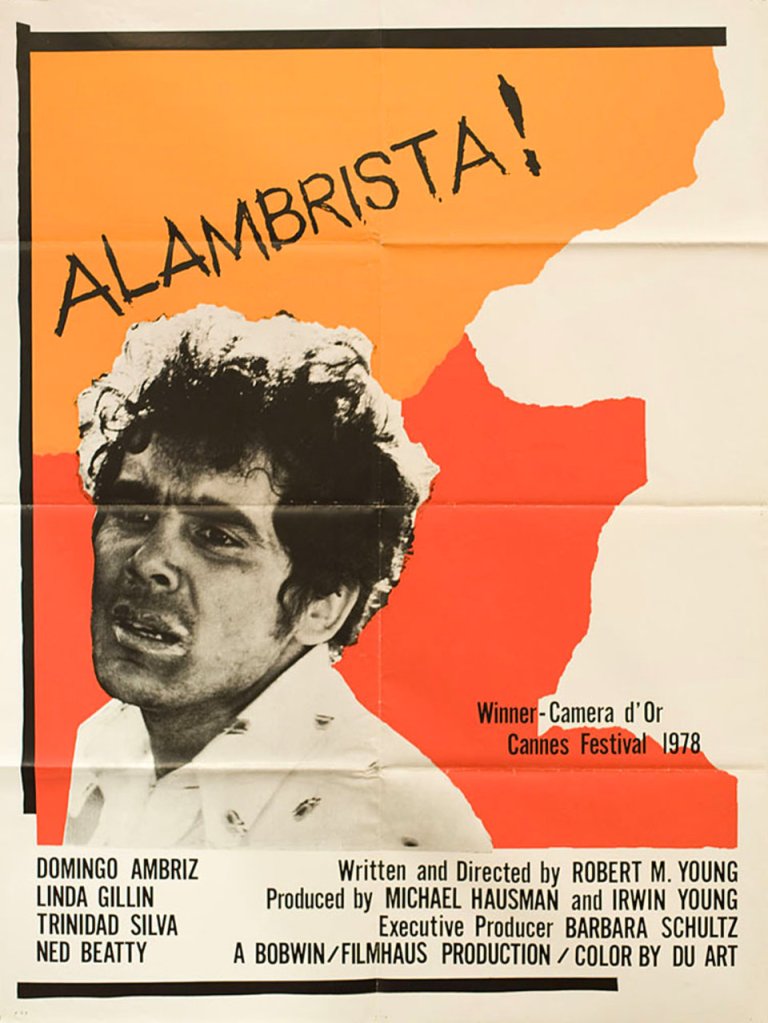
#686) ¡Alambrista! (1977)
OR “Las Uvas de Ira”
Directed & Written by Robert M. Young
Class of 2023
The Plot: Upon the birth of his daughter, Roberto (Domingo Ambriz) leaves his home in Michoacán, Mexico to illegally cross the border into the United States and find work to support his family and farm. His travels through California highlight the never-ending struggles of immigrants in search of the American dream and a better life. Among his adventures are hitchhiking with fellow immigrant Joe (Trinidad Silva), an extended stay with White waitress Sharon (Linda Gillen), sudden appearances by “La Migra” that keep Roberto on the run, and even an offer of scab work in Colorado from the shady Anglo Coyote (Ned Beatty). Shot in a documentary style, “¡Alambrista!” is a realistic, unapologetic look at what it takes to make it in America, and the humanity underneath an issue that still strikes a chord in this country almost 50 years later.
Why It Matters: The NFR praises the film’s “powerful, emotional story”, calling it “as relevant today as it was on its 1977 release, a testament to its enduring humanity.” There’s also a detailed essay by film professor Charles Ramírez Berg (actually it’s his essay from the film’s 2012 Criterion release, reprinted with permission).
But Does It Really?: One of my first notes reads “I’m hooked”. From the very beginning, “¡Alambrista!” grabbed me and never let go. This is the kind of movie I’m looking for in the NFR; the lesser-known pieces of art crafted by pure passion and a unique perspective. The best movies are eye-openers, and forgive me and my privileged White bubble, but “¡Alambrista!” opened my eyes to an illegal immigrant’s perspective that didn’t evoke fake sympathy or stand on a soapbox: it just said, “This is what it’s really like, and how you feel about it is up to you.” I’m delighted that “¡Alambrista!” is on the NFR and available for viewing (go Criterion Channel!), and I can’t recommend it enough.
Everybody Gets One: Not his only NFR appearance, but let’s highlight Robert M. Young for a minute. After studying chemical engineering at MIT and English literature at Harvard, Young turned his filmmaking hobby into a career, working on educational shorts in the ’50s and various pieces for the news show “NBC White Paper” in the ’60s. In 1973, Young directed the documentary short “Children of the Fields” about a family of migrant workers, and his experience (and subsequent research on illegal immigrants) inspired him to write “¡Alambrista!”. Young’s other NFR work includes as writer and cinematographer of the Civil Rights era drama “Nothing But a Man“, and as one of the writers of the IMAX movie “To Fly!“.
Wow, That’s Dated: Not a hell of a lot, sadly. Outside of the occasional payphone or aggressive sideburns, there’s very little in this movie to remind you it’s the ’70s and not the present.
Title Track: A few things about this title. 1) The on-screen translation is “The Illegal”, though Young’s original translation was “The Fence-Jumper”. 2) The film ends with a title song that gives a very detailed recap of the entire movie (specific characters and events are mentioned in the lyrics). And 3) This is the only movie on the list with an inverted exclamation mark, which I was excited to learn how to type on my keyboard. Turns out this old dog can still learn some new tricks.
Seriously, Oscars: No theatrical run for “¡Alambrista!”, and therefore no Oscars. The film did, however, pick up a few festival prizes, including the Cannes’ inaugural Caméra d’Or award for best first feature.
Other notes
- I feel obligated to mention that this film about a Mexican immigrant is written and directed by a White man from New York. While many articles I read pointed this out, practically everyone who has worked with Young cites his intense research and unwavering passion to depict his films as honestly as possible. And to his credit, the final film doesn’t feel – for lack of a better term – “White”. It’s not Hollywoodized or filled with forced sentimentality, nor does it shoehorn in any White savior narrative (though Sharon comes close). I cannot describe the film’s aesthetic beyond that it all feels very real; a difficult feat to pull off regardless of your director’s ethnicity. Also, totally unrelated, but I think it’s amusing that Robert Young gave his protagonist a variation on his own name.
- Young’s documentary background shows up in full force in this movie. The film is shot completely in hand-held, shaky-cam style, giving the movie its grounded realism. While this approach has become gimmicky over the years, in “¡Alambrista!” it feels fresh and organic; it helps you immediately accept the reality of the situation.
- The border crossing scenes in this movie are a tense viewing experience, which leads me to believe that an actual present-day crossing must be 1000 times worse.
- The first “La Migra” raid scene is another highlight. I love how the camera also appears to be hiding from the cops, as if it too is afraid of getting arrested. And while we’re talking about this scene: Is a sax solo really the best choice to underscore an immigration raid? It sounds like a Benny Hill sketch.
- As Joe, Trinidad Silva brings a welcomed levity to the movie, teaching Roberto how to smile and order “ham, eggs, and coffee”. I’m just glad the guy from “UHF” was capable of a more nuanced performance. Silva left us much too soon.
- One of Joe’s observations about Americans is “The gringos, they always cross their legs.” As God is my witness, I was sitting with my legs crossed at the exact moment he said that. What can I say, Joe’s got my number.
- And then Joe mentions that he and Roberto are traveling to Stockton for work, and my jaw practically hit the floor. This is the second movie on the 2023 list that is partially set in my hometown of Stockton, California, although I can’t find anything to confirm that “¡Alambrista!” actually filmed in Stockton. I am once again pleasantly surprised that another movie on this list has a Stockton connection.
- Among the many lessons NFR movies have taught me over the years: Never, ever, ever hitchhike. Only bad things will happen if you are hitchhiking or pick up a hitchhiker while driving (That being said, this movie and “It Happened One Night” are the exceptions that prove the rule).
- That is Edward James Olmos in an early film role as one of the drunks yelling at the immigrants lining up for migrant work. This is Olmos’ sixth film on the Registry, and his third entry in three consecutive years. I assume this is all part of an initiative to get every Edward James Olmos movie on the Registry. Side note: The other drunk in the scene is Julius Harris, who I remember as Ivan Dixon’s alcoholic father in “Nothing But a Man”.
- I like the scenes between Roberto and Sharon, in which they are both trying to connect despite the major language barrier between them, and eventually succeeding (at least on a physical level). I assume Sharon trying to teach Roberto how to say “apple pie” is a metaphor for American assimilation or something like that.
- Oh my god, this guy at the diner won’t stop talking! I think it’s meant to be comic relief, but really I just need this guy to shut up. Also, that actor is Jerry Hardin, longtime character actor and father of Melora Hardin, aka Jan from “The Office”.
- The scene where Sharon tries to help Roberto wire money to his wife is just great. It’s the scene where Sharon finally learns that Roberto is married, and both actors play it perfectly: Sharon concealing her pain in public, Roberto either coldly aware or blissfully unaware (Ambriz plays it a bit cryptically).
- Ah norteña music, we meet again.
- Oh right, Ned Beatty’s in this, appearing briefly in two scenes I imagine he knocked out in one day of shooting. I suspect Beatty’s work here was part of his “Never turn down work” mantra, hence why he shows up in every ’70s movie. Fun Fact: At the time “¡Alambrista!” was released, Beatty had just received an Oscar nomination for his supporting turn in “Network“, no doubt adding a bit of prestige to this film.
- [Spoilers] The last chunk of the movie throws a lot of curveballs at the last minute. First, we get the stuff with Roberto’s dad, a subplot I genuinely forgot about. Then Roberto finally snaps in the only bit of capital A acting that Domingo Ambriz is required to do. But most memorably for me, the final scene is Roberto witnessing a pregnant woman going into labor at the US/Mexico border, happy that her newborn is healthy and – more importantly – born in America. My analysis on the final scene: the American dream of an immigrant making a new life in this country is long gone. Only those born here have a chance to thrive. I admit it’s a downer interpretation, but then again, we live in real downer times. At least we have this peppy end credits music to play us out.
Legacy
- “¡Alambrista!” premiered on KCET (LA’s PBS affiliate and one of the film’s producers) in the fall of 1977 and played a few film festivals afterwards. Despite positive reviews, the film more or less disappeared after a few more PBS airings. In the early 2000s, aided by academics David Carrasco and Nicholas J. Cull, Robert Young released a director’s cut of “¡Alambrista!” as part of an educational package about Mexican immigration sold to schools. This cut – the only widely available version – is dedicated to “the spirit of Trinidad Silva”.
- According to the Ramírez Berg Criterion essay, “¡Alambrista!” led to the second wave of Mexican American filmmaking, which focused more on narrative features about the Mexican American experience rather than documentaries or shorts. Among this second wave are “El Norte“, “La Bamba“, and “Stand and Deliver“; all of which have been inducted into the NFR.
- Apart from Ned Beatty and Edward James Olmos, most of this cast never got another role as substantial as their work in “¡Alambrista!”, appearing in bit parts in movies and episodic television over the next few decades. Coincidentally, both Domingo Ambriz and Trinidad Silva appear in Steve Martin’s “The Jerk” in 1979, though I don’t recall them having any scenes together.
- Robert Young would continue directing for the next 35 years, bouncing back and forth between narrative films and documentaries. He even directed five episodes of “Battlestar Galactica” starring his frequent collaborator Edward James Olmos. We’ll meet up with Young (and Olmos) again when I cover “The Ballad of Gregorio Cortez“. Sadly, Young died just a few days before my viewing of “¡Alambrista!” at the age of 99.
- And finally, I’d be remiss not to mention that “Alambrista” was one of the 27 movies Representative Joaquin Castro submitted for NFR consideration in 2023, and the only one to make the list that December. Now if only I can convince him to lobby for “Original Cast Album: Company” or “It’s a Mad, Mad, Mad, Mad World”. They are not made by or about Latinos, but it couldn’t hurt to try and get these movies the Castro Bump.
 The Horse's Head
4 thoughts on “#686) ¡Alambrista! (1977)”