
#719) El Norte (1983)

#719) El Norte (1983)

OR “A Dream Deferred”

Directed by Gregory Nava

Written by Nava and Anna Thomas

Class of 1995

The Plot: Siblings Rosa and Enrique Xuncax (Zaide Silvia Gutiérrez and David Villalpando) are indigenous Mayans living in San Pedro, Guatemala during the Guatemalan Civil War of the mid to late 20th century. When government agents murder their father Arturo (Ernesto Gómez Cruz) and capture their mother Lupe (Alicia del Lago), Rosa and Enrique decide to flee their homeland and make the dangerous journey north through Mexico to America (“El Norte”), where they hope to live out the fantasy American dream they have been told all their lives. After several setbacks in Mexico, Rosa and Enrique arrive in Los Angeles, taking any menial job or day labor while trying to avoid Immigration. “El Norte” is a sobering, heartbreaking account of the ongoing struggles for immigrants, even after they have arrived in “the land of the free”.

Why It Matters: The NFR calls the film a “sweeping story infused with Mayan folklore” and quotes the Variety write-up declaring the film the “first American independent epic”. An essay by Ithaca Teaching Fellow Matt Holtmeier focuses on the film’s visual motifs and evergreen themes.

But Does It Really?: “El Norte” is one of those movies the NFR is all about. I was drawn into the world of “El Norte” almost immediately, feeling and hurting for these two characters every step of the way, and by the end I truly felt like I had been on this journey with them. The film walks a fine line of sympathy without sentimentality, with an artistic style that still feels grounded. This straight-forward, compelling approach helps an audience more readily accept this film’s depiction of the immigrant experience. I can’t recommend “El Norte” enough, and I’m so glad the NFR inducted this film in only its third year of eligibility.

Everybody Gets One: Gregory Nava was raised in San Diego and crossed the US-Mexican border several times throughout his childhood to visit family in Tijuana. The drastic differences between San Diego and Tijuana (separated by a mere fence) were the germ of what became “El Norte”, which Nava wrote with his creative partner (and then-wife) Anna Thomas. Fun Fact: While Anna Thomas was studying film at UCLA, she wrote the cookbook The Vegetarian Epicure, which helped ignite the vegetarian movement of the 1970s!

Wow, That’s Dated: “El Norte” is another NFR film that highlights how much easier air travel was in the 20th century. You could walk right up to the gate!

Seriously, Oscars?: Despite being an independent production with a limited theatrical release, “El Norte” managed to break through at the Oscars with a nomination for Best Original Screenplay. Facing such eclectic competition as “Beverly Hills Cop“, “Broadway Danny Rose”, and “Splash”, “El Norte” lost to “Places in the Heart”, a Best Picture nominee whose major contribution to pop culture was from its win in another category. To date, the “El Norte” screenplay nomination is the only Oscar recognition for either Gregory Nava or Anna Thomas.

Other notes

  • “El Norte” was funded in part by the Corporation for Public Broadcasting, and presumably contributions from Viewers Like You. Thank you.
  • Since Guatemala was still very much under dictatorship in the early 1980s, the Guatemala scenes were filmed in Chiapas, a city in Mexico near the Guatemalan border with its own Mayan community. Later filming in Mexico near the US Border was cut short when the Mexican police held the crew at gunpoint and forced production to shut down. Remaining scenes were filmed in Los Angeles where, somewhat ironically, they found a much larger population of Guatemalan immigrants than they did in Mexico. That story again: scenes set in Guatemala were filmed in Mexico, and some scenes set in Mexico were filmed in America.
  • One detail I found amusing is that Rosa’s image of America comes from what she has seen in issues of Good Housekeeping. This could have been a one-off joke, but thanks to this film’s expert screenwriting, it comes across as an authentic detail of Rosa’s personality and informs much of what she does later in the film.
  • I could tell I was in the hands of a good movie based on how quickly I sympathized with these characters. The film’s initial setup makes it obvious that Arturo is not going to survive, but I was still hoping against hope that he would.
  • Both of our leads are great, but Zaide Silvia Gutiérrez is your MVP. She has one of those movie star faces that conveys a lot of very subtle emotion. With a quick glance or head movement, you can see everything that Rosa is thinking and feeling. It’s a wonderfully empathetic performance, and it’s no wonder that Gutiérrez has maintained an acting career in her native Mexico for the last 40 years.
  • The secret to the movie’s success is how fully immersed we are in Rosa and Enrique’s perspective. The first hour of “El Norte” is spoken in K’iche’, and the film’s first act is spent entirely in San Pedro with the Mayans and their customs. Once English language is eventually spoken, it is jarring enough to make you understand how foreign English is to Rosa and Enrique for the rest of the film.
  • After an understandably tense first act establishing the character motivations and stakes, we get some much-needed levity in the second act. Before arriving in Mexico, Enrique is told to claim to be Mexican so they won’t get deported back to Guatemala, and that the best way to pretend to be Mexican is by infusing his vocabulary with frequent profanity. The first line spoken by a Mexican character in the movie is “Motherfucking tire!”, and this stereotyping gets a very funny pay-off later.
  • “El Norte” gives us not one, but two border crossing scenes, filmed near the actual US border with cooperation from Border Patrol. The second is the longer and more harrowing of the two, featuring Rosa and Enrique crawling through a sewer pipe. It’s now impossible for any film buff to watch this scene and not hear Morgan Freeman narrating about “smelling foulness I can’t even imagine.”
  • As if the sewer scene wasn’t unpleasant enough already, we get rats! So many rats! According to an article by Roger Ebert, those were actual rats used for the scene, and Zaide Silvia Gutiérrez insisted on performing the scene herself despite her fear of rats. Hats off to Gutiérrez and Villalpando; you couldn’t pay me to do a scene like that.
  • The scene where Rosa and Enrique see San Diego for the first time is shot like Dorothy and her friends arriving at Emerald City. I know it’s meant to be a beautiful, pivotal moment for these two, but thanks to the likes of “Anchorman” the city of San Diego is an immediate punchline for me.
  • The film’s third act in Los Angeles introduces two characters played by NFR stalwarts. It was a pleasant surprise to see Trinidad Silva in another NFR movie, especially after his character in “¡Alambrista!” unceremoniously disappeared. And at long last this blog has entered its Lupe Ontiveros era, with the late great actor playing Nacha, Rosa’s guardian angel who gets her a job cleaning houses. Ms. Ontiveros has five films on the NFR, four of which have been inducted since I started The Horse’s Head in 2017.
  • I found this film’s depiction of White people very interesting. First off, there are mercifully no White saviors. The White characters are not here to help or support Enrique and Rosa; they have their own agendas and are completely unaware of what these two have gone through. The other intriguing aspect was that the White characters – especially Enrique’s wait staff co-workers – all have clever banter with each other, as if we’ve stumbled onto a Neil Simon play mid-performance (Simon also gets name-checked by one of these characters).
  • In addition to the obvious comparisons to ¡Alambrista!”, “El Norte” shares a lot of DNA with another NFR movie: “The Grapes of Wrath“. I spent my viewings of both “Grapes” and “El Norte” worried at every point that something bad would happen to our protagonists on their journey to find a better life in California.
  • The final few scenes are appropriately devastating, but not in a drawn-out or overly depressing way. Enrique’s last-minute ultimatum is a tense addition, and Rosa’s final monologue is a genuine heartbreaker. Without getting into spoilers: one interpretation of the final shot is that a character has committed suicide, but I think it is there as a reminder of the Guatemalan genocide, which was still very much going on in 1983, continuing through 1996.

Legacy

  • “El Norte” premiered at the Telluride Film Festival in September 1983, and was so well received that its initial PBS broadcast was postponed in favor of a theatrical release. The film started its limited theatrical run in January 1984, and strong reviews (including raves from both Siskel and Ebert on their TV show) helped “El Norte” find a bigger audience and play in some markets for over a year. “El Norte” finally aired on PBS as part of “American Playhouse” in May 1985, three months after receiving its Oscar nomination.
  • Many articles I have read about “El Norte” cite its influence on American immigration policies in the mid-80s, and that both Ronald Reagan and Walter Mondale referenced the movie during one of their 1984 presidential debates. I couldn’t find any direct reference to “El Norte” in the debate transcripts, and I don’t feel like scrubbing through three hours of debate footage, so if anyone can confirm this happened that would be great.
  • Gregory Nava and Anna Thomas’ next film was the 1988 WWII drama “A Time of Destiny”, which was a critical and box office disappointment. Though both of their filmographies are sparse, Nava and Thomas gave us “My Family”, future NFR inductee “Selena”, and the screenplay for Julie Taymor’s “Frida”. Nava and Thomas also co-founded Independent Film Project/West; the organization now known as Film Independent that currently produces the Independent Spirit Awards.
#718) The Plow That Broke the Plains (1936)

#718) The Plow That Broke the Plains (1936)

OR “Agents of Field”

Directed & Written by Pare Lorentz

Class of 1999

Today’s oversimplified history lesson: the Great Plains and the Oklahoma Dust Bowl. As always, I’m just here to talk about the movie, but I encourage further research into these expansive topics.

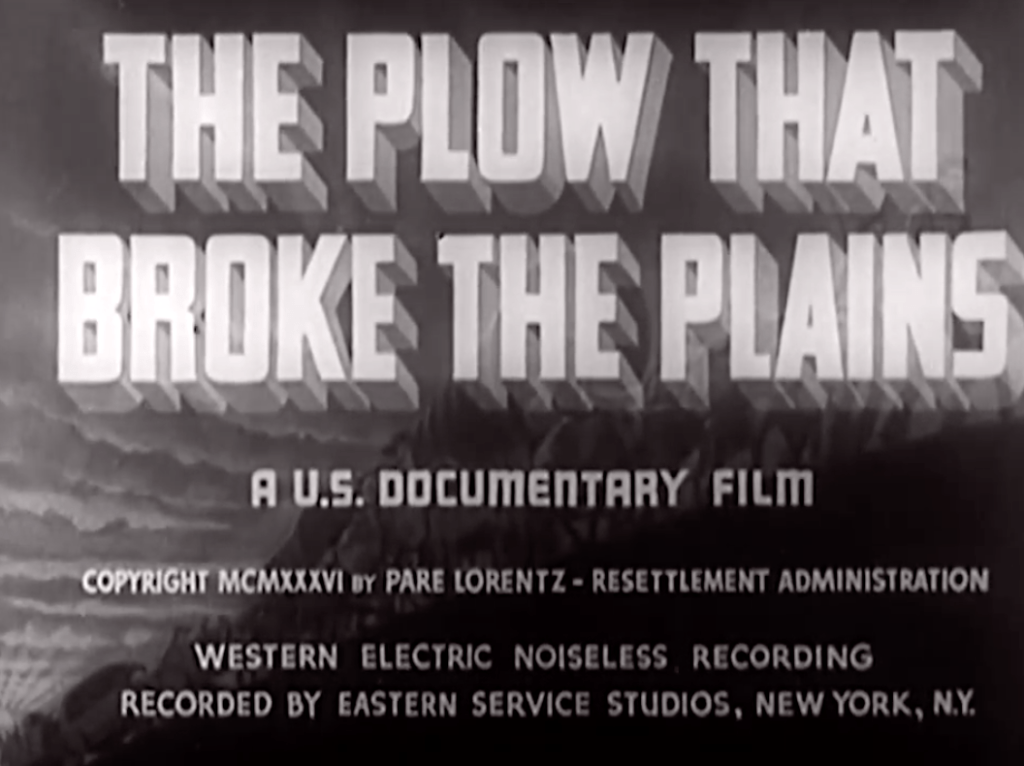
The Plot: “The Plow That Broke the Plains” is the story of the Great Plains; the 1.1 million square miles of flatland that stretches across 12 states in the Midwest, and how it was nearly destroyed in just a half-century. We begin in the late 1800s as settlers arrive and start developing the grassland. As those settlers continue westward, the remaining farmers start plowing the fields, despite the area’s lack of rivers and rain. The land gets a boost when World War I breaks out and there is a demand for wheat. This excessive growth continues through the 1920s but hits a breaking point with stock market crash of 1929 and the Dust Bowl and ongoing droughts of the 1930s, making the land virtually unfarmable. If only there was an off shoot of the US government that could help rehabilitate this bounteous land. Brought to you by your friends at the U.S. Resettlement Administration.

Why It Matters: Both the NFR write-up and the accompanying essay by Lorentz expert Dr. Robert J. Snyder rehash Pare Lorentz and the film’s production.

But Does It Really?: This is a situation we come across every so often on this blog: two films that cover the same ground (so to speak). Like Lorentz’s other NFR film “The River“, “Plow” is a government funded documentary short about a piece of endangered American land, narrated by Thomas Chalmers, and scored by Virgil Thompson. While they’re both equally compelling, neither is more famous or impactful than the other, which makes both being on the NFR a bit of a headscratcher. Although “The River” was made two years after “Plow”, it was added to the Registry first, and I suspect “Plow” was inducted nine years later as Lorentz’s stepping stone movie. On its own, “Plow” is an effective, dramatic look at nature’s destruction by humankind, but as an NFR entry it seems redundant. However, Lorentz is far from the only obscure filmmaker with multiple entries on the Registry, so I’ll shrug my shoulders and give “Plow” the same pass I gave its cinematic younger sibling. But if I see one more Pare Lorentz movie on this list, NFR, you and I are going to have a talk.

Everybody Gets One: Pare Lorentz started his career as a freelance writer in the 1920s, eventually being assigned as a film critic for Judge magazine even though he had no interest in films. By the 1930s, Lorentz had relocated from New York to Washington DC, and became fascinated with Franklin Roosevelt’s New Deal campaign, writing about it at length during Roosevelt’s first term as president. These writings caught the eye of Secretary of Agriculture Henry Wallace, who arranged for Lorentz to meet with Rexford Tugwell (great name) of the newly formed Resettlement Administration. Originally hired as a film consultant, Lorentz agreed to direct a short about the Dust Bowl, a topic that interested him greatly. Unfortunately, his lack of filmmaking experience caused him to lowball his budget, requesting and receiving only $6,000 (about $135,000 today) from the government, and paying with his own money for the extra costs – another $14,000 ($316,000 today).

Wow, That’s Dated: As I said in my “River” post, “this whole thing is pure New Deal propaganda”.

Other notes

  • From the opening prologue: “By 1880 we had cleared the Indian, and with him, the buffalo, from the Great Plains” Yikes. You know it’s government propaganda when they gloss over Indigenous genocide and the near extinction of the buffalo in favor of their patriotic narrative.
  • In the five years since covering “The River”, I forgot how much I enjoy hearing the rich, excitable tones of narrator Thomas Chalmers. Side note: In my previous research on Chalmers, I somehow missed his directing career, which includes fellow NFR short “The Sex Life of the Polyp“.
  • Shoutout to this film’s cinematographers: Leo Hurwitz, Ralph Steiner, Paul Strand, and Paul Ivano. Unlike their director, each of them had previous experience in filmmaking. In fact, both Steiner and Strand have their own films on the Registry! The Great Plains are shot very stylistically throughout, with plenty of low and high horizons in the frame. Someone was listening to David Lynch as John Ford.
  • Classical composer Virgil Thompson was hired to score “Plow” in part because he also had no film experience. Thompson’s score has that vibrant American sound that was coming into classical music at the time, which explains why it reminded me of something Aaron Copland would compose (Copland was a contemporary – and possibly rival – of Thompson).
  • I didn’t realize World War I was such a major factor in the decline of the Great Plains. Lorentz and his team have fun showing us tractors plowing the field while Great War-era marching songs play. And then they start crosscutting with stock footage of tanks in battle just in case you couldn’t figure it out.
  • The breaking point of the land development climaxes with footage of a stock ticker crashing to the ground. Get it? GET IT? Side note: Apparently none of the major Hollywood studios were willing to supply stock footage to Lorentz, so he had to use his friendships with industry insiders to get the footage he needed.
  • This film would play very well before a screening of “The Grapes of Wrath“, helping give that film a proper historical context for a modern audience. According to one John Steinbeck biographer, “Plow” might have been an influence on the author while he was writing “Grapes of Wrath”. I’m a little skeptical on this one, so no “Legacy” section for you!
  • Unlike other propaganda films, “Plow” isn’t so much about what you the viewer can do to help or could have done to prevent this, but more of a “isn’t your government great?” kind of film. That being said, the film does condemn those who plowed the land to begin with. Allegedly at one screening, Pare Lorentz overheard an audience member say, “They never should have plowed them plains.” Sounds like this film reached at least one person.

Legacy

  • After a successful screening at the White House for President Roosevelt, “The Plow That Broke the Plains” premiered at DC’s Mayflower Hotel. Wider distribution, however, was harder to come by, as the major theater chains refused to carry the film due to its government affiliation. Pare Lorentz travelled with the film across the country, getting independent theaters to screen it and local critics to review it. This strategy created strong word of mouth and helped “Plow” get screened in over 3,000 theaters across America in 1937. The film received positive reviews from critics, and less-than-positive reviews from actual farmers and citizens of the Great Plains.
  • Although Pare Lorentz had resigned from his film consultant position with the US government shortly after completing “The Plow That Broke the Plains”, Franklin Roosevelt convinced him to return and make another film, this time about the Mississippi River.
  • Like many a New Deal program, the Resettlement Administration was dissolved in 1937, becoming the Farm Security Administration, which begat the Farmers Home Administration, which begat the USDA Rural Development.
  • As for the Plains themselves, things finally started picking up in the 1950s thanks to concentrated efforts to better irrigate the land. While the Great Plains are nowhere near as populous as they were before the Dust Bowl, they contain plenty of usable farmland, and in more recent years have shifted their focus to wind power.

#717) Flowers and Trees (1932)

#717) Flowers and Trees (1932)

OR “Hue’s Woods These Are”

Directed by Burt Gillett

Class of 2021

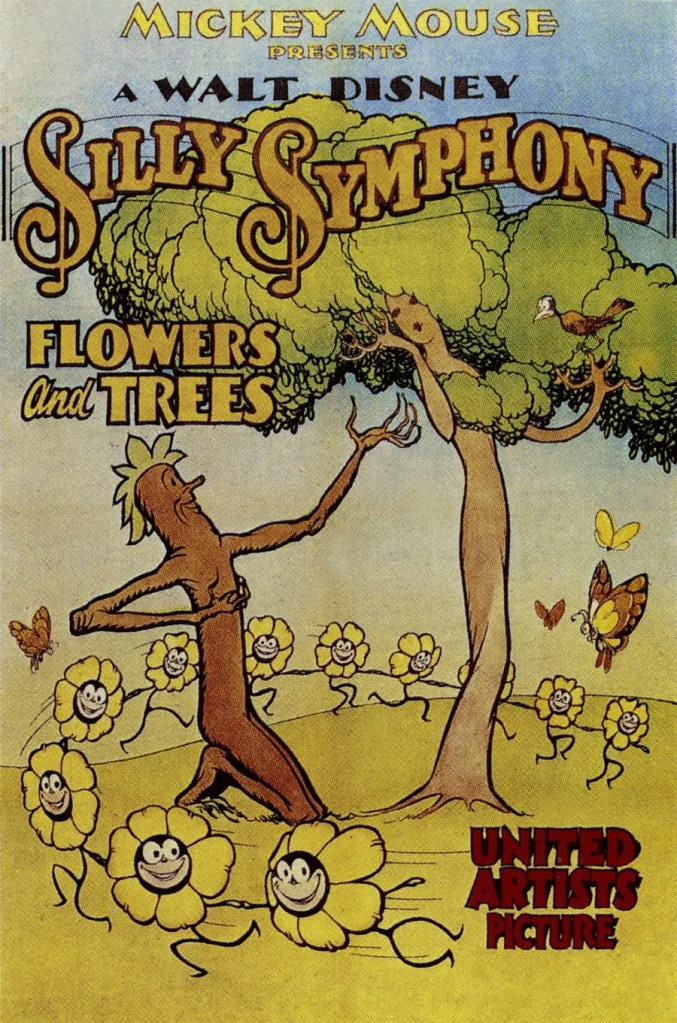
The Plot: “Flowers and Trees” lives up to its title as an animated tale of anthropomorphized flowers and trees…well, mostly trees. As dawn breaks in an idyllic forest, a Boy Tree woos a Girl Tree with a harp made of vines. All this wooing angers a nearby Old Man Tree, who wants the Girl Tree for his own. Boy Tree easily wins a fight for Girl Tree’s honor, and Old Man Tree retaliates by starting a forest fire. But all ends happily in this Disney Silly Symphony; the first film (animated or otherwise) to utilize the new technological marvel of three-strip Technicolor.

Why It Matters: The NFR gives the short its technical achievement, singling out the film’s “vibrant Technicolor”.

But Does It Really?: “Flowers and Trees” is a pleasant, agreeable short, though ultimately its technical innovation is what pushes it into the “important film” column. As a lifelong Disney history buff, I have seen “Flowers and Trees” before and was aware of its significance in Disney history, but even that wasn’t enough for me to include it on my own NFR nomination ballot over the years. Still, it’s nice to see that other people advocated for its NFR inclusion, and it’s refreshing to know that there’s at least one Disney short from this era that can go on Disney+ without any disclaimers or backlash. A pass for “Flowers and Trees”; an important, though not monumental, moment in the history of color film and Disney animation.

Seriously, Oscars?: At the 5th Academy Awards, “Flowers and Trees” was the first winner in a brand-new category: Best Short Subjects, Cartoons (now known as Best Animated Short). Oscar rules at the time gave the award to a short’s producer, not its director, so Walt Disney collected the first of his eventual 26 Oscars (which is still the record). Disney also received an Honorary Oscar that evening for the creation of Mickey Mouse.

Other notes

  • While Technicolor had been around since 1916, the company didn’t perfect their three-color film technique until the early 1930s (I covered this process in greater detail in my “Becky Sharp” post). Technicolor co-founder Herbert Kalmus and his team created a camera that could handle this new process in 1932, but the expensive device attracted few takers in Hollywood (this being the Great Depression and all). While waiting for his team to make enough cameras to be able to loan out to live-action productions, Kalmus wanted to test the camera on an animated short and convinced Walt Disney to sign an exclusive three-year contract with Technicolor. Knowing that his “Silly Symphony” shorts needed a boost in popularity, Disney picked “Flowers and Trees”, already in production, as a test subject. This meant that all the black-and-white animation already completed for the film had to be scrapped and reshot in Technicolor, a move that quickly increased the short’s budget.
  • Even though he’s not in the short, Mickey Mouse’s popularity can be felt here with the opening credit “Mickey Mouse Presents a Walt Disney Silly Symphony”. 
  • I assume “Flowers and Trees” was most audiences’ first experience with color film (aside from the more muted two-strip of such 1920s films as “The Black Pirate“). It must have been astonishing to see this on a big screen, probably like people today going ape for that 18K Darren Aronofsky film at the Sphere in Las Vegas.
  • As with all of Disney’s early productions, there is no credited voice cast. Granted there’s no spoken dialogue in this, but dammit Walt I want to know who did the birds’ chirping and the Old Tree’s growling!
  • Do we know what kind of trees these are? The Disney Fandom wiki lists our three main trees with very unhelpful descriptions of their size and bark color. But I guess that is to be expected from a niche wiki page.
  • I don’t know how else to describe it, but Girl Tree has a very ’30s look to her. Maybe it’s her overall slenderness. She also kinda looks like Edvard Munch’s “The Scream” with leaves.
  • My favorite artistic choice in the film: the Old Man Tree’s tongue is a lizard that lives in his hollow trunk. 
  • I forgot that this movie’s big dramatic climax is a forest fire. Given the number of fires here in California in recent years, this scene is perhaps more relevant now than it was 90 years ago. Now I understand why that fir tree makes a run for it; he knows he’s the redshirt of the forest.
  • This short’s deus ex machina comes from the little birdies flying up into the sky and poking holes through the clouds, therefore creating rain. Is that how that works? Man, I really should’ve paid more attention in school.

Legacy

  • Although the ballooning budget of “Flowers and Trees” made Disney and their distributor United Artists nervous, the film premiered at Grauman’s Chinese Theatre in July 1932 after Sid Grauman was won over by a rough cut. Playing before the prestige MGM drama “Strange Interlude”, “Flowers and Trees” was an instant hit.
  • The popularity of “Flowers and Trees” helped save the Silly Symphonies series, which was further boosted by another Technicolor short the next year: “The Three Little Pigs“. Disney would continue producing shorts and eventually features using Technicolor, or at the very least the Technicolor dye-transfer technique, through the late 1970s.
  • The trees from “Flowers and Trees” have made a few cameos over the years, usually as a tip of the hat to their place in Disney history. Boy Tree and Girl Tree have appeared in “Who Framed Roger Rabbit“, episodes of the TV show “House of Mouse”, and in the final group shot of “Once Upon a Studio”, a short that I absolutely adore.