
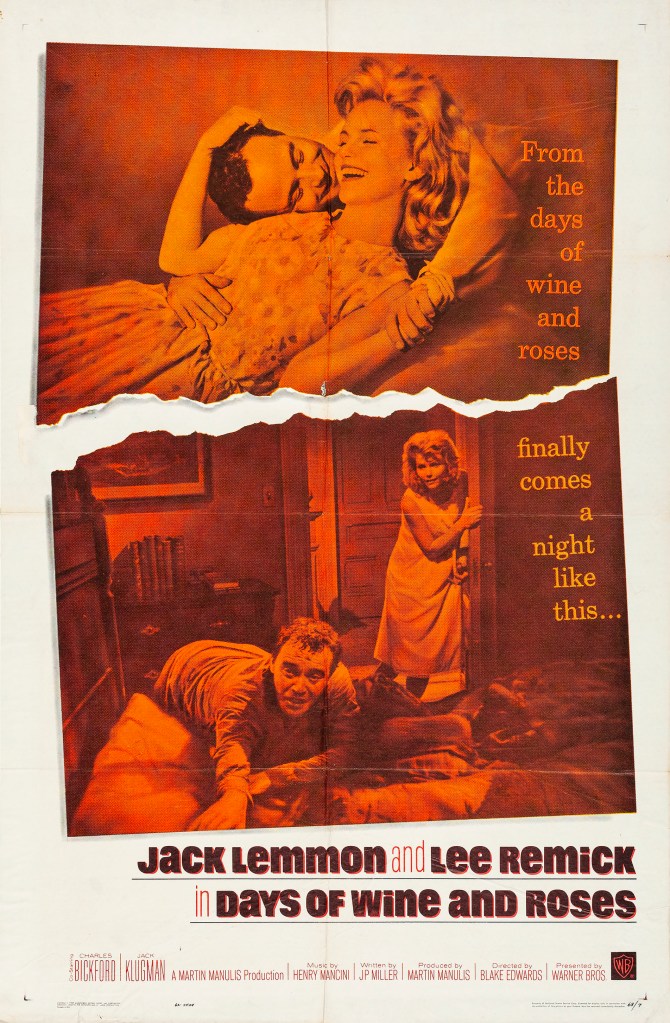
#820) Days of Wine and Roses (1962)
OR “Lemmon with a Twist”
Directed by Blake Edwards
Written by JP Miller. Based on his teleplay.
Class of 2018
The Plot: PR man Joe Clay (Jack Lemmon) meets secretary Kirsten Arnesen (Lee Remick) at a party. Although they initially dislike each other, the two begin dating, and Joe introduces Kirsten to social drinking, which she had purposefully abstained from. Eventually Joe and Kirsten get married, and their casual drinking turns into alcoholism, costing Joe his job. After years of spiraling, Joe learns to sober up with the help of Alcoholics Anonymous, but is it too late for Kirsten?
Why It Matters: The NFR calls “Days” an “uncompromisingly bleak film”, praising Edwards, Lemmon, Remick, and the score by Henry Mancini.
But Does It Really?: Despite its dour subject matter, ultimately I liked “Days of Wine and Roses”. While not the first film to tackle alcoholism, “Days” has more freedom than the likes of “The Lost Weekend” or “Come Back, Little Sheba” to openly explore the subject. Add pitch perfect performances from Lemmon and Remick, a sharp script from JP Miller, and some surprisingly sensitive direction from Blake Edwards, and you’ve got a movie that is up to the challenge of tackling alcoholism head-on. “Days” may be remembered more for its title than anything else, but it’s well worth a watch over 60 years later, and more than deserving of its NFR status.
Title Track: The film gets its name from a line in the Ernest Dowson poem “Vitae Summa Brevis Spem Nos Vetat Incohare Longam”: “They are not long, the days of wine and roses”. Kirsten quotes the line on her first date with Joe. The film also gives us a title song courtesy of Henry Mancini and Johnny Mercer.
Seriously, Oscars?: “Days of Wine and Roses” received five Oscar nominations, including for Jack Lemmon and Lee Remick, who lost to, respectively, Gregory Peck in “To Kill a Mockingbird” and Anne Bancroft in “The Miracle Worker”. The film did win in one category: Best Song for the title song, the second consecutive win in the category for Mancini and Mercer following “Moon River”.
Other notes
- “Days of Wine and Roses” began as an episode of “Playhouse 90” starring Cliff Robertson and Piper Laurie. It was broadcast live on October 2nd, 1958, and received critical praise as well as two Emmy nominations. Producer Martin Munulis originally planned on bringing “Days” to the Broadway stage, but decided to turn the property into his first motion picture. “Days” was produced under Jack Lemmon’s production company, Jalem, and was originally set up at 20th Century Fox. Unfortunately, Fox dropped the project when Elizabeth Taylor’s “Cleopatra” went over-budget, but Warner Bros. picked it up a few weeks later.
- Original teleplay director John Frankenheimer was passed over in favor of Blake Edwards, who at that point was fresh off of such comedies as “Operation Petticoat” and “Breakfast at Tiffany’s”. I imagine the situation was a win-win for Edwards; he got to show off his dramatic sensibilities as a director, while at the same time injecting a bit more humor into the film’s first half. While Frankenheimer was initially ticked off at not getting the job, he made “The Manchurian Candidate” instead, so everyone’s fine.
- At two different points in the movie, before taking a drink, Joe quietly says, “Magic time”, the same phrase Jack Lemmon would quietly say to himself before each take. I didn’t realize he actually said that in a movie.
- I sure hope the prevalent sexism of the opening party dies down a bit. We start off with lots of condescending talk towards the “girls” in the scene, and topping it all off is a brief appearance by Jack Albertson as a sleazy businessman. Don’t worry Jack, “The Subject was Roses” is only a few years away.
- Lemmon and Remick are both great in this, and have undeniable chemistry. Like his director, Lemmon is relishing the chance to do something more dramatic, and while Remick already had her share of dramatic work under her belt, this is her first true leading performance, an opportunity she clearly did not take for granted. Ultimately these two do such a good job that you hate to see their two characters give in to their alcoholism.
- While this is largely a two-hander, there are a handful of important supporting roles in the movie, most notably Charles Bickford as Kirsten’s stoic father. Fun Fact: Bickford is the only actor from the original “Playhouse 90” episode to reprise their role for the movie, allegedly replacing first choice Karl Malden.
- It was smart to set the film in San Francisco; with its share of taxi cabs and public transportation, no one has to worry about drunk driving.
- Whenever Kirsten is watching TV while drinking, she has cartoons on and, surprise surprise, they’re made by Warner Bros.! For the record, the cartoons playing in the background are “The Bee-Deviled Bruin” and “Shishkabugs”.
- In the most harrowing scene in the movie, while staying with Kirsten’s father, Joe destroys the Arnesen family greenhouse trying to find the last bottle hidden in one of the potted plants. It’s alcoholism at its most naked and dangerous, and Lemmon plays it perfectly.
- Speaking of these great performances, how hard was it to be an Oscar voter in 1962? How do you even compare Jack Lemmon to Gregory Peck to Peter O’Toole? Or Lee Remick to Anne Bancroft to Bette Davis? Not all Oscar ceremonies are created equal, and 1962 is one of those years you wish more than one person could go home with a trophy.
- The film’s other key supporting turn shows up in the third act in the form of Jack Klugman as Jim Hungerford, Joe’s AA sponsor. He’s quite good as the cold splash of reality Joe needs to sober up. In the “funny in hindsight” category, scenes between Lemmon and Klugman feature Felix from the movie version of “The Odd Couple” and Oscar from the TV sitcom version.
- The last chunk of the movie feels like a commercial for AA, which made me theorize that it must have been new in 1962. Turns out AA’s been around since the late 1930s, with the introduction of their 12 step program in the early 1950s. Still, I’m sure this organization was new to a lot of people in 1962, hence the detailed explanation.
- Oof, that ending packs quite a punch. To ensure the studio didn’t film an alternate “happy” ending, once the original ending was shot (the last scene filmed before production wrapped), Jack Lemmon headed off to Paris and couldn’t be reached, therefore making him unavailable for any mandated reshoots.
Legacy
- “Days of Wine and Roses” opened in December 1962, and was generally well-received by critics, though some preferred the original teleplay. In addition to its Oscar win, the title song took home three Grammys in the spring of 1964, including Record of the Year and Song of the Year.
- Surprisingly, all the major players in “Days” would spend the rest of the ‘60s doing lighter fare like romantic comedies and farces. We wouldn’t get another Jack Lemmon performance this dramatic until “Save the Tiger”, and from Lee Remick until…I dunno, “The Omen”?
- There have been multiple stage adaptations of “Days” over the years, the first adapted by JP Miller himself. The early 2000s saw an off-Broadway revival of the play, as well as a West End production adapted by Owen McCafferty. In 2024, a musical adaptation by Adam Guettel and Craig Lucas briefly played Broadway starring Kelli O’Hara and Brian d’Arcy James. Surprisingly, the musical version does not include the song “Days of Wine and Roses”.
- Both of the film’s leads as well as director Blake Edwards admitted to sobering up after making “Days of Wine and Roses”. This led to one of the more memorable moments on “Inside the Actors Studio” in the 1990s, when Jack Lemmon revealed publicly for the first time that he was a recovering alcoholic.
- Side Legacy: Cliff Robertson was pissed that he was passed over for the film version of “Days”, and made sure it wouldn’t happen again. After starring in a 1961 TV adaptation of “Flowers for Algernon”, Robertson bought the film rights, which eventually became the 1968 film “Charly”, and earned him the Oscar for Best Actor.
Listen to This: While watching “Days of Wine and Roses” on television, singer Bill Withers was inspired to write the song “Ain’t No Sunshine”, which found its way onto the National Recording Registry in 2024. And for the record, Wither sings the phrase “I know” 26 times in a row in the middle of “Ain’t No Sunshine”.

