
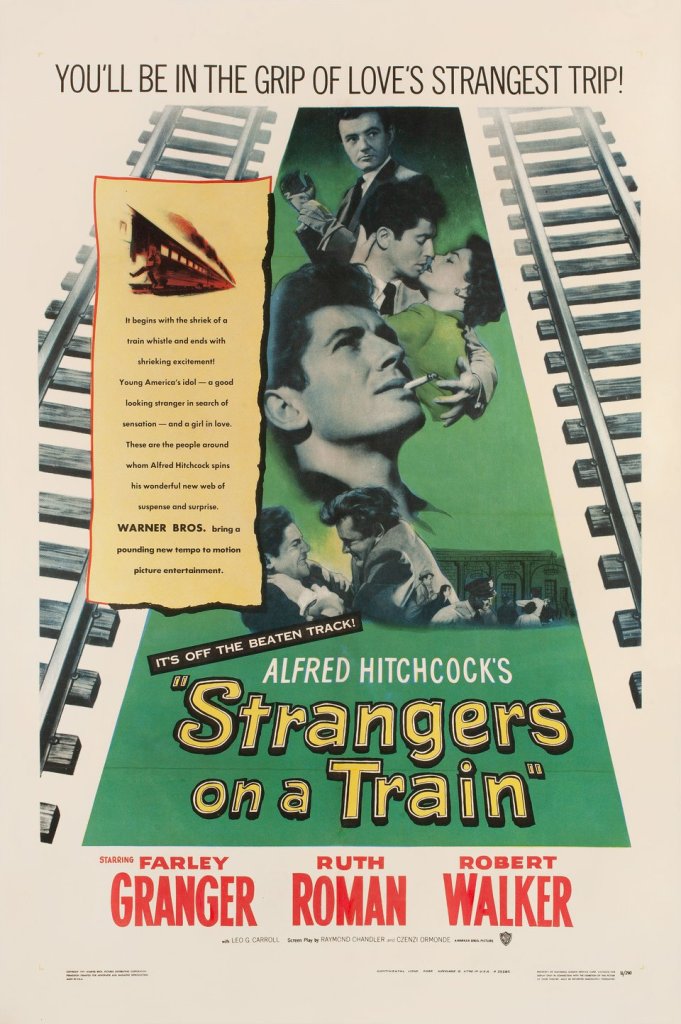
#819) Strangers on a Train (1951)
OR “We Don’t Talk About Bruno”
Directed by Alfred Hitchcock
Written by Raymond Chandler and Czenzi Ormonde. Adaptation by Whitfield Cook. Based on the novel by Patricia Highsmith.
Class of 2021
The Plot: While traveling from Washington D.C. by train, two strangers strike up a conversation. Tennis star Guy Haines (Farley Granger) reveals that he is trying to divorce his wife Miriam (Kasey Rogers aka Laura Elliott) so he can marry his girlfriend Anne (Ruth Roman). Bruno Antony (Robert Walker) wants his father (Jonathan Hale) dead and proposes a “criss cross”: Bruno will kill Miriam and Guy will kill Mr. Antony, therefore absolving the other man of any wrongdoing since there appears to be no motive. Guy pretends to be interested in this theory, and is shocked a few days later when Bruno shows up at his doorstep saying he killed Miriam and expects Guy to hold up his end of the deal. Guy refuses, and Bruno repeatedly hounds him about it. What follows is the kind of suspense and morbid hypotheticals that only Alfred Hitchcock could provide.
Why It Matters: The NFR heaps praise on this movie, calling it “riveting” and “[w]ildly imitated but never topped”.
But Does It Really?: “Strangers on a Train” is one of those second-tier Hitchcock films I always forget about, which is saying something because it’s a well-made thriller that still holds up 75 years later. From its commanding lead performances to its clever script and moody cinematography, it’s a thoroughly enjoyable movie. The only fault I can find in “Strangers” is that Hitchcock’s infallible masterpieces were still ahead of him. Still, as I’ve said before, B+ Hitchcock is still better than most other directors’ A+ work, and I have no qualms about “Strangers on a Train” making the NFR.
Everybody Gets One: This is the only major NFR appearance for all three of our top-billed leads. Farley Granger was under contract with Samuel Goldwyn when Hitchcock cast him in “Rope” (which still isn’t in the NFR, by the way). Granger’s film career came to a halt in the mid-50s when he left Hollywood to pursue theater in New York. Ruth Roman was a Warner contract player that Jack Warner insisted be in the film, much to the dismay of Hitchcock, who repeatedly bullied her on set. Robert Walker was pivoting from boy-next-door characters to more complex roles when “Strangers” came along. Sadly, this would be Walker’s final completed film; he died a few months after the film’s release at age 32.
Wow, That’s Dated: Trains as a major form of public transportation is a big one, but mainly the notion that people were more open to talking to strangers back then. Today, Guy would be on his phone, paying Bruno no attention at all and there would be one less classic movie.
Seriously, Oscars?: “Strangers on a Train” received one Oscar nomination for Robert Burks’ cinematography, losing to “A Place in the Sun”. “Strangers” was the first of 12 collaborations between Burks and Hitchcock, with Burks finally winning an Oscar for his work on “To Catch a Thief”.
Other notes
- Despite Raymond Chandler’s prominent billing, very little if any of his screenplay drafts are in the final film. The bulk of “Strangers” was written by Czenzi Ormonde (Ben Hecht’s assistant whose short stories were getting good notices), Hitchcock’s associate producer Barbara Keon, and Hitchcock’s wife Alma Reville. Keon and Reville remained uncredited, and Warner Bros. insisted on Chandler receiving credit so that a “prestige” name would be associated with the film.
- I like both of our leads. Farley Granger fits right in as the kind of everyman Hitch liked to get into more trouble than they can handle, and Walker is perfectly unhinged from the start. And don’t worry, these two men have plenty of homosexual undertones if you look for them (it helps that Granger was gay in real life).
- Hi Hitch. Hitchcock makes his cameo 11 minutes into the movie, boarding the train while carrying a double bass. Apparently this is one of many “double” motifs seen throughout the movie, but I leave that to the real film snobs.
- I enjoyed Kasey Rogers’ performance as Miriam. It’s essentially only two scenes, but she comes across as antagonistic without being a walking cliche of every “bad woman” in these kind of movies. Speaking of Kasey Rogers, it is my duty to mention that this movie features not one, but two “Bewitched” actors: Rogers would go on to play Mrs. Louise Tate, and Marion Lorne (playing Bruno’s mother) would later play Aunt Clara.
- The amusement park scene ramps up the tension as Bruno stalks Miriam and her friends through the fairgrounds. In fact, it maybe ramps up that tension for too long. Just kill her already! It’s all worth it, however, for the shot where Miriam’s murder is viewed through her glasses lens on the ground, a shot achieved using a giant concave mirror and some optical effects. Easily the most impressive shot in the whole movie.
- Funnily enough, I was relieved immediately after the murder when Bruno remembered to pick up Guy’s lighter that had fallen to the ground. Only Hitch could make me sympathize with a total psychopath.
- One dangling thread this movie never comes back to is the fact that Bruno gives Guy Miriam’s glasses after the murder. If the police found those glasses in Guy’s possession they would have enough to implicate him for the murder. I’m surprised that never comes up again.
- Continuing the double motif is Patricia Hitchcock (Alfred’s daughter) as Barbara, Anne’s bratty younger sister who bares more than a passing resemblance to Miriam (to the point where I initially thought Patricia was playing Miriam). This was Pat’s American film debut, having appeared in her father’s “Sabotage” and “Stage Fright” back in her native England. While Patricia Hitchcock lived to see many of her father’s films enter the NFR, she died just a few months before “Strangers” made the cut.
- I like that Anne is the one who figures it all out, piecing together that Bruno murdered Miriam and that Guy may have been involved. It helps make Anne more interesting and dimensional than just being “the girl” in the movie. That’s what happens when you have three women working on your screenplay.
- The tennis match at the end got me wondering: how many tennis movies are there? All I could think of was “Challengers” and “King Richard”. Did Air Bud ever play tennis? Regardless, I feel like “Strangers” was at one point the only major tennis movie in the pantheon.
- This film returns to the amusement park for quite the climax, though I feel bad for that poor merry-go-round operator; he was just doing his job. It also makes me laugh that the hero of this movie is the random old guy willing to crawl under the merry-go-round to stop it.
- The final scene was apparently a Warner Bros. mandate, and it’s a bit hokey but I didn’t mind it. After all, Hitch would end one of his later films with a gag on a train.
Legacy
- “Strangers on a Train” premiered in the summer of 1951, and while critics were initially mixed (especially regarding the logistics of the murder plot), the film was a box office success. Over the following decades, critic reception improved to be overall positive towards “Strangers”.
- Author Patricia Highsmith was initially pleased with the film, but over time she had some trepidations about some of the differences between book and movie, but always praised Robert Walker’s performance. Highsmith is best known for one of her follow-up novels, 1955’s “The Talented Mr. Ripley”, which has been adapted multiple times over the years.
- “Strangers on a Train” has also gotten its share of remakes, including the 1969 film “Once You Kiss a Stranger”, and the similarly titled 1996 TV movie “Once You Meet a Stranger”. “Strangers” also features prominently in the 1987 comedy “Throw Momma from the Train”, which I saw years ago, but all I can remember is Anne Ramsey’s grating, yet Oscar-nominated, cry of “Ohhhhh-wennnnnnn!”
- Perhaps the film’s most unique legacy is its impact on TV legend Carol Burnett. During the film’s original run, Burnett was an usher at the Hollywood Pacific Theatre (then known as the Warner Bros. Theatre), but was fired when she encouraged a couple to not enter the theater during the film’s climax and spoil the ending. 25 years later, when Burnett received her star on the Hollywood Walk of Fame, she requested that it be placed directly in front of the Hollywood Pacific Theatre.

