#327) Little Caesar (1931)

MV5BYzE4ZTI3MDQtMTE5MS00MzQxLTkwZGMtYWM5MjU2MzE3OTk5XkEyXkFqcGdeQXVyNjc1NTYyMjg@._V1_

#327) Little Caesar (1931)          

OR “The Power of ‘Myeah’”

Directed by Mervyn LeRoy

Written by Francis Edward Faragoh and Robert N. Lee. Based on the novel by W.R. Burnett.

Class of 2000

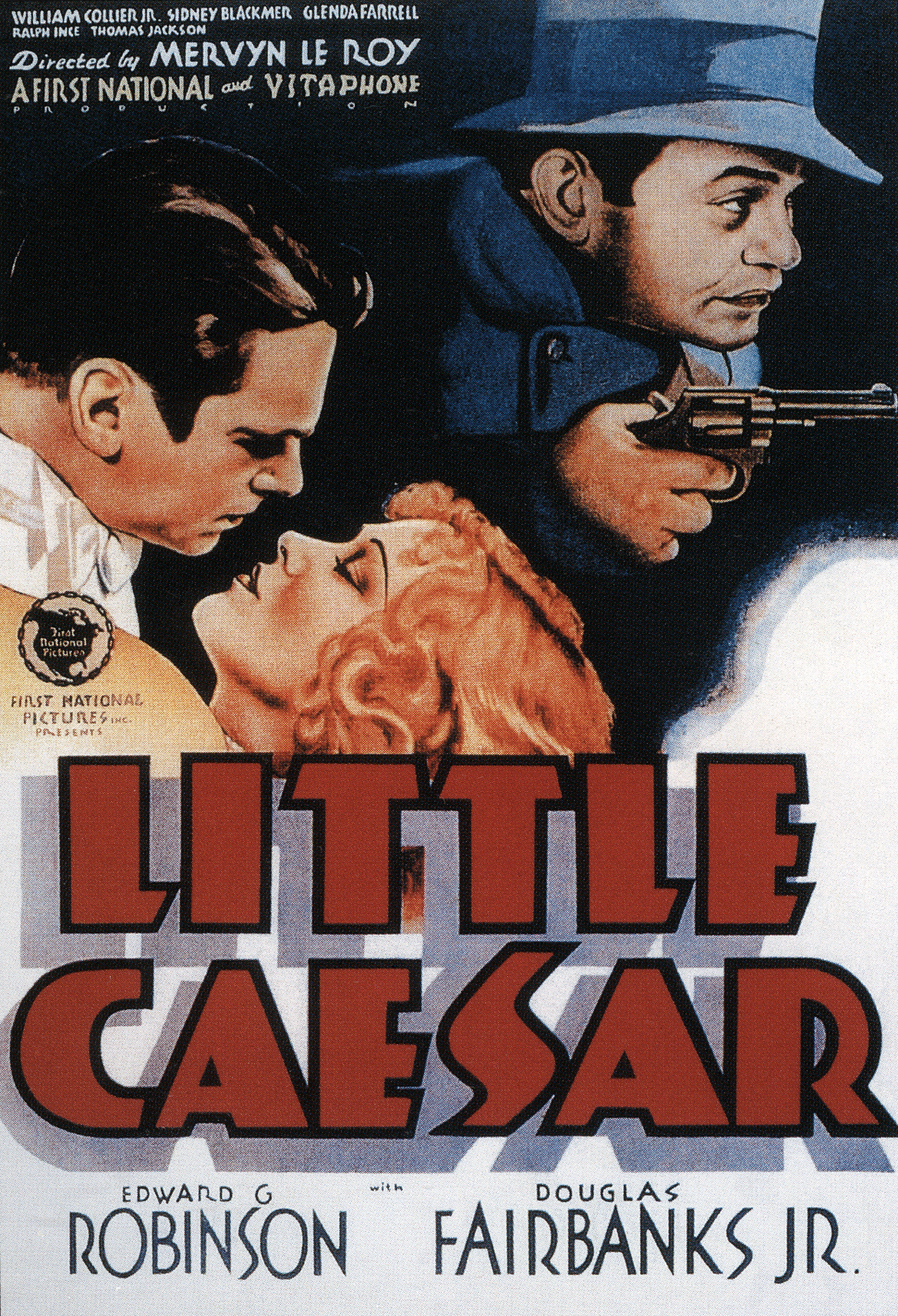
The Plot: The crime scene of 1930s Chicago gets an unexpected jolt with the arrival of Caesar Enrico “Rico” Bandello (Edward G. Robinson). Tired of being a small-time crook, Caesar and his cohort Joe Massara (Douglas Fairbanks Jr.) join gang leader Sam Vettori (Stanley Fields), who gives Rico the nickname “Little Caesar”. While Rico climbs the organizational ladder – eventually becoming the leader of several Chicago territories – Joe becomes a successful dancer and spends more time with his partner/girlfriend Olga (Glenda Farrell). Rico suspects Sam has “gone soft” on him and attempts to get Sam back in his fold, but his newfound power may have gone to his head. This all begs the question: “Mother of Mercy, is this the end of Rico?”

Why It Matters: The NFR praises both Robinson and director LeRoy, though does mention that the film contains “every gangster cliché in its original form”, and that some of the film’s artistry is due to “constraints of sound recording in its early days.”

But Does It Really?: This is another movie whose cultural impact really can’t be measured. Very few people realize their gangster impression is Edward G. Robinson in “Little Caesar”, but the influence of Robinson’s iconic performance is still being felt today. As a whole, “Little Caesar” is an entertaining gangster picture that never outstays its welcome, but Robinson is the reason for its warranted NFR induction.

Wow, That’s Dated: Well the NFR was on to something: this film has every ‘30s gangster cliché, from Italian mobsters to Irish cops.

Seriously, Oscars?: A big hit in 1931, “Little Caesar” received one nomination at the 4th Academy Awards. The film’s Best Adapted Screenplay nod lost to that year’s Best Picture winner, “Cimarron”. Edward G. Robinson never received an Oscar nomination throughout his career, but was honored with a lifetime achievement Oscar in 1973. Sadly, Robinson died shortly after the initial announcement, and his widow Jane accepted the award on his behalf.

Other notes

  • While not Edward G. Robinson’s first film, “Little Caesar” was his first starring role after a handful of supporting credits. For the record, the “G” stands for Goldenberg, his actual surname before pursuing an acting career.
  • Right from the beginning, Rico is established as someone not to be messed with. Rare is the gangster who can be intimidating while wearing a bowtie.
  • I see why Edward G. Robinson impressions are so frequent; he says “myeah” quite a bit in this film. The parodies write themselves.
  • Every time someone says Joe Massara’s name, I get “Fruma-Sarah” stuck in my head.
  • It seems to be purely coincidental, but there is a scene where Olga asks Joe where he’s going with that gun in his hand. Did Jimi Hendrix ever see this movie?
  • We’re only four years into talking pictures, but “Little Caesar” still feels the need to include a handful of intertitles. The few present in this film establish either a scene’s location or a passage of time.
  • Like all the early film greats, Edward G. Robinson is fully aware that less is more. Everyone in this movie overacts around him, but Robinson knows the power of stillness and economy of movement.
  • In addition, Robinson has that “joy of acting” about him. It’s not necessarily the character having fun, but you can tell that Robinson is enjoying playing this part. It helps you enjoy an otherwise unlikable character.
  • Was there a studio policy against quick cuts? The hold-up sequence is done with several dissolves, whereas today it would be more tightly edited.
  • Allegedly, Robinson always closed his eyes when firing a gun, so his eyes had to be taped open. It makes for good copy, but does anyone know if that’s true? And if so, can you spot the tape in the final film?
  • I am living for Thomas E. Jackson’s performance as the super sarcastic Sergeant Flaherty. Apparently he played this stock character in several other films of the era.
  • Say what you will about Rico, he set a goal for himself and damn it, he’s going to achieve it. Do you think he had a five-year plan?
  • Thank god this is pre-code, some of these kills are pretty brutal. But I tip my hat to filmdom’s alleged first drive-by shooting.
  • I think this movie’s alternate title was “Italian Stereotype Bingo”. Mamma mia!
  • Do newspapers still have society pages? I guess in order to have them there need to be newspapers.
  • Wow, this movie did the Spielberg mirror shot 50 years before Spielberg did!
  • If Ma Magdalena sounds familiar, she’s character actor Lucille La Verne, best remembered as the voice of the Queen/Peddler Woman in “Snow White”. Ma Magdalena’s voice sounds like a combination of the two.
  • The police entice Rico to come out of hiding by printing stories in the paper about what a coward he is. That’s actual yellow journalism!
  • Although the Hays Code was not in effect yet, Warner Bros. still felt the need to tone down the film’s final line for fear of offending state censorship boards. Therefore, “Mother of God” became “Mother of Mercy, is this the end of Rico?”

Legacy

  • “Little Caesar” was Edward G. Robinson’s breakout role, and he leaned into the typecasting of gangsters for pretty much the rest of his career.
  • This movie is also responsible for every single Edward G. Robinson impression you’ve ever heard, from Bugs Bunny to Billy Crystal to Chief Wiggum.
  • While not the first gangster picture of the ‘30s, “Little Caesar” is the one that convinced Warner Bros. to start cranking them out. Among the follow-ups are fellow NFR entries “The Public Enemy” and United Artists’ “Scarface”.
  • I can’t find evidence that Little Caesars Pizza is named after the movie, but I just want to point out how much I enjoy the delicious pizza that Little Caesars has been offering for 60 years. And don’t forget to order Crazy Bread!

Please give me free pizza.

#326) Jazz on a Summer’s Day (1960)

MV5BNWRjMTcyOGUtZjU5NC00Y2U5LTk4NWYtNjRkYTEyMTYzZTgyXkEyXkFqcGdeQXVyMjI4MjA5MzA@._V1_

#326) Jazz on a Summer’s Day (1960)

OR “Wake Up Little Rhody”

Directed by Aram Avakian and Bert Stern

Written by Albert D’Annibale and Arnold Perl

Class of 1999

The Plot: Filmmakers Aram Avakian and Bert Stern covered four days of the Newport Jazz Festival in Newport, Rhode Island in July 1958. Every style of jazz from bebop to Dixieland is highlighted, intercut with footage from the recent America’s Cup races. On the roster are performances by the Jimmy Giuffre 3, the Thelonious Monk Trio, Sonny Stitt and Sal Salvador, Anita O’Day, George Shearing, Dinah Washington, the Gerry Mulligan Quartet with Art Farmer, Big Maybelle, Chuck Berry, the Chico Hamilton Quintet, Louis Armstrong and his All-Stars, and Mahalia Jackson.

Why It Matters: As with many of the early NFR entries, the official description for “Jazz on a Summer’s Day” is a brief synopsis of the film and a rundown of the talent roster.

But Does It Really?: I’m always down to support a documentary that covers a specific culture, especially if that culture has an awesome soundtrack. Plus it’s great to see footage of the likes of Armstrong and Jackson, “Jazz” being one of the rare opportunities to see what these greats were like live. “Jazz on a Summer’s Day” is another film that passes all three NFR criteria for me: culturally, historically, and aesthetically significant.

Everybody Gets One: Director Bert Stern was primarily a photographer, most famously for one of Marilyn Monroe’s final photo shoots in 1962.  Co-Director Aram Avakian was also a photographer, known for his photos of the jazz recording sessions produced by his brother George Avakian. “Jazz on a Summer’s Day” was the first directorial effort for both Stern and Avakian, with Avakian also editing the picture. This is also the only NFR entry for a majority of the performers, most notably Louis Armstrong. Though performing since the ‘20s, Armstrong didn’t gain popularity until the jazz revival of the early ‘40s. His large mouth earned him the nickname “Satchel Mouth”, later shortened to the more familiar “Satchmo”.

Seriously, Oscars?: “Jazz” did not receive a nomination for Best Documentary. Weirdly, there were only two nominees in the category that year, the winner being something called “The Horse with the Flying Tail”.

Other notes

  • The 1958 Newport Jazz Festival took place from Thursday July 3rd to Sunday July 6th. This film is primarily from the sets on the 5th and 6th. As best I can tell, the America’s Cup race wasn’t until that September.
  • Oh no, these credits lead me to believe I’m watching another “Staring at Water” movie! Not again!
  • I’ll argue that “documentary” is a misleading label for this movie. Yes, it is reportage of an event, but like jazz itself, the film doesn’t really adhere to structure or form. There’s plenty of footage of the performances, intercut with the audience and other nearby sights. Not so much a documentary as it is an atmospheric tone poem.
  • In the time of do-wop and early rock ‘n’ roll, jazz was still considered underground and experimental. A public showcasing for jazz was still pretty progressive in 1958, as was a desegregated event with no questions asked.
  • I don’t know what it is, but watching all this footage of boats with Thelonious Monk playing in the background just feels right.
  • Anita O’Day is on hand representing the West Coast style of jazz. Her disciplined scat style is quite impressive, even more so when she revealed years later that she was most likely high on heroin during that performance.
  • Pianist George Shearing may be Peter Sellers’ finest character work ever.
  • Dinah Washington is best remembered for her hit single “What a Diff’rence a Day Makes”. Here she sings “All of Me”, and it’s great watching her kill at something more upbeat. Plus there’s a jazz xylophonist! What’s not to love?
  • Some audience members are really digging this, which begs the question: are we sure that’s just cigarette smoke?
  • Like Dinah Washington, Big Maybelle is also best remembered for a slower crossover single (“Candy”), but gets to cut loose here with the upbeat “I Ain’t Mad At You”.
  • For those of you paying attention, that’s two different NFR entries that include Chuck Berry performing “Sweet Little Sixteen”. You can never have too much of a good thing.
  • That being said, does Chuck Berry’s rock ‘n’ roll/rhythm and blues sound really qualify as jazz?
  • Louis Armstrong’s appearance at the Newport Jazz Festival is a little perplexing, seeing as how he didn’t consider the bebop sound of the younger jazz musicians real music. But Armstrong did enjoy performing (doing as many as 300 shows per year) and as they say, a gig’s a gig. Not surprisingly, his set is composed of older standards like “Up the Lazy River”.
  • I enjoyed this movie’s soundtrack, but it was Mahalia Jackson’s take on “Didn’t It Rain” that got my toes tapping.
  • Apparently the Saturday night set at the festival went so long Mahalia Jackson didn’t get to the stage until it was technically Sunday morning. Appropriately enough, the film concludes with her somber, stirring rendition of “The Lord’s Prayer”.
  • Also playing at the 1958 Newport Jazz Festival was a young up-and-comer named Ray Charles. Call it shortsightedness, but Charles is nowhere to be seen in “Jazz”. Charles’ set was, however, recorded by Atlantic Recording, and released as an album four months after the festival.

Legacy

  • Bert Stern never directed another film after “Jazz”, returning to his photography, while Aram Avakian directed a handful of credits, including the cult film “End of the Road”.
  • Co-writer Arnold Perl went on to write and direct the documentary “Malcolm X”, posthumously released in 1972. Spike Lee would use this film’s screenplay as the basis for his own “Malcolm X”.
  • We’ll see more of Thelonious Monk on the Registry in the 1988 documentary “Thelonious Monk: Straight, No Chaser”.
  • After moving to New York in 1972, the Newport Jazz Festival returned to Rhode Island in the ‘80s, and has played every summer ever since.

Listen to This: Louis Armstrong is represented by several National Recording Registry entries, notably his Hot Five and Hot Seven recordings from 1925 to 1928, and his 1956 cover of “Mack the Knife”. Mahalia Jackson can be heard in her 1948 recording of “Move On Up a Little Higher”. Of the remaining performers, the Registry includes Chuck Berry’s “Roll Over Beethoven”, Thelonious Monk’s “Brilliant Corners” album, and The Gerry Mulligan Quartet’s “My Funny Valentine” (featuring Chet Baker).

#325) The Bride of Frankenstein (1935)

8b1231b491e549e4d0cd4608cb6d306e

#325) The Bride of Frankenstein (1935)         

OR “Something Old, Something New, Someone Buried, Dead Like You”

Directed by James Whale

Written by William Hurlbut. Adapted by Hurlbut and John L. Balderston. Based on the novel “Frankenstein” by Mary Shelley.

Class of 1998

The Plot: Picking up immediately from where the first film left off, it turns out both Henry Frankenstein (Colin Clive) and his creation (Boris Karloff) survived their confrontation in that burning mill. The monster escapes a vengeful mob and wanders the countryside, being befriended by a blind hermit (O.P. Heggie) who teaches him speech. Henry returns home and swears off playing God, but a visit from his mentor Dr. Pretorius (Ernest Thesiger) convinces Henry to create a mate (Elsa Lanchester) for the creature. Will lightning literally strike twice for the doctor?

Why It Matters:The NFR praises the performances of Karloff and Thesiger (“captivatingly bizarre”), mentions the “surreal visuals” and the film’s standing as “superior to the original.” And hey, there’s that essay from film critic Richard T. Jameson again!

But Does It Really?: Like its predecessor, “Bride of Frankenstein” is unquestionably iconic enough for preservation. That being said, I don’t know if this film is better than the original. Despite sharing the same creative team, these are two surprisingly different films. “Bride” is somehow simultaneously more theatrical and more cinematic than the first film. In addition to actually having a score (from the legendary Franz Waxman) the technical leaps made in “Bride” are outstanding (it helps that the budget for “Bride” was 35% larger than “Frankenstein”). The two “Frankenstein” films are apples and oranges, but “Bride” stands next to the first as the horror film all others strive to be.

Everybody Gets One: Stage actor Ernest Thesiger was a colleague of James Whale’s during their theater days in England. Whale insisted on Thesiger for the role of Pretorius over Universal’s first choice: Claude Rains. Also featured is Universal contract player Valerie Hobson, replacing an unavailable Mae Clarke as Elizabeth.

Take a Shot: This is the first film in the series to explicitly refer to the monster as “Frankenstein”, and Thesiger does call the mate “the bride of Frankenstein” near the end of the film.

Seriously, Oscars?: This film outdid the original in at least one aspect: it got an Oscar nomination. “The Bride of Frankenstein” was up for Best Sound Recording, but lost to fellow NFR-entry “Naughty Marietta”.

Other notes

  • Plans for a “Frankenstein” sequel began immediately, but were delayed as James Whale rejected draft after draft. The final screenplay is a combination of two drafts: one by “Frankenstein” screenwriter John L. Balderson, and one by playwright William Hurlbut. Both use a subplot from the original novel of Dr. Frankenstein’s attempts at making a mate for the creature.
  • What a difference a few years make; Boris Karloff goes from a “?” credit at the bottom of the original film’s cast list to over-the-title billing (as simply “Karloff”). The “?” distinction goes to Elsa Lanchester as “The Monster’s Mate”. Speaking of credits, Mrs. Percy Shelley finally gets her due, being credited here as Mary Wollstonecraft Shelley.
  • Elsa Lanchester also plays Mary Shelley in a prologue where she tells the story of “Bride of Frankenstein” to Percy Shelley and Lord Byron. There was no home video or streaming services in 1935, so the story begins with an extensive “Previously on ‘Frankenstein’” sequence.
  • Sadly, Reginald Kerr passed away in 1933, so Baron Frankenstein does not appear in the sequel, nor is it explained what happened to him.
  • In the interim between “Frankenstein” films, Whale directed “The Invisible Man”, where he first worked with Una O’Connor, whom he cast here as Minnie, one of filmdom’s most shrill second-bananas. And no, she’s not “Hold-Me, Touch-Me”.
  • When people refer to this film as “campier” than the original, they are definitely talking about Ernest Thesiger as Doctor Pretorious. There isn’t a piece of scenery left un-chewed.
  • And then Pretorious shows off his homunculi and things get real weird real fast. Very impressive effects, though.
  • Once again, Karloff makes you feel the tragedy of the creature. He’s just trying to make sense of the world. But then again, aren’t we all?
  • You may notice that the monster looks a little different in this film. Jack Pierce gave the monster scars and less hair, as befitting a burn victim. He also subtly changed the makeup throughout the film so that the monster’s wounds appeared to be healing. Where. Is. His. Oscar?
  • The scenes between the monster and the blind hermit are genuinely sincere, but I found myself laughing throughout, thinking of Gene Hackman and his espresso.
  • Dwight Frye, aka Fritz from the first “Frankenstein”, shows up here as Pretorius’ henchman Karl. I guess they liked having him around.
  • And then they get to Henry’s old laboratory and the camera angles become more slanted than a “Batman” episode.
  • Henry’s exclamation of “She’s alive!” just doesn’t pack the same punch as it did the first time. His heart’s not in it.
  • Kind of amazing how effective Elsa Lanchester is as the Bride. She has maybe three minutes of screentime.
  • “You stay. We belong dead.” Oof, that stings.
  • Okay, that is a very cut-and-dried ending; definitely no more sequels for the “Frankenstein” series.

Legacy

  • The next sequel in the “Frankenstein” series was 1939’s “Son of Frankenstein” with Basil Rathbone as Wolf von Frankenstein, Boris Karloff in his last performance as the Monster, and Bela Lugosi as an assistant named Ygor.
  • There isn’t an interpretation of the Bride out there that isn’t the frizzy-haired version created for this film. Look no further than Madeline Kahn’s riff on the bride in “Young Frankenstein”. Speaking of “Naughty Marietta”…
  • This is also the first film where the creature starts talking, so any impression out there that involves “friend good” or “fire bad” can trace its lineage back to “Bride of Frankenstein”.
  • “The Bride of Frankenstein” was remade in 1985 as “The Bride” with Sting as the doctor, Clancy Brown as the monster, and Jennifer Beals as the bride. She’s a welder by day and a monster by night.
  • And much like the Javier Bardem “Frankenstein” remake, the Angelina Jolie “Bride of Frankenstein” Dark Universe entry has been shelved.

Further Viewing: A line from “Bride of Frankenstein” served as the title for the 1998 James Whale biopic “Gods and Monsters”; starring Ian McKellen in his first Oscar-nominated performance. The film features a recreation of scenes from “Bride of Frankenstein”.

#324) How the West Was Won (1962)

Poster_-_How_the_West_Was_Won

#324) How the West Was Won (1962)

OR “Frontierland: The Motion Picture”

Directed by John Ford (Part 3), Henry Hathaway (Parts 1, 2 & 5), and George Marshall (Part 4)

Written by James R. Webb. Based on LIFE Magazine series.

Class of 1997

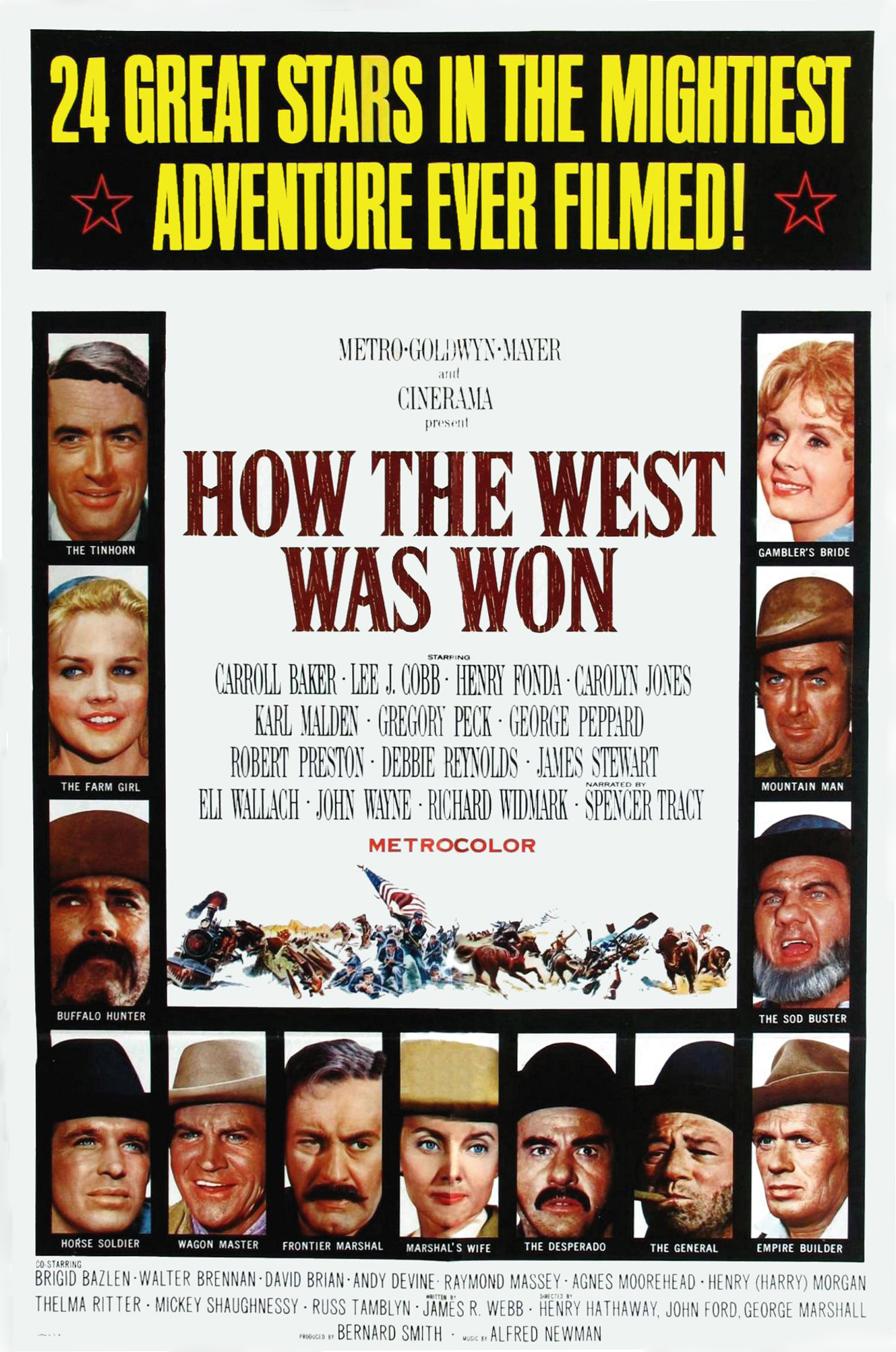
The Plot: Narrated by Spencer Tracy and filmed in Cinerama, “How the West Was Won” spans 50 years of the Prescott/Rawlins family traveling and surviving in the American West. In 1839, the Prescott family travels along the Erie Canal to Illinois, with daughter Eve (Carroll Baker) falling for mountain man Linus Rawlins (James Stewart). In 1851, Eve’s sister Lily (Debbie Reynolds) travels across the plains to inherit a California gold mine. In 1861, Eve’s son Zeb (George Peppard) joins the Union Army, serving in the Battle of Shiloh. By 1868, Zeb is in the cavalry, trying to maintain peace between the Arapahos tribe and the impending Central Pacific Railroad. And finally, in 1889, Zeb, now a Sheriff, must protect his family from a bandit (Eli Wallach), and help bring order to the lawless West.

Why It Matters: The NFR calls the film a “sprawling epic” and declares Ford’s segment on the Civil War “probably the best of the film’s three parts”. First of all, the film is five parts. Second of all, no.

But Does It Really?: In an era of filmmaking filled with spectacles, “How the West Was Won” out-spectacles them all. While not without its shortcomings, the film’s expansive Cinerama photography and all-star cast help put it head-and-shoulders above other Westerns of the era. Definitely NFR-worthy, though I recommend watching this on the biggest screen you can find, preferably in the curved “Smilebox” format available on the Blu-Ray release.

Everybody Gets One: James R. Webb got his start at Republic Pictures in the ‘40s writing screenplays for the Roy Rogers westerns. He also wrote the screenplay to the original “Cape Fear”. Producer Bernard Smith was a literary editor and critic during the ‘30s. His few producing credits include this, “Elmer Gantry”, and John Ford’s final films.

Wow, That’s Dated: While there is some nuance to the film’s depiction of Native Americans, they are still secondary to the white settlers who take over their land. Also, thanks to some detailed background action, this film requires a BLACKFACE WARNING. In fact, anyone in this movie who isn’t a white male gets a raw deal overall.

Seriously, Oscars?: Oddly enough, “How the West Was Won” premiered in London in 1962, with American screenings starting in January 1963. At the 1964 Oscars, “West” received eight nominations, including Best Picture. The film won three awards: Editing, Sound, and Original Screenplay. Most egregious of its losses, Alfred Newman’s iconic score lost to Best Picture winner “Tom Jones”, and the film’s four cinematographers all lost to the equally epic “Cleopatra”.

Other notes

  • I know I’ve definitely heard this score before, but until this screening I couldn’t have told you it was from this movie.
  • Cinerama is impressive to watch during the action sequences, but doesn’t lend itself well to more intimate moments. For one thing, close-ups were technically impossible, so the best you can get is a medium shot with plenty of space on either side of the actor.
  • Karl Malden plays Carroll Baker’s father. If you’ve seen “Baby Doll” you understand how unintentionally creepy that is.
  • This movie has not one, but TWO readouts on the Michael Douglas Scale. There’s 23 years between James Stewart and Carroll Baker, and 16 between Gregory Peck and Debbie Reynolds. Oh Classic Hollywood, will you never learn?
  • The film’s first major action sequence is the Prescott’s raft navigating the rapids. If nothing else, Debbie Reynolds is unsinkable, I give her that.
  • It’s fun watching Gregory Peck play against type as a con artist. Also great seeing Robert Preston in the kind of rugged western role he specialized in before becoming a Broadway star.
  • Those are some impressive wagon train sequences. When does someone die of dysentery?
  • How much did years of playing the loveless sidekick damage Thelma Ritter’s self-esteem?
  • The Indian raid wins no points for its depiction of Native Americans, but is an impressive coordination of camerawork and stunts.
  • It turns out “Rosebud” was the name of Andy Devine’s horse. Mystery solved!
  • Despite being one of the film’s biggest stars, John Wayne only has one scene, playing General Sherman to Harry Morgan’s General Grant. Side note: Spencer Tracy was cast as Grant, but bowed out due to health. He became the film’s narrator, a role he is better suited for than original choice Bing Crosby.
  • When quoting Linus, George Peppard does his Jimmy Stewart impression. John Ford hated it, but since re-takes with Cinerama cameras were expensive, this take made the final cut.
  • Appropriate that Henry Fonda plays an old friend of James Stewart’s, since the two were close in real-life.
  • I assume this film utilized every buffalo in existence for the stampede sequence. Another very impressive scene to see on a big screen.
  • It took two hours but we finally get a shot of Monument Valley. No western is complete without a trip to the Arizona-Utah border.
  • Very odd seeing Debbie Reynolds and Carroll Baker in old age makeup. For what it’s worth, they both aged better in real life.
  • “The Outlaws” is the most character driven of the segments, but still packs a punch with its train shoot-out finale. I just feel bad for stuntman Bob Morgan, who was severely injured during the scene’s production.
  • The epilogue includes some beautiful shots of modern-day (1962) Los Angeles and San Francisco. Another point in favor of Cinerama being used for non-narrative travelogues.

Legacy

  • While “How the West Was Won” was successful in its day, studios were wary of doing more narrative films with expensive, cumbersome Cinerama cameras. Later Cinerama films – including “2001: A Space Odyssey” – were actually filmed in standard flat widescreen formats and projected on Cinerama’s curved screens.
  • “How the West Was Won” inspired the 1977 TV miniseries of the same name with Eva Marie Saint and James Arness. This spun-off into a weekly series that ran for two seasons on ABC.
  • It was a screening of “How the West Was Won” that convinced Sergio Leone to cast Eli Wallach as “The Ugly” in “The Good, the Bad and the Ugly”.
  • Most of the film’s legacy has been how many times the title is referenced throughout our culture. But it does give me a chance to reference the 1994 Olsen Twins movie “How the West Was Fun”!

#323) The Forgotten Frontier (1931)

image-w1280

#323) The Forgotten Frontier (1931)

OR “Call the Midwife”

Directed by Marvin Breckinridge

Class of 1996

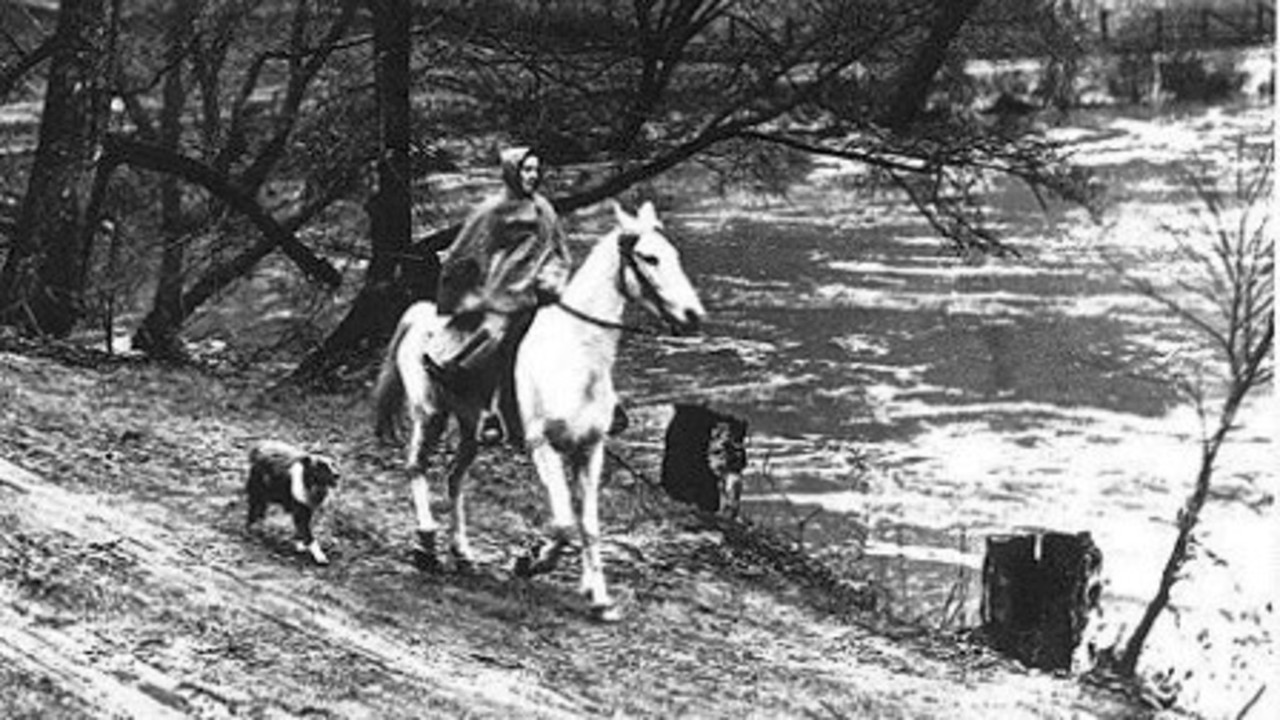
The Plot: Photojournalist Marvin Breckinridge ventured into filmmaking to document the humanitarian work being done by her cousin Mary in Kentucky. Mary’s organization, the Frontier Nursing Service, provides nurses and midwives to the underserved Appalachian Mountains. In filmed recreations – some involving the actual patients – Mary and her team ride on horseback for miles to help the community, from delivering babies to inoculating children to tending bullet wounds.

Why It Matters: The NFR write-up has no superlatives, just a run-down of the film and its historical context (though one of the sentences is weirdly cut off mid-way through).

But Does It Really?: As always, I will give a film a pass for representing a filmmaker in the Registry and/or highlighting a community that rarely gets recognition. “The Final Frontier” is both, introducing me to the work of Marvin Breckinridge (and her generations of famous relatives) as well as showcasing an organization I’m embarrassed to say I had never heard of. Obviously medical technology has evolved over 90 years, but the Frontier Nursing Service’s rustic beginnings make for a fascinating historical document, and a welcome addition to the NFR. And as for the unsung heroes of the medical profession, lets give nurses three cheers…and significantly higher pay.

Everybody Gets One: Mary Breckinridge had gotten her nursing degree in 1910, but did not pursue a career until ten years later, following her divorce and the death of her two young children. While in Europe she saw the British midwife system in action, and founded the Frontier Nursing Service in 1925 upon her return to America. Mary’s cousin was also named Mary Breckinridge, but went by her middle name, Marvin, to help differentiate between the two. Marvin was an international photojournalist throughout the ‘30s, joining CBS News during WWII and becoming the only woman on the original “Murrow’s Boys” team.

Wow, That’s Dated: It’s a nursing service that relies on horses and river fording. You can pretty much date everything in this movie.

Other notes

  • You know who else is a cousin of Mary and Marvin’s? John Cabell Breckinridge Jr., better known as Bunny Breckinridge, the actor who played the Alien Ruler in “Plan 9 from Outer Space”. I wonder if that ever came up at Thanksgiving?
  • Despite the film’s title and its frequent reliance on horses, this is not a western.
  • There’s a lot of Kentucky/Appalachian terminology I had to look up as I went along. For starters, “fotched-on” is a variation of “fetched-on”, as in someone fetched from another part of the country to the Appalachians.
  • “Hey woman! My woman is a-needin’ you!” Not exactly the Bat-Signal, is it?
  • I know it’s a recreation, but the woman in labor is going for the Melanie Hamilton Award for Most Quiet Childbirth (2018’s winner: Emily Blunt in “A Quiet Place”!)
  • One of the assistant directors of the Frontier Nursing Service is identified as “Miss Peacock”. What happened to her depends on which room she is in, and with what object (and which ending you watch).
  • I like that all of the nurses wear ties and coats while on duty. Gender norms be damned!
  • Is the schoolteacher discouraging her students from getting inoculated? Ah man, even back then history had Jenny McCarthys.
  • There are several scenes where the nurses have to ford a river on horseback. You have to be really dedicated to want to do this line of work.
  • The man who delivers the orphaned babies is referred to as “a widow-man”. Did the term “widower” not exist yet?
  • Another Appalachian term: the “least’uns” is the youngest member of a family. I’m the least’uns of my family!
  • There’s a scene in which an angry man guns down his neighbor. Do you think either of these men were willing to recreate that moment?
  • I’m in amazement that not only does this group of volunteers take the gun victim 16 miles on foot to the nearest hospital, and not only does the surgeon travel 25 miles on horseback to operate on him, but that the victim survived long enough for any of this to happen, AND survived the operation. That’s sheer determination at that point.
  • The final shot is of Mary riding off to help another family, in this instance riding a horse in the middle of the night using a flare to guide the way, which seems terrifying. That is some true dedication to your work. Makes me question all of my life choices up to this point.

Legacy

  • Marvin Breckinridge became a philanthropist towards the end of her life, donating her photos and art to, among other places, the Library of Congress. She lived long enough to see “The Forgotten Frontier” make the National Film Registry.
  • Mary Breckinridge continued to direct the Frontier Nursing Service until her death in 1965. She was inducted into the National Women’s Hall of Fame in 1995, and received her own postage stamp in 1998.
  • The Frontier Nursing Service is still in operation in Kentucky, and was added to the National Register of Historic Places in 1991. You can learn more about them here.