#247) The Asphalt Jungle (1950)

asphalt_jungle

#247) The Asphalt Jungle (1950)

OR “Ocean’s Acht”

Directed by John Huston

Written by Huston and Ben Maddow. Based on the novel by W.R. Burnett

Class of 2008

The Plot: The Midwest crime world of the ‘50s gets an unexpected jolt when notorious thief Doc Reidenschneider (Sam Jaffe) is released from prison and wants to immediately pull off another heist. Backed by corrupt lawyer Alonzo Emmerich (Louis Calhern), Doc employs three hoods to steal half a million in jewelry. Dix Handley (Sterling Hayden) is a drifter with dreams of getting out of the racket, Gus Minissi (James Whitmore) is the getaway driver and Dix’s voice of reason, and safe-cracker Louie Ciavelli (Anthony Caruso) is…also there. The heist is a success, but there may be more than one joker in this deck. And that young actress playing Emmerich’s mistress is Marilyn Monroe. And now you know the rest of the story!

Why It Matters: The NFR calls the film a “brilliant crime drama” and mentions Marilyn Monroe’s performance.

But Does It Really?: I’m worried this film is only remembered today for Marilyn. To single out Ms. Monroe would be to completely ignore a film that is expertly crafted from top to tail. As film noir was going out of vogue, “The Asphalt Jungle” helped ease the transition into the grittier pulp crime dramas of the ‘50s. In the confident hands of John Huston, and quite possibly the best ensemble of ‘50s character actors in one film, “The Asphalt Jungle” is the rare crime film where the characters are just as interesting as the caper. A “minor classic” compared to Huston’s other entries, but worth a watch nonetheless.

Everybody Gets One: The only major players making their sole NFR appearance are Marc Lawrence as Cobby and Anthony Caruso as Louie. Both men were character actors who specialized in playing shady underworld types.

Wow That’s Dated: Lots of great ‘50s slang in this one, like “a bunch of swells” and “yipe”.

Seriously, Oscars?: “The Asphalt Jungle” missed out on a Best Picture nod, but did manage Oscar nominations in four major categories: Director, Adapted Screenplay, Supporting Actor (Sam Jaffe), and Cinematography. The film lost the first three categories to Best Picture winner “All About Eve” (Jaffe lost to George Sanders), while Cinematography went to a little British import called “The Third Man”.

Other notes

  • Is an Asphalt Jungle any relation to a Blackboard Jungle?
  • I can never see Sterling Hayden in a movie and not think of those three magic words: “Precious bodily fluids”.
  • Wow, young James Whitmore! He does exist!
  • Will #2 please step forward? That’s him, Officer! That’s Strother Martin in his film debut!
  • His name is Dix Handley? No, I’m not quietly giggling like a 10-year-old.
  • Commissioner Hardy is played by John McIntire, who you know as either Sheriff Chambers in “Psycho” or crotchety cat Rufus in “The Rescuers”. Hardy is easily his best film performance.
  • Like you need me to tell you that John Huston is a brilliant filmmaker. Look no further than the scene where Gus tries to convince Dix to lay low. Huston covers the entire scene in one uninterrupted take. He even gets the cat to hit its mark!
  • While we’re at it, shoutout to cinematographer Harold Rosson. Anyone who can film this, “The Wizard of Oz” and “Singin’ in the Rain” deserves high praise.
  • Cobby looks like if Laurence Olivier played Fredo Corleone.
  • No offense to Sam Jaffe, who is wonderfully restrained as Riedenschneider, but if I were an Oscar voter I would have put Louis Calhern on my ballot for Best Supporting Actor. It helps that Emmerich gets a stronger character arc, but Calhern gives him a lot of dimension. I suspect Jaffe’s nom was to reward his versatile career (and possibly to show support for his run-in with HUAC). Calhern didn’t go unnoticed by the Academy, however; he was nominated for Lead Actor that year for recreating his stage performance in “The Magnificent Yankee”.
  • Get it, Lina Lamont! Jean Hagen adds a nice touch of humanity as Doll, Dix’s live-in moll.
  • Thanks to this film’s 11-minute centerpiece heist, I now feel fully qualified to rob a ‘50s bank vault. It’s just a shame they blew up the vault while Burgess Meredith was still in there. 
  • Dead Man Blinking! We got a Dead Man Blinking!
  • Emmerich is not very convincing when he gives his alibi. Jon Lovitz is a better liar.
  • Fine, I’ll mention Marilyn. She’s good, and is everything the part asks of her. She’s not incredible, but it’s nice to see her in a performance from when she was still an actor and not an icon.
  • Perhaps my favorite character in the piece is Eddie the stereotypical Italian. He’s played by Puerto Rican actor Alberto Morin. Dat’s a spicy-a cultural appropriation!
  • Alright Huston, that’s enough shots of the dancing girl’s torso. Break it up, break it up.
  • Oh my god, a score! Miklos Rosza finally shows up five minutes before it’s over. He must have gotten lost on the way to the recording studio.

Legacy

  • While not the first in the genre, “The Asphalt Jungle” is the granddaddy of all heist movies where a guy is released from prison and pulls “one last job”. Immediate follow-ups in the genre include “Rififi” and “The Killing”.
  • The original novel also inspired such wide-ranging films as the Western “The Badlanders” and the Blaxploitation movie “Cool Breeze”.
  • “The Asphalt Jungle” TV series aired on ABC in the spring of 1961. The show starred Jack Warden, who may or may not have a role in the movie. Further research is needed.
  • Gus would eventually be transferred to Shawshank State Penitentiary. Going by the alias “Brooks”, he rehabilitated himself by maintaining the prison library.
  • Just a reminder that the director of this film would go on to helm the original film version of “Annie”.

#246) The Three Little Pigs (1933)

MV5BOTViY2Q5NGYtZDdhMi00NDdhLWJiMDAtNjkzNzAzNzNmOGI2XkEyXkFqcGdeQXVyNzY1NDgwNjQ@._V1_

#246) The Three Little Pigs (1933)

OR “The Original Property Brothers”

Directed by Burt Gillett

Written by Pinto Colvig, Albert Hunter, Boris V. Morkovin, Ted Sears, and Webb Smith. Based on the fable. “Who’s Afraid of the Big Bad Wolf?” by Frank Churchill and Ann Ronnell.

Class of 2007

The Plot: Two carefree pigs and their more reasonable brother are building their own homes. Fifer (voiced by Dorothy Compton) builds his house of straw, Fiddler (voiced by Mary Moder) builds a stick house, and Practical (voiced by Pinto Colvig), true to his name, builds a brick house. But the Big Bad Wolf (voiced by Billy Bletcher) is nearby, ready to huff and puff and blow their houses down. A cautionary tale on the importance of solid housing structures.

Why It Matters: Citing it as “among the best cartoons of all time”, the NFR write-up notes the popularity of the film (as well as the song), and contextualizes “Pigs” as an artistic stepping stone for Walt Disney on his way to making “Snow White”.

But Does It Really?: Oh sure. The film is an iconic piece of early Disney, and has stayed in the rotation long enough that multiple generations have grown up with it. “Three Little Pigs” is an important part of the Disney legacy, and it’s the kind of simple storytelling that Walt and company excelled at in the beginning. Why the pigs had to wait almost 20 years to make the NFR cut is anyone’s guess.

Everybody Gets One: Burt Gillett started off as an animator on the East Coast before moving to Hollywood in 1929 to join the up-and-coming Disney Studios. He quickly rose from animator to director, helming “Pigs” and “Flowers and Trees”. Burt may have been the director, but Walt still had the final say, occasionally arguing with Burt in front of the other animators. Shortly after the success of “Pigs”, Gillett left to run rival animation studio Van Beuren, although his constant bullying of staff (to the point of preventing them from unionizing) led to very low morale and a high turnover rate. Van Beuren Studios folded in 1937.

Wow, That’s Dated: Oh boy, here we go. If you stumble upon the original version of the short, you’ll find a brief scene of the Big Bad Wolf disguised as a Jewish peddler, complete with stereotypical Yiddish accent and a mask with a large nose. Disney would eventually rerelease the short with those shots reanimated and redubbed to remove anything offensive, though the derogatory music cue still remains.

Seriously, Oscars?: Easily the most successful short of the Depression era, “Three Little Pigs” became the second film to win the Oscar for “Short Subjects, Cartoons”. The only reason the equally popular “Who’s Afraid of the Big Bad Wolf” didn’t win Best Song is because the category wouldn’t be introduced until the following year.

Other notes

  • The full title card is “Mickey Mouse Presents Walt Disney’s Silly Symphony in Technicolor ‘Three Little Pigs’. The title gets fifth billing! Also, I didn’t realize Mickey was a producer on these shorts as well. Maybe he was the muscle this whole time.
  • Dorothy Compton and Mary Moder were radio actors and studio day players without a lot of confirmed credits to their names. Pinto Colvig was a storyboard artist for Disney who also lent his voice to such characters as Goofy and Grumpy. All three (along with cartoon legend Billy Bletcher) reprised their roles in the “Pigs” follow-up shorts.
  • So Fifer and Fiddler wear no pants but Practical wears overalls? Is that why he’s called Practical Pig?
  • The Big Bad Wolf must have borrowed his carpetbag from Mary Poppins, that thing is filled with an unlimited supply of props and costumes.
  • How good is the sound quality on a brick piano?
  • And now for some surprisingly morbid humor from this beloved Disney short: Practical has a framed photo on his wall of sausage links labeled “Father”. Who’s afraid of the big bad therapy session?

Legacy

  • “Pigs” was a huge success for Disney, and he followed up with three little sequels: 1934’s “The Big Bad Wolf”, 1936’s “Three Little Wolves” and 1938’s “The Practical Pig”. Walt learned the laws of diminishing returns with each sequel, and often dismissed any sequels to his other films with, “You can’t top pigs with pigs”.
  • “Who’s Afraid of the Big Bad Wolf?” was a hit song on its own, becoming a song of optimism for the Depression. It was later used to criticize America’s complacency during the Nazis’ rise to power in Europe.
  • This film’s main takeaway for animation was the advent of the storyboard. With more detailed stories and characters, Disney realized they needed a Story Department before going straight to animation, thus the storyboard was invented to help plan out their shorts and eventual features. To this day, storyboarding is an integral part of the animation process.
  • Some random drunkard wrote “Who’s Afraid of Virginia Woolf?” on the bathroom mirror in a New York bar, Edward Albee saw that, and it was all fun and games from there.
  • The home of each of the pigs (as well as the Wolf) can be seen in Storybookland at Disneyland. There’s also the Fiddler, Fifer & Practical Café in California Adventure that serves drinks, desserts and…a sausage breakfast sandwich!? You monsters!
  • If it were not for the success of “Three Little Pigs”, we probably wouldn’t have the jazzy Warner Bros. version, nor Tex Avery’s sexually aggressive cartoon wolf.
  • There have been many versions of “The Three Little Pigs” in the past 85 years, but nothing will top Jeff Goldblum’s interpretation of the wolf on “Faerie Tale Theatre”.
  • I’m gonna assume this was the Commodores’ inspiration for “Brick House”.

#245) Red Dust (1932)

Red-Dust-1932-film-poster_(2)

#245) Red Dust (1932)

OR “Harlow If Ya Hear Me”

Directed by Victor Fleming

Written by John Mahin. Based on the play by Wilson Collison.

Class of 2006

The Plot: Dennis Carson (Clark Gable) runs a rubber plantation in French-Indochina. A cargo ship brings in stowaway prostitute Vantine Jefferson (Jean Harlow), and sparks immediately start flying between her and Dennis. Shortly afterwards, engineer Gary Willis (Gene Raymond) arrives at the plantation, alongside his wife Barbara (Mary Astor). Dennis is also drawn to Barbara, and he starts to seduce her, much to Vantine’s envy and Gary’s obliviousness. A sudden monsoon forces them all to stay in close quarters, where tempers, and passions, flare.

Why It Matters: The NFR praises the film’s “well-remembered humor, star chemistry and atmosphere” while singling out director Victor Fleming. They also use such exciting adjectives as “steamy”, “virile” and “saucy”. Someone had fun writing this entry.

But Does It Really?: “Red Dust” is not a perfect movie by any stretch, but there’s enough star power on display to hold your interest. Gable and Harlow are irresistible together, and while this isn’t Harlow’s only film on the list, it’s the only one that showcases her iconic persona. “Red Dust” is quite archaic in its production value and attitude towards the sexes, but if you’re willing to forgive that, there are definitely some redeeming qualities. A pass for NFR inclusion from me.

Everybody Gets One: Gene Raymond’s character may be a total cipher, but the man himself was anything but. In addition to being an actor, composer, and WWII pilot, Raymond was married to legendary singer Jeanette MacDonald. Their 28-year marriage was arranged by Louis B. Mayer for two reasons: to prevent MacDonald from marrying long-time co-star Nelson Eddy, and to hide Raymond’s bisexuality from the press.

Wow, That’s Dated: Chinese actor Willie Fung plays Hoy, the extremely stereotypical coolie/comic relief. It’s very uncomfortable. On top of that is the very dated gender politics between Gable and Harlow (complete with butt-patting), and a character named “Captain Limey”.

Seriously, Oscars?: No nominations for “Red Dust”. MGM’s Best Picture nominee that year was “Smilin’ Through”, a more prestigious romantic film with such Oscar bait as Norma Shearer, Fredric March, and Leslie Howard.

Other notes

  • Let’s acknowledge the elephant in the room right now: During filming, Jean Harlow’s newlywed husband (producer Paul Bern) committed suicide. Louis B. Mayer tried to get Harlow replaced on “Red Dust”, but public sympathy was on her side, and she returned to the film 10 days later. Any sign of Harlow’s personal trauma does not seep through her performance.
  • Victor Fleming directed over 40 movies in his career, but he is best remembered for the one-two punch of helming “The Wizard of Oz” and “Gone with the Wind”.
  • Does anyone know what the original play was like? It’s probably dated as hell, but it seems like a fun idea.
  • Sure Gable was handsome, but it took him a while to grow into those ears.
  • Everyone in this movie pronounces the city of Saigon as “Say-gon”. Was that an acceptable alternative? Or did no one bother to look it up?
  • Harlow definitely has that indefinable star quality. She’s everything the role requires, plus her own alluring, funny persona. I find myself in the odd position of being attracted to a woman who’s been dead for over 80 years.
  • “Well for the love of mud!” said Jean Harlow.
  • Most movies pan to blowing curtains during a love scene, “Red Dust” pans to an excitable parrot.
  • No one says the word “prostitute”, but this movie is not subtle with the implications. At one point Dennis gives Vantine money! Y’all better get this out of your system before the Hays Code shows up.
  • Wow, Fung’s getting a lot of screentime. Did test audiences demand more coolies?
  • Gable takes his shirt off but no one talks about this movie tanking undershirt sales. What the hell, Hollywood lore?
  • And now we get to the infamous Jean Harlow bathing scene. It’s quaint by today’s standards, but not without its provocative elements. The story goes that during one take Harlow stood up from the barrel au naturel and announced “this one’s for the boys in the lab!” If that footage still exists it would be added to the NFR in a heartbeat.
  • A very talky film with no soundtrack and constant rainfall? Are they trying to put me to sleep?
  • Due to some re-looping rear projection, the clouds behind Gable and Raymond jump several feet instantly. Is that what causes monsoons?
  • Gary is really laying on how much he loves Barbara in front of Dennis. I keep expecting him to say he’s also three days away from retirement.
  • [Spoilers] Boy, the last 10 minutes of this movie escalated quickly. That being said, Gable has the best reaction to being shot, “Alright, if that makes you feel any better.”
  • And one last shot of Fung for the ride home. What a weird little movie.

Legacy

  • The box-office success of “Red Dust” helped MGM survive the Depression. MGM was one of the few movie studios to turn a profit in 1932, thanks in part to this movie.
  • “Red Dust” was remade 21 years later with John Ford’s “Mogambo”. The action was transplanted to Africa, with the love triangle now being comprised of Ava Gardner, Grace Kelly and…Clark Gable? That’s what Gable loves about his co-stars: he gets older, they stay the same age.
  • Harlow sent up the bathing scene while playing a movie star in 1933’s “Bombshell”.
  • Clark Gable and Jean Harlow made four more films together, including Harlow’s final film, “Saratoga”.
  • As for Harlow’s legacy, her tragic death of kidney failure at age 26 solidified her legendary movie star status. She is still one of the best remembered of the early Hollywood stars. Harlow’s life story spawned two movies in 1965, and she was immortalized on Judge Harry Stone’s office wall on “Night Court”.

Further Listening: “You Must Remember This” did an excellent episode on Jean Harlow as part of their Hollywood Blondes series. Karina Longworth (that’s her) takes a detailed look at Harlow’s life and sudden death that will probably be the most accurate report we’ll ever get.

#244) The French Connection (1971)

french_connection

#244) The French Connection (1971)

OR “Take the ‘H’ Train”

Directed by William Friedkin

Written by Ernest Tidyman. Based on the book by Robin Moore.

Class of 2005

The Plot: Based on a true crime, “The French Connection” follows New York detectives Jimmy “Popeye” Doyle (Gene Hackman) and Buddy “Cloudy” Russo (Roy Scheider) as they try to bust a drug trafficking scheme. The two are convinced that French smuggler Alain Charnier (Fernando Rey) is bringing heroin into New York using TV personality Henri Deveraux (Frederic de Pasquale) as a front. There’s no definitive evidence of Charnier’s involvement, but Doyle’s blind obsession keeps him going. Using his highly questionable methods, Doyle will do what it takes to catch the smugglers, even if it means recklessly driving a commandeered Pontiac LeMans to follow a hijacked elevated train. Hypothetically speaking, of course.

Why It Matters: The NFR points out the film’s departure from other detective movies of the era, praises cinematographer Owen Roizman, and calls the chase scene “one of the most viscerally exciting screen moments”.

But Does It Really?: Having never seen “The French Connection” before (I know, I know), this movie had quite the reputation to live up to, and I’m happy to say that, for me, it did. “The French Connection” is the high-energy antihero action movie that came to define the early ‘70s. Friedkin keeps everything moving at an almost frenetic pace, culminating in a chase scene that I’ll gush about later. Throw in a fully committed Gene Hackman in the lead role, and Owen Roizman’s trademark gritty cinematography, and you’ve got yourself a classic.

Everybody Gets One: William Friedkin knew there was only one man who could play Alain Charnier: Francisco Rabal. Friedkin loved his performance in “Belle de Jour”, but couldn’t remember his name. The casting director contacted his co-star Fernando Rey by mistake instead, and Rey was kept on the film when it was discovered that Rabal did not speak English or French.

Wow, That’s Dated: Doyle, can you lay off the racial slurs for just one scene? On a lighter note, the film features a performance by female vocal group The Three Degrees singing the very ‘60s song “Everybody Gets to Go to the Moon”. Of the three members featured in the film, Valerie Holiday is the only one still with the group!

Seriously, Oscars?: In a year with no clear front-runner, “The French Connection” tied with “The Last Picture Show” and “Fiddler on the Roof” for most Oscar nominations (eight). “French” prevailed with five awards: Picture, Director, Actor, Adapted Screenplay and Editing. Roy Scheider lost Best Supporting Actor to veteran Ben Johnson for “Last Picture Show”, and the film lost Cinematography and Sound to “Fiddler”. If only Popeye did more singing.

Other notes

  • Gah! These credits are assaulting me!
  • Just a reminder that executive producer G. David Schine was mixed up in the McCarthy hearings of the ‘50s. Schine somehow got his hands on the film rights to the book and wouldn’t release them to 20th Century Fox without payment and a screen credit.
  • Fun Fact: Screenwriter Ernest Tidyman wrote the novel and screenplay for another 1971 detective movie: “Shaft”.
  • Gene Hackman IS Santa Claus. Before “Die Hard”, this was the not-Christmas action movie of choice.
  • Everyone’s favorite bit of what-if casting: Jackie Gleason was seriously considered for Popeye. It would have been a completely different movie. For one thing, I can’t imagine Gleason doing any of the running scenes. Among the other potentials, Peter Boyle would have been very good in the role as well.
  • Hackman’s trying really hard to make “You ever pick your feet in Poughkeepsie?” the next “Do you feel lucky, punk?”. It’s not, please stop.
  • Can Roy Scheider do expository dialogue for every movie?
  • The real life Popeye and Cloudy appear in the film; Eddie Egan is Supervisor Simonson (he even gets a “You’re off special assignment!” scene), while Sonny Grosso is Agent Klein.
  • I appreciate this film’s restraint on dialogue. There are several stretches of the film where no one talks, but there’s no lack of action or character development.
  • I guarantee you that filming this movie pissed off local New Yorkers. This is the town that gave us “I’m walkin’ here!”
  • Well, they don’t call it one of filmdom’s greatest chase scenes for nothing. The car vs. train chase is still a brilliant orchestration of action, cinematography, and editing. Kudos to everyone involved. The one downside is that there’s still a half hour of movie to go after this. Nothing can top that, and nothing does.
  • Huh, it turns out the poster is a massive spoiler.
  • Hackman absolutely nails the character’s complete obsession over the case. Thanks to Hackman, you can see Doyle hit the point of no return.
  • Real life NYPD mechanic Irving Abrahams plays NYPD mechanic Irv. Where’s his Oscar?
  • Henri is just now realizing that there was some risk involved in this scheme? Even for a TV personality he’s a bit dense.
  • By way of its “where are they now” epilogue text, “The French Connection” has the same ending as “Animal House”.

Legacy

  • “French Connection II” appears on most lists of sequels that aren’t terrible. Hackman and Rey reprised their roles, with Doyle travelling to Marseilles to get Charnier once and for all, but not without becoming a heroin addict himself. The capable and game John Frankenheimer took over directing duties.
  • William Friedkin followed-up “French Connection” with another NFR entry: “The Exorcist”.
  • Eddie Egan realized that many of Doyle’s unethical tactics could easily be traced back to him once the film came out and announced his retirement from the NYPD. He was dismissed from the force prior to his retirement date with no pension, though that was eventually reversed.
  • “French Connection” producer Philip D’Antoni made another movie about unorthodox New York cops: 1973’s “The Seven-Ups”. While not a sequel to “French”, it did star Roy Scheider and Tony Lo Bianco in very similar roles.
  • Before he was Al Bundy, Ed O’Neill was “Popeye Doyle”, at least for a TV movie pilot in 1986 that never went to series.
  • Another attempt to make the French Connection story a TV series resulted in the 2005 pilot “N.Y.-70” with Donnie Wahlberg, Bobby Cannavale, and the stunt casting of Tony Lo Bianco.
  • Either the clothing outlet French Connection is named for the movie or for the original drug trafficking scheme. Either way, weird choice.
  • I’ll tell you what is actually named for this movie: Popeyes Louisiana Chicken. Louisiana Fast!

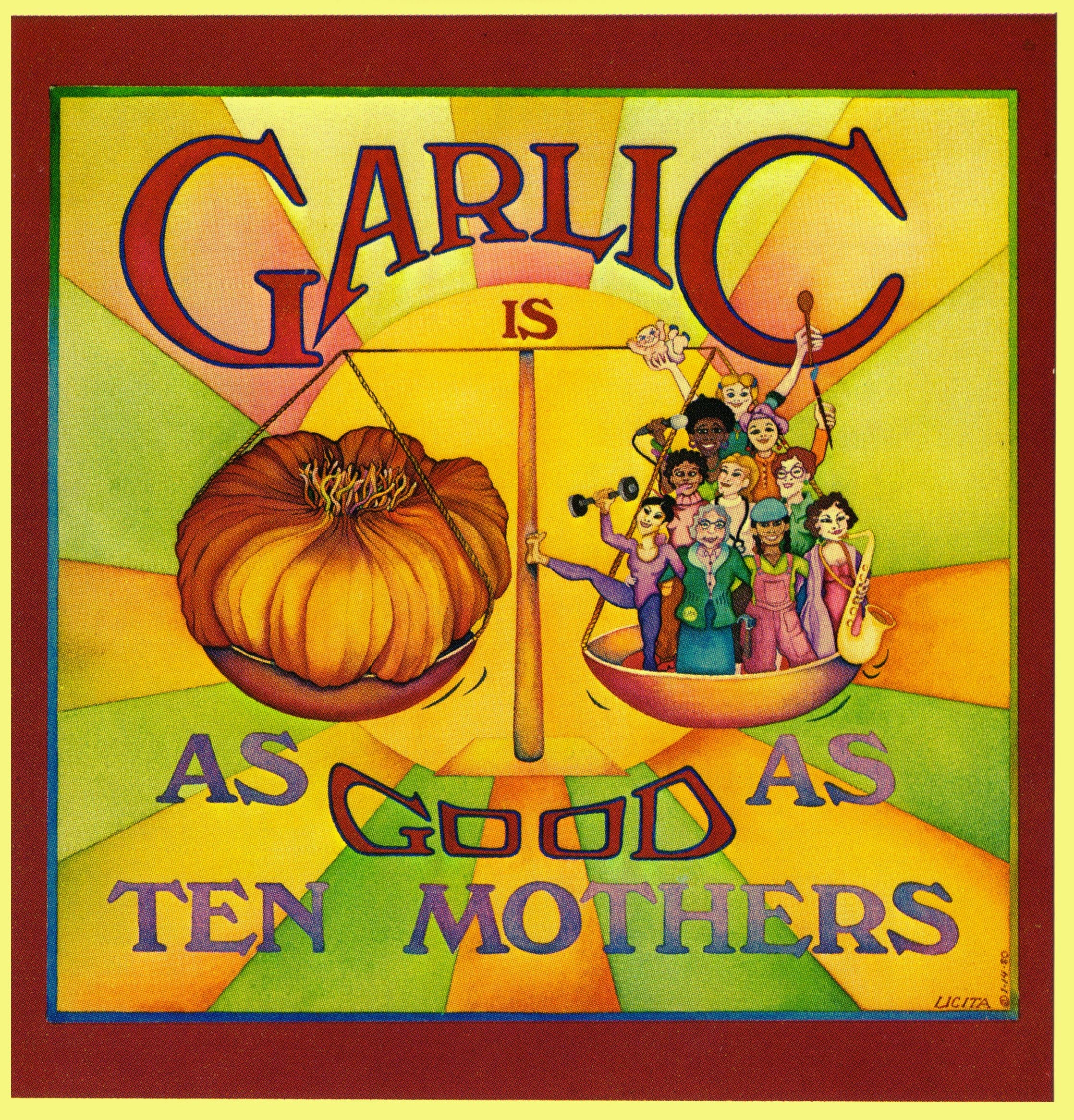
#243) Garlic Is as Good as Ten Mothers (1980)

maxresdefault

#243) Garlic Is as Good as Ten Mothers (1980)

OR “Banned in Transylvania”

Directed by Les Blank

Class of 2004

No trailer, but here’s a clip

The Plot: A documentary about garlic. Sounds weird, right? But in the hands of Les Blank, this movie is an entertaining celebration of garlic and the people who love it. In 50 minutes Les shows us garlic chefs both professional and amateur, those who grow garlic, those who sell garlic, a group called “Lovers of the Stinking Rose”, the anti-mouthwash movement, authors, children, and the proud few who literally sing the praises of everyone’s favorite deformed onion.

Why It Matters: The NFR salute Les Blank, calling the film “hilarious and affectionate”. They also make mention of the film’s “AromaRound” release, involving the smell of garlic being piped into the theater throughout special screenings.

But Does It Really?: I’d be more inclined to give this a pass if it was Les Blank’s only film on the list, but he’s got “Chulas Fronteras” as well, and that got inducted on the fifth round! I guess they really like Les Blank over at the NFR. “Garlic” is a fun, informative slice (forgive me) of life, but is it really worthy of preservation ahead of “Grey Gardens” and “Hoop Dreams”? I don’t know.

Shout Out?: The credits say that “It’s a Wonderful Life” is featured during the film. Did I miss it? I assume it’s the clip of Mr. Potter using the slur “garlic eaters”. The credits state that the clip is courtesy of public domain. Well…sort of.

Everybody Gets One: As is the case with most documentaries, this is the only NFR entry for most of its subjects. Most notable among those interviewed is fellow filmmaker Werner Herzog!

Wow, That’s Dated: Ah the Bay Area of the late ‘70s/early ‘80s. It’s the world my parents got married in, so I’m always a bit nostalgic for this time. And now I have something completely unrelated in my eye.

Title Track: No one says the title, but the rest of the saying is “…for keeping the girls away.”

Seriously, Oscars?: Due to weird eligibility guidelines regarding documentaries, I don’t know if “Garlic” would have been eligible for the 1980 or 1981 Oscars. Either way, it didn’t get nominated. Had it been, Les would have lost to either a documentary about Western music in China or the Holocaust. The Oscars definitely weren’t giving that award to a film about garlic.

Other notes

  • I hope Kander & Ebb sued for the obvious “Money” parody.
  • I’m sorry to report that the Flint’s Bar-B-Q featured in the movie closed in 2010. It is still remembered fondly in Oakland and the East Bay.
  • You gotta wonder how many of these people like but don’t love garlic, but wanted to be in a movie.
  • Ah! Dead pigs! I’m not a vegetarian, but this is unsettling. I don’t need to see how the sausage is made! In this case literally!
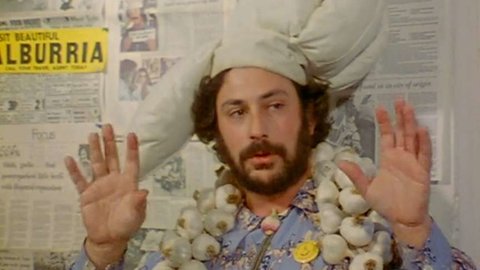
  • The Lovers of the Stinking Rose are giving me a real hippie vibe. Did they run out of drugs? And who told Lloyd John Harris that a giant garlic hat was a good idea? Side Note: I’ve been to the Stinking Rose. Good stuff.
1113027_landscape
  • If this film were made today it’d be a quickly edited, blandly narrated Food Network Special called something like “The Great Guide to Garlic!”
  • Werner Herzog’s appearance may seem random, but at the time Les was working on “Burden of Dreams”, a documentary about the making of Herzog’s “Fitzcarraldo”. Herzog also directed “Nosferatu”, hence his appearance in a movie about garlic. It’s pretty amazing when Werner Herzog is the most normal seeming person in your movie.
  • Remember the film I mentioned last week about Werner Herzog eating his shoe? That was Les Blank. It’s all connected!
  • Oh man I started salivating about halfway through this movie. My advice: eat before viewing.
  • Filmmakers approaching unattended kids on a playground asking them questions? Not anymore! Simpler times indeed.
  • Thanks for sitting through my documentary about garlic, have some brief backside nudity!
  • “Hippie dipshit” may be my new favorite phrase.
  • Why is this narrator yelling at me? And why is he only showing up now?
  • True to form, Les Blank showcases a lot of music in this film. Turns out the most common themes in songs are love, pain, and garlic.
  • For the record, garlic bread is amazing.

Legacy

  • Les Blank continued cranking out documentaries for the next 35 years, most notably “Burden of Dreams”. He even managed to release four posthumous documentaries. That has got to be the record.
  • Well, people still eat garlic, and you can’t prove that this film didn’t help that.