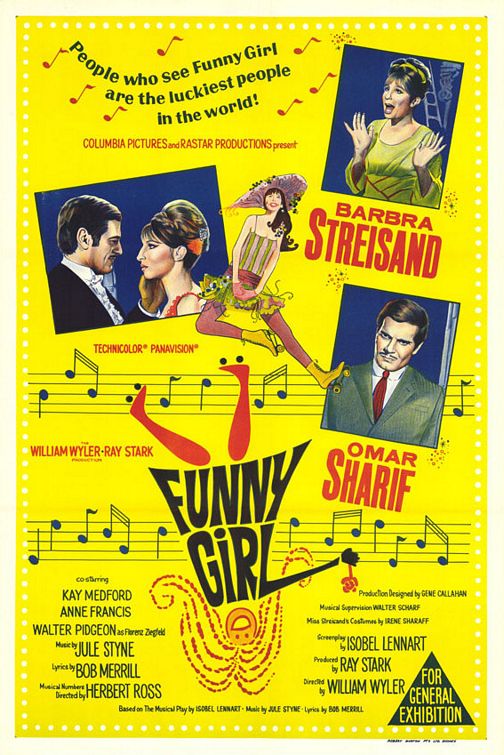
#140) Funny Girl (1968)

funny_girl_ver2

#140) Funny Girl (1968)

OR “The Streisand Effect”

Directed by William Wyler

Written by Isobel Lennart. Based on her play. Original Music by Jule Styne. Original Lyric by Bob Merrill.

Class of 2016

Sadly, no original theatrical trailer presently available. Here’s the trailer from the film’s 2001 reissue.

The Plot: Loosely based on real life events, “Funny Girl” is the story of Fanny Brice (Barbra Streisand) getting her big break in vaudeville performing comic numbers in the Follies, under the exasperated eye of Florenz Ziegfeld (Walter Pidgeon). Along the way she falls for Nicky Arnstein (Omar Sharif), a professional gambler whose natural charm covers up his shady dealings. And just as Fanny blossoms from an insecure newcomer to an independent star, so does Streisand from recording artist to unstoppable multi-hyphenate with her own basement mall.

Why It Matters: The NFR hails Streisand’s “impressive vocal talent and understated acting”, and calls the film “among the last of the successful big-budget musicals”.

But Does It Really?: Love her or hate her, this film’s success falls on Barbra Streisand. “Funny Girl” is one of those serendipitous movies with the right performer in the right role at the right time. Her acting chops are natural, her comic timing is perfect, and I guess she sings alright too. The rest of the film fares okay as a successful adaptation of a stage musical. The film’s iconic status secures its place in the NFR, and overall the film is enjoyable, but if you’re not here for Barbra, this ain’t your movie.

Everybody Gets One: Amazingly, the only major player to call this film their only NFR entry is Barbra Streisand herself.

Wow, That’s Dated: A little bit of late ‘60s optical effects going on (especially in the opening credits), and some of that New Wave style of editing. Also dated: You can’t convince me that Fanny’s outfits in Act II are period appropriate.

Title Track: We don’t get the title (or the title number) until almost the very end of the film. Strangely, there was no title number in the original stage version. It was written for the film.

Seriously, Oscars?: Second only to “2001” at the box office, “Funny Girl” received eight Oscar nominations, including Best Picture. The film lost in most of its categories to Columbia’s other big musical, “Oliver!”, but it won in the category that mattered most: Best Actress for Barbra Streisand. For her film debut, Streisand miraculously tied the legendary Katharine Hepburn in “The Lion in Winter”.

Other notes

  • I’m a sucker for a Roadshow presentation.
  • Much of this film occurs in silence, including most of the first scene. Similarly, very little of this film has underscore when no one is singing. Bold choice for a musical.
  • That’s Mae Questel, the voice of Betty Boop, as Mrs. Strakosh. And she even sings! She’s still got it, Eddie!
  • Speaking of, the film’s first number, “If a Girl Isn’t Pretty”, abruptly ends mid-verse when Fanny leaves. Exhibit A that material was deleted from the final cut in favor of more Barbra.
  • No offense to Kay Medford, but how did she get an Oscar nomination? She gets nothing to do but be a stereotypical Jewish mother. They even cut her songs!
  • Babs may have called a lot of the shots, but she didn’t have complete control over William Wyler, as evidenced by her frequent lip-synching (a pet peeve of Barbra’s) and many shots of her so-called “bad side”.
  • “His Love Makes Me Beautiful” is the kind of Ziegfeld extravaganza that “Springtime for Hitler” is parodying. Coincidentally, one of the dancers is Lee Meredith, aka Ulla.
  • I never miss an Omar Sharif musical. Although I suspect that we are seeing the limits of Mr. Sharif’s singing abilities.
  • Of this film’s score (or what’s left of it), “You Are Woman, I Am Man” is the only clunker.
  • Wyler must have really enjoyed shooting the handful of scenes Barbara isn’t in.
  • The final shot of “Don’t Rain on My Parade” gets my vote for “Best Opened Up Scene from a Play”.
  • The child playing Fanny and Nick’s baby is 50 years old now!
  • Nick caustically tells Fanny “you never lose”. I guess he missed the 1964 Tonys.
  • This film reminded me that FAO Schwarz is no longer a thing and now I’m sad.
  • Boy, they really gloss over Baby Snooks in this film. Wasn’t that Fanny Brice’s big thing?
  • After watching this film, I now understand why Streisand wants to remake “Gypsy”. And Barbra, on the off-chance you’re reading this, if you want to ONLY DIRECT “GYPSY”, you have my blessing.

Legacy

  • Barbra Streisand spent the ‘70s being a movie star in addition to her status as a recording star. She’s incredibly miscast in the god-awful “Hello, Dolly!”, but I admit to enjoying her in “What’s Up, Doc?”
  • Streisand reluctantly reprised the role of Fanny in 1975’s “Funny Lady”. The follow-up took liberties with Brice’s marriage to Billy Rose (James Caan), and was nowhere near as successful as the first film. But how about that synchronized swimming?
  • A testament to Streisand’s performance (or perhaps to how shaky the original show is), the stage version of “Funny Girl” has never been revived on Broadway. An attempt to bring it back to New York with Lauren Ambrose and Bobby Cannavale fell through in 2011, but a more recent West End revival (with a completely overhauled book) found success, so who knows?

Listen to This: Take a listen to the real Fanny Brice in her two NRR recordings: “My Man” and “Second Hand Rose”.

Listen to This Too!: Barbra’s third album “People” gets its name from the famous “Funny Girl” song. The album was released just prior to the stage show’s out-of-town tryouts. The story goes that the album was so successful audiences applauded “People” when it appeared in the show’s overture.

#139) L.A. Confidential (1997)

la_confidential

#139) L.A. Confidential (1997)

OR “LAPD Blue”

Directed by Curtis Hanson

Written by Hanson & Brian Helgeland. Based on the novel by James Ellroy.

Class of 2015

The Plot: “L.A. Confidential” is the LAPD of the early ‘50s as seen through the film noir lens. Straight-arrow Sergeant Exley (Guy Pearce) wants to live up to his famous detective father’s reputation, and is hungry for any step up the career ladder. Captain Dudley Smith (James Cromwell) doesn’t think Exley has what it takes to be a detective, but Exley goes ahead trying to solve a multiple homicide in a seedy diner. Throw in thuggish but morally complex Officer Bud White (Russell Crowe), sleazy narcotics expert Jack Vincennes (Kevin Spacey), tabloid editor Sid Hudgens (Danny DeVito), and a call girl who doubles as Veronica Lake (Kim Basinger), and you’ve got all the ingredients for a classic Hollywood murder mystery.

Why It Matters: The NFR praise Hanson and Helgeland for “successfully interpret[ing] film noir’s dark and seamy allure for new audiences.” The cast and cinematography are also lauded.

But Does It Really?: If film noir was allowed to have violence and nudity and swearing, it would be “L.A. Confidential”. I bought this world instantly, and once this film had me it didn’t let go the whole way through. Hanson et al help you navigate this complicated maze without getting lost, but without spoon-feeding you everything either. The script is airtight, the direction divine, and the entire cast top-notch (Yes, even that creep. More on him later). I’m not sure the film has enough of a cultural or historical impact to warrant this somewhat early recognition, but “L.A. Confidential” is some pretty masterful storytelling, and that’s good enough for me.

Shout Outs: Hanson cites “In a Lonely Place”, “Kiss Me Deadly”, and “The Bad and the Beautiful” as influences, the latter appearing briefly on a theater marquee in the film. Bud and Lynn watch “Roman Holiday” on a date.

Everybody Gets One: As with most recent NFR entries, this is the meal ticket for almost everyone involved. Special Mention to Hanson, Crowe, Pearce**, Basinger, Cromwell, and Kevin Spacey, who recently made sure that none of his other films make this list for a while.

Wow, That’s Dated: Jerry Goldsmith’s score gets just a little too ‘90s action movie towards the end. Other than that, the only dated quality is the fact that a major movie studio produced a non-franchise adult drama.

Seriously, Oscars?: In the year where “Titanic” was poised to sweep, “L.A. Confidential” was close behind with nine nominations, and positioned itself as the potential spoiler (Host Billy Crystal jokingly referred to the film as “the iceberg”). “Confidential” lost in seven categories to “Titanic”, but did manage two wins: Supporting Actress for Kim Basinger, and Adapted Screenplay for Hanson and Helgeland. Interestingly enough, Helgeland won the Razzie that same weekend for Worst Screenplay (“The Postman”). He referred to the experience as “the Quixotic nature of Hollywood.”

Other notes

  • Never pick a fight with Russell Crowe. You will lose.
  • I kept an ear out for any line spoken by Kevin Spacey that could be deemed ironic given what we know now. The winner is actually one of Jack’s first lines: “America isn’t ready for the real me.” Yikes.
  • Does Danny DeVito ever actually need to crouch?
  • “L.A. Confidential” makes my “Die Hard” list of great films set during Christmas that aren’t Christmas movies.
  • Ron Rifkin: Because Bob Balaban is unavailable.
  • A lot of great dialect work going on here. New Zealander Russell Crowe and English-by-way-of-Australian Guy Pearce nail their American accents, and James Cromwell has a lovely Irish lilt throughout the film. Well done, dialect coach Jessica Drake.
  • David Strathairn plus ‘50s style pencil moustache equals pretty convincing-looking Walt Disney. Just saying.
  • Be on the lookout for Simon “The Mentalist” Baker in the brief but pivotal role of Matt Reynolds.
  • If they think a Hollywood actor’s bisexuality is taboo, wait until they hear about Exley’s past.
  • Kim Basinger says so much with a subtle glance of her eyes. Take that, old lady from “Titanic”!
  • Bud has plenty of cash on hand at all times for bribes. How often does he go to his bank? That’s a scene I want to see.
  • All I will say about the ending is that my jaw dropped during one of the big revelations. Any other details are “off the record, on the QT, and very hush-hush.”

Legacy

  • This is the film that introduced Guy Pearce and Russell Crowe to America. So we have “L.A. Confidential” to blame for…
  • An attempt to turn “L.A. Confidential” into an HBO miniseries fell apart in 1999. That miniseries later served as the basis for a pilot starring Kiefer Sutherland. The pilot finally saw the light of day in 2003, but Sutherland had already moved on.
  • So far, this and 2006’s “The Black Dahlia” are the only film versions of James Ellroy’s “L.A. Quartet” novels. A film adaptation of “White Jazz” by George Clooney never got off the ground.
  • And of course, the flurry of noir-homage films that cashed in on the success of “L.A. Confidential”. Hey, it could still happen!

Final Viewing: Sorry “The Usual Suspects” and “American Beauty”, but you’ll have to wait for your NFR inclusion when future generations forget what a garbage human Kevin Spacey is. To borrow from Patton Oswalt, I always admired Kevin Spacey, but this is where we say goodbye. If only we could replace Spacey with Christopher Plummer in all of his films…

**2017 Update: Guy Pearce now has “Memento” as well. Kevin Spacey still has only this.

#138) The Way of Peace (1947)

8-releasesheet

#138) The Way of Peace (1947)

OR “Plastic Jesus”

Directed & Written by Frank Tashlin

Class of 2014

The Plot: Funded by the Lutheran Church and narrated by Lew Ayres, “The Way of Peace” is a stop-motion tale about the dangers of non-belief in our modern (‘40s) world. After a whirlwind CliffsNotes version of the Bible (both Old and New Testament), we are warned that turning away from God and His message will lead to mankind’s destruction, as demonstrated by a lot of miniature sets being blown up.

Why It Matters: The NFR describes the film’s history and undertaking, but cites no specific reason why the film has been chosen for preservation. A much more detailed look at the film can be found in this article by Mark Quigley of UCLA’s Film Archive (who, not so coincidentally, recently restored this film).

But Does It Really?: The aforementioned article helps a bit, and I can give this film a pass on historical merit. If you’re willing to overlook the film’s (obvious and intentional) heavy-handedness, at its core is a plea to stop killing each other, from a generation that had just survived yet another war to end all wars. Sadly, 70 years later, we still need the reminder.

Everybody Gets One: While not his only NFR entry (see “Legacy” below), we’ll give a quick shout-out to director Frank Tashlin. An animator for practically every major studio in the ‘30s, Tashlin finally landed at Warner Bros., helming many of their shorts, including the infamous “Private Snafu” shorts during World War II. Artist and sculptor Wah Ming Chang produced “The Way of Peace” through his business venture, The East-West Film Company. Among his many accomplishments over the years are the communicators used on the original “Star Trek” series.

Wow, That’s Dated: Atomic age paranoia, and the organ as a dramatic instrument (forever associated with early soap operas).

Take a Shot: As if they knew that 70 years later some yahoo would try to turn this into a drinking game, the phrase “the way of peace” pops up frequently in this 18 minute short. I’m pretty sure at one point Lew Ayres says it twice in the same sentence.

Seriously, Oscars?: No Animated Short nomination for “The Way of Peace”. The winner that year was “Tweetie Pie”, the first Merrie Melodies cartoon to pair Sylvester with Tweetie.

Other notes

  • This is the only film I could find that was produced by Christian Films, a company with the imaginative logo of, wait for it…a cross.
  • Jeez, half of this movie is credits.
  • This thing has all the production values of an episode of “Thunderbirds”.
  • Lew Ayres warns about man building walls out of fear, intolerance, and greed. Have you guys talked to the Cards Against Humanity people lately?
  • What is the New Testament if not the Bible’s soft reboot?
  • In true “Ben-Hur” fashion, we do not see Jesus’ face. But someone did make a Claymation Jesus, remember that as you go about your day.
  • We went from Jesus’ crucifixion to Nazis and lynchings real quick. I think I got whiplash.
  • Atomic bombs really are just an extension of penises.
  • Why did I pick a nuclear destruction film to watch right now?
  • It must have been fun blowing up miniatures that day on set.
  • Okay we get it! Total friggin’ annihilation! Move on!
  • The film ends with the passage John 3:17. I thought John 3:16 was the one everyone liked quoting. Anyway, I’m more of a John 11:35 man myself.

Legacy

  • Frank Tashlin somehow pivoted from animated shorts to live-action features, directing several Jerry Lewis titles as well as fellow NFR entry “Will Success Spoil Rock Hunter?
  • I’ll go ahead and blame this short for “Davey and Goliath”.

#137) King of Jazz (1930)

kingofjazzad1

#137) King of Jazz (1930)

OR “Whiteman Can’t Jump”

Directed by John Murray Anderson

Written by Harry Ruskin

Class of 2013

The Plot: Plot? What plot? “King of Jazz” is a revue showcasing Paul Whiteman and his orchestra. Featured along the way are musical numbers, comedy sketches, and even a cartoon! Plus, be on the lookout for a young Bing Crosby.

Why It Matters: The NFR calls the film “[a] sparkling example of a musical in the earliest days of two-color Technicolor.” There’s also a pretty by-the-numbers essay by Swedish film historian Jonas Nordin.

But Does It Really?: Well it gets by on “Belloq film” status, and the new restoration looks great, but man is this thing tough to get through. “King of Jazz” is very much filmed vaudeville, with little if any attempt to make it cinematic. Audiences didn’t care for it in 1930, why should I care now? I can’t believe the deleted “Magnificent Ambersons” footage is gone forever, but this thing lives on.

Shout Outs: One of the sketches is inspired by “All Quiet on the Western Front”, which premiered the same week as this film!

Everybody Gets One: Paul Whiteman was one of the most popular bandleaders of the ‘20s and ‘30s. He helped introduce jazz to a white audience (though it was really orchestral jazz, and white people definitely didn’t invent that). Among his career highlights: He was the first to conduct Gershwin’s “Rhapsody in Blue”. It was his version that made the National Recording Registry in 2002.

Wow, That’s Dated: References to jazz as “new music”, as well as one character remembering Prohibition. But the main takeaway is the final “Melting Pot” number with some of the whitest dancer I’ve ever seen. I’ll just take this time upfront to apologize to every nationality.

Title Track: Paul Whiteman’s nickname “the King of Jazz” is said only twice at the very beginning of the film. The cartoon by Walter Lang is about how he got the moniker.

Seriously, Oscars?: “King of Jazz” was nominated for and won the Oscar in one category: Best Art Direction. Truly this is Hollywood’s way of saying “At least the sets looked nice.”

Other notes

  • The cartoon sequence is notable for being the first animation in two-color Technicolor. And for a cartoon set in the jungles of Africa, they really don’t utilize that much color.
  • Surprise guest appearance by Oswald the Lucky Rabbit.
  • While introducing the band, the pianist plays a few bars of “Nola”. It’s been done.
  • When I think of chorus girls I think of them sitting down and only moving their hands. Could none of them actually dance?
  • All female reporters in the first sketch. How progressive.
  • And to think one of the Rhythm Boys would one day win an Oscar and sing a Christmas duet with David Bowie.
  • Where’s the giant vaudeville hook when you need it?
  • Oooh, overhead dancing shots that predate Busby Berkeley. How do like that?
  • One of the blackout sketches is referred to as “Another Quickie”. Ahem.
  • “Rhapsody in Blue” is entertaining, but “Fantasia 2000” did it better.
  • Between the rag doll number and the finale, I guarantee at least one on-set injury occurred.
  • “So help me Bob”? Who’s Bob?
  • That’s future three-time Oscar winner Walter Brennan as the front of a horse.
  • Listen closely to the father in the proposal sketch. Sound familiar? That’s Otis Harlan, the voice of Happy (of the Seven Dwarfs).
  • At one point my notes simply read “WHAT IS HAPPENING?”

Legacy

  • “King of Jazz” pretty much killed the film musical until “42nd Street”.
  • The film’s only real legacy is giving Bing Crosby the exposure he needed to become a star.

#136) A Christmas Story (1983)

christmas_story_xlg

#136) A Christmas Story (1983)

OR “When You Comin’ Back, Red Ryder?”

Directed by Bob Clark

Written by Clark & Jean Shepherd & Leigh Brown. Based on Shepherd’s novel “In God We Trust: All Others Pay Cash” and other short stories.

Class of 2012

The Plot: Based on Jean Shepherd’s childhood in Indiana (or not), “A Christmas Story” is about Ralphie Parker (Peter Billingsley, older version voiced by Jean Shepherd) and his quest to get a Red Ryder BB Gun for Christmas. Mom (Melinda Dillon) is concerned he’ll shoot his eye out, while the Old Man (Darren McGavin) is more fixated on a “major award” leg lamp. Throw in the neighbor’s dogs, a malfunctioning furnace, and all the fake swearing a PG movie can handle, and you got a holiday classic.

Why It Matters: The NFR highlights Bob Clark’s love for the material, and that the film’s “expertly realized moments reflect an astute understanding of human nature.” Wow, they didn’t say anything this nice about “The Graduate”, that’s for sure.

But Does It Really?: Full disclosure: I didn’t see this film until I was an adult. Everyone’s got that classic film they somehow missed growing up, and this is mine. I enjoyed it, but we’ve already covered my personal favorite Christmas movie. The journey “A Christmas Story” made from cult film to holiday standard is admirable, and the film has more reasons for preservation than others on this list. I liked “A Christmas Story”, but I don’t need to see it every year. And if that upsets you well…go fudge yourself.

Shout Outs: Several “Wizard of Oz” references, plus fleeting shout-outs to “Snow White and the Seven Dwarfs” and “Frankenstein”. Special bonus reference: The end credits list actors playing the roles of Flash Gordon and Ming the Merciless, despite neither of them making the final cut.

Everybody Gets One: Jean Shepherd was a radio personality who specialized in improvised monologues about his childhood. Encouraged by his friend, author Shel Silverstein, he used these stories as the basis for his novel “In God We Trust: All Others Pay Cash”. This film is also the only NFR appearance for director Bob “Porky’s” Clark, actors Darren “Kolchak” McGavin and Peter “Ralphie from ‘A Christmas Story’” Billingsley.

Wow, That’s Dated: The casual racism towards Arabs and the Chinese. Also, Melinda Dillon’s hair, but mostly the casual racism.

Seriously, Oscars?: Despite this film doing very well at Canada’s Genie Awards (the bulk of the film was shot in Ontario), “A Christmas Story” only received one major American nomination: a Writers Guild nod for Best Adapted Comedy. The film lost to… “Terms of Endearment”? I mean, it’s kind of funny, but how can a movie with a kid in a bunny costume be less funny than Debra Winger dying of cancer?

Other notes

  • I’ll just reiterate that Bob Clark also directed raunchy teen comedy “Porky’s”. Though to be fair, it was the success of that film (and several horror films) that led to Clark being able to make this movie.
  • Mom gets top billing because she’s a two-time Oscar nominee and the original Honey, goddammit!
  • Ralphie sweetie, I know you’re an adorable kid, but you need to articulate.
  • Even in a child’s fantasy, the black character is the first one to get shot.
  • I am pretty confident that the Red Ryder theme is from the Grand Canyon diorama at Disneyland.
  • Darren McGavin kinda looks like Jim Backus.
  • And then Flick gets his tongue stuck to a flagpole and I start to warm up to this film.
  • That has got to be the easiest unboxing of a crate that big ever.
  • Fantasy Miss Shields gives an F for misuse of a semicolon. I would not do well in her class.
  • I guess my main turn-off with this film is that there’s so much screaming. The kids scream, Mom screams, and there’s no ice cream to be had. This film is periodically very unpleasant to listen to.
  • Someone’s having fun with those scene transitions.
  • I laughed hardest at Randy’s line, “Dad’s gonna kill Ralphie.” The whole run of Randy hiding in the cabinet is hilarious.
  • Jean Shepherd’s description of Santa borders on Rex Kramer territory.
  • A quick anachronism: That Mickey Mouse costume is definitely the ‘70s version. The ‘40s Mickey Mouse costume was a bit more grotesque.
  • Anything you need to know about shopping mall Santas you can learn from David Sedaris.
  • No extended family? Now this is my kind of Christmas.

Legacy

  • “A Christmas Story” wasn’t a huge success when it first premiered, but home video and cable showings helped give the film a cult status. By the late ‘90s TBS and/or TNT aired 24-hour marathons of “A Christmas Story” during the holidays, a tradition that continues to this day.
  • Bob Clark and Jean Shepherd reteamed in the ‘90s to make “My Summer Story” (aka “It Runs in the Family”), based on additional work by Shepherd. Because it had been 11 years between films, the entire Parker family had to be recast. Same goes for the PBS adaptations throughout the ‘90s.
  • Oh dear god, I forgot they made a sequel. To no one’s surprise, the direct-to-video “A Christmas Story 2” takes no inspiration from Jean Shepherd’s stories.
  • Peter Billingsley grew up and shifted his show business career towards producing. He still occasionally acts, most notably in another holiday classic: “Elf”.
  • Like many a classic film whose franchise days are over, “A Christmas Story” was turned into a Broadway musical in 2012. The show did well in its limited engagement, and managed a Best Musical nomination at the 2013 Tony Awards.
  • The musical version will be getting the live TV treatment, because that’s a thing that’s still happening.
  • They brought back Red Ryders because of this film.
  • And finally, I’ll blame “A Christmas Story” for “The Wonder Years”, “The Goldbergs” and every other show where a narrator looks nostalgically at their childhood.