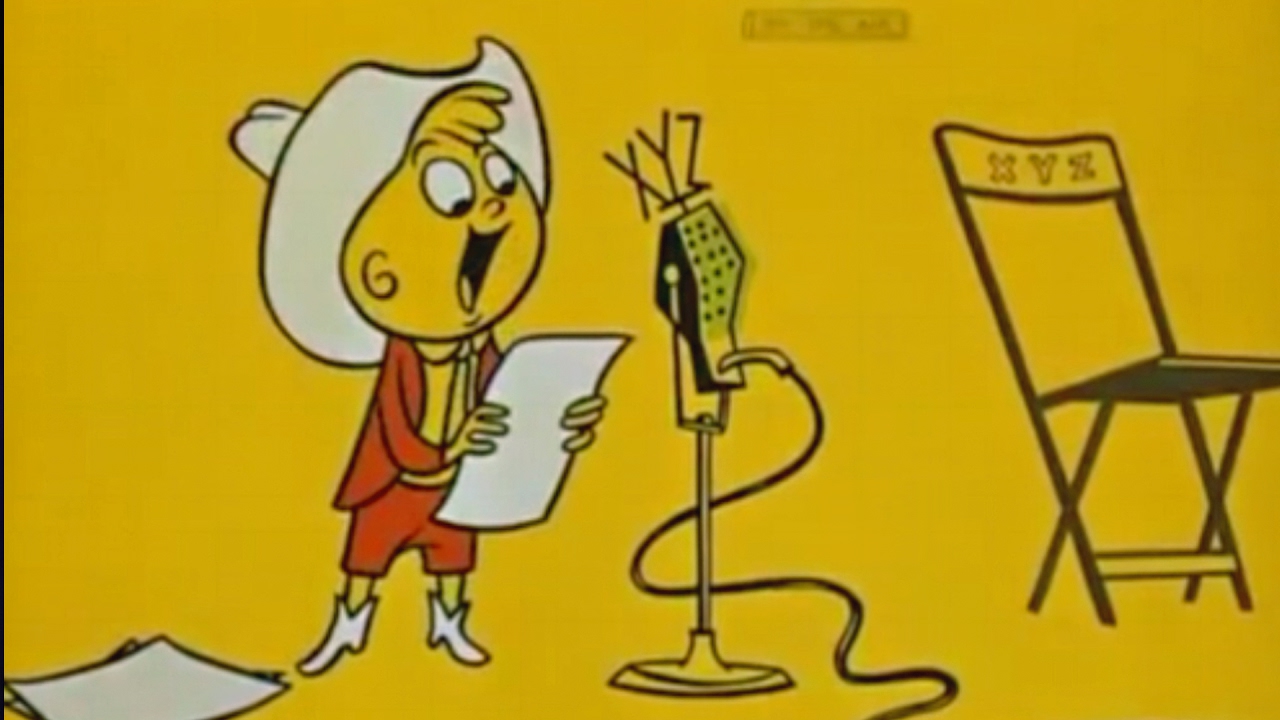
#63) Gerald McBoing-Boing (1950)

maxresdefault

#63) Gerald McBoing-Boing (1950)

OR “The Boinging of a New Era”

Directed by Robert Cannon

Written by Bill Scott & Phil Eastman. Based on the story by Dr. Seuss.

Class of 1995

The Plot: In Dr. Seuss fashion, a story in rhyme

Of a boy who speaks sound effects all of the time.

I’m kidding. How much would you hate me if I did this whole post in verse?

Why It Matters: The NFR cites the film as a representation of UPA’s more cartoonish style of animation, versus Disney’s more realistic style.

But Does It Really?: UPA was a game-changer in the world of animation, and I’m glad there’s a place for them on the Registry. “Gerald McBoing-Boing” is harmless enough as far as shorts go. It tells a good story with inventive animation, which is really all you can ask for.

Everybody Gets One: Among the animators who worked on the film was Bill Melendez, who would go on to turn the “Peanuts” comic strip into a series of acclaimed animated TV specials.

Wow, That’s Dated: Doctors paying house calls, kids playing marbles, radio dramas.

Seriously, Oscars?: In one of the rare cases where Oscar actually embraced something new, “Gerald McBoing-Boing” won the Best Animated Short category against more traditional fare like “Tom & Jerry”. UPA would continue to have a strong showing in this category throughout the ‘50s, most notably in 1957 when all 3 nominees were from UPA!

Other notes

  • Bill Scott, one of the writers, would go on to voice Bullwinkle in “Rocky & Bullwinkle”.
  • UPA’s animated shorts were called Jolly Frolics? Were all their other names taken?
  • So what do you think causes a boy to speak in sound effects? Is it a recessive gene that finally made its way through? Or is this yet another side effect from a generation that smoked and drank during pregnancy?
  • I do have to update the NFR’s statement that UPA is “still in business today”. While that was true when “Gerald” first entered the Registry in 1995, the company closed for good in 2000. The current rights to the UPA library are owned by NBCUniversal, though UPA still holds the licensing rights to its most famous creation; Mr. Magoo.

Legacy

  • Gerald had three animated follow-ups; “Gerald McBoing Boing’s Symphony”, “How Now Boing Boing” and “Gerald McBoing! Boing! on Planet Moo”. Notice that there is no consistency on his last name’s punctuation.
  • Following these shorts, Gerald moved to television with “The Gerald McBoing-Boing Show”, which was revamped in the mid 2000’s.
  • And I’m gonna go ahead and blame Gerald for Michael Winslow in those “Police Academy” films.

Further Viewing: If you’re looking for another Dr. Seuss film adaptation that’s not based on his classic books, might I recommend the incredibly bizarre “The 5,000 Fingers of Dr. T.” It’s…weird, it’s just weird.


#62) Hell’s Hinges (1916)

MV5BYWU0MzcxMDgtYWQzOC00MzZmLThjMGQtMzk4M2FkYjEwMTQ0XkEyXkFqcGdeQXVyMDUyOTUyNQ@@._V1_UY1200_CR86,0,630,1200_AL_

#62) Hell’s Hinges (1916)

OR “Are You There God? It’s Me, a Cowboy.”

Directed by Charles Swickard (with uncredited assistance from William S. Hart and Clifford Smith).

Written by C. Gardner Sullivan

Class of 1994

If the link below stops working, you can view the film online at the National Film Preservation Foundation.

The Plot: The lawless western town of Placer Center, aka Hell’s Hinges (take a shot), is turned on its head when an inept Reverend (Jack Standing) and his aptly devout sister Faith (Clara Williams) come to town. They are bullied by the saloon owner Silk Miller (Alfred Hollingsworth), but surprisingly welcomed by ambiguous anti-hero Blaze Tracy (William S. Hart). When Blaze falls for Faith and turns to the good book, the town’s ban on law and religion is thrown into turmoil.

Why It Matters: The NFR praises Hart and Williams as well as the cinematography of Joseph August. An essay by film historian David Menefee reminds us what a big deal William Hart was back in the day.

But Does It Really?: As a representation of William Hart, a forgotten legend of early cinema, I give it a pass. As a western, it’s okay. It’s entertaining, it tells a compelling –albeit slightly dated – story, and it doesn’t waste a lot of time. There are worse ways to spend an hour.

Everybody Gets One: Director Charles Swickard, actors Alfred Hollingsworth and Louise Glaum.

Wow, That’s Dated: In the cringe-inducing department, Miller is described as having “the oily craftiness of a Mexican”. Oof. Also, and this is not the film’s fault, a burning cross doesn’t just mean a burning cross anymore.

Take a Shot: Being the name of the town, Hell’s Hinges is referenced consistently throughout.

Other notes

  • When the film was first released, Variety called it “corking”. We need to bring back corking as an adjective.
  • Legend says that among the extras in this film are future matinée idol John Gilbert and actor Jean Hersholt, who I’m told was a heck of a humanitarian.
  • The Petticoat Brigade is described as being “a drop of water in a barrel of rum”. I hate to break it to you, but that’s still rum. The drop does nothing.
  • William Hart has the same smile as the Grinch when he gets a wonderful awful idea.
  • Sorry Silk, but that goatee just isn’t evil-looking enough.
  • Pretty impressive that Blaze falls for Faith even though SHE LITERALLY DOES NOTHING THE ENTIRE FILM.
  • Nothing says “church sermon” like roadkill nailed to a wall.
  • Where do “dance hall girls” go on their birthday? Computer school?
  • I can’t tell if this is a bad print or if the editing is a little sloppy.
  • Can’t this town do anything independently? Must they always clump together in a giant mob?
  • Ladies and gentlemen, Arizona Frank.
  • Some of these intertitles a bit too flowery. It’s a western, for crying out loud!
  • Color tinting on film is a lost art.
  • Oooh, Blaze said “damn”.
  • So the moral of this film is “Find religion or Go to Hell!”

Legacy

  • The band The Caledonia Mission wrote a song based on the film called “The Ballad of Blaze Tracy”. I can only find it on websites where you have to download it first. Google and listen at your own risk.

#61) The Godfather Part II (1974)

godfather_part_ii

#61) The Godfather Part II (1974)

OR “The ‘Godfather 2’ of Sequels”

Directed by Francis Ford Coppola

Written by Coppola & Mario Puzo. Based on the novel “The Godfather” by Puzo.

Class of 1993

The Plot: Picking up where the first film left off, Michael (Al Pacino) is now the Don of the Corleone family and is struggling with his empire’s move to Nevada, a business partnership/possible betrayal from Florida mobster Hyman Roth (Lee Strasberg), an ongoing Senate committee on organized crime, and his deteriorating relationship with his wife Kay (Diane Keaton). Told in parallel is the story of his father Vito (Robert De Niro) as a young man emigrating from Italy to start a new life in America.

Why It Matters: The NFR calls the film one of the few sequels that is “as good or better than the original”. An essay by Michael Sragow is a tribute to both films.

But Does It Really?: Given the story structure it’s hard to separate this film from “The Godfather”. It expands on the story of the original in the right ways and gives more dimension to the characters, even if it means a lot more spinning plates to keep track of. The film as a whole is great, but by its nature a sequel can never be the breakthrough its predecessor was. It doesn’t help that a lot of this film is about maintaining a legacy, be it Michael with his father or Coppola with his films. Is “The Godfather Part II” better than the original? Not really. Is it a worthy successor that can stand alongside the first? Absolutely.

Shout Outs: Ummm…the first one?

Everybody Gets One: Perhaps the name most associated with “The Method”, Lee Strasberg ran the Actors Studio for 31 years and taught several generations of acclaimed actors. He had retired from acting to focus on teaching, but former pupil Al Pacino persuaded him to take the role of Hyman Roth after director and former Actors Studio member Elia Kazan turned it down. Strasberg finally relented and received an Academy Award nomination for his troubles. In addition, he was nominated for a Golden Globe for Most Promising Newcomer – at the age of 73.

Seriously, Oscars?: “The Godfather Part II” defied expectations and scored 11 Oscar nominations and six wins. Among the prizes claimed were Best Picture, Director for Coppola, Adapted Screenplay (even though very little of the film is based on the novel), Supporting Actor for De Niro, and Original Score (even though the first film’s score was deemed ineligible. I don’t know how these things work). Despite the sweep, Pacino once again went home empty-handed (They went sentimental and gave Best Actor to Art Carney for “Harry & Tonto”). The film’s wins were deserving, but meant there was no room for fellow NFR entries “Chinatown” and “The Conversation”.

Other notes

  • Just to reiterate, the only part of this film based on the original novel is the Vito flashbacks, and that’s only one chapter. Everything involving Michael is unique to the film.
  • I had a first communion and I didn’t get a reception with dancers or bocce ball or senators or Troy Donahue.
  • The character of Frank Pentangeli was originally intended to be Pete Clemenza from the first film. When actor Richard Castellano asked for too much money and script demands, the character was killed off. And then they wrote it in that Clemenza didn’t tie things up with the Rosato brothers. I guess Coppola held a grudge.
  • Speaking of Clemenza, he’s played in the flashbacks by a young Bruno Kirby. I will always remember him best as a short-tempered caricature of himself on “The Larry Sanders Show”. He left us much too soon.
  • Damn, Pacino is good in this. Like you needed me to tell you that.
  • Someone in this film actually says the phrase “mamma mia!”
  • It’s a lot of fun watching De Niro doing his interpretation of Brando’s Vito. If the stories are true and Martin Scorsese plans on de-aging De Niro for scenes in “The Irishman”, he’s got his work cut out for him.
  • I’m a little disappointed that Duvall really gets nothing to do as Tom Hagen in this one. No wonder he didn’t want to do the third one.
  • It must have been great for Pacino to watch his former acting teacher Strasberg have to practice what he preached.
  • How come they didn’t translate “paisan” on the subtitles?
  • I’m glad things worked out for Signora Colombo and her landlord. I hope this means a bright future for her son.
  • Among the actors playing senators in the committee are B-movie producer Roger Corman and author Richard Matheson, who wrote the “Twilight Zone” episode “Nightmare at 20,000 Feet”.
  • Senator Geary says that the Mafia hearings are not “a slur upon the great Italian people.” Sure, but it didn’t help either.
  • Always great to see Diane Keaton in a performance before she became self-parody.
  • The Oscars managed to include three of this film’s actors in the Best Supporting Actor category, but couldn’t find room for John Cazale’s iconic and heartbreaking work as Fredo? Where’s the justice in that, I ask you?
  • The film’s final flashback is pretty great, and also quite emotional since it brings several characters back from the dead. It’s a shame Brando didn’t show up for this one.

Legacy

  • Although content with the two films being halves of a larger whole, Coppola did finally relent and make a third one in 1990, calling it an epilogue to the original two. Most people call it the Fredo of the bunch.
  • This film, of all things, led to more sequels having the number in their title, as opposed to “Son of” or “Revenge of” or “Beneath the”.
  • Everyone who says “Keep your friends close and your enemies closer”, or “I knew it was you. You broke my heart.”
  • Don Homer
  • This interesting reference on Seinfeld.
  • While not De Niro’s first film, it did propel him into the mainstream and to one day play straight man to Ben Stiller.

#60) What’s Opera, Doc? (1957) [Original 2017 version]

What's_Opera_Doc_Lobby_Card

#60) What’s Opera, Doc? (1957)

OR “That’s Valhalla, Folks!”

Directed by Chuck Jones

Written by Michael Maltese

Class of 1992

Not the full thing, but here’s the clip you need!

NOTE: This is the original version of my “What’s Opera, Doc?” write-up. You can read the revised and expanded version here.

The Plot: After trying to best each other for 17 years, the longstanding Bugs Bunny-Elmer Fudd feud climaxes in operatic fashion. Taking a cue from Richard Wagner, Fudd (voiced by Arthur Q. Bryan) is Siegfried, who must “kill the wabbit” using his spear and magic helmet. Bugs (voiced by Mel Blanc) outwits the hunter by dressing in drag as Bruunhilde and seducing him. They sing, they dance, and they give most people their only knowledge of Wagner.

Why It Matters: The NFR hails it as “Jones’ cinematic masterpiece” and points out the film’s feat of being the first animated short to be included on the Registry. Also included is a loving tribute to Chuck Jones by his grandson, Craig Kausen.

But Does It Really?: Oh of course. This is the culmination of years of Chuck Jones honing his craft and creating two surprisingly dimensional animated characters. It’s as if all those other shorts were set-up and this is the payoff. Though in order to really appreciate “What’s Opera, Doc?” you should watch some of that “set-up” to get an idea of just how high the stakes are in this one (See “Prior Viewing” below).

Everybody Gets One: Due to what I’m guessing is a good agent, Mel Blanc is the only voice actor credited in any of these shorts. Attention must be paid to Arthur Q. Bryan, the original voice of Elmer Fudd, heard here in one of his final performances. Bryan was a longtime radio performer and voiced Fudd (and his predecessor Egghead) for 20 years.

Wow, That’s Dated: The assumption that an average audience has passing knowledge of opera.

Take a Shot: No one says the title, but Bugs does sing his trademark “What’s up, Doc?”

Seriously, Oscars?: No Animated Short Subject nod for “What’s Opera, Doc?”. The Oscars did, however, nominate two other Looney Tunes shorts that year; Speedy Gonzales’ “Tabasco Road”, and the winner in that category, the Sylvester and Tweety vehicle “Birds Anonymous”. Chuck Jones would have to wait eight more years before winning in this category for “The Dot and the Line”.*

Other notes

  • No one has ever been able to tell me the difference between Merrie Melodies and Looney Tunes. Are they the same thing?
  • Thumbs up to Bryan singing as Fudd to Bruunhilde. It’s so sincere you can’t help but laugh.
  • Just like how you can’t fall off a cliff until you look down, cartoon physics dictate that you can’t know it’s a disguise until the wig falls off.
  • I realized while watching this that I always get this short mixed up with “Rabbit of Seville”. Interestingly, Fudd’s the one in drag in that one.

Legacy

  • Three words: Kill the wabbit.

Prior Viewing: If you want to see where the Bugs/Fudd rivalry began, check out 1940’s “A Wild Hare”. It’s all there, from Bugs’ first “What’s up, doc?” to Elmer’s first “Be vewy vewy quiet.”


* UPDATE: Cartoon historian Jerry Beck recently discovered documentation that “What’s Opera, Doc?” was on the shortlist for Academy Award consideration.

#59) Sherlock Jr. (1924) [Original 2017 Post]

470ce852c8f197f79f33116f84728e44

#59) Sherlock Jr. (1924)

OR “A Study in Silent”

Directed by Buster Keaton

Written by Jean Havez & Joe Mitchell and Clyde Bruckman

Class of 1991

This is my original “Sherlock Jr.” post; you can read my revised and expanded version here.

The Plot: A young film projectionist/amateur detective (Buster Keaton) vies for the affection of a young woman (Kathryn McGuire) against a rival (Ward Crane). When he is framed for stealing the pocket watch of the girl’s father (Joe Keaton), he is banned from ever seeing her again. While on the job he falls asleep and dreams he can walk into the movie he’s showing. He assumes the role of Sherlock Jr. and solves a mystery using only his detective skills, his porkpie hat, and his deadpan demeanor.

Why It Matters: The NFR praises Keaton and calls the film “a comedic masterpiece that both acknowledges and embraces the cinematic medium”.

But Does It Really?: This is another one where I didn’t write down too many notes because I was laughing too hard. Of the silent film legends, Keaton has always been my favorite. Chaplin had the pathos, but Keaton had the technique. His films contain a seemingly endless supply of gags and stunts, all performed in-camera with no special effects (sometimes at the sacrifice of Keaton’s own health). “Sherlock Jr.” cannot be beat in terms of sheer ingenuity. Plus it’s a breezy 45 minutes. It tells the story it needs to tell and doesn’t forget to be uproariously funny.

Everybody Gets One: Leading lady Kathryn McGuire started off as a dancer and performed in several Mack Sennett comedies. This brought her to Keaton’s attention and he cast her in this film as well as “The Navigator”**. In the late ‘20s she retired from acting to marry and raise a daughter.

Wow, That’s Dated: Phrases like “the local sheik”. Also the job of film projectionist.

Title Track: Keaton is introduced as “Sherlock Jr.” only once about halfway through the film.

Other notes

  • Why the fake moustache at the beginning?
  • That’s Keaton’s dad Joe playing the girl’s father.
  • Only Keaton could make a banana peel gag work and still be funny.
  • Ah yes, back in the days when a detective would just show up to your house.
  • How did the demonstration of the exploding pool ball not arouse immediate suspicion?
  • Wow, this film has more impressive trick shots than “The Hustler”.
  • I know it’s a dream and all, but what happens when they have to change reels?
  • The story goes that Keaton broke his neck by falling on a railroad track too hard. He kept going and didn’t know he broke it until years later!
  • Keaton’s assistant sort of looks like young Ian McKellen.
  • So, the bad guys have a guy just hanging around in a torture device?
  • This film is filled with a lot of amazing stunts, but the shot of Keaton diving into the suitcase tops them all. I’ve had the trick explained to me and I’m still not quite sure how they did it.
  • Let the record show that for my stag party I’d also like to play tug o’ war.
  • Like many of the great film detectives, Sherlock Jr. relies primarily on luck and coincidence.

Legacy

  • In “The Purple Rose of Cairo”, Woody Allen flips the idea and shows a character walking out of a movie.

Further Viewing: I’m a big fan of the video essay series “Every Frame a Painting” by Tony Zhou (what is it about guys named Tony and classic films?). His look at Buster Keaton in “The Art of the Gag” is insightful, thoroughly researched, and above all an entertaining tribute to the master. Look for all of these Keaton rules the next time you watch one of his pictures.

** 2018 Update: And now “The Navigator” is on the Registry! Kathryn gets two!!