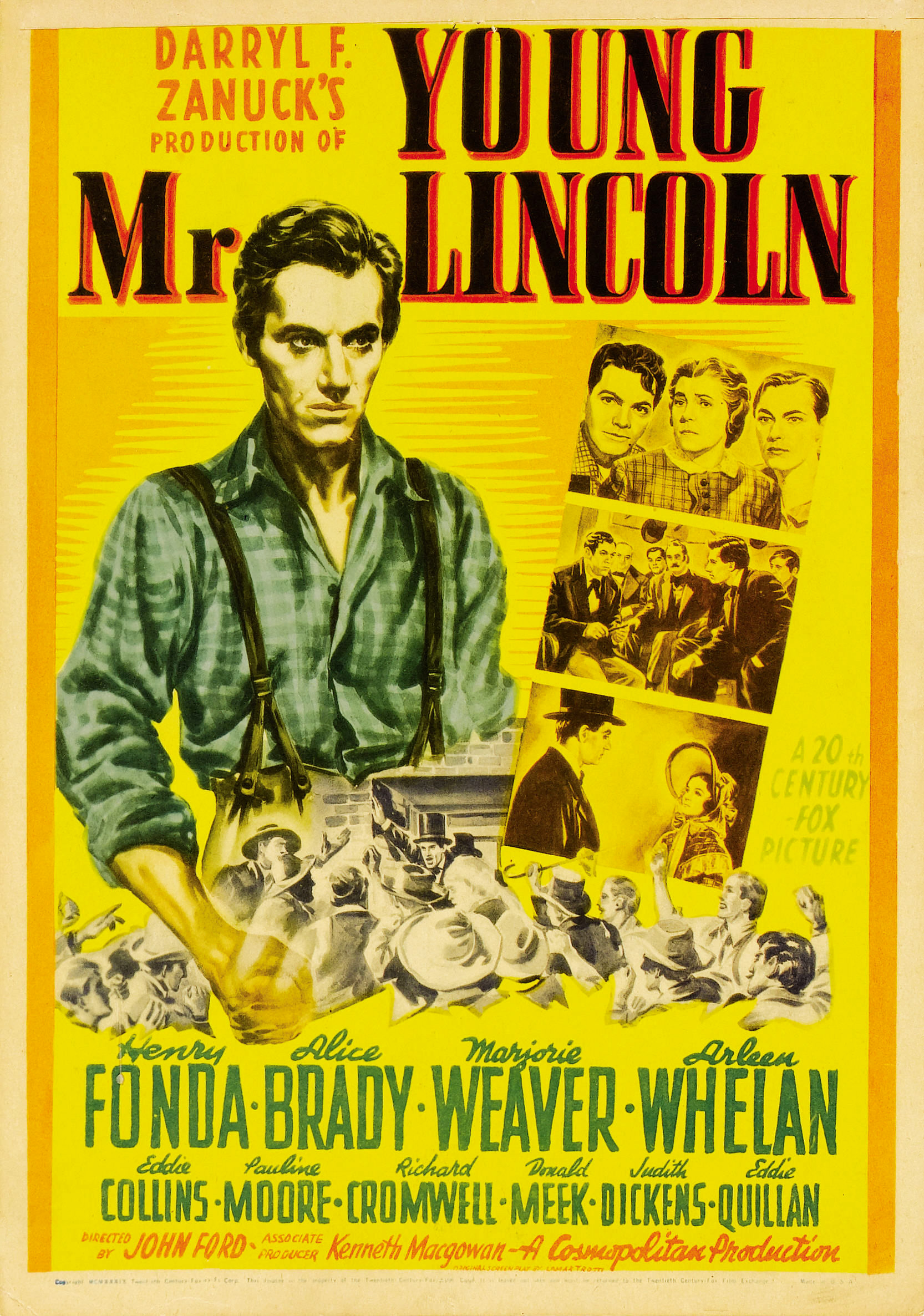
#43) Young Mr. Lincoln (1939)

Poster - Young Mr. Lincoln_01

#43) Young Mr. Lincoln (1939)

OR “Southside with Abe”

Directed by John Ford

Written by Lamar Trotti

Class of 2003

I wasn’t able to track down the film’s original trailer, so here’s the film’s recreation of a landmark moment in American history; Lincoln judging a pie contest.

The Plot: In the early 1830s young Abe (Henry Fonda) teaches himself common law and heads off to Springfield, Illinois to practice. His first big case involves two brothers (Richard Cromwell & Eddie Quillan) accused of murdering a man during a 4th of July celebration. Abe uses his book smarts, his keen eye of human behavior, and his average sized stovepipe hat to help defend the boys. And that man grew up to be President Abraham Lincoln. And now you know the rest of the story!

Why It Matters: The NFR cites this film alongside John Ford’s two other 1939 offerings; “Stagecoach” and “Drums Along the Mohawk”. They also point out that Ford and Fonda would collaborate six more times after this film. So for the record, nothing of note about the film itself, other than it was Fonda’s “most significant role up to that point”, a claim that would be eclipsed just eight months later.

But Does It Really?: Well, it’s definitely a step up from my previous Fonda screening, “The Ox-Bow Incident”. Being a John Ford film it can’t help but be interesting to watch, and Fonda gives a very strong performance here that is more Fonda than Lincoln, but I have no problem with that. As a biopic it’s a bit on the nose (there are more historical nods in this film than in “Shakespeare in Love”). As courtroom drama it’s a bit more engaging. As a classic film worthy of preservation, I have my doubts. I’m also convinced the NFR thought they were voting for “Abe Lincoln in Illinois”, which came out around the same time as this film.

Everybody Gets One: Rounding out the historical figures are Marjorie Weaver as Mary Todd, Pauline Moore as Ann Rutledge, and Milburn “Doc” Stone as Stephen Douglas. Slightly odd mention to Judith Dickins, who is credited for playing Carrie Sue, a character that’s not in the film. Now that’s a good agent. And as always, special mention to Fred Kohler Jr. as Scrub White, aka “The Vic”.

Wow, That’s Dated: It’s not a John Ford film until someone vilifies Native Americans. In this case a “drunk Indian” killed Abigail’s husband. Also I was not expecting this film to discuss the origin of “The Jew’s Harp”.

Seriously, Oscars?: Facing competition from the bevy of films that made up “the greatest year for movies ever”, “Young Mr. Lincoln” received only one nomination; Best Original Story (a forerunner to the Original Screenplay category). It lost to the significantly more famous 1939 political film “Mr. Smith Goes to Washington” (Interestingly enough, that film’s only win at the Oscars).

Other notes

  • I don’t know the exact timeline, but John Ford made this film either right before or right after “Stagecoach”, arguably his first true classic. (UPDATE: It was right after)
  • As for historical accuracy, this film muddles the details, but overall gets things correct. The case that Lincoln tries is based on one that actually took place several years later right before he was a nominee for the Senate.
  • Kudos to that make-up team. There are some shots where Fonda looks just like Lincoln.
  • This may be the folksiest film on the Registry. I suddenly understand why “Matlock” was on the air for so long.
  • He runs into Stephen Douglas AND meets Mary Todd in the same scene? Does he shake hands with JFK too?
  • Yes, Honest Abe, the man who cheats in a tug o’ war contest.
  • Let’s all get our fingerprints over the murder weapon. Good idea everyone.
  • How come whenever Fonda shows up in a movie a lynch mob breaks out?
  • “By Gene”? Who’s Gene?
  • Awkward Lincoln trying to dance with Mary Todd is adorable.
  • There’s a passage in the score’s main romantic theme that keeps turning into “Ascot Gavotte” for a second.
  • Alice Brady kinda looks like she should be Patricia Neal’s mother. Also, I’m surprised Brady didn’t get a Best Supporting Actress nomination for this film. She was a previous winner, and this performance is the kind of “strong, protective mother” character type that has done well for others. Plus she died just after the film was released but before Oscar campaigning had begun. No room for one final nomination bouquet?
  • Ward Bond plays John Palmer Cass here. A favorite of John Ford’s (despite their very antagonistic relationship), Bond appears in 25 of his films. Bond is also in 14 films on the National Film Registry, which has got to be the record.

Legacy

  • The film produced one sequel: “Great Moments with Mr. Lincoln”.
  • Though he did not portray Lincoln during his presidency, Henry Fonda did run for President in 1964’s “The Best Man”.
  • Tom Hanks
  • While Lincoln’s courtroom antics got laughter from the crowds, he didn’t attempt standup until many years later.
  • When it comes down to it there’s only two kinds of Lincoln movies; the ones where he’s a Vampire Hunter, and the ones where he isn’t.

Further Viewing: The aforementioned “Abe Lincoln in Illinois”, which covers most of the same territory as “Young Mr. Lincoln”, and throws in his first presidential campaign for good measure. Plus it’s got young Ruth Gordon as Mary Todd!

#42) The Endless Summer (1966)

HAMERSVELD_1964_The_Endless_Sumer_movie_poster

#42) The Endless Summer (1966)

OR “Have Board, Will Travel”

Directed & Written by Bruce Brown

Class of 2002

The beginning of this trailer is missing, but rest assured they probably say the word “surf” at least eight more times.

The Plot: Surfers Mike Hynson and Robert August travel the world in order to catch the best waves during the warmest conditions, hence an “Endless Summer”. Director Bruce Brown casually narrates as they travel the coasts of Africa, Australia and New Zealand to find the best beaches, some un-surfed by man at that point. All this and endless surf music!

Why It Matters: The NFR’s official description of the film is just a rundown of the film’s struggle to get distribution. The only superlative used to describe the film itself is “droll”. Not exactly a selling point.

But Does It Really?: By comparison my response seems overzealous. It’s not the greatest documentary ever, but “The Endless Summer” does what any good documentary should do; showcase a culture or a place that you might not know or might not fully understand. It never gets too stuffy or self-important and keeps a fun attitude throughout. Plus, it’s a great travelogue of all the places they visit. I guess I never truly appreciated the art of surfing before this film. If you’re going to have one surf film on the Registry, this is a fine choice.

Shout Outs: Bruce throws in a “Lawrence of Arabia” homage while everyone travels across the South African desert.

Everybody Gets One: Bruce Brown made several surf documentaries leading up to “Endless Summer”. Ironically, he received his one Oscar nomination for Best Documentary when he left surfing and moved on to motorcycle racing for “On Any Sunday”. As of this writing both Mike Hynson and Robert August are still with us and sell surfboards online along with other beach/“Endless Summer” paraphernalia. Here’s Mike’s website and here’s Robert’s.

Wow, That’s Dated: Ladies and Gentlemen, The Sandals! Also, at one point the boys complain that gas in Senegal is $1 a gallon. Highway robbery, I tell you!

Other notes

  • Malibu Beach is a secret spot?
  • I will say Bruce’s narration grew on me. It has a nice easy-going manner to it, almost like he’s just chatting with you while they play the film. It’s as much commentary as it is narration.
  • Of course as soon as I make that last observation Bruce says, “Being good Africans they throw a few rocks.” I literally groaned out loud when he said that.
  • Mike kinda looks like Max Headroom with his sunglasses and suit.
  • There’s juuuuust enough padding in this film to suggest that the initial footage wasn’t feature length. We get several extended trips back to Hawaii during the boys’ travels. Does anyone know if that’s from Bruce’s previous documentaries?
  • There’s something very satisfying about watching a surfer dude get chased by a zebra.
  • This documentary is worth a watch just for the shots of the perfect wave at Cape St. Francis. They left me speechless.
  • And then the female surfers show up and the boys can’t concentrate. Thanks Bruce.
  • Bruce’s attempt at an Australian accent does more travelling than Mike and Robert.
  • I appreciate this film’s use of the flashback dissolve.
  • Needless to say that this seminal surf film gives you plenty of “plumber shots”.
  • Bruce says that Pearl’s swimsuit is unique. Were two-pieces not a thing back then?
  • The final credits give thanks to “Old King Neptune for providing the waves”. Get a haircut, hippies.

Legacy

  • The film’s sequel “The Endless Summer II” features surfers Pat O’Connell and Robert “Wingnut” Weaver following the original film’s same travel path 30 years later. The trailer is…very ’90s.
  • Bruce’s son Dana took unused footage from this and the sequel to make the companion film “The Endless Summer Revisited”.
  • Since its appearance in this film, Cape St. Francis is now world-famous for its surfing. There goes the neighborhood.
  • What’s this!? Batman and his best baddie board up for a battle of brawn by the beach!?
  • Surfing went mainstream thanks in part to this film, eventually leading to surf legend Greg Brady.

Listen to This: They’re not mentioned in “The Endless Summer”, but how can you talk ‘60s beach culture without The Beach Boys? Added to the NRR in 2004, their album “Pet Sounds” shifts away from the surf-specific themes of their earlier songs, but nevertheless defines the ’60s surf era. And it’s “Wouldn’t It Be Nice” right out of the gate! How perfect an album is that?

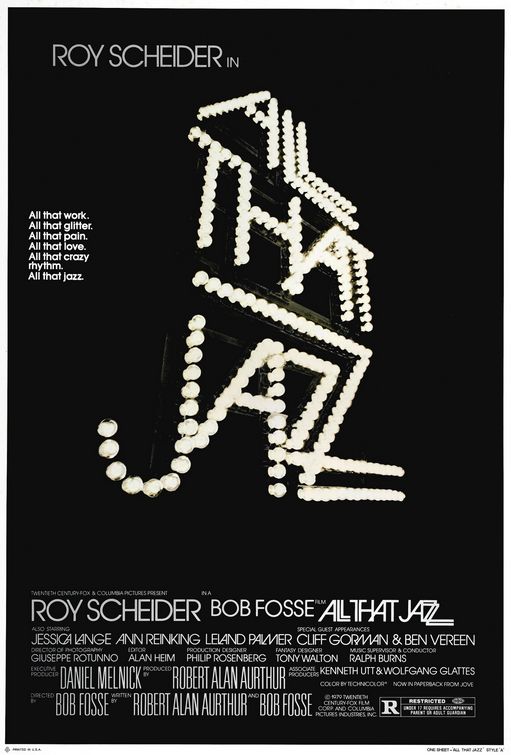
#41) All That Jazz (1979) [Original 2017 Post]

all_that_jazz

#41) All That Jazz (1979)

OR “5-6-7-8 1/2!”

Directed by Bob Fosse

Written by Fosse & Robert Alan Aurthur

Class of 2001

All That Trailer

This is my original post on “All That Jazz”. You can read the revised and expanded version here.

The Plot: Joe Gideon (Roy Scheider) is a legendary Broadway director/choreographer and successful film director (not unlike Fosse). Additionally, Joe juggles an ex-wife/collaborator (Leland Palmer), a girlfriend who wants him to commit (Ann Reinking), a daughter who wants more stability (Erzsebet Foldi), a smoking habit, a pill addiction and a relentless desire to entertain. While rehearsing his latest musical and editing his latest film, Joe’s health starts to falter and he is hospitalized. Throughout his struggles he has an ongoing flirtation with an angel of death (Jessica Lange). Oh, and there’s a whole bunch of songs and dances.

Why It Matters: The NFR praises Fosse’s unflinching look at the toll showbiz takes on entertainers while “mercilessly reversing the feel-good mood of the classical movie musicals”.

But Does It Really?: As a self-reflection on Fosse and a glimpse of a Broadway that no longer exists, “All That Jazz” is fascinating. Scheider is great in a role no one but Fosse would cast him in. The film as a whole is bit pretentious, but that’s to be expected. I found it all so enjoyable that I wished it had dug deeper into what really makes Joe/Fosse tick (and not just literally, more on that later). Ultimately, the film is like one of Joe/Fosse’s dance numbers: entertaining, imaginative, seductive, but in the end just smoke-and-mirrors hiding the real truth. The film’s legacy isn’t so much the film itself, but rather the insight into one of last century’s greatest artists.

Shout Outs: Brief references made to “A Streetcar Named Desire” and Fosse’s own “Cabaret”.

Everybody Gets One: ‘70s Broadway staples Ann Reinking, Leland Palmer and Ben Vereen, character actor C.C.H. Pounder, and John Lithgow, back when he was just a New York stage actor and had not yet mastered alien invasions and serial killing.

Wow, That’s Dated: Well, Joe’s massive cassette player is your first clue. But with this film I get to play one of my favorite games; “What’s Playing on Broadway Back Now?” Quick shots of Broadway and Times Square show us marquees for “I Love My Wife”, “Beatlemania” and “A Broadway Musical”, the latter dates filming of these scenes to December 1978. The late ’70s were also that magical time when Cliff Gorman could be credited as making a “special guest appearance” in your film.

Title Track: Ben Vereen says “all that jazz” once right before the final number.

Seriously, Oscars?: “All That Jazz” went into the 1979 Oscars with nine nominations, including Best Picture. Though the big winner was “Kramer vs. Kramer”, “Jazz” still managed four wins; Adapted Score, Art Direction, Costume Design, and Editing. Fosse was aware of his slim chances and told the New York Daily News, “I’m such a long shot that I think anyone who bet on me should get a toaster, like they give out at the bank for having made an investment.”

Other notes

  • Speaking of the film’s Oscar night, producer/co-writer Robert Alan Aurthur died before the film’s release and received two posthumous Oscar nominations. His daughter Kate wrote a touching tribute to him a few years ago and recounted her experience with her mother as his Oscar proxy.
  • Stay with me folks; Joe is Fosse (natch), Audrey is Gwen Verdon, Kate is Ann Reinking (yep, she’s playing herself), “The Stand-Up” is Fosse’s own underrated “Lenny” and “Take Off With Us” has elements of “Magic to Do” from “Pippin”.
  • This film has one of my favorite expository reveals of a character’s name. We first see the name Joe Gideon on the label of his bottle of pills.
  • The best line in the film; “That’s how you get a job.”
  • Yes, that’s Jessica Lange, back during that brief period when she was best known as “You’re no Fay Wray”.
  • Leland Palmer is 20 years younger than her real-life counterpart Gwen Verdon. Nice try, Fosse.
  • Kudos to the composers of the Stephen Schwartz/Kander & Ebb pastiches throughout the score. Just the right amount of flavor.
  • For his brief turn as Joshua, Max Wright (aka the Dad from “ALF”) was nominated for a Golden Stinkers Award (a precursor to the Razzies) for Worst Supporting Actor. I mean, the character’s annoying, but he’s not that bad. He lost to little Ricky Schroeder for “The Champ”.
  • Joe’s doctor is adamant he knows more about angina than “show people”. This, coming from an actor who’s playing a doctor.
  • That is actual footage from an actual open-heart surgery. See? This film’s educational too!
  • Ladies and Gentlemen, half of Roy Scheider’s ass!
  • If there’s an afterlife, I hope Ben Vereen’s there when I die. On second thought, I’d rather it be Jessica Lange.

Legacy

  • The film version of “Chicago” definitely takes a thing or two from “All That Jazz”, and I don’t just mean the title.
  • Bob Odenkirk gave the film a wink and a nod during an episode of “Better Call Saul”.
  • While Ann Reinking’s film career never took off, it doesn’t matter because she’s got Annie! Oh, and “Chicago” revival money.
  • “Take Off With Us” eventually made it to Broadway as part of the musical revue “Fosse” (Sinatra never recorded it, though).
  • Stephen Colbert recently told Jessica Lange that this film and her performance in it are partly why he went into show business.
  • And in a sad case of life imitating art, Bob Fosse made one more film, “Star 80”, before dying of a sudden heart attack in 1987.

Further Viewing: Federico Fellini’s “8 ½” is the benchmark for films that are thinly veiled autobiographies of their directors. The comparisons between this film and “All That Jazz” are too numerous to mention, especially when “8 ½” rounded up and became the musical “Nine”.

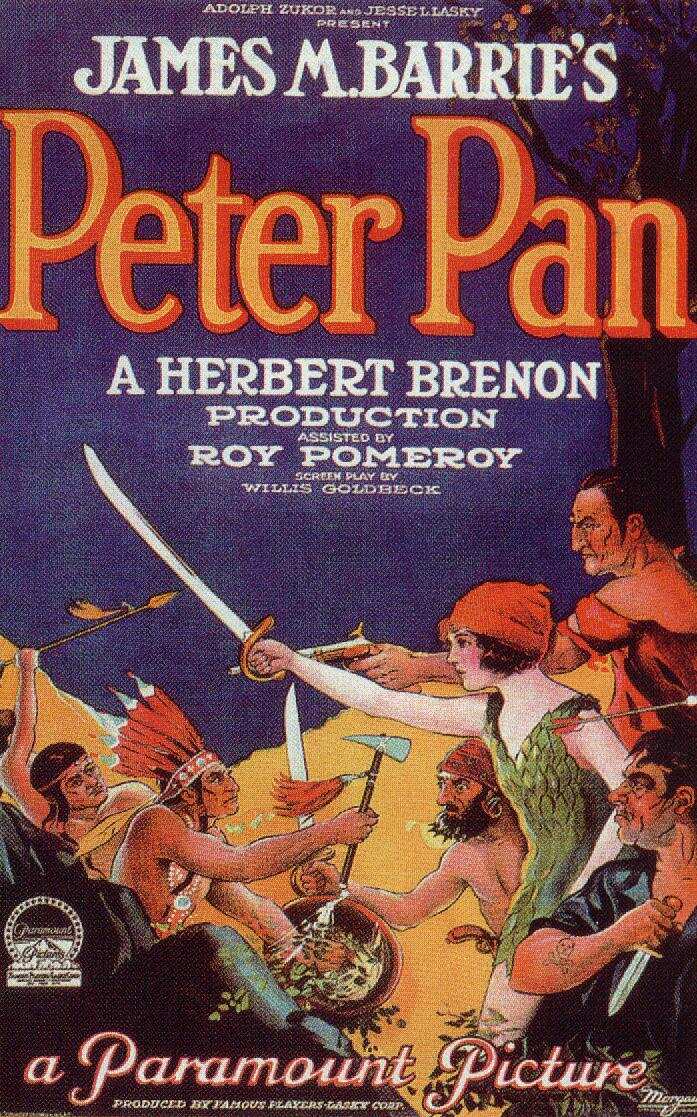
#40) Peter Pan (1924)

Peter_Pan_1924_movie

#40) Peter Pan (1924)

OR “Filming Neverland”

Directed by Herbert Brenon

Written by Willis Goldbeck. Based on the play and novel by J.M. Barrie.

Class of 2000

View the whole film below!

The Plot: Three innocent children (Mary Brian, Jack Murphy & Phillipe De Lacy) are persuaded to run away from home by an 18-year-old woman pretending to be a boy (Betty Bronson). They venture to a place where grown adults are tormented by children and where the natives are routinely disrespected. There’s attempted murder and Freudian quagmires galore in this beloved children’s classic.

Why It Matters: The NFR mentions J.M. Barrie’s initial reluctance and eventual support of adapting his play into a film, then goes on to praise the film’s special effects and Bronson’s “exquisitely stylized performance”.

But Does It Really?: This one gets a pass more for its historical merits than anything else. It’s the earliest film version of “Peter Pan”, and though eclipsed by later versions, was quite the success in its day. The film was also presumed lost for many decades, so it gets “Belloq film” status. While it never quite achieves what subsequent adaptations have done, this “Peter Pan” is as enjoyable as a silent version can be. Besides, if I say, “I didn’t like ‘Peter Pan’” out loud, another copy of a silent film somewhere drops dead.

Everybody Gets One: Betty Bronson was handpicked by J.M. Barrie to play Peter Pan. While her career never really took off, she did manage to transition from silent picture to talkies. Plus she’s in “Blackbeard’s Ghost”! While most of Herbert Brenon’s directing career was already behind him by 1924, he did manage to be among the very first Best Director nominees at the 1929 Oscars for “Sorrel and Son”. And at this point in his life, 64-year-old J.M. Barrie was still writing (though nothing as popular as “Peter Pan”) and was collecting lifetime achievement awards, including an Order of Merit in 1922.

Wow, That’s Dated: Oh how I wish this could just be about quaint phrases like “drowsing” or “perambulators”, but no, I have to give the REDFACE WARNING. As is often the case with “Peter Pan”, we get Tiger Lily and the other native Indians. While most of them are uncredited, it’s a safe bet that none of them are being played by actual Native Americans*. Oh, and I couldn’t find any additional information on Hook’s only black pirate; but please let him actually be black, oh please oh please oh please…

Other notes

  • This may be the only version of “Peter Pan” where Nana gets top billing.
  • Speaking of that dog, why are her pupils so large? Did she just come from the optometrist?
  • Esther Ralston (Mrs. Darling) was 22 when she filmed this. Her on-screen husband Cyril Chadwick was 45. [Shudder]
  • Wow, John and Michael can sleep through anything.
  • When Peter gives the example of saying, “I don’t believe in fairies”, does that actually kill a fairy? Is he endangering the species just by mentioning this?
  • This is one of the rare versions of “Peter Pan” where Captain Hook and Mr. Darling are played by two different actors. I guess it doesn’t actually matter, I’m just so used to the double casting.
  • That’s legendary Chinese American actress Anna May Wong as Tiger Lily. It’s still not an actual Native American playing the part, but it could have been worse, it could have been Rooney Mara.
  • Call it “exquisitely stylized” if you must, but Betty Bronson’s playing to a back of the house that ain’t there. Even by silent film standards it’s a bit much.
  • Wait, they’re American in this version? What a bizarre choice, especially when John wants the Lost Boys to behave like “American gentlemen”. That’s not a thing.
  • Lay off all the tongue acting, Hook! Yeesh.
  • Whenever the audience has to clap to bring Tinker Bell back to life I always think of this.
  • Oof, mermaids are not that impressive going back into the water.
  • The Lost Boys come to the Darling house dressed in the pirate clothes, which means that somewhere in Never Never Land is a pile of dead naked pirates.
  • Is the flying pirate ship just hanging out in front of the Darling house in full view of the whole neighborhood?
  • Peter Pan is very concerned about growing up and becoming President (again, because they’re American). I’ll let you, the reader, come up with your own political joke here.

Legacy

  • According to some very exhaustive research, it appears that “Peter Pan” has been adapted for film a few times throughout the years. Perhaps most notable is the 1953 Disney version, which animates the fantasy aspects wonderfully, but keeps all the political incorrectness and adds its own!
  • The team behind this film got back together in 1925 to adapt another J.M. Barrie play; “A Kiss for Cinderella”. The film was an artistic success but a commercial failure.
  • This is the first version of “Peter Pan” to depict Tinker Bell as a woman, rather than just a flashing light.
  • “Peter Pan” was adapted as a Broadway musical in 1954 starring Mary Martin. We get a revival (or a god-awful TV remake) every so often, but you really can’t touch the original version.
  • I’m citing this film (as well as the original stage concept of a woman playing Peter) as the cause of Mr. B Natural.
  • Captain Hook was eventually brought to trial for his crimes by a very theatrical maritime lawyer. Cute story.
  • And finally, a British “in-the-round” stage production toured America in the early 2010s and gave this writer a much-needed paycheck and introduced me to my girlfriend. Thanks J.M. Barrie!


*UPDATE: From the AFI Film Catalog: “The Aug 1924—Jan 1925 issue of Motion Picture Magazine reported that [director Herbert] Brenon recruited members of the Nakota, an indigenous people in Western Canada, to portray the Native inhabitants of “Neverland.” You win this round, “Peter Pan”.

#39) Lambchops (1929)

Mv5-

#39) Lambchops (1929)

OR “Say Hello, Gracie”

Directed by Murray Roth

Written by George Burns and Al Boasberg

Class of 1999

The Plot: George Burns & Gracie Allen make their film debut in a Vitaphone Varieties short, recreating their successful vaudeville routine. They tell jokes -George is already the bemused straight man to Gracie’s “illogical logic” – and they even sing and dance together.

Why It Matters: The NFR acknowledges that while “Lambchops” was not a hit in its day, it was the start of Burns and Allen’s film career, which would help prepare them for their successful radio and TV programs. An essay by Vitaphone expert Ron Hutchinson is mostly an essay on Vitaphone Varieties, and a shout-out to a very outdated fansite.

But Does It Really?: I give this one a pass, mainly as a representation of Burns & Allen, and mainly because even that early in their careers, you cannot beat that timing.

Everybody Gets One: George Burns and Gracie Allen had been performing together for seven years (and had been married for three) by the time “Lambchops” came along. The film is a combination of their “Lambchops” and “Dizzy” routines. A few years of shorts led to a film career in the ‘30s, followed by 16 years on radio, and eight seasons of a successful TV program. Following Gracie’s death in 1964, George reinvented himself as a one-liner machine and returned to films, winning an Oscar for “The Sunshine Boys” playing, what else, a former vaudevillian.

Wow, That’s Dated: The word “aeroplane”, the phrase “I give it up” as opposed to “I give up”, and because it’s a vaudeville routine, mother-in-law jokes.

Title Track: Spoilers – “lambchops” is a punchline.

Other notes

  • George never takes his hat off because his toupee was still in his luggage. That’s all well and good, but why is it titled towards the camera? You can’t see his face half the time.
  • Both George and Gracie actually sing in this short, which is amazing because anyone who ever heard George “sing” in his later career knows that’s not always the case.
  • During my research for this post, I learned that according to several sources, including George himself, Gracie never actually said “Goodnight, Gracie” in their act. Rowan & Martin did a similar routine in the ‘60s and most people just assumed they were stealing it from Burns & Allen. The foundation of my comedy education is crumbling around me!

Legacy

  • A selection from the works of Burns & Allen:
  • Burns & Allen tap-dancing with Fred Astaire in 1937’s “A Damsel in Distress”
  • Gracie Allen’s 1940 presidential campaign;
  • An episode from their radio program;
  • The one episode of their television series filmed in color!
  • And James L. Brooks’ production company is named after Gracie.

Further Viewing: In a 1976 TV special, George Burns recreates a Burns & Allen routine with the one living woman who could do Gracie Allen justice; Madeline Kahn.