#744) Cruisin’ J-Town (1975)

#744) Cruisin’ J-Town (1975)

OR “Hiroshima mon amour”

Directed by Duane Kubo

Class of 2023

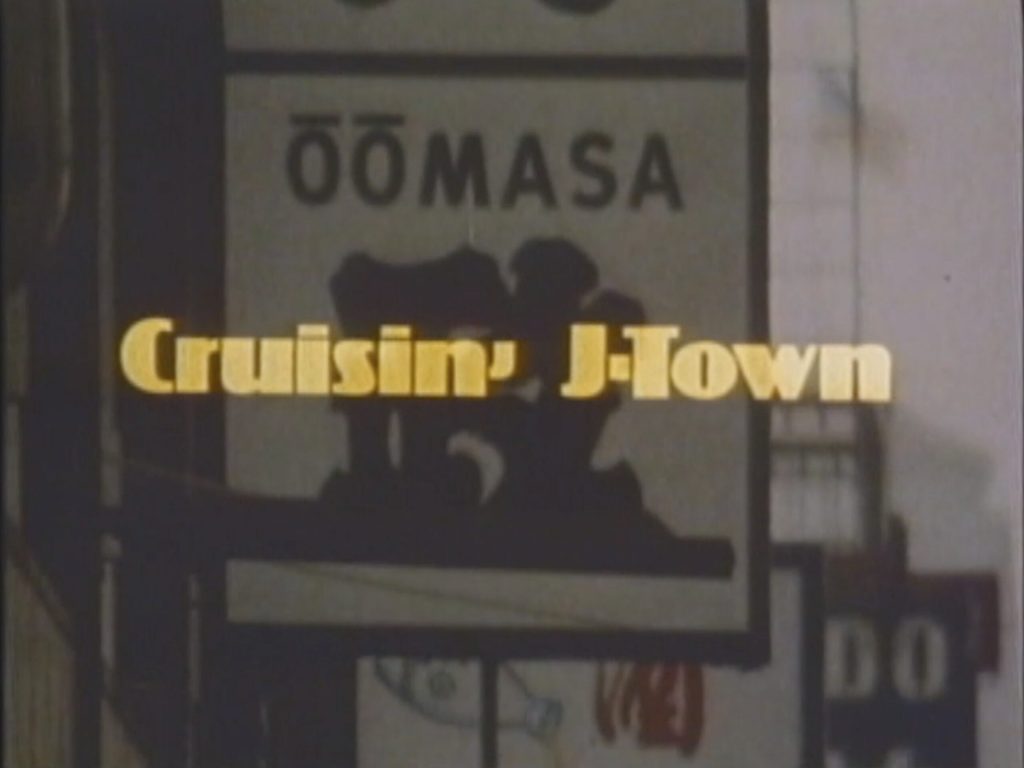
“Cruisin’ J-Town” is currently available to stream on the VC Archives website on a pay-what-you-can sliding scale. So send a few bucks their way and check out their collection!

The Plot: UCLA’s Duane Kubo heads over to L.A.’s Little Tokyo (aka J-Town) to document the performances of Japanese fusion jazz band Hiroshima. While “Cruisin’ J-Town” is primarily footage of Hiroshima’s performances, we also get insight from the musicians, many of whom comment on their own identity struggles amidst the rising Asian-American movement of the early ‘70s. The result is an entertaining blend of Japanese tradition and the funkiness of ‘70s jazz.

Why It Matters: The NFR write-up is mostly a rundown of the film, though they call the interviewees “articulate and interesting”, so that’s something.

But Does It Really?: Oh yeah. “Cruisin’ J-Town” covers two favorites of the NFR: diverse culture and UCLA alumni. The film is an engaging and uplifting chronicle of third-generation Japanese Americans as they take the traditions of their ancestors and create something uniquely their own. And as always, I love anything on this list that’s short and/or has a great soundtrack. Welcome to the NFR, “Cruisin’ J-Town”!

Everybody Gets One: While at UCLA, Duane Kubo co-founded Visual Communications, an organization creating and promoting the art of Asian-American and Pacific Islander filmmakers.  I’m not sure exactly when or how Kubo met up with Hiroshima, which had started performing in Little Tokyo around 1974, but like Kubo, Hiroshima founder Dan Kuramoto was heavily influenced by the political movement of the late ‘60s and the growing Asian-American movement, so I’m not surprised these two found each other.

Wow, That’s Dated: The end credits list support from the U.S. Office of Education, a government department that split into the U.S. Department of Education and the U.S. Department of Health and Human Services just a few years after this film was released. I wrote this post back in December and initially had a joke about neither of those departments existing by the time this finally got published. I hate it when I’m right.

Title Track: Either the movie takes its title from one of Hiroshima’s songs, or the song gets its name from the movie, I’m not quite sure. Hiroshima released the song in 1980, though it could have been part of their set in 1975. Either way, it’s a banger.

Seriously, Oscars?: No nominations for “Cruisin’ J-Town” from the Oscars or any other awards organization. The 1975 winner for Best Documentary Short Subject was Robin Lehman’s “The End of the Game”, a film about conserving the Afric- wait a minute, didn’t I do this one already?

Other notes

  • Yes, the band is named after the city in Japan that was almost entirely destroyed by a nuclear bomb in 1945. While at first glance the naming seems in bad taste, the group was inspired by the city’s phoenix-like rise from the ashes of WWII (Today, Hiroshima is one of the largest cities in Japan). I like the name as a bit of reclaiming by this generation of Japanese Americans. For many, Hiroshima is still synonymous with its wartime decimation, but I like that there’s a small faction of the population out there that associate the name Hiroshima with the band.
  • There’s a lovely section of the movie in which Hiroshima member June Kuramoto – Dan’s then-wife – talks about inheriting her grandmother’s koto, the Japanese instrument that she rocks throughout the film. Side note: June is the only original member of Hiroshima who was from Japan, moving to Los Angeles with her family when she was six years old. The rest of the original Hiroshima line-up were all native Angelenos. Side Side note: How can you hate any movie that features a koto solo?
  • The final performance in the movie is a jam session with Hiroshima and Daniel Valdez with Teatro Campesino at the Performing Arts Center in San Jose (Kubo’s hometown). This marks Daniel Valdez’s fourth appearance on the NFR, the first outside of his collaborations with his brother Luis.
  • I don’t have a lot of notes on this movie; I was just enjoying it so much. The film is simultaneously light and deep, light because of its focus on the music, deep because of the band’s comments regarding racial identity. At the end of the movie, Dan Kuramoto is talking with Daniel Valdez and quotes someone who said that the arts are important because they are common, regardless of race or any other manmade barrier. You can’t see it, but I’m snapping my fingers in agreement.

Legacy

  • A few years after “Cruisin’ J-Town”, Duane Kubo co-directed “Hito Hata: Raise the Banner”, which was, according to New Day Films, “the first feature length narrative film created exclusively by Asian Americans.” Kubo returned to the Bay Area in the 1980s and continues to be active in the Asian film community, most recently his work with San Jose’s J-Town FilmFest.
  • Visual Communications is still around as well. Check them out!
  • In the last half-century, Hiroshima has released 20 albums (two of which went gold) and have received two Grammy nominations. As of this writing, Hiroshima is still performing with several of the original members seen in this film!
#743) The Buffalo Creek Flood: An Act of Man (1975)

#743) The Buffalo Creek Flood: An Act of Man (1975)

Directed by Mimi Pickering

Class of 2005

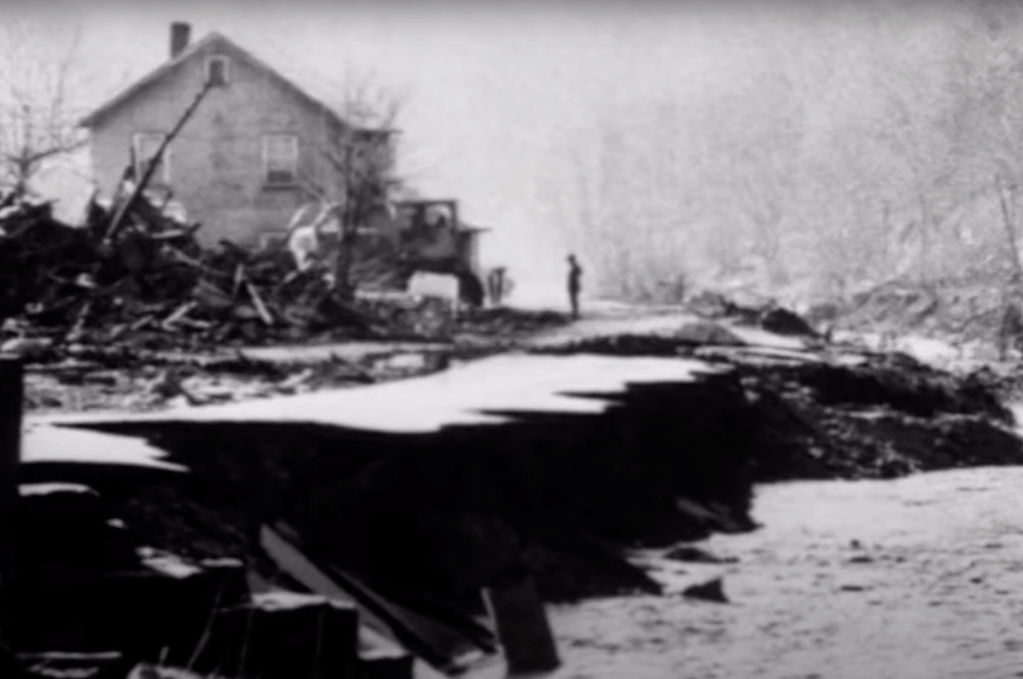
In the early morning of February 26th, 1972, one of three coal slurry dams overlooking the Buffalo Creek tributary in Logan County, West Virginia burst following heavy rainfall. The burst overwhelmed the structure of the other two dams, and the resulting flood unleashed 132 million gallons of contaminated water onto 16 different coal towns in Logan County. In the end, the flood caused 50 million dollars in property damage (over 375 million dollars today) and claimed the lives of 125 citizens. The Pittston Coal Company, owners of the dams, had found the dam to be “satisfactory” in a safety inspection four days before the flood, and claimed no responsibility for the flood’s destruction, calling the event “an act of God”. While a government sanctioned investigation yielded no definitive action, a citizen committee found Pittston to be responsible for the flood, and subsequent lawsuits were settled by Pittston out of court. “The Buffalo Creek Flood” chronicles the surviving citizens in their quest for any sort of resolution, featuring candid interviews with many locals and political non-answers from government officials. Lundale resident Shirley Marcum echoes the sentiment of many survivors when she declares “I don’t believe [the flood] was an act of God. It was an act of man.”

Admittedly I knew nothing about the Buffalo Creek flood before this viewing, and “The Buffalo Creek Flood: An Act of Man” does what many a great film on the NFR does; it shines a light on a subculture in this country that is often overlooked and undervalued. While it’s easy to portray Appalachians as their worst stereotypes (looking at you, “Deliverance”), “Buffalo Creek Flood” shows us this culture’s humanity during one of the region’s most harrowing tragedies. As I watched “Buffalo Creek Flood”, I felt the devastation that these citizens carried with them in the immediate aftermath of the flood, and found myself frustrated with the government’s lack of response and cooperation. “Buffalo Creek Flood” is a touching report of time and place, and you’ll get no argument from me about its inclusion in the NFR.

Why It Matters: The NFR states that the film “represents the finest in regional filmmaking”. An essay by the film’s director, Mimi Pickering, is a recount of her experience making the movie and a plea for safer coal mining practices to avoid another incident like the Buffalo Creek flood.

Everybody Gets One: A graduate of Antioch College, Mimi Pickering joined the Appalachian Film Workshop (now known as Appalshop) in 1971 as a filmmaker. Shortly after the Buffalo Creek flood, Pickering was approached by the Citizen’s Commission To Investigate The Buffalo Creek Disaster to film their hearings. Pickering and her team spent weeks filming these events (as well as the ongoing damage of the flood) using whatever film or video they had at their disposal, and with no budget or funding, only receiving a grant from the Abelard Foundation after filming had wrapped.

Seriously, Oscars?: No nominations for “Buffalo Creek Flood” from the Oscars or any other awards organizations. The 1975 winner for Best Documentary Short Subject was Robin Lehman’s “The End of the Game”, a film about conserving the African savanna and its wildlife.

Other notes

  • Because I was primarily focused on getting the facts straight about the flood while watching this film, I don’t have that many other observations, but I did want to highlight one particularly memorable moment. The most moving part of the film for me was one eyewitness to the flood (who unless I missed something goes uncredited) tearing up as he recounts his story of that morning. He personifies the survivor’s guilt felt by many in the community with his closing remark, “I’m sorry that God let me live to see it.”

Legacy

  • As of this writing, Mimi Pickering is still with Appalshop, currently listed as the Project Director of their Community Media Initiative. Pickering’s most recent film is 2012’s “Anne Braden: Southern Patriot”, which she co-directed with her longtime collaborator Anne Lewis.
  • Mimi Pickering revisited Buffalo Creek in 1985’s “Buffalo Creek Revisited”, which shows the growth and healing of the towns effected by the flood and the rebuilding of their communities 10 years later.
  • Appalshop continues to produce films, theater, radio, and other media that paint a positive picture of Appalachian culture. Check them out.
  • After decades of decline, the Pittston Coal Company sold its coal mines and changed its name to match its more successful subsidiary: Brink’s. To this day, they have not taken any responsibility for the Buffalo Creek flood.
  • Buffalo Creek still exists in Logan County, and within the last few years has seen fish and other aquatic life start to inhabit the water for the first time since 1972. The Buffalo Creek flood still looms large in the towns effected by it, with several holding special gatherings to commemorate the 50th anniversary in 2022.

#742) Little Fugitive (1953)

#742) Little Fugitive (1953)

OR “Joey’s Day Out”

Directed & Written by Raymond Abrashkin (aka Ray Ashley), Morris Engel, and Ruth Orkin

Class of 1997

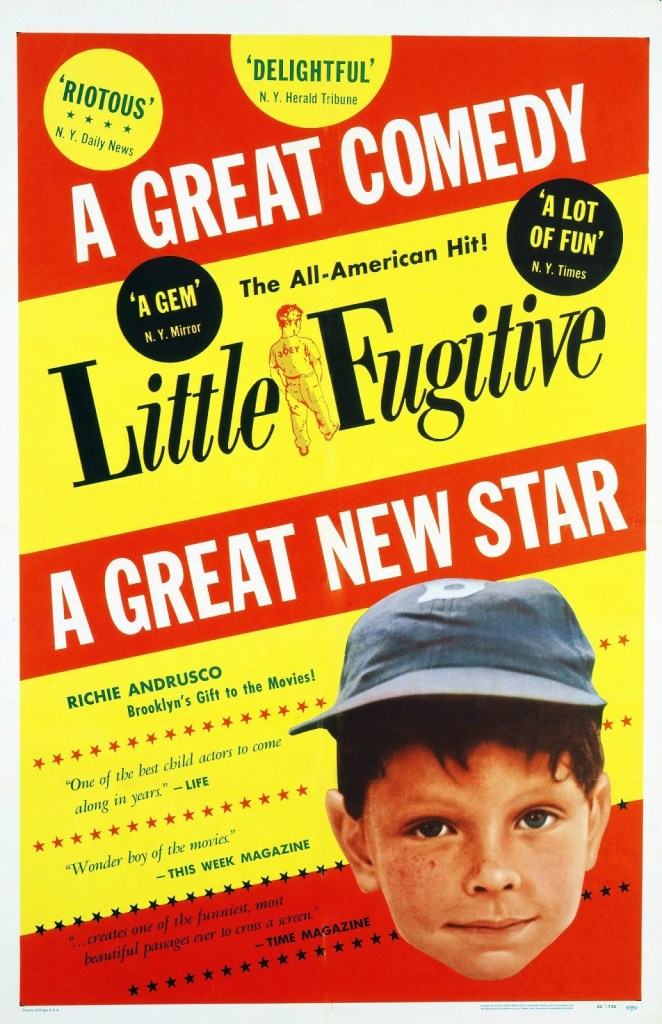
The Plot: Joey Norton (Richie Andrusco) is a seven-year-old boy living in a Brooklyn apartment with his older brother Lennie (Richard Brewster) and their mother (Winifred Cushing). When their mother leaves for a few days to take care of their grandmother, Lennie must cancel his plans to visit Coney Island and look after Joey instead. While playing with their friend Harry (Charlie Moss) and his dad’s rifle, Lennie and Harry prank Joey into thinking that Joey has fatally shot Lennie. Afraid that the police will get him, Joey takes the six dollars left for him by his mother and runs away to Coney Island. What follows is Joey’s adventures playing the games and riding the rides at the island’s Steeplechase Park, which in the hands of our trio of filmmakers becomes an endearing look at the world from a child’s perspective.

Why It Matters: The NFR praises the film’s “deft, mostly hand-held camera work” and the “unaffected acting” of Richie Andrusco. Unfortunately, the NFR write-up gets the brothers’ names mixed up, referring to Andrusco’s character as “Lennie” throughout the write-up. Whoops.

But Does It Really?: Despite being one of the Registry’s more obscure titles, “Little Fugitive” stands on the unique piece of ground I’m looking for in an NFR entry. While Hollywood was still producing lavish spectacle, three New Yorkers created an authentic, documentary-like story with a distinctiveness that holds up over 70 years later. Admittedly, I found the film’s opening scenes a bit grating, but once Joey took off for Coney Island, I could see what the filmmakers were going for and found the experience to be quite pleasant. A yes for “Little Fugitive” on the NFR, a quick, enjoyable movie and a harbinger of the independent film movement.

Everybody Gets One: Morris Engel was a photographer by trade, though in 1939 he got into filmmaking when he served as cinematographer on “Native Land” by his friend and fellow NFR director Paul Strand. During WWII, Engel was a photographer in the Navy, where he would have used the Cunningham Combat Camera, a small, chest-mounted movie camera that could be used in combat areas. After the war, Engel modified the Cunningham to make it less cumbersome for general use, and after unsuccessfully pitching a series of shorts utilizing this technology to different distributors, decided to go all in on a feature. “Little Fugitive” was created by Engel, his wife Ruth Orkin (an established photographer in her own right), and Raymond Abrashkin (credited here as Ray Ashley), a writer and colleague of Engel’s when they worked at the liberal newspaper PM in the early 1940s.

Wow, That’s Dated: Steeplechase Park (the amusement park on Coney Island that Joey visits), was already in decline by 1953, and the park closed after its 1964 season. The former site of Steeplechase Park has been developed and re-developed over the years and is currently home to the minor league stadium Maimonides Park. While a handful of rides from the neighboring Coney Island parks continue to operate, the Parachute Jump tower is the only remnant of Steeplechase Park still standing.

Seriously, Oscars?: At a time when independent films getting Oscar nods was unheard of, “Little Fugitive” managed to break in with one nomination for its Original Story. Abrashkin, Engel, and Orkin lost to Ian McLellan Hunter Dalton Trumbo for “Roman Holiday”.

Other notes

  • Despite the title, “Little Fugitive” is not another Harrison Ford prequel series a la “The Young Indiana Jones Chronicles”.
  • “Little Fugitive” was shot on a budget of $87,000 (about a million today). Richie Andrusco was not a child actor, being “discovered” by Engel and Orkin while riding the carousel at Coney Island. He was paid $250 a week (about $3000 today) for his performance. Thanks to the discreetness of Engel’s custom-made handheld camera, filming on Coney Island mainly went unnoticed by the public. Due to the camera’s limitations, however, only the picture was recorded, meaning the entire soundtrack was created after filming and editing.
  • I will say from personal experience that this movie gets the older/younger brother dynamic down, though it goes on long enough without variation to become annoying. Thankfully, things improve once the film picks up steam and ditches the dialogue.
  • The six dollars Joey and Lennie’s mother leaves them for groceries is about 70 dollars in today’s money. That is one very trusting mother. 
  • The NFR loves films like this that showcase slices of life in New York’s boroughs in the mid-20th century: this, “On the Bowery”, “In the Street”, “A Bronx Morning”. Always an important counterpart to the glamourous image of Times Square we associate with this period of the Big Apple.
  • Ah yes, the antiquated innocence of childhood gunplay. Obviously, the conversation regarding firearms and their proximity/accessibility to children is very different today than it was in 1953, so you have to take this part of the movie with a grain of salt.
  • Like I said, the movie really comes together once Joey heads off to Coney Island. The film’s bread-and-butter is long, dialogue-free scenes of Joey being a natural seven-year-old boy, running around like a kid in a candy shop and having adventures. It’s all very charming.
  • The photographer that takes Joey’s picture in the cowboy cutout is played by Will Lee, the only professional actor in the cast. Lee was still about 20 years away from playing his most iconic character: Mr. Hooper on “Sesame Street”.
  • Why does every hot dog in this movie look disgusting? I mean, hot dogs are disgusting, but these specific ones even more so. It must be how they’re cooked.
  • The Coney Island scenes have a very similar vibe to the short “Johnny at the Fair”. “’Jiminy,’ thinks Johnny, ‘if only I could get a ride in one of those.’”
  • My favorite part of the movie is the runner of Joey trying to knock down the milk bottles, practicing in-between games and improving over time. They don’t hit you over the head with it, just a child trying to reach a goal all by himself, conveyed solely through great visual storytelling.
  • When Joey realizes he has run out of money and can’t do the pony rides, he heads to the most crowded beach I’ve ever seen (apparently this was a recurring issue at Coney Island). I laughed pretty hard once Joey realizes he can make money by depositing empty soda bottles he finds on the beach. Turns out business is booming for Joey that day; good thing we don’t litter this much anymore, right? [Nervous laughter]
  • Jay Williams plays Jay, the pony ride attendant who assists Joey, and the only adult in this entire movie who questions why a seven-year-old is wandering around Coney Island alone. While Williams was primarily a writer, he did briefly perform stand-up at the Borsch Belt in the 1930s. He has a very genuine, sweet rapport with Joey.
  • Look closely during the summer storm and you’ll see “The Greatest Show on Earth” advertised on the marquee of a nearby movie theater. If Joey went to the movies instead of Steeplechase Park, he too might have become one of the most influential movie directors of all time.
  • As “Little Fugitive” was coming to its natural conclusion, I had the feeling that the film was going to have a cute ending where everything gets wrapped up neatly. It did, but I admit they stuck the landing and cut to the credits quickly enough that it didn’t overstay its welcome.

Legacy

  • “Little Fugitive” was distributed by Joseph Burstyn Inc., which also distributed such acclaimed independent/international films as “Umberto D.” and “Fear and Desire”. After premiering at the Venice Film Festival in September 1953, “Little Fugitive” opened in New York that October, the first major release of a film shot with a handheld 35mm camera. The film was a hit, earning $500,000 in box office revenue.
  • In addition to its surprise Oscar nomination, “Little Fugitive” won the Silver Lion at the 1953 Venice Film Festival. Typically, the Silver Lion goes to the film that came in second place to the Golden Lion recipient, but that year the jury had such a hard time choosing a winner they decided not to give out a Golden Lion and instead gave the Silver Lion to six films, including “Little Fugitive”, “Ugetsu”, and “Moulin Rouge” (the John Huston one).
  • Of our creative trio, only Morris Engel continued filmmaking (Orkin co-directed their follow-up “Lovers and Lollipops” before returning to photography, and Abrashkin never made another film). Engel’s later films were shorts and home movies that have remained widely unseen by the public. Engel and Orkin were married until Ruth’s death in 1985. Morris Engel died in 2005, living long enough to see “Little Fugitive” make the NFR.
  • Raymond Abrashkin would go on to co-write the “Danny Dunn” book series with “Little Fugitive” actor Jay Williams. Sadly, Abrashkin died of ALS only seven years after the release of “Little Fugitive”.
  • To the best of my knowledge, at the time of this writing Richie Andrusco is still alive, and while “Little Fugitive” was his only film performance, he made a few TV guest spots, as well an appearance in a 2008 documentary on Morris Engel.
  • The biggest cultural impact “Little Fugitive” has had on film came just a few years later, when Francois Truffaut used a similar documentary-style filmmaking approach when directing his breakthrough film “The 400 Blows”. Truffaut would go on to say that without “Little Fugitive”, there would be no French New Wave movement. How about that?
  • And finally, “Little Fugitive” received a remake in 2006 by filmmaker Joanna Lipper. Other than the modern setting, the only major change is that now Joey and Lennie’s dad is not only still alive, but he’s in prison and he’s Peter Dinklage. The remake was well-received by critics and seems to have neither enhanced nor hurt the legacy of the original.

Further Clicking: Be sure to check out the “Little Fugitive” page on Morris Engel’s official website, which includes some rare behind-the-scenes photos of the film’s production, in color no less!

#741) Beverly Hills Cop (1984)

#741) Beverly Hills Cop (1984)

OR “Murphy’s Law”

Directed by Martin Brest

Written by Daniel Petrie Jr. Story by Petrie and Danilo Bach.

Class of 2024

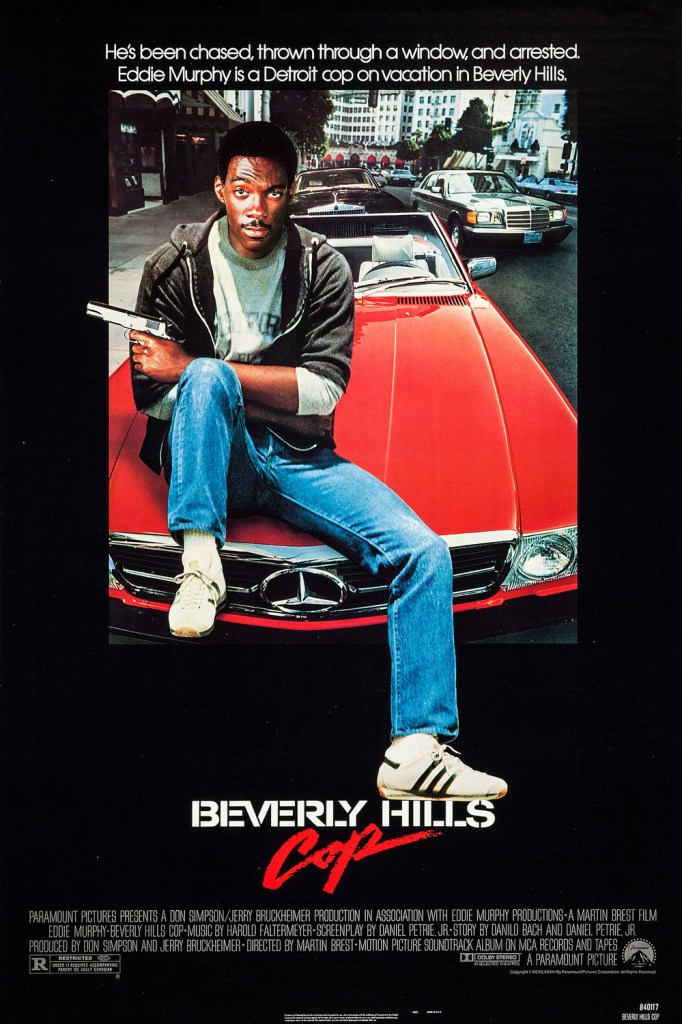
The Plot: Det. Axel Foley (Eddie Murphy) is often at odds with the rest of the Detroit Police Department for his reckless behavior and unauthorized investigations. When Axel’s friend Mikey Tandino (James Russo) is murdered, Axel is barred from taking on the case himself. Remembering a conversation with Mikey about his recent work in Beverly Hills with their childhood friend Jenny Summers (Lisa Eilbacher), Axel loads up the car and he drives to Beverly (Hills, that is). Axel’s investigation leads to an art gallery where Jenny works for the instantly suspicious Victor Maitland (Steven Berkoff), but Maitland’s clout in the Beverly Hills art scene thwarts Axel’s plans, as does the interference of local police led by Sgt. John Taggart and Det. Billy Rosewood (John Ashton and Judge Reinhold). That’s enough plot for now; please enjoy Eddie Murphy’s natural star power and that kick-ass synth score.

Why It Matters: Not a lot of superlatives from the NFR, other than calling it “a film that keeps viewers laughing” and praising the “legendary” theme music by Harold Faltermeyer.

But Does It Really?: As an NFR entry, “Beverly Hills Cop” works as representation for both Eddie Murphy and Martin Brest (otherwise represented by, respectively, “Shrek” and “Hot Dogs for Gauguin”). As a film, “Beverly Hills Cop” is still laugh-out-loud funny all these years later, thanks to its evergreen underdog stance and Eddie’s winning performance. And, come on, that score? Forget about it; that alone should have gotten the movie on this list years ago. “Beverly Hills Cop” is still a winner and highlights the best qualities of the ‘80s blockbuster, so no argument for its NFR inclusion from me.

Shout Out: Billy compares the showdown with the bad guys to the final shootout in “Butch Cassidy and the Sundance Kid” (Taggart’s response: “Billy, I’m gonna make you pay for this.”)

Wow, That’s Dated: Much like “Die Hard”, this movie uses bearer bonds as a plot device. While bearer bonds still exist, they have been essentially banned in the U.S. since 1988 due to their frequent use in illegal activities, such as drug trafficking as seen in this film.

Seriously, Oscars?: The 1984 Oscars were dominated by more serious fare like “Amadeus”, but “Beverly Hills Cop” managed a nomination for its screenplay, losing to Best Picture nominee/more conventional Oscar bait “Places in the Heart”.

Other notes

  • Most sources cite the initial concept for “Beverly Hills Cop” originating with producer Don Simpson in the late ‘70s (though then-head of Paramount Michael Eisner swears it was his idea). Danilo Bach’s drafts of the screenplay were more dramatic, and Daniel Petrie Jr. was brought in to emphasize the “fish out of water” comedy elements. After a few delays in production, first choice Mickey Rourke left the project and was replaced by Sylvester Stallone, who re-wrote the script again as an action-oriented movie akin to “Rambo”. It was during this point that Martin Brest, freshly fired from “WarGames”, was brought on to direct after the likes of Martin Scorsese and David Cronenberg passed. Don Simpson and Jerry Bruckheimer were unhappy with Stallone’s revisions, and the star left “Beverly Hills Cop” two weeks before production began. Eddie Murphy, already a breakout “SNL” star with “48 Hrs.” and “Trading Places” under his belt, signed on to star as Axel Foley, and the entire script was once again re-written to suit his comic sensibilities. The script was finished the day filming started, with many more day-of re-writes to come (in fact, when Stephen Elliott arrives as Chief Hubbard, the papers he is holding in his hands are his freshly revised script pages!).
  • In his first top-billed starring role, Eddie Murphy’s star power is undeniable. He is so natural on screen, exuding an unparalleled level of confidence. And of course, the man is hilarious; always skewering the scene in a fun Bugs Bunny kinda way, aided by his trademark laugh that is so unique it must be authentic. Also, a reminder that Eddie Murphy was 23 years old when he filmed this! Take that, Orson Welles!
  • Our first big action piece is the Detroit police chasing a truck barreling through a residential neighborhood with Axel hanging out of the truck’s opened rear door. It’s a fun sequence, setting up Axel’s character while delivering an exciting chase scene. Additionally, any scene in any movie is greatly improved by playing “The Neutron Dance” in the background.
  • Axel’s no-nonsense boss, Inspector Todd, is played by Gilbert Hill, a real-life Inspector for the Detroit Police Department during production. Despite having never acted before, Hill more than holds his own against Murphy, though it doesn’t help that he’s saddled with every cop movie cliché in the book (he actually says, “Your ass is skating on thin ice as it is!”). Oh, and Paul Reiser is in these scenes too for some reason.
  • As one of Maitland’s henchmen, it’s nice to see Jonathan Banks make a second NFR appearance (he has one of my favorite lines in “Airplane!”). It’s also nice seeing Jonathan Banks with hair!
  • The contrast between Detroit and Beverly Hills in conveyed immediately in a quick montage highlighting Axel as a stranger in a strange land. This is followed by a meta-reference to “Eddie Murphy Delirious” that somehow keeps the film’s fourth wall securely intact.
  • The $235 per night rate at the Beverly Palms Hotel is about $713 in today’s money. Fortunately, the Biltmore Los Angeles (filling in for the fictional Beverly Palms Hotel) currently has room rates much closer to the film’s unadjusted number.
  • Today on “No such thing as a small part”: Bronson Pinchot as Serge. An overly-effeminate, vaguely European art gallery curator should not mesh with the rest of this movie, but Pinchot makes a meal out of the role, not to mention an eight-season series.
  • Another ‘80s action staple: the European bad guy. Steven Berkoff was born in England, is of Russian and Romanian descent, and has one of those faces that automatically reads as villainous, leading to a career where he has played everything from a Bond villain to Hitler! Side Note: Berkoff allegedly hates this movie.
  • What surprised me most about “Beverly Hills Cop” is how leisurely it is compared to other action comedies. The action set pieces are few and far between, and the comedy is much more character driven, with the laughs coming from the interactions and contrasts between the characters rather than a bunch of one-liners.
  • The dynamic between Axel, Taggart, and Rosewood is a lot of fun, with Reinhold and Ashton playing their part of the scenes perfectly; knowing when to play straight man to Eddie Murphy and when to be funny. In fact, I really appreciated that Axel isn’t the only character allowed to be funny in this movie. Taggart and Rosewood have some great interactions, and even Jenny gets in a few good lines, despite being underutilized for most of the movie.
  • I only knew Ronny Cox as one of the dueling banjos in “Deliverance”, so I enjoyed seeing him here as Taggart and Rosewood’s boss Lt. Bogomil. “Beverly Hills Cop” kicked off a second phase in Cox’s acting career as various authority figures in such action movies as “RoboCop” and “Total Recall”.
  • If this film has one iconic moment, it’s Axel thwarting Taggart and Rosewood on their stakeout by putting a banana in their tailpipe. This is the sequence for which Harold Faltermeyer composed “Axel F”, which has become the iconic theme music for the “Beverly Hills Cop” franchise. And that’s Damon Wayans making his film debut as the hotel employee who offers Axel the banana, doing what I believe is the “Mr. Monopoly” voice that will one day get him fired from “SNL”.
  • My biggest LOL in this movie comes when Axel is having the country club valet park his beat-up 1970 Chevrolet Nova: “Can you put this in a good spot? All that shit happened the last time I parked here.”
  • As we start wrapping up the plot and heading towards the finale, the film loses some of its momentum and becomes a more typical action movie. It’s all a little too “ba-dow ba-dow” for my taste, but there’s still a few funny moments (especially from Judge Reinhold), and Ronny Cox gets an entertaining reprise of Axel’s “Supercop” monologue from earlier. And because it’s a Simpson/Bruckheimer production, we end on a freeze frame. Ah, the ‘80s.
  • Do we know if opera singer Beverly Sills ever saw this movie? The “Beverly Sills Cop” parody writes itself: “I’m your worst fucking nightmare; I’m a soprano with a badge.” (Yes, I know that’s from “48 Hrs.” not “Beverly Hills Cop”, but whatever, I thought it was funny.)

Legacy

  • “Beverly Hills Cop” opened in December 1984, and just edged out “Ghostbusters” as the highest-grossing movie of the year (though “Ghostbusters” reclaimed the title following a re-release in 1985). “Beverly” held its #1 weekly box office spot for 13 consecutive weeks, and adjusted for inflation is still one of the highest-grossing R rated movies of all time.
  • If “48 Hrs.” and “Trading Places” made Eddie Murphy a star, “Beverly Hills Cop” made him a supernova. With follow-ups like “Eddie Murphy Raw” and “Coming to America”, Eddie Murphy was unstoppable in the ‘80s.
  • Martin Brest’s follow-up to “Beverly Hills Cop” was 1988’s “Midnight Run”, which maintains a strong cult following to this day. As for the rest of Brest’s filmography…don’t worry about it.
  • Harold Faltermeyer’s “Beverly Hills Cop” theme has become synonymous with the ‘80s and has endured in pop culture. I’ve had it stuck in my head during this entire writing process, specifically the “Family Guy” version with Peter singing along.
  • Plans for a “Beverly Hills Cop” sequel began before the first film was even released. Directed by the more action-oriented Tony Scott, 1987’s “Beverly Hills Cop II” was also a hit, but not as well received as the original. 1994’s “Beverly Hills Cop III” was a major letdown (even Eddie Murphy admitted he did it just for the money), but 2024’s revival “Beverly Hills Cop: Axel F.” fared better as a serviceable if not remarkable return to form. Also, despite proposed sequels that would have taken Axel to other countries like England or France, every sequel has him coming back to Beverly Hills for some reason.
  • A 2013 pilot for a potential “Beverly Hills Cop” TV series centered around Axel’s hereto unmentioned son, Aaron. Eddie Murphy returned as Axel for a cameo, which led CBS to think he would be a recurring character. When Murphy said that this would not be the case, the network did not pick up the pilot for series.
  • And finally, because I have nowhere else to put this: while Eddie Murphy was promoting “Beverly Hills Cop: Axel F.” in 2024, he mentioned his plans to star in a remake of “It’s a Mad, Mad, Mad, Mad World” with Martin Lawrence. All the more reason to induct the original film into the NFR if you ask me.

#740) The Old Mill (1937)

#740) The Old Mill (1937)

OR “Multiplane of Madness”

Directed by Wilfred Jackson

Written by Dick Rickard

Class of 2015

The Plot: As the sun sets on an idyllic farmland, an assortment of birds and frogs and crickets begin to inhabit the night. When a summer storm suddenly arrives, the animals take shelter in a nearby abandoned mill. What this Disney short lacks in story and character it more than makes up for with its artistry and breakthrough technology.

Why It Matters: The NFR write-up is mostly a rehash of the film’s technical achievements: the multiplane camera, plus realistic lighting design and animal movement. The film’s visuals are hailed as “dazzling” and Leigh Harline’s score is declared “compelling”.

But Does It Really?: I’m putting this in the same category as “Flowers and Trees”, a decent Disney short whose NFR worthiness is solely technical. There’s nothing wrong with “The Old Mill”, but its technological advances have been so far surpassed that they are no longer part of the film’s entertainment value. And while the realistic animal depictions are commendable, it leaves us without any memorable characters (at least the realistic animals of “Bambi” could talk). Despite my issues, “The Old Mill” is a quick, visually engaging entry in the Disney canon; not so much a cartoon you can watch and enjoy, but more like a moving painting you can view and admire. I understand and support the film’s NFR induction, but I’m not over the moon about it either.

Everybody Gets One: Not his only NFR movie, but shoutout to this film’s director Wilfred Jackson. Freshly graduated from L.A.’s Otis Art Institute in 1928, Jackson got his start at Disney as a volunteer helping custodial wash animation cels. Jackson quickly rose up the ranks, directing early Mickey Mouse and Silly Symphony shorts by 1929. “The Old Mill” was Jackson’s 51st Disney short as a director, which he worked on concurrently with his responsibilities as one of the five sequence directors on “Snow White and the Seven Dwarfs”.

Seriously, Oscars?: Since the inception of Best Short Subject – Cartoons at the Oscars in 1932, Disney had a lock on the category, winning every year for the first eight years; “The Old Mill” was the sixth short in this winning streak. Academy rules at the time gave the award to the producer, not the director, which meant Walt took home his seventh career Oscar with this win, while Wilfred Jackson received zero nominations, despite directing three consecutive Oscar-winning shorts (preceded by “The Tortoise and the Hare” and “The Country Cousin”). The NFR write-up mentions that the multiplane camera also received a technical Oscar, but I couldn’t find anything to back that up.

Other notes

  • What is a multiplane camera? I’m glad you asked. The multiplane camera is a special film camera used for cel animation in which multiple layers of animation (anywhere from three to seven) are photographed at different speeds and distances to create the illusion of depth and parallax in 2D animation. Precursors to the multiplane camera had been tinkered with by different artists at different studios since the 1920s (you can see the Fleischer Studios’ variation in “Popeye the Sailor Meets Sindbad the Sailor”), but the most advanced version was developed at Disney by engineer William Garity for use in “Snow White and the Seven Dwarfs”. “The Old Mill” was used as a testing ground for the multiplane camera and was released in theaters six weeks before the premiere of “Snow White”.
  • The music that bookends the short is the song “One Day When We Were Young”, written by Johann Strauss for his 1885 operetta “The Gypsy Baron”. We are definitely hitting the “Symphony” part of this “Silly Symphony”.
  • To the best of my knowledge, the frog croaking is provided by Clarence Nash, who at that point had been with the studio a few years supplying his trademark animal noises. Despite being a voiceover in seven different NFR titles, Nash has yet to have one movie on the list where he voices his most iconic character: Donald Duck.
  • Yeah, not much else I have to say about “The Old Mill”. It’s beautiful to look at, and I love the score, especially the wind sounds as the storm intensifies, but this isn’t one of my favorites. I enjoyed seeing this film again after all these years, but it’ll be a while before I watch “The Old Mill” by choice rather than by my self-imposed film blog obligation.

Legacy

  • The multiplane camera continued to be in use at Disney for the next 40 years, though by the 1970s the cameras were becoming difficult to maintain and operate (they were 12 feet tall and took up a whole room). “The Little Mermaid” was the final Disney film to utilize the multiplane camera (albeit one shot farmed out to another company) before the studio’s full conversion to digital. 
  • Three multiplane cameras are still known to exist, and I’ve had the pleasure of seeing one of them on display at the Walt Disney Family Museum in San Francisco.
  • William Garity would go on to help create Fantasound, the precursor to Surround Sound used in “Fantasia” and won an honorary Oscar for this achievement. 
  • Wilfred Jackson directed both shorts and features at Disney for the next 20 years, including “Pinocchio”, “Cinderella”, “Alice in Wonderland”, and the “Night on Bald Mountain” section of “Fantasia”. Jackson’s final short for Disney was 1960’s “Goliath II” before his retirement in 1961.
  • “The Old Mill” still gets the occasional shout out from Disney, almost always for its technical properties. The film is also well respected in the animation community, ranking #14 in the 1994 book “The 50 Greatest Cartoons: As Selected by 1,000 Animation Professionals”, just behind “Steamboat Willie”.
  • Despite its relative obscurity among Disney animation, “The Old Mill” has quietly maintained a presence in the Disney theme parks. A model of the old mill resided in the Storybook Land Canal Boats at Disneyland for almost 60 years before being replaced by Arendelle from “Frozen”. The miniature mill still has a place in the ride’s Paris counterpart, as well as a full-scale version that housed a Ferris wheel during Disneyland Paris’ first decade.