#686) ¡Alambrista! (1977)

#686) ¡Alambrista! (1977)

OR “Las Uvas de Ira”

Directed & Written by Robert M. Young

Class of 2023

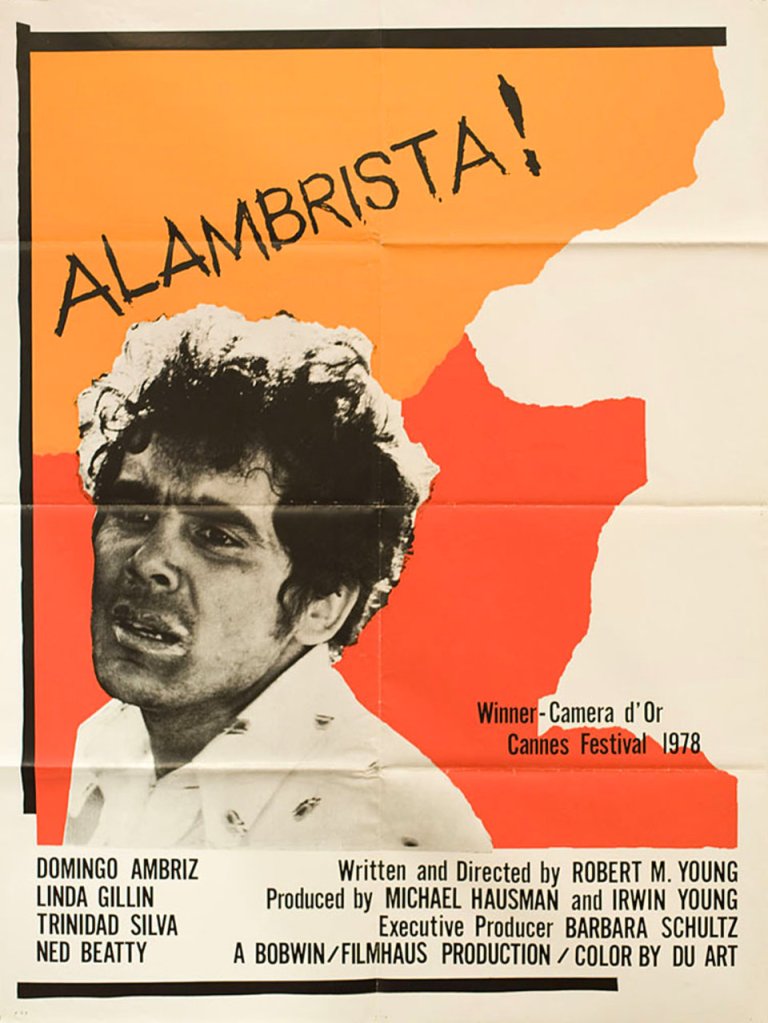
The Plot: Upon the birth of his daughter, Roberto (Domingo Ambriz) leaves his home in Michoacán, Mexico to illegally cross the border into the United States and find work to support his family and farm. His travels through California highlight the never-ending struggles of immigrants in search of the American dream and a better life. Among his adventures are hitchhiking with fellow immigrant Joe (Trinidad Silva), an extended stay with White waitress Sharon (Linda Gillen), sudden appearances by “La Migra” that keep Roberto on the run, and even an offer of scab work in Colorado from the shady Anglo Coyote (Ned Beatty). Shot in a documentary style, “¡Alambrista!” is a realistic, unapologetic look at what it takes to make it in America, and the humanity underneath an issue that still strikes a chord in this country almost 50 years later.

Why It Matters: The NFR praises the film’s “powerful, emotional story”, calling it “as relevant today as it was on its 1977 release, a testament to its enduring humanity.” There’s also a detailed essay by film professor Charles Ramírez Berg (actually it’s his essay from the film’s 2012 Criterion release, reprinted with permission).

But Does It Really?: One of my first notes reads “I’m hooked”. From the very beginning, “¡Alambrista!” grabbed me and never let go. This is the kind of movie I’m looking for in the NFR; the lesser-known pieces of art crafted by pure passion and a unique perspective. The best movies are eye-openers, and forgive me and my privileged White bubble, but “¡Alambrista!” opened my eyes to an illegal immigrant’s perspective that didn’t evoke fake sympathy or stand on a soapbox: it just said, “This is what it’s really like, and how you feel about it is up to you.” I’m delighted that “¡Alambrista!” is on the NFR and available for viewing (go Criterion Channel!), and I can’t recommend it enough.

Everybody Gets One: Not his only NFR appearance, but let’s highlight Robert M. Young for a minute. After studying chemical engineering at MIT and English literature at Harvard, Young turned his filmmaking hobby into a career, working on educational shorts in the ’50s and various pieces for the news show “NBC White Paper” in the ’60s. In 1973, Young directed the documentary short “Children of the Fields” about a family of migrant workers, and his experience (and subsequent research on illegal immigrants) inspired him to write “¡Alambrista!”. Young’s other NFR work includes as writer and cinematographer of the Civil Rights era drama “Nothing But a Man“, and as one of the writers of the IMAX movie “To Fly!“.

Wow, That’s Dated: Not a hell of a lot, sadly. Outside of the occasional payphone or aggressive sideburns, there’s very little in this movie to remind you it’s the ’70s and not the present.

Title Track: A few things about this title. 1) The on-screen translation is “The Illegal”, though Young’s original translation was “The Fence-Jumper”. 2) The film ends with a title song that gives a very detailed recap of the entire movie (specific characters and events are mentioned in the lyrics). And 3) This is the only movie on the list with an inverted exclamation mark, which I was excited to learn how to type on my keyboard. Turns out this old dog can still learn some new tricks.

Seriously, Oscars: No theatrical run for “¡Alambrista!”, and therefore no Oscars. The film did, however, pick up a few festival prizes, including the Cannes’ inaugural Caméra d’Or award for best first feature.

Other notes

  • I feel obligated to mention that this film about a Mexican immigrant is written and directed by a White man from New York. While many articles I read pointed this out, practically everyone who has worked with Young cites his intense research and unwavering passion to depict his films as honestly as possible. And to his credit, the final film doesn’t feel – for lack of a better term – “White”. It’s not Hollywoodized or filled with forced sentimentality, nor does it shoehorn in any White savior narrative (though Sharon comes close). I cannot describe the film’s aesthetic beyond that it all feels very real; a difficult feat to pull off regardless of your director’s ethnicity. Also, totally unrelated, but I think it’s amusing that Robert Young gave his protagonist a variation on his own name.
  • Young’s documentary background shows up in full force in this movie. The film is shot completely in hand-held, shaky-cam style, giving the movie its grounded realism. While this approach has become gimmicky over the years, in “¡Alambrista!” it feels fresh and organic; it helps you immediately accept the reality of the situation.
  • The border crossing scenes in this movie are a tense viewing experience, which leads me to believe that an actual present-day crossing must be 1000 times worse.
  • The first “La Migra” raid scene is another highlight. I love how the camera also appears to be hiding from the cops, as if it too is afraid of getting arrested. And while we’re talking about this scene: Is a sax solo really the best choice to underscore an immigration raid? It sounds like a Benny Hill sketch.
  • As Joe, Trinidad Silva brings a welcomed levity to the movie, teaching Roberto how to smile and order “ham, eggs, and coffee”. I’m just glad the guy from “UHF” was capable of a more nuanced performance. Silva left us much too soon.
  • One of Joe’s observations about Americans is “The gringos, they always cross their legs.” As God is my witness, I was sitting with my legs crossed at the exact moment he said that. What can I say, Joe’s got my number.
  • And then Joe mentions that he and Roberto are traveling to Stockton for work, and my jaw practically hit the floor. This is the second movie on the 2023 list that is partially set in my hometown of Stockton, California, although I can’t find anything to confirm that “¡Alambrista!” actually filmed in Stockton. I am once again pleasantly surprised that another movie on this list has a Stockton connection.
  • Among the many lessons NFR movies have taught me over the years: Never, everever hitchhike. Only bad things will happen if you are hitchhiking or pick up a hitchhiker while driving (That being said, this movie and “It Happened One Night” are the exceptions that prove the rule).
  • That is Edward James Olmos in an early film role as one of the drunks yelling at the immigrants lining up for migrant work. This is Olmos’ sixth film on the Registry, and his third entry in three consecutive years. I assume this is all part of an initiative to get every Edward James Olmos movie on the Registry. Side note: The other drunk in the scene is Julius Harris, who I remember as Ivan Dixon’s alcoholic father in “Nothing But a Man”.
  • I like the scenes between Roberto and Sharon, in which they are both trying to connect despite the major language barrier between them, and eventually succeeding (at least on a physical level). I assume Sharon trying to teach Roberto how to say “apple pie” is a metaphor for American assimilation or something like that.
  • Oh my god, this guy at the diner won’t stop talking! I think it’s meant to be comic relief, but really I just need this guy to shut up. Also, that actor is Jerry Hardin, longtime character actor and father of Melora Hardin, aka Jan from “The Office”.
  • The scene where Sharon tries to help Roberto wire money to his wife is just great. It’s the scene where Sharon finally learns that Roberto is married, and both actors play it perfectly: Sharon concealing her pain in public, Roberto either coldly aware or blissfully unaware (Ambriz plays it a bit cryptically).
  • Ah norteña music, we meet again.
  • Oh right, Ned Beatty’s in this, appearing briefly in two scenes I imagine he knocked out in one day of shooting. I suspect Beatty’s work here was part of his “Never turn down work” mantra, hence why he shows up in every ’70s movie. Fun Fact: At the time “¡Alambrista!” was released, Beatty had just received an Oscar nomination for his supporting turn in “Network“, no doubt adding a bit of prestige to this film.
  • [Spoilers] The last chunk of the movie throws a lot of curveballs at the last minute. First, we get the stuff with Roberto’s dad, a subplot I genuinely forgot about. Then Roberto finally snaps in the only bit of capital A acting that Domingo Ambriz is required to do. But most memorably for me, the final scene is Roberto witnessing a pregnant woman going into labor at the US/Mexico border, happy that her newborn is healthy and – more importantly – born in America. My analysis on the final scene: the American dream of an immigrant making a new life in this country is long gone. Only those born here have a chance to thrive. I admit it’s a downer interpretation, but then again, we live in real downer times. At least we have this peppy end credits music to play us out.

Legacy

  • “¡Alambrista!” premiered on KCET (LA’s PBS affiliate and one of the film’s producers) in the fall of 1977 and played a few film festivals afterwards. Despite positive reviews, the film more or less disappeared after a few more PBS airings. In the early 2000s, aided by academics David Carrasco and Nicholas J. Cull, Robert Young released a director’s cut of “¡Alambrista!” as part of an educational package about Mexican immigration sold to schools. This cut – the only widely available version – is dedicated to “the spirit of Trinidad Silva”.
  • According to the Ramírez Berg Criterion essay, “¡Alambrista!” led to the second wave of Mexican American filmmaking, which focused more on narrative features about the Mexican American experience rather than documentaries or shorts. Among this second wave are “El Norte“, “La Bamba“, and “Stand and Deliver“; all of which have been inducted into the NFR.
  • Apart from Ned Beatty and Edward James Olmos, most of this cast never got another role as substantial as their work in “¡Alambrista!”, appearing in bit parts in movies and episodic television over the next few decades. Coincidentally, both Domingo Ambriz and Trinidad Silva appear in Steve Martin’s “The Jerk” in 1979, though I don’t recall them having any scenes together.
  • Robert Young would continue directing for the next 35 years, bouncing back and forth between narrative films and documentaries. He even directed five episodes of “Battlestar Galactica” starring his frequent collaborator Edward James Olmos. We’ll meet up with Young (and Olmos) again when I cover “The Ballad of Gregorio Cortez“. Sadly, Young died just a few days before my viewing of “¡Alambrista!” at the age of 99.

#685) Jubilo (1919)

#685) Jubilo (1919)

OR “Danger! Danger, Will Rogers!”

Directed by Clarence G. Badger

Written by Robert F. Hill (with an assist from Will Rogers). Based on the serial by Ben Ames Williams.

Class of 2021

The Plot: Jubilo (Will Rogers) is a hobo aimlessly wandering Oklahoma with an endless array of homespun witticisms. After witnessing a train robbery and not wanting to be noticed by either the robbers or the local sheriff, Jubilo lays low at the farm of Judge Jim Hardy and his daughter Rose (Charles K. French and Josie Sedgwick). Despite his aversion to actual labor, Jubilo agrees to work as a farmhand in exchange for food and shelter. While in town, Jubilo encounters Bert Rooker (Jim Mason), who he recognizes as the leader of the train robbers. When he learns of Bert’s plan to frame Judge Hardy for the robbery, Jubilo must learn to be unselfish and help his fellow man, as well as his fellow man’s cute daughter that he’s taken a liking to.

Why It Matters: The NFR really felt the need the justify this film’s inclusion, giving us a lengthy paragraph about Rogers’ stage and screen career, as well as the popularity of his films with critics, audiences, and even Erich von Stroheim! The NFR also highlights Rogers’ standing as “a multiracial member of the Cherokee nation” (both of his parents were of Cherokee descent), because for modern NFR picks, diversity is the name of the game (not a criticism, just an observation).

But Does It Really?: When I covered “State Fair” I questioned its NFR standing as representation of Will Rogers and vowed that “the second another one of his movies makes the list [‘State Fair’ is] getting a reevaluation.” Well here we are, five years after making that claim and 2 ½ years after “Jubilo” made the list (I’ve been busy, okay?). “Jubilo” is the star-vehicle for Will Rogers that “State Fair” isn’t, but I’m still not convinced it’s the right choice for this list. “Jubilo” is not Rogers’ most iconic film, being virtually forgotten until its NFR induction. On top of that, reading Rogers’ trademark one-liners via intertitles isn’t the same as getting to hear him deliver them as he did on stage, radio, or his later sound films (though to be fair, most of his audience in 1919 would have known him primarily from his various print columns). Still, “Jubilo” is a well-made movie and holds up reasonably well a century later. Maybe if “Jubilo” and “State Fair” held a joint spot in the NFR I’d be satisfied.

Wow, That’s Dated: The NFR’s extended write-up on the movie explains its most topical joke: When Hardy’s car breaks down, Jubilo quips, “No wonder he didn’t get into the Senate, with everyone owning one of these.” My instinct was correct: Jubilo is referring to Henry Ford, the automobile titan who unsuccessfully ran to represent Michigan in the U.S. Senate in November 1918.

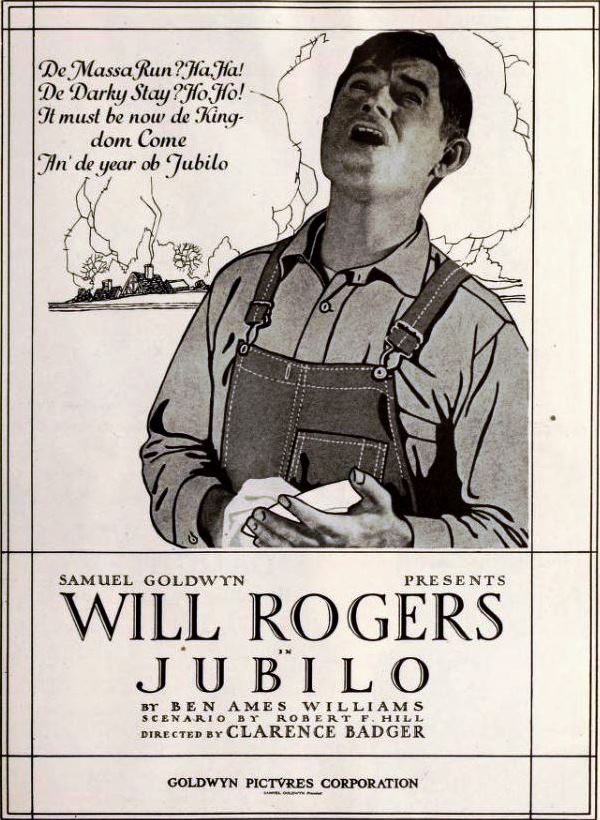
Title Track: Worst. Title Song. Ever. Jubilo gets his name from the Civil War-era song “Kingdom Coming”, in which slaves celebrate their upcoming freedom as a day of jubilee (or “jubilo” in the song’s super-racist approximation of a Black dialect). If you want an idea of just how bad these lyrics are, the refrain is printed in the film’s poster at the top of this post. And trust me, it gets worse.

Other notes

  • Before I go any further, a huge tip of my hat to my fellow NFR-obsessed colleague over at “Registering the Registry” for writing the only thorough essay on “Jubilo” I could find online. “Registering” clearly enjoyed delving into Will Rogers’ career, with the post increasingly being written in a Rogers-esque folksy manner. Keep up the good work, Gargus!
  • “Jubilo” originated as a serial in The Saturday Evening Post in June and July of 1919. The film adaptation was released that December, allowing me to once again marvel at just how quick the turnaround was with silent films. Allegedly there was no script, with the actors reading the short story and improvising their lines, but I don’t know if I believe that. What I do know is that Will Rogers definitely had a hand in re-writing some of the intertitles to better match his writing style.
  • “Jubilo” was Will Rogers’ third movie, and the earliest known to still survive. It was also his second of an eventual 14 collaborations with director Clarence Badger, the first was “Almost a Husband”, released just two months before “Jubilo” in October 1919. Once again, the turnaround on these things, I tell ya.
  • Well, this movie wastes no time getting started. The title cards play over a shot of Jubilo waking up in a field and starting his day, and then he immediately witnesses the train robbery. We got less than an hour, let’s keep it moving!
  • Speaking of title cards, many of the intertitles feature some beautiful artwork, often showing us what is being mentioned by the characters (an illustration of Rose’s pie, etc.)
  • It should be noted that Will Rogers does zero rope twirling in this movie. Heck, he barely does any humorous one-liners. Clearly the Will Rogers film vehicle had not been perfected in 1919.
  • For a movie that is often labeled a comedy, there sure isn’t a lot of comedy. Aside from a few funny lines, the film’s only bit of comic schtick is a scene where Jubilo tries to milk a cow. It starts off as funny, and then turns into borderline animal abuse.
  • One of Judge Hardy’s horses has the same large white mark on its rear end as one of the horses at the train robbery, which makes Jubilo suspicious of his new employer. That story again: Our first plot point involves a horse’s ass.
  • Also, the Judge Jim Hardy of this movie is of no relation to the Judge James Hardy from those Mickey Rooney movies. In fact, the play that the Andy Hardy film series is based on wouldn’t be written for another decade.
  • Sheriff Punt is played by Willard Louis, who looks like if Charles Durning played W.C. Fields (which would have been great casting in another movie). The sheriff comes by to inspect Hardy’s “white-rumped” horse, a phrase that continues to tickle me just right.
  • The actor playing Bert Rooker is credited here as Jim Mason, though for most of his career he would go by James Mason – not to be confused with the British James Mason that would become a big movie star in the 1950s. In fact, Jim’s film career was virtually over by the time James started acting in England in the 1930s.
  • Line that made me laugh out loud: “The barn wins by two-thirds majority.”
  • Shout out to cinematographer Marcel Le Picard. The camerawork in “Jubilo” isn’t particularly artistic or revelatory but compared to other films of the time it’s well shot with a sharp eye for composition. Le Picard would continue to work as a Hollywood cinematographer for the next 30 years, almost exclusively for B movies at various Poverty Row studios (he worked with both the Bowery Boys and the East Side Kids!).
  • This movie has not one but two fight scenes! The first one is Judge Hardy beating Jubilo for his laziness, but the other is a much more entertaining barroom brawl between Jubilo and Bert. You can’t fully hate any movie with a barroom brawl.
  • There’s a lot of subtle hinting throughout the movie about Bert’s past connection to the Hardys, and I admit that it helped keep me engaged with this movie as it went on. No spoilers, but the eventual reveal is a fun twist in an otherwise predictable movie.
  • Judge Hardy may be the best shot in any movie I’ve ever seen: He fires his gun from underneath his overalls!
  • This movie ends with Jubilo and Rose singing “Kingdom Coming” together, which is always an odd choice for a silent movie.

Legacy

  • I can’t find anything to confirm if “Jubilo” was a hit when released, but according to the NFR, “Kingdom Coming” became Will Rogers’ theme song because of its use in this film. So, there’s that.
  • Will Rogers reprised his role as Jubilo a handful of times; first in a pair of shorts for Hal Roach: 1923’s “Jus’ Passin’ Through” and 1924’s “Jubilo Jr.” (one of the “Our Gang” shorts), and then one last time for the film’s 1932 sound remake “Too Busy to Work”.
  • Among the many other film adaptations of Ben Ames Williams’ work is another future NFR inductee: the 1945 noir classic “Leave Her to Heaven“.
  • Clarence G. Badger would go on to direct two more NFR movies: “Hands Up!” with Raymond Griffith and “It” with Clara Bow. Badger and Rogers would work together on 12 more films over the next three years, with such amusing titles as “The Ropin’ Fool”, “Jes’ Call Me Jim”, and “Cupid the Cowpuncher”.
  • But of course, this film’s main legacy is the beginning of Will Rogers’ brief but successful film career, abruptly ending with his tragic death in 1935. Among Rogers’ other movies are the aforementioned “State Fair”, as well as “A Connecticut Yankee”, which I still think would work better as his NFR pick.

Bonus Clip: I have somehow gone two Will Rogers posts without mentioning “The Will Rogers Follies”, which played Broadway in the early ’90s and waved the flag for American musicals amid the dominance of Britain’s mega-musical imports. Here’s the always great Keith Carradine as Rogers, a role he has reprised from time to time.

#684) Detour (1945)

#684) Detour (1945)

OR “You Can Kill Me Al”

Directed by Edgar G. Ulmer

Written by Martin Goldsmith. Based on his novel.

Class of 1992

A modern trailer for the 2018 restoration

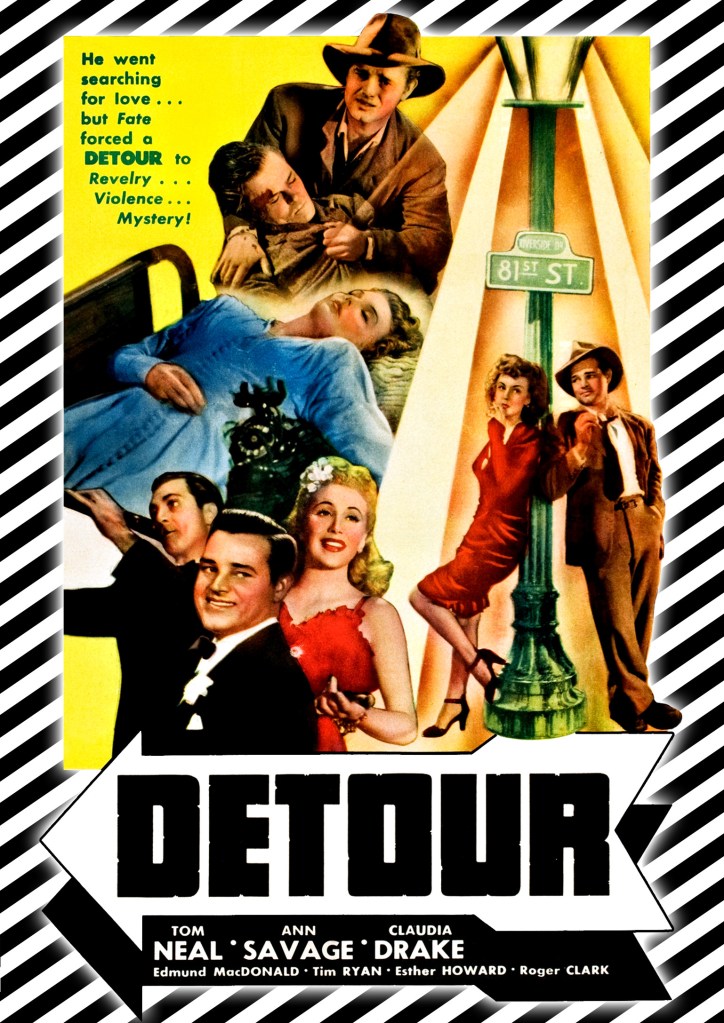
The Plot: At a small diner outside Reno, Nevada, Al Roberts (Tom Neal) sits despondently and narrates to us how he got there. We flashback to his life as a piano player in a New York nightclub with his girlfriend, the club’s lead singer Sue Harvey (Claudia Drake). When Sue breaks up with Al and moves to Hollywood, Al becomes depressed, but ultimately decides to head out West to reconcile. While hitchhiking across the country, Al is picked up by Charles Haskell Jr. (Edmund MacDonald), a bookie en route to LA with a briefcase full of cash. While serving as Haskell’s relief driver, Al discovers that Haskell has died of an apparent heart attack. Realizing that the police will assume he killed Haskell for his money, and determined to get to Sue in Hollywood, Al hides the body and keeps driving, but a mysterious hitchhiker named Vera (Ann Savage) complicates matters. “Detour” is prime film noir and a gem from one of Hollywood’s lesser-known Poverty Row studios.

Why It Matters: The NFR calls it “one of the most stylish B pictures ever produced”, praising the “bleak nightmare existence” Ulmer was able to create under budget constraints. An essay by film critic J. Hoberman is mostly a biography of Ulmer, though he amusingly compares the film’s art through adversity style to “a Rembrandt drawing wrapped around a wad of bubble gum”.

But Does It Really?: I figured out pretty early on why “Detour” got selected for the NFR. At a time when the NFR only had 100 movies on it, “Detour” is an excellent representation of the ’40s B movie. “Detour” feels like someone put every ’40s film noir in a blender, and the results are occasionally uneven, but always watchable. With great lead performances by Neal and Savage, and the artistic eye of Edgar Ulmer behind the camera, “Detour” stands out as one of the best of the Bs. I’m glad “Detour” made the NFR so early, and continues to get discovered by new generations of film lovers.

Everybody Gets One: Born in what was then Austria-Hungary, Edgar G. Ulmer started his film career as an art director, heading to Hollywood to help his mentor F.W. Murnau with “Sunrise“. His directing career got off to a promising start with the horror film “The Black Cat”, Universal’s biggest hit of 1934. Unfortunately, Ulmer’s affair with his script supervisor Shirley Beatrice Kassler (who was married at the time to the nephew of Universal head Carl Laemmle) got him blacklisted from working with the major studios. Ulmer eventually found work with Producers Releasing Corporation (PRC), one of the “Poverty Row” movie studios that cranked out cheap B pictures. Ulmer’s penchant for economically made yet artistically stimulating films earned him the moniker “The King of PRC”. Fun Fact: The G stands for Georg.

Wow, That’s Dated: This is one of many movies that would play very differently if smart phones and the internet existed. If nothing else, Al could contact Sue directly and find out how she’s doing, or just stalk her on social media. And almost everything in the film’s second half would fall apart if everyone was under modern surveillance. That all being said, there is something almost romantic about living life “off the grid”. There’s an anonymity we’ve lost in recent years that this movie reminds us of. But enough of my Andy Rooney rant, back to the movie…

Seriously, Oscars?: Unsurprising for a B movie, “Detour” received no Oscar love. In fact, as best I can tell the only film made by Producers Releasing Corporation in their seven year existence that got any Oscar nominations was 1944’s “Minstrel Man”, a sleeper hit with an unfortunate title.

Other notes

  • There’s an oft-repeated story (including in the NFR write-up) that “Detour” was shot in only six days on a budget of $20,000. While Ulmer liked to tell this story towards the end of his life, it has been repeatedly debunked. “Detour” was actually filmed over four weeks with a budget of almost $100,000 (which is still paltry compared to the average studio film budget of around one million dollars).
  • Right off the bat, this movie is far more stylish than its contemporaries. Al’s inner monologue is accompanied by a dramatic lighting shift as the camera glides towards the jukebox. There’s your German Expressionism influence at play.
  • You can sense the film’s budget constraints pretty clearly. The nightclub Al and Sue perform at has maybe five people in the audience, and the street they walk on afterwards is the foggiest street in movie history.
  • Tom Neal has one hell of a face. Sometimes he looks like Charlton Heston, other times Brian Williams. I gotta say though, he looks great staring off into nothing and sulking in his bleak existence.
  • Also dated: The lost profession of switchboard operator. No early Hollywood movie is complete without a row of women moving phone plugs around and connecting people to their parties.
  • I think the working title for “Detour” was “Rear Projection: The Motion Picture”. I get the sense that most of this movie’s production was the cast in a stationary car pretending to drive and/or sitting in silence as Al narrates.
  • Speaking of driving, I noticed a few shots during the hitchhiking montage where the steering wheel is on the wrong side, and it looks like Al is hitchhiking across Europe. Turns out that in order to save money, some of the shots of Al hitchhiking back East from the film’s opening were flipped and used for his trip out West, hence why some of these shots look slightly off.
  • In another alleged bit of B movie cost cutting, Haskell’s car – a 1941 Lincoln Continental convertible – was Edgar Ulmer’s actual car. Could he bill the mileage to PRC?
  • Because movies like “Detour” tend to fly under the radar, I was completely unaware of the film’s twists and turns. Once Haskell becomes unresponsive I immediately started saying “Oh no oh shit oh no” over and over. It’s a delightful twist, the moment that starts the domino effect for the rest of the movie, and Haskell hitting his head on a rock as he falls out of the car is the cherry on top. From this point on, Al is royally screwed.
  • What can I say about Ann Savage? She doesn’t show up until about halfway through the movie, but once she does she owns every frame of it. In a Hollywood filled with glamorized, uninteresting ingenues, Ann Savage lives up to her last name with a brassy, cutting performance. She’s somewhere between a young Bette Davis and a young Elaine Stritch, with a bit of Barbara Stanwyck thrown in for fun. Side note: As much as I wish Ann Savage was her real name, it’s actually Berniece Lyon.
  • Also, it doesn’t help that Al makes several bad decisions after he discovers Haskell’s body, including PICKING UP ANOTHER HITCHHIKER. Did you learn nothing?
  • I will once again advocate for black-and-white film as an aesthetic choice for certain movies, including this one. The film’s third act in Hollywood would have been too bright and flashy in color, especially compared to its New York beginning. Every spot in this movie is bleak, because Al and Vera make it bleak.
  • “Detour” contains what I assume is the second most famous movie scene where someone on the run tries to quickly sell their car at a lot. Three if you count “The Muppet Movie“.
  • I don’t want to spoil the ending, suffice it to say that there was a point where I had no idea where the movie was going, and it was great. It all culminates with Al’s final narration, in which he concludes that at any time “Fate or some mysterious force can put the finger on you or me for no good reason at all.” It’s this unrelenting pessimism towards life that makes “Detour” an irresistible antidote to its more upbeat big studio contemporaries.

Legacy

  • Edgar G. Ulmer continued directing movies for the next 20 years after “Detour”, always within the confines of his B movie jail (Side Note: One of his later movies – “The Amazing Transparent Man” – wound up on “MST3K”!) Ulmer died in 1972, just as his work was starting to get reappraised.
  • After PRC folded in 1946, most of their film library was sold off and started making the late night TV rounds in the 1950s. At some point in the early ’70s, “Detour” slipped into the public domain. Mixed with Ulmer fitting in neatly with the then-popular “auteur theory” of film, “Detour” found a second life with a new generation of film critics and became a prime example of a classic Hollywood B movie. 
  • While Ann Savage lived long enough to see the film and her performance be re-evaluated and celebrated, Tom Neal…did not. In a bizarre bit of life imitating art, Neal was convicted of involuntary manslaughter when he accidentally shot and killed his wife Gale Bennett. He served six years before being released on parole, and died less than a year later.
  • And finally, “Detour” got the remake treatment in 1992, using the original script with several deleted sequences intact. Al was played by Tom Neal’s son Tom Neal Jr. in his first and only on-screen performance.

#683) Civilization (1916)

#683) Civilization (1916)

OR “At Faith Value”

Directed by Reginald Barker, Thomas Ince, and Raymond West

Written by C. Gardner Sullivan and Edward Sloman

Class of 1999

The Plot: With the U.S. on the verge of entering World War I, producer Thomas Ince presents his unapologetic parable for peace. The kingdom of Nurma is sent to war by its King (Herschel Maydall), and his court inventor Count Ferdinand (Howard C. Hickman) takes his latest invention – a submarine – out to battle. While on a mission to sink civilian ship the ProPatria, Ferdinand is struck unconscious and ends up in Purgatory. There he meets Jesus (George Fisher), who urges him to repent and advocate for peace in His name. When Ferdinand returns, his newfound anti-war pleas fall on deaf ears, and the King has him put to death. As Ferdinand lies dying in his cell, Jesus intervenes and shows the King how his needless war has ravaged his kingdom. It’s an epic anti-war statement that unfortunately still holds up today.

Why It Matters: The NFR gives a rundown of the movie, and admits that Thomas Ince is best remembered today “for his infamously mysterious death in 1924” rather than for any artistic achievement. An essay by Ince expert Brian Taves contextualizes the hell out of this movie and its relation to the first World War.

But Does It Really?: Oh brother, this movie. “Civilization” is definitely on the historical side of things; an Important Movie of its time that has all but disappeared in the last century, and even at 83 minutes it is a slog to get through. I get why “Civilization” is on the list, and I’ll give it a pass for representing America’s trepidation to enter World War I, but I’m ready to check out of Inceville for a while.

Title Track: “Civilization” was originally titled “He Who Returned”, but was changed shortly before the film’s premiere when Thomas Ince decided it was “misleading and ambiguous”. “Civilization” was chosen for its straightforwardness, with the opening prologue stating there is no civilization until we have achieved peace. So…I guess we’re still waiting on that one.

Other notes

  • World War I had been going on for two years by the time “Civilization” was released in 1916, and while the U.S. was still neutral, public opinion was slowly shifting towards entering the war. C. Gardner Sullivan came up with the idea for “Civilization” while attending an Easter Sunday service in 1915, and was struck by the divide between what was being practiced and preached in Jesus’s name. “Civilization” was in production for most of 1915, with a budget of $100,000 (roughly $2.7 million today).
  • As with many an Ince production, the jury is still out over who actually directed “Civilization”. Contemporary sources cite Ince as the sole director, with Reginald Barker and Raymond West assisting, but I know that Ince had a history of taking more credit than he deserved on his projects, so I’m giving everyone credit for now.
  • I assume Count Ferdinand is a not-so-subtle reference to Archduke Franz Ferdinand, whose assassination in July 1914 (along with his wife Sophie, Duchess of Hohenberg) is generally considered the inciting incident for World War I.
  • This film has great production value, I give it that. This is very much your “cast of thousands” kind of filmmaking that is still impressive to watch. Promotion at the time is mostly a rattling-off of production statistics, most of which I assume were embellished.
  • How many movies claim to be the first anti-war movie? I guess being anti-war was a relatively new concept at the time, seeing as how we had never had a world war up to that point.
  • They lay on the Christianity angle pretty thick in this movie. Surely there are other religions equally as anti-war? Also, the first time a character mentions their devotion to Christ, the cross on their clothing was designed in such a way that I thought she was talking about the Red Cross.
  • The sinking of the Lusitania (which I covered in a previous post) happened early in production of “Civilization” and started the US’s shift away from neutrality, so it’s no surprise that a Lusitania-esque civilian ship is a major story point here. Side note: The battle ships seen were actually U.S. Navy ships, shot with permission over a two week period in San Diego. A whaling ship – the Bowhead – was dressed up to look like a warship and specifically destroyed for the film.
  • Almost every source I read declares George Fisher’s performance as Jesus (billed here as “The Christus”) as the first on-screen depiction of Christ. I guess everybody forgot about “From the Manger to the Cross“, which showed Jesus on the big screen a full four years before “Civilization” did. Heck, it even made the NFR before “Civilization”. Am I the only one paying attention? To its credit, “Civilization” was released just a few months before “Intolerance” and its portrayal of Christ (billed there as “The Nazarene”).
  • The peaceful protest at the end of the movie is described in the intertitles as “the invasion of the Capital”, which has taken on a completely different meaning in recent years.
  • Jesus gives  the King what experts call “the Scrooge treatment”, showing him how the war is impacting his citizens. Jesus is the Ghost of Future Present, or something like that.
  • Of course, the film ends with peace in the kingdom and everyone celebrating the end of the war. I kept waiting for Ewoks to pop up singing “Yub Nub”.
  • All in all, my takeaway from this movie is that it definitely could have been a short.

Legacy

  • The NFR writeup states that the film’s anti-war sentiment was unpopular with audiences, who “sentenced the film to death at the box office.” All my other research shows that the film was a financial success, earning more than eight times its budget. so I don’t know where this narrative is coming from.
  • According to the Democratic National Committee’s then-press representative William Cochrane, “Civilization” helped President Woodrow Wilson win his re-election campaign (his slogan: “He Kept Us Out of War”). After Wilson’s re-election in early 1917, Woodrow’s first order of business was…getting the U.S. into the war. “Civilization” disappeared from theaters shortly after that declaration.
  • “Civilization” was re-released around 1930, no doubt to cash in on the success of such recent WWI-themed hits as “The Big Parade” and “Wings“.
  • Among those who saw “Civilization” was Yasujiro Ozu, who was inspired to become a film director. So if nothing else, we got “Tokyo Story” and “An Autumn Afternoon” out of all this.
  • “Civilization” was Thomas Ince at his peak as a Hollywood producer. A few years later Ince sold his share of Triangle Studios back to Mack Sennett and D. W. Griffith (the other two “sides”) to focus on independent productions. In 1924, Ince was in the middle of negotiations to loan out his studios to William Randolph Hearst when he died aboard Hearst’s yacht. Cause of death: pre-existing heart conditions. End of story.

#682) 20 Feet from Stardom (2013)

#682) 20 Feet from Stardom (2013)

OR “The Great Unsung”

Directed & Written by Morgan Neville

Class of 2023

The Plot: After several documentaries focusing on some of music’s greatest headliners, Morgan Neville turns his camera to the backup vocalists. “20 Feet from Stardom” is a celebration of the singers who, despite being in the background, are as outstanding as the artists they’re supporting. Of the singers interviewed, “20 Feet” primarily focuses on four: Darlene Love, Merry Clayton, Lisa Fischer, and Judith Hill. Each recounts their early passion for singing, their first successes singing backup for bigger acts, their struggles branching out into solo careers, and their surprisingly unresentful feelings about where they ended up in life.

Why It Matters: Once again, the NFR write-ups for 2023 are lacking in superlatives, with “20 Feet” only getting a basic rundown; though they do call Merry Clayton’s “Gimme Shelter” contribution “[a] highlight”.

But Does It Really?: How can anyone not like this movie? In a culture teeming with talking head rock documentaries, “20 Feet from Stardom” stands out thanks to its unique perspective and sensitive storytelling. In a brisk 90 minutes, Morgan Neville takes us on a journey with these women, and gives us a newfound appreciation for all of the artists that contribute to our favorite music, not just the headliners. It’s too soon to know if “20 Feet from Stardom” will be a classic or essential documentary, but I’m awfully glad it’s on the NFR. 

Shout Outs: Among the clips shown of projects the interviewees have provided backup vocals for are NFR entries “Thriller“, “Stop Making Sense“, and “The Lion King“. “Stop Making Sense” backup performer Lynn Mabry is one of this film’s interviewees.

Everybody Gets One: Morgan Neville started his career as a journalist before pivoting to documentary filmmaking at age 25. Almost all of his early documentaries center around musicians, with subjects including Johnny Cash, Muddy Waters, and Brian Wilson. Neville was pitched the idea for “20 Feet from Stardom” by record producer Gil Friesen, who had just watched a Leonard Cohen concert and was impressed with its backup singers. Neville quickly realized that there was virtually nothing documenting the careers of backup singers, and interviewed dozens of singers (as many as 50) for an oral history. These interviews served as the backbone for what became “20 Feet from Stardom”.

Everybody Gets One – Zero Feet from Stardom Edition: Thanks to their participation in the film’s interviews, this is the only NFR appearance for such music legends as Sting, Bruce Springsteen, Stevie Wonder, Sheryl Crow, and Bette Midler.

Title Track: Interestingly enough, although all of the film’s promotional material lists the title as “20 Feet from Stardom”, the actual title in the film spells out the number as “Twenty Feet from Stardom”. Usually I side with whatever is in the film proper, but I’m sticking to the number 20 because I’ve already updated this site and I’m too lazy to change everything.

Seriously, Oscars?: A hit upon release, “20 Feet from Stardom” won the Oscar for Best Documentary Feature. Morgan Neville was joined onstage by co-producer Caitrin Rogers, Janet Friesen (representing her late husband Gil), and Darlene Love, who brought the house down with her rendition of “His Eye Is On the Sparrow”.

Other notes

  • Morgan Neville mentioned in interviews at the time the difficulty he had narrowing the film’s focus from the very broad starting point of “backup singers”. Ultimately, it was Lou Reed’s “Walk on the Wild Side” (featured in the opening credits) that led to the focus on specifically women of color in the rock, R&B, and soul music scenes from the late ’50s to the present. Love, Clayton, Fisher, and Hill were all selected as representation of their respective generations, with narratives that were unique to their own lives, but also complimented the others’ stories.
  • The first high point of the movie is watching Darlene Love reunite with her ’60s girl group The Blossoms as they listen to all of the songs they sang uncredited backup for, including of all things “Monster Mash”. I also learned in my research that The Blossoms sang backup for Marvin Gaye during his appearance in “The T.A.M.I. Show“. Man, The Blossoms are like the Kevin Bacon of girl groups: they’re in everything!
  • I first saw “20 Feet from Stardom” about 10 years ago, not too long after it won the Oscar. While I enjoyed the movie overall, the only specific scene I remembered was when Merry Clayton playfully chastises Morgan Neville for making her turn off her radio while driving so they can add music in post. Clearly, Morgan never saw “Rush Hour”.
  • The closest this movie gets to a bad guy is Phil Spector, the convicted murderer/record producer who had Darlene Love under a very restrictive contract in the ’60s and ’70s. Also mentioned briefly is Ike Turner, who interviewee Claudia Lennear did backup for (along with Tina of course). If you know anything about Ike Turner, it should come as no surprise that his mention here segues into a conversation about toxic work environments and emotional abuse.
  • Speaking of Tina Turner, I can see how she earned her nickname “The Hardest Working Woman in Show Business”. She and her backup singers have choreography that blows the roof off of anything else that was going on back then. Watching Tina’s backup performers (the chauvinistically named Ikettes) be able to match her boundless energy on stage is still an incredible thing to watch. You just wish they had all been treated better at the time.
  • Claudia Lennear’s interview fascinated me, as she is the only major interviewee in this movie who walked away from showbiz and never returned, spending the last several decades teaching high school Spanish, French, and Math. She slyly skirts around her relationships with Mick Jagger and David Bowie in her interview, and seems to have forgotten that she posed for Playboy in 1974. What a life.
  • As the NFR write-up mentions, the real treasure of the movie is Merry Clayton relating the story of how she got a late-night call to sing a solo for a Rolling Stones recording session, which ended up being the solo in the middle of “Gimme Shelter”, arguably the most famous vocal solo in rock history. The highlight is when Merry, nearly 50 years later, gets to hear her isolated vocal track, allowing us to hear her contribution in all its raw glory.
  • Lisa Fischer speaks fondly of her time singing backup for Luther Vandross, who I always forget started off as a backup singer himself. Side note: Mr. Vandross sings backup on Bowie’s “Young Americans”, one of my favorite songs.
  • Also on hand throughout are the Waters siblings – Oren, Julia, and Maxine – who rattle off the impressive list of films and music they have supplied vocals for. Oren even mentions supplying bird noises for “Avatar” (possibly the Mighty Ikran). It amuses me that a movie that includes a clip from “Avatar” made the NFR before “Avatar” (which as of this writing hasn’t made the cut).
  • Of course, the most heartbreaking segment is when all of these singers recount their attempts at solo careers that never got off the ground. One of this film’s main points is that talent doesn’t always equal fame, a hard lesson to learn in your youth. Merry Clayton sums it up when she says, “I felt that if I gave my heart to what I was doing I would automatically be a star.” Backup singer/interviewee Tata Vega gives her own spin on the upside of not being famous, theorizing that if her solo career had taken off, she would have OD’d long before this documentary was made.
  • As a lifelong devotee of David Letterman, it shocks me that there was a time when Darlene Love was anything other than a star. Her annual performance of “Christmas (Baby Please Come Home)” on Letterman’s show was always a season highlight, and it’s just not Christmas for me (and many others) without Darlene.
  • Judith Hill is positioned within the film’s narrative as a rising star, and understandably so. She was touring with Michael Jackson when he died, and her performance at his memorial concert made her an overnight sensation. Hill talks here about her struggles to focus on her solo career while turning down backup gigs, and the backlash she got on Twitter when she was spotted singing backup for Kylie Minogue on a Leno appearance. This may be the first NFR movie to mention the hellhole that is Twitter/X.
  • I walked away from this movie really liking Lisa Fischer. She just seems like the loveliest human, and one who is happy with her lot in life; getting to share her talents without dealing with the hassles and hazards of fame. It’s funny how after 90 minutes I feel like I know Lisa (as well as the other subjects), with my main takeaway being “I hope she’s doing well.”
  • The finale is Darlene Love recording a cover of “Lean on Me” with Lisa and Judith (alongside singer Jo Lawry) on back-up. It’s hard to think of a song that works as a metaphor for backup singing, but “Lean on Me” does the job, and it is no surprise that these four knock it out of the park with a simple, sincere, yet powerful rendition.

Legacy

  • “20 Feet from Stardom” premiered at Sundance in January 2013, and was quickly acquired by – speaking of toxic work environments – the Weinstein Company. The film played its general release that summer, earning good box office and near-unanimous critical praise.
  • In addition to the aforementioned Oscar, “20 Feet from Stardom” won the Grammy for Best Music Film. Since that award is given to a film’s primary artists as well as its producers, Darlene Love, Merry Clayton, and Judith Hill all received the first Grammy awards of their careers (this was the second win for Lisa Fischer; a clip of her first win can be seen in the film).
  • Morgan Neville’s immediate follow-up to “20 Feet” was as far away from this movie as you can get: 2015’s “The Best of Enemies: Buckley vs. Vidal”. Subsequent films include “Won’t You Be My Neighbor?” and “Roadrunner: A Film About Anthony Bourdain”. My personal favorite is “They’ll Love Me When I’m Dead”, his 2018 companion piece to Orson Welles’ final film “The Other Side of the Wind”.
  • In the decade since “20 Feet” came out, Darlene Love, Merry Clayton, Lisa Fischer, Judith Hill, and Tata Vega have all continued to perform both as solo artists and backup singers (and as best I can tell Claudia Lennear is still teaching). Darlene Love recently reunited with Letterman to do another rendition of “Christmas (Baby Please Come Home)” and I’m not crying you’re crying.

Listen To This: Unsurprisingly, some of these singers show up doing backup vocals on songs in the National Recording Registry. Darlene Love (along with The Blossoms) can be heard singing backup on The Righteous Brothers’ “You’ve Lost That Lovin’ Feeling“, the Waters do backup on Michael Jackson’s “Thriller” album, and Maxine Waters is featured on Irene Cara’s “Flashdance…What a Feeling“.